REVIEW 5 major objections 5 minor 40 references
NGC 1261: A time-series \emph{VI} study of its variable stars
T0 review · 5 major / 5 minor · reviewed 2026-08-14 · deepseek-v4-flash
Pith's one-line read Using complete VI light curves of member RR Lyrae stars together with Gaia DR2 membership, this paper revises NGC 1261's metallicity to [Fe/H]ZW = -1.42 ± 0.05 and its distance to 17.2 ± 0.4 kpc, and finds its pulsation modes cleanly…
desk verdict Solid observational study of NGC 1261's variables, but the headline distance and metallicity are not consistently derivable from the paper's own tables; needs a careful revision before it is citable. read the letter →
The pith
A machine-rendered reading of the paper's core claim, the machinery that carries it, and where it could break.
The reading
What carries the argument
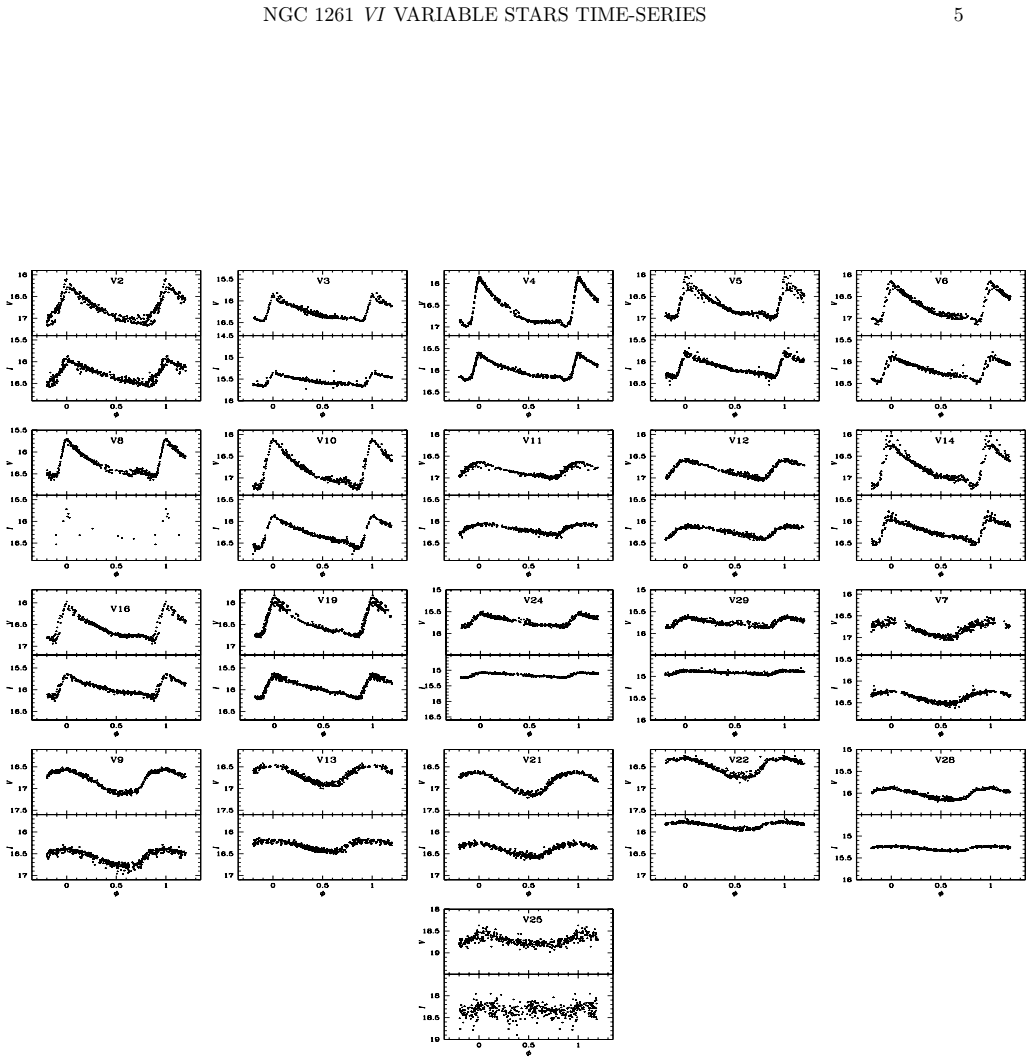
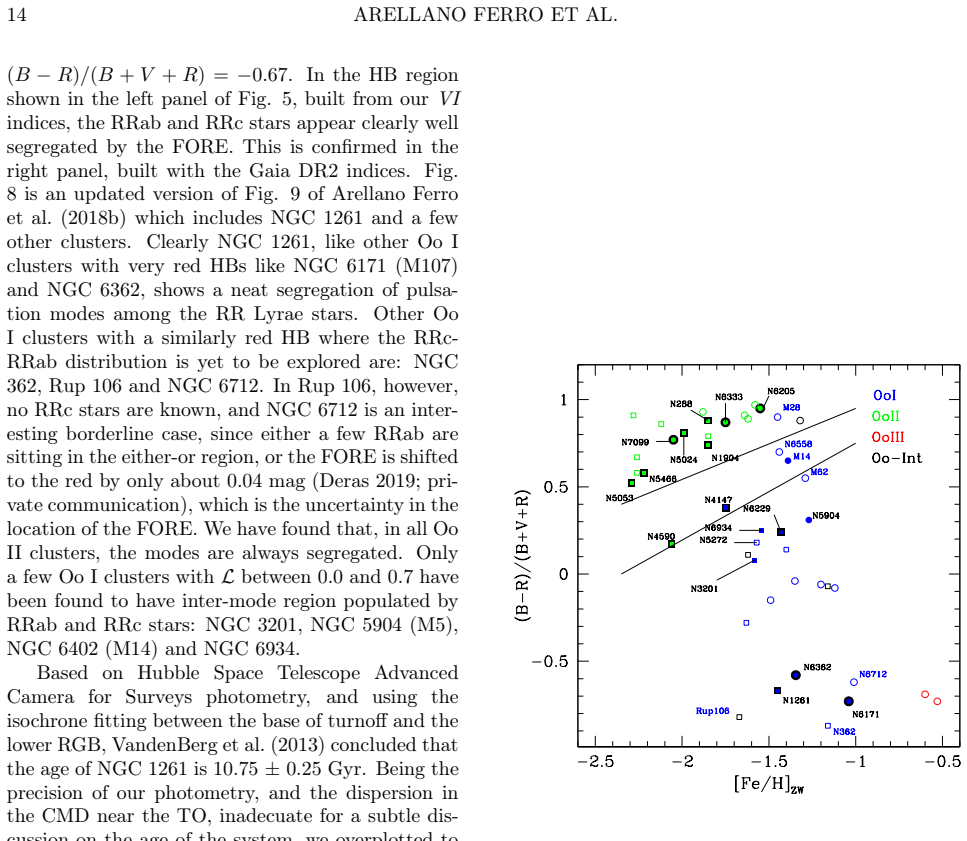
The load-bearing machinery is Fourier decomposition of the VI light curves: each RR Lyrae magnitude series is written as $m(t) = A_0 + \sum_k A_k \cos(2\pi k(t-E_0)/P + \phi_k)$, and the phase combinations $\phi_{21}$, $\phi_{31}$, $\phi_{41}$ and amplitude ratios $R_{ij}$ feed empirical calibration formulae — Jurcsik & Kovács (1996) and Kovács & Walker (2001) for RRab stars, Morgan et al. (2007) and Kovács & Kanbur (1998) for RRc stars — that return individual [Fe/H], $M_V$, radius and mass. Membership is vetted before the parameters are averaged: a hierarchical clustering over Gaia DR2 positions and proper motions separates cluster members from field stars, and Gaia photometry is used to correct the magnitudes and amplitudes of variables blended with close neighbours. The first-overtone red edge (FORE), the empirical boundary between RRc and RRab pulsation in the instability strip, is the diagnostic object for the mode-segregation claim.
What would settle it
Measure the iron abundance of a handful of NGC 1261 red giants spectroscopically; if the mean is near -1.27 rather than -1.42, the Fourier-calibration metallicity and the distance derived from it are biased. Similarly, a direct geometric distance for member stars from Gaia parallaxes or from a detached eclipsing binary in the cluster that lands near 16.4 kpc rather than 17.2 kpc would falsify the revised distance.
Extended reading notes
Core claim
The paper claims that the RR Lyrae population of NGC 1261, observed in V and I over seventeen nights, yields a cluster metallicity [Fe/H]ZW = -1.42 ± 0.05 dex and a distance d = 17.2 ± 0.4 kpc once Gaia DR2 proper motions are used to confirm membership and unresolved neighbouring stars are subtracted. It further claims that the fundamental (RRab) and first-overtone (RRc) pulsators are cleanly separated around the first-overtone red edge, as expected for an Oosterhoff type I cluster with a very red horizontal branch, and that a careful multi-method search found no previously unknown variable stars in the field.
Load-bearing premise
The empirical Fourier calibrations that turn light-curve shapes into [Fe/H] and absolute magnitude are assumed to apply to NGC 1261's RR Lyrae stars without a metallicity-dependent or period-dependent bias, and the paper checks them only against photometric estimates, not against an independent spectroscopic metallicity.
Editorial extensions
If this is right
- NGC 1261's catalog entries for distance and metallicity should be revised from about 16.4 kpc and [Fe/H] = -1.27 to about 17.2 kpc and [Fe/H]ZW = -1.42 if these results hold.
- The clean mode split around the FORE adds NGC 1261 to the small set of red-horizontal-branch Oo I clusters where RRc and RRab stars do not mix, supporting the link between horizontal-branch morphology and pulsation-mode distribution.
- The I-band P-L relation distance (16.65 ± 0.27 kpc) and the Fourier distance (17.2 ± 0.4 kpc) agree within uncertainties, indicating the RR Lyrae-based distance ladder is internally consistent for this cluster.
- The paper's reported individual masses and radii for member RR Lyrae stars can serve as test points for horizontal-branch evolution models at [Fe/H] ≈ -1.4.
- The null result of the variable search sets a photometric limit on undiscovered variables in the 10×10 arcmin² field, so future discoveries in NGC 1261 will have to come from deeper or higher-resolution data.
Reading between the lines
- If the revised distance of 17.2 kpc holds, the cluster's position in the Milky Way's inner halo shifts by roughly 0.8 kpc, which would affect any orbital or dynamical models built on the older catalog distance.
- A spectroscopic metallicity of member red giants could decide between the RRab-based value (-1.42) and the RRc-based value (-1.51), revealing whether the two independent Fourier calibrations carry a small systematic offset.
- The claimed link between red horizontal branches and clean mode segregation could be tested in the other unstudied red-HB Oo I clusters the paper lists, such as NGC 362; if any of them shows mixed modes, the connection would be cluster-specific rather than general.
- The reported null search for new variables is only as deep as the CCD photometry; a space-based or longer-baseline search could plausibly turn up additional low-amplitude or crowded-core variables that this ground-based survey would miss.
Signed reviews
Editorial analysis
A structured set of objections, weighed in public.
Referee Report
Summary. The paper presents new time-series VI CCD photometry of the globular cluster NGC 1261, obtained with the 1.54 m telescope at Bosque Alegre over 2017–2018. After a Gaia DR2 proper-motion membership analysis, the authors Fourier-decompose the light curves of member RR Lyrae stars and apply empirical calibrations to derive individual metallicities, absolute magnitudes, radii, and masses. They also use an I-band period-luminosity relation for RR Lyrae stars. The paper reports a mean metallicity [Fe/H]_ZW = -1.42 ± 0.05 dex and a distance d = 17.2 ± 0.4 kpc, identifies NGC 1261 as an Oosterhoff type I cluster with a clean separation of RRab and RRc stars around the first-overtone red edge, and reports that a multi-approach search found no new variable stars in the 10 × 10 arcmin^2 field.
Significance. If the quoted values are correct, the paper revises the cluster distance from the Harris (1996) value of about 16.4 kpc to about 17.2 kpc and its metallicity from about -1.27 to about -1.42 dex, a meaningful update for a cluster with no published spectroscopic metallicity. The paper's strengths include a substantial homogeneous time series, the use of a Gaia DR2 membership analysis, explicit corrections for blended light from unresolved Gaia sources, and a documented search for new variables. The mode-segregation discussion around the FORE is also a useful addition to the ongoing mapping of Oosterhoff properties. However, the headline quantitative claims are not internally consistent as written, and the reported uncertainties are internal fitting errors rather than total errors, so the central results are not yet auditable.
major comments (5)
- [§8, §10, Abstract] The central distance claim is not self-consistent. Section 8 reports Fourier RRab and RRc distances of 17.2 ± 0.4 and 17.6 ± 0.7 kpc, then states that the best RRab-only Fourier estimate is 17.2 ± 0.7 kpc, and then combines the RRab Fourier result with the I-band P-L result of 16.65 ± 0.27 kpc to quote an average of 16.7 kpc. The Abstract and §10 nevertheless state that the best distance is 17.2 ± 0.4 kpc. These numbers cannot all be the adopted best value, so the headline distance is not derivable from the tables and equations as written.
- [§7, §10, Table 6] The metallicity claim is internally inconsistent. Table 6 and §7 give the RRab weighted mean as [Fe/H]_ZW = -1.42 ± 0.05, while §10 states [Fe/H]_ZW = -1.45 ± 0.02 for the same RRab stars. These cannot both be the weighted mean of Table 6. The §10 value appears to be an erroneous or outdated average and must be reconciled with Table 6.
- [§6, Abstract] The Abstract presents [Fe/H] = -1.42 ± 0.05 dex and d = 17.2 ± 0.4 kpc without qualification, but §6 explicitly states that the quoted uncertainties are only internal errors from the Fourier fitting procedure and exclude systematic calibration errors. The Abstract should either quote the standard deviation of the mean values, which §6 identifies as a more reliable estimate of systematic errors, or explicitly state that the reported uncertainties are internal only.
- [Table 3, V2] Table 3 lists V2 as an RRab star with <V> = 16.780 and <I> = 12.285, which gives V−I = 4.495 and is unphysical for an RR Lyrae star, while the light curve in Fig. 3 is clearly not that extreme. This appears to be a typographical error, likely <I> = 16.285, but as printed it would corrupt the distance estimate for V2 and must be corrected.
- [§6, §7] The entire distance and metallicity derivation depends on empirical Fourier calibrations (Jurcsik & Kovács 1996; Kovács & Walker 2001; Morgan et al. 2007; Kovács & Kanbur 1998), and the paper notes that no spectroscopic metallicity for NGC 1261 has been published. A metallicity- or period-dependent bias in these calibrations would shift both [Fe/H] and M_V, and hence the distance, in a coherent way that the comparison with earlier photometric estimates cannot break. I recommend an explicit external consistency check, for example spectroscopy of two or three RRab stars or a comparison with Gaia DR2 parallaxes of the member RR Lyrae, to demonstrate that the revised cluster parameters are not calibration artefacts.
minor comments (5)
- [§1, §8] The Harris (1996) distance to NGC 1261 is quoted as 16.4 kpc in §1 and as 16.3 kpc in §8; please harmonize these values.
- [§6, §1] There are typographical errors, including 'respctively' in §6 and 'inestability' in §1, which should be corrected.
- [§5] The sentence 'the average of which, converted to E(V−I)/1.259 is 0.055 ± 0.051' is unclear; presumably the intended relation is E(B−V) = E(V−I)/1.259. Please rewrite for clarity.
- [§3.3] The description of the non-variable star C1 says it 'lies a bit above the red clump,' but the position is not quantified; please give the offset or a direct figure reference so readers can assess the non-variability claim.
- [Abstract] The phrase 'either-or or bimodal region' is not defined in the Abstract; please introduce the standard terminology in §1 or define it at first use.
Circularity Check
No load-bearing circularity: the quoted [Fe/H] and distance are outputs of external Fourier calibrations and P-L relations, not self-referential fits; self-citations such as the FORE line are peripheral to the headline numbers.
full rationale
I followed the derivation chain through §§6–10. The metallicity is obtained by applying the external empirical Fourier calibrations of Jurcsik & Kovács (1996), Kovács & Walker (2001), Morgan et al. (2007), and Kovács & Kanbur (1998) to the period and Fourier parameters of the RR Lyrae light curves; the equations are imported from Deras et al. (2019), which itself applies those same external calibrations, and NGC 1261 is not part of the calibration samples. The RRab distance of 17.2 ± 0.4 kpc follows from the calibrated M_V values plus the observed mean V magnitudes, and the I-band P-L check uses the independent Catelan et al. (2004) relation. Membership and reddening are established before the parameter estimates, using Gaia DR2 proper motions and the Sturch/Guldenschuh method, respectively. The FORE line used in the mode-segregation discussion is cited to Arellano Ferro et al. (2016), a self-citation, but it is an empirical boundary determined from other clusters and it does not enter the headline [Fe/H] or distance. I find no step where an output is defined in terms of itself, where a fitted parameter is relabelled a prediction, or where a uniqueness claim is imported from the authors' prior work. The paper does contain internal inconsistencies in the quoted distance and RRab metallicity (17.2 ± 0.4 versus 17.2 ± 0.7 and 16.7 kpc; −1.42 ± 0.05 versus −1.45 ± 0.02), and it explicitly states that quoted uncertainties are internal Fourier-fit errors, but these are auditability and reproducibility defects, not circularity.
Assumptions & free parameters
assumptions (6)
- domain assumption The empirical RRab calibration of Jurcsik & Kovács (1996) and Kovács & Walker (2001) maps Fourier parameters to [Fe/H] and M_V without bias.
- domain assumption The empirical RRc calibrations of Morgan et al. (2007) and Kovács & Kanbur (1998) are similarly valid.
- domain assumption The cluster reddening is E(B-V)=0.01.
- domain assumption The Catelan et al. (2004) I-band P-L relation with [alpha/Fe]=0.4 applies to this cluster.
- domain assumption The Gaia DR2 membership method of Bustos Fierro & Calderón (2019) and the Gaia-to-VI colour transformations correctly identify members and contaminants.
- domain assumption The Victoria-Regina isochrones and ZAHB models (VandenBerg et al. 2014) for [Fe/H]=-1.4, Y=0.25, [alpha/Fe]=0.4 describe the cluster CMD.
Cite this review
Pith. "Pith review of NGC 1261: A time-series \emph{VI} study of its variable stars." pith.science (2026). https://pith.science/paper/7Z4N3WDK
@misc{pith2026190804808,
  author       = {Pith},
  title        = {Pith review of: NGC 1261: A time-series \emphVI study of its variable stars},
  year         = {2026},
  howpublished = {\url{https://pith.science/paper/7Z4N3WDK}},
  note         = {Machine review of arXiv:1908.04808}
}
abstract
Time-series \emph{VI} CCD photometry of the globular cluster NGC 1261 is employed to study its variable star population. A membership analysis of most variables based on Gaia~DR2 proper motions and colours, was performed prior to the estimation of the mean cluster distance and metallicity. For the member RR Lyrae, their light curves were Fourier decomposed to calculate their individual values of distance, [Fe/H], radius and mass. The $I$-band P-L for RR Lyrae stars was also employed. Our best estimates of the metallicity and distance of this Oo I cluster are [Fe/H]$_{\rm ZW}$=$-1.42 \pm 0.05$ dex and $d=17.2 \pm 0.4$ kpc. No mixture of fundamental and first overtone RR Lyrae stars in the either-or or bimodal region is seen in this cluster, as it seems to be the rule for Oo~I clusters with a red horizontal branch. A multi-approach search in a region of about 10$\times$10 arcmin$^2$ around the cluster revealed no new variable stars within the limitations of our CCD photometry.
Figures


Figures from the paper (5 more)


Reference graph
Works this paper leans on
-
[1]
2011, MNRAS, 416, 2265 Arellano Ferro, A., Luna, A., Bramich, D
Kuppuswamy, K. 2011, MNRAS, 416, 2265 Arellano Ferro, A., Luna, A., Bramich, D. M., Giridhar, S., Ahumada, J. A., & Muneer, S. 2016, Ap&SS, 361, 175 Arellano Ferro, A., Mancera Piña, P. E., Bramich, D. M.,
work page 2011
-
[2]
A., Kains, N., & Kup- puswamy, K
Giridhar, S., Ahumada, J. A., Kains, N., & Kup- puswamy, K. 2015, MNRAS, 452, 727 Arellano Ferro, A., Rojas Galindo, F. C., Muneer, S., &
work page 2015
-
[3]
Bartolini, C., Grilli, F., & Robertson, J. W. 1971, Infor- mation Bulletin on Variable Stars, 594
work page 1971
-
[4]
Bono, G., Caputo, F., & Stellingwerf, R. F. 1994, ApJ, 423, 294
work page 1994
-
[5]
Bramich, D. M. 2008, MNRAS, 386, L77
2008
-
[6]
Bramich, D. M., Bachelet, E., Alsubai, K. A., Mislis, D., & Parley, N. 2015, A&A, 577, A108 Bramich,D.M.,FigueraJaimes,R.,Giridhar,S.,&Arel- lano Ferro, A. 2011, MNRAS, 413, 1275
work page 2015
-
[7]
Bramich, D. M. & Freudling, W. 2012, MNRAS, 424, 1584
2012
-
[8]
Kains, N., Arellano Ferro, A., Figuera, J. R., & Girid- har, S. 2013, MNRAS, 428, 2275
work page 2013
Show all 40 references
-
[9]
W., & Boy, W
Burke, Edward W., J., Rolland, W. W., & Boy, W. R. 1970, Journal of the Royal Astronomical Society of Canada, 64, 353 Bustos Fierro, I. H. & Calderón, J. H. 2019, MNRAS, 488, 3024
1970
-
[10]
M., & Carney, B
Cacciari, C., Corwin, T. M., & Carney, B. W. 2005, AJ, 129, 267
2005
-
[11]
1978, A&A, 67, 107
Caputo, F., Castellani, V., & Tornambe, A. 1978, A&A, 67, 107
1978
-
[12]
2009, A&A, 508, 695
Lucatello, S. 2009, A&A, 508, 695
2009
-
[13]
J., & Smith, H
Catelan, M., Pritzl, B. J., & Smith, H. A. 2004, ApJS, 154, 633
2004
-
[14]
M., Muzzin, A., Dufton, Q., Ponnampalam, T., Wang, J., Burford, J., Richardson, A., Rosebery, T., Rowe, J., & Hogg, H
Clement, C. M., Muzzin, A., Dufton, Q., Ponnampalam, T., Wang, J., Burford, J., Richardson, A., Rosebery, T., Rowe, J., & Hogg, H. S. 2001, AJ, 122, 2587
2001
-
[15]
Clement, C. M. & Shelton, I. 1997, AJ, 113, 1711
1997
-
[16]
Muraveva, T., Rimoldini, L., Guy, L. P., Jevardat de Fombelle, G., Nienartowicz, K., Marchal, O., Au- dard, M., Holl, B., Leccia, S., Marconi, M., Musella, I., Mowlavi, N., Lecoeur-Taibi, I., Eyer, L., De Rid- der, J., Regibo, S., Sarro, L. M., Szabados, L., Evans, D. W., & Ri...
2019
-
[17]
Cohen, R. E. & Sarajedini, A. 2012, MNRAS, 419, 342
2012
-
[18]
H., Calderón, J
Deras, D., Arellano Ferro, A., Lázaro, C., Bustos Fierro, I. H., Calderón, J. H., Muneer, S., & Giridhar, S. 2019, MNRAS, 486, 2791
2019
-
[19]
Dworetsky, M. M. 1983, MNRAS, 203, 917
1983
-
[20]
R., Clementini, G., Fusi-Pecci, F., Vitiello, E., & Buonanno, R
Ferraro, F. R., Clementini, G., Fusi-Pecci, F., Vitiello, E., & Buonanno, R. 1993, MNRAS, 264, 273
1993
-
[21]
Fourcade, C. R. & Laborde, J. R. 1966, Atlas y Catálogo de Estrellas Variables en Cúmulos globulares al sur de -29◦, Cordoba, Argentina Gaia Collaboration, Brown, A. G. A., Vallenari, A., 16 ARELLANO FERRO ET AL
1966
-
[22]
Jones, C. A. L., Biermann, M., Evans, D. W., Eyer, L., & et al. 2018, A&A, 616, A1
2018
-
[23]
2010, AJ, 140, 1830
Sarajedini, A., & Woodley, K. 2010, AJ, 140, 1830
2010
-
[24]
2005, PASP, 117, 721
Young, A. 2005, PASP, 117, 721
2005
-
[25]
Harris, W. E. 1996, AJ, 112, 1487
1996
-
[26]
& Kovács, G
Jurcsik, J. & Kovács, G. 1996, A&A, 312, 111 Kovács, G. & Kanbur, S. M. 1998, MNRAS, 295, 834 Kovács, G. & Walker, A. R. 2001, A&A, 374, 264
1996
-
[27]
L., Matsunaga, N., Salaris, M., Lee, J.-W., & Chaboyer, B
Clem, J. L., Matsunaga, N., Salaris, M., Lee, J.-W., & Chaboyer, B. 2013, AJ, 146, 119
2013
-
[28]
Laborde, J. R. & Fourcade, C. R. 1966, Mem. Soc. As- tron. Italiana, 37, 251
1966
-
[29]
& Breger, M
Lenz, P. & Breger, M. 2005, Communications in Astero- seismology, 146, 53
2005
-
[30]
M., Wahl, J
Morgan, S. M., Wahl, J. N., & Wieckhorst, R. M. 2007, MNRAS, 374, 1421
2007
-
[31]
V., Greco, C., Ma- teo, M., Dell’Arciprete, L., Rizzi, L., Gullieuszik, M., & Maio, M
Poretti, E., Clementini, G., Held, E. V., Greco, C., Ma- teo, M., Dell’Arciprete, L., Rizzi, L., Gullieuszik, M., & Maio, M. 2008, ApJ, 685, 947
2008
-
[32]
1993, ApJ, 414, 580
Salaris, M., Chieffi, A., & Straniero, O. 1993, ApJ, 414, 580
1993
-
[33]
A., & Pritzl, B
Salinas, R., Catelan, M., Smith, H. A., & Pritzl, B. J. 2007, Information Bulletin on Variable Stars, 5744
2007
-
[34]
B., & Simunovic, M
Catelan, M., Peacock, M. B., & Simunovic, M. 2016, AJ, 152, 55 Schlafly, E. F. & Finkbeiner, D. P. 2011, ApJ, 737, 103
2016
-
[35]
J., Finkbeiner, D
Schlegel, D. J., Finkbeiner, D. P., & Davis, M. 1998, ApJ, 500, 525
1998
-
[36]
Stetson, P. B. 2000, PASP, 112, 925
2000
-
[37]
1966, ApJ, 143, 774
Sturch, C. 1966, ApJ, 143, 774
1966
-
[38]
A., Bergbusch, P
VandenBerg, D. A., Bergbusch, P. A., Ferguson, J. W., & Edvardsson, B. 2014, ApJ, 794, 72
2014
-
[39]
2013, ApJ, 775, 134
Casagrande, L. 2013, ApJ, 775, 134
2013
-
[40]
& West, M
Zinn, R. & West, M. J. 1984, ApJS, 55, 45 A. Arellano Ferro (armando@astro.unam.mx): Instituto de Astronomía, Universidad Nacional Autónoma de México, México. I Bustos Fierro (ivanbf@oac.unc.edu.ar), J. H. Calderón (calderon@oac.unc.edu.ar), J. A. Ahumada (javier.ahumada@unc.e...
1984
Reviewed August 14, 2026 · model on record in the stance chip above.
Discussion (0). Continue with ORCID to comment.