REVIEW 5 major objections 6 minor 74 references
On The Role of Supermassive Black Holes in Quenching Star Formation in Local Central Galaxies
T0 review · 5 major / 6 minor · reviewed 2026-08-14 · deepseek-v4-flash
Pith's one-line read The paper shows that two semi-analytic models with different AGN feedback prescriptions fail to reproduce the passive fractions of local central galaxies, and concludes that radio-mode black hole feedback alone does not explain quenching.
desk verdict Useful and honest model-data comparison, though the headline agreements are partly calibration and the observed central selection lacks a purity check. read the letter →
The pith
A machine-rendered reading of the paper's core claim, the machinery that carries it, and where it could break.
The reading
What carries the argument
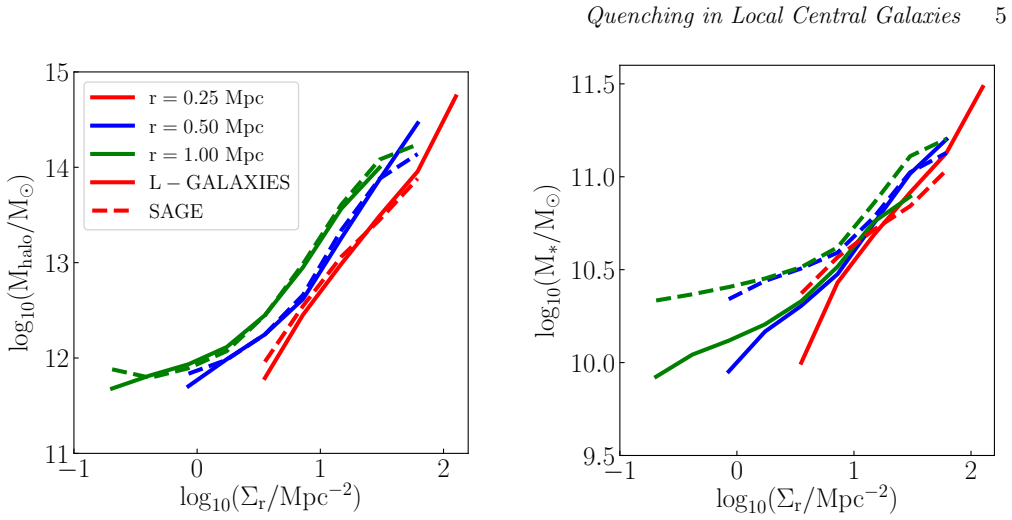
The load-bearing device is the adaptive cylindrical aperture used to identify central galaxies by stellar-mass rank in both data and models. For each galaxy, a cylinder of radius $r(n, r_{\rm max}, v_{\rm depth}) = \min(r_{\rm max}, n\,10^{\alpha \log M_* + \beta})$ and velocity depth $v_{\rm depth}$ is built, and the galaxy is called central if it has the highest stellar mass among galaxies inside. This gives an observationally measurable definition of 'central' that applies uniformly to SDSS and to both simulations, turning the model-data comparison into a controlled experiment. The second ingredient is the passive fraction $f_{\rm pass} = \Sigma w_{\rm pass}/\Sigma w_{\rm all}$, computed in bins of stellar mass and neighbour density, with the neighbour density acting as a halo-mass proxy that breaks the stellar mass-halo mass degeneracy.
What would settle it
A definitive test would be to build a large, complete sample of local massive central galaxies with reliable group halo masses from redshift surveys or X-ray groups and measure passive fraction at fixed stellar mass: if f_pass rises steeply with halo mass at fixed stellar mass, the paper's claim that observed quenching is driven by stellar and bulge mass rather than by halo mass would be overturned. Alternatively, if direct dynamical black hole masses show that the observed passive fraction is actually set by black hole mass at fixed bulge mass, then the AGN-feedback picture the models embody would be supported.
Extended reading notes
Core claim
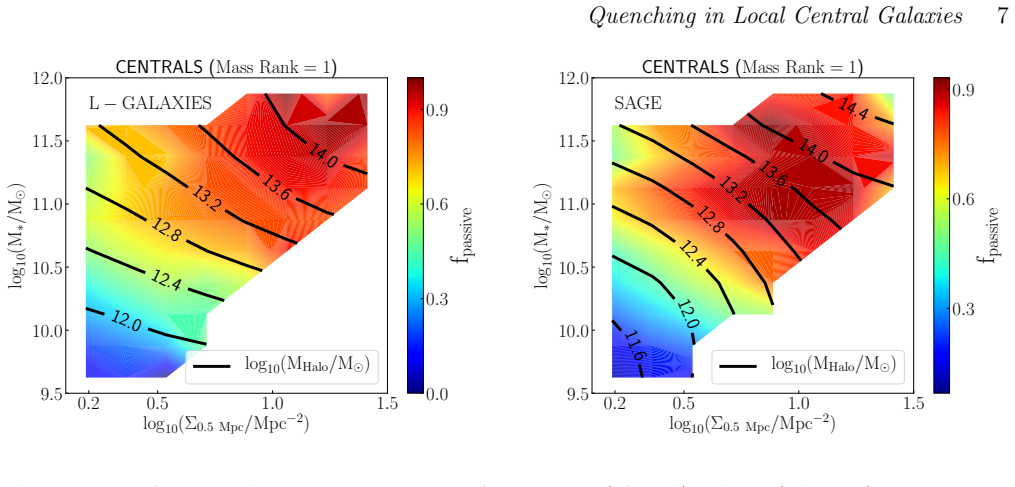
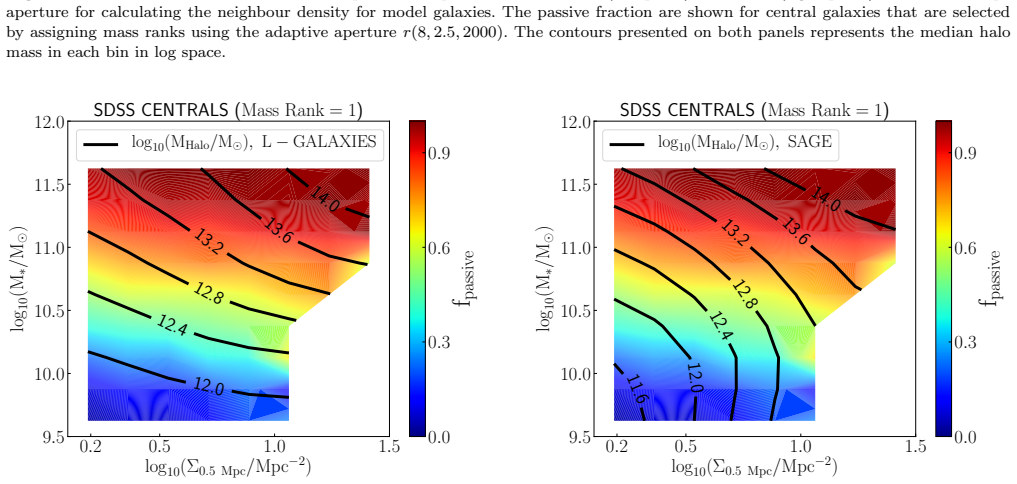
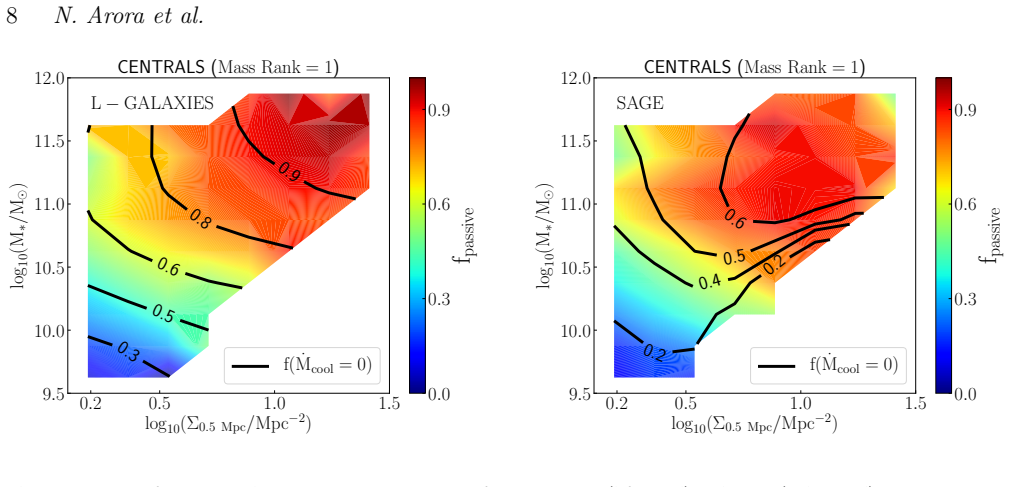
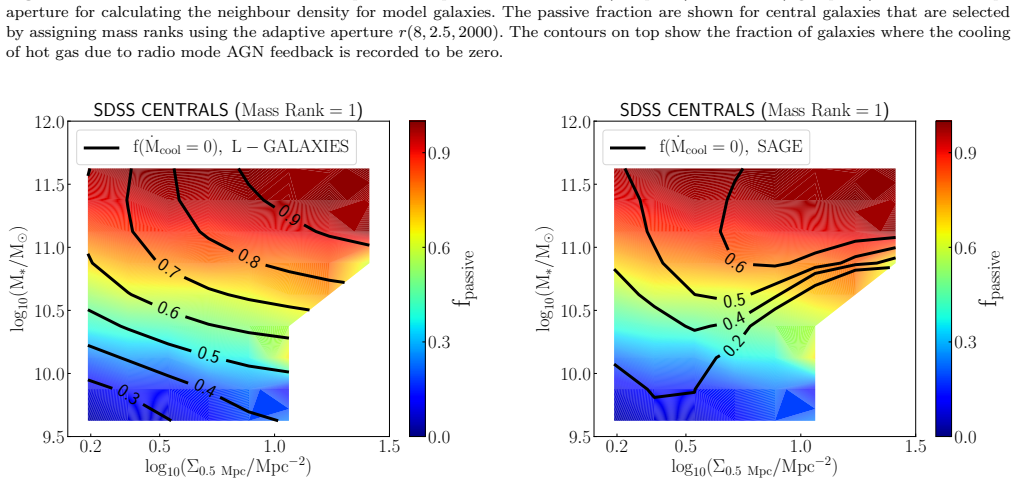
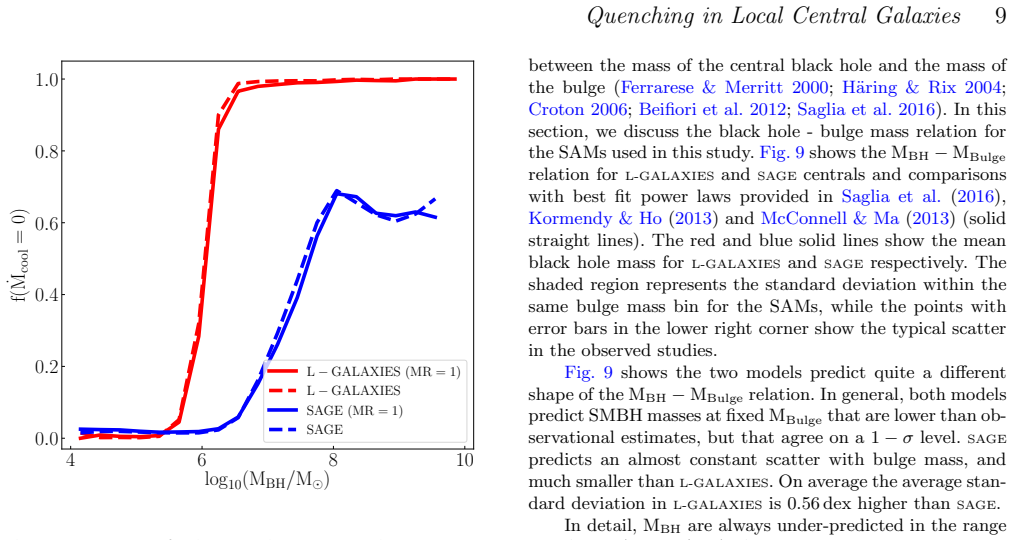
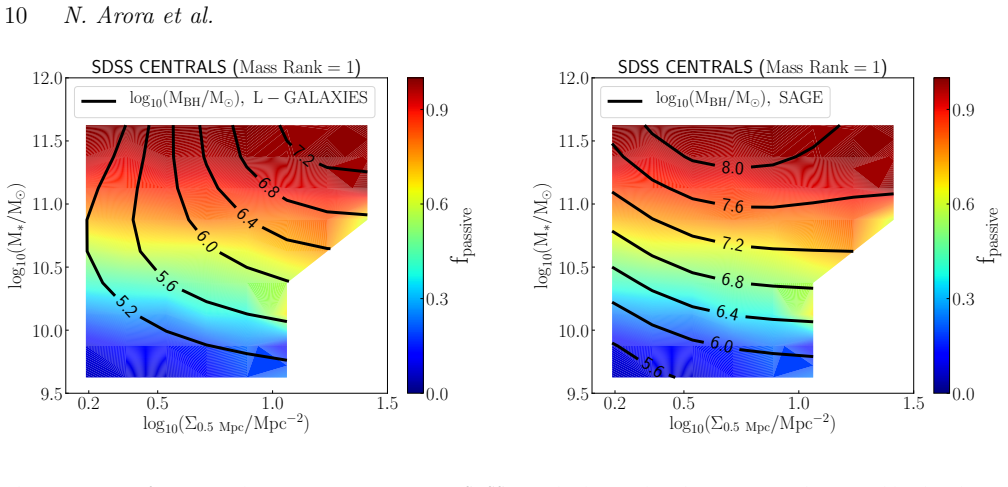
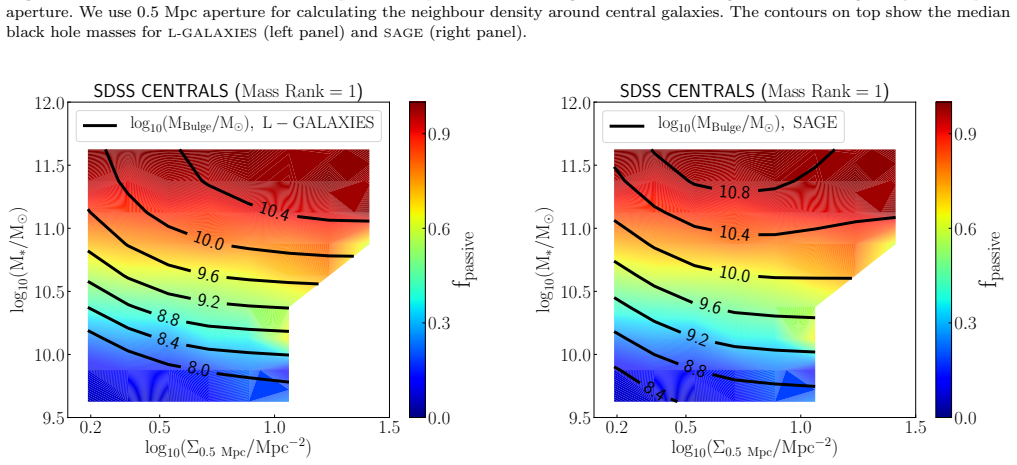
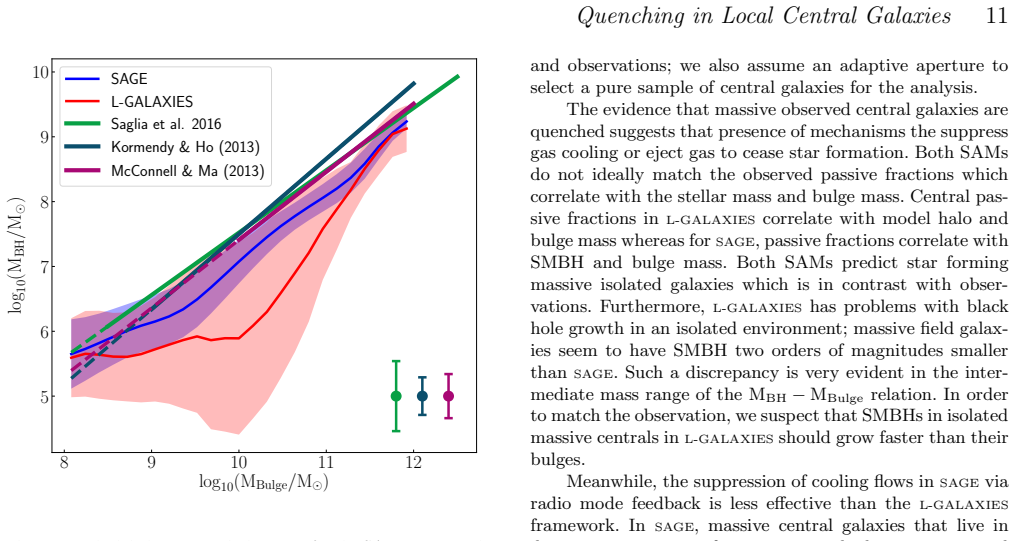
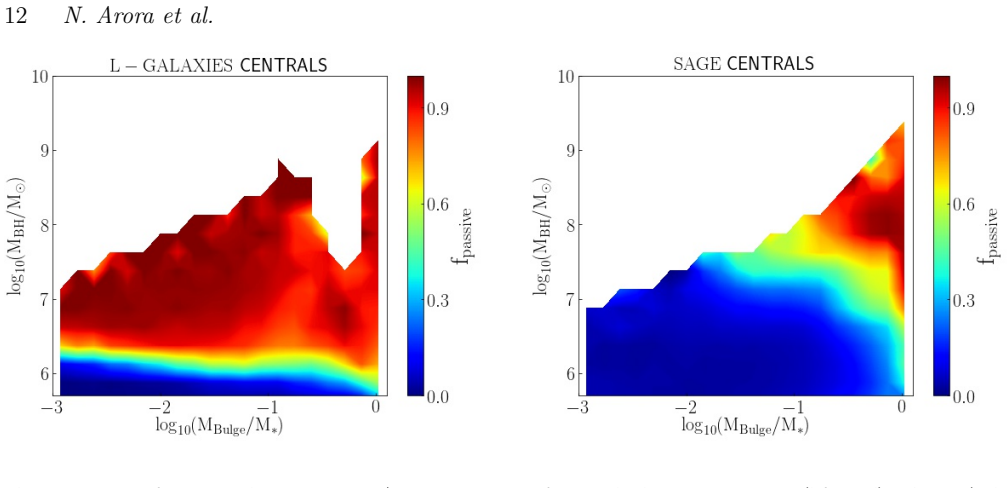
The paper's central discovery is a mismatch between where quenching happens in observations and where the models place it. In the SDSS, the passive fraction of central galaxies rises with stellar mass and bulge mass across environments, with massive field galaxies overwhelmingly passive. In L-GALAXIES, the quenched fraction instead correlates most strongly with halo mass and black hole mass, with radio-mode feedback suppressing cooling for essentially all centrals above $\log_{10}(M_{\rm BH}/M_\odot) \approx 6$. In SAGE, passive fractions correlate with black hole and bulge mass, but even at high black hole mass only about 60% of central galaxies have their cooling completely suppressed. The authors also show SAGE produces a tighter $M_{\rm BH}{-}M_{\rm bulge}$ relation with a slope closer to local observations, yet this improved black hole calibration does not remove the model-data tension. The paper concludes that neither the simple phenomenological feedback of L-GALAXIES nor the more physical coupled cooling-heating scheme of SAGE fully explains the observed quenched central population.
Load-bearing premise
The whole comparison rests on the assumption that the adaptive aperture with n = 8, r_max = 2.5 Mpc and v_depth = 2000 km/s selects the same central population in the SDSS as in the two simulations, since the observed sample's purity cannot be checked against real halo membership and small selection differences could masquerade as model-data tension.
Editorial extensions
If this is right
- Observed quenching in local central galaxies is tied to baryonic structure, especially stellar mass and bulge mass, more than to environment, so any successful model needs a quenching channel that tracks the bulge.
- In L-GALAXIES, radio-mode feedback acts as a sharp switch: nearly every central with $\log_{10}(M_{\rm BH}/M_\odot) \geq 6$ has its gas cooling suppressed, making black hole mass the effective determinant of quiescence.
- In SAGE, the same feedback is less efficient, suppressing cooling in only about 60% of high-black-hole-mass centrals, which explains why SAGE leaves more massive centrals star-forming.
- The two models' failure to reproduce massive isolated passive galaxies points to missing physics, likely merger-driven cold gas supply or the treatment of orphan satellites, rather than to the absence of AGN feedback.
- SAGE's closer agreement with the observed black hole-bulge mass relation does not by itself solve the quenching problem, showing that a good black hole scaling relation is not sufficient for a good passive fraction.
Reading between the lines
- A natural extension is to add a bulge-mass-dependent quenching channel, such as morphological quenching or gas starvation, to the models; the prediction would be that passive fractions in massive isolated centrals rise without invoking stronger AGN heating.
- The adaptive-aperture central selection could be applied to hydrodynamical simulations or to higher-redshift surveys; if its purity and completeness vary with redshift, part of the model-data tension could be a selection artefact rather than a physics gap.
- The paper's 'non-resolved substructures' hypothesis is testable: re-running SAGE with a higher-resolution simulation or with orphan galaxies surviving longer should lower the cold-gas supply in massive centrals and raise their passive fractions.
- A direct observational check of the merger-fed cold gas idea is to measure molecular gas in a sample of massive isolated passive centrals; a significant gas reservoir would support the model tension, while gas-poor galaxies would instead point to an over-efficient quenching mechanism.
Signed reviews
Editorial analysis
A structured set of objections, weighed in public.
Referee Report
Summary. The paper compares passive fractions of local central galaxies in SDSS DR7 with predictions from two semi-analytic models, L-GALAXIES (Henriques et al. 2015) and SAGE (Croton et al. 2016), using the same adaptive cylindrical aperture to select centrals in both data and models. The observed passive fractions are studied in the stellar mass versus neighbour density plane and in relation to model halo mass, black hole mass, and bulge mass. The authors report that observed passive fractions correlate best with stellar mass and bulge mass; L-GALAXIES passive fractions correlate with halo and black hole mass; SAGE passive fractions correlate with black hole and bulge mass; and that neither model fully reproduces the observed quenched population, especially massive isolated galaxies. They also compare the black hole to bulge mass relation in the models with recent observational fits, finding SAGE in better agreement, while noting tensions remain.
Significance. If the central claim holds, the paper provides a useful observational constraint on AGN feedback prescriptions in semi-analytic models, with a concrete technique for selecting central galaxies uniformly in observations and simulations. The use of the same adaptive aperture in SDSS and in both SAMs is a genuine methodological contribution, and the paper is honest about residual tensions. However, the headline conclusions are largely qualitative: passive fractions are shown without uncertainties, the claimed correlations are not quantified, and part of the model-data agreement is explicitly attributable to model calibration. The significance is therefore moderate: the paper is a useful test case for radio-mode AGN feedback, but its evidential weight is weaker than its conclusions imply.
major comments (5)
- [Appendix A] The adaptive central-galaxy selection is validated only against simulation truth, so the observed SDSS sample is assumed to have the same purity and completeness as the model samples. The central comparison depends on matching central selection in data and models; differential contamination as a function of stellar mass and neighbour density could bias the passive-fraction maps and mimic or hide model-data tension. The paper itself states in Appendix A that contamination 'can affect the trends seen in passive fractions and leads to inaccurate conclusions.' Please add an observed-side validation, e.g., using group catalogues or varying r(n, rmax, vdepth) and showing that the maps and conclusions are stable, or explicitly quantify the expected contamination in the SDSS sample.
- [Section 5, Figs 2-8] Passive fractions are presented without error bars, bootstrap uncertainties, or significance tests. Equation (8) defines a weighted observed fraction, but no statistical uncertainty is propagated, and claims such as 'good correlation with stellar mass and bulge mass' are not supported by any quantitative correlation measure. Without this, it is not possible to tell whether the qualitative differences between L-GALAXIES, SAGE, and SDSS are statistically meaningful. Please add uncertainties and report appropriate significance tests (e.g., rank correlations or binomial errors per bin) for the central claims.
- [Section 6 and Section 7] The better agreement of the SAGE black hole-bulge mass relation with observations is explicitly attributed in Section 6 to the model having been calibrated to reproduce that relation, and L-GALAXIES/H15 was tuned to match observed passive fractions (Section 2.1). The paper should therefore not present these agreements as independent support for the physical prescriptions. The calibration-dependent parts of the comparison need to be clearly separated from genuinely predictive statements, such as the distribution of quenched galaxies in the M*-Sigma plane and the behaviour of massive isolated galaxies, which are the more convincing elements of the analysis.
- [Section 5.1] Bins with fewer than 30 objects are dropped post hoc and are not marked in the figures. This affects the appearance of the maps, particularly in the low-mass, high-density region, and the threshold choice is not justified. The paper should either report the excluded bins in the figures, show that the qualitative results are robust to the threshold value, or justify the threshold a priori.
- [Section 3 and Section 5] The passive definition is specified for the observed sample (sSFR < 0.3 t_hubble^-1 ~ 10^-11 yr^-1) but not for the model galaxies. Since the central claim is a comparison of passive fractions, it is essential to state explicitly whether the same sSFR threshold is applied to the SAM outputs or whether the models use a different quiescent/star-forming classification. If different definitions are used, the comparison is not uniform and the reported tensions may be partly definitional.
minor comments (6)
- [Abstract] The abstract contains subject-verb agreement errors ('passive fractions in L-GALAXIES correlate...', 'For SAGE, the passive fraction correlate...'); these should be corrected.
- [Section 3] The sentence 'The datasets provides the number of neighbours...' has a subject-verb agreement error; also, the catalogue construction from Wilman et al. (2010) could be described more precisely.
- [Section 5.3] The phrase 'A central galaxies population' is ungrammatical and should read 'A central galaxy population' or 'The population of central galaxies'.
- [Figure 9] The caption refers to left and right panels ('The left panel shows... the right panel shows...'), but the figure appears to be a single panel; please correct the caption or the figure layout.
- [Appendix A, Eq. A1] The parameters alpha and beta in Eq. A1 are introduced but their values are never given or justified; please state the adopted values for the adaptive aperture used in the analysis.
- [Throughout] There are several typographical issues with accented characters (e.g., 'sersic', 'Beifiori') and inconsistent spacing around equations; a thorough proofreading pass is recommended.
Circularity Check
SAGE's M_BH-M_bulge slope agreement is a calibrated input, but the paper's central model-data tension finding remains independent.
-
fitted input called prediction
[Section 6 (Black Hole - Bulge Mass Relation); see Section 2.2 (SAGE model description)]
"SAGE predicts a slope for the MBH− MBulge relation that is closer to the observation estimate (due to the fact that the model has been explicitly calibrated to reproduce the constrain). ... a secondary set of constrains are applied using ... the black hole-bulge mass relation (Scott et al. 2013)."
The abstract advertises SAGE's better MBH−MBulge slope agreement with observations as a model result. Section 6, however, states that this agreement arises because SAGE was explicitly calibrated to reproduce that observed relation, and Section 2.2 lists the black hole-bulge mass relation (Scott et al. 2013) among the model's constraints. The slope agreement is therefore a reproduction of a fitting input, not an independent prediction, so the comparison is statistically forced by construction. The paper's main conclusion — that neither SAM fully reproduces the observed quenched central-galaxy population — does not depend on this calibrated agreement and retains independent content.
full rationale
The paper is mostly a comparative analysis of existing SAMs against SDSS, and its central finding is a tension: observed passive fractions correlate with stellar and bulge mass, while the SAMs' passive fractions correlate more with halo and black hole mass, and neither model reproduces the full observed quenched population. That central comparison is not circular: it uses a uniform adaptive-aperture central selection applied to both data and models, and the tensions are stated as failures of the models, not as confirmations. The one clear circular step is the SAGE MBH−MBulge slope claim, which the paper itself explicitly attributes to calibration against the observed relation; calling it a better prediction is a fitted input renamed as a result. L-GALAXIES is also stated to have been tuned to match passive fractions, so broad passive-fraction agreement would be a consistency check, but the paper does not rest on that agreement and instead emphasizes discrepancies in the M*-density plane. The Fossati et al. (2015) selection technique is validated against simulation truth in Appendix A; observed-sample purity is assumed, which is a selection-systematics risk rather than a circular derivation. Overall, the central claim is independent, so the circularity score is moderate rather than high.
Assumptions & free parameters
free parameters (5)
- k_AGN (L-GALAXIES radio-mode normalization) =
5.3e-3 M_sun/yr
- kappa_R (SAGE radio-mode efficiency) =
0.08
- SAGE star formation efficiency (Kennicutt-Schmidt) =
not stated
- sSFR passive threshold =
0.3 t_hubble^-1 ~ 10^-11 yr^-1
- adaptive aperture parameters (n, rmax, vdepth) =
8, 2.5 Mpc, 2000 km/s
assumptions (6)
- domain assumption Lambda-CDM hierarchical structure formation is the correct framework for galaxy evolution.
- domain assumption Radio-mode AGN feedback is the dominant quenching mechanism for massive central galaxies.
- domain assumption L-GALAXIES (H15) and SAGE (C16) are representative implementations of AGN feedback and their public catalogues faithfully encode the models.
- domain assumption Differences in cosmology between L-GALAXIES (Planck) and SAGE (WMAP-1) do not materially affect the comparison.
- domain assumption The adaptive aperture selects equivalent central galaxies in models and observations.
- domain assumption SDSS DR7/MPA-JHU stellar masses, SFRs and neighbour counts are accurate enough for passive fraction measurements.
Cite this review
Pith. "Pith review of On The Role of Supermassive Black Holes in Quenching Star Formation in Local Central Galaxies." pith.science (2026). https://pith.science/paper/F53SIV2I
@misc{pith2026190804813,
  author       = {Pith},
  title        = {Pith review of: On The Role of Supermassive Black Holes in Quenching Star Formation in Local Central Galaxies},
  year         = {2026},
  howpublished = {\url{https://pith.science/paper/F53SIV2I}},
  note         = {Machine review of arXiv:1908.04813}
}
read the original abstract
In this work, we analyze the role of AGN feedback in quenching star formation for massive, central galaxies in the local Universe. In particular, we compare the prediction of two semi-analytic models (L-GALAXIES and SAGE) featuring different schemes for AGN feedback, with the SDSS DR7 taking advantage of a novel technique for identifying central galaxies in an observational dataset. This enables us to study the correlation between the model passive fractions, which is predicted to be suppressed by feedback from an AGN, and the observed passive fractions in an observationally motivated parameter space. While the passive fractions for observed central galaxies show a good correlation with stellar mass and bulge mass, passive fractions in L-GALAXIES correlate with the halo and black hole mass. For SAGE, the passive fraction correlate with the bulge mass as well. Among the two models, SAGE has a smaller scatter in the black hole - bulge mass (M_BH - M_Bulge) relation and a slope that agrees better with the most recent observations at z \sim 0. Despite the more realistic prescription of radio mode feedback in SAGE, there are still tensions left with the observed passive fractions and the distribution of quenched galaxies. These tensions may be due to the treatment of galaxies living in non-resolved substructures and the resulting higher merger rates that could bring cold gas which is available for star formation.
Figures
Figures from the paper (7 more)
Reference graph
Works this paper leans on
-
[1]
Abazajian K. N., et al., 2009, @doi [The Astrophysical Journal Supplement Series] 10.1088/0067-0049/182/2/543 , https://ui.adsabs.harvard.edu/#abs/2009ApJS..182..543A 182, 543
-
[4]
Behroozi P. S., Wechsler R. H., Conroy C., 2013, @doi [ ] 10.1088/2041-8205/762/2/L31 , https://ui.adsabs.harvard.edu/\#abs/2013ApJ...762L..31B 762, L31
-
[5]
Beifiori A., Courteau S., Corsini E. M., Zhu Y., 2012, @doi [ ] 10.1111/j.1365-2966.2011.19903.x , http://adsabs.harvard.edu/abs/2012MNRAS.419.2497B 419, 2497
arXiv 2012
-
[6]
Benson A. J., Bower R. G., Frenk C. S., Lacey C. G., Baugh C. M., Cole S., 2003, @doi [ ] 10.1086/379160 , http://adsabs.harvard.edu/abs/2003ApJ...599...38B 599, 38
doi:10.1086/379160 2003
-
[7]
Bernyk M., et al., 2016, @doi [The Astrophysical Journal Supplement Series] 10.3847/0067-0049/223/1/9 , https://ui.adsabs.harvard.edu/#abs/2016ApJS..223....9B 223, 9
-
[8]
Bitsakis T., et al., 2019, @doi [ ] 10.1093/mnras/sty2857 , http://adsabs.harvard.edu/abs/2019MNRAS.483..370B 483, 370
-
[9]
Bluck A. F. L., Ellison S. L., Patton D. R., Simard L., Mendel J. T., Teimoorinia H., Moreno J., Starkenburg E., 2014a, preprint ( @eprint 1412.3862 )
-
[10]
Bluck A. F. L., Mendel J. T., Ellison S. L., Moreno J., Simard L., Patton D. R., Starkenburg E., 2014b, @doi [ ] 10.1093/mnras/stu594 , https://ui.adsabs.harvard.edu/abs/2014MNRAS.441..599B 441, 599
Show all 74 references
-
[11]
Bondi H., 1952, @doi [ ] 10.1093/mnras/112.2.195 , https://ui.adsabs.harvard.edu/#abs/1952MNRAS.112..195B 112, 195
1952 doi
-
[13]
Boylan-Kolchin M., Springel V., White S. D. M., Jenkins A., Lemson G., 2009, @doi [ ] 10.1111/j.1365-2966.2009.15191.x , https://ui.adsabs.harvard.edu/#abs/2009MNRAS.398.1150B 398, 1150
2009
-
[15]
Cano-D \' az M., et al., 2016, @doi [ ] 10.3847/2041-8205/821/2/L26 , http://adsabs.harvard.edu/abs/2016ApJ...821L..26C 821, L26
2016 doi
-
[16]
H., 2009, @doi [ ] 10.1088/0004-637X/696/1/620 , https://ui.adsabs.harvard.edu/\#abs/2009ApJ...696..620C 696, 620
Conroy C., Wechsler R. H., 2009, @doi [ ] 10.1088/0004-637X/696/1/620 , https://ui.adsabs.harvard.edu/\#abs/2009ApJ...696..620C 696, 620
2009 doi
-
[17]
P., Gao L., Guo Q., Frenk C
Cooper A. P., Gao L., Guo Q., Frenk C. S., Jenkins A., Springel V., White S. D. M., 2015, @doi [ ] 10.1093/mnras/stv1042 , https://ui.adsabs.harvard.edu/\#abs/2015MNRAS.451.2703C 451, 2703
2015 doi
-
[21]
J., et al., 2016, @doi [ ] 10.3847/0067-0049/222/2/22 , https://ui.adsabs.harvard.edu/abs/2016ApJS..222...22C 222, 22
Croton D. J., et al., 2016, @doi [ ] 10.3847/0067-0049/222/2/22 , https://ui.adsabs.harvard.edu/abs/2016ApJS..222...22C 222, 22
2016 doi
-
[23]
Di Matteo T., Springel V., Hernquist L., 2005, @doi [ ] 10.1038/nature03335 , https://ui.adsabs.harvard.edu/abs/2005Natur.433..604D 433, 604
2005 doi
-
[24]
J., Muriel H., Madrid J
Donzelli C. J., Muriel H., Madrid J. P., 2011, @doi [The Astrophysical Journal Supplement Series] 10.1088/0067-0049/195/2/15 , https://ui.adsabs.harvard.edu/\#abs/2011ApJS..195...15D 195, 15
2011 doi
-
[25]
Dressler A., 1980, @doi [ ] 10.1086/157753 , https://ui.adsabs.harvard.edu/\#abs/1980ApJ...236..351D 236, 351
1980 doi
-
[26]
C., 1994, @doi [ ] 10.1146/annurev.aa.32.090194.001425 , https://ui.adsabs.harvard.edu/abs/1994ARA&A..32..277F 32, 277
Fabian A. C., 1994, @doi [ ] 10.1146/annurev.aa.32.090194.001425 , https://ui.adsabs.harvard.edu/abs/1994ARA&A..32..277F 32, 277
1994
-
[27]
C., 2012, @doi [ ] 10.1146/annurev-astro-081811-125521 , https://ui.adsabs.harvard.edu/abs/2012ARA&A..50..455F 50, 455
Fabian A. C., 2012, @doi [ ] 10.1146/annurev-astro-081811-125521 , https://ui.adsabs.harvard.edu/abs/2012ARA&A..50..455F 50, 455
2012 doi
-
[29]
Ferrarese L., Merritt D., 2000, @doi [ ] 10.1086/312838 , https://ui.adsabs.harvard.edu/#abs/2000ApJ...539L...9F 539, L9
2000 doi
-
[32]
Fontanot F., Monaco P., Shankar F., 2015, @doi [ ] 10.1093/mnras/stv1930 , https://ui.adsabs.harvard.edu/abs/2015MNRAS.453.4112F 453, 4112
2015 doi
-
[33]
Fossati M., et al., 2015, @doi [ ] 10.1093/mnras/stu2255 , https://ui.adsabs.harvard.edu/abs/2015MNRAS.446.2582F 446, 2582
2015 doi
-
[34]
Fossati M., et al., 2017, @doi [ ] 10.3847/1538-4357/835/2/153 , https://ui.adsabs.harvard.edu/abs/2017ApJ...835..153F 835, 153
2017 doi
-
[35]
G., F \"o rster Schreiber N
Franx M., van Dokkum P. G., F \"o rster Schreiber N. M., Wuyts S., Labb \'e I., Toft S., 2008, @doi [ ] 10.1086/592431 , https://ui.adsabs.harvard.edu/abs/2008ApJ...688..770F 688, 770
2008 doi
-
[37]
W., Scott N., 2013, @doi [ ] 10.1088/0004-637X/764/2/151 , https://ui.adsabs.harvard.edu/abs/2013ApJ...764..151G 764, 151
Graham A. W., Scott N., 2013, @doi [ ] 10.1088/0004-637X/764/2/151 , https://ui.adsabs.harvard.edu/abs/2013ApJ...764..151G 764, 151
2013 doi
-
[38]
Gu M., Conroy C., Behroozi P., 2016, @doi [ ] 10.3847/0004-637X/833/1/2 , https://ui.adsabs.harvard.edu/abs/2016ApJ...833....2G 833, 2
2016 doi
-
[40]
E., Henriques B., Lemson G., Boylan-Kolchin M., Thomas P., Short C., 2013, @doi [ ] 10.1093/mnras/sts115 , https://ui.adsabs.harvard.edu/abs/2013MNRAS.428.1351G 428, 1351
Guo Q., White S., Angulo R. E., Henriques B., Lemson G., Boylan-Kolchin M., Thomas P., Short C., 2013, @doi [ ] 10.1093/mnras/sts115 , https://ui.adsabs.harvard.edu/abs/2013MNRAS.428.1351G 428, 1351
2013 doi
-
[41]
H \"a ring N., Rix H.-W., 2004, @doi [ ] 10.1086/383567 , https://ui.adsabs.harvard.edu/abs/2004ApJ...604L..89H 604, L89
2004 doi
-
[42]
Henriques B. M. B., White S. D. M., Thomas P. A., Angulo R. E., Guo Q., Lemson G., Springel V., 2013, @doi [ ] 10.1093/mnras/stt415 , https://ui.adsabs.harvard.edu/#abs/2013MNRAS.431.3373H 431, 3373
2013 doi
-
[43]
Henriques B. M. B., White S. D. M., Thomas P. A., Angulo R., Guo Q., Lemson G., Springel V., Overzier R., 2015, @doi [ ] 10.1093/mnras/stv705 , https://ui.adsabs.harvard.edu/abs/2015MNRAS.451.2663H 451, 2663
2015 doi
-
[44]
Hirschmann M., De Lucia G., Wilman D., Weinmann S., Iovino A., Cucciati O., Zibetti S., Villalobos \'A ., 2014, @doi [ ] 10.1093/mnras/stu1609 , https://ui.adsabs.harvard.edu/abs/2014MNRAS.444.2938H 444, 2938
2014 doi
-
[45]
Hirschmann M., De Lucia G., Fontanot F., 2016, @doi [ ] 10.1093/mnras/stw1318 , https://ui.adsabs.harvard.edu/abs/2016MNRAS.461.1760H 461, 1760
2016 doi
-
[46]
T., et al., 2017, @doi [ ] 10.3847/1538-4357/aa9af3 , https://ui.adsabs.harvard.edu/abs/2017ApJ...851...66H 851, 66
Hogan M. T., et al., 2017, @doi [ ] 10.3847/1538-4357/aa9af3 , https://ui.adsabs.harvard.edu/abs/2017ApJ...851...66H 851, 66
2017 doi
-
[47]
W., SDSS Collaboration 2003, in American Astronomical Society Meeting Abstracts \#202
Hogg D. W., SDSS Collaboration 2003, in American Astronomical Society Meeting Abstracts \#202. p. 51.03
2003
-
[48]
P., Giovanelli R., Brinchmann J., 2012, @doi [ ] 10.1088/0004-637X/756/2/113 , https://ui.adsabs.harvard.edu/\#abs/2012ApJ...756..113H 756, 113
Huang S., Haynes M. P., Giovanelli R., Brinchmann J., 2012, @doi [ ] 10.1088/0004-637X/756/2/113 , https://ui.adsabs.harvard.edu/\#abs/2012ApJ...756..113H 756, 113
2012 doi
-
[49]
V., 2011, @doi [ ] 10.1088/0004-637X/734/2/92 , https://ui.adsabs.harvard.edu/abs/2011ApJ...734...92J 734, 92
Jahnke K., Macci \`o A. V., 2011, @doi [ ] 10.1088/0004-637X/734/2/92 , https://ui.adsabs.harvard.edu/abs/2011ApJ...734...92J 734, 92
2011 doi
-
[50]
Kauffmann G., Haehnelt M., 2000, @doi [ ] 10.1046/j.1365-8711.2000.03077.x , https://ui.adsabs.harvard.edu/abs/2000MNRAS.311..576K 311, 576
2000
-
[51]
Kauffmann G., et al., 2003, @doi [ ] 10.1046/j.1365-8711.2003.06292.x , https://ui.adsabs.harvard.edu/abs/2003MNRAS.341...54K 341, 54
2003
-
[52]
Kauffmann G., White S. D. M., Heckman T. M., M \'e nard B., Brinchmann J., Charlot S., Tremonti C., Brinkmann J., 2004, @doi [ ] 10.1111/j.1365-2966.2004.08117.x , http://adsabs.harvard.edu/abs/2004MNRAS.353..713K 353, 713
2004
-
[53]
J., 1989, @doi [ ] 10.1086/167834 , https://ui.adsabs.harvard.edu/\#abs/1989ApJ...344..685K 344, 685
Kennicutt Robert C. J., 1989, @doi [ ] 10.1086/167834 , https://ui.adsabs.harvard.edu/\#abs/1989ApJ...344..685K 344, 685
1989 doi
-
[54]
Kennicutt Jr. R. C., 1998, @doi [ ] 10.1086/305588 , http://adsabs.harvard.edu/abs/1998ApJ...498..541K 498, 541
1998 doi
-
[55]
King A., Pounds K., 2015, @doi [ ] 10.1146/annurev-astro-082214-122316 , http://adsabs.harvard.edu/abs/2015ARA
2015 doi
-
[56]
Knebe A., et al., 2018, @doi [ ] 10.1093/mnras/stx2662 , https://ui.adsabs.harvard.edu/abs/2018MNRAS.474.5206K 474, 5206
2018 doi
-
[57]
C., 2013, @doi [ ] 10.1146/annurev-astro-082708-101811 , https://ui.adsabs.harvard.edu/abs/2013ARA&A..51..511K 51, 511
Kormendy J., Ho L. C., 2013, @doi [ ] 10.1146/annurev-astro-082708-101811 , https://ui.adsabs.harvard.edu/abs/2013ARA&A..51..511K 51, 511
2013 doi
-
[58]
V., Vikhlinin A
Kravtsov A. V., Vikhlinin A. A., Meshcheryakov A. V., 2018, @doi [Astronomy Letters] 10.1134/S1063773717120015 , https://ui.adsabs.harvard.edu/\#abs/2018AstL...44....8K 44, 8
2018 doi
-
[59]
Martig M., Bournaud F., Teyssier R., Dekel A., 2009, @doi [ ] 10.1088/0004-637X/707/1/250 , https://ui.adsabs.harvard.edu/\#abs/2009ApJ...707..250M 707, 250
2009 doi
-
[61]
A., Schaller M., Bower R., Theuns T., 2017, @doi [ ] 10.1093/mnras/stw2884 , https://ui.adsabs.harvard.edu/abs/2017MNRAS.465.2381M 465, 2381
Matthee J., Schaye J., Crain R. A., Schaller M., Bower R., Theuns T., 2017, @doi [ ] 10.1093/mnras/stw2884 , https://ui.adsabs.harvard.edu/abs/2017MNRAS.465.2381M 465, 2381
2017 doi
-
[62]
J., Ma C.-P., 2013, @doi [ ] 10.1088/0004-637X/764/2/184 , https://ui.adsabs.harvard.edu/abs/2013ApJ...764..184M 764, 184
McConnell N. J., Ma C.-P., 2013, @doi [ ] 10.1088/0004-637X/764/2/184 , https://ui.adsabs.harvard.edu/abs/2013ApJ...764..184M 764, 184
2013 doi
-
[63]
Monaco P., Fontanot F., Taffoni G., 2007, @doi [ ] 10.1111/j.1365-2966.2006.11253.x , https://ui.adsabs.harvard.edu/abs/2007MNRAS.375.1189M 375, 1189
2007
-
[64]
Peng Y.-j., et al., 2010, @doi [ ] 10.1088/0004-637X/721/1/193 , https://ui.adsabs.harvard.edu/abs/2010ApJ...721..193P 721, 193
2010 doi
-
[65]
J., Renzini A., Carollo M., 2012, @doi [ ] 10.1088/0004-637X/757/1/4 , https://ui.adsabs.harvard.edu/abs/2012ApJ...757....4P 757, 4
Peng Y.-j., Lilly S. J., Renzini A., Carollo M., 2012, @doi [ ] 10.1088/0004-637X/757/1/4 , https://ui.adsabs.harvard.edu/abs/2012ApJ...757....4P 757, 4
2012 doi
-
[66]
Planck Collaboration et al., 2014, @doi [ ] 10.1051/0004-6361/201321591 , http://adsabs.harvard.edu/abs/2014A
2014 doi
-
[67]
P., et al., 2016, @doi [ ] 10.3847/0004-637X/818/1/47 , https://ui.adsabs.harvard.edu/abs/2016ApJ...818...47S 818, 47
Saglia R. P., et al., 2016, @doi [ ] 10.3847/0004-637X/818/1/47 , https://ui.adsabs.harvard.edu/abs/2016ApJ...818...47S 818, 47
2016 doi
-
[68]
Santini P., et al., 2017, @doi [ ] 10.3847/1538-4357/aa8874 , http://adsabs.harvard.edu/abs/2017ApJ...847...76S 847, 76
2017 doi
-
[69]
W., Schombert J., 2013, @doi [ ] 10.1088/0004-637X/768/1/76 , https://ui.adsabs.harvard.edu/#abs/2013ApJ...768...76S 768, 76
Scott N., Graham A. W., Schombert J., 2013, @doi [ ] 10.1088/0004-637X/768/1/76 , https://ui.adsabs.harvard.edu/#abs/2013ApJ...768...76S 768, 76
2013 doi
-
[70]
Shankar F., et al., 2016, @doi [ ] 10.1093/mnras/stw678 , https://ui.adsabs.harvard.edu/abs/2016MNRAS.460.3119S 460, 3119
2016 doi
-
[71]
A., 2012, @doi [Research in Astronomy and Astrophysics] 10.1088/1674-4527/12/8/004 , https://ui.adsabs.harvard.edu/\#abs/2012RAA....12..917S 12, 917
Silk J., Mamon G. A., 2012, @doi [Research in Astronomy and Astrophysics] 10.1088/1674-4527/12/8/004 , https://ui.adsabs.harvard.edu/\#abs/2012RAA....12..917S 12, 917
2012 doi
-
[73]
S., Dav \'e R., 2015, @doi [ ] 10.1146/annurev-astro-082812-140951 , https://ui.adsabs.harvard.edu/abs/2015ARA&A..53...51S 53, 51
Somerville R. S., Dav \'e R., 2015, @doi [ ] 10.1146/annurev-astro-082812-140951 , https://ui.adsabs.harvard.edu/abs/2015ARA&A..53...51S 53, 51
2015 doi
-
[74]
S., Primack J
Somerville R. S., Primack J. R., Faber S. M., 2001, @doi [ ] 10.1046/j.1365-8711.2001.03975.x , https://ui.adsabs.harvard.edu/#abs/2001MNRAS.320..504S 320, 504
2001
-
[75]
S., Hopkins P
Somerville R. S., Hopkins P. F., Cox T. J., Robertson B. E., Hernquist L., 2008, @doi [ ] 10.1111/j.1365-2966.2008.13805.x , https://ui.adsabs.harvard.edu/abs/2008MNRAS.391..481S 391, 481
2008
-
[76]
N., et al., 2003, @doi [The Astrophysical Journal Supplement Series] 10.1086/377226 , https://ui.adsabs.harvard.edu/#abs/2003ApJS..148..175S 148, 175
Spergel D. N., et al., 2003, @doi [The Astrophysical Journal Supplement Series] 10.1086/377226 , https://ui.adsabs.harvard.edu/#abs/2003ApJS..148..175S 148, 175
2003 doi
-
[77]
Springel V., 2005, @doi [ ] 10.1111/j.1365-2966.2005.09655.x , https://ui.adsabs.harvard.edu/abs/2005MNRAS.364.1105S 364, 1105
2005
-
[78]
Springel V., et al., 2005, @doi [ ] 10.1038/nature03597 , https://ui.adsabs.harvard.edu/#abs/2005Natur.435..629S 435, 629
2005 doi
-
[79]
V., McGaugh S
Stark D. V., McGaugh S. S., Swaters R. A., 2009, @doi [ ] 10.1088/0004-6256/138/2/392 , https://ui.adsabs.harvard.edu/#abs/2009AJ....138..392S 138, 392
2009 doi
-
[80]
Tremaine S., et al., 2002, @doi [ ] 10.1086/341002 , https://ui.adsabs.harvard.edu/abs/2002ApJ...574..740T 574, 740
2002 doi
-
[81]
A., et al., 2004, @doi [ ] 10.1086/423264 , https://ui.adsabs.harvard.edu/#abs/2004ApJ...613..898T 613, 898
Tremonti C. A., et al., 2004, @doi [ ] 10.1086/423264 , https://ui.adsabs.harvard.edu/#abs/2004ApJ...613..898T 613, 898
2004 doi
-
[82]
J., et al., 2014, @doi [ ] 10.1051/0004-6361/201424198 , https://ui.adsabs.harvard.edu/\#abs/2014A&A...569A...1W 569, A1
Walcher C. J., et al., 2014, @doi [ ] 10.1051/0004-6361/201424198 , https://ui.adsabs.harvard.edu/\#abs/2014A&A...569A...1W 569, A1
2014 doi
-
[83]
E., van Dokkum P
Whitaker K. E., van Dokkum P. G., Brammer G., Franx M., 2012, @doi [ ] 10.1088/2041-8205/754/2/L29 , https://ui.adsabs.harvard.edu/\#abs/2012ApJ...754L..29W 754, L29
2012 doi
-
[84]
E., et al., 2017, @doi [ ] 10.3847/1538-4357/aa6258 , https://ui.adsabs.harvard.edu/abs/2017ApJ...838...19W 838, 19
Whitaker K. E., et al., 2017, @doi [ ] 10.3847/1538-4357/aa6258 , https://ui.adsabs.harvard.edu/abs/2017ApJ...838...19W 838, 19
2017 doi
-
[85]
White S. D. M., Frenk C. S., 1991, @doi [ ] 10.1086/170483 , https://ui.adsabs.harvard.edu/abs/1991ApJ...379...52W 379, 52
1991 doi
-
[86]
White S. D. M., Rees M. J., 1978, @doi [ ] 10.1093/mnras/183.3.341 , https://ui.adsabs.harvard.edu/abs/1978MNRAS.183..341W 183, 341
1978 doi
-
[87]
J., Zibetti S., Budav \'a ri T., 2010, @doi [ ] 10.1111/j.1365-2966.2010.16845.x , https://ui.adsabs.harvard.edu/abs/2010MNRAS.406.1701W 406, 1701
Wilman D. J., Zibetti S., Budav \'a ri T., 2010, @doi [ ] 10.1111/j.1365-2966.2010.16845.x , https://ui.adsabs.harvard.edu/abs/2010MNRAS.406.1701W 406, 1701
2010
-
[88]
J., van den Bosch F
Yang X., Mo H. J., van den Bosch F. C., 2008, @doi [ ] 10.1086/528954 , https://ui.adsabs.harvard.edu/abs/2008ApJ...676..248Y 676, 248
2008 doi
-
[89]
P., White M., 2017, preprint, http://adsabs.harvard.edu/abs/2017arXiv170305326V ( @eprint arXiv 1703.05326 )
van Daalen M. P., White M., 2017, preprint, http://adsabs.harvard.edu/abs/2017arXiv170305326V ( @eprint arXiv 1703.05326 )
2017 arXiv
Reviewed August 14, 2026 · model on record in the stance chip above.
Discussion (0). Continue with ORCID to comment.