REVIEW 3 major objections 4 minor 32 references
Rigidity for perimeter inequality under spherical symmetrisation
T0 review · 3 major / 4 minor · reviewed 2026-08-14 · deepseek-v4-flash
Pith's one-line read The paper proves that equality in the spherical-symmetrisation perimeter inequality forces a single global rotation exactly when the cap-angle function is locally absolutely continuous on one interval.
desk verdict First real candidate for the spherical rigidity characterization, but the (ii)=>(i) direction currently rests on sketched circular-symmetrisation machinery that a referee cannot certify from the written proof. read the letter →
The pith
A machine-rendered reading of the paper's core claim, the machinery that carries it, and where it could break.
The reading
What carries the argument
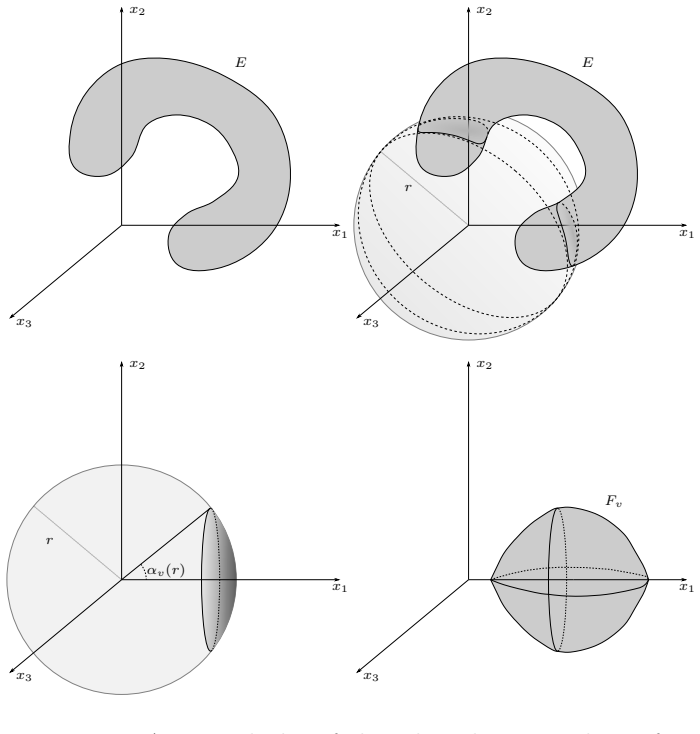
The objects carrying the argument are the cap-angle function $\alpha_v$ and its approximate limits $\alpha_v^\wedge$ and $\alpha_v^\vee$; the measure $\lambda_E$ that records the radial contribution of the boundary where the tangential normal vanishes; the decomposition of the reduced boundary normal into radial and tangential parts; and the circular symmetrisation, the codimension-one version of the spherical one obtained by slicing with planes and symmetrising circumference arcs. The proof of the sufficiency direction works through the average direction $d_E(r)$, the normalized barycentre of the spherical slice $E_r$, showing that under condition (ii) it lies in $W^{1,1}_{\mathrm{loc}}$ and its derivative vanishes almost everywhere, so all slices share one common axis. The necessity direction builds counterexamples: rotating the set beyond a radius where $\alpha_v$ reaches $0$ or $\pi$, rotating across a jump of $\alpha_v$, and for a nonzero Cantor part approximating the Cantor function by step functions and taking a limit of perimeters.
What would settle it
Take $n=3$ and let $\alpha_v$ be a scaled Cantor function on an interval, with $v$ determined by (1.2)-(1.3); form the set $E$ from equations (8.20)-(8.28) in which each slice is rotated by $\beta(r)=\lambda(\alpha_v(r)-\alpha_v(a))$. If a direct computation of $P(E)$ by approximating $\alpha_v$ with step functions gives strict inequality $P(E)>P(F_v)$, the perimeter-preservation claim in Proposition 8.4 fails. Conversely, verifying $P(E)=P(F_v)$ for such an explicit Cantor $\alpha_v$ — for instance by computing the limit of the piecewise-rotated approximations — tests the necessity direction of Theorem 1.2.
Extended reading notes
Core claim
On its own terms, the central result is Theorem 1.2. Let $v$ be a measurable area-distribution function satisfying the volume constraint, with finite-volume finite-perimeter associated symmetral $F_v$, and let $\alpha_v$ be the function whose value at radius $r$ is the aperture of the spherical cap of area $v(r)$. Rigidity $(R)$ — every spherically $v$-distributed set $E$ with $P(E)=P(F_v)$ equals a rotated copy of $F_v$ up to negligible sets — holds if and only if the effective set $\{0<\alpha_v^\wedge\le \alpha_v^\vee<\pi\}$ is a possibly unbounded interval $I$ and $\alpha_v$ belongs to $W^{1,1}_{\mathrm{loc}}$ on the interior of $I$, where $\alpha_v^\wedge$ and $\alpha_v^\vee$ are the representative-independent approximate lower and upper limits. The equivalence is established by showing in one direction that the average direction of the spherical slices of an extremal is locally absolutely continuous and satisfies a first-order ODE that forces it constant, and in the other direction by constructing extremals that piece together rotated copies of $F_v$ when the interval condition fails, when $\alpha_v$ jumps, or when its Cantor part is nonzero.
Load-bearing premise
The main equivalence rests on Lemma 1.3, whose proof depends on Theorem 1.4 and Lemma 1.5 about circular symmetrisation; the paper only sketches those proofs by adapting earlier results, so any hidden technical failure there would break the sufficiency direction.
Editorial extensions
If this is right
- Whenever condition (ii) holds, every extremal of the spherical-symmetrisation perimeter inequality is, up to Lebesgue-negligible sets, the image of the spherical symmetral under one fixed orthogonal transformation.
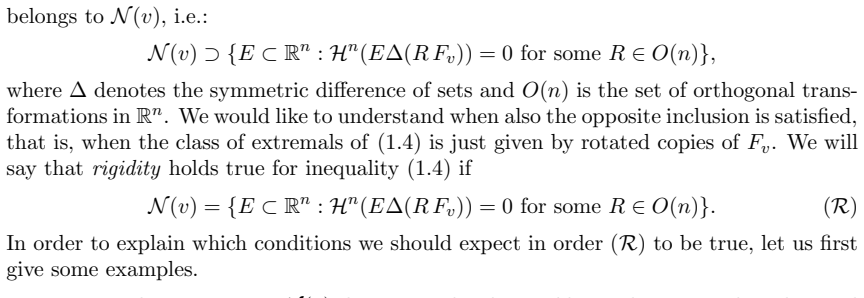
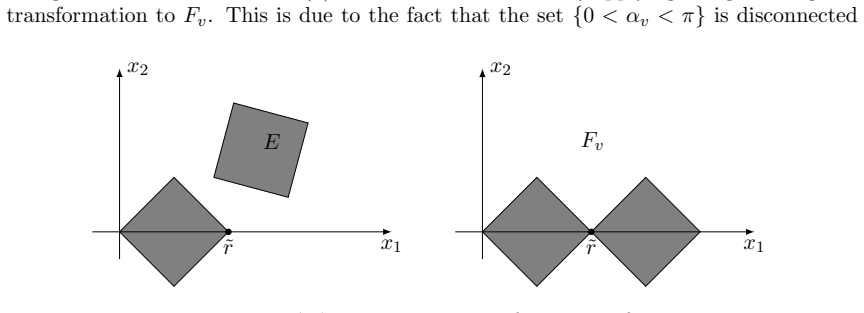
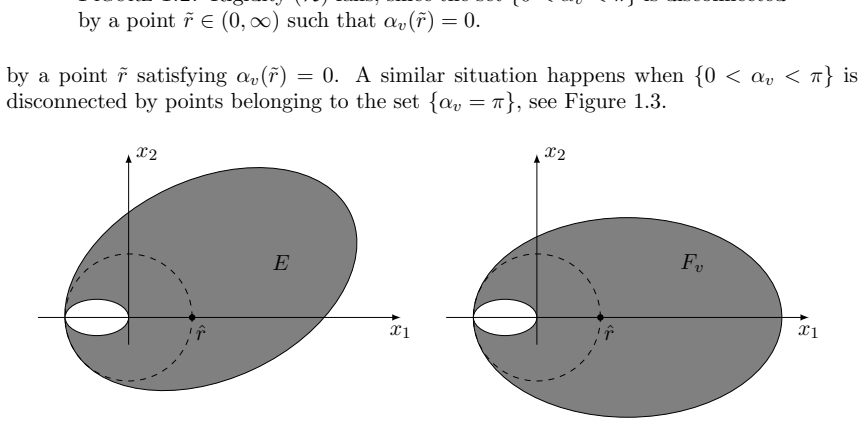
- If the set of active radii $\{0<\alpha_v^\wedge\le\alpha_v^\vee<\pi\}$ is disconnected by a radius with $\alpha_v=0$ or $\alpha_v=\pi$, rigidity fails and equality cases can join independently rotated copies of the symmetral on the two sides.
- If $\alpha_v$ has an approximate jump, rigidity fails: rotating all slices beyond the jump by any sufficiently small angle preserves the perimeter.
- If $\alpha_v$ has a nonzero Cantor part, rigidity fails: there are extremals whose slice direction rotates by a continuous function built from the Cantor part, so equality cases form a nontrivial family.
- On an open interval $I$, the condition $\alpha_v\in W^{1,1}_{\mathrm{loc}}(I)$ is equivalent to the tangential part of the boundary of $F_v$ being $\mathcal{H}^{n-1}$-negligible there, linking rigidity to a geometric non-degeneracy of the symmetral's boundary.
Reading between the lines
- A natural testable extension is that the same dichotomy holds for symmetrisations with densities or anisotropic norms: equality cases are rigid exactly when the analogue of the cap-angle is locally absolutely continuous on a single interval, because the average-direction ODE only uses the local geometry of the spheres.
- For PDE applications, failure of rigidity means spherical symmetrisation alone cannot force a global foliated-Schwarz axis; one would need a second argument to rule out the continuously varying axes that the Cantor-part counterexamples produce.
- The construction for Cantor parts suggests that whenever the derivative measure of $\alpha_v$ has a singular continuous part, the family of extremals has positive 'dimension', so quantitative stability estimates for the perimeter deficit cannot hold uniformly over all distributions.
- In dimension $n=2$, spherical and circular symmetrisation coincide, so the theorem gives a complete rigidity criterion for the original two-dimensional setting introduced in 1950; checking the explicit Cantor example numerically would provide a direct verification of the construction.
Signed reviews
Editorial analysis
A structured set of objections, weighed in public.
Referee Report
Summary. The paper studies the perimeter inequality under spherical symmetrisation and gives a necessary and sufficient condition for rigidity, i.e. for the equality cases in (1.4) to consist only of rotated copies of the spherical symmetral F_v. The main result, Theorem 1.2, states that rigidity holds if and only if the set {0 < α_v^∧ ≤ α_v^∨ < π} is an interval I and α_v is locally W^{1,1} on the interior of I. The proof has two parts: the necessity direction (i)⇒(ii) is proved by constructing explicit extremals when the interval condition or W^{1,1} regularity fails, including a construction using jumps and a Cantorian part; the sufficiency direction (ii)⇒(i) is proved through Theorem 1.1, a new Lemma 1.3 on the vanishing of tangential normal components, and a regularity argument for the barycentre direction d_E(r). The paper also proves the perimeter inequality (1.4) in detail and develops tools for the circular symmetrisation introduced by Pólya.
Significance. If the result is correct, it settles a natural rigidity question for spherical symmetrisation that was previously open in this generality; the closest earlier result, [25, Theorem 6.2], only sketched the inequality and did not address rigidity. The paper contains a detailed proof of Theorem 1.1, a genuinely new deformation argument for the necessity direction, and an original reduction of the sufficiency direction to the circular symmetrisation. I also want to credit the authors for making the counterexamples for the non-interval, jump, and Cantor cases explicit. However, the sufficiency direction rests on Sections 6 material — Theorem 1.4 and Lemma 1.5 — whose proofs are only sketched, and on a geometric identification in the proof of Lemma 1.3 that is asserted without proof. These are load-bearing gaps rather than cosmetic omissions.
major comments (3)
- [Section 6, Theorem 1.4] Theorem 1.4 is the circular analogue of Theorem 1.1, and its proof is dismissed with the sentence 'Using the results shown above, Theorem 1.4 can be proved by following the lines of the proof of Theorem 1.1.' This is not a routine adaptation: the circular symmetrisation depends on the two-dimensional parameter (r,x′) and involves the singular measures |r D_r^s ξ_ℓ| and |D_{x′}^s ℓ| in Corollary 6.10, which have no counterpart in the one-variable spherical proof of Theorem 1.1. Since Theorem 1.4 is used directly in the proof of Lemma 1.5, and Lemma 1.5 is used to prove Lemma 1.3, this gap affects the implication (ii)⇒(i) of Theorem 1.2.
- [Section 6, Lemma 1.5] The proof of Lemma 1.5 is given as 'adapting the arguments used in the proof of [12, Proposition 4.2]'. That proposition concerns codimension-one Steiner symmetrisation with a single spatial variable, whereas Lemma 1.5 concerns the full circular symmetrisation of a set E with distribution ℓ(r,x′) and with the normal decomposition into ν_{12‖} and ν_{12⊥}. The proof passes through Proposition 6.12 and Corollary 6.10, both of which are only stated. Because Lemma 1.5 is the essential bridge from equality in the spherical perimeter inequality to vanishing of the tangential-normal contribution in Lemma 1.3, this is a load-bearing incompleteness in the written proof.
- [Lemma 1.3, Step 2b] The proof asserts that after applying circular symmetrisations with respect to (e1,e2), …, (e1,en), one obtains E_n = F_v because 'H1-a.e. spherical section of E is a spherical cap'. This geometric identification is not proved, and it is not obvious when the spherical caps are centred at directions d(r) different from e1; the sequential circular symmetrisations in coordinate planes may interact with the centre of the cap in a nontrivial way. This identification is used to justify the chain of equalities P(F_v; Φ(I×S^{n-1})) = P(E_{n-1}; Φ(I×S^{n-1})) = … = P(E; Φ(I×S^{n-1})), which is central to the proof of (ii)⇒(i).
minor comments (4)
- [Corollary 6.10] The displayed formula for P(F_ℓ; Φ_{12}(B×S^1)) contains p_E(r,x′) on the right-hand side, but the corollary is about F_ℓ; this should presumably be p_{F_ℓ}(r,x′), as in the analogous spherical formula (5.9).
- [Proposition 4.3, Step 5] The inequality 'P(F_v; Φ(Ω×S^{n-1})) ≤ 2P(E; P(F_v; Φ(Ω×S^{n-1})))' appears to be a typographical error; the right-hand side should be 2P(E; Φ(Ω×S^{n-1})).
- [Lemmas 1.3 and 1.5] The word 'Viceversa' should be 'Vice versa' in both statements.
- [Figure 1.4] The caption contains the misspelling 'rigitidy' and should read 'rigidity'.
Circularity Check
Theorem 1.2's proof is not circular: rigidity and the interval/W^{1,1} condition are not assumed into each other, and cited prior work is used only as a technical template.
full rationale
The central claim is an equivalence between rigidity (R) and condition (ii). Neither side is presupposed by the other: the implication (i)=> (ii) constructs explicit counterexamples when the interval or W^{1,1} condition fails (Propositions 8.1, 8.3, 8.4), while (ii)=> (i) proves that any extremal has a locally constant direction map d_E (Section 7), relying on Lemma 1.3. Lemma 1.3 is established through the circular symmetrisation results Theorem 1.4 and Lemma 1.5. The paper explicitly says 'We will only sketch the proofs' for these auxiliary results, and Lemma 1.5 is said to follow by adapting [12, Proposition 4.2]; this is a completeness gap in the written proof, not a circular reduction, since [12] is an external result on Steiner symmetrisation and the circular machinery does not presuppose the spherical rigidity theorem. Similarly, the proof of Theorem 1.4 states that it 'can be proved by following the lines of the proof of Theorem 1.1', and Theorem 1.1 itself is proved in detail while adapting the argument of [3, Theorem 1.1]; these are methodological analogies, not logical inputs that already contain the target conclusion. No parameter is fitted and no known result is merely renamed: the spherical rigidity theorem requires a genuinely new construction of non-rigid examples and a new analysis of the circular symmetrisation. The only self-citations are contextual and non-load-bearing. Hence no circular step can be exhibited, and the appropriate score is 0.
Assumptions & free parameters
assumptions (4)
- standard math Federer's theorem, De Giorgi structure theorem, coarea formula, and Vol'pert slicing theorem for sets of finite perimeter and BV functions
- standard math Isoperimetric inequality on the sphere: if a set has measure equal to a geodesic ball, its boundary measure is at least that ball's (see (3.17))
- domain assumption The domain assumption that v satisfies 0 ≤ v(r) ≤ nω_n r^{n-1} and that F_v has finite perimeter and finite volume (or its complement does)
- ad hoc to paper The sketched Theorem 1.4 and Lemma 1.5 on circular symmetrisation, which the paper says can be proved by adapting earlier arguments
Cite this review
Pith. "Pith review of Rigidity for perimeter inequality under spherical symmetrisation." pith.science (2026). https://pith.science/paper/ALXBRKQI
@misc{pith2026190804865,
  author       = {Pith},
  title        = {Pith review of: Rigidity for perimeter inequality under spherical symmetrisation},
  year         = {2026},
  howpublished = {\url{https://pith.science/paper/ALXBRKQI}},
  note         = {Machine review of arXiv:1908.04865}
}
read the original abstract
Necessary and sufficient conditions for rigidity of the perimeter inequality under spherical symmetrisation are given. That is, a characterisation for the uniqueness (up to orthogonal transformations) of the extremals is provided. This is obtained through a careful analysis of the equality cases, and studying fine properties of the circular symmetrisation, which was firstly introduced by P\'olya in 1950.
Figures
Figures from the paper (3 more)


Reference graph
Works this paper leans on
-
[1]
L. Ambrosio, V. Caselles, S. Masnou, and J. Morel , Connected components of sets of finite perimeter and applications to image processing , J. Eur. Math. Soc. (JEMS), 3 (2001), pp. 39–92
work page 2001
-
[2]
L. Ambrosio, N. Fusco, and D. Pallara , Functions of bounded variation and free discontinuity problems, Oxford Mathematical Monographs, The Clarendon Press, Oxford University Press, New York, 2000
work page 2000
-
[3]
M. Barchiesi, F. Cagnetti, and N. Fusco , Stability of the Steiner symmetrization of convex sets , J. Eur. Math. Soc., 15 (2013), pp. 1245–1278
work page 2013
-
[4]
T. Bartsch, T. Weth, M. Willem , Partial symmetry of least energy nodal solutions to some vari- ational problems, J. Anal. Math., 96 (2005), pp. 1–18
work page 2005
-
[5]
Baernstein, A unified approach to symmetrization , Symposia Matematica, 35 (1995), pp
A. Baernstein, A unified approach to symmetrization , Symposia Matematica, 35 (1995), pp. 47–91
work page 1995
-
[6]
I , Birindelli, F Leoni, F Pacella, Symmetry and spectral properties for viscosity solutions of fully nonlinear equations, J. Math. Pures Appl. 107(9), (2017), pp. 409–428
work page 2017
-
[7]
V. B ¨ogelein, F. Duzaar, N. Fusco , A quantitative isoperimetric inequality on the sphere , Adv. Calc. Var. (3), 10 (2017), pp. 223–265
work page 2017
-
[8]
J. E. Brothers and W. P. Ziemer , Minimal rearrangements of Sobolev functions , J. Reine Angew. Math., 384 (1988), pp. 153–179
1988
Show all 32 references
-
[9]
Cagnetti, M
F. Cagnetti, M. Colombo, G. De Philippis, and F. Maggi, Rigidity of equality cases in Steiner’s perimeter inequality, Anal. PDE, 7 (2014), pp. 1535–1593
2014
-
[10]
, Essential connectedness and the rigidity problem for Gaussian symmetrization , J. Eur. Math. Soc. (JEMS), 19 (2017), pp. 395–439
2017
-
[11]
G. M. Capriani, The Steiner rearrangement in any codimension, Calc. Var. Partial Differential Equa- tions, 49 (2014), pp. 517–548. 47
2014
-
[12]
Chleb´ık, A
M. Chleb´ık, A. Cianchi, and N. Fusco , The perimeter inequality under Steiner symmetrization: cases of equality, Ann. of Math. (2), 162 (2005), pp. 525–555
2005
-
[13]
Cianchi and N
A. Cianchi and N. Fusco, Functions of bounded variation and rearrangements, Arch. Ration. Mech. Anal., 165 (2002), pp. 1–40
2002
-
[14]
Math., 203 (2006), pp
, Steiner symmetric extremals in P´ olya-Szeg¨ o type inequalities, Adv. Math., 203 (2006), pp. 673– 728
2006
-
[15]
Cianchi, N
A. Cianchi, N. Fusco, F. Maggi, and A. Pratelli , On the isoperimetric deficit in Gauss space , Amer. J. Math., 133 (2011), pp. 131–186
2011
-
[16]
De Giorgi, Sulla propriet` a isoperimetrica dell’ipersfera, nella classe degli insiemi aventi frontiera orientata di misura finita , Atti Accad
E. De Giorgi, Sulla propriet` a isoperimetrica dell’ipersfera, nella classe degli insiemi aventi frontiera orientata di misura finita , Atti Accad. Naz. Lincei. Mem. Cl. Sci. Fis. Mat. Nat. Sez. I (8), 5 (1958), pp. 33–44
1958
-
[17]
[Author name on title page: Ennio Giorgi], Edited by Luigi Ambrosio, Gianni Dal Maso, Marco Forti, Mario Miranda and Sergio Spagnolo, Reprint of the 2006 edition
, Selected papers, Springer Collected Works in Mathematics, Springer, Heidelberg, 2013. [Author name on title page: Ennio Giorgi], Edited by Luigi Ambrosio, Gianni Dal Maso, Marco Forti, Mario Miranda and Sergio Spagnolo, Reprint of the 2006 edition
2013
-
[18]
Giaquinta, G
M. Giaquinta, G. Modica, and J. Soucek , Cartesian currents in the Calculus of Variations. I. Cartesian currents, vol. 37 of Ergebnisse der Mathematik und ihrer Grenzgebiete. 3. Folge. A Series of Modern Surveys in Mathematics, Springer-Verlag, Berlin, 1998
1998
-
[19]
Gidas, W.M
B. Gidas, W.M. Ni, L. Nirenberg , Symmetry and related properties via the maximum principle , Comm. Math. Phys., 68 (1979), 209–243
1979
-
[20]
Kawohl, Rearrangements and convexity of level sets in PDE , vol
B. Kawohl, Rearrangements and convexity of level sets in PDE , vol. 1150 of Lecture Notes in Math- ematics, Springer-Verlag, Berlin, 1985
1985
-
[21]
Rational Mech
, On the isoperimetric nature of a rearrangement inequality and its consequences for some vari- ational problems, Arch. Rational Mech. Anal., 94 (1986), pp. 227–243
1986
-
[22]
Maggi, Sets of finite perimeter and geometric variational problems, vol
F. Maggi, Sets of finite perimeter and geometric variational problems, vol. 135 of Cambridge Studies in Advanced Mathematics, Cambridge University Press, Cambridge, 2012. An introduction to Geometric Measure Theory
2012
-
[23]
McGillivray, An isoperimetric inequality in the plane with a log-convex density , Ric
I. McGillivray, An isoperimetric inequality in the plane with a log-convex density , Ric. Mat., 67 (2018), No. 2, pp. 817–874
2018
-
[24]
Morgan, S
F. Morgan, S. Howe, N. Harman , Steiner and Schwarz symmetrization in warped products and fiber bundles with density , Rev. Mat. Iberoam. 27 (2011), no. 3, 909–918
2011
-
[25]
Morgan, A
F. Morgan, A. Pratelli , Existence of isoperimetric regions in Rn with density Ann. Global Anal. Geom. 43 (2013), no. 4, 331–365
2013
-
[26]
Perugini, Rigidity of Steiner’s inequality for the anisotropic perimeter (preprint)
M. Perugini, Rigidity of Steiner’s inequality for the anisotropic perimeter (preprint)
-
[27]
P´olya, Sur la sym´ etrisation circulaire
G. P´olya, Sur la sym´ etrisation circulaire. (French) C. R. Acad. Sci. Paris 230, (1950), pp 25–27
1950
-
[28]
E Schmidt, Beweis der isoperimetrischen Eigenschaft der Kugel im hyperbolischen und sph¨ arischen Raum jeder Dimensionszahl, Math. Z. 49 (1943/44), pp 1–109
1943
-
[29]
Serrin, A symmetry property in potential theory , Arch
J. Serrin, A symmetry property in potential theory , Arch. Rational Mech. Anal., 43 (1971), pp 304– 318
1971
-
[30]
L. Simon, Lectures on geometric measure theory, Proceedings of the Centre for Mathematical Analysis, Australian National University, 3, Centre for Mathematical Analysis, Canberra, 1983
1983
-
[31]
Smets, M
D. Smets, M. Willem, Partial symmetry and asymptotic behavior for some elliptic variational prob- lems, Calc. Var. Partial Differ. Equ., 18 (2003), pp 57–75
2003
-
[32]
A. I. Vol′ pert, Spaces BV and quasilinear equations, Mat. Sb. (N.S.), 73 (115) (1967), pp. 255–302. Department of Mathematics, University of Sussex, Pevensey 2, BN1 9QH, Brighton, UK E-mail address: f.cagnetti@sussex.ac.uk Department of Mathematics, University of Sussex, Peve...
1967
Reviewed August 14, 2026 · model on record in the stance chip above.
Discussion (0). Continue with ORCID to comment.