REVIEW 2 major objections 6 minor 14 references
Neutrino source searches and a realtime neutrino alert stream in the southern sky with IceCube starting tracks
T0 review · 2 major / 6 minor · reviewed 2026-08-14 · deepseek-v4-flash
Pith's one-line read By requiring muon tracks to start inside IceCube, this paper isolates southern-sky astrophysical neutrinos above 10 TeV and lays the basis for a new realtime alert stream.
desk verdict Clever new starting-track selection for IceCube's southern sky, but the central veto probability is mis-defined as written and the claimed event rates rest on that equation. read the letter →
The pith
A machine-rendered reading of the paper's core claim, the machinery that carries it, and where it could break.
The reading
What carries the argument
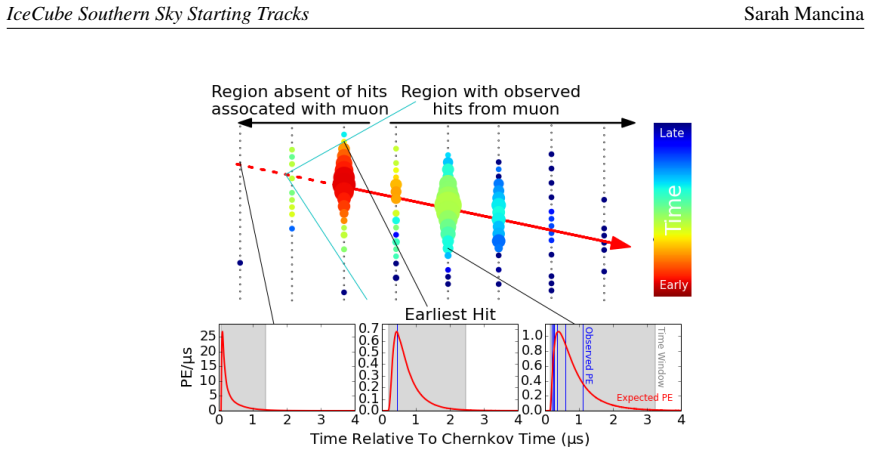
The load-bearing object is the event-specific veto region. Given a reconstructed muon track, DOMs within $350\,\mathrm{m}$ of the track are divided by a Cherenkov cone into a 'muon region' (hits consistent with the track timing) and a 'dark region' (where an incoming muon would have been expected to leave light). The track's average luminosity is scaled from the muon-region hits through a likelihood, and $p_{\mathrm{miss}}$ -- a product over dark-region DOMs of the log Poisson probability of observing zero photoelectrons -- is used to decide whether the event could be an entering muon. Because the detector's strings are spaced $125\,\mathrm{m}$ apart, the selection also tests 'alleyway' paths through the gaps, splits the best tracks into 131 segments for timing, and feeds the results into a boosted decision tree whose key variables are the position of the first reconstructed energy loss and the distance of the track start from the detector edge.
What would settle it
Rerun the selection with $p_{\mathrm{miss}}$ replaced by the actual Poisson probability of observing zero photoelectrons in the dark region, or by a proper log-likelihood, and compare the resulting event rates and purity with Table 1; if the quoted numbers change materially, the central claim is not robust.
Extended reading notes
Core claim
The central claim is that a neutrino-induced muon whose track starts inside IceCube can be separated from an entering atmospheric muon by using the track's good angular resolution to create, for each event, a veto region tailored to that event. Hits consistent with the reconstructed track define a 'muon region', while DOMs behind the Cherenkov cone that should have detected an entering muon define a 'dark region'; the quantity $p_{\mathrm{miss}}$ is meant to give the probability that the dark region stayed dark under the incoming-muon hypothesis. Combined with alleyway test tracks and a boosted decision tree, this suppresses atmospheric neutrinos in the $10$--$100\,\mathrm{TeV}$ range, giving an expected rate of less than one atmospheric muon per year and high astrophysical neutrino purity above $10\,\mathrm{TeV}$ for $\delta < -30^{\circ}$. The paper further shows pre-trial sensitivities competitive with through-going tracks in the southern sky and proposes a realtime stream that would send southern-sky starting-track alerts at energies of $10$--$200\,\mathrm{TeV}$.
Load-bearing premise
The selection depends on $p_{\mathrm{miss}}$ being a valid probability that an incoming muon would leave the dark region unlit; as written, $p_{\mathrm{miss}}$ is a product of log Poisson probabilities, which is not a probability and can be negative, so the $10^{-3}$ and $10^{-5}$ thresholds are ill-defined unless this is corrected.
Editorial extensions
If this is right
- In the southern sky, the starting-track sample gives point-source sensitivities that become competitive with through-going tracks at mid-TeV energies, especially for source spectra with index 2.5 or 3.
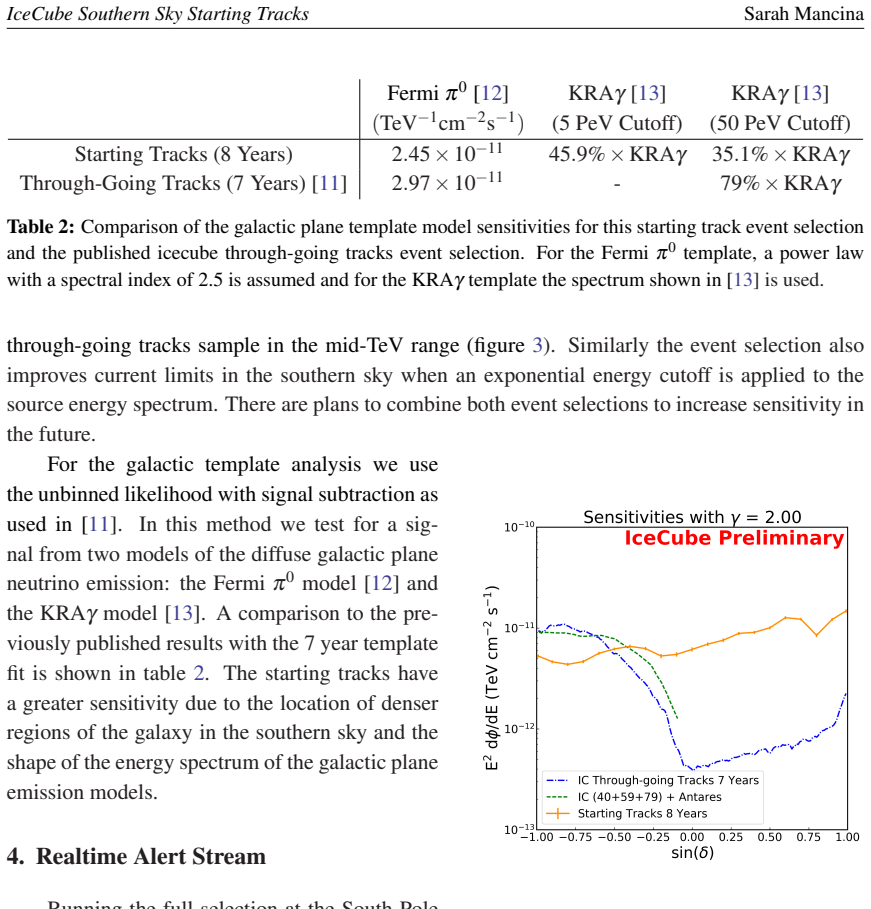
- The galactic plane template search with starting tracks reaches a sensitivity of $2.45\times10^{-11}\,\mathrm{TeV}^{-1}\mathrm{cm}^{-2}\mathrm{s}^{-1}$ for the Fermi $\pi^{0}$ template, improving on the previous result for the KRA$\gamma$ models.
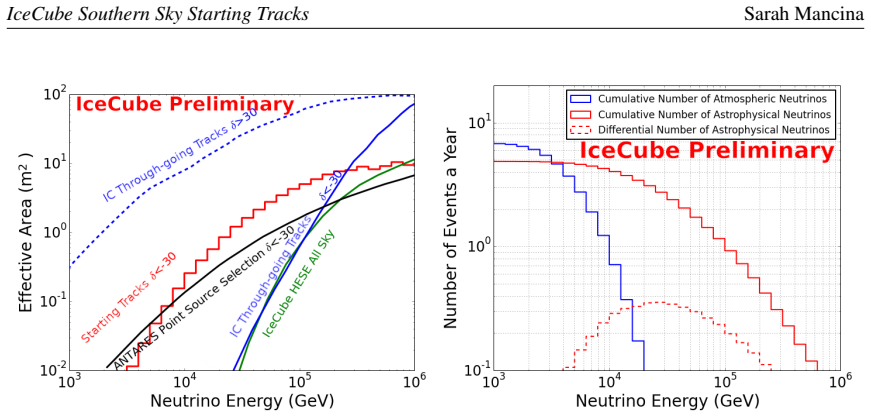
- A realtime starting-track alert stream would add roughly 5.5 astrophysical neutrinos per year with 50% or greater signalness in the 10--200 TeV range from the southern sky, a lower energy band than current alerts.
- The sample's neutrino energy resolution of $0.25$ in $\log_{10}(E_{\nu})$ is better than the through-going muon energy resolution because the starting cascade adds information.
- The starting-track and through-going selections can be combined to increase future sensitivity.
Reading between the lines
- Editorial inference: if the $p_{\mathrm{miss}}$ definition is corrected to a true probability, the event rates in Table 1 may shift, but the event-specific veto concept could still hold with retuned thresholds.
- Editorial inference: the same track-based veto idea could be transferred to other sparse neutrino detectors with kilometer-scale lattices, where a fixed outer veto wastes fiducial volume at low energies.
- Editorial inference: the strong suppression of atmospheric neutrinos at TeV energies should also sharpen measurements of the diffuse astrophysical spectrum and the galactic diffuse emission, since the self-veto matters most below 100 TeV.
- Editorial inference: the 16.8 triggers per day from the online stream imply that realtime latency and background rejection at the South Pole will need tight control if the stream is to yield prompt multimessenger alerts.
Signed reviews
Editorial analysis
A structured set of objections, weighed in public.
Referee Report
Summary. The paper presents a new IceCube event selection for southern-sky starting muon-neutrino tracks. The method defines an event-specific veto region around each reconstructed track, computes a quantity pmiss intended to be the probability that the dark-region DOMs saw zero charge under the hypothesis that the event is an incoming muon, and applies successive pmiss thresholds (10^-3, 10^-5) before a boosted decision tree. The authors report expected event rates, effective areas, and pre-trial point-source and galactic-plane sensitivities, and they propose a realtime alert stream for declinations δ ≤ -20° using a modified online selection. The central claimed result is a high-purity astrophysical neutrino sample in the southern sky above roughly 10 TeV, competitive with through-going tracks at mid-TeV energies.
Significance. The idea of using track morphology to build an event-by-event veto is a genuinely useful contribution, and the comparison with through-going tracks indicates a real improvement in southern-sky sensitivity at 1-100 TeV. The paper gives explicit, falsifiable predictions from simulation, and the proposed alert stream is of immediate multimessenger interest. However, the central selection is defined through Eq. (2.1), which is incorrect as written; until that is fixed, the quantitative claims in Table 1 and the sensitivities in Figs. 3 and 4 cannot be assessed reliably.
major comments (2)
- [Section 2.1, Eq. (2.1)] The quantity pmiss is defined as the product over dark-region DOMs of log(p(λ_i, k=0)). Since p(λ_i, 0) = e^{-λ_i}, each factor is -λ_i, so pmiss = (-1)^N ∏ λ_i, which is not a probability, is not bounded to [0,1], and changes sign with the number N of dark-region DOMs. The thresholds 10^-3 and 10^-5 used in Section 2.2 are therefore not meaningful as written; for example, one dark DOM with λ=5 gives pmiss = -5 and passes the cut, while two such DOMs give pmiss = +25 and fail. The surrounding sentence states the intended definition as a product of the probabilities ∏ p(λ_i, 0), so this is likely a typographical intrusion of 'log', but the equation must be corrected and the thresholds (and Table 1) re-derived from the corrected quantity before the selection is well-defined.
- [Section 2.2, Table 1] The abstract's headline claim of 'high astrophysical neutrino purity above 10 TeV at declinations less than -30°' is not directly supported by the numbers as presented. Table 1 lists 8 astrophysical versus 33 atmospheric neutrinos per year for δ ≤ -20° (plus 0.8 atmospheric muons), an integrated purity of about 20%; the energy-differential purity that would justify the headline claim is not shown. Please add a purity-versus-reconstructed-energy curve (or the equivalent) for the final selection, and state explicitly the declination and energy range to which the claim refers.
minor comments (6)
- [Throughout] There are repeated typographical errors that should be corrected, including 'Chernkov' (Cherenkov), 'Cummulative' (Cumulative), 'Therfore' (Therefore), and 'supression' (suppression).
- [Section 2.2] The sentence 'This event selection has the largest neutrino effective area at declinations of less that 30°' is unclear; it should presumably read 'declinations less than -30°' or 'δ < -30°'.
- [Section 2.2] The phrase 'pre-run track reconstruction' is unclear; it should likely read 'preliminary track reconstruction' or specify the reconstruction algorithm used for the first pmiss calculation.
- [Section 3, Table 2] The comparison in Table 2 uses 8 years for the starting-track selection and 7 years for the through-going-track selection; the livetime difference should be stated, and the sensitivities should be quoted in a way that makes the livetime scaling transparent.
- [Section 3] The sensitivities in Fig. 4 are pre-trial and no systematic uncertainties are included; this is acceptable for a proceedings contribution, but a sentence explicitly stating what is not included would help avoid overinterpretation.
- [Section 4] The sentence 'approximately 17.9 atmospheric neutrinos per year and 5.5 astrophysical neutrinos per year with 50% signalness or greater' is ambiguous: it should be clarified whether 5.5 is the number of astrophysical neutrinos passing the modified selection, or only those with signalness ≥ 50%.
Circularity Check
No significant circularity: the event selection is defined from an explicit veto probability and simulation, with the astrophysical flux used only as an external input.
full rationale
Circularity check: the paper's central object is an event selection, not a fitted model output. Section 2 defines pmiss from a Poisson expectation product (Eq. 2.1) and applies fixed thresholds (10^-3, 10^-5) before a boosted decision tree; no parameter of this chain is adjusted to reproduce the claimed purity or the Table 1 rates. The astrophysical flux from [5] enters only after the selection as an external empirical input for rate and signalness estimates (Table 1, Fig. 3, Section 4), and the comparisons to [8], [10], and [11] use published independent analyses. Citations to prior IceCube work are data and simulation anchors, not uniqueness theorems or unverified ansatzes; no load-bearing claim is justified solely by a self-citation. The concern raised about Eq. 2.1 (the log inside the product making pmiss not a probability) is a correctness or typography issue: if valid, it would undermine the selection thresholds, but it does not make the selection equivalent to its inputs, so it is outside the circularity definition. Hence no circular step is present; score 0.
Assumptions & free parameters
free parameters (3)
- Astrophysical neutrino flux normalization and index =
2.06e-18 (E/100 TeV)^-2.46 GeV^-1 cm^-2 s^-1 sr^-1
- pmiss cut thresholds =
10^-3 (early), 10^-5 (final)
- Veto and alleyway geometry parameters =
350 m, 300 m, 131 segments, 1625 fine tracks
assumptions (6)
- standard math Poisson model for DOM photon counts
- domain assumption Ice optical model predicts expected PE yields for minimum-ionizing muons
- domain assumption CORSIKA simulation with forced neutrino interactions models the atmospheric self-veto
- domain assumption Astrophysical flux from [5] describes the true signal
- domain assumption BDT trained on simulation generalizes to real data
- domain assumption Track reconstruction is accurate enough for event-specific veto regions
Cite this review
Pith. "Pith review of Neutrino source searches and a realtime neutrino alert stream in the southern sky with IceCube starting tracks." pith.science (2026). https://pith.science/paper/SL764TBM
@misc{pith2026190804869,
  author       = {Pith},
  title        = {Pith review of: Neutrino source searches and a realtime neutrino alert stream in the southern sky with IceCube starting tracks},
  year         = {2026},
  howpublished = {\url{https://pith.science/paper/SL764TBM}},
  note         = {Machine review of arXiv:1908.04869}
}
abstract
IceCube analyses which look for an astrophysical neutrino signal in the southern sky face a large background of atmospheric muons and neutrinos created by cosmic ray air showers. By selecting starting events in the southern sky, atmospheric muons and neutrinos with accompanying muons are rejected, producing a sample with high astrophysical neutrino purity at lower energies than northern sky samples. Our new selection method looks for muon tracks from a neutrino interaction with a vertex contained inside the detector volume by using the good pointing resolution of the track morphology to create an event specific veto region in the detector to reject entering tracks. This starting track event selection has a high astrophysical neutrino purity above 10 TeV at declinations less than -30$^{\circ}$ which makes it ideal for use as a southern sky realtime neutrino alert stream. We will discuss neutrino point source searches using this event selection and look at the advantages of the starting track alert stream for multimessenger astrophysics.
Figures

Figures from the paper (1 more)
Reference graph
Works this paper leans on
-
[5]
IceCube Collaboration, M. G. Aartsen et al., Phys. Rev. D91 (2015) 022001
work page 2015
-
[1]
IceCube Collaboration, M. G. Aartsen et al., Science 361 (2018) 147–151
2018
-
[2]
IceCube Collaboration, M. G. Aartsen et al., Phys. Rev. Lett. 115 (2015) 081102
2015
-
[3]
C. A. Argüelles, S. Palomares-Ruiz, A. Schneider, L. Wille, and T. Yuan, JCAP 1807 (2018) 047
2018
-
[4]
IceCube Collaboration, M. G. Aartsen et al., Science 342 (2013) 1242856
2013
-
[6]
IceCube Collaboration, PoS(ICRC2019)1010 (these proceedings)
-
[7]
D. Heck, J. Knapp, J. N. Capdevielle, G. Schatz, and T. Thouw
-
[8]
IceCube Collaboration, M. G. Aartsen et al., Astrophys. J. 835 (2017) 151
2017
Show all 14 references
-
[9]
Abbasi et al., Nucl
IceCube Collaboration, R. Abbasi et al., Nucl. Instrum. Meth. A703 (2013) 190–198
2013
-
[10]
Adrian-Martinez et al., Astrophys
ANTARES, IceCube Collaboration, S. Adrian-Martinez et al., Astrophys. J. 823 (2016) 65
2016
-
[11]
IceCube Collaboration, M. G. Aartsen et al., Astrophys. J. 849 (2017) 67
2017
-
[12]
Ackermann et al., Astrophys
Fermi-LA TCollaboration, M. Ackermann et al., Astrophys. J. 750 (2012) 3
2012
-
[13]
Gaggero, D
D. Gaggero, D. Grasso, A. Marinelli, A. Urbano, and M. Valli, Astrophys. J. 815 (2015) L25
2015
-
[14]
IceCube Collaboration, M. G. Aartsen et al., Astropart. Phys. 92 (2017) 30–41. 8
2017
Reviewed August 14, 2026 · model on record in the stance chip above.
Discussion (0). Continue with ORCID to comment.