REVIEW 3 major objections 5 minor 1 cited by
NuSTAR and XMM-Newton observations of SXP 59 during its 2017 giant outburst
T0 review · 3 major / 5 minor · reviewed 2026-08-14 · deepseek-v4-flash
Pith's one-line read The 2017 giant outburst of the Be X-ray pulsar SXP 59 revealed a hot blackbody component near the neutron star that standard accretion-column models cannot explain.
desk verdict A solid NuSTAR/XMM-Newton study of SXP 59, but the headline claim—a constant hot blackbody size challenging accretion theory—rests on an epoch whose normalization is effectively unconstrained. read the letter →
The pith
A machine-rendered reading of the paper's core claim, the machinery that carries it, and where it could break.
The reading
What carries the argument
The load-bearing element is the hot blackbody component added to the cut-off power-law continuum in the X-ray spectral fit: a thermal component with temperature $kT \sim 1.5$--$4$ keV whose normalization remains roughly constant, giving an inferred radius $R \sim 0.6$ km that barely changes as the luminosity drops by more than an order of magnitude. That constancy, combined with the beam-geometry picture in which super-critical accretion produces a fan beam and sub-critical accretion a pencil beam, is what makes the component physically puzzling and carries the argument that standard dipole accretion-column models are incomplete.
What would settle it
A future broad-band outburst observation of SXP 59 in which the same data are fitted with several independent physical Comptonization continua and the hot-blackbody normalization changes by more than a factor of three, or the component is no longer required at the same confidence, would falsify the claim that a constant ~0.6 km blackbody persists across luminosity states.
Extended reading notes
Core claim
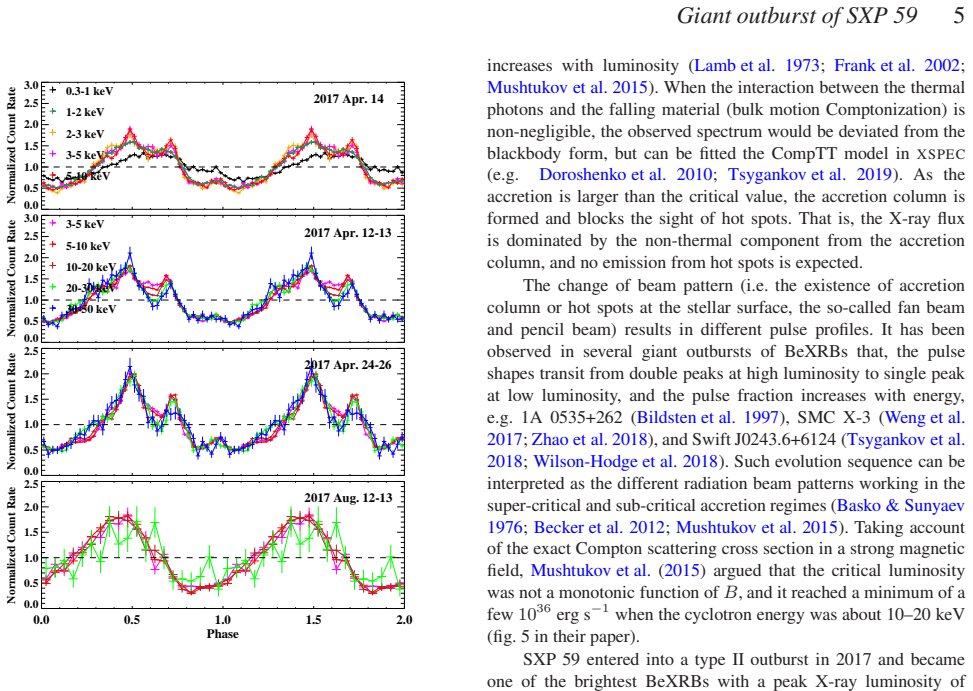
In three NuSTAR observations sampling the outburst peak, decay, and low-luminosity states, the 3--79 keV spectrum is best described by a non-thermal cut-off power law, an iron emission line at high states, and a hot blackbody component. The blackbody temperature drops from about 4.1 keV to 1.7 keV as the luminosity falls, while its normalization stays near $10^{-2}$, corresponding to an emission radius of about 0.6 km, much smaller than the neutron star radius. The paper states that such a component is not predicted by current accretion theories for luminous Be X-ray pulsars, because in the high-luminosity regime the accretion column should hide stellar hot spots; therefore either the spectral models need to be more physical or the magnetic field deviates from a dipole close to the neutron star surface. The paper also confirms the soft excess below 2 keV as a cool blackbody plus hot thermal plasma, reports pulse fractions that rise with energy and saturate near 65% above 10 keV, and interprets the double-peaked to single-peaked pulse-profile change as a super-critical to sub-critical transition.
Load-bearing premise
The hot blackbody is a real, separate emission region rather than an artifact of the chosen cut-off power-law continuum; the authors test alternative continua, but those change its inferred size by up to a factor of three and cannot prove the component is physical.
Editorial extensions
If this is right
- Spectral models of luminous Be X-ray pulsars will need to include a compact thermal component or replace the cut-off power law with a continuum that naturally produces the same feature.
- For SXP 59 the critical luminosity is bracketed between about $3\times10^{36}$ and $6\times10^{37}$ erg s$^{-1}$, consistent with a typical neutron-star magnetic field of $10^{12}$--$10^{13}$ G if the beam-transition interpretation is correct.
- The pulse fraction that rises with energy and saturates near 65% above 10 keV becomes a diagnostic of beam geometry in future outbursts of SXP 59.
- Similar compact hot blackbodies seen in other luminous X-ray pulsars would form a class of objects that all point to the same missing physics in current accretion-column models.
Reading between the lines
- A testable extension would be phase-resolved spectroscopy during a future outburst: if the hot blackbody flux modulates with the pulse phase, it is tied to the polar-cap region, while a phase-independent component would favour an extended or scattered origin.
- The constant 0.6 km radius could locate the component at the base of the accretion column rather than on the stellar surface, which would make the tension with dipole models less severe and could be checked by tracking radius and temperature jointly over a full outburst.
- If the magnetic field is genuinely non-dipole near the neutron star, cyclotron absorption searches might fail at high luminosity even with a typical surface field, because the field strength seen by the emitting region would vary with position; mapping any cyclotron feature across pulse phase would test this.
Signed reviews
Editorial analysis
A structured set of objections, weighed in public.
Referee Report
Summary. This paper analyzes XMM-Newton and NuSTAR observations of the Be X-ray pulsar SXP 59 during its 2017 giant outburst, covering the peak, decay, and low-luminosity epochs. The authors find that the pulse profile changes from double-peaked at high luminosity to single-peaked at low luminosity, which they interpret as a transition from the super-critical (fan-beam) to sub-critical (pencil-beam) accretion regime. The X-ray continuum is modeled with a cut-off power law plus a hot blackbody and an iron line, while the soft excess is modeled with a cool blackbody and an APEC plasma. The paper's headline physical claim is that the hot blackbody component has a roughly constant emitting radius of about 0.6 km while its temperature declines, and that this behavior cannot be explained by standard dipole accretion column theories.
Significance. The paper provides a useful multi-epoch data set for a relatively poorly studied SMC BeXRP and performs a careful empirical spectral decomposition with standard tools, including checks of alternative continuum models (NPEX, FDCut, highecut, CompTT) and 90% confidence errors. The pulse-fraction energy dependence and the qualitative double-to-single pulse profile change are interesting and consistent with the super-/sub-critical transition picture. However, the most striking conclusion---that the hot blackbody size is constant and therefore challenges canonical accretion theory---is not supported by the reported uncertainties, because the decisive low-luminosity epoch has a normalization consistent with a large variation. The paper's value as an observational contribution is solid, but the theoretical inference needs to be reframed or quantitatively defended.
major comments (3)
- [§2.4, Table 2, Figure 4] The claim that the hot blackbody size remains constant is not established by the data. For the last NuSTAR epoch (2017 Aug 12-13), Norm_BB_high = 10.1^{+21.6}_{-7.1} x 10^-3, so the 90% confidence interval extends down to about 3.0 x 10^-3, a factor of roughly 3 below the values at the two high-luminosity epochs (10.1 and 9.7 x 10^-3). Because the bbodyrad radius scales as the square root of the normalization, the data are consistent with a radius smaller by about a factor of 1.7, and the full 90% range corresponds to radii between roughly 0.34 km and 1.1 km. The data are therefore nearly uninformative about whether the size is constant. The statement in Section 2.4 result (III) and the theoretical tension in Section 3 should be either supported by a formal confidence interval on the normalization ratio (including cross-calibration systematics) or substantially softened.
- [§2.2] The evidence for a physically distinct hot blackbody component rests on the improvement over a cut-off power law, but the paper does not report quantitative results for the alternative continuum models mentioned in the text. Since the final claim---that standard accretion column models cannot explain the hot blackbody---depends on this component surviving plausible continuum choices, please provide a table or explicit Delta-chi-squared values and required blackbody significances for NPEX, FDCut, highecut, and CompTT, and show how the inferred radius varies among them. The current statement that the size 'could vary by a factor of <3' is too vague to be load-bearing.
- [§2.4, §3] The super-critical to sub-critical transition is inferred from the morphology of only four pulse profiles, double-peaked at high luminosity and single-peaked at low luminosity. The paper's own statement in Section 3 that it is difficult to constrain the geometry with the limited data should be reflected in the abstract and conclusions. Please either add a quantitative comparison of the profiles (e.g., a statistical measure of peak structure or a fit with a beam model) or downgrade the transition claim from a result to a tentative suggestion.
minor comments (5)
- [§1] The abbreviation 'HXMBs' should be 'HMXBs' (high-mass X-ray binaries).
- [Table 1] The epoch for the 2017 Apr 24-26 NuSTAR observation appears to be misprinted as 5.786930; it should likely be about 17.786930 (MJD-57850).
- [Table 2] Please define the units of Norm_low_BB and state explicitly that Norm_high_BB is the XSPEC bbodyrad normalization, since the conversion to radius assumes this convention.
- [Figure 4] A logarithmic scale for Norm_BB_high would better display the large asymmetric error bar of the last epoch and avoid visually suggesting constancy despite the wide 90% range.
- [§3] The source name 'Swift J2043.6+6124' appears to be a typo for Swift J0243.6+6124, which is the source discussed in the rest of the text.
Circularity Check
No circular derivation: spectral fits are empirical, the critical-luminosity comparison is external, and self-citations are comparative only.
full rationale
The paper's central chain is observational: fit XMM-Newton and NuSTAR spectra with empirical multicomponent models, extract pulse profiles, then interpret the results using external accretion theory. The hot blackbody component is a fitted spectral constituent, not a quantity derived from the theory it is later compared with. Its temperature and normalization are free parameters determined by the data, so the claim that its size appears constant is an empirical statement, not a prediction generated from the same model. The theoretical expectation that the hot spot shrinks by a factor of about 3 during decay is attributed to Mushtukov et al. (2015) and standard accretion ideas (Lamb et al. 1973; Frank et al. 2002), which are external to this paper. The critical luminosity versus magnetic-field relation is likewise taken from Mushtukov et al. (2015), and the paper uses it only to bracket L_crit and infer a typical field strength; it does not fit that relation to the present data. Self-citations to Weng et al. (2017) and Zhao et al. (2018) appear as comparative examples of pulse-profile transitions in SMC X-3, but the paper's own pulse profiles carry that point, so those citations are not load-bearing. The skeptical concern that the low-luminosity normalization is poorly constrained (Norm_BB_high = 10.1^{+21.6}_{-7.1} x 10^{-3}) is a statistical robustness critique of an empirical result, not an instance of circular reasoning. No equation or fitted parameter is renamed as a prediction, and no claim is justified solely by a self-citation. The derivation is therefore self-contained against external benchmarks, and no significant circularity is present.
Assumptions & free parameters
free parameters (7)
- Hot blackbody temperature kT_high_BB =
1.66 to 4.09 keV
- Hot blackbody normalization Norm_high_BB =
9.5 to 10.1 x 10^-3
- Power-law photon index Gamma =
0.78 to 1.11
- Cutoff energy Ecut =
11.7 to 31.0 keV
- Absorption column nH =
0.10 x 10^22 cm^-2 (fixed for NuSTAR fits)
- Cool blackbody temperature kT_low_BB =
0.19 keV
- Iron line parameters =
E=6.30 keV, sigma=0.33 keV
assumptions (4)
- domain assumption Distance to the SMC is 62.1 kpc
- domain assumption The critical luminosity of accretion column formation depends on magnetic field as calculated by Mushtukov et al. (2015)
- domain assumption The cutoff power-law plus blackbody decomposition of the hard X-ray continuum is physically meaningful
- domain assumption Pulse profile shape changes track the accretion beam pattern (fan beam versus pencil beam)
Cite this review
Pith. "Pith review of NuSTAR and XMM-Newton observations of SXP 59 during its 2017 giant outburst." pith.science (2026). https://pith.science/paper/4R5QEXVG
@misc{pith2026190804908,
  author       = {Pith},
  title        = {Pith review of: NuSTAR and XMM-Newton observations of SXP 59 during its 2017 giant outburst},
  year         = {2026},
  howpublished = {\url{https://pith.science/paper/4R5QEXVG}},
  note         = {Machine review of arXiv:1908.04908}
}
abstract
The Be X-ray pulsar (BeXRP) SXP 59 underwent a giant outburst in 2017 with a peak X-ray luminosity of $1.1\times10^{38}$ erg~s$^{-1}$. We report on the X-ray behaviour of SXP 59 with the XMM--Newton and NuSTAR observations collected at the outburst peak, decay, and the low luminosity states. The pulse profiles are energy dependent, the pulse fraction increases with the photon energy and saturates at $\sim$ 65% above 10 keV. It is difficult to constrain the change in the geometry of emitting region with the limited data. Nevertheless, because the pulse shape generally has a double-peaked profile at high luminosity and a single peak profile at low luminosity, we prefer the scenario that the source transited from the super-critical state to the sub-critical regime. This result would further imply that the neutron star (NS) in SXP 59 has a typical magnetic field. We confirm that the soft excess revealed below 2 keV is dominated by a cool thermal component. On the other hand, the NuSTAR spectra can be described as a combination of the non-thermal component from the accretion column, a hot blackbody emission, and an iron emission line. The temperature of the hot thermal component decreases with time, while its size remains constant ($R \sim 0.6$ km). The existence of the hot blackbody at high luminosity cannot be explained with the present accretion theories for BeXRPs. It means that either more sophisticated spectral models are required to describe the X-ray spectra of luminous BeXRPs, or there is non-dipole magnetic field close to the NS surface.
Figures


Figures from the paper (3 more)


Forward citations
Cited by 1 Pith paper
-
X-Ray Views of Galactic Accreting Pulsars in High-Mass X-Ray Binaries
A concise review of the timing, spectral, and polarization properties of accreting X-ray pulsars in high-mass X-ray binaries, including recent IXPE results.
Reference graph
Works this paper leans on
-
[1]
Arnaud, K. A. 1996, in Jacoby, G. H., Barnes, J., eds, ASP Conf . Ser. 101, Astronomical Data Analysis Software and Systems V . Astron. Soc. Pac., San Francisco, p. 17
work page 1996
-
[2]
M., & Sunyaev, R
Basko, M. M., & Sunyaev, R. A. 1976, MNRAS, 175, 395
1976
-
[3]
Becker, P . A. et al. 2012, A&A , 544, A123
work page 2012
-
[4]
Bildsten, L. et al. 1997, ApJS, 113, 367
work page 1997
-
[5]
Bird, A. J., Coe, M. J., McBride, V . A., & Udalski, A. 2012, MNR AS, 423, 3663
work page 2012
-
[6]
Coburn, W. et al. 2002, ApJ, 580, 394
work page 2002
-
[7]
Coe, M. J., & Kirk, J. 2015, MNRAS, 452, 969 D’A` ı, A. et al. 2015, MNRAS, 449, 4288
work page 2015
-
[8]
Piraino, S. 2015, MNRAS, 452, 2490 Doroshenko V ., Santangelo A., Suleimanov V ., Kreykenbohm I ., Staubert R., Ferrigno C., Klochkov D., 2010, A&A, 515, A10
work page 2015
Show all 46 references
-
[9]
2018, A&A, 613, A19 Fishman G
Doroshenko, V ., Tsygankov, S., & Santangelo, A. 2018, A&A, 613, A19 Fishman G. J., Kouveliotou C., van Paradijs J., Harmon B. A., Paciesas W. S., Briggs M. S., Kommers J., Lewin W. H. G., 1995, IAU Circ., 6 272
2018
-
[10]
Frank, J., King, A., & Raine, D. J. 2002, Accretion Power in As trophysics, Cambridge University Press, Cambridge, p. 398
2002
-
[11]
E., Lochner, J
Markwardt, C., Marhshall, F. E., Lochner, J. 2008, ApJS, 177 , 189
2008
-
[12]
Graczyk, D. et al. 2014, ApJ, 780, 59
2014
-
[13]
2016, A&A, 586, A81
Haberl, F., & Sturm, R. 2016, A&A, 586, A81
2016
-
[14]
2004, AJ, 127, 1531
Harris, J., & Zaritsky, D. 2004, AJ, 127, 1531
2004
-
[15]
Harrison, F. A. et al. 2013, ApJ, 770, 103
2013
-
[16]
C., Narayan, R., & Kallman, T
Hickox, R. C., Narayan, R., & Kallman, T. R. 2004, ApJ, 614, 88 1
2004
-
[17]
W., Howarth, I
Hilditch, R. W., Howarth, I. D., & Harries, T. J. 2005, MNRAS, 357, 304
2005
-
[18]
B., Edwards, R
Hobbs, G. B., Edwards, R. T. & M anchester, R. N, 2006, MNRAS, 3 69, 655 ˙
2006
-
[19]
C ¸ ., Baykal, A., Swank, J., & Stark, M
Inam, S. C ¸ ., Baykal, A., Swank, J., & Stark, M. J. 2004, ApJ, 616, 463
2004
-
[20]
Kaaret, P ., Feng, H., & Roberts, T. P . 2017, ARA&A, 55, 303
2017
-
[21]
D., & Haberl, F
Kahabka, P ., Pietsch, W., Filipovi´ c , M. D., & Haberl, F. 1999, A&AS, 136, 81
1999
-
[22]
A., Evans, P
Kennea, J. A., Evans, P . A., & Coe, M. J. 2017, Astron. Telegra m, 10250
2017
-
[23]
A., Coe, M
Kennea, J. A., Coe, M. J., Evans, P . A., Waters, J., & Jasko, R. E. 2018, ApJ, 868, 47
2018
-
[24]
1995, ApJ , 450, 763
Kraus, U., Nollert, H.-P ., Ruder, H., & Riffert, H. 1995, ApJ , 450, 763
1995
-
[25]
K., Pethick, C
Lamb, F. K., Pethick, C. J., & Pines, D. 1973, ApJ, 184, 271 La Palombara, N., Esposito, P ., Pintore, F., et al. 2018, A&A, 619, A126 La Palombara, N., Sidoli, L., Esposito, P ., Tiengo, A., & Mer eghetti, S. 2009, A&A, 505, 947
1973
-
[26]
Z., van Paradijs, J., & van den Heuvel, E
Liu, Q. Z., van Paradijs, J., & van den Heuvel, E. P . J. 2005, A& A, 442, 1135
2005
-
[27]
Z., van Paradijs, J., & van den Heuvel, E
Liu, Q. Z., van Paradijs, J., & van den Heuvel, E. P . J. 2006, A& A, 455, 1165
2006
-
[28]
E., Lochner, J
Marshall, F. E., Lochner, J. C., Santangelo, A., et al. 1998, IAUC, 6818, 1
1998
-
[29]
1998, Adv
Mihara, T., Makishima, K., & Nagase, F. 1998, Adv. Space Res. , 22, 987
1998
-
[30]
2005, A&A, 431, 667
Mukherjee, U., & Paul, B. 2005, A&A, 431, 667
2005
-
[31]
A., Suleimanov, V
Mushtukov, A. A., Suleimanov, V . F., Tsygankov, S. S., & Pout anen, J. 2015, MNRAS, 447, 1847
2015
-
[32]
A., Larchenkova, T
Lutovinov, A. A., Larchenkova, T. I., 2018, MNRAS, 474, 5425
2018
-
[33]
F., Charles, P
Rajoelimanana, A. F., Charles, P . A., & Udalski, A. 2011, MNR AS, 413, 1600
2011
-
[34]
J., 1999, MNRAS, 302, 700
Reig, P ., 2011, Ap&SS, 332, 1 Reig P ., Coe M. J., 1999, MNRAS, 302, 700
2011
-
[35]
1988, ApJ, 325, 207
Riffert, H., & Meszaros, P . 1988, ApJ, 325, 207
1988
-
[36]
R., 2016, ApJ, 816, 49
Rich, J., Seibert, M., Rigby, J. R., 2016, ApJ, 816, 49
2016
-
[37]
Sturm, R. et al. 2013, A&A, 558, A3
2013
-
[38]
1986, in Mihalas D., Karl-Heinz, A
Tanaka, Y . 1986, in Mihalas D., Karl-Heinz, A. W., eds, IAU Co lloq. 89: Radiation Hydrodynamics in Stars and Compact Objects, Spri nger- V erlag, Berlin, 198
1986
-
[39]
Tao, L., Feng, H., Zhang, S.-N., Bu, Q.-C., Zhang, S., Qu, J.- L., Zhang, Y ., 2019, ApJ, 873, 19
2019
-
[40]
2018, MNRAS, 479, L134
Poutanen, J. 2018, MNRAS, 479, L134
2018
-
[41]
2017, ApJ, 843, 69
Weng, S.-S., Ge, M.-Y ., Zhao, H.-H., Wang, W., Zhang, S.-N.,Bian, W.-H., & Y uan, Q.-R. 2017, ApJ, 843, 69
2017
-
[42]
F., Wolfram, K
West, B. F., Wolfram, K. D., & Becker, P . A. 2017, ApJ, 835, 130
2017
-
[43]
Willingale, R., Starling, R. L. C., Beardmore, A. P ., Tanvir , N. R., & O’Brien, P . T. 2013, MNRAS, 431, 394
2013
-
[44]
Wilson-Hodge, C. A. et al. 2018, ApJ, 863, 9 Y ang, J., Laycock, S. G. T., Christodoulou, D. M., Fingerman , S., Coe, M. J., Drake, J. J., 2017, ApJ, 839, 119 Y oshida, Y ., Kitamoto, S., Suzuki, H., Hoshino, A., Naik, S. , Jaisawal, G. K., 2017, ApJ, 838, 30
2018
-
[45]
B., Grebel, E
Zaritsky, D., Harris, J., Thompson, I. B., Grebel, E. K., & Ma ssey, P . 2002, AJ, 123, 855
2002
-
[46]
2018, Ap&SS, 363, 21 MNRAS 000, 000–000 (0000)
Zhao, H.-H., Weng, S.-S., Ge, M.-Y ., Bian, W.-H., & Y uan, Q.- R. 2018, Ap&SS, 363, 21 MNRAS 000, 000–000 (0000)
2018
Reviewed August 14, 2026 · model on record in the stance chip above.
Discussion (0). Continue with ORCID to comment.