REVIEW 2 major objections 6 minor 34 references
Re-Pair In Small Space
T0 review · 2 major / 6 minor · reviewed 2026-08-14 · deepseek-v4-flash
Pith's one-line read Re-Pair grammar compression is computable in quadratic time in text-sized working space, including the text itself.
desk verdict Valuable small-space Re-Pair algorithm with a real, fixable bug in the main frequency-counting lemma; deserves serious review. read the letter →
The pith
A machine-rendered reading of the paper's core claim, the machinery that carries it, and where it could break.
The reading
What carries the argument
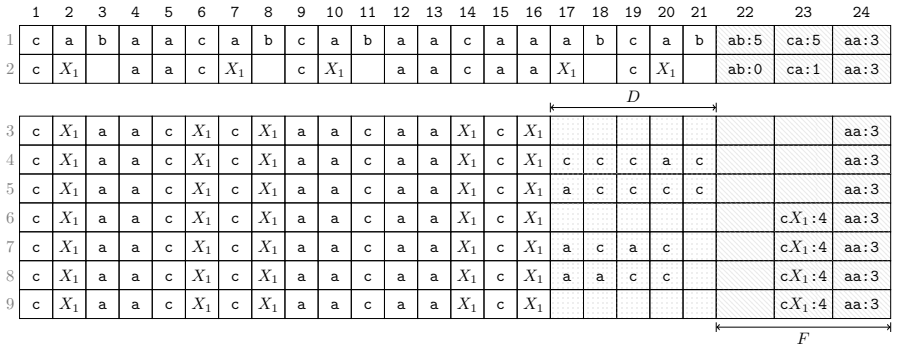
The load-bearing object is a growing frequency table $F$, physically stored in the text space freed by replacing bigrams with single non-terminals, together with a threshold $t$ fixed at each round as $F$'s lowest stored frequency. Lemma 2.2 is the trade-off subroutine: to find the $d$ most frequent bigrams it splits the text into overlapping blocks of length $d$, builds a candidate table per block, counts candidates by scanning the text with binary search, and merges partial tables, costing $O(\max(n,d)\, n \lg d / d)$ time in $2d\lceil\lg(\sigma^2 n/2)\rceil$ bits. $F$'s rounds grow its capacity $f_k$ by a constant factor $\gamma > 1$, so only $O(\lg n)$ recomputations are needed, and each turn's update rule—decrement frequencies adjacent to replaced occurrences, add bigrams that newly contain the non-terminal, drop entries below $t$—keeps $F$ synchronized with the text.
What would settle it
Run the algorithm on a unary text $a^{2k}$ with the trade-off parameter $d=1$: Lemma 2.2's left-to-right scan reports $2k-1$ occurrences of the bigram $aa$, whereas Re-Pair's definition of frequency demands $k$ non-overlapping occurrences. Comparing the frequency stored in $F$ against a direct run-aware count on this input settles whether the subroutine is correct.
Extended reading notes
Core claim
The paper's central claim is that Re-Pair can be driven by a frequency table $F$ that is stored in the space freed up by the very replacements it guides. At the start of round $k$ the table holds $f_k$ bigrams and a threshold $t$, the table's lowest frequency; as long as $F$ is non-empty after a turn, it still contains a most frequent bigram, so the next turn can simply take the highest-frequency entry. Only when $F$ empties is it rebuilt, with capacity multiplied by a factor $\gamma > 1$; because $\gamma$ is bounded away from 1, only $O(\lg n)$ rebuilds occur, and each rebuild uses a trade-off subroutine (Lemma 2.2) that partitions the text into overlapping blocks and counts the $d$ most frequent bigrams in $O(\max(n,d)\, n \lg d / d)$ time with $2d\lceil\lg(\sigma^2 n/2)\rceil$ bits. The result is Theorem 2.3's $O(n^2)$ time and text-sized working space, with variants for bit-parallel counting, parallelism, external memory, and MR-Re-Pair.
Load-bearing premise
Lemma 2.2's proof assumes that a single left-to-right scan that finds each scanned bigram in a candidate table and increments its counter yields the non-overlapping frequency Re-Pair needs; on a run of $L$ equal characters that scan records $L-1$ occurrences of the repeated bigram, while only $\lfloor L/2 \rfloor$ non-overlapping copies exist. Since every round's table is seeded by this subroutine, the main theorem inherits that assumption.
Editorial extensions
If this is right
- Re-Pair becomes computable in text-sized working memory plus $O(\lg n)$ bits, so large-scale grammar compression no longer requires frequency tables that dwarf the input.
- The restore model guarantees the original text can be recovered in the time of the whole computation with only $O(\lg n)$ extra bits, so overwriting the input is safe.
- For integer alphabets with $\sigma = \Omega(n)$, this is the first non-trivial in-place Re-Pair algorithm; earlier space-efficient Re-Pair algorithms assumed a constant alphabet.
- The same frequency-table skeleton gives a parallel CRCW variant running in $O(n^2/p)$ time with $O(p\lg n)$ extra bits and an external-memory variant whose I/O cost is bounded by scans and sorting instead of a large heap.
- When the terminal-plus-nonterminal alphabet $\tau$ satisfies $\tau = o(n)$, bit-parallel broadword search lowers the time to $O(n^2 \lg \log_\tau n \lg \lg \lg n / \log_\tau n)$ in the same space.
Reading between the lines
- The round-growth pattern is a general recipe: any compressor whose bottleneck is a candidate or frequency table could grow that table inside the space its own output frees up, using a threshold to avoid frequent rebuilds.
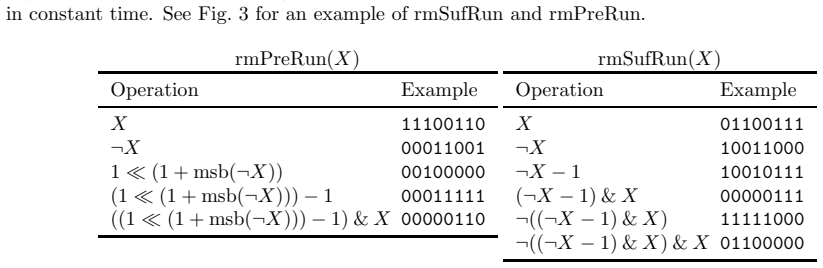
- The broadword bigram-counting primitive of Section 3 is reusable on its own for other small-space string algorithms that need bigram frequencies under tight memory.
- A natural extension is to make the Lemma 2.2 scan run-aware for repeated bigrams, counting $\lfloor L/2 \rfloor$ inside a run of $L$ equal characters instead of $L-1$ occurrences; such a count would match Re-Pair's non-overlapping definition directly and should preserve the time bound.
- The practical bottleneck is the early rounds with tiny $f_k$; combining the paper's heuristics (majority vote when one bigram dominates, temporary full table for small alphabets) into an adaptive start could make the $O(n^2)$ worst case rare on real corpora.
Signed reviews
Editorial analysis
A structured set of objections, weighed in public.
Referee Report
Summary. The paper proposes an algorithm that computes the Re-Pair grammar compression for a text of length n over an integer alphabet in O(n^2) time using max((n/c) lg n, n⌈lg σ_m⌉)+O(lg n) bits of working space including the text space, working in the restore model. The central tool is a trade-off lemma (Lemma 2.2) that computes the d most frequent bigrams in O(max(n,d) n lg d / d) time and 2d⌈lg(σ^2 n/2)⌉+O(lg n) bits, which is invoked O(lg n) times in the main sequential algorithm. The paper also gives a bit-parallel variant (Theorem 3.1), a parallel variant (Theorem 5.3), an external-memory variant (Theorem 6.1), an adaptation to MR-Re-Pair (Section 4), and a C++ implementation (Section 2.5).
Significance. If the main theorem is correct, this is the first non-trivial in-place Re-Pair algorithm for large integer alphabets, and the same framework extends to parallel and external-memory settings, which would be a meaningful contribution. The paper also includes an implementation and practical heuristics, and the bit-parallel section (Section 3.1) correctly handles the delicate case of repeated-character bigrams by using runs and parity of ending positions. However, the central Lemma 2.2, on which Theorems 2.3, 3.1, 5.3, and 6.1 all rely, counts overlapping occurrences rather than the non-overlapping frequencies required by the paper's own definition of Re-Pair, so the main correctness claim is not established as written.
major comments (2)
- [Section 2.3, capacity of F] The proof of Lemma 2.2 computes frequencies by scanning the text from left to right and incrementing a counter for every position whose bigram appears in F'. For a run of L identical characters, this counts L−1 occurrences of the repeated bigram, whereas the paper defines the frequency of a bigram as its number of non-overlapping occurrences (Section 1.2), which is floor(L/2). This is not a cosmetic discrepancy: for T = aaaaabcbcbcb, the scan reports aa with count 4 and bc with count 3, so with d = 1 it selects aa as the most frequent bigram, while the non-overlapping frequencies are aa = 2 and bc = 3, making bc the correct choice. Since Theorem 2.3 invokes Lemma 2.2 O(lg n) times and every replacement decision in the main loop is based on the resulting table F, the algorithm can diverge from the Re-Pair replacement rule from the first turn. The paper itself describes the correct treatment in Section 3.1 (Case b = c), counting runs via even/odd ending positions; that technique can be ported to Lemma 2.2 by skipping to the end of each run and adding floor(L/2), while preserving the O(n lg d) per-scan time. As written, however, the proof of Lemma 2.2 does not implement this, so the central theorem is not established. I consider this a load-bearing correctness issue that must be resolved in a revision.
- [Section 2.3, capacity of F] The proof of Theorem 2.3 does not rigorously establish that the freed text space at the beginning of each round is large enough to store the frequency table F together with the working space of Lemma 2.2. The text says 'suppose that we have enough space available for storing the frequencies of α f_k bigrams' and then gives a growth calculation using constants α and β, but it never proves by induction that the space actually freed by previous replacements reaches this size. Since the claimed space bound (max((n/c) lg n, n⌈lg σ_m⌉) + O(lg n) bits including the text) is a central contribution, the authors should supply an explicit invariant that relates the number of freed characters, the bit width ⌈lg σ_{i+1}⌉, and the capacity α f_k, and verify it for large alphabets (σ = Ω(n)), where Lemma 2.2's frequency table has entries of size Θ(lg n) bits. Without such an invariant, the in-place space claim is not fully supported.
minor comments (6)
- [Section 2.1, proof of Lemma 2.2] The extended substring S_j has length d+2 and can contain up to d+1 distinct bigrams, while the frequency table F' has only d entries; the proof's statement that 'there are at most d different bigrams in S_j' is false in general. Increase F' to d+1 entries or note that constants absorb the extra slot.
- [Section 2.1, Lemma 2.2] The time bound O(max(n,d) n lg d / d) is undefined for d = 1 because lg 1 = 0. Either state the result for d ≥ 2 and handle d = 1 separately with an O(n^2) bound, or adjust the formula.
- [Section 2.3, Eq. (1)] The summation notation with O(lg n) as the upper limit is informal; replacing it with an explicit bound such as sum_{k=0}^{C lg n} for a constant C would make the time analysis more precise.
- [Section 3.1, Case b = c] The handling of runs that cross chunk borders is described only in prose; a formal statement of how the run lengths are accumulated and how the even/odd parity is applied across chunk boundaries would improve reproducibility.
- [Section 2.5, implementation] The implementation fixes the bit width of the text space to 16 bits and assumes a byte alphabet, so the reported experiments do not exercise the bit-width enlargement step that is central to the in-place space claim of Theorem 2.3. This simplification should be stated more prominently.
- [Abstract] The notation O(n^2) ∩ O(n^2 lg log_τ n lg lg lg n / log_τ n) is unconventional; since the second term is never larger than the first, describing the bound as O(n^2) with the refinement given in Theorem 3.1 would be clearer.
Circularity Check
No significant circularity; central Re-Pair derivation is self-contained, though Lemma 2.2 has a correctness issue with overlapping equal-character bigrams.
full rationale
The paper's central claim (Theorem 2.3) is derived from Lemma 2.2, a frequency-table construction over text partitions, plus an invariant-maintenance argument for the table F and a growth analysis (Eq. 1). None of these steps fits parameters to data or assumes the theorem it is trying to prove. The threshold t, capacities f_k, and constants alpha, beta, and gamma are introduced as analytic quantities and bounded inside the proof, not tuned from empirical observations; benchmarks in Section 2.5 are illustrative and not used as inputs to the algorithm. Self-citations ([13], [16], [27]) appear in related-work discussion and in the MR-Re-Pair adaptation; they are not load-bearing for the main sequential, parallel, or external-memory Re-Pair theorems. In particular, [13] is used only to argue the optional MR-Re-Pair adaptation, and even there the paper gives an algorithmic construction (extending occurrences) rather than importing the claimed result. The major caveat is Lemma 2.2's proof: it says frequencies are computed 'by scanning the text from left to right' and locating each scanned bigram, which counts overlapping occurrences; Section 1.2 defines frequency as non-overlapping. For a run of equal characters this can select a different most frequent bigram than the Re-Pair definition. That is a correctness gap in the derivation, not circularity, because the false step does not make the output equivalent to the input by construction. Overall, no circular step was found; the derivation is self-contained relative to its stated (though partly buggy) assumptions.
Assumptions & free parameters
assumptions (4)
- standard math Word RAM model with word size Ω(lg n) and restore model
- domain assumption Text can be enlarged from ni⌈lg σ_i⌉ bits to ni⌈lg σ_{i+1}⌉ bits without extra memory
- ad hoc to paper A left-to-right scan that increments a counter for every matching position computes the non-overlapping frequency of a bigram
- standard math In-place heapsort sorts n items in O(n lg n) time
Cite this review
Pith. "Pith review of Re-Pair In Small Space." pith.science (2026). https://pith.science/paper/LLF4OW7T
@misc{pith2026190804933,
  author       = {Pith},
  title        = {Pith review of: Re-Pair In Small Space},
  year         = {2026},
  howpublished = {\url{https://pith.science/paper/LLF4OW7T}},
  note         = {Machine review of arXiv:1908.04933}
}
abstract
Re-Pair is a grammar compression scheme with favorably good compression rates. The computation of Re-Pair comes with the cost of maintaining large frequency tables, which makes it hard to compute Re-Pair on large scale data sets. As a solution for this problem we present, given a text of length $n$ whose characters are drawn from an integer alphabet, an $O(n^2) \cap O(n^2 \lg \log_\tau n \lg \lg \lg n / \log_\tau n)$ time algorithm computing Re-Pair in $n \lg \max(n,\tau)$ bits of space including the text space, where $\tau$ is the number of terminals and non-terminals. The algorithm works in the restore model, supporting the recovery of the original input in the time for the Re-Pair computation with $O(\lg n)$ additional bits of working space. We give variants of our solution working in parallel or in the external memory model.
Figures

Figures from the paper (2 more)


Reference graph
Works this paper leans on
-
[1]
A. Aggarwal and J. S. Vitter. The input/output complexity of so rting and related problems. Com- mun. ACM , 31(9):1116–1127, 1988
work page 1988
-
[2]
The smallest grammar problem revisited
H. Bannai, M. Hirayama, D. Hucke, S. Inenaga, A. Jez, M. Lohre y, and C. P. Reh. The smallest grammar problem revisited. arXiv 1908.06428 , 2019. 15
work page Pith review arXiv 1908
-
[3]
K. E. Batcher. Sorting networks and their applications. In Proc. AFIPS , volume 32 of AFIPS Conference Proceedings, pages 307–314, 1968
work page 1968
-
[4]
Practical and Effective Re-Pair Compression
P. Bille, I. L. Gørtz, and N. Prezza. Practical and effective Re-P air compression. arXiv 1704.08558, 2017
work page Pith review arXiv 2017
- [5]
-
[6]
R. S. Boyer and J. S. Moore. MJRTY: A fast majority vote algorit hm. In Automated Reasoning: Essays in Honor of Woody Bledsoe , Automated Reasoning Series, pages 105–118, 1991
work page 1991
-
[7]
T. M. Chan, J. I. Munro, and V. Raman. Selection and sorting in th e “restore” model. ACM Trans. Algorithms, 14(2):11:1–11:18, 2018
work page 2018
-
[8]
M. Charikar, E. Lehman, D. Liu, R. Panigrahy, M. Prabhakaran, A. Sahai, and A. Shelat. The smallest grammar problem. IEEE Trans. Information Theory , 51(7):2554–2576, 2005
work page 2005
Show all 34 references
-
[9]
Crochemore, R
M. Crochemore, R. Grossi, J. K¨ arkk¨ ainen, and G. M. Landau. Computing the Burrows-Wheeler transform in place and in small space. J. Discrete Algorithms , 32:44–52, 2015
2015
-
[10]
F. A. da Louza, T. Gagie, and G. P. Telles. Burrows-Wheeler tra nsform and LCP array construction in constant space. J. Discrete Algorithms , 42:14–22, 2017
2017
-
[11]
De Luca, V
P. De Luca, V. M. Russiello, R. Ciro Sannino, and L. Valente. A stu dy for image compression using Re-Pair algorithm. arXiv e-prints , 2019
2019
-
[12]
M. L. Fredman and D. E. Willard. Surpassing the information theo retic bound with fusion trees. J. Comput. Syst. Sci. , 47(3):424–436, 1993
1993
-
[13]
Furuya, T
I. Furuya, T. Takagi, Y. Nakashima, S. Inenaga, H. Bannai, an d T. Kida. MR-RePair: Grammar compression based on maximal repeats. In Proc. DCC, pages 508–517, 2019
2019
-
[14]
Ganczorz
M. Ganczorz. Entropy lower bounds for dictionary compressio n. In Proc. CPM , volume 128 of LIPIcs, pages 11:1–11:18, 2019
2019
-
[15]
Ganczorz and A
M. Ganczorz and A. Jez. Improvements on Re-Pair grammar co mpressor. In Proc. DCC , pages 181–190, 2017
2017
-
[16]
K. Goto. Optimal time and space construction of suffix arrays a nd LCP arrays for integer alphabets. ArXiv e-prints , 2017
2017
-
[17]
Jiang and K
S. Jiang and K. G. Larsen. A faster external memory priority q ueue with decreasekeys. In Proc. SODA, pages 1331–1343, 2019
2019
-
[18]
K¨ arkk¨ ainen, D
J. K¨ arkk¨ ainen, D. Kempa, and S. J. Puglisi. Lightweight Lempel-Ziv parsing. In Proc. SEA, volume 7933 of LNCS, pages 139–150, 2013
2013
-
[19]
J. C. Kieffer and E. Yang. Grammar-based codes: A new class of universal lossless source codes. IEEE Trans. Information Theory , 46(3):737–754, 2000
2000
-
[20]
D. E. Knuth. The Art of Computer Programming, Volume 4, Fascicle 1: Bitwi se Tricks & Tech- niques; Binary Decision Diagrams . Addison-Wesley, 12th edition, 2009
2009
-
[21]
N. J. Larsson and A. Moffat. Offline dictionary-based compress ion. In Proc. DCC, pages 296–305, 1999
1999
-
[22]
Z. Li, J. Li, and H. Huo. Optimal in-place suffix sorting. In Proc. SPIRE, volume 11147 of LNCS, pages 268–284, 2018
2018
-
[23]
Lohrey, S
M. Lohrey, S. Maneth, and R. Mennicke. XML tree structure c ompression using repair. Inf. Syst. , 38(8):1150–1167, 2013. 16
2013
-
[24]
Masaki and T
T. Masaki and T. Kida. Online grammar transformation based on Re-Pair algorithm. In Proc. DCC, pages 349–358, 2016
2016
-
[25]
Navarro and L
G. Navarro and L. M. S. Russo. Re-Pair achieves high-order en tropy. In Proc. DCC, page 537, 2008
2008
-
[26]
Ochoa and G
C. Ochoa and G. Navarro. RePair and all irreducible grammars ar e upper bounded by high-order empirical entropy. IEEE Trans. Information Theory , 65(5):3160–3164, 2019
2019
-
[27]
Sakai, T
K. Sakai, T. Ohno, K. Goto, Y. Takabatake, T. I, and H. Sakam oto. RePair in compressed space and time. In Proc. DCC, pages 518–527, 2019
2019
-
[28]
Sekine, H
K. Sekine, H. Sasakawa, S. Yoshida, and T. Kida. Adaptive dictio nary sharing method for Re-Pair algorithm. In Proc. DCC, page 425, 2014
2014
-
[29]
S. Simic. Jensen’s inequality and new entropy bounds. Appl. Math. Lett. , 22(8):1262–1265, 2009
2009
-
[30]
Tabei, H
Y. Tabei, H. Saigo, Y. Yamanishi, and S. J. Puglisi. Scalable partial least squares regression on grammar-compressed data matrices. In Proc. SIGKDD, pages 1875–1884, 2016
2016
-
[31]
S. Vigna. Broadword implementation of rank/select queries. In Proc. WEA, volume 5038 of LNCS, pages 154–168, 2008
2008
-
[32]
J. W. J. Williams. Algorithm 232 - heapsort. Communications of the ACM , 7(6):347–348, 1964
1964
-
[33]
Yoshida and T
S. Yoshida and T. Kida. Effective variable-length-to-fixed-leng th coding via a Re-Pair algorithm. In Proc. DCC, page 532, 2013
2013
-
[34]
Ziv and A
J. Ziv and A. Lempel. A universal algorithm for sequential data c ompression. IEEE Trans. Infor- mation Theory, 23(3):337–343, 1977. 17
1977
Reviewed August 14, 2026 · model on record in the stance chip above.
Discussion (0). Continue with ORCID to comment.