REVIEW 3 major objections 5 minor 68 references
Helium settling in F stars: constraining turbulent mixing using observed helium glitch signature
T0 review · 3 major / 5 minor · reviewed 2026-08-14 · deepseek-v4-flash
Pith's one-line read The observed helium glitch in three F stars is reproducible only if turbulent mixing stirs an envelope mass of roughly $5\times10^{-4}\,M_\odot$ — far more than heavy-element abundance fits suggest.
desk verdict First seismic constraint on turbulent mixing in F stars: the qualitative case for much stronger mixing than heavy-element studies is solid, but the headline ΔM0 ≈ 5e-4 is a coarse grid point, not a fitted value. read the letter →
The pith
A machine-rendered reading of the paper's core claim, the machinery that carries it, and where it could break.
The reading
What carries the argument
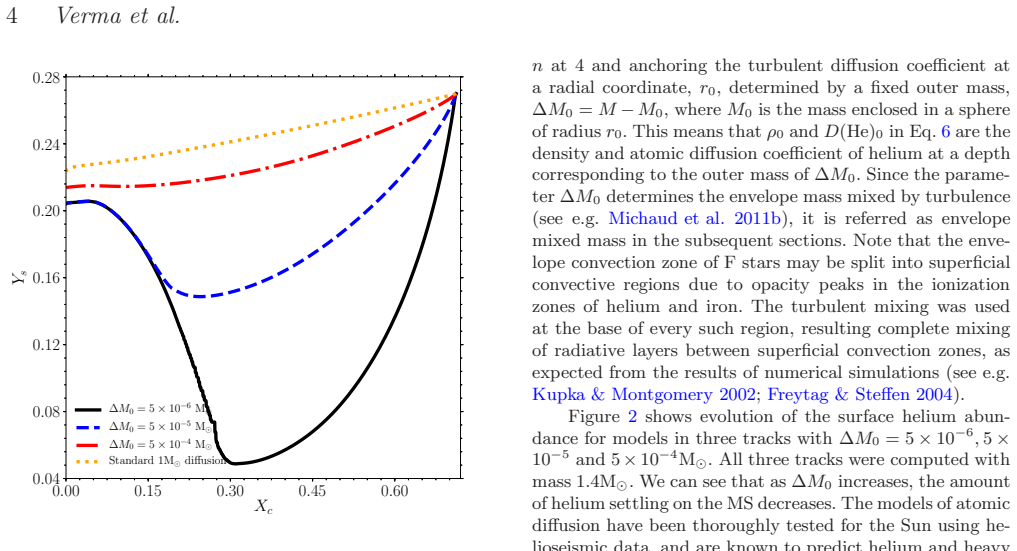
The load-bearing object is the density-dependent turbulent diffusion coefficient $D_T = \omega D(\mathrm{He})_0 (\rho_0/\rho)^n$ from Richer et al. (2000), reparameterised by Michaud et al. (2011a,b) so that the surface abundances depend only on the envelope mixed mass $\Delta M_0$: the turbulent diffusion coefficient is anchored at the radius where the mass outside is $\Delta M_0$, with fixed constants $\omega=10^4$ and $n=4$. Because surface abundances in this scheme depend only on $\Delta M_0$, the paper can scan three discrete values of this one parameter and compare the predicted helium glitch amplitude, computed from the fitted amplitude $A_\mathrm{He}$ and width $\Delta_\mathrm{He}$ in the glitch formula $\delta\nu_\mathrm{He}=A_\mathrm{He}\nu e^{-8\pi^2\Delta_\mathrm{He}^2\nu^2}\sin(4\pi\tau_\mathrm{He}\nu+\psi_\mathrm{He})$, against the observed value.
What would settle it
Measure the surface helium of KIC 2837475, 9139163, or 11253226 independently, for example from helium lines in high-resolution spectra, and compare it with the $Y_s\approx0.25$–$0.26$ that the $\Delta M_0=5\times10^{-4}\,M_\odot$ models imply; a clearly lower value, or a fourth similar F star whose glitch amplitude requires $\Delta M_0$ well below $5\times10^{-4}\,M_\odot$ when other parameters are held fixed, would settle against the paper's conclusion.
Extended reading notes
Core claim
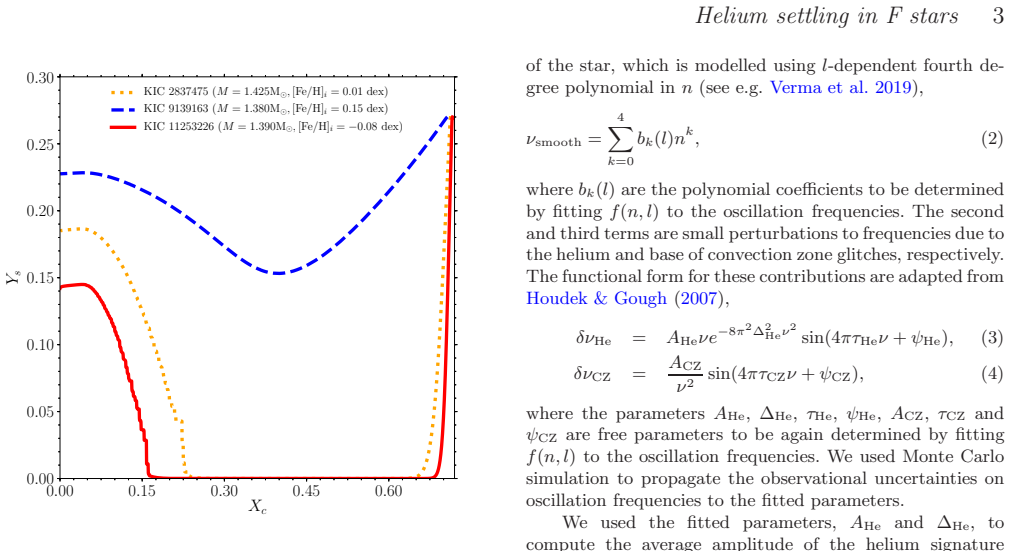
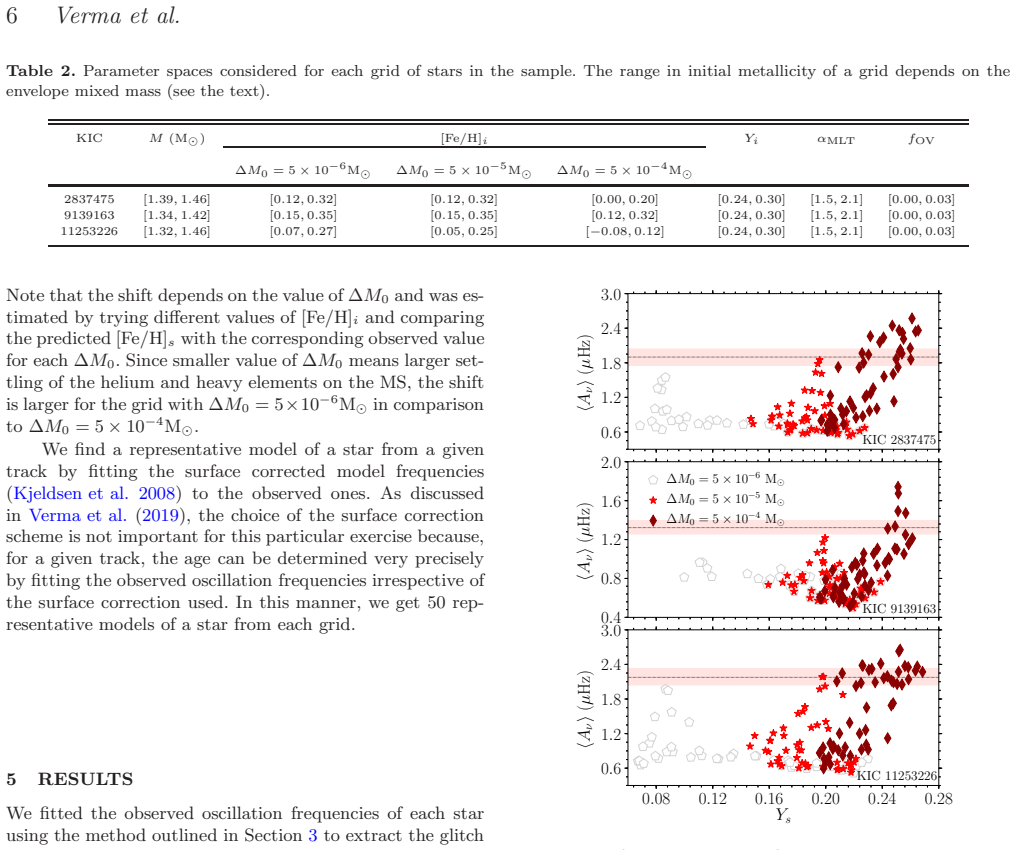
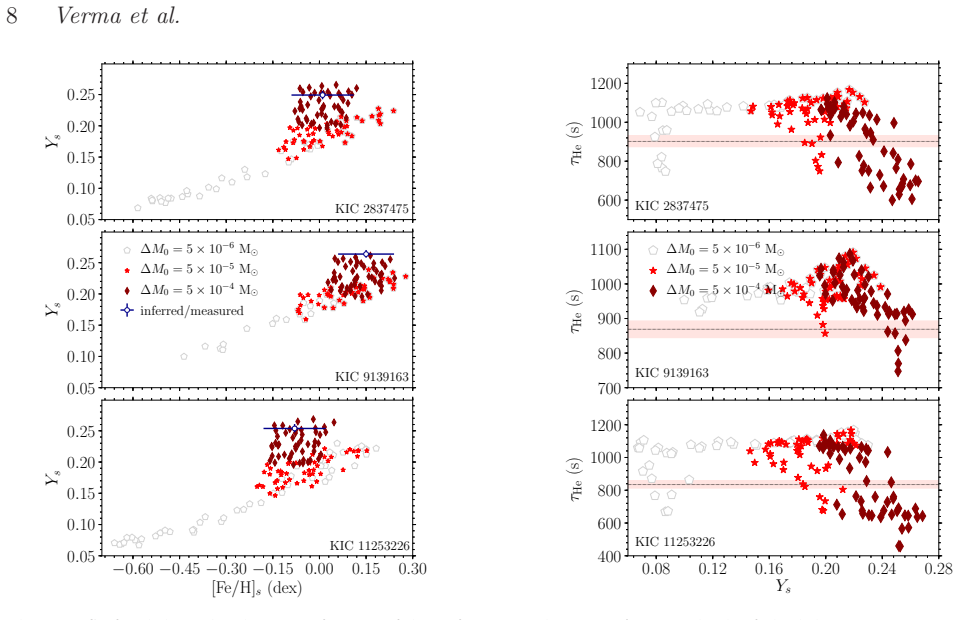
For KIC 2837475, 9139163, and 11253226, the paper finds that the envelope mixed mass $\Delta M_0$ must be approximately $5\times10^{-4}\,M_\odot$: only grids with this value reproduce the observed average amplitude of the helium signature $\langle A_\nu\rangle$ and the acoustic depth of the helium ionization zone. Models with $\Delta M_0 = 5\times10^{-6}$ and $5\times10^{-5}\,M_\odot$ underpredict $\langle A_\nu\rangle$ because too much helium has settled out. The same models simultaneously match the measured surface metallicity $[\mathrm{Fe/H}]_s$ and the inferred surface helium abundance $Y_s \approx 0.25$–$0.26$, while the smaller-mixing models do not. The claim is not that the true turbulent diffusion profile is known; it is that, within the one-parameter turbulent mixing formalism, the data demand a mixed mass two orders of magnitude larger than previous heavy-element studies inferred.
Load-bearing premise
The conclusion assumes the only thing slowing helium settling is turbulent mixing of a specific density-dependent form, fully described by one number, the envelope mixed mass; if the real mixing has a different depth profile or other processes such as mass loss also act, the inferred $5\times10^{-4}\,M_\odot$ is not the true mixed mass.
Editorial extensions
If this is right
- Standard atomic-diffusion-only models under-predict the surface helium of $1.3$–$1.5\,M_\odot$ F stars, so stellar properties inferred from such models for these stars carry a systematic bias.
- The seismic helium signature can discriminate between candidate diffusion-suppression processes: turbulent mixing with $\Delta M_0 \approx 5\times10^{-4}\,M_\odot$ fits the data, while the much smaller mixing inferred from heavy elements does not.
- Atomic diffusion and this turbulent mixing can be applied consistently in models of both cool and hot stars, removing the arbitrary switch between diffusion and non-diffusion treatments.
- The surface helium values inferred here, $Y_s \approx 0.249$–$0.264$, give concrete targets for spectroscopic or seismic checks of envelope mixing.
Reading between the lines
- A testable prediction follows from the paper's own logic: these three stars should have surface helium near $Y_s \approx 0.25$–$0.26$, so an independent measurement of helium in their atmospheres would either support or contradict the inferred mixed mass.
- Mass loss is the main alternative left aside. If mass loss also slows helium settling, the turbulent mixed mass required could be smaller than $5\times10^{-4}\,M_\odot$, so the value is best read as a constraint within the turbulence-only scenario rather than a direct measurement of the true mixed mass.
- Applying the same glitch calibration to a larger Kepler sample would show whether a single $\Delta M_0$ works for all F stars or whether the required mixing varies with mass and temperature; the latter would mean the one-parameter turbulent model is too simple.
- The discrepancy between the helium-based and heavy-element-based mixed masses suggests heavy-element abundances alone are nearly blind to the helium-bearing layers; combining the two observables is what actually separates competing diffusion-suppression processes.
Signed reviews
Editorial analysis
A structured set of objections, weighed in public.
Referee Report
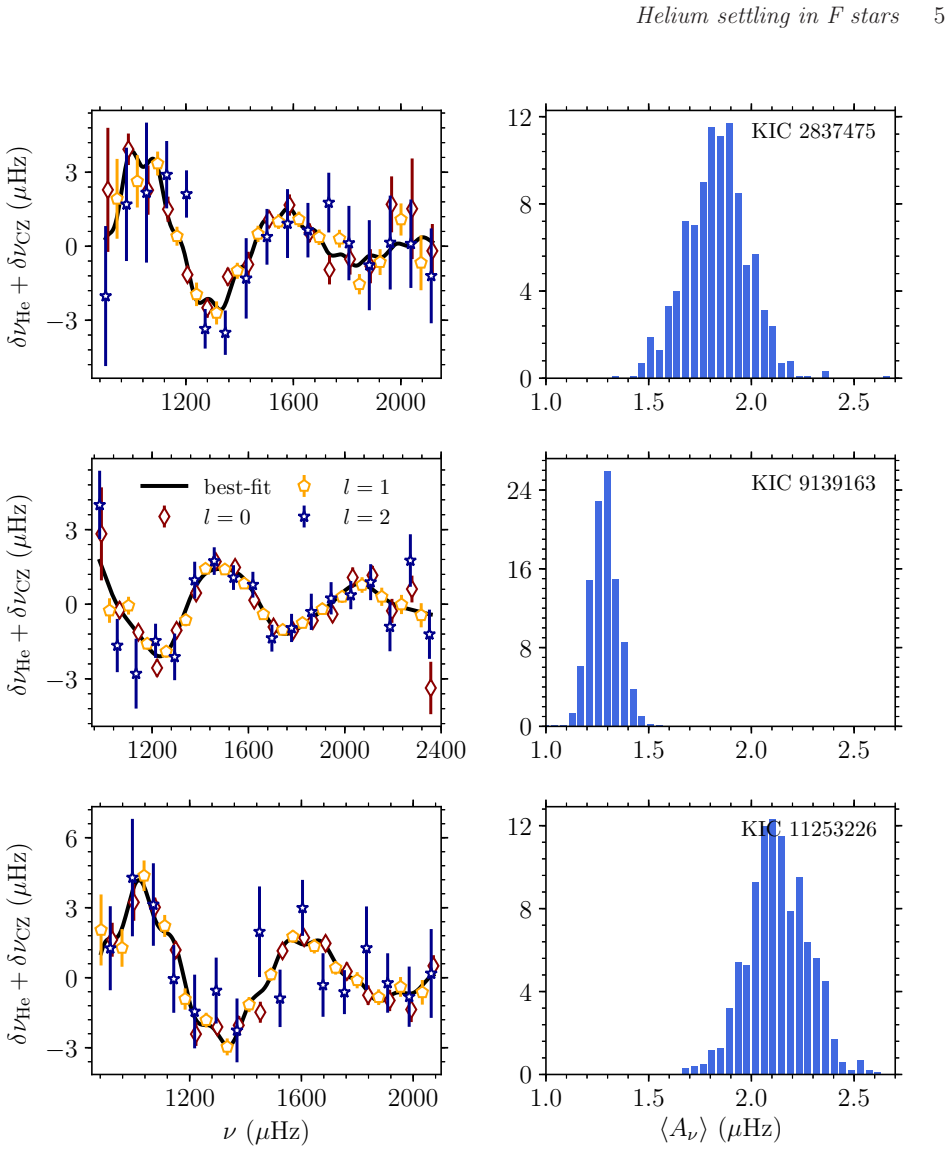
Summary. The paper uses the amplitude of the helium ionization glitch in Kepler oscillation frequencies to constrain helium settling in three F stars (KIC 2837475, 9139163, 11253226). For each star the authors extract an observed average glitch amplitude with Monte Carlo uncertainties, compute grids of stellar models with atomic diffusion plus a phenomenological turbulent mixing scheme, and compare the observed and model amplitudes. On the basis of grids sampling three values of the envelope mixed mass, ΔM0 = 5e-6, 5e-5, and 5e-4 M_sun, they conclude that approximately 5e-4 M_sun of envelope mixing is necessary to reproduce the observed helium signature, much larger than the ~1e-6 M_sun inferred from heavy-element abundance studies. They also compare inferred surface helium and metallicity jointly and check acoustic depths of the helium ionization zone as a sanity check.
Significance. If the central conclusion holds, the paper provides a new seismic route to constraining the physical processes that compete with atomic diffusion in F stars, with potential consequences for consistent diffusion treatment across the Hertzsprung-Russell diagram and for the cosmological lithium problem. The extraction of the observed glitch amplitude is carefully done: model and observed frequencies are fitted with the same mode set and weights, uncertainties are propagated by Monte Carlo simulation, and the acoustic-depth sanity check in Section 5.3 is a useful robustness test. The comparison is genuinely forward-modeled: model amplitudes are computed from stellar models rather than inverted from the observed quantity, so there is no circularity in the basic amplitude comparison. The main limitation is that the inference of a specific ΔM0 value is based on only three discrete grid points, and the supporting Ys calibration involves a trial-and-error relative weighting; these issues affect the precision and defensibility of the headline number, although not the qualitative conclusion that much stronger mixing than ~1e-6 M_sun is required.
major comments (3)
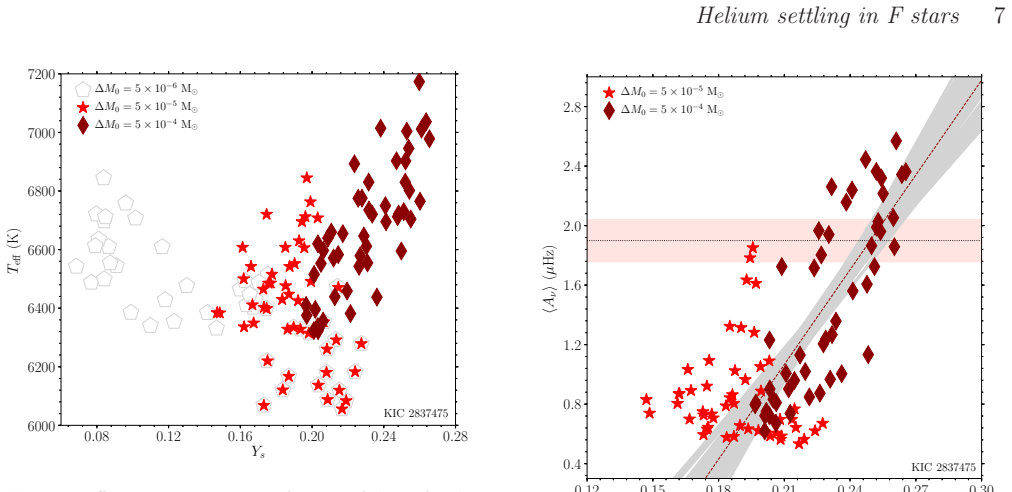
- [§4.2, §5.1, Figure 4] The headline claim that an envelope mixed mass of approximately 5e-4 M_sun is 'necessary' is not supported by the discrete grid. Only three values of ΔM0 (5e-6, 5e-5, 5e-4 M_sun) are computed, and Figure 4 shows that the 5e-5 models fall below the observed ⟨Aν⟩ band while the 5e-4 models reproduce it; the data therefore constrain ΔM0 only to lie in the interval (5e-5, 5e-4] or possibly above 5e-4, since no larger value was computed. To support a specific value, intermediate and larger ΔM0 (for example 1e-4, 2e-4, and 1e-3 M_sun) must be modeled, or the paper should explicitly state that the result is a lower-bound threshold rather than a precise value.
- [§5.1, Table 2] The initial metallicity ranges in Table 2 are adjusted separately for each ΔM0 grid by a trial-and-error comparison of predicted and observed [Fe/H]_s, and the shift depends on ΔM0. Because the grids are therefore not a continuous or uniformly sampled scan of ΔM0 at fixed other physics, the joint agreement in Figure 7 for the 5e-4 grid is partly a consequence of this tuning. The paper should quantify how sensitive the conclusion is to the choice of [Fe/H]_i ranges, for example by showing the predicted [Fe/H]_s distributions for all grids before the shift is applied.
- [§5.1, Figure 6] The Ys calibration uses a trial-and-error weighting in which models with ΔM0 = 5e-5 M_sun are given one-fourth the weight of those with ΔM0 = 5e-4 M_sun. This weighting is arbitrary and affects the fitted straight line, the inferred Ys values, and hence the joint comparison in Figure 7. The paper should either justify the weighting from the data, test the sensitivity of the inferred Ys to alternative weights, or present the calibration without this ad hoc adjustment.
minor comments (5)
- [§2] The text refers to 'KIC 2839163' when describing complete depletion of surface helium, but the target list in Table 1 contains KIC 2837475 and KIC 9139163; this appears to be a typo.
- [§4.2] The sentence describing the Sobol-sequence sampling is grammatically awkward: 'sampling uniformly using quasi-random numbers (more specifically using Sobol sequences) the 5-D space' should be rephrased for clarity.
- [§5.1] The reported inferred Ys values are typeset in an unclear way (for example, '0.2490.007−0.007'); the notation for asymmetric uncertainties should be made consistent and readable.
- [§5.1] The paper states that the scatter in Figure 4 is 'intrinsic and due to differences in M, [Fe/H]_i, α_MLT, f_OV and age' without quantifying the individual contributions; a brief decomposition or at least a statement on the dominant source would help the reader judge whether the grid ranges are broad enough.
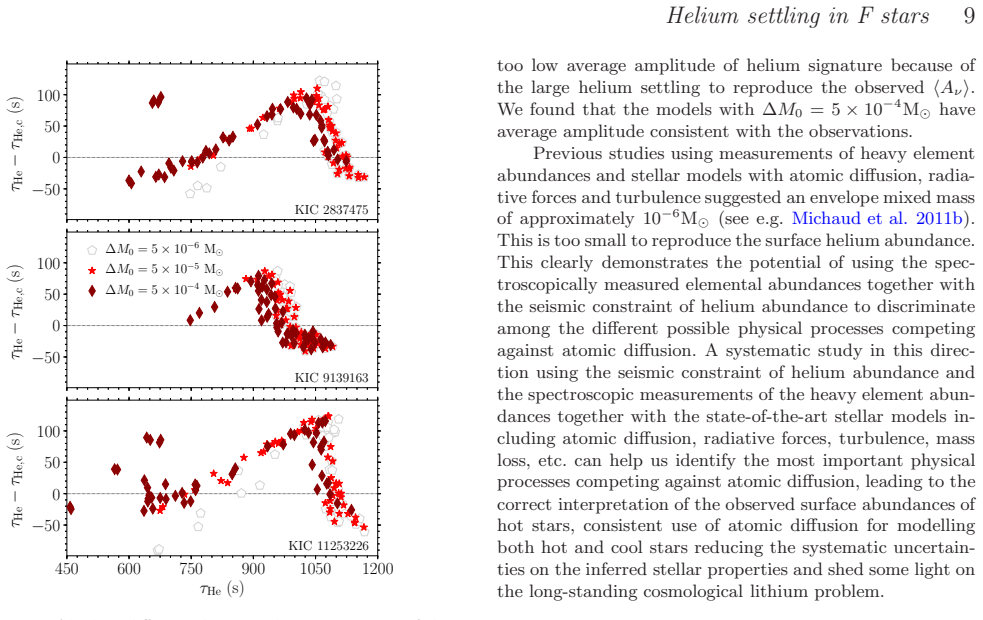
- [§5.3] The sanity check assumes specific choices for the acoustic surface and for R_He (the Γ1 peak), and the paper acknowledges a maximum systematic uncertainty of 225 s; it would be useful to state explicitly whether the conclusions of Figure 8 are robust to that systematic uncertainty.
Circularity Check
No significant circularity: the observed helium glitch amplitude is an independent observable and model amplitudes are forward-computed; the coarse three-point Delta-M0 grid limits precision but does not make the derivation circular.
full rationale
The central derivation is not circular. The observed average helium glitch amplitude <A_nu> is an independent seismic observable, and the model amplitudes are forward-computed by fitting the oscillation frequencies of stellar models built with three fixed values of the envelope mixed mass Delta_M0 (5e-6, 5e-5, and 5e-4 solar masses). Figure 4 directly compares these forward-computed model amplitudes with the observed band; models with Delta_M0 = 5e-6 and 5e-5 fall below the observed amplitude, while Delta_M0 = 5e-4 models reproduce it. Delta_M0 is not fitted to the observed amplitude; it is a grid parameter, so the headline comparison does not reduce to an input by construction. The later Ys calibration in Section 5.1 is a standard model-calibrated inference, although it is not an independent confirmation: the straight-line fit to <A_nu> versus Ys is deliberately weighted toward the Delta_M0 = 5e-4 models ("we gave less weight to these models", with a "trial and error" choice of one-fourth weight), and Figure 7 then uses this inferred Ys together with measured [Fe/H]s, whose model [Fe/H]i ranges were themselves shifted to match the observed surface metallicity (Section 4.2). These steps create a mild consistency loop, but they are not the primary evidence for the stated conclusion; the direct forward-model amplitude comparison already supports the qualitative result. The self-cited extraction method (Verma et al. 2019) is published, externally falsifiable work and is used as a tool rather than as an unverified uniqueness assumption. The paper itself acknowledges the residual possibility that Delta_M0 = 5e-5 models cannot be completely disregarded (Section 5.1), and the three-value grid sets only a coarse threshold rather than a precise upper bound; this is a resolution and overinterpretation concern, not a circularity. Overall, the derivation is self-contained against the observed glitch amplitude, with only a minor non-load-bearing calibration loop.
Assumptions & free parameters
free parameters (3)
- Envelope mixed mass Delta M0 =
approximately 5e-4 M_sun (tested 5e-6, 5e-5, 5e-4 M_sun)
- Initial metallicity range [Fe/H]_i per grid =
e.g., [0.12,0.32] for KIC 2837475 at 5e-6; [0.00,0.20] at 5e-4
- Relative weight of 5e-5 models in Y_s calibration =
1/4 that of 5e-4 models
assumptions (5)
- domain assumption Atomic diffusion follows Thoul et al. (1994) coefficients for helium and heavy elements
- domain assumption Turbulent diffusion coefficient of Richer et al. (2000) with Michaud et al. (2011a,b) normalization uniquely determines surface abundances for a given Delta M0
- domain assumption Radiative forces have negligible effect on surface helium, so turbulence is the only process opposing settling
- domain assumption The helium glitch amplitude <A_nu> is a reliable function of surface Y_s and T_eff, per Verma et al. 2014a, 2019
- domain assumption Sobol-sampled 5-D grid of 50 tracks adequately covers the stellar parameter space
Cite this review
Pith. "Pith review of Helium settling in F stars: constraining turbulent mixing using observed helium glitch signature." pith.science (2026). https://pith.science/paper/UKI3O5FV
@misc{pith2026190804939,
  author       = {Pith},
  title        = {Pith review of: Helium settling in F stars: constraining turbulent mixing using observed helium glitch signature},
  year         = {2026},
  howpublished = {\url{https://pith.science/paper/UKI3O5FV}},
  note         = {Machine review of arXiv:1908.04939}
}
abstract
Recent developments in asteroseismology -- thanks to space-based missions such as {\it CoRoT} and {\it Kepler} -- provide handles on those properties of stars that were either completely inaccessible in the past or only poorly measured. Among several such properties is the surface helium abundance of F and G stars. We used the oscillatory signature introduced by the ionization of helium in the observed oscillation frequencies to constrain the amount of helium settling in F stars. For this purpose, we identified three promising F stars for which the standard models of atomic diffusion predict large settling (or complete depletion) of surface helium. Assuming turbulence at the base of envelope convection zone slows down settling of the helium and heavy elements, we found an envelope mixed mass of approximately $5 \times 10^{-4}$M$_\odot$ necessary to reproduce the observed amplitude of helium signature for all the three stars. This is much larger than the mixed mass of the order of $10^{-6}$M$_\odot$ found in the previous studies performed using the measurements of the heavy element abundances. This demonstrates the potential of using the helium signature together with measurements of the heavy element abundances to identify the most important physical processes competing against atomic diffusion, allowing eventually to correctly interpret the observed surface abundances of hot stars, consistent use of atomic diffusion in modelling both hot and cool stars, and shed some light on the long-standing cosmological lithium problem.
Figures
Figures from the paper (4 more)
Reference graph
Works this paper leans on
-
[1]
write newline
" write newline "" before.all 'output.state := FUNCTION fin.entry write newline FUNCTION new.block output.state before.all = 'skip after.block 'output.state := if FUNCTION new.sentence output.state after.block = 'skip output.state before.all = 'skip after.sentence 'output.state := if if FUNCTION not #0 #1 if FUNCTION and 'skip pop #0 if FUNCTION or pop #1...
-
[2]
Aller L. H., Chapman S., 1960, @doi [ ] 10.1086/146943 , http://adsabs.harvard.edu/abs/1960ApJ...132..461A 132, 461
-
[3]
Angulo C., et al., 1999, @doi [Nuclear Physics A] 10.1016/S0375-9474(99)00030-5 , http://adsabs.harvard.edu/abs/1999NuPhA.656....3A 656, 3
-
[4]
Appourchaux T., et al., 2012, @doi [ ] 10.1051/0004-6361/201218948 , http://adsabs.harvard.edu/abs/2012A
-
[6]
Bahcall J. N., Pinsonneault M. H., Basu S., Christensen-Dalsgaard J., 1997, @doi [Physical Review Letters] 10.1103/PhysRevLett.78.171 , http://adsabs.harvard.edu/abs/1997PhRvL..78..171B 78, 171
-
[7]
Balmforth N. J., Gough D. O., 1990, @doi [ ] 10.1086/169262 , http://adsabs.harvard.edu/abs/1990ApJ...362..256B 362, 256
-
[8]
M., Narasimha D., 1994, , http://adsabs.harvard.edu/abs/1994MNRAS.267..209B 267, 209
Basu S., Antia H. M., Narasimha D., 1994, , http://adsabs.harvard.edu/abs/1994MNRAS.267..209B 267, 209
work page 1994
-
[9]
Basu S., Mazumdar A., Antia H. M., Demarque P., 2004, @doi [ ] 10.1111/j.1365-2966.2004.07644.x , http://adsabs.harvard.edu/abs/2004MNRAS.350..277B 350, 277
arXiv 2004
Show all 68 references
-
[10]
Bertelli Motta C., et al., 2018, @doi [ ] 10.1093/mnras/sty1011 , https://ui.adsabs.harvard.edu/\#abs/2018MNRAS.478..425B 478, 425
2018 doi
-
[11]
Broomhall A.-M., et al., 2014, @doi [ ] 10.1093/mnras/stu393 , http://adsabs.harvard.edu/abs/2014MNRAS.440.1828B 440, 1828
2014 doi
-
[12]
Chapman S., 1917a, @doi [ ] 10.1093/mnras/77.7.539 , http://adsabs.harvard.edu/abs/1917MNRAS..77..539C 77, 539
-
[13]
Chapman S., 1917b, @doi [ ] 10.1093/mnras/77.7.540 , http://adsabs.harvard.edu/abs/1917MNRAS..77..540C 77, 540
-
[14]
Chapman S., 1922, @doi [ ] 10.1093/mnras/82.5.292 , http://adsabs.harvard.edu/abs/1922MNRAS..82..292C 82, 292
1922 doi
-
[15]
Christensen-Dalsgaard J., 2008, @doi [ ] 10.1007/s10509-007-9689-z , http://adsabs.harvard.edu/abs/2008Ap
2008 doi
-
[16]
R., Thompson M
Christensen-Dalsgaard J., Proffitt C. R., Thompson M. J., 1993, @doi [ ] 10.1086/186725 , http://adsabs.harvard.edu/abs/1993ApJ...403L..75C 403, L75
1993 doi
-
[17]
L., Bedding T
Compton D. L., Bedding T. R., Stello D., 2019, @doi [ ] 10.1093/mnras/stz432 , https://ui.adsabs.harvard.edu/abs/2019MNRAS.485..560C 485, 560
2019 doi
-
[18]
J., Marques J
Deal M., Alecian G., Lebreton Y., Goupil M. J., Marques J. P., LeBlanc F., Morel P., Pichon B., 2018, @doi [ ] 10.1051/0004-6361/201833361 , http://adsabs.harvard.edu/abs/2018A
2018 doi
-
[19]
Dotter A., Conroy C., Cargile P., Asplund M., 2017, @doi [ ] 10.3847/1538-4357/aa6d10 , http://adsabs.harvard.edu/abs/2017ApJ...840...99D 840, 99
2017 doi
-
[20]
W., Alexander D
Ferguson J. W., Alexander D. R., Allard F., Barman T., Bodnarik J. G., Hauschildt P. H., Heffner-Wong A., Tamanai A., 2005, @doi [ ] 10.1086/428642 , http://adsabs.harvard.edu/abs/2005ApJ...623..585F 623, 585
2005 doi
-
[21]
J., Weiss W
Freytag B., Steffen M., 2004, in Zverko J., Ziznovsky J., Adelman S. J., Weiss W. W., eds, IAU Symposium Vol. 224, The A-Star Puzzle. pp 139--147, @doi 10.1017/S174392130400448X
2004 doi
-
[22]
Gai N., Basu S., Tang Y., 2018, @doi [ ] 10.3847/1538-4357/aab1f7 , http://adsabs.harvard.edu/abs/2018ApJ...856..123G 856, 123
2018 doi
-
[23]
O., 1990, in Osaki Y., Shibahashi H., eds, Lecture Notes in Physics, Berlin Springer Verlag Vol
Gough D. O., 1990, in Osaki Y., Shibahashi H., eds, Lecture Notes in Physics, Berlin Springer Verlag Vol. 367, Progress of Seismology of the Sun and Stars. p. 283, @doi 10.1007/3-540-53091-6
1990 doi
-
[24]
O., Thompson M
Gough D. O., Thompson M. J., 1988, in Christensen-Dalsgaard J., Frandsen S., eds, IAU Symposium Vol. 123, Advances in Helio- and Asteroseismology. p. 155
1988
-
[25]
J., 1998, @doi [ ] 10.1023/A:1005161325181 , http://adsabs.harvard.edu/abs/1998SSRv...85..161G 85, 161
Grevesse N., Sauval A. J., 1998, @doi [ ] 10.1023/A:1005161325181 , http://adsabs.harvard.edu/abs/1998SSRv...85..161G 85, 161
1998 doi
-
[26]
J., Richard O., Grundahl F., Collet R., Mashonkina L
Gruyters P., Korn A. J., Richard O., Grundahl F., Collet R., Mashonkina L. I., Osorio Y., Barklem P. S., 2013, @doi [ ] 10.1051/0004-6361/201220821 , http://adsabs.harvard.edu/abs/2013A
2013 doi
-
[27]
J., 2014, @doi [ ] 10.1051/0004-6361/201423590 , http://adsabs.harvard.edu/abs/2014A
Gruyters P., Nordlander T., Korn A. J., 2014, @doi [ ] 10.1051/0004-6361/201423590 , http://adsabs.harvard.edu/abs/2014A
2014 doi
-
[28]
Herwig F., 2000, , http://adsabs.harvard.edu/abs/2000A
2000
-
[29]
731, Equation-of-State and Phase-Transition in Models of Ordinary Astrophysical Matter
Houdek G., 2004, in Celebonovic V., Gough D., D \"a ppen W., eds, American Institute of Physics Conference Series Vol. 731, Equation-of-State and Phase-Transition in Models of Ordinary Astrophysical Matter. pp 193--207, @doi 10.1063/1.1828405
2004 doi
-
[30]
O., 2007, @doi [ ] 10.1111/j.1365-2966.2006.11325.x , http://adsabs.harvard.edu/abs/2007MNRAS.375..861H 375, 861
Houdek G., Gough D. O., 2007, @doi [ ] 10.1111/j.1365-2966.2006.11325.x , http://adsabs.harvard.edu/abs/2007MNRAS.375..861H 375, 861
2007
-
[31]
Imbriani G., et al., 2005, @doi [European Physical Journal A] 10.1140/epja/i2005-10138-7 , http://adsabs.harvard.edu/abs/2005EPJA...25..455I 25, 455
2005 doi
-
[32]
R., Christensen-Dalsgaard J., 2008, @doi [ ] 10.1086/591667 , http://adsabs.harvard.edu/abs/2008ApJ...683L.175K 683, L175
Kjeldsen H., Bedding T. R., Christensen-Dalsgaard J., 2008, @doi [ ] 10.1086/591667 , http://adsabs.harvard.edu/abs/2008ApJ...683L.175K 683, L175
2008 doi
-
[33]
J., Grundahl F., Richard O., Barklem P
Korn A. J., Grundahl F., Richard O., Barklem P. S., Mashonkina L., Collet R., Piskunov N., Gustafsson B., 2006, @doi [ ] 10.1038/nature05011 , http://adsabs.harvard.edu/abs/2006Natur.442..657K 442, 657
2006 doi
-
[34]
J., Grundahl F., Richard O., Mashonkina L., Barklem P
Korn A. J., Grundahl F., Richard O., Mashonkina L., Barklem P. S., Collet R., Gustafsson B., Piskunov N., 2007, @doi [ ] 10.1086/523098 , http://adsabs.harvard.edu/abs/2007ApJ...671..402K 671, 402
2007 doi
-
[35]
W., Staudt G., Harissopulos S., Paradellis T., 2002, @doi [ ] 10.1086/338384 , http://adsabs.harvard.edu/abs/2002ApJ...567..643K 567, 643
Kunz R., Fey M., Jaeger M., Mayer A., Hammer J. W., Staudt G., Harissopulos S., Paradellis T., 2002, @doi [ ] 10.1086/338384 , http://adsabs.harvard.edu/abs/2002ApJ...567..643K 567, 643
2002 doi
-
[36]
H., 2002, @doi [ ] 10.1046/j.1365-8711.2002.05268.x , https://ui.adsabs.harvard.edu/abs/2002MNRAS.330L...6K 330, L6
Kupka F., Montgomery M. H., 2002, @doi [ ] 10.1046/j.1365-8711.2002.05268.x , https://ui.adsabs.harvard.edu/abs/2002MNRAS.330L...6K 330, L6
2002
-
[37]
J., Barklem P
Lind K., Korn A. J., Barklem P. S., Grundahl F., 2008, @doi [ ] 10.1051/0004-6361:200810051 , http://adsabs.harvard.edu/abs/2008A
2008 doi
-
[38]
N., et al., 2017, @doi [ ] 10.3847/1538-4357/835/2/172 , http://adsabs.harvard.edu/abs/2017ApJ...835..172L 835, 172
Lund M. N., et al., 2017, @doi [ ] 10.3847/1538-4357/835/2/172 , http://adsabs.harvard.edu/abs/2017ApJ...835..172L 835, 172
2017 doi
-
[39]
Mazumdar A., et al., 2014, @doi [ ] 10.1088/0004-637X/782/1/18 , http://adsabs.harvard.edu/abs/2014ApJ...782...18M 782, 18
2014 doi
-
[40]
Michaud G., Charland Y., 1986, @doi [ ] 10.1086/164774 , http://adsabs.harvard.edu/abs/1986ApJ...311..326M 311, 326
1986 doi
-
[41]
Michaud G., Tarasick D., Charland Y., Pelletier C., 1983, @doi [ ] 10.1086/161034 , http://adsabs.harvard.edu/abs/1983ApJ...269..239M 269, 239
1983 doi
-
[42]
Michaud G., Richer J., Richard O., 2011a, @doi [ ] 10.1051/0004-6361/201015997 , http://adsabs.harvard.edu/abs/2011A
-
[43]
Michaud G., Richer J., Vick M., 2011b, @doi [ ] 10.1051/0004-6361/201116999 , http://adsabs.harvard.edu/abs/2011A
-
[44]
Monteiro M. J. P. F. G., Thompson M. J., 1998, in Deubner F.-L., Christensen-Dalsgaard J., Kurtz D., eds, IAU Symposium Vol. 185, New Eyes to See Inside the Sun and Stars. p. 317
1998
-
[46]
Monteiro M. J. P. F. G., Christensen-Dalsgaard J., Thompson M. J., 1994, , http://adsabs.harvard.edu/abs/1994A 247
1994
-
[47]
Monteiro M. J. P. F. G., Christensen-Dalsgaard J., Thompson M. J., 2000, @doi [ ] 10.1046/j.1365-8711.2000.03471.x , http://adsabs.harvard.edu/abs/2000MNRAS.316..165M 316, 165
2000
-
[48]
Morel P., Th \'e venin F., 2002, @doi [ ] 10.1051/0004-6361:20020768 , http://adsabs.harvard.edu/abs/2002A
2002 doi
-
[49]
J., Richard O., Lind K., 2012, @doi [ ] 10.1088/0004-637X/753/1/48 , http://adsabs.harvard.edu/abs/2012ApJ...753...48N 753, 48
Nordlander T., Korn A. J., Richard O., Lind K., 2012, @doi [ ] 10.1088/0004-637X/753/1/48 , http://adsabs.harvard.edu/abs/2012ApJ...753...48N 753, 48
2012 doi
-
[50]
Paxton B., Bildsten L., Dotter A., Herwig F., Lesaffre P., Timmes F., 2011, @doi [ ] 10.1088/0067-0049/192/1/3 , http://adsabs.harvard.edu/abs/2011ApJS..192....3P 192, 3
2011 doi
-
[51]
Paxton B., et al., 2013, @doi [ ] 10.1088/0067-0049/208/1/4 , http://adsabs.harvard.edu/abs/2013ApJS..208....4P 208, 4
2013 doi
-
[52]
Paxton B., et al., 2015, @doi [ ] 10.1088/0067-0049/220/1/15 , http://adsabs.harvard.edu/abs/2015ApJS..220...15P 220, 15
2015 doi
-
[53]
R., Michaud G., 1991, @doi [ ] 10.1086/170580 , http://adsabs.harvard.edu/abs/1991ApJ...380..238P 380, 238
Proffitt C. R., Michaud G., 1991, @doi [ ] 10.1086/170580 , http://adsabs.harvard.edu/abs/1991ApJ...380..238P 380, 238
1991 doi
-
[54]
A., 1996, , http://adsabs.harvard.edu/abs/1996A
Richard O., Vauclair S., Charbonnel C., Dziembowski W. A., 1996, , http://adsabs.harvard.edu/abs/1996A
1996
-
[55]
Richer J., Michaud G., Turcotte S., 2000, @doi [ ] 10.1086/308274 , http://adsabs.harvard.edu/abs/2000ApJ...529..338R 529, 338
2000 doi
-
[56]
J., Nayfonov A., 2002, @doi [ ] 10.1086/341894 , http://adsabs.harvard.edu/abs/2002ApJ...576.1064R 576, 1064
Rogers F. J., Nayfonov A., 2002, @doi [ ] 10.1086/341894 , http://adsabs.harvard.edu/abs/2002ApJ...576.1064R 576, 1064
2002 doi
-
[57]
Schatzman E., 1969, , http://adsabs.harvard.edu/abs/1969A
1969
-
[58]
J., 2005, @doi [ ] 10.1111/j.1365-2966.2005.00019.x , http://adsabs.harvard.edu/abs/2005MNRAS.362L...1S 362, L1
Seaton M. J., 2005, @doi [ ] 10.1111/j.1365-2966.2005.00019.x , http://adsabs.harvard.edu/abs/2005MNRAS.362L...1S 362, L1
2005
-
[59]
Silva Aguirre V., et al., 2017, @doi [ ] 10.3847/1538-4357/835/2/173 , http://adsabs.harvard.edu/abs/2017ApJ...835..173S 835, 173
2017 doi
-
[60]
A., Bahcall J
Thoul A. A., Bahcall J. N., Loeb A., 1994, @doi [ ] 10.1086/173695 , http://adsabs.harvard.edu/abs/1994ApJ...421..828T 421, 828
1994 doi
-
[61]
Turcotte S., Richer J., Michaud G., 1998, @doi [ ] 10.1086/306056 , http://adsabs.harvard.edu/abs/1998ApJ...504..559T 504, 559
1998 doi
-
[62]
Varenne O., Monier R., 1999, , http://adsabs.harvard.edu/abs/1999A
1999
-
[63]
Vauclair S., Vauclair G., Schatzman E., Michaud G., 1978a, @doi [ ] 10.1086/156292 , http://adsabs.harvard.edu/abs/1978ApJ...223..567V 223, 567
-
[64]
Vauclair G., Vauclair S., Michaud G., 1978b, @doi [ ] 10.1086/156324 , http://adsabs.harvard.edu/abs/1978ApJ...223..920V 223, 920
-
[65]
Verma K., et al., 2014a, @doi [ ] 10.1088/0004-637X/790/2/138 , http://adsabs.harvard.edu/abs/2014ApJ...790..138V 790, 138
-
[66]
M., Basu S., Mazumdar A., 2014b, @doi [ ] 10.1088/0004-637X/794/2/114 , http://adsabs.harvard.edu/abs/2014ApJ...794..114V 794, 114
Verma K., Antia H. M., Basu S., Mazumdar A., 2014b, @doi [ ] 10.1088/0004-637X/794/2/114 , http://adsabs.harvard.edu/abs/2014ApJ...794..114V 794, 114
-
[67]
M., Mazumdar A., Basu S., Lund M
Verma K., Raodeo K., Antia H. M., Mazumdar A., Basu S., Lund M. N., Silva Aguirre V., 2017, @doi [ ] 10.3847/1538-4357/aa5da7 , http://adsabs.harvard.edu/abs/2017ApJ...837...47V 837, 47
2017 doi
-
[68]
R., Lund M
Verma K., Raodeo K., Basu S., Silva Aguirre V., Mazumdar A., Mosumgaard J. R., Lund M. N., Ranadive P., 2019, @doi [ ] 10.1093/mnras/sty3374 , http://adsabs.harvard.edu/abs/2019MNRAS.483.4678V 483, 4678
2019 doi
-
[69]
Vick M., Michaud G., Richer J., Richard O., 2010, @doi [ ] 10.1051/0004-6361/201014307 , http://adsabs.harvard.edu/abs/2010A
2010 doi
-
[70]
V., 1988, in Christensen-Dalsgaard J., Frandsen S., eds, IAU Symposium Vol
Vorontsov S. V., 1988, in Christensen-Dalsgaard J., Frandsen S., eds, IAU Symposium Vol. 123, Advances in Helio- and Asteroseismology. p. 151
1988
Reviewed August 14, 2026 · model on record in the stance chip above.
Discussion (0). Continue with ORCID to comment.