REVIEW 1 major objections 5 minor 60 references
Asymptotic spreading of interacting species with multiple fronts II: Exponentially decaying initial data
T0 review · 1 major / 5 minor · reviewed 2026-08-14 · deepseek-v4-flash
Pith's one-line read The paper proves exact spreading speeds for two competing species with exponentially decaying initial data and shows the slower species' speed depends on the faster species' front.
desk verdict Resolves the second spreading speed for exponentially decaying data; proof is mostly coherent but leans on unproved companion lemmas. read the letter →
The pith
A machine-rendered reading of the paper's core claim, the machinery that carries it, and where it could break.
The reading
What carries the argument
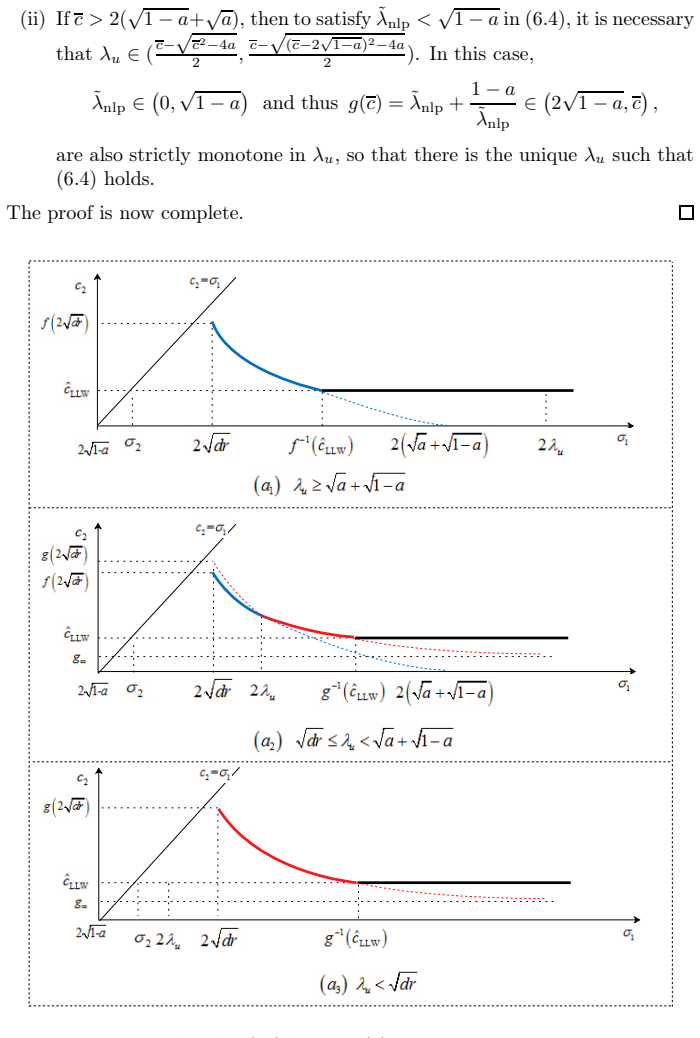
The central object is the limiting Hamilton–Jacobi equation obtained from the WKB ansatz $w^\epsilon_2(t,x) = -\epsilon \log u(t/\epsilon,x/\epsilon)$, namely $\min\{\partial_t w + |\partial_x w|^2 + 1 - a\chi_{\{x<σ_1 t\}}, w\} = 0$, with initial data $w(0,x) = \lambda_u \max\{x,0\}$. The zero level set of its viscosity solution gives the boundary of the region where species $u$ survives, and the speed $\hat{c}_{nlp}$ is read off from the slope of that level set. The argument is carried by the comparison principle (Theorem A.1) for viscosity super- and sub-solutions of Hamilton–Jacobi equations with piecewise Lipschitz, possibly discontinuous Hamiltonians of the form $H(t,x,p)=|p|^2 + R(x/t)$ with $R$ of bounded variation; the paper constructs explicit piecewise linear super-solutions and uses the comparison principle to turn large-deviation estimates into matching lower and upper bounds on $c_2$.
What would settle it
Run a numerical simulation of (1.1) with exponentially decaying initial data in a regime with $σ_1 > σ_2$, e.g. $\lambda_u<1<\lambda_v^+$, measure the large-time rightward front speed of $u$, and compare it with $\max\{c_{LLW},\hat{c}_{nlp}\}$ from (1.6). Varying $\lambda_v^+$ while holding $\lambda_u$ fixed should change $c_2$ through $\hat{c}_{nlp}$; a measured $c_2$ that is insensitive to $\lambda_v^+$ would falsify the central claim. A more direct test targets the comparison principle: check whether condition (A3) admits a counterexample for $H(t,x,p)=|p|^2+1-a\chi_{\{x<σ_1 t\}}$, since that would break both bounds on $c_2$.
Extended reading notes
Core claim
For initial data with prescribed exponential decay rates $u_0(x) \sim e^{-\lambda_u x}$ and $v_0(x) \sim e^{-\lambda_v^+ x}$ as $x \to +\infty$, and $v_0(x) \sim e^{\lambda_v^- x}$ as $x \to -\infty$, the paper proves that if $σ_1 > σ_2$, the four spreading limits in (1.4) hold with speeds $c_1 = σ_1$, $c_2 = \max\{c_{LLW}, \hat{c}_{nlp}\}$, and $c_3 = -\max\{\tilde{c}_{LLW}, σ_3\}$. The quantity $\hat{c}_{nlp}$ is given by the three-branch formula (1.6), in which $σ_1$ and $\lambda_u$ enter through $\tilde{\lambda}_{nlp} = \tfrac12[\sigma_1 - \sqrt{(\sigma_1-2\lambda_u)^2+4a}]$. This is the precise sense in which the slower species' rightward spreading speed $c_2$ is nonlocally determined by the faster species' speed $σ_1$. When $σ_1 = σ_2$, the two fronts coincide and (1.9) shows a single front connecting the coexistence state $(k_1,k_2)$ to the empty state $(0,0)$, confirming the coexistence-to-empty invasion mode as a degenerate case.
Load-bearing premise
The load-bearing premise is the comparison principle stated in Theorem A.1 for Hamilton–Jacobi equations whose Hamiltonian may be discontinuous along a set $Γ$; the paper's Remark A.2 asserts that the required hypotheses, especially the directional local monotonicity condition (A3), hold for the indicator-type coefficients $1-a\chi_{\{x<σ_1 t\}}$ and $1-a\chi_{\{σ_2 t<x<σ_1 t\}}$ because the profile $R(x/t)$ has bounded variation. If (A3) fails for these coefficients, the lower and upper bounds on $c_2$ collapse even though all other estimates stand.
Editorial extensions
If this is right
- If the initial data decay fast enough ($\lambda_v^+ \ge \sqrt{r/d}$ and $\lambda_u > σ_1/2$), the speeds $c_1$ and $c_2$ reduce to the compactly supported initial-data values from the companion paper.
- The speed $c_2$ is non-increasing in both $σ_1$ and $\lambda_u$: a faster leading front or a sparser tail of $u$ slows the invasion of $u$.
- As $|σ_1-σ_2|\to 0$ the spacing between the two fronts shrinks to zero, and at $σ_1=σ_2$ the solution exhibits a single front connecting the coexistence state to the empty state, exactly the coexistence-to-empty invasion mode.
- The same Hamilton–Jacobi comparison machinery recovers and extends the spreading formula for the case $0<a<1<b$ previously obtained by other methods, now with full dependence on the initial exponential decay rates.
- The approach extends to higher space dimensions under minor modifications, so the nonlocal-determination phenomenon is not an artifact of the one-dimensional setting.
Reading between the lines
- The regime boundaries in (1.6) predict a measurable threshold: continuously varying the faster species' decay rate should cause the slower species' speed $c_2$ to switch between the three functional forms of $\hat{c}_{nlp}$, a feature that could be tested experimentally or numerically.
- The same mechanism likely produces a chain of nonlocal dependences in three-species competition, where a middle species' speed may be set by the fastest front ahead of it; Section 7's forcing-term extension appears intended as a step in that direction.
- The results suggest a management lever: altering the shape of the faster species' leading tail (not just its growth rate) can change whether and how fast the slower species follows into open habitat.
Signed reviews
Editorial analysis
A structured set of objections, weighed in public.
Referee Report
Summary. The paper studies the two-species Lotka–Volterra competition–diffusion system (1.1) with 0<a,b<1, for initial data satisfying the exponential-decay hypothesis (Hλ). The main result (Theorem 1.3) states that, when σ1>σ2, the solution has four asymptotic zones with speeds c1=σ1, c2=max{cLLW,ĉnlp}, and c3=−max{c̃LLW,σ3}, where ĉnlp is given explicitly by (1.6) and depends on σ1 (the speed of the faster species v) and λu (the decay rate of u). In particular, the speed of the slower species is nonlocally determined by the leading front. The proof uses the WKB transform, half-relaxed limits, a comparison principle for discontinuous Hamilton–Jacobi equations (Appendix A), and explicit piecewise-linear super- and sub-solutions. Theorem 1.5 treats the degenerate case σ1=σ2, recovering the direct invasion of (0,0) by the coexistence state (Tang–Fife wave as two coincident fronts). Section 6 extends the formula to 0<a<1<b, and Section 7 gives an extension with forcing terms.
Significance. If correct, the paper resolves the open question of the second spreading speed for exponentially decaying data and makes precise the nonlocal dependence of c2 on σ1 and λu. The proof is largely self-contained: Appendix A contains a full proof of the comparison principle; the piecewise-linear super-solutions in Lemma 3.8 are explicit; the algebraic identity in Proposition 4.2, Step 3, is verifiable and correct. The formulas contain no fitted parameters. The main weakness is not an internal inconsistency but the dependence on the companion preprint [41] for two lemmas (B.1 and B.2) that are load-bearing in the proof of the upper bound on c2 and the lower bound on c3.
major comments (1)
- [Appendix B; Proposition 4.2, Step 3; Proposition 4.5, Step 3] Lemmas B.1(a),(b),(d) and B.2(a),(b) are stated without proofs and cited to [41]. Lemma B.2(a) is the decisive instrument: in Proposition 4.2, Step 3 it converts the exponential estimate (4.4) into the upper bound c2 ≤ c_{σ1,μ} (Eq. (4.11)), and Lemma B.2(b) plays the same role in Proposition 4.5, Step 3 for c3. Since [41] is a preprint, the central proof is not self-contained at this point. I do not see a mathematical error in the way the lemma is applied — the hypotheses (i) and (ii) appear to be met, and the final identity c_{σ1,μ} = max{cLLW, ĉnlp} checks out — but the missing proof or a published reference must be supplied.
minor comments (5)
- [Remark A.2] Remark A.2 asserts that (A1)–(A4) are easy to verify for H(p)+R(x/t) when R has bounded variation. For the step-function R used here, condition (A3) is the key point; the orientation in (A3) makes it plausible by choosing the normal pointing into the side where H is larger, but the verification should be written out because Theorem A.1 is the engine of all bounds.
- [Lemma 3.8, case (b)] The super-solution check for w2 in case (b) at the boundaries x/t=σ1 and x/t=˜cnlp is only asserted; please provide the omitted details or state explicitly that they are analogous to case (a).
- [Proposition 4.2, Step 1] The verification that the function in (4.2) is a viscosity sub-solution of (4.1) is delegated to 'straightforward'. Since this function is used to produce the important estimate (4.4), the verification at the corner x/t=2 and at the kink for λu≤1 should be included.
- [Section 5, formula for σ3^δ] In the displayed formula for σ^δ_3 after (5.5), the denominator contains λ_v^+; by analogy with (1.3) it should be λ_v^-.
- [Section 6] Theorem 6.1 and Proposition 6.2 are stated without proofs; the text only says 'by arguing similarly as in Theorem 1.3'. If these are intended as original results, proofs are needed; otherwise they should be explicitly labeled as remarks or conjectures.
Circularity Check
No significant circularity: the spreading-speed formula is derived by an independent Hamilton–Jacobi comparison argument, not imposed by construction.
full rationale
The paper's central claim, c2 = max{cLLW, ĉ_nlp}, is not equivalent to its inputs by definition. The quantity ĉ_nlp is first introduced as a closed-form expression in (1.6), and then independently characterized in the introduction as the boundary of the zero set of the viscosity solution to the Hamilton–Jacobi equation (1.8). The actual derivation in Section 3.2 constructs explicit piecewise-linear viscosity super-solutions whose zero-level sets have boundary ĉ_nlp, and then uses the genuinely proved comparison principle (Theorem A.1) to transfer this to the large-deviation limit of u. The upper bound in Proposition 4.2 is likewise obtained by constructing an explicit viscosity sub-solution, deriving the exponential decay exponent w2(1,σ1), and then performing the algebraic verification in Step 3 that c_{σ1,μ} = max{cLLW, ĉ_nlp}; this is a reduction of the formula to the HJ calculation, not a restatement of the conclusion. The only imported ingredient is Lemma B.2 from the companion paper [41], which is a self-citation and is load-bearing for the upper bound on c2. However, it is not circular: Lemma B.2 is stated in full as a general lemma about a truncated competition system with exponential boundary decay, and its hypotheses do not contain the target formula c2 = max{cLLW, ĉ_nlp}. A missing proof of an imported lemma is a completeness or correctness concern, not a circularity of the derivation chain. The comparison-principle hypotheses (A1)–(A4) are also addressed in Remark A.2 rather than proved in detail for the indicator-type Hamiltonians, but this is again a verification gap, not a circular reduction. Overall, no equation in the paper reduces to itself, no fitted parameter is relabeled as a prediction, and the main formula is genuinely computed from the stated assumptions.
Assumptions & free parameters
assumptions (5)
- domain assumption Initial data hypothesis (Hλ): u0 ≥ θ0 on (-∞,0]; u0(x) ~ e^{-λu x} at +∞; v0(x) ~ e^{λv- x} at -∞; v0(x) ~ e^{-λv+ x} at +∞, with all rates positive.
- standard math Single-species Fisher-KPP theory [34,44]: an initial tail e^{-λx} spreads at speed dλ + r/λ when λ < sqrt(r/d) and at the minimal speed 2 sqrt(dr) when λ ≥ sqrt(r/d).
- standard math Theorem 1.1 of Lewis, Li and Weinberger [36]: compactly supported perturbations spread at speed c_LLW between the ordered pair of equilibria (k1,k2) and (0,1).
- domain assumption Lemmas B.1 and B.2 from the authors' companion paper [41], stated in full in Appendix B.
- standard math Classical comparison and maximum principles for the cooperative (monotone) parabolic system (1.1) and for scalar KPP equations.
Cite this review
Pith. "Pith review of Asymptotic spreading of interacting species with multiple fronts II: Exponentially decaying initial data." pith.science (2026). https://pith.science/paper/G44CYWE7
@misc{pith2026190805026,
  author       = {Pith},
  title        = {Pith review of: Asymptotic spreading of interacting species with multiple fronts II: Exponentially decaying initial data},
  year         = {2026},
  howpublished = {\url{https://pith.science/paper/G44CYWE7}},
  note         = {Machine review of arXiv:1908.05026}
}
read the original abstract
This is part two of our study on the spreading properties of the Lotka-Volterra competition-diffusion systems with a stable coexistence state. We focus on the case when the initial data are exponential decaying. By establishing a comparison principle for Hamilton-Jacobi equations, we are able to apply the Hamilton-Jacobi approach for Fisher-KPP equation due to Freidlin, Evans and Souganidis. As a result, the exact formulas of spreading speeds and their dependence on initial data are derived. Our results indicate that sometimes the spreading speed of the slower species is nonlocally determined. Connections of our results with the traveling profile due to Tang and Fife, as well as the more recent spreading result of Girardin and Lam, will be discussed.
Figures

Reference graph
Works this paper leans on
-
[41]
Q. Liu, S. Liu, K.Y. Lam, Asymptotic spreading of intera cting species with mul- tiple fronts I: A geometric optics approach, arXiv:1908.05 025 [math.AP]
work page 1908
- [1]
-
[2]
Alvarez, Bounded-from-below viscosity solutions of Hamilton-Jacobi equa- tions
O. Alvarez, Bounded-from-below viscosity solutions of Hamilton-Jacobi equa- tions. Differential Integral Equations 10 (1997) 419-436
work page 1997
-
[3]
D.G. Aronson, H.F. Weinberger, Nonlinear diffusion in po pulation genet- ics, combustion, and nerve pulse propagation, Partial diffe rential equa- tions and related topics (ed. J.A. Goldstein; Springer, Ber lin, 1975) 5-49. https://doi.org/10.1007/BFb0070595
- [4]
-
[5]
H. Berestycki, J. Fang, Forced waves of the Fisher-KPP eq uation in a shifting environment, J. Differential Equations 264 (2018 ) 2157-2183. https://doi.org/10.1016/j.jde.2017.10.016
-
[6]
H. Berestycki, F. Hamel, G. Nadin, Asymptotic spreading in heteroge- neous diffusive excitable media, J. Func. Anal. 255 (2008) 21 46-2189. https://doi.org/10.1016/j.jfa.2008.06.030
-
[7]
H. Berestycki, G. Nadin, Spreading speeds for one-dimen sional monos- table reaction- diffusion equations, J. Math. Phys. 53 (2012 ) 115619. https://doi.org/115619.10.1063/1.4764932
Show all 60 references
-
[8]
Berestycki, G
H. Berestycki, G. Nadin, Asymptotic spreading for gener al heterogeneous equa- tions, submitted
-
[9]
Booty, R
M.R. Booty, R. Haberman, A.A. Minzoni, The accommodatio n of traveling waves of Fisher’s to the dynamics of the leading tail, SIAM J. Appl. Math. 53 (1993) 1009-1025. https://doi.org/10.1137/0153050
1993 doi
-
[10]
Carrère, Spreading speeds for a two-species competi tion- diffusion system, J
C. Carrère, Spreading speeds for a two-species competi tion- diffusion system, J. Differential Equations 264 (2018) 2133- 2156. https://doi.org/10.1016/j.jde.2017.10.017
2018 doi
-
[11]
X. Chen, B. Hu, Viscosity solutions of discontinuous Ha milton-Jacobi equations, Interfaces Free Bound. 10 (2008) 339-359. https://doi.org/10.471/IFB/192
2008
-
[12]
Crandall, P.L
M.G. Crandall, P.L. Lions, Viscosity solution of Hamil ton-Jacobi equations, Trans. Amer. Math. Soc. 277 (1983) 1-42. https://doi.org/10.2307/1999343 46
1983 doi
-
[13]
Crandall, P.L
M.G. Crandall, P.L. Lions, H. Ishii, Uniqueness of visc osity solutions of Hamilton-Jacobi equations revisited, J. Math. Soc. Japan 3 9 (1987) 581-596. https://doi.org/10.2969/jmsj/03940581
1987
-
[14]
Y.H. Du, C.H. Wu, Spreading with two speeds and mass segr egation in a diffusive competition system with free boundaries, Calc. Var. Partia l Differential Equations 57 (2018), Art. 52. https://doi.org/10.1007/s00526-018-1339-5
2018 doi
-
[15]
Ducrot, T
A. Ducrot, T. Giletti, H. Matano, Spreading speeds for m ulti- dimensional reaction-diffusion systems of the prey-predat or type, Calc. Var. Partial Differential Equations 58 (2019) Art. 137 . https://doi.org/10.1007/s00526-019-1576-2
2019 doi
-
[16]
Ebert, W.V
U. Ebert, W.V. Saarloos, Front propagation into unstab le states: Universal al- gebraic convergence towards uniformly translating pulled fronts, Physica D 146 (2000) 1-99. https://doi.org/10.1016/S0167-2789(00)00068-3
2000 doi
-
[17]
Evans, P.E
L.C. Evans, P.E. Souganidis, A PDE approach to geometri c optics for cer- tain semilinear parabolic equations, Indiana Univ. Math. J . 38 (1989) 141-172. https://www.jstor.org/stable/24895345
1989
-
[18]
Evans, P.E
L.C. Evans, P.E. Souganidis, G. Fournier, M. Willem, A P DE ap- proach to certain large deviation problems for systems of pa rabolic equa- tions, Annales de l?I. H. P., section C, tome S6 (1989), 229-2 58 http://www.numdam.org/item?id=AIHPC_1989__S6__229_0
1989
-
[19]
Fang, Y.J
J. Fang, Y.J. Lou, J.H. Wu, Can pathogen spread keep pace with its host invasion? SIAM J. Appl. Math. 74 (2016) 1633-1657. https://doi.org/10.1137/15M1029564
2016 doi
-
[20]
Fang, X.Q
J. Fang, X.Q. Zhao, Traveling waves for monotone semiflo ws with weak compactness, SIAM J. Math. Anal. 46 (2014) 3678-3704. https://doi.org/10.1137/140953939
2014 doi
-
[21]
Fisher, The wave of advance of advantageous genes, Ann
R.A. Fisher, The wave of advance of advantageous genes, Ann. Hum. Genet 7 (1937) 355-369. https://doi.org/10.1111/j.1469-1809.1937.tb02153.x
1937
-
[22]
Freidlin, Limit theorems for large deviations and reaction-diffusion equation, Ann
M.I. Freidlin, Limit theorems for large deviations and reaction-diffusion equation, Ann. Probab. 13 (1985) 639-675. https://doi.org/10.1214/aop/1176992901
1985
-
[23]
Freidlin, Coupled reaction-diffusion equations
M.I. Freidlin, Coupled reaction-diffusion equations. Ann. Probab. 19 (1991) 29-57 https://www.jstor.org/stable/2244251
1991
-
[24]
Garnier, T
J. Garnier, T. Giletti, G. Nadin, Maximal and minimal sp read- ing speeds for re- action diffusion equations in nonperiodic slowly varying media, J. Dynam. Differential Equations 24 (2012) 52 1-538. https://doi.org/10.1007/s10884-012-9254-5
2012 doi
-
[25]
Y. Giga, P. Górka, P. Rybka, A comparison principle for H amilton-Jacobi equa- tions with discontinuous Hamiltonians, Proc. Amer. Math. S oc. 139 (2011) 1777-
2011
-
[26]
Girardin, K.Y
L. Girardin, K.Y. Lam, Invasion of an empty habitat by tw o competitors: spread- ing properties of monostable two-species competition-diff usion systems, P. Lond. Math. Soc. 119 (2019) 1279-1335. https://doi.org/10.1112/plms.12270
2019 doi
-
[27]
Guo, C.H
J.S. Guo, C.H. Wu, Dynamics for a two-species competiti on-diffusion model with two free boundaries, Nonlinearity 28 (2015) 1-27 . https://doi.org/10.1088/0951-7715/28/1/1
2015 doi
-
[28]
Hamel, G
F. Hamel, G. Nadin, Spreading properties and complex dy namics for monostable reaction-diffusion equations, Comm. Partial Differential E quations 37 (2012) 511-
2012
-
[29]
Holzer, A
M. Holzer, A. Scheel, Accelerated fronts in a two stage i nvasion process, SIAM J. Math. Anal. 46 (2014) 397-427. https://doi.org/10.1137/120887746
2014 doi
-
[30]
Hoppensteadt, Mathematical theories of populati ons: demographics, genet- ics, and epidemics, CBMS-NSF Regional Conf
F.C. Hoppensteadt, Mathematical theories of populati ons: demographics, genet- ics, and epidemics, CBMS-NSF Regional Conf. Ser. in Appl. Ma th. 15, SIAM, Philadelphia, 1975. https://doi.org/10.1137/1.9781611970487
1975 doi
-
[31]
M. Iida, R. Lui, H. Ninomiya, Stacked fronts for coopera tive systems with equal diffusion coefficients, SIAM J. Math. Anal. 43 (2011 ) 1369-1389. https://doi.org/10.1137/100792846
2011 doi
-
[32]
Ishii, Hamilton-Jacobi equations with discontinuo us Hamiltonians on arbitrary open Sets, Bull
H. Ishii, Hamilton-Jacobi equations with discontinuo us Hamiltonians on arbitrary open Sets, Bull. Facul. Sci Eng. Chuo Univ. 28 (1985) 33-77
1985
-
[33]
Ishii, Comparison results for hamilton-jacobi equa tions without growth condition on solutions from above, Appl
H. Ishii, Comparison results for hamilton-jacobi equa tions without growth condition on solutions from above, Appl. Anal. 67 (1997) 357 -372. https://doi.org/10.1080/00036819708840617
1997 doi
-
[34]
Kametaka, On the nonlinear diffusion equation of Kolm ogorov- Petrovski-Piskunov type, Osaka J
Y. Kametaka, On the nonlinear diffusion equation of Kolm ogorov- Petrovski-Piskunov type, Osaka J. Math. 13 (1976) 11-66. https://doi.org/10.18910/9093
1976 doi
-
[35]
Kolmogorov, I.G
A.N. Kolmogorov, I.G. Petrovsky, N.S. Piskunov, Étude de léquation de la diffu- sion avec croissance de la quantité de matiére et son applica tion à un probléme biologique, Bulletin Université d’État à Moscou 1 (1937) 1- 25
1937
-
[36]
Lewis, B.T
M.A. Lewis, B.T. Li, H.F. Weinberger, Spreading speed a nd linear determi- nacy for two-species competition models, J. Math. Biol. 45 ( 2002) 219-233. https://doi.org/10.1007/s002850200144
2002 doi
-
[37]
Li, Multiple invasion speeds in a two-species inte gro- difference competition model, J
B.T. Li, Multiple invasion speeds in a two-species inte gro- difference competition model, J. Math. Biol. 76 (2018) 1975- 2009. https://doi.org/10.1007/s00285-017-1200-z
2018 doi
-
[38]
B.T. Li, H.F. Weinberger, M.A. Lewis, Spreading speeds as slowest wave speeds for cooperative systems. Math. Biosci. 196 (200 5) 82-98. https://doi.org/10.1016/j.mbs.2005.03.008
2005 doi
-
[39]
Liang, X.Q
X. Liang, X.Q. Zhao, Asymptotic speeds of spread and tra veling waves for mono- tone semiflows with applications, Comm. Pure Appl. Math. 60 ( 2007) 1-40. https://doi.org/10.1002/cpa.20154 48
2007 doi
-
[40]
Lin, W.T
G. Lin, W.T. Li, Asymptotic spreading of competition di ffusion systems: the role of interspecific competitions, European J. Appl. Math. 23 (2012) 669-689. https://doi.org/10.1017/S0956792512000198
2012 doi
-
[42]
Liu, H.M
S.Y. Liu, H.M. Huang, M.X. Wang, Asymptotic spreading o f a diffusive compe- tition model with different free boundaries, J. Differential Equations 266 (2019) 4769-4799. https://doi.org/10.1016/j.jde.2018.10.009
2019 doi
-
[43]
Lui, Biological growth and spread modeled by sys- tems of recursions, Math
R. Lui, Biological growth and spread modeled by sys- tems of recursions, Math. Biosciences 93 (1989) 269-295 https://doi.org/10.1016/0025-5564(89)90026-6
1989 doi
-
[44]
Mckean, Application of Brownian motion to the equa tion of Kolmogorov- Petrovskii-Piskunov, Commun
H.P. Mckean, Application of Brownian motion to the equa tion of Kolmogorov- Petrovskii-Piskunov, Commun. Pure Appl. Math. 28 (1975) 32 3-331. https://doi.org/10.1002/cpa.3160280302
1975 doi
-
[45]
Nolen, J
J. Nolen, J. Xin, Asymptotic spreading of KPP reactive f ronts in incompressible space-time random flows, Ann. de l’Inst. Henri Poincare Anal yse Non Lineaire 26 (2008) 815-839. https://doi.org/10.1016/j.anihpc.2008.02.005
2008 doi
-
[46]
Ostrov, Solutions of Hamilton-Jacobi equations a nd scalar conservation laws with discontinuous space-time dependence, J
D.N. Ostrov, Solutions of Hamilton-Jacobi equations a nd scalar conservation laws with discontinuous space-time dependence, J. Differential Equations 182 (2002) 51-77. https://doi.org/10.1006/jdeq.2001.4088
2002
-
[47]
W.V Saarloos, Front propagation into unstable states, Phys. Rep. 386 (2003) 29-222. https://doi.org/10.1016/j.physrep.2003.08.001
2003 doi
-
[48]
Shigesada, K
N. Shigesada, K. Kawasaki, Biological invasions: Theo ry and Practice, Oxford University Press, Oxford, 1997
1997
-
[49]
Smith, Monotone Dynamical Systems: An Introducti on to the Theory of Competitive and Cooperative Systems, AMS, Providence, RI 1 995
H.L. Smith, Monotone Dynamical Systems: An Introducti on to the Theory of Competitive and Cooperative Systems, AMS, Providence, RI 1 995
-
[50]
Tang, P.C
M.M. Tang, P.C. Fife, Propagating fronts for competing species equa- tions with diffusion, Arch. Ration. Mech. Anal. 73 (1980) 69- 77. https://doi.org/10.1007/BF00283257
1980 doi
-
[51]
Tourin, A comparison theorem for a piecewise Lipschi tz continuous Hamilto- nian and application to Shape-from-Shading problems, Nume r
A. Tourin, A comparison theorem for a piecewise Lipschi tz continuous Hamilto- nian and application to Shape-from-Shading problems, Nume r. Math. 62 (1992) 75-85. https://doi.org/10.1007/BF01396221
1992 doi
-
[52]
Volpert, V.A
A.I. Volpert, V.A. Volpert, V.A. Volpert, Traveling Wa ve Solutions of Parabolic Systems, Transl. Math. Monogr., Amer. Math. Soc. 1994
1994
-
[53]
M.X. Wang Y. Zhang, Note on a two-species competition-d iffusion model with two free boundaries, Nonlinear Anal. 159 (2017) 4 58-467. https://doi.org/10.1016/j.na.2017.01.005
2017 doi
-
[54]
M.X. Wang, Y. Zhang, Dynamics for a diffusive prey-preda tor model with different free boundaries, J. Differential Equations 264 (20 18) 3527-3558. https://doi.org/10.1016/j.jde.2017.11.027 49
2017 doi
-
[55]
Weinberger, Long-time behavior of a class of biolo gical models, SIAM J
H.F. Weinberger, Long-time behavior of a class of biolo gical models, SIAM J. Math. Anal. 13 (1982) 353-396 https://doi.org/10.1137/0513028
1982 doi
-
[56]
Weinberger, On spreading speed and traveling wave s for growth and migration models in a periodic habitat, J
H.F. Weinberger, On spreading speed and traveling wave s for growth and migration models in a periodic habitat, J. Math. Biol. 45 (20 02) 511-548. https://doi.org/10.1007/s00285-002-0169-3
-
[57]
Weinberger, M.A
H.F. Weinberger, M.A. Lewis and B.T. Li, Analysis of lin ear determi- nacy for spread in cooperative models, J. Math. Biol. 45 (200 2) 183-218. https://doi.org/10.1007/s002850200145
-
[58]
Wu, The minimal habitat size for spreading in a weak competition sys- tem with two free boundaries, J
C.H. Wu, The minimal habitat size for spreading in a weak competition sys- tem with two free boundaries, J. Differential Equations 259 ( 2015) 873-897. https://doi.org/10.1016/j.jde.2015.02.021 50
2015 doi
-
[537]
https://doi.org/10.1080/03605302.2011.647198
2011
-
[1785]
https://doi.org/10.1090/S0002-9939-2010-10630-5 47
2010 doi
Reviewed August 14, 2026 · model on record in the stance chip above.
Discussion (0). Continue with ORCID to comment.