REVIEW 4 major objections 5 minor 39 references
Towards Topological Protection based millimetre wave devices
T0 review · 4 major / 5 minor · reviewed 2026-08-14 · deepseek-v4-flash
Pith's one-line read Topological microwaves gain a low-reflection launcher and a coupler
desk verdict A pragmatic engineering paper: a solid matched circular-waveguide launcher for topological metawaveguides, plus a plausible but under-justified two-mechanism coupled-mode picture for a hybrid directional/contra-directional coupler. read the letter →
The pith
A machine-rendered reading of the paper's core claim, the machinery that carries it, and where it could break.
The reading
What carries the argument
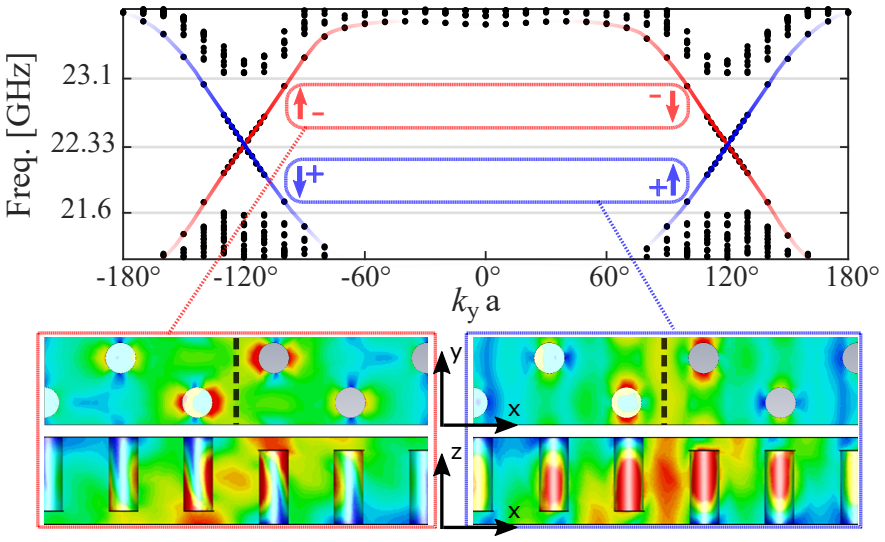
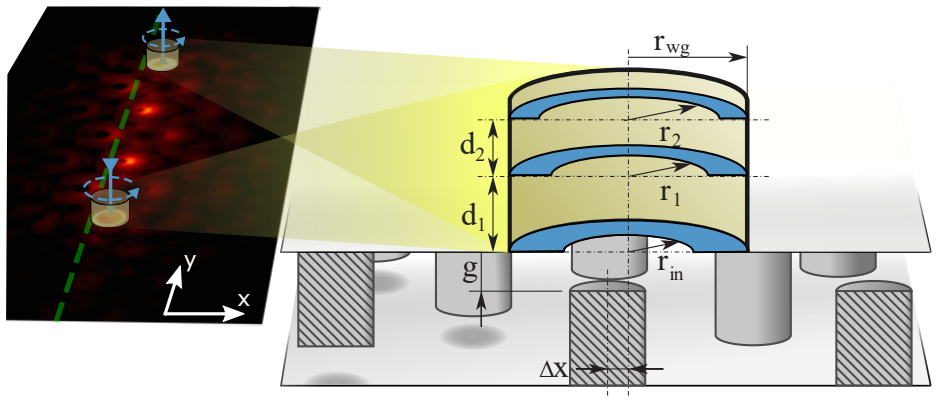
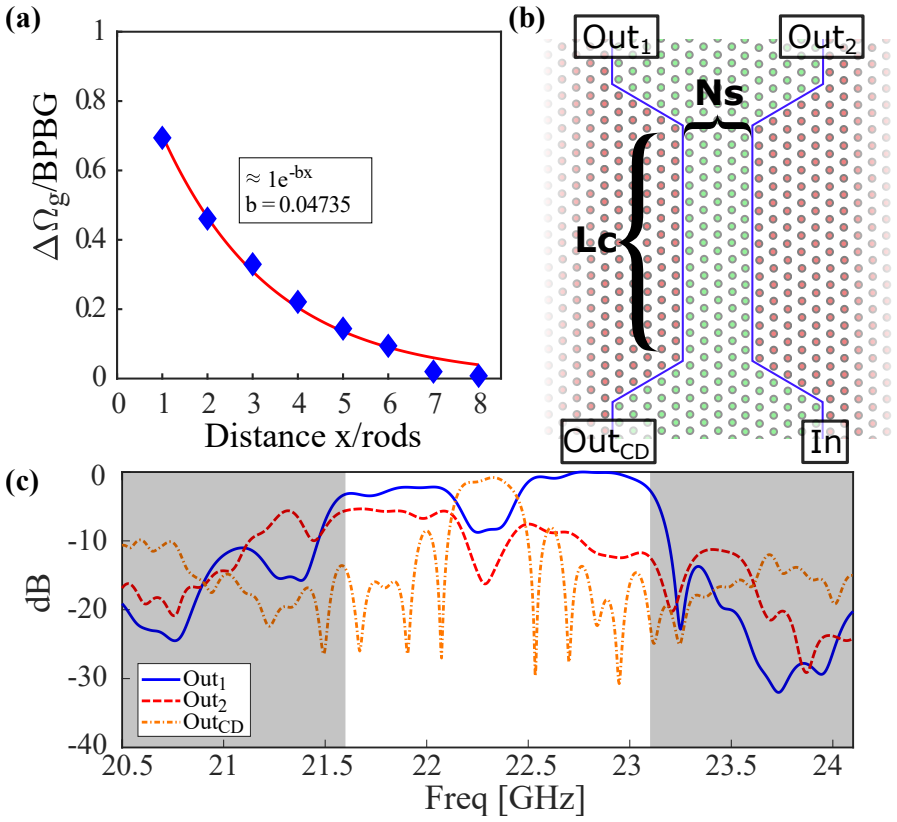
The load-bearing object is the pair of coupled topological metawaveguides, together with the circular-waveguide launcher used to reach them. The launcher rests on the degenerate TE x,y 11 modes of a circular waveguide, transformed into left and right circular polarization via the matrix $T=\frac{1}{\sqrt{2}}\begin{bmatrix}1&j\\1&-j\end{bmatrix}$, with a two-iris matching network tuned by genetic-algorithm optimization and mode-matching simulation; it converts a waveguide mode to a single quasi-spin direction and suppresses cross-polarization. The coupling analysis reduces the full 16 coupled-mode equations for the double interface to two mechanisms: spin (inter-modal) coupling between same-spin counter-propagating modes of the two waveguides, which is phase-matched only near the degeneracy point and opens the avoided-crossing gap that enables contra-directional coupling; and inter-spin (modal) coupling between opposite-spin co-propagating modes, allowed by the partial loss of topological protection in the finite central region, which splits the modes into symmetric/antisymmetric supermodes with coupling length $L_0 = \pi/\Delta_{sa}$. Separation $N_s$ controls the contra-directional bandwidth, and interaction length $L_c$ controls the directional splitting ratio.
What would settle it
Feed an LCP signal into one port of the coupler with $N_s=5$ and $L_c=30a_0$ and measure the power returning to the input port and leaving the bar port across 22.1-22.5 GHz; if a non-negligible fraction of the input returns as reflection or appears at the bar output in the anticrossing band, the neglected same-waveguide couplings are not negligible and the claimed spin-locked contra-directional coupling fails.
Extended reading notes
Core claim
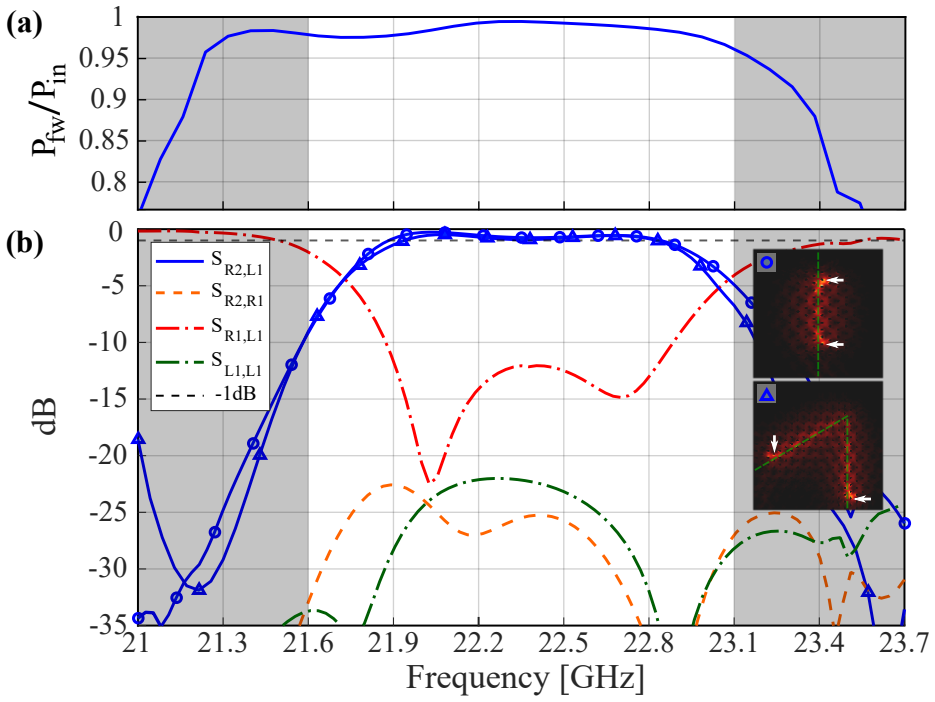
The central claim is that a local breaking of topological protection is not a defect but a design tool. A circular-waveguide launcher, optimized by standard impedance-matching methods, couples the degenerate TE11 modes of a conventional circular waveguide to the quasi-spin modes of a bianisotropic topological metawaveguide with reflection below -10 dB over 1.1 GHz, and the resulting two-port measurements show LCP-to-RCP transmission with maximum total losses of 1 dB over a 4.4% fractional bandwidth, while the unwanted spin is attenuated by more than 20 dB. When two such waveguides of opposite handedness are separated by a small number of rods, the authors show that their interaction splits into spin coupling, which opens an avoided crossing and produces contra-directional power transfer between counter-propagating modes, and inter-spin coupling, which produces symmetric and antisymmetric supermodes and directional coupling. A coupler with five interstitial rods and a coupling length of 30 lattice constants gives roughly 50% splitting below 22.1 GHz, a complete cross state above 22.5 GHz, and near-unitary contra-directional transmission between 22.1 and 22.5 GHz. The paper thereby claims a practical interface and a coupling-based topological device on this platform.
Load-bearing premise
The predicted behaviour rests on the assumption that coupling between different modes of the same topological metawaveguide is negligible, so that the full 16-equation coupled-mode problem reduces to spin and inter-spin couplings alone; if those neglected same-guide couplings become significant at the chosen separations, the device would not behave as described.
Editorial extensions
If this is right
- The launcher converts the topological waveguide into a standard two-port microwave component, so S-parameters measured with a network analyser can characterize topological propagation, including around sharp bends.
- Because straight and sharply bent topological waveguides transmit nearly identically inside the matching band, topological protection is directly observable as bend-loss immunity in a practical measurement setup.
- The hybrid coupler routes power among three ports by frequency: directional splitting below 22.1 GHz, a complete cross state above 22.5 GHz, and contra-directional transfer between 22.1 and 22.5 GHz.
- Contra-directional coupling is built in by the waveguides' spin symmetries, so no Bragg grating or detuning between waveguides is required, and spin conservation prevents self back-coupling.
- A 50/50 topological splitter of this kind could serve as a beam splitter in quantum-optics experiments on a topological platform, as the authors note.
Reading between the lines
- The launcher design separates the aperture transition from the impedance-matching network, so the same matching procedure should transfer to planar or slot antennas; testing that generalization would be a direct extension of the paper's method.
- The exponential dependence of contra-directional bandwidth on inter-waveguide separation, which the paper reports, implies that fabrication tolerances on $N_s$ will be the limiting factor for narrowband versions of the coupler; this sensitivity is an editorial inference, not analysed in the paper.
- A natural next step the paper leaves open is replacing the ideal eigenmode excitations with the matched circular-waveguide launchers at every port; the resulting full-device S-parameters would show whether the coupling picture survives end-to-end integration.
- Because the model keeps only spin and inter-spin couplings, deliberately breaking the symmetry between the two waveguides should reactivate the neglected couplings and could tune the cross-state frequency; this offers a testable lever not explored in the paper.
Signed reviews
Editorial analysis
A structured set of objections, weighed in public.
Referee Report
Summary. The manuscript presents a simulation-based design study for two millimetre-wave components built on a bianisotropic topological metawaveguide. In Section I the authors design a circular-waveguide launcher, using an optimized iris matching network, and report a reflection coefficient below -10 dB over 1.1 GHz (about 73% of the bulk bandgap) and LCP-to-RCP transmission with maximum total losses of 1 dB over a 4.4% fractional bandwidth for both straight and sharply bent waveguides. In Section II they study two coupled topological waveguides and propose that the interaction is governed by only two mechanisms: spin (inter-modal, same-spin) coupling producing a contra-directional band near the degeneracy frequency, and inter-spin (modal, opposite-spin) coupling producing directional coupling away from it. This leads to a hybrid directional/contra-directional coupler, simulated in CST, with approximately 50% splitting below 22.1 GHz, a complete cross state above 22.5 GHz, and near-unitary contra-directional transmission between 22.1 and 22.5 GHz.
Significance. If the central claims hold, the circular-waveguide launcher would solve a practical interface problem for topological waveguides, and the coupled-waveguide analysis would identify a compact, bend-immune route to routing and beam splitting. The paper's strengths are its concrete, reproducible design parameters; the use of a standard impedance-matching optimization for the launcher; the explicit presentation of the coupler study as a proof of concept; and the recognition that local breaking of topological protection is what enables coupling. The quantitative claims, however, rest entirely on full-wave simulations with no convergence study, and the coupler interpretation depends on a truncated coupled-mode model that is not validated against the simulations. These issues are fixable but central to the paper's main claims.
major comments (4)
- [Section II, opening paragraph and Fig. 5] The reduction from the full 16 coupled-mode equations to only spin and inter-spin couplings is the load-bearing assumption of the coupler section. The stated justification, that couplings between different modes of the same TPMW can be neglected 'because of their orthogonality in the uncoupled case', is not a valid coupled-mode-theory argument: orthogonality of eigenmodes of the isolated guides does not prevent a perturbation from inducing coupling between those modes, and the paper itself states in Section II.b that topological order is partially lost in the central region, so the uncoupled eigenbasis is not the appropriate basis there. Since the predicted absence of self back-coupling and the clean separation into directional and contra-directional regimes depend on this truncation, the authors should either derive the truncation from the full 16-mode system with explicit expressions for all neglected coefficients, or extract the coupling coefficients from the simulated geometry and show that the neglected terms are numerically small.
- [Section II.c and Fig. 7c] The coupler transmittances are defined from averaged field intensities recorded by six probes per port rather than from S-parameters or a modal projection. This procedure cannot cleanly separate co-directional from contra-directional power, can mask standing-wave and reflection effects, and does not quantify the impedance match at the ports. Consequently the claims of approximately 50% splitting, a complete cross state, and 'almost unitary' contra-directional transmission are not quantitatively established. The authors should report de-embedded S-parameters or modal power fluxes at all ports, including return loss, for the coupler.
- [Section I and Section II.c] No convergence or mesh-independence study is reported for any of the CST full-wave simulations. The quantitative headline numbers (below -10 dB over 1.1 GHz, 1 dB insertion loss over 4.4% bandwidth, the gap widths in Fig. 7a, and the transmission values in Fig. 7c) are all simulation-derived; a mesh refinement sweep showing stability of the S-parameters or of an energy-norm error estimate is needed to establish that these numbers are converged.
- [Section II.b and Section II.c] There is an unresolved tension between the statement that the central region partially loses topological order and the later use of spin conservation to forbid self back-coupling. If the perturbation is strong enough to break spin orthogonality, which is invoked to allow inter-spin coupling, the same perturbation could in principle induce back-coupling into the input waveguide. The manuscript should specify which symmetry, if any, survives in the coupled region and why it prohibits self back-coupling while permitting inter-spin transfer.
minor comments (5)
- [Throughout] There are numerous typographical and grammatical errors, including 'omeomorphic' (should be 'homeomorphic'), 'eneregy' (should be 'energy'), 'T opological' in the section heading, 'deg 120' (should be '120 degrees'), and 'mediating' where 'averaging' is meant. A careful copy edit is needed.
- [Section I.a, Eq. (2)] The CP-basis S-parameter transformation relies on reference 30; the convention for the rotation direction of outgoing waves should be restated in the text so that Eq. (2) is self-contained and the reader does not have to consult the cited paper.
- [Section I.b] The manuscript says the authors 'observe' transmission and reflection behavior, but the results are simulations, not measurements; the wording should be changed to 'simulate' or 'model' throughout.
- [Fig. 4 caption] The caption mentions circles and triangles for straight and bent waveguides, but the text and legend are not explicit about which symbol corresponds to which case; please define this unambiguously.
- [References] Reference 28 is listed as 'to be presented' and should be updated to a published or archival version if available, or removed if it never appears.
Circularity Check
No significant circularity: the launcher and coupler results are full-wave simulation outputs, not derivations from their own claims.
full rationale
The paper's central claims are the low-reflection circular-waveguide launcher (Section I) and the hybrid directional/contra-directional topological coupler (Section II). Neither is obtained by fitting a parameter to the claimed output or by defining a quantity in terms of the target. The reflection coefficient below -10 dB over 1.1 GHz is the result of a genetic-algorithm optimization with mode-matching and CST full-wave simulation, and the coupler transmission spectra are computed from fully simulated field intensities; the only simplification is the Section II reduction of the 16 coupled-mode problem to spin and inter-spin couplings. That truncation is an approximation with stated physical justification (orthogonality of uncoupled modes, spin conservation), and the paper presents the coupler as a qualitative proof of concept, not as a derivation of the simulation from the approximation. The self-citations (refs. 30 and 35) are used for the standard CP S-parameter basis transformation and for earlier rotating-source excitation; they are supporting tools and are not load-bearing for the claimed results. The cited topological metawaveguide platform (refs. 7 and 8) is external prior work. Under the review rules, concerns about the validity of the two-mechanism truncation are correctness risks, not circularity, and no equation in the paper reduces a predicted quantity to its own input by construction.
Assumptions & free parameters
free parameters (7)
- launcher hole radius ratio rin/r =
2.25
- iris thickness t =
0.5 mm
- iris distances d1, d2 =
6.75 mm, 7.65 mm
- iris radii r1, r2 =
0.62 rwg, 0.66 rwg
- inter-waveguide separation Ns =
5 rods
- coupling length Lc =
30 a0
- CD bandwidth decay constant b =
0.04735
assumptions (4)
- domain assumption Bulk-edge correspondence: the number of edge modes equals the difference in topological invariants across the interface.
- domain assumption The two quasi-spin sectors (RCP/LCP) are uncoupled in the unperturbed TPMW, so spin-Chern numbers are separately defined and spin is conserved during propagation.
- ad hoc to paper The coupled TPMW system can be described by only spin (inter-modal, same-spin) and inter-spin (modal, opposite-spin) couplings, neglecting intra-waveguide and higher-order cross-waveguide couplings.
- domain assumption Full-wave simulations (CST MWS) with matched impedance boundary conditions and the mode-matching method are converged and accurate.
Cite this review
Pith. "Pith review of Towards Topological Protection based millimetre wave devices." pith.science (2026). https://pith.science/paper/YAZOOUWJ
@misc{pith2026190805036,
  author       = {Pith},
  title        = {Pith review of: Towards Topological Protection based millimetre wave devices},
  year         = {2026},
  howpublished = {\url{https://pith.science/paper/YAZOOUWJ}},
  note         = {Machine review of arXiv:1908.05036}
}
read the original abstract
Feasibility of Topological Metawaveguides supporting helical propagation in the microwave range has been recently proven. The advantages of unidirectional propagation supported by such waveguides however can only be exploited in real devices if topological modes are endowed with the capability to interact within themselves as well as with trivial modes. Here we show a modal launcher to interface a topological metawaveguide with conventional circular waveguides with negligible reflection and we exploit the properties of coupled topological modes to show a proof of concept of a topological contra-directional coupler.
Figures

Figures from the paper (4 more)


Reference graph
Works this paper leans on
-
[1]
author author Z. Wang , author Y. Chong , author J. D. \ Joannopoulos , \ and\ author M. Solja c i \' c ,\ @noop journal journal Physical Review Letters \ volume 100 ( year 2008 ) NoStop
work page 2008
-
[2]
author author Z. Wang , author Y. Chong , author J. D. \ Joannopoulos , \ and\ author M. Solja c i \' c ,\ 10.1038/nature08293 journal journal Nature \ volume 461 ,\ pages 772 ( year 2009 ) NoStop
-
[3]
author author F. D. M. \ Haldane \ and\ author S. Raghu ,\ 10.1103/PhysRevLett.100.013904 journal journal Physical Review Letters \ volume 100 ( year 2008 ),\ 10.1103/PhysRevLett.100.013904 NoStop
-
[4]
author author A. B. \ Khanikaev , author S. Hossein Mousavi , author W. K. \ Tse , author M. Kargarian , author A. H. \ MacDonald , \ and\ author G. Shvets ,\ 10.1038/nmat3520 journal journal Nature Materials \ volume 12 ,\ pages 233 ( year 2013 ) NoStop
-
[5]
author author M. C. \ Rechtsman , author J. M. \ Zeuner , author Y. Plotnik , author Y. Lumer , author D. Podolsky , author F. Dreisow , author S. Nolte , author M. Segev , \ and\ author A. Szameit ,\ 10.1038/nature12066 journal journal Nature \ volume 496 ,\ pages 196 ( year 2013 ) NoStop
-
[6]
author author L. Lu , author J. D. \ Joannopoulos , \ and\ author M. Solja c i \' c ,\ 10.1038/nphoton.2014.248 journal journal Nature Photonics \ volume 8 ,\ pages 821 ( year 2014 ) NoStop
-
[7]
author author T. Ma , author A. B. \ Khanikaev , author S. H. \ Mousavi , \ and\ author G. Shvets ,\ 10.1103/PhysRevLett.114.127401 journal journal Physical Review Letters \ volume 114 ( year 2015 ),\ 10.1103/PhysRevLett.114.127401 NoStop
-
[8]
author author K. Lai , author T. Ma , author X. Bo , author S. Anlage , \ and\ author G. Shvets ,\ 10.1038/srep28453 journal journal Scientific Reports \ volume 6 ( year 2016 ),\ 10.1038/srep28453 NoStop
Show all 39 references
-
[9]
author author M. C. \ Rechtsman , author Y. Lumer , author Y. Plotnik , author A. Perez-Leija , author A. Szameit , \ and\ author M. Segev ,\ 10.1109/PIERS.2016.7734548 journal journal 2016 Progress in Electromagnetic Research Symposium (PIERS) \ volume 3 ,\ pages 974 ( year 2...
2016
-
[10]
author author A. B. \ Khanikaev \ and\ author G. Shvets ,\ 10.1038/s41566-017-0048-5 journal journal Nature Photonics \ volume 11 ,\ pages 763 ( year 2017 ) NoStop
2017 doi
-
[11]
Ozawa , author H
author author T. Ozawa , author H. M. \ Price , author A. Amo , author N. Goldman , author M. Hafezi , author L. Lu , author M. C. \ Rechtsman , author D. Schuster , author J. Simon , author O. Zilberberg , \ and\ author I. Carusotto ,\ 10.1103/RevModPhys.91.015006 journal jou...
-
[12]
author author C. L. \ Kane \ and\ author E. J. \ Mele ,\ @noop journal journal Science \ volume 314 ,\ pages 1692 ( year 2006 ) NoStop
2006
-
[13]
author author B. A. \ Bernevig , author T. L. \ Hughes , \ and\ author S.-C. \ Zhang ,\ 10.1126/science.1133734 journal journal Science \ volume 314 ( year 2006 ),\ 10.1126/science.1133734 NoStop
2006 doi
-
[14]
author author M. Z. \ Hasan \ and\ author C. L. \ Kane ,\ 10.1103/RevModPhys.82.3045 journal journal Reviews of Modern Physics \ volume 82 ,\ pages 3045 ( year 2010 ) NoStop
2010 doi
-
[15]
author author M. S. \ Rudner , author N. H. \ Lindner , author E. Berg , \ and\ author M. Levin ,\ 10.1103/PhysRevX.3.031005 journal journal Phys. Rev. X \ volume 3 ,\ pages 031005 ( year 2013 ) NoStop
2013 doi
-
[16]
Nathan \ and\ author M
author author F. Nathan \ and\ author M. S. \ Rudner ,\ 10.1088/1367-2630/17/12/125014 journal journal New Journal of Physics \ volume 17 ,\ pages 125014 ( year 2015 ) NoStop
2015 doi
-
[17]
author author J. D. \ Joannopoulos ,\ @noop title Photonic crystals \ ( publisher Princeton University Press ,\ year 2008 ) NoStop
2008
-
[18]
Longhi ,\ 10.1002/lpor.200810055 journal journal Laser & Photonics Reviews \ volume 3 ,\ pages 243 ( year 2009 ) NoStop
author author S. Longhi ,\ 10.1002/lpor.200810055 journal journal Laser & Photonics Reviews \ volume 3 ,\ pages 243 ( year 2009 ) NoStop
2009 doi
-
[19]
Ma \ and\ author G
author author T. Ma \ and\ author G. Shvets ,\ 10.1103/PhysRevB.95.165102 journal journal Physical Review B \ volume 95 ( year 2017 ),\ 10.1103/PhysRevB.95.165102 NoStop
2017 doi
-
[20]
Quelle , author C
author author A. Quelle , author C. Weitenberg , author K. Sengstock , \ and\ author C. M. \ Smith ,\ 10.1088/1367-2630/aa8646 journal journal New Journal of Physics \ volume 19 ,\ pages 113010 ( year 2017 ) NoStop
2017 doi
-
[21]
Yves , author R
author author S. Yves , author R. Fleury , author T. Berthelot , author M. Fink , author F. Lemoult , \ and\ author G. Lerosey ,\ 10.1038/ncomms16023 journal journal Nature Communications \ volume 8 ,\ pages 16023 ( year 2017 ) NoStop
-
[22]
author author L. J. \ Maczewsky , author J. M. \ Zeuner , author S. Nolte , \ and\ author A. Szameit ,\ 10.1038/ncomms13756 journal journal Nature Communications \ volume 8 ( year 2017 ),\ 10.1038/ncomms13756 NoStop
2017 doi
-
[23]
Mukherjee , author A
author author S. Mukherjee , author A. Spracklen , author M. Valiente , author E. Andersson , author P. Öhberg , author N. Goldman , \ and\ author R. R. \ Thomson ,\ 10.1038/ncomms13918 journal journal Nature Communications \ volume 8 ( year 2017 ),\ 10.1038/ncomms13918 NoStop
-
[24]
Ma \ and\ author G
author author T. Ma \ and\ author G. Shvets ,\ 10.1088/1367-2630/18/2/025012 journal journal New Journal of Physics \ volume 18 ,\ pages 25012 ( year 2016 ) NoStop
2016 doi
-
[25]
Barik , author H
author author S. Barik , author H. Miyake , author W. DeGottardi , author E. Waks , \ and\ author M. Hafezi ,\ 10.1088/1367-2630/18/11/113013 journal journal New Journal of Physics \ volume 18 ,\ pages 113013 ( year 2016 ) NoStop
2016 doi
-
[26]
author author L. J. \ Maczewsky , author B. H \"o ckendorf , author M. Kremer , author T. Biesenthal , author M. Heinrich , author A. Alvermann , author H. Fehske , \ and\ author A. Szameit ,\ @noop journal journal arXiv e-prints \ ,\ eid arXiv:1812.07930 ( year 2018 ) ,\ http...
2018 arXiv
-
[27]
He , author X.-C
author author C. He , author X.-C. \ Sun , author X.-P. \ Liu , author M.-H. \ Lu , author Y. Chen , author L. Feng , \ and\ author Y.-F. \ Chen ,\ 10.1073/pnas.1525502113 journal journal Proceedings of the National Academy of Sciences \ volume 113 ,\ pages 4924 ( year 2016 ) NoStop
-
[28]
author author G. G. \ Gentili , author N. guarducci , author G. Pelosi , author F. Piccioli , \ and\ author S. Selleri ,\ in\ @noop booktitle 2019 Progress In Electromagnetics Research Symposium (PIERS) \ ( address Rome (IT) ,\ year to be presented ) NoStop
2019
-
[29]
author author C. D. \ Graves ,\ 10.1109/JRPROC.1956.274912 journal journal Proceedings of the IRE \ volume 44 ,\ pages 248 ( year 1956 ) NoStop
1956
-
[30]
author author G. G. \ Gentili , author G. Pelosi , author F. Piccioli , \ and\ author S. Selleri ,\ 10.1002/mop.31553 journal journal Microwave and Optical Technology Letters \ volume 61 ,\ pages 464 ( year 2019 ) NoStop
2019 doi
-
[31]
Selleri ,\ 10.1109/map.2011.5949360 journal journal IEEE Antennas and Propagation Magazine \ volume 53 ,\ pages 180 ( year 2011 ) NoStop
author author S. Selleri ,\ 10.1109/map.2011.5949360 journal journal IEEE Antennas and Propagation Magazine \ volume 53 ,\ pages 180 ( year 2011 ) NoStop
2011
-
[32]
Agastra , author G
author author E. Agastra , author G. Pelosi , author S. Selleri , \ and\ author R. Taddei ,\ title Multiobjective optimization techniques , \ in\ 10.1002/047134608X.W8226 booktitle Wiley Encyclopedia of Electrical and Electronics Engineering \ ( publisher American Cancer Socie...
-
[33]
Agastra , author G
author author E. Agastra , author G. Bellaveglia , author L. Lucci , author R. Nesti , author G. Pelosi , author G. Ruggerini , \ and\ author S. Selleri ,\ 10.2528/pier08061806 journal journal Progress In Electromagnetics Research \ volume 83 ,\ pages 335 ( year 2008 ) NoStop
-
[34]
Itoh ,\ @noop title Numerical techniques for microwave and millimeter-wave passive structures \ ( publisher J
author author T. Itoh ,\ @noop title Numerical techniques for microwave and millimeter-wave passive structures \ ( publisher J. Wiley ,\ year 1989 ) NoStop
1989
-
[35]
author author G. G. \ Gentili , author G. Pelosi , author F. Piccioli , \ and\ author S. Selleri ,\ in\ 10.1109/APUSNCURSINRSM.2017.8072072 booktitle 2017 IEEE International Symposium on Antennas and Propagation & USNC/URSI National Radio Science Meeting \ ( address San Diego ...
2017
-
[36]
author author W. K. \ Burns ,\ 10.1109/50.4098 journal journal Journal of Lightwave Technology \ volume 6 ,\ pages 1051 ( year 1988 ) NoStop
1988 doi
-
[37]
Qiu \ and\ author M
author author M. Qiu \ and\ author M. Swillo ,\ 10.1016/S1569-4410(03)00003-8 journal journal Photonics and Nanostructures - Fundamentals and Applications \ volume 1 ,\ pages 23 ( year 2003 ) NoStop
2003 doi
-
[38]
Jandieri , author K
author author V. Jandieri , author K. Yasumoto , \ and\ author J. Pistora ,\ 10.1364/JOSAA.31.000518 journal journal Journal of the Optical Society of America A \ volume 31 ,\ pages 518 ( year 2014 ) NoStop
2014 doi
-
[39]
Shi , author X
author author W. Shi , author X. Wang , author C. Lin , author H. Yun , author Y. Liu , author T. Baehr-Jones , author M. Hochberg , author N. A. F. \ Jaeger , \ and\ author L. Chrostowski ,\ 10.1364/OE.21.003633 journal journal Optics Express \ volume 21 ,\ pages 3633 ( year ...
Reviewed August 14, 2026 · model on record in the stance chip above.
Discussion (0). Continue with ORCID to comment.