REVIEW 4 major objections 4 minor 57 references
Asymmetric accretion and thermal `mountains' in magnetized neutron star crusts
T0 review · 4 major / 4 minor · reviewed 2026-08-14 · deepseek-v4-flash
Pith's one-line read Magnetic funneling alone cannot explain PSR J1023+0038's spin-down; shallow crustal heating could.
desk verdict First estimate of magnetic asymmetry for thermal mountains: robust negative result for standard reactions, but the shallow-heating scenario rests on a fragile extrapolation and still falls short. read the letter →
The pith
A machine-rendered reading of the paper's core claim, the machinery that carries it, and where it could break.
The reading
What carries the argument
The argument runs on the Grad–Shafranov equation, solved numerically to find the equilibrium density structure of a magnetically confined mound of accreted matter at the polar cap. The density is expanded in spherical harmonics and the ratio $\rho_2/\rho_0$ (quadrupolar to spherical component) is extrapolated linearly to the densities of the crustal reaction layers; there it is converted, through a polytropic equation of state and a model of the heat capacity, into the quadrupolar temperature perturbation $\delta T_q/\Delta T$. That perturbation is inserted into the Ushomirsky et al. (2000) formula for the mass quadrupole produced by reaction layers.
What would settle it
A concrete way to test the claim is to compute magnetostatic equilibria of magnetic mounds with a realistic electron-degenerate equation of state for the outer crust and directly read off $\rho_2/\rho_0$ at densities above $10^9$ g cm$^{-3}$. If the ratio falls to $1\%$ before reaching $10^{10}$ g cm$^{-3}$, the shallow-heating quadrupole for J1023 shrinks below the required value. Alternatively, a detection of continuous gravitational waves from an accreting LMXB would set the ellipticity directly and settle whether the mountain is large enough to explain the spin-down.
Extended reading notes
Core claim
The central result is that magnetic confinement of accreted matter produces a quadrupolar density perturbation that is generally too weak to deform the deep crustal reaction layers enough to explain the observed spin-down of PSR J1023+0038. For standard reactions the induced quadrupole is $Q_T \approx 10^{31}$–$10^{33}$ g cm$^2$, about two orders of magnitude below the required $4.4\times10^{35}$ g cm$^2$. The exception is the outermost, shallow layers: if a shallow heating source releases $Q_M \approx 5$ MeV per baryon at $\rho \approx 10^9$ g cm$^{-3}$, as inferred from cooling curves of X-ray transients, the quadrupole becomes $Q_T\approx -8\times10^{34}$ g cm$^2$ for J1023-like parameters and $Q_T\approx -3\times10^{38}$ g cm$^2$ (ellipticity $\epsilon\approx4\times10^{-7}$) for a persistently accreting star at the Eddington rate with a $10^{10}$ G field, the latter being potentially detectable by current ground-based interferometers.
Load-bearing premise
The paper's quadrupole estimates depend on linearly extrapolating the quadrupolar density perturbation measured at densities below about $10^9$ g cm$^{-3}$ up to reaction-layer densities near $10^{13}$ g cm$^{-3}$, using a neutron-polytrope equation of state that does not match the electron-dominated outer crust; if the true scaling is steeper, the values become upper limits and could be orders of magnitude smaller.
Editorial extensions
If this is right
- Standard deep-crustal reactions alone cannot build a mountain large enough to explain PSR J1023+0038's enhanced spin-down during outburst.
- The existence of shallow heating at densities below $10^{10}$ g cm$^{-3}$ would make the quadrupole large enough, linking gravitational-wave emission to the same heating source invoked to fit cooling curves.
- Persistently accreting, strongly magnetized neutron stars with shallow heating could emit continuous gravitational waves at an ellipticity of about $4\times10^{-7}$, within reach of current detectors for known LMXBs.
- The thermal mountain is erased on a timescale of roughly $0.2 P_{30}^{3/4}$ years, so repeated outbursts are required to accumulate a compositional mountain over many episodes.
- If the quadrupole comes from temperature asymmetries alone, the signal from a single outburst would be transient; searches need to account for the thermal washout timescale.
Reading between the lines
- The extrapolation from simulated densities to reaction layers is the softest point: if the true scaling of $\rho_2/\rho_0$ with density is steeper than linear (the authors themselves note $k\approx2$ is possible), the quoted quadrupoles become upper limits and the shallow-heating explanation for J1023 could weaken.
- A realistic outer-crust equation of state dominated by degenerate electrons, rather than the neutron polytrope used here, might change the density at which the asymmetry disappears; this is testable in future magnetostatic calculations.
- The model implies that measuring the spin-down increase of other transitional millisecond pulsars during outburst could serve as an indirect probe of shallow crustal heating, complementing cooling-curve fits.
- If gravitational waves from a known LMXB are detected in the near future, the amplitude would pin down the strength and depth of the shallow heating layer, not just the magnetic field configuration.
Signed reviews
Editorial analysis
A structured set of objections, weighed in public.
Referee Report
Summary. This paper models magnetically confined accretion mounds on neutron stars using a Grad-Shafranov solver, expands the resulting density distribution in spherical harmonics, and uses the ratio rho2/rho0 to estimate quadrupolar temperature perturbations in crustal reaction layers. The authors linearly extrapolate rho2/rho0 from their simulated densities to the densities of the reaction layers in Table 1, then apply the Ushomirsky et al. (2000) quadrupole formula to estimate thermal mountains. Their central negative result is that standard deep-crustal reactions give mass quadrupoles of order 10^31-10^33 g cm^2, far below the 4.4x10^35 g cm^2 benchmark needed to explain the enhanced spin-down of PSR J1023+0038. Their positive scenario invokes a shallow heating source at rho ~ 10^9 g cm^-3 with Q_M = 5 MeV, for which they quote Q_T ~ -8x10^34 g cm^2 for J1023+0038 and Q_T ~ -3x10^38 g cm^2 for Eddington-rate accretors, and they claim the former can explain the observed spin-down and the latter may be detectable by Advanced LIGO/Virgo.
Significance. If the central claims hold, the paper would provide a quantitative first step toward connecting magnetic confinement of accreted matter with thermal mountains and continuous gravitational wave emission. The negative result for standard reactions is a useful, conservative confirmation that this mechanism cannot explain PSR J1023+0038 without additional ingredients. The paper also earns credit for using an external observational benchmark rather than fitting to the target spin-down, for using a recent reaction table (Fantina et al. 2018), and for being explicit about several limitations. However, the positive shallow-heating claim is not supported by the paper's own numbers: the quoted quadrupole is about a factor of five below the required benchmark, and the extrapolation on which it rests is fragile and acknowledged by the authors as an upper limit only if the true scaling is steeper. The manuscript is therefore a promising contribution that needs substantial revision before the positive scenario can be accepted as stated.
major comments (4)
- [§5, Eqs. (37) and (42)] The headline positive statement is numerically inconsistent with the paper's own benchmark. Equation (42) gives Q_T ~ -8x10^34 g cm^2 for the shallow-heating model, while Eq. (37) states that explaining the spin-down of PSR J1023+0038 requires Q_22 = 4.4x10^35 g cm^2; the former is smaller by a factor of about 5.5. Nevertheless, the text immediately after Eq. (42) says this quadrupole "would explain the increased spin-down of PSR J1023+0038 during outburst." This is not a wording issue: it is the central positive claim of the paper. The authors should either show quantitatively how the remaining factor is supplied (for example by a larger accreted mass, accumulation over multiple outbursts, or an additional mechanism) or explicitly state that shallow heating can only contribute about one-fifth of the required quadrupole.
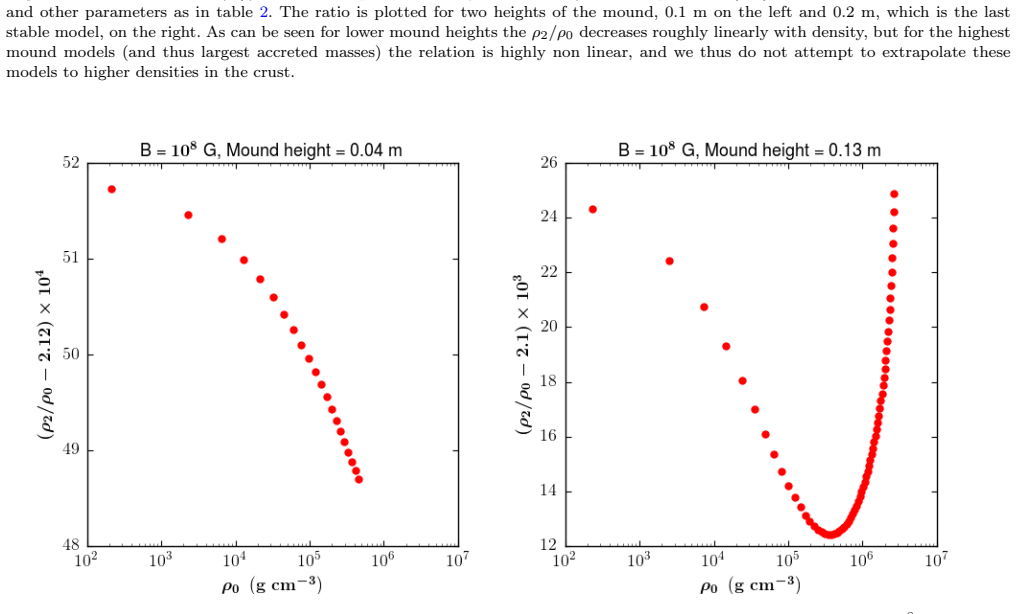
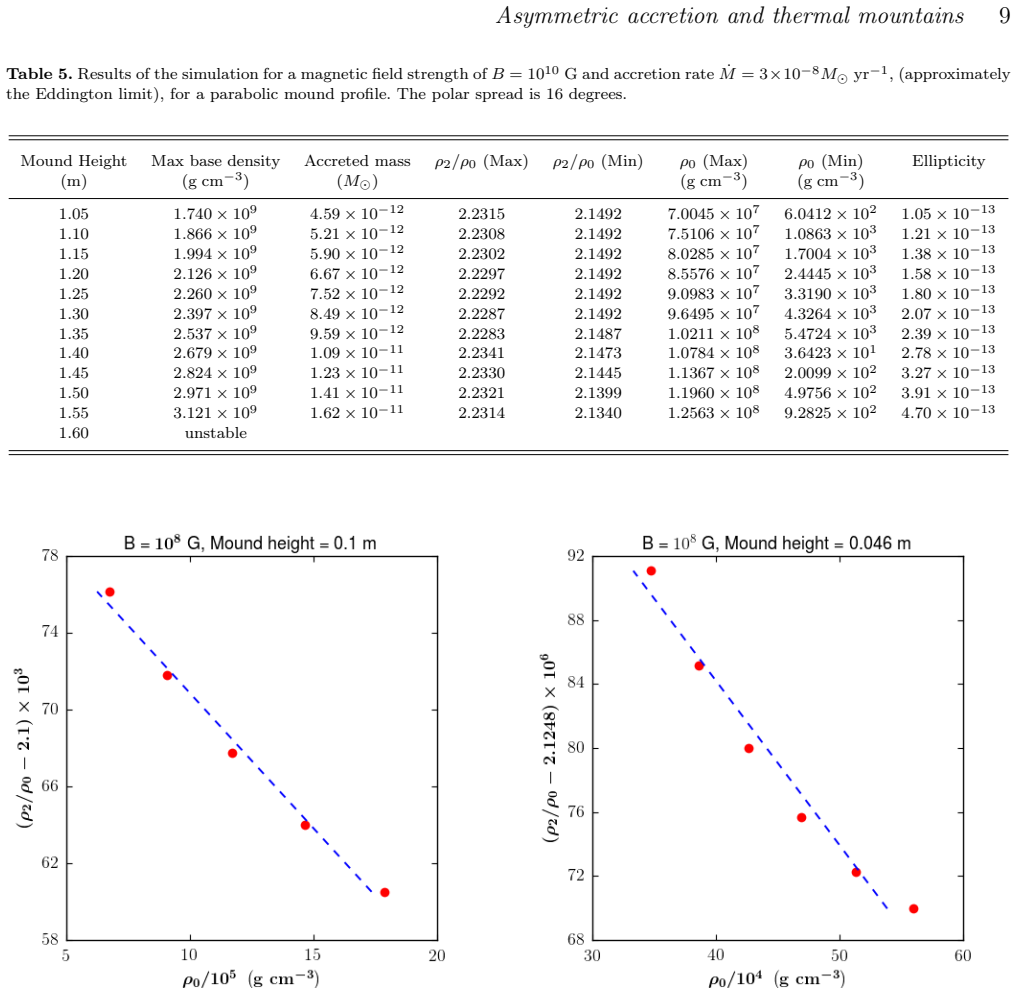
- [§4, Eq. (36) and Table 7; used in §5, Eq. (38)] The extrapolation of rho2/rho0 to the shallow-heating density rests on almost no constraining data. For the hollow-mound model used in Eq. (38) (Table 7, height 0.046 m), the simulated l=0 densities span roughly 2.6x10^2 to 5.6x10^5 g cm^-3, and rho2/rho0 changes from 2.1252 to 2.1249, a relative variation below 0.03%. A linear fit to this essentially constant ratio produces a line that remains near rho2/rho0 ~ 2 out to rho0 ~ 10^9 g cm^-3 by construction; the data do not constrain the behavior there. The authors' own caveat that a steeper decay with k ~ 2 would turn the results into upper limits applies precisely in this regime, and a k=2 power law normalized in the simulated range would reduce rho2/rho0 at 10^9 g cm^-3 by roughly two orders of magnitude. The shallow-heating estimate should therefore be presented as an upper limit with a quantitative sensitivity study (for example k = 1, 1.5, 2), not as the expected value. This concern is compounded by the acknowledged use of a Gamma = 5/3 neutron-polytrope EOS for a region that is actually electron-dominated, as noted in Sections 3.1 and 6.
- [§4, Eqs. (33)-(34)] The analytic argument offered to justify the functional form of the extrapolation is internally inconsistent. Equation (33) gives rho2/rho ~ sin^2(lambda_a/R) cos(lambda_a/R), which near lambda_a/R = pi/2 is proportional to (pi/2 - lambda_a/R). For the Gamma = 5/3 polytrope, lambda_a/R grows with density as rho^{3/2} (from Eq. (32)), so (pi/2 - lambda_a/R) decreases with density; however Eq. (34) states rho2/rho ~ rho^{3/2}, which increases with density. The two statements cannot both be true, and Eq. (34) as written predicts the opposite trend from the simulations. This paragraph should be corrected or removed; the case for a linear fit must rest on the numerical data and an explicit uncertainty analysis, not on this scaling argument.
- [§3.2 and §6] The linear perturbation framework is used in a regime where it may not be valid. The simulations give rho2/rho0 ~ 2.1 at the base of the mounds (Tables 2-5), and the linear extrapolation keeps this value near 2 at rho = 10^9 g cm^-3; substituting drho/rho0 ~ rho2/rho0 ~ 2 into Eqs. (26)-(27) yields delta T_q/Delta T of order unity, which is not a small perturbation around the spherical background. The paper notes in Section 6 that "treating this effect as a linear perturbation is likely to be an inadequate approach" for the largest quadrupoles, but it does not apply this caveat to the shallow-heating estimate that is the paper's main positive scenario. The shallow-heating numbers should be labeled as order-of-magnitude upper limits obtained from a formally invalid linearization, unless the authors can justify the linear treatment despite rho2/rho0 ~ 2.
minor comments (4)
- [§2, Eq. (4)] The expression "delta T_q/Delta T & 0.03" appears to be a LaTeX rendering error; it should read "delta T_q/Delta T >~ 0.03" or equivalent.
- [Tables 2-5] Several table entries have broken superscripts and spacing (for example Table 3 lists "1.012", "9.016", "2.589x10 4", and "5 .44x10-16"), which makes the tables difficult to read; please retypeset them carefully.
- [References] The reference entries for Gittins & Andersson (2018) and Parikh et al. (2018) give only "arXiv e-prints" with no arXiv number; please supply complete identifiers or journal details.
- [§4, Eq. (36) and Tables 6-9] The symbol rho0 is used both for the l=0 component of the density and as the independent variable in the fit rho0 = A(rho2/rho0) + B; this is confusing. Please introduce a distinct symbol for the fit variable or clarify the notation.
Circularity Check
No significant circularity: the quadrupole estimate is a forward calculation from magnetic-mound density perturbations; the J1023 target and shallow-heating input come from independent external analyses.
full rationale
The derivation chain is self-contained rather than circular. The density perturbation ρ2/ρ0 is obtained from numerical Grad-Shafranov mound equilibria (Sec. 3.1, Eqs. 13-14) and expanded in spherical harmonics (Sec. 3.2, Eq. 21); it is not fitted to the observed spin-down. The conversion to a temperature perturbation, δTq/ΔT = -[(δp30,q/p30)+(δCk,q/Ck)] (Eq. 26), together with the polytropic relation (Eq. 27) and heat-capacity perturbation (Eqs. 30-31), is an algebraic model with explicitly stated assumptions (e.g., T ≈ ΔT, δT22 ≈ δT20); none of these equations contains the target quadrupole 4.4×10^35 g cm^2. That target is an external benchmark cited from Haskell & Patruno (2017) and Haskell et al. (2018), which are in turn anchored to timing observations of J1023+0038, and the shallow-heating strength QM ≈ 5 MeV is taken from independent cooling-curve analyses (Deibel et al. 2015; Waterhouse et al. 2016; Parikh et al. 2017, 2018). No parameter is fitted to the spin-down observable: the quoted shallow-heating quadrupole QT ≈ -8×10^34 g cm^2 (Sec. 5, Eq. 42) is a forward product of the chosen QM, ΔM, and extrapolated density ratio, and is in fact below the required benchmark. The linear extrapolation (Eq. 36) and the Γ=5/3 neutron-polytrope EOS are acknowledged limitations that affect numerical accuracy and could make the results upper limits, but they are not a restatement of the input or a hidden fit. The self-citations in the paper (Haskell & Patruno 2017; Haskell et al. 2015, 2018) set the observational context and target, but do not supply the derived quadrupole, so they are not load-bearing in a circular sense.
Assumptions & free parameters
free parameters (4)
- Linear fit slope A and intercept B =
Varies by model; e.g., A=-9.721e9, B=2.065e10 for hollow mound, B=1e8 G, ΔM=1.63e-15 Msun
- Shallow heating energy release QM =
5 MeV per baryon at ρ=1e9 g/cm^3
- Polytropic EOS constants K and Γ =
K = 5.4e9 cgs, Γ = 5/3
- Background crustal temperature T =
1e7 K for PSR J1023+0038, 1e8 K for Eddington accretors
assumptions (4)
- domain assumption Static, axisymmetric ideal MHD equilibrium described by the Grad-Shafranov equation with prescribed mound height profiles (parabolic and hollow).
- domain assumption The l=2, m=0 density perturbation can be used in place of the l=2, m=2 temperature perturbation (δT22≈δT20).
- domain assumption Crustal temperature is dominated by local crustal heating, so T≈ΔT(l=0), and δTq/ΔT is given by the sum of fractional pressure and heat capacity perturbations (Eqs. 25-26).
- ad hoc to paper The ratio ρ2/ρ0 can be linearly extrapolated to densities up to about 1e13 g/cm^3.
Cite this review
Pith. "Pith review of Asymmetric accretion and thermal `mountains' in magnetized neutron star crusts." pith.science (2026). https://pith.science/paper/KTMEXUSZ
@misc{pith2026190805038,
  author       = {Pith},
  title        = {Pith review of: Asymmetric accretion and thermal `mountains' in magnetized neutron star crusts},
  year         = {2026},
  howpublished = {\url{https://pith.science/paper/KTMEXUSZ}},
  note         = {Machine review of arXiv:1908.05038}
}
read the original abstract
Accreting neutron stars are one of the main targets for continuous gravitational wave searches, as asymmetric accretion may lead to quadrupolar deformations, or `mountains', on the crust of the star, which source gravitational wave emission at twice the rotation frequency. The gravitational wave torque may also impact on the spin evolution of the star, possibly dictating the currently observed spin periods of neutron stars in Low Mass X-ray Binaries and leading to the increased spindown rate observed during accretion in PSR J1023+0038. Previous studies have shown that deformed reaction layers in the crust of the neutron star lead to thermal and compositional gradients that can lead to gravitational wave emission. However, there are no realistic constraints on the level of asymmetry that is expected. In this paper we consider a natural source of asymmetry, namely the magnetic field, and calculate the density and pressure perturbations that are expected in the crust of accreting neutron stars. In general we find that only the outermost reaction layers of the neutron star are strongly perturbed. The mass quadrupole that we estimate is generally small and cannot explain the increase of spin-down rate of PSR J1023+0038. However, if strong shallow heating sources are present at low densities in the crust, as cooling observations suggest, these layers will be strongly perturbed and the resulting quadrupole could explain the observed spindown of PSR J1023+0038, and lead to observable gravitational wave signals from systems with higher accretion rates.
Figures

Figures from the paper (2 more)


Reference graph
Works this paper leans on
-
[1]
Abbott B. P., et al., 2016, @doi [Phys. Rev. Lett.] 10.1103/PhysRevLett.116.061102 , 116, 061102
-
[2]
Abbott B. P., et al., 2017, @doi [Phys. Rev. Lett.] 10.1103/PhysRevLett.119.161101 , 119, 161101
-
[3]
Abbott B. P., et al., 2018, @doi [Phys. Rev. Lett.] 10.1103/PhysRevLett.121.161101 , 121, 161101
-
[4]
Abbott B. P., et al., 2019a, @doi [Phys. Rev. D] 10.1103/PhysRevD.99.122002 , 99, 122002
-
[5]
Abbott B. P., et al., 2019b, @doi [Phys. Rev. D] 10.1103/PhysRevD.100.024004 , 100, 024004
-
[6]
P., et al., 2019c, @doi [The Astrophysical Journal] 10.3847/1538-4357/ab20cb , 879, 10
Abbott B. P., et al., 2019c, @doi [The Astrophysical Journal] 10.3847/1538-4357/ab20cb , 879, 10
-
[7]
Alpar M. A., Cheng A. F., Ruderman M. A., Shaham J., 1982, @doi [ ] 10.1038/300728a0 , http://adsabs.harvard.edu/abs/1982Natur.300..728A 300, 728
doi:10.1038/300728a0 1982
-
[8]
Andersson N., Glampedakis K., Haskell B., Watts A. L., 2005, @doi [ ] 10.1111/j.1365-2966.2005.09167.x , http://adsabs.harvard.edu/abs/2005MNRAS.361.1153A 361, 1153
arXiv 2005
Show all 57 references
-
[9]
M., et al., 2009, @doi [Science] 10.1126/science.1172740 , http://adsabs.harvard.edu/abs/2009Sci...324.1411A 324, 1411
Archibald A. M., et al., 2009, @doi [Science] 10.1126/science.1172740 , http://adsabs.harvard.edu/abs/2009Sci...324.1411A 324, 1411
2009 doi
-
[10]
A., Chugunov A
Baiko D. A., Chugunov A. I., 2018, @doi [ ] 10.1093/mnras/sty2259 , http://adsabs.harvard.edu/abs/2018MNRAS.480.5511B 480, 5511
2018 doi
-
[11]
Bildsten L., 1998, @doi [ ] 10.1086/311440 , http://adsabs.harvard.edu/abs/1998ApJ...501L..89B 501, L89
1998 doi
-
[12]
Bonazzola S., Gourgoulhon E., 1996, , https://ui.adsabs.harvard.edu/abs/1996A&A...312..675B 312, 675
1996
-
[13]
F., Bildsten L., 1998, @doi [ ] 10.1086/305419 , http://adsabs.harvard.edu/abs/1998ApJ...496..915B 496, 915
Brown E. F., Bildsten L., 1998, @doi [ ] 10.1086/305419 , http://adsabs.harvard.edu/abs/1998ApJ...496..915B 496, 915
1998 doi
-
[14]
F., Bildsten L., Rutledge R
Brown E. F., Bildsten L., Rutledge R. E., 1998, @doi [ ] 10.1086/311578 , http://adsabs.harvard.edu/abs/1998ApJ...504L..95B 504, L95
1998 doi
-
[15]
Cavecchi Y., et al., 2011, @doi [ ] 10.1088/2041-8205/740/1/L8 , https://ui.adsabs.harvard.edu/abs/2011ApJ...740L...8C 740, L8
2011 doi
-
[16]
F., Zdunik J
Chamel N., Fantina A. F., Zdunik J. L., Haensel P., 2015, @doi [ ] 10.1103/PhysRevC.91.055803 , http://adsabs.harvard.edu/abs/2015PhRvC..91e5803C 91, 055803
2015 doi
-
[17]
S., 1994, @doi [ ] 10.1086/173976 , http://adsabs.harvard.edu/abs/1994ApJ...425..210C 425, 210
Chong N., Cheng K. S., 1994, @doi [ ] 10.1086/173976 , http://adsabs.harvard.edu/abs/1994ApJ...425..210C 425, 210
1994 doi
-
[18]
R., 2017, @doi [ ] 10.1093/mnras/stx1306 , http://adsabs.harvard.edu/abs/2017MNRAS.470.3316D 470, 3316
D'Angelo C. R., 2017, @doi [ ] 10.1093/mnras/stx1306 , http://adsabs.harvard.edu/abs/2017MNRAS.470.3316D 470, 3316
2017 doi
-
[19]
F., Page D., 2015, @doi [ ] 10.1088/2041-8205/809/2/L31 , http://adsabs.harvard.edu/abs/2015ApJ...809L..31D 809, L31
Deibel A., Cumming A., Brown E. F., Page D., 2015, @doi [ ] 10.1088/2041-8205/809/2/L31 , http://adsabs.harvard.edu/abs/2015ApJ...809L..31D 809, L31
2015 doi
-
[20]
F., Lamb F
Elsner R. F., Lamb F. K., 1977, @doi [ ] 10.1086/155427 , http://adsabs.harvard.edu/abs/1977ApJ...215..897E 215, 897
1977 doi
-
[21]
F., Zdunik J
Fantina A. F., Zdunik J. L., Chamel N., Pearson J. M., Haensel P., Goriely S., 2018, @doi [ ] 10.1051/0004-6361/201833605 , http://adsabs.harvard.edu/abs/2018A
2018 doi
-
[22]
K., 1979, @doi [ ] 10.1086/157285 , http://adsabs.harvard.edu/abs/1979ApJ...232..259G 232, 259
Ghosh P., Lamb F. K., 1979, @doi [ ] 10.1086/157285 , http://adsabs.harvard.edu/abs/1979ApJ...232..259G 232, 259
1979 doi
-
[23]
Gittins F., Andersson N., 2018, arXiv e-prints, http://adsabs.harvard.edu/abs/2018arXiv181100550G
2018
-
[24]
M., 2010, @doi [ ] 10.1103/PhysRevC.82.035804 , http://adsabs.harvard.edu/abs/2010PhRvC..82c5804G 82, 035804
Goriely S., Chamel N., Pearson J. M., 2010, @doi [ ] 10.1103/PhysRevC.82.035804 , http://adsabs.harvard.edu/abs/2010PhRvC..82c5804G 82, 035804
2010 doi
-
[25]
L., 1990, , http://adsabs.harvard.edu/abs/1990A
Haensel P., Zdunik J. L., 1990, , http://adsabs.harvard.edu/abs/1990A
1990
-
[26]
Haskell B., Patruno A., 2017, @doi [Physical Review Letters] 10.1103/PhysRevLett.119.161103 , http://adsabs.harvard.edu/abs/2017PhRvL.119p1103H 119, 161103
2017 doi
-
[27]
I., Andersson N., 2006, @doi [ ] 10.1111/j.1365-2966.2006.10998.x , http://adsabs.harvard.edu/abs/2006MNRAS.373.1423H 373, 1423
Haskell B., Jones D. I., Andersson N., 2006, @doi [ ] 10.1111/j.1365-2966.2006.10998.x , http://adsabs.harvard.edu/abs/2006MNRAS.373.1423H 373, 1423
2006
-
[29]
D., 2015, @doi [ ] 10.1093/mnras/stv726 , http://adsabs.harvard.edu/abs/2015MNRAS.450.2393H 450, 2393
Haskell B., Priymak M., Patruno A., Oppenoorth M., Melatos A., Lasky P. D., 2015, @doi [ ] 10.1093/mnras/stv726 , http://adsabs.harvard.edu/abs/2015MNRAS.450.2393H 450, 2393
2015 doi
-
[30]
L., Fortin M., Bejger M., Wijnands R., Patruno A., 2018, @doi [ ] 10.1051/0004-6361/201833521 , http://adsabs.harvard.edu/abs/2018A
Haskell B., Zdunik J. L., Fortin M., Bejger M., Wijnands R., Patruno A., 2018, @doi [ ] 10.1051/0004-6361/201833521 , http://adsabs.harvard.edu/abs/2018A
2018 doi
-
[31]
Heng K., Spitkovsky A., 2009, @doi [ ] 10.1088/0004-637X/703/2/1819 , http://adsabs.harvard.edu/abs/2009ApJ...703.1819H 703, 1819
2009 doi
-
[32]
J., Kadau K., 2009, @doi [Physical Review Letters] 10.1103/PhysRevLett.102.191102 , http://adsabs.harvard.edu/abs/2009PhRvL.102s1102H 102, 191102
Horowitz C. J., Kadau K., 2009, @doi [Physical Review Letters] 10.1103/PhysRevLett.102.191102 , http://adsabs.harvard.edu/abs/2009PhRvL.102s1102H 102, 191102
2009 doi
-
[33]
M., Hessels J
Jaodand A., Archibald A. M., Hessels J. W. T., Bogdanov S., D'Angelo C. R., Patruno A., Bassa C., Deller A. T., 2016, @doi [ ] 10.3847/0004-637X/830/2/122 , http://adsabs.harvard.edu/abs/2016ApJ...830..122J 830, 122
2016 doi
-
[34]
K., Owen B
Johnson-McDaniel N. K., Owen B. J., 2013, @doi [ ] 10.1103/PhysRevD.88.044004 , http://adsabs.harvard.edu/abs/2013PhRvD..88d4004J 88, 044004
2013 doi
-
[35]
Klu \'z niak W., Rappaport S., 2007, @doi [ ] 10.1086/522954 , http://adsabs.harvard.edu/abs/2007ApJ...671.1990K 671, 1990
2007 doi
-
[36]
F., Rosner R., 2001, @doi [ ] 10.1086/320952 , https://ui.adsabs.harvard.edu/abs/2001ApJ...553..788L 553, 788
Litwin C., Brown E. F., Rosner R., 2001, @doi [ ] 10.1086/320952 , https://ui.adsabs.harvard.edu/abs/2001ApJ...553..788L 553, 788
2001 doi
-
[37]
Mukherjee D., 2017, @doi [Journal of Astrophysics and Astronomy] 10.1007/s12036-017-9465-6 , http://adsabs.harvard.edu/abs/2017JApA...38...48M 38, 48
2017 doi
-
[39]
Mukherjee D., Bhattacharya D., Mignone A., 2013a, @doi [ ] 10.1093/mnras/stt020 , http://adsabs.harvard.edu/abs/2013MNRAS.430.1976M 430, 1976
1976 doi
-
[40]
Mukherjee D., Bhattacharya D., Mignone A., 2013b, @doi [ ] 10.1093/mnras/stt1344 , http://adsabs.harvard.edu/abs/2013MNRAS.435..718M 435, 718
-
[41]
E., 1978, @doi [ ] 10.1093/mnras/184.3.501 , http://adsabs.harvard.edu/abs/1978MNRAS.184..501P 184, 501
Papaloizou J., Pringle J. E., 1978, @doi [ ] 10.1093/mnras/184.3.501 , http://adsabs.harvard.edu/abs/1978MNRAS.184..501P 184, 501
1978 doi
-
[42]
S., et al., 2017, @doi [ ] 10.3847/2041-8213/aa9e03 , http://adsabs.harvard.edu/abs/2017ApJ...851L..28P 851, L28
Parikh A. S., et al., 2017, @doi [ ] 10.3847/2041-8213/aa9e03 , http://adsabs.harvard.edu/abs/2017ApJ...851L..28P 851, L28
2017 doi
-
[43]
S., et al., 2018, arXiv e-prints, http://adsabs.harvard.edu/abs/2018arXiv181005626P
Parikh A. S., et al., 2018, arXiv e-prints, http://adsabs.harvard.edu/abs/2018arXiv181005626P
2018
-
[44]
Patruno A., Haskell B., Andersson N., 2017, @doi [ ] 10.3847/1538-4357/aa927a , http://adsabs.harvard.edu/abs/2017ApJ...850..106P 850, 106
2017 doi
-
[45]
Payne D. J. B., Melatos A., 2004, @doi [ ] 10.1111/j.1365-2966.2004.07798.x , http://adsabs.harvard.edu/abs/2004MNRAS.351..569P 351, 569
2004
-
[46]
Payne D. J. B., Melatos A., 2007, @doi [ ] 10.1111/j.1365-2966.2007.11451.x , http://adsabs.harvard.edu/abs/2007MNRAS.376..609P 376, 609
2007
-
[47]
Y., Pons J
Potekhin A. Y., Pons J. A., Page D., 2015, @doi [ ] 10.1007/s11214-015-0180-9 , http://adsabs.harvard.edu/abs/2015SSRv..191..239P 191, 239
2015 doi
-
[48]
Priymak M., Melatos A., Payne D. J. B., 2011, @doi [ ] 10.1111/j.1365-2966.2011.19431.x , http://adsabs.harvard.edu/abs/2011MNRAS.417.2696P 417, 2696
2011
-
[49]
Riles K., 2017, @doi [Modern Physics Letters A] 10.1142/S021773231730035X , http://adsabs.harvard.edu/abs/2017MPLA...3230035R 32, 1730035
2017 doi
-
[50]
Shibazaki N., Murakami T., Shaham J., Nomoto K., 1989, @doi [ ] 10.1038/342656a0 , http://adsabs.harvard.edu/abs/1989Natur.342..656S 342, 656
1989 doi
-
[51]
C., Taam R
Spruit H. C., Taam R. E., 1993, @doi [ ] 10.1086/172162 , http://adsabs.harvard.edu/abs/1993ApJ...402..593S 402, 593
1993 doi
-
[52]
G., Mastrano A., Geppert U., 2016, @doi [ ] 10.1093/mnras/stw909 , http://adsabs.harvard.edu/abs/2016MNRAS.459.3407S 459, 3407
Suvorov A. G., Mastrano A., Geppert U., 2016, @doi [ ] 10.1093/mnras/stw909 , http://adsabs.harvard.edu/abs/2016MNRAS.459.3407S 459, 3407
2016 doi
-
[53]
E., 2001, @doi [ ] 10.1046/j.1365-8711.2001.04515.x , http://adsabs.harvard.edu/abs/2001MNRAS.325.1157U 325, 1157
Ushomirsky G., Rutledge R. E., 2001, @doi [ ] 10.1046/j.1365-8711.2001.04515.x , http://adsabs.harvard.edu/abs/2001MNRAS.325.1157U 325, 1157
2001
-
[54]
Ushomirsky G., Cutler C., Bildsten L., 2000, @doi [ ] 10.1046/j.1365-8711.2000.03938.x , http://adsabs.harvard.edu/abs/2000MNRAS.319..902U 319, 902
2000
-
[56]
Wang Y.-M., 1996, @doi [ ] 10.1086/310150 , http://adsabs.harvard.edu/abs/1996ApJ...465L.111W 465, L111
1996 doi
-
[57]
C., Degenaar N., Wijnands R., Brown E
Waterhouse A. C., Degenaar N., Wijnands R., Brown E. F., Miller J. M., Altamirano D., Linares M., 2016, @doi [ ] 10.1093/mnras/stv2959 , http://adsabs.harvard.edu/abs/2016MNRAS.456.4001W 456, 4001
2016 doi
-
[58]
L., Krishnan B., Bildsten L., Schutz B
Watts A. L., Krishnan B., Bildsten L., Schutz B. F., 2008, @doi [ ] 10.1111/j.1365-2966.2008.13594.x , https://ui.adsabs.harvard.edu/abs/2008MNRAS.389..839W 389, 839
2008
-
[59]
Wijnands R., Degenaar N., Page D., 2017, @doi [Journal of Astrophysics and Astronomy] 10.1007/s12036-017-9466-5 , http://adsabs.harvard.edu/abs/2017JApA...38...49W 38, 49
2017 doi
-
[60]
A., 1991, @doi [ ] 10.1086/191538 , http://adsabs.harvard.edu/abs/1991ApJS...75..449V 75, 449
van Riper K. A., 1991, @doi [ ] 10.1086/191538 , http://adsabs.harvard.edu/abs/1991ApJS...75..449V 75, 449
1991 doi
Reviewed August 14, 2026 · model on record in the stance chip above.
Discussion (0). Continue with ORCID to comment.