REVIEW 3 major objections 3 minor 28 references
Network Lifetime Maximization in Wireless Mesh Networks for Machine-to-Machine Communication
T0 review · 3 major / 3 minor · reviewed 2026-08-14 · deepseek-v4-flash
Pith's one-line read Reconfiguring a wireless mesh network as batteries drain can extend its lifetime by up to 75 percent, using only around ten distinct configurations.
desk verdict Solid column-generation formulation for lifetime-maximizing reconfiguration in M2M mesh networks; read the 75% baseline carefully. read the letter →
The pith
A machine-rendered reading of the paper's core claim, the machinery that carries it, and where it could break.
The reading
What carries the argument
The key machinery is the split between a non-compact master problem and a pricing problem. The master problem maximizes the sum of configuration timeshares subject to per-node battery depletion constraints; its dual assigns prices to nodes' energy use. The pricing problem then finds a valid configuration with minimum reduced cost, i.e., minimum sum of dual prices times depletion fractions, while enforcing the nK-condition, loop-free routing, and aggregation of multiple measurements into single transmissions. Column generation iterates between these two problems, and a price-and-branch step solves the integer version once the configuration set is fixed.
What would settle it
Compute, on the same 10- to 30-node random networks, the best lifetime achievable with exactly one configuration, for example by maximizing the minimum node lifetime rather than minimizing total energy, and compare it with the multi-configuration lifetime. If the best single configuration already comes within a few percent of the multi-configuration lifetime, the reported 75% improvement would be an artifact of comparing against the minimum-energy configuration rather than a genuine reconfiguration gain.
Extended reading notes
Core claim
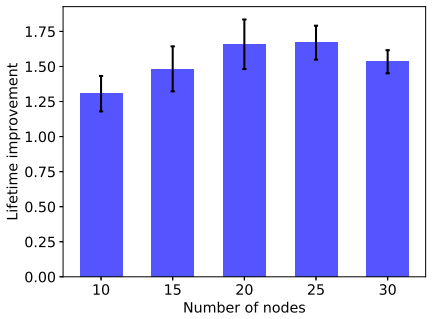
The central claim is that maximum network lifetime under the nK-condition can be expressed as an integer or linear program over configurations, where each configuration is a valid combination of sensor, aggregator, and actuator roles plus routing that delivers K unique measurements to each of n actuators, and the solution is a set of configurations with timeshares in measurement periods. Because the number of valid configurations is exponential, the paper solves the linear relaxation by column generation; the pricing problem generates the configuration most improving the lifetime by minimizing the sum of dual-weighted battery depletion fractions, subject to flow conservation, routing, and aggregation constraints taken from the earlier nK energy-minimization formulation. The numerical study reports lifetime improvements up to 75% compared with using only the minimum-total-energy configuration, and shows that the optimal solutions use around 10 configurations, implying reconfiguration overhead is low.
Load-bearing premise
The headline gain is measured against a single minimal-energy configuration; if the natural comparison is instead the best single configuration for lifetime, the advantage of reconfiguration may be smaller than 75%.
Editorial extensions
If this is right
- A deployed mesh network can get materially longer useful life by cycling through a handful of configurations rather than operating one energy-efficient configuration.
- Because the master problem is task-agnostic, the same lifetime-maximization framework applies to any other network task by swapping in a new pricing problem.
- The linear relaxation solution scales with battery capacities, so it can be used to dimension batteries for a target lifetime, with quantization error shrinking as capacities grow.
- Rounding down the linear-relaxation timeshares gives a feasible integer schedule that is nearly optimal, so practical deployment does not require full branch-and-price.
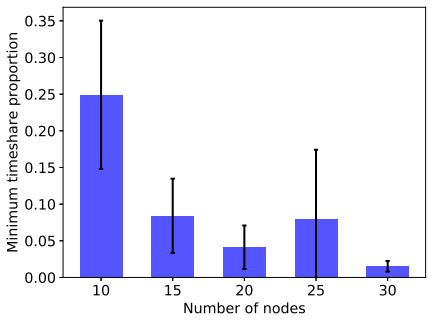
- Only modest storage and infrequent synchronization are needed, since roughly 10 configurations suffice even for the largest tested networks.
Reading between the lines
- The 75% figure is measured against the minimum-total-energy configuration; if the comparison were instead the best single configuration chosen for lifetime, the reconfiguration gain would likely be smaller, since part of the gain is just the difference between lifetime-optimal and energy-optimal single configurations.
- The exponential growth in pricing-problem solution time (from about 1.6 seconds at 10 nodes to about 227 hours at 30 nodes) suggests that for larger networks the column-generation loop, not the master problem, will be the practical bottleneck; real-time reconfiguration would need faster pricing heuristics or precomputation.
- A testable extension would be to include switching energy explicitly in the master problem, or to compare against the best single-configuration lifetime solution as the baseline, which would separate the benefit of reconfiguration per se from the benefit of lifetime-aware configuration.
Signed reviews
Editorial analysis
A structured set of objections, weighed in public.
Referee Report
Summary. The manuscript studies the maximum lifetime of a wireless mesh network performing machine-to-machine data aggregation and dissemination under the nK-condition (n actuators each collecting K measurements). It formulates a non-compact integer master problem over all valid network configurations, solves its linear relaxation by column generation, and prices new configurations with a routing/aggregation mixed-integer program adapted from the authors' earlier energy-minimization work [1]. The integer master is solved by a price-and-branch approach, and lower and upper bounds are compared. A numerical study on randomly generated networks of 10 to 30 nodes reports that the optimal lifetime is up to about 75% larger than that of a single minimal-total-energy configuration, that roughly ten configurations are used, and that the main computational burden is in the pricing problem.
Significance. The master/pricing decomposition is clean and general: the task-specific constraints are isolated in the pricing problem, and the reduced-cost criterion (min π[E] < 1) is standard and correctly stated. The paper is also transparent about the suboptimality of price-and-branch and about the rounding-based bounds, which is a useful practical contribution. However, the headline numerical claim is not benchmarked against the best single lifetime-optimal configuration, so the specific gain attributable to reconfiguration is not yet established. In addition, the pricing formulation as written contains variable-domain and indexing errors that must be corrected before the approach can be applied as stated. With these fixes and a fair baseline comparison, the paper would make a solid contribution to practical network-lifetime optimization.
major comments (3)
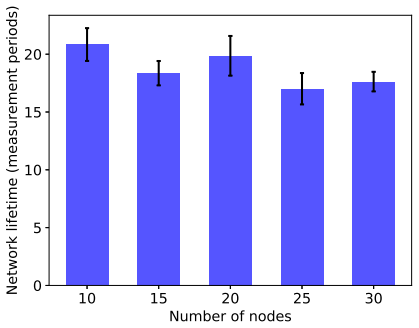
- [Section 4.1.1, Figures 2-3, Abstract] The headline 'up to 75%' improvement is measured against the single minimal-total-energy configuration obtained from the authors' prior work [1], not against the best single configuration chosen for lifetime. Since a single configuration can already be chosen to minimize the maximum depletion rate, the correct null model for quantifying the value of reconfiguration is max_{c in C} 1 / max_{v in O union N} E(v,c). This baseline is not reported. Without it, the portion of the 75% gain attributable to reconfiguration, and hence the practical significance of 'only around 10 configurations', is unquantified. Please add this baseline and restate the improvement relative to it.
- [Section 3, 'nK-condition'; Section 3.4, constraint (4b)] The problem definition states that n may be smaller than the total number of actuators, but the pricing problem imposes sum_{o in O} x_od >= K for every d in D. There is no variable selecting which n actuators must receive measurements. If |D| > n, the formulation solves a different, stronger problem. Please either restrict the model to the case n = |D| and state this explicitly, or extend the pricing problem with destination-selection variables and constraints.
- [Section 3.4, constraints (4j), (4m), (4u)] The pricing formulation has formal errors that affect its correctness. Variable X_{oo'}^v is declared only for v in N union D in (4u), but constraint (4j) quantifies over all v in V; since Section 3.1 explicitly allows origin nodes to aggregate, X must also be defined for v in O. In addition, constraint (4m) uses the index v in the summation sum_{a in delta^-(v)} Y_a, but the constraint is written for an origin node o; the summation should be over delta^-(o). These inconsistencies must be corrected for the column-generation pricing problem to be a valid formulation.
minor comments (3)
- [Section 3.4, text after (4e)-(4h)] The sentence 'on arcs with no transmissions they are forced to 1 (constraint (4f))' appears to be a typo: constraint (4f) is an upper bound, Y_a <= sum_{o,d} z_od^a, so on arcs with no transmissions Y_a is forced to 0, not 1.
- [Section 3 and Table 2] The parameter n appearing in the nK-condition is never defined in the notation table. Please state its value in the numerical study (presumably n = |D|) and align it with the general definition given in Section 3.
- [Figures 2 and 7] The linear-relaxation results use battery capacity B = 100, while the integer results use B = 1000; stating these values in the captions would make the comparison across figures easier to follow.
Circularity Check
No circularity found; the lifetime maximization and the 75% gain are produced by explicit optimization against a stated min-energy baseline, not by construction.
full rationale
The paper presents a standard master–pricing decomposition: formulation (1) maximizes configuration timeshares subject to battery constraints, the linear relaxation (2) is solved by column generation, and the pricing problem (4) minimizes the dual-weighted depletion fraction over configurations satisfying the nK routing and aggregation constraints. The pricing constraints are taken from the authors' prior work [1] with the objective changed from total energy to dual cost, which is an explicit modeling choice rather than a hidden identification of the result with its inputs. The numerical claim is an optimization output: 20 random networks per size are solved, and the up-to-75% improvement is compared with 'the configuration that gives the minimal total energy'—the column-generation seed—as stated in Section 4 and Figure 3. Even though a best-single-lifetime-configuration baseline might change the magnitude of the gain attributed to reconfiguration, that is a baseline-interpretation question, not circularity: the reported gain is not fitted to any target and does not reuse the answer in the question. Self-citations to [1] supply the model and network-generation parameters, but [1] is prior published work with independent content and is not invoked as an unverified uniqueness or ansatz theorem. No step in the derivation reduces by definition to its own inputs.
Assumptions & free parameters
free parameters (4)
- Transmission energy cost T(a) =
5 (relative units)
- Aggregation energy cost S(v) =
1 (relative units)
- Battery capacity B(v) for integer master problem =
1000 (energy units)
- Network generation parameters (area width, K, |O|, |D|, |N|) =
See Table 2 (scaled with network size)
assumptions (6)
- domain assumption Wireless links exist between nodes within range if SNR is satisfactory, and transmissions can be serialized within a measurement period so interference is ignored.
- domain assumption Nodes consume energy only for sensing, aggregation, receiving, and transmitting; sleep energy is negligible.
- domain assumption Reception energy is included in transmission or aggregation energy rather than modeled separately.
- domain assumption Destination nodes have unlimited battery capacity.
- domain assumption The nK-condition (n destinations each collect K unique measurements) defines a valid configuration and the network lifetime.
- standard math Price-and-branch over the column set produced at the root yields a feasible (generally suboptimal) integer solution, with bounds from LR floor/ceiling.
Cite this review
Pith. "Pith review of Network Lifetime Maximization in Wireless Mesh Networks for Machine-to-Machine Communication." pith.science (2026). https://pith.science/paper/X43ISKFW
@misc{pith2026190805055,
  author       = {Pith},
  title        = {Pith review of: Network Lifetime Maximization in Wireless Mesh Networks for Machine-to-Machine Communication},
  year         = {2026},
  howpublished = {\url{https://pith.science/paper/X43ISKFW}},
  note         = {Machine review of arXiv:1908.05055}
}
read the original abstract
In this paper we present new optimization formulations for maximizing the network lifetime in wireless mesh networks performing data aggregation and dissemination for machine-to-machine communication in the Internet of Things. We focus on heterogeneous networks in which multiple applications co-exist and nodes may take on different roles for different applications. Moreover, we address network reconfiguration as a means to increase the network lifetime, in keeping with the current trend towards software defined networks and network function virtualization. To test our optimization formulations, we conducted a numerical study using randomly-generated mesh networks from 10 to 30 nodes, and showed that the network lifetime can be increased using network reconfiguration by up to 75% over a single, minimal-energy configuration. Further, our solutions are feasible to implement in practical scenarios: only few configurations are needed, thus requiring little storage for a standalone network, and the synchronization and signalling needed to switch configurations is low relative to each configuration's operating time.
Figures


Figures from the paper (9 more)





Reference graph
Works this paper leans on
-
[1]
E. Fitzgerald, M. Pi´ oro, A. Tomaszewski, Energy-optimal data aggregation and dis- semination for the Internet of Things, IEEE Internet of Things Journal 5 (2) (2018) 955–969
work page 2018
-
[23]
F. Casta˜ no, A. Rossi, M. Sevaux, N. Velasco, An exact approach to extend network lifetime in a general class of wireless sensor networks, Information Sciences 433 (2018) 274–291
work page 2018
- [2]
-
[3]
D. Li, S. Wang, K. Zhu, S. Xia, A survey of network update in SDN, Frontiers of Computer Science 11 (1) (2017) 4–12
work page 2017
- [4]
-
[5]
C. Lin, Y. Zhou, H. Dai, J. Deng, G. Wu, MPF: Prolonging network lifetime of wireless rechargeable sensor networks by mixing partial charge and full charge, in: 15th Annual IEEE International Conference on Sensing, Communication, and Networking (SECON), IEEE, 2018, pp. 1–9
work page 2018
-
[6]
F. Mansourkiaie, L. S. Ismail, T. M. Elfouly, M. H. Ahmed, Maximizing lifetime in wire- less sensor network for structural health monitoring with and without energy harvesting, IEEE Access 5 (2017) 2383–2395
work page 2017
-
[7]
O. Iova, F. Theoleyre, T. Noel, Using multiparent routing in RPL to increase the sta- bility and the lifetime of the network, Ad Hoc Networks 29 (2015) 45–62
work page 2015
Show all 28 references
-
[8]
Yetgin, K
H. Yetgin, K. T. K. Cheung, M. El-Hajjar, L. Hanzo, Cross-layer network lifetime max- imization in interference-limited WSNs, IEEE Transactions on Vehicular Technology 64 (8) (2015) 3795–3803
2015
-
[9]
M. E. Keskin, ˙I. K. Altınel, N. Aras, C. Ersoy, Wireless sensor network lifetime max- imization by optimal sensor deployment, activity scheduling, data routing and sink mobility, Ad Hoc Networks 17 (2014) 18–36. 23
2014
-
[10]
M. M. Ahmed, A. Taha, A. E. Hassanien, E. Hassanien, An optimized k-nearest neighbor algorithm for extending wireless sensor network lifetime, in: International conference on advanced machine learning technologies and applications, Springer, 2018, pp. 506–515
2018
-
[11]
W. R. Heinzelman, A. Chandrakasan, H. Balakrishnan, Energy-efficient communication protocol for wireless microsensor networks, in: Proceedings of the 33rd annual Hawaii international conference on system sciences, IEEE, 2000, pp. 10–pp
2000
-
[12]
W. B. Heinzelman, A. P. Chandrakasan, H. Balakrishnan, An application-specific pro- tocol architecture for wireless microsensor networks, IEEE Transactions on Wireless Communications 1 (4) (2002) 660–670
2002
-
[13]
G. Anil, J. Iqbal, A novel energy efficient network routing protocol for lifetime im- provements in wireless sensor networks., International Journal of Simulation–Systems, Science & Technology 19 (6)
-
[14]
Nayak, A
P. Nayak, A. Devulapalli, A fuzzy logic-based clustering algorithm for WSN to extend the network lifetime, IEEE Sensors Journal 16 (1) (2016) 137–144
2016
-
[15]
Leu, T.-H
J.-S. Leu, T.-H. Chiang, M.-C. Yu, K.-W. Su, Energy efficient clustering scheme for prolonging the lifetime of wireless sensor network with isolated nodes, IEEE Communi- cations Letters 19 (2) (2015) 259–262
2015
-
[16]
Osamy, A
W. Osamy, A. M. Khedr, An algorithm for enhancing coverage and network lifetime in cluster-based wireless sensor networks, International Journal of Communication Net- works and Information Security 10 (1) (2018) 1–9
2018
-
[17]
Halder, S
S. Halder, S. D. Bit, Enhancement of wireless sensor network lifetime by deploying heterogeneous nodes, Journal of Network and Computer Applications 38 (2014) 106– 124
2014
-
[18]
H. U. Yildiz, Maximization of underwater sensor networks lifetime via fountain codes, IEEE Transactions on Industrial Informatics (2019) 1–12 in press. doi:10.1109/TII. 2019.2892866
2019
-
[19]
P. A. Kale, M. J. Nene, Scheduling of data aggregation trees using local heuristics to enhance network lifetime in sensor networks, Computer Networks 160 (2019) 51–64
2019
-
[20]
T. P. Raptis, A. Passarella, M. Conti, Maximizing industrial IoT network lifetime under latency constraints through edge data distribution, in: 2018 IEEE Industrial Cyber- Physical Systems (ICPS), IEEE, 2018, pp. 708–713
2018
-
[21]
Cheng, M
Z. Cheng, M. Perillo, W. B. Heinzelman, General network lifetime and cost models for evaluating sensor network deployment strategies, IEEE Transactions on Mobile Com- puting 7 (4) (2008) 484–497
2008
-
[22]
Y. Chen, Q. Zhao, On the lifetime of wireless sensor networks, IEEE Communications Letters 9 (11) (2005) 976–978. 24
2005
-
[24]
Korte, J
B. Korte, J. Vygen, Combinatorial Optimization: Theory and Algorithms, Springer- Verlag, 2012
2012
-
[25]
Lasdon, Optimization Theory for Large Systems, MacMillan, 1970
L. Lasdon, Optimization Theory for Large Systems, MacMillan, 1970
1970
-
[26]
Pi´ oro, Network optimization techniques, in: E
M. Pi´ oro, Network optimization techniques, in: E. Serpedin, T. Chen, D. Rajan (Eds.), Mathematical Foundations for Signal Processing, Communications, and Networking, CRC Press, Boca Raton, USA, 2012, Ch. 18, pp. 627–690
2012
-
[27]
Minoux, Mathematical Programming: Theory and Algorithms, John Wiley & Sons, 1986
M. Minoux, Mathematical Programming: Theory and Algorithms, John Wiley & Sons, 1986
1986
-
[28]
Fitzgerald, Wireless network generator, https://bitbucket.org/EIT_networking/ network_generator
E. Fitzgerald, Wireless network generator, https://bitbucket.org/EIT_networking/ network_generator. 25
Reviewed August 14, 2026 · model on record in the stance chip above.
Discussion (0). Continue with ORCID to comment.