REVIEW 3 major objections 8 minor 16 references
WiFi-based Real-time Breathing and Heart Rate Monitoring during Sleep
T0 review · 3 major / 8 minor · reviewed 2026-08-14 · deepseek-v4-flash
Pith's one-line read A pair of commodity WiFi devices can measure breathing and heart rate live during sleep, reporting average errors of 0.575 bpm for breathing and 3.9 bpm for heart rate.
desk verdict Plausible and honest WiFi sensing work, but the reported accuracy numbers are lab-specific; the transferable claim needs much stronger evidence. read the letter →
The pith
A machine-rendered reading of the paper's core claim, the machinery that carries it, and where it could break.
The reading
What carries the argument
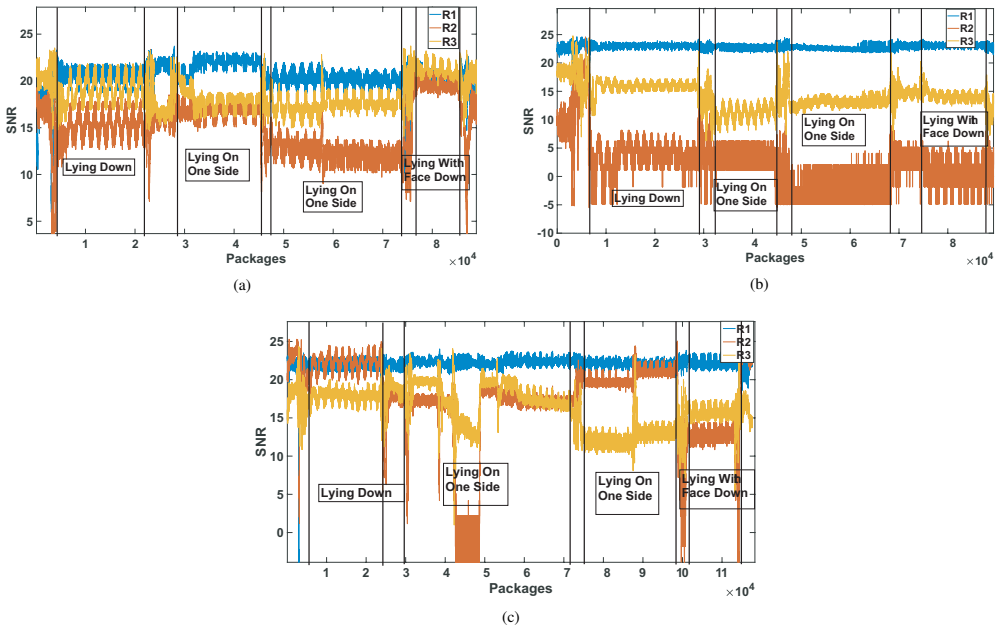
The load-bearing mechanism is the Fresnel-zone geometry of the antenna pair plus an empirical stream-selection rule. Fresnel zones are the concentric ellipsoids between transmitter and receiver on which a reflected path's phase shift is an integer multiple of half the wavelength; breathing and heartbeat motions change the reflected path length, and placing the body inside a sensitive zone is supposed to maximize the resulting channel response. The paper finds that the model is only a rough guide: in its own preliminary experiments the theoretically favored stream is not always the best one, and obstacles such as a plastic plate can make another stream more sensitive. The prototype therefore places the bed just outside the second Fresnel zone of the chosen T1-R3 link, puts a lead sheet under the transmitter to boost sensitivity, and manually selects R3 as the working stream, while the other two antennas are kept to prevent R3 from having the highest SNR. The processing chain then runs subcarrier selection by variance, Hampel outlier filtering, Butterworth bandpass separation of the breathing and heartbeat bands, and FFT-based rate extraction.
What would settle it
Run the same two-device setup in a different room with no plastic plate between the antennas, no lead sheet, and no manual stream search, and compare the accuracy of the automatically chosen best stream with the reported 96.636% breathing and 94.215% heart-rate accuracy; if the average errors rise well above 0.575 bpm and 3.9 bpm, the claimed general capability does not transfer as stated.
Extended reading notes
Core claim
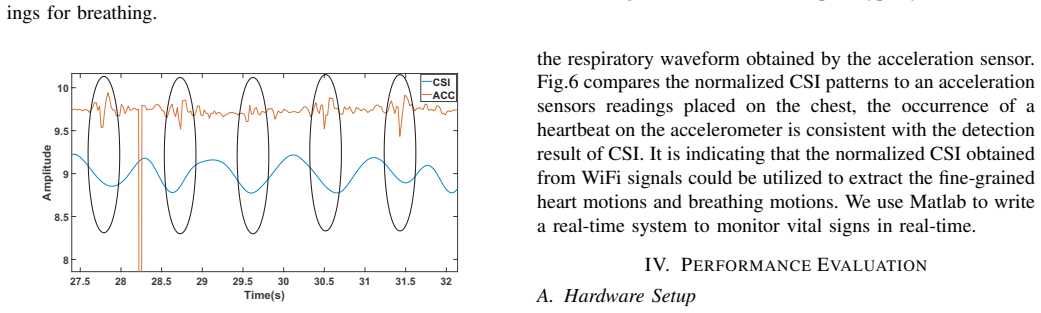
The paper's central claim is that a single pair of WiFi transceivers with omnidirectional antennas suffices for real-time individual breathing-rate and heart-rate monitoring during sleep, in supine, prone, and left/right recumbent postures. The authors position this as the first demonstration of that capability: earlier WiFi sleep-monitoring work either needed multiple transmitters and receivers, restricted heart-rate detection to a supine posture with a directional antenna in line of sight, or used a metronome to pace the subject's breathing. The system extracts channel state information from an Intel 5300 NIC, selects the most sensitive subcarrier, filters the signal into a breathing band (0.25-0.5 Hz) and a heartbeat band (1-2 Hz), and derives rates by FFT. Ground truth came from an abdomen-worn accelerometer for breathing and a fingertip pulse oximeter for heart rate; the reported average errors are 0.575 bpm and 3.9 bpm. The authors also report that the best receiving antenna is not the one with the highest SNR, and that after each restart the best data stream must be rediscovered.
Load-bearing premise
The claim rests on the hand-tuned antenna configuration—the chosen stream, the lead sheet, and even the plastic plate that was present—transferring to other rooms and other people without losing accuracy.
Editorial extensions
If this is right
- A contactless home monitor for sleep breathing and heart rate becomes feasible with equipment already present in many homes, at a fraction of the cost of polysomnography.
- The reported per-posture performance suggests supine monitoring is easiest, while prone breathing and left-recumbent heart-rate measurements are the hardest; a practical system would need to handle those cases explicitly.
- Because the system runs on commodity WiFi CSI, it could be integrated into existing routers or smart-home access points without new hardware.
- The 40-second accumulation window for the FFT means the system can report vital signs at interactive time scales, suitable for overnight logging.
Reading between the lines
- The system's dependence on manually rediscovering the best antenna after every restart suggests that automating stream selection is the key engineering step for deployment outside the test room; the paper leaves this as future work.
- The incidental plastic-plate result indicates that deliberate reflectors could be used as a design parameter, potentially replacing the unexplained lead-sheet trick with a reproducible rule.
- A natural testable extension is apnea detection: a prolonged absence of energy in the 0.25-0.5 Hz band, using the same pipeline with a shorter FFT window, would flag respiratory pauses without new hardware.
Signed reviews
Editorial analysis
A structured set of objections, weighed in public.
Referee Report
Summary. The paper proposes a WiFi-CSI-based system for contactless, real-time monitoring of breathing rate and heart rate during sleep, using one transmitting and one receiving commodity WiFi device with omnidirectional antennas. The authors motivate antenna placement with Fresnel-zone theory, implement a real-time Matlab processing pipeline (subcarrier selection, Hampel filtering, bandpass segmentation, FFT-based rate extraction), and report average errors of 0.575 bpm for breathing and 3.9 bpm for heart rate across five participants in four sleep postures, claiming overall accuracies of 96.636% and 94.215%. They further claim to be the first to achieve real-time individual breathing and heart-rate monitoring in different sleeping postures with a single pair of WiFi devices and omnidirectional antennas.
Significance. If the central claim held, the system would be a meaningful low-cost, contactless sleep vital-sign monitor, and the real-time implementation on commodity hardware is a practical strength. The authors use external ground-truth sensors (accelerometer and pulse oximeter), report comparisons across postures, and are candid about the limitations of Fresnel theory in their own setting. However, the current evidence does not establish transferability: the evaluation is small and homogeneous, the accuracy metric is undefined, and the system relies on manually discovered, environment-specific antenna configurations that the paper itself shows are not predicted by the theory it invokes.
major comments (3)
- [Section IV-C, Table I] The overall-accuracy figures (96.636% for breathing and 94.215% for heart rate) are never defined; no formula links them to the reported mean errors, and there are no per-participant or per-posture distributions, confidence intervals, or statistical tests. Please provide the exact definition of accuracy, the underlying per-measurement/per-subject data, and quantitative variance measures.
- [Section III-A, Section II-B] The system's operation depends on a manually identified "best data stream" that must be re-found after every restart (Section III-A states "Every time we restart the system, we need to find the best data stream"), and the final setup includes a lead sheet under T1 and an incidental plastic plate that are not part of any reproducible design rule. Because Section II-B reports that Fresnel theory failed to predict that R3 would be the best stream in Setting 1, the reported accuracies cannot be separated from the particular lab configuration. Please specify an automatic, principled criterion for stream selection and validate the configuration transfer across rooms, antenna placements, and users.
- [Section IV-B, Section IV-C] The evaluation is under-powered for the generality claimed: five university students aged 21–26 in a single office-like lab, with no cross-environment testing, no repeated trials, no inter-subject variability analysis, and no statistical significance testing. The statement in Section IV-C that "in general, our system can accurately monitor vital signs with different sleeping postures" goes beyond what this dataset can support. Please add a larger and more diverse participant pool, multiple environments, repeated sessions, and appropriate statistical reporting.
minor comments (8)
- [Section IV-B, Section IV-C] The word "sout" appears twice ("We soutconduct experiment" and "directlysout") and should be corrected.
- [Figure 9] The label "pron" should be "prone."
- [Figure 3] The x-axis label "Packages" should be "Packets" for consistency with the rest of the paper.
- [Table I] The Performance column for reference [12] contains "Na"; either provide the performance figure or explain the abbreviation.
- [Reference [9]] Reference [9] lacks venue and publication details and should be completed.
- [Section III-B] The "FFT time threshold" is a free parameter; please state its chosen value and report the sensitivity of the results to it.
- [Section II-A] The notation in Equation (1) should be made consistent (|TxRx| vs. |TxRx|) and the "effective displacement" along the normal line should be defined formally.
- [Figure 7] The schematic in Figure 7 does not show the lead sheet or the plastic plate that the text says are important; please include these elements in the figure or a separate setup diagram.
Circularity Check
No significant circularity; the reported accuracy is benchmarked against external accelerometer and pulse-oximeter ground truth, and the Fresnel model is used only as a heuristic setup guide, not as the source of the vital-sign estimates.
full rationale
The central performance claims (average error 0.575 bpm for breathing and 3.9 bpm for heart rate) are obtained by comparing CSI-derived rates with readings from an accelerometer placed on the abdomen and a fingertip pulse oximeter (Section IV-B), i.e., external ground truth, not with quantities derived from the model's own assumptions. The Fresnel-zone model in Section II-A is used only to guide antenna placement, and the paper explicitly reports that the theory is limited: 'The guidance provided by Fresnel theory is limited' (Section II-B), noting that the best stream in Setting 1 contradicted the prediction of prior work [12]. The subcarrier-selection rule cites the authors' prior work [16], but it is a practical selection heuristic, not a derivation of the final vital-sign output. Self-citations [14]-[16] are motivational or experiential and are not load-bearing: removing them does not change any equation or measured accuracy. The accuracy percentages are not produced by fitting a parameter and then renaming the fit a prediction; the processing chain uses standard filters (Hampel filter, Butterworth bandpass filters) and FFT, and the reported errors are direct differences measured against external sensors. Therefore no step reduces by construction to its own inputs, and no significant circularity is present.
Assumptions & free parameters
free parameters (4)
- FFT time threshold =
40 s (manually adjustable)
- Best antenna data stream =
Selected per restart (one of R1-R3)
- Antenna placement and lead sheet position =
T1-R3 distance 80 cm; lead sheet under T1
- Subcarrier selection criterion =
None (heuristic: maximum variance)
assumptions (4)
- domain assumption The Fresnel zone model as defined in Eq. (1), with the phase shift relation e^{-j2πd(t)/λ}, describes how a point reflector's motion affects CSI amplitude.
- domain assumption Breathing and heartbeat produce measurable chest/abdomen displacements that modulate WiFi signals.
- domain assumption Breathing and heart rate occupy separable frequency bands (0.25-0.5 Hz and 1-2 Hz), so bandpass filtering isolates them.
- ad hoc to paper A 'least sensitive' CSI stream with SNR around 20 always exists when three antennas are used, and it is the most stable for vital sign extraction.
Cite this review
Pith. "Pith review of WiFi-based Real-time Breathing and Heart Rate Monitoring during Sleep." pith.science (2026). https://pith.science/paper/JOAFEHW7
@misc{pith2026190805108,
  author       = {Pith},
  title        = {Pith review of: WiFi-based Real-time Breathing and Heart Rate Monitoring during Sleep},
  year         = {2026},
  howpublished = {\url{https://pith.science/paper/JOAFEHW7}},
  note         = {Machine review of arXiv:1908.05108}
}
read the original abstract
Good quality sleep is essential for good health and sleep monitoring becomes a vital research topic. This paper provides a low cost, continuous and contactless WiFi-based vital signs (breathing and heart rate) monitoring method. In particular, we set up the antennas based on Fresnel diffraction model and signal propagation theory, which enhances the detection of weak breathing/heartbeat motion. We implement a prototype system using the off-shelf devices and a real-time processing system to monitor vital signs in real time. The experimental results indicate the accurate breathing rate and heart rate detection performance. To the best of our knowledge, this is the first work to use a pair of WiFi devices and omnidirectional antennas to achieve real-time individual breathing rate and heart rate monitoring in different sleeping postures.
Figures


Figures from the paper (5 more)




Reference graph
Works this paper leans on
-
[1]
Who technical meeting on sleep and health: Bonn, germany 22-24 january 2004,
W. H. Organization et al., “Who technical meeting on sleep and health: Bonn, germany 22-24 january 2004,” in WHO technical meeting on sleep and health: Bonn, Germany 22-24 January 2004, 2004
work page 2004
-
[2]
A. N. Pedersen, S. Korreman, H. Nystr ¨om, and L. Specht, “Breathing adapted radiotherapy of breast cancer: reduction of cardiac and pul- monary doses using voluntary inspiration breath-hold,” Radiotherapy and oncology, vol. 72, no. 1, pp. 53–60, 2004
work page 2004
-
[3]
Noncontact respiration rate measurement system using an ultrasonic proximity sensor,
S. D. Min, J. K. Kim, H. S. Shin, Y . H. Yun, C. K. Lee, and M. Lee, “Noncontact respiration rate measurement system using an ultrasonic proximity sensor,” IEEE Sensors Journal, vol. 10, no. 11, pp. 1732– 1739, 2010
work page 2010
-
[4]
P. X. Braun, C. F. Gmachl, and R. A. Dweik, “Bridging the collaborative gap: Realizing the clinical potential of breath analysis for disease diagnosis and monitoring–tutorial,” IEEE Sensors Journal, vol. 12, no. 11, pp. 3258–3270, 2012
work page 2012
-
[5]
Sleep disordered breathing in a high-risk cohort prevalence and severity across pregnancy,
F. L. Facco, D. W. Ouyang, P. C. Zee, and W. A. Grobman, “Sleep disordered breathing in a high-risk cohort prevalence and severity across pregnancy,”American journal of perinatology, vol. 31, no. 10, pp. 899– 904, 2014
work page 2014
-
[6]
C. A. Kushida, M. R. Littner, T. Morgenthaler, C. A. Alessi, D. Bailey, J. Coleman Jr, L. Friedman, M. Hirshkowitz, S. Kapen, M. Kramer et al., “Practice parameters for the indications for polysomnography and related procedures: an update for 2005,” Sleep, vol. 28, no. 4, pp. 499–523, 2005
work page 2005
-
[7]
Z. He, X. Zhang, Y . Cao, Z. Liu, B. Zhang, and X. Wang, “Litenet: Lightweight neural network for detecting arrhythmias at resource- constrained mobile devices,” Sensors, vol. 18, no. 4, p. 1229, 2018
work page 2018
-
[8]
Propagation parameter estimation, modeling and measurements for ultrawideband mimo radar,
J. Salmi and A. F. Molisch, “Propagation parameter estimation, modeling and measurements for ultrawideband mimo radar,” IEEE Transactions on Antennas and Propagation, vol. 59, no. 11, pp. 4257– 4267, 2011
work page 2011
Show all 16 references
-
[9]
Multi-person motion tracking via rf body reflections,
F. Adib, Z. Kabelac, and D. Katabi, “Multi-person motion tracking via rf body reflections,” 2014
2014
-
[10]
Contactless respiration monitoring via off-the-shelf wifi devices,
X. Liu, J. Cao, S. Tang, J. Wen, and P. Guo, “Contactless respiration monitoring via off-the-shelf wifi devices,” IEEE Transactions on Mobile Computing, vol. 15, no. 10, pp. 2466–2479, 2016
2016
-
[11]
Monitoring vital signs and postures during sleep using wifi signals,
J. Liu, Y . Chen, Y . Wang, X. Chen, J. Cheng, and J. Yang, “Monitoring vital signs and postures during sleep using wifi signals,” IEEE Internet of Things Journal, vol. 5, no. 3, pp. 2071–2084, 2018
2018
-
[12]
Human respiration detection with commodity wifi devices: do user location and body orientation matter?
H. Wang, D. Zhang, J. Ma, Y . Wang, Y . Wang, D. Wu, T. Gu, and B. Xie, “Human respiration detection with commodity wifi devices: do user location and body orientation matter?” in Proceedings of the 2016 ACM International Joint Conference on Pervasive and Ubiquitous Computing. ...
2016
-
[13]
From fresnel diffraction model to fine-grained human respiration sensing with commodity wi-fi devices,
F. Zhang, D. Zhang, J. Xiong, H. Wang, K. Niu, B. Jin, and Y . Wang, “From fresnel diffraction model to fine-grained human respiration sensing with commodity wi-fi devices,” Proceedings of the ACM on Interactive, Mobile, Wearable and Ubiquitous Technologies, vol. 2, no. 1, p. 53, 2018
2018
-
[14]
Emosense: Data-driven emotion sensing via off-the-shelf wifi devices,
Y . Gu, T. Liu, J. Li, F. Ren, Z. Liu, X. Wang, and P. Li, “Emosense: Data-driven emotion sensing via off-the-shelf wifi devices,” in Proc. of IEEE ICC, May 2018
2018
-
[15]
Mosense: An rf-based motion detection system via off-the-shelf wifi devices,
Y . Gu, J. Zhan, Y . Ji, J. Li, F. Ren, and S. Gao, “Mosense: An rf-based motion detection system via off-the-shelf wifi devices,” IEEE Internet of Things Journal, vol. 4, no. 6, pp. 2326–2341, Dec 2017
2017
-
[16]
Your wifi knows how you behave: Leveraging wifi channel data for behavior analysis,
Y . Gu, X. Zhang, C. Li, F. Ren, J. Li, and Z. Liu, “Your wifi knows how you behave: Leveraging wifi channel data for behavior analysis,” in 2018 IEEE Global Communications Conference (GLOBECOM). IEEE, 2018, pp. 1–6
2018
Reviewed August 14, 2026 · model on record in the stance chip above.
Discussion (0). Continue with ORCID to comment.