REVIEW 2 major objections 4 minor 42 references
Geometric transition from hyperbolic to anti-de Sitter structures in dimension four
T0 review · 2 major / 4 minor · reviewed 2026-08-14 · deepseek-v4-flash
Pith's one-line read Hyperbolic and anti-de Sitter structures are joined continuously for the first time in dimension four.
desk verdict First genuine hyperbolic-to-AdS geometric transition in dimension four, built from explicit polytopes; the main theorem is probably right, but the load-bearing vertex enumeration is not shipped with the paper. read the letter →
The pith
A machine-rendered reading of the paper's core claim, the machinery that carries it, and where it could break.
The reading
What carries the argument
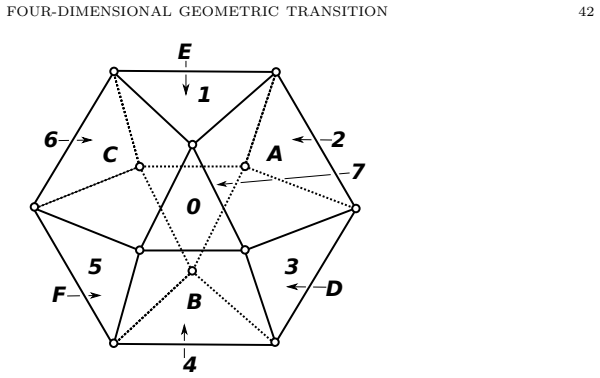
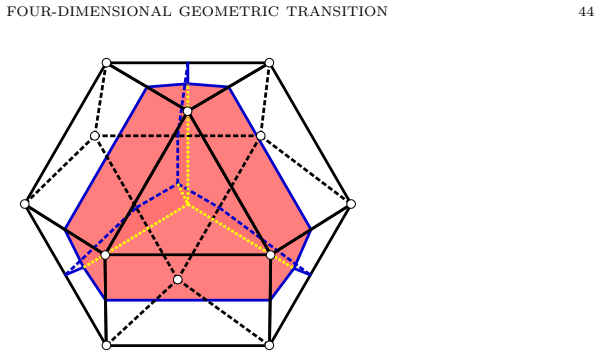
The load-bearing object is the deforming projective 4-polytope $P_t$, a family of 4-polytopes defined by 22 half-spaces with coefficients depending on $t$. For $t>0$, $P_t$ is a finite-volume hyperbolic polytope whose non-right dihedral angles tend to $\pi$ as $t\to 0$, collapsing to the ideal right-angled cuboctahedron $C\subset H^3$; the paper extends the same half-space pattern to $t<0$, where $P_t$ is an anti-de Sitter polytope with spacelike and timelike facets, and shows the rescaled family $r_{|t|}(P_t)$ converges to a half-pipe polytope at $t=0$. The proof that all of these have one constant combinatorics—46 vertices, with 12 on the boundary and 34 inside—is done by a computer-assisted enumeration (Lemma 7.8) rather than by a written calculation, and every gluing step depends on it. The gluing pairs facets of copies of $P_t$ following an orbifold covering of the cuboctahedron and doubles the result, producing $N\times S^1$ with the foam singularity, while explicitly computed limits of rescaled reflections supply the half-pipe orbifold structure.
What would settle it
Run the exhaustive vertex enumeration for $r_{|t|}(P_t)$ over a dense sample of $t\in(-1,0)$ and at $t=0$: solve the linear systems defining intersections of bounding hyperplanes, check whether each solution lies in the polytope, and compare the face-incidence poset with the positive-time case. Finding any vertex count different from 46, or any edge or face incidence that changes with $t$, would disprove Proposition 7.3 and with it the claimed constancy of the topology of $X_t$.
Extended reading notes
Core claim
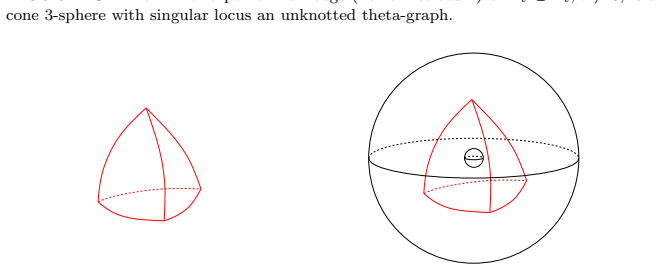
The central result, Theorem 1.1, is a $C^1$ family $\{\sigma_t\}_{t\in(-\epsilon,\epsilon]}$ of simple projective cone-manifold structures on $X=N\times S^1$, singular along a compact foam $\Sigma$. At $t=\epsilon$ the structure is a complete finite-volume hyperbolic orbifold with cone angles $\pi$; for $t>0$ it is a hyperbolic cone structure with cone angles $\alpha_t\in[\pi,2\pi)$ decreasing as $t\to 0^+$; at $t=0$ it is a half-pipe structure with spacelike singularity; and for $t<0$ it is an anti-de Sitter structure with spacelike singularity of magnitude $\beta_t\in(-\infty,0)$ increasing as $t$ moves away from zero. The paper obtains these structures by taking a known one-parameter family of hyperbolic 4-polytopes that collapses to the ideal right-angled cuboctahedron, proving an analogous family of anti-de Sitter polytopes exists for negative times, rescaling to get a half-pipe limit, and gluing copies of the polytope according to an orbifold covering $N\to C$. The singular locus is a foam, a 2-complex locally modelled on the cone over the 1-skeleton of a tetrahedron.
Load-bearing premise
The load-bearing premise is that the rescaled polytope has exactly the same 46-vertex combinatorics for every $t$ in the interval, including the anti-de Sitter and half-pipe regimes; the proof is omitted and deferred to a computer worksheet, so an undiscovered change of combinatorics would break the gluing and the statement of Theorem 1.1.
Editorial extensions
If this is right
- Geometric transition from hyperbolic to anti-de Sitter structures is not confined to dimension three; explicit four-dimensional examples exist, with a foam as singular locus.
- The method produces finite-volume non-compact examples whose cusp sections themselves transition from Euclidean to Minkowski geometry through Galilean geometry.
- The local models near the singular foam give the first four-dimensional links supporting a transition from spherical to HS cone structures, via an intermediate half-pipe cone structure.
- The construction is flexible: the paper notes it extends to any cuboctahedral hyperbolic 3-manifold with chequerboard-preserving facet pairings, and to a double cover for every cuboctahedral manifold.
Reading between the lines
- If the constant-combinatorics lemma is correct, the same half-space deformation pattern could probably be adapted to other right-angled ideal 3-polytopes that admit collapsing 4-dimensional deformations, producing transitions beyond the cuboctahedron.
- The paper's explicit handling of the half-pipe reflection ambiguity suggests a general principle: a geometric transition is fixed only when one records the limits of the reflection holonomies, not just the projective limit of the polytopes.
- A testable next step, which the paper does not settle, is whether the foam singularity is necessary or whether an embedded surface can support a four-dimensional transition; the paper notes no such surface-singularity deformations are currently known.
Signed reviews
Editorial analysis
A structured set of objections, weighed in public.
Referee Report
Summary. The paper constructs, in dimension four, explicit examples of geometric transition from hyperbolic to anti-de Sitter structures through half-pipe geometry. The main object is a family of projective 4-polytopes P_t, defined by 22 explicit half-spaces depending on a parameter t in (-1, 1/sqrt(3)]. For t>0 these are the Kerckhoff--Storm hyperbolic polytopes; the paper extends the family to t<0 as anti-de Sitter polytopes, applies the rescaling r_{|t|}, and shows that the rescaled polytopes converge at t=0 to a half-pipe polytope. Copies of P_t are then glued according to an orbifold cover of the ideal right-angled cuboctahedron, and the resulting space is doubled to obtain the 4-manifold X=N x S^1. The main theorem, Theorem 1.1, states that these glued structures form a C^1 family of simple projective cone-manifold structures with singular locus a compact foam, realizing hyperbolic cone structures for t>0, a half-pipe structure at t=0, and AdS cone structures for t<0, with the cone angles and boost magnitudes tending to the stated limiting values and the structures collapsing to a hyperbolic 3-manifold N.
Significance. If the construction is fully justified, this is the first geometric transition from hyperbolic to anti-de Sitter structures in dimension four, a significant extension of Danciger's three-dimensional work. The paper provides concrete, explicit half-space coordinates, derives the dihedral angle formulas, and proves the C^1 convergence of rescaled reflections in Lemma 7.15. The AdS and half-pipe sides are derived independently rather than obtained by fitting, and the gluing construction is detailed. The description of cusp geometry, including the Galilean transition on horospherical sections, is an additional strength. However, the central combinatorial-geometric assertions for the new cases t<=0 are not fully proved in the text: Lemma 7.9's printed proof is incomplete, and Lemma 7.8's vertex enumeration is deferred to an old arXiv appendix and an unspecified Sage worksheet. Since Proposition 7.3 and all subsequent gluing statements rely on these lemmas, the main theorem is conditional on repairing these gaps.
major comments (2)
- [§7.2, Lemma 7.9] The proof of Lemma 7.9 as printed analyzes only the inequalities (9) and (11), omitting the t-dependent inequalities (10). The inference 'By summing the first two equations and using the third, we get y1=y2=sqrt(2)/2' is not valid: summing the first two inequalities gives only y1+y2 <= sqrt(2), and the inequalities y2 <= y1 <= sqrt(2)/2 do not force equality. For example, at t=-0.9 the affine point (0.7, 0.6, 0.6, -0.509...) satisfies (9), (11), and the boundary equation y1^2+y2^2+y3^2-t^2 y4^2=1, but it violates the first inequality of (10). Thus the stated conclusion r_{|t|}(Q_t) cap boundary X^4_t = {[2:sqrt(2):sqrt(2):0:0]} is not established by the argument given. Since Lemma 7.9 is used in the proof of Proposition 7.3 to prove r_{|t|}(P_t) subset X^4_t cap A^4, the containment for t<0 and t=0 is not established as written. The statement may be true, but the proof must be repaired.
- [§7.2, Lemma 7.8] Lemma 7.8 asserts that r_{|t|}(P_t) has 46 vertices for all t in I, with 12 on the boundary of X^4_t and 34 in its interior. For t in I- union {0} the proof is replaced by the statement that the number of computations is 'terribly big', with details deferred to the old arXiv version [RSb, Appendix A] and an unspecified Sage worksheet. This is load-bearing: Proposition 7.3, Proposition 7.10, Proposition 7.13, and the gluing/homeomorphism arguments all use the constancy of the combinatorics and the 12/34 split. If the vertex count or the boundary/interior split changed with t, the topology of X_t or the singular foam could change and Theorem 1.1 would fail. A complete, machine-checkable certificate, or the actual code and its full output, must be included in the final version; a reference to an earlier arXiv version of the same paper is not a substitute.
minor comments (4)
- [Abstract] The word 'contribuitions' in the abstract is a typo and should be 'contributions'.
- [Section 7, opening paragraph] The phrase 'giving as a byproduct also rigours to the assertions' should read 'giving as a byproduct also rigor to the assertions'.
- [§7.2, after Proposition 7.3] The sentence 'In contrast with Pt, the polytope Pt is simple' appears to contain a typo; please clarify which polytope is meant, since both occurrences are printed identically.
- [§7.2, Lemma 7.8] If the Sage computation is retained, the final version should provide a stable identifier or repository URL for the worksheet, together with the exact version of Sage used, so that the verification is reproducible.
Circularity Check
No circularity: the AdS and half-pipe deformations are computed from explicit half-space data and independent geometric formulas, not fitted to the claimed transition.
full rationale
The paper's derivation chain is not circular. The hyperbolic side is imported from the published, external work of Kerckhoff–Storm and Martelli–Riolo, while the anti-de Sitter and half-pipe sides are constructed from the same explicit list of half-spaces in Table 2, with containment, combinatorics, dihedral angles, reflections, and holonomy limits computed directly from the quadratic forms q1, q−1, q0 via Lemmas 4.4, 4.6, 4.8, 4.10 and Lemma 7.15. No parameter is fitted to the target conclusion: the cone angles θt and magnitudes ϕt are derived, not assigned, and the C1 dependence follows from the explicit matrix entries of the rescaled reflections. Proposition 7.3, the load-bearing step, is supported by Lemma 7.8 and Lemma 7.9. Lemma 7.8's vertex enumeration is admittedly deferred to an old arXiv version of the same paper and an unspecified Sage worksheet, and Lemma 7.9's printed proof does omit the t-dependent inequalities (10) of the rescaled fundamental domain. These are gaps in verification or exposition, not circular reductions: the asserted combinatorics is computed from the half-space data rather than assumed, and no equation of the claimed transition is used as an input. The self-citations [RSb] and [RSa] point to computational details and a posteriori uniqueness, but the central existence claim does not reduce to those citations; the hyperbolic input is independently published, and the AdS/HP geometry is derived. Hence no circular step satisfying the quoted-evidence standard is present, and the appropriate score is 0.
Assumptions & free parameters
assumptions (4)
- standard math Kerckhoff-Storm [KS10] and Martelli-Riolo [MR18] establish the hyperbolic polytope P_t for t > 0: finite volume, constant combinatorics, facet and vertex description.
- standard math Selberg's Lemma and Malcev's Theorem provide torsion-free finite-index subgroups of the reflection group of the cuboctahedron, giving orbifold covers N to C.
- standard math Vinberg's theory of acute-angled hyperbolic polytopes is used in the hyperbolic case for the vertex enumeration of Lemma 7.8 and in [MR18].
- ad hoc to paper The Sage vertex enumeration in Lemma 7.8 correctly and exhaustively lists the 46 vertices of r_{|t|}(P_t) for all t in the interval.
Cite this review
Pith. "Pith review of Geometric transition from hyperbolic to anti-de Sitter structures in dimension four." pith.science (2026). https://pith.science/paper/MFO3CM5C
@misc{pith2026190805112,
  author       = {Pith},
  title        = {Pith review of: Geometric transition from hyperbolic to anti-de Sitter structures in dimension four},
  year         = {2026},
  howpublished = {\url{https://pith.science/paper/MFO3CM5C}},
  note         = {Machine review of arXiv:1908.05112}
}
read the original abstract
We provide the first examples of geometric transition from hyperbolic to anti-de Sitter structures in dimension four, in a fashion similar to Danciger's three-dimensional examples. The main ingredient is a deformation of hyperbolic 4-polytopes, discovered by Kerckhoff and Storm, eventually collapsing to a 3-dimensional ideal cuboctahedron. We show the existence of a similar family of collapsing anti-de Sitter polytopes, and join the two deformations by means of an opportune half-pipe orbifold structure. The desired examples of geometric transition are then obtained by gluing copies of the polytope.
Figures


Figures from the paper (24 more)









Reference graph
Works this paper leans on
-
[1]
E. M. Andreev. Convex polyhedra in L oba c evski spaces. Mat. Sb. (N.S.) , 81 (123):445--478, 1970
work page 1970
-
[2]
E. M. Andreev. Convex polyhedra of finite volume in L oba c evski space. Mat. Sb. (N.S.) , 83 (125):256--260, 1970
work page 1970
-
[3]
Norbert A'Campo and Athanase Papadopoulos. Transitional geometry. Sophus Lie and Felix Klein: the Erlangen program and its impact in mathematics and physics , 23:217, 2015
work page 2015
-
[4]
Collisions of particles in locally A d S spacetimes I
Thierry Barbot, Francesco Bonsante, and Jean-Marc Schlenker. Collisions of particles in locally A d S spacetimes I . L ocal description and global examples. Comm. Math. Phys. , 308(1):147--200, 2011
work page 2011
-
[5]
Quasi- F uchsian co- M inkowski manifolds, 2018
Thierry Barbot and Fran c ois Fillastre. Quasi- F uchsian co- M inkowski manifolds, 2018. To appear in book ``In the tradition of Thurston'', arXiv:1801.10429 https://arxiv.org/abs/1801.10429
arXiv 2018
-
[6]
M.R. Bridson and A. H \"a fliger. Metric Spaces of Non-Positive Curvature . Grundlehren der mathematischen Wissenschaften. Springer Berlin Heidelberg, 2011
work page 2011
-
[7]
Geometrization of 3-dimensional orbifolds
Michel Boileau, Bernhard Leeb, and Joan Porti. Geometrization of 3-dimensional orbifolds. Ann. of Math. (2) , 162(1):195--290, 2005
work page 2005
-
[8]
Daryl Cooper, Jeffrey Danciger, and Anna Wienhard. Limits of geometries. Trans. Amer. Math. Soc. , 370:6585--6627, 2018
work page 2018
Show all 42 references
-
[9]
Hodgson, and Steven P
Daryl Cooper, Craig D. Hodgson, and Steven P. Kerckhoff. Three-dimensional orbifolds and cone-manifolds , volume 5 of MSJ Memoirs . Mathematical Society of Japan, Tokyo, 2000. With a postface by Sadayoshi Kojima
2000
-
[10]
Geometric structures on orbifolds and holonomy representations
Suhyoung Choi. Geometric structures on orbifolds and holonomy representations. Geom. Dedicata , 104:161--199, 2004
2004
-
[11]
Choi, G.-S
S. Choi, G.-S. Lee, and L. Marquis. Convex projective generalized D ehn filling. Ann. Sci. \'Ec. Norm. Sup\'er. , 53:217--266, 2020
2020
-
[12]
Geometric transition: from hyperbolic to AdS geometry
Jeffrey Danciger. Geometric transition: from hyperbolic to AdS geometry . PhD thesis, Stanford University, 2011
2011
-
[13]
A geometric transition from hyperbolic to anti-de S itter geometry
Jeffrey Danciger. A geometric transition from hyperbolic to anti-de S itter geometry. Geom. Topol. , 17(5):3077--3134, 2013
2013
-
[14]
Ideal triangulations and geometric transitions
Jeffrey Danciger. Ideal triangulations and geometric transitions. J. Topol. , 7(4):1118--1154, 2014
2014
-
[15]
Spherical, hyperbolic, and other projective geometries: convexity, duality, transitions
Fran c ois Fillastre and Andrea Seppi. Spherical, hyperbolic, and other projective geometries: convexity, duality, transitions. In Eighteen essays in non- E uclidean geometry , volume 29 of IRMA Lect. Math. Theor. Phys. , pages 321--409. Eur. Math. Soc., Z\" u rich, 2019
2019
-
[16]
Degeneration and regeneration of hyperbolic structures on three-manifolds (foliations, D ehn surgery)
Craig David Hodgson. Degeneration and regeneration of hyperbolic structures on three-manifolds (foliations, D ehn surgery) . ProQuest LLC, Ann Arbor, MI, 1986. Thesis (Ph.D.)--Princeton University
1986
-
[17]
Regenerating singular hyperbolic structures from S ol
Michael Heusener, Joan Porti, and Eva Su\' a rez. Regenerating singular hyperbolic structures from S ol. J. Differential Geom. , 59(3):439--478, 2001
2001
-
[18]
Hyperbolic four-manifolds with one cusp
Alexander Kolpakov and Bruno Martelli. Hyperbolic four-manifolds with one cusp. Geom. Funct. Anal. , 23(6):1903--1933, 2013
1903
-
[19]
Singular hyperbolic structures on pseudo-Anosov mapping tori
Kenji Kozai. Singular hyperbolic structures on pseudo-Anosov mapping tori . PhD thesis, Stanford University, 2013
2013
-
[20]
Hyperbolic structures from sol on pseudo-anosov mapping tori
Kenji Kozai. Hyperbolic structures from sol on pseudo-anosov mapping tori. Geometry & Topology , 20(1):437--468, 2016
2016
-
[21]
Kerckhoff and Peter A
Steven P. Kerckhoff and Peter A. Storm. From the hyperbolic 24-cell to the cuboctahedron. Geom. Topol. , 14(3):1383--1477, 2010
2010
-
[22]
Geometric conemanifold structures on T _ p/q , the result of p/q surgery in the left-handed trefoil knot T
Mar \' a Teresa Lozano and Jos \'e Mar \' a Montesinos-Amilibia. Geometric conemanifold structures on T _ p/q , the result of p/q surgery in the left-handed trefoil knot T . Journal of Knot Theory and Its Ramifications , 24(12):1550057, 2015
2015
-
[23]
On the degeneration of some 3-manifold geometries via unit groups of quaternion algebras
Mar \' a Teresa Lozano and Jos \'e Mar \' a Montesinos-Amilibia. On the degeneration of some 3-manifold geometries via unit groups of quaternion algebras. Revista de la Real Academia de Ciencias Exactas, F \' sicas y Naturales. Serie A. Matem \'a ticas , 109(2):669--715, 2015
2015
-
[24]
A small closed convex projective 4-manifold via D ehn filling
Gye-Seon Lee, Ludovic Marquis, and Stefano Riolo. A small closed convex projective 4-manifold via D ehn filling. 2019. arXiv:1910.11649 https://arxiv.org/abs/1801.10429
2019 arXiv
-
[25]
Coxeter group in H ilbert geometry
Ludovic Marquis. Coxeter group in H ilbert geometry. Groups Geom. Dyn. , 11(3):819--877, 2017
2017
-
[26]
McMullen
Curtis T. McMullen. The G auss- B onnet theorem for cone manifolds and volumes of moduli spaces. Amer. J. Math. , 139(1):261--291, 2017
2017
-
[27]
Hyperbolic D ehn filling in dimension four
Bruno Martelli and Stefano Riolo. Hyperbolic D ehn filling in dimension four. Geom. Topol. , 22(3):1647--1716, 2018
2018
-
[28]
Regenerating hyperbolic and spherical cone structures from E uclidean ones
Joan Porti. Regenerating hyperbolic and spherical cone structures from E uclidean ones. Topology , 37(2):365--392, 1998
1998
-
[29]
Regenerating hyperbolic cone structures from N il
Joan Porti. Regenerating hyperbolic cone structures from N il. Geom. Topol. , 6:815--852, 2002
2002
-
[30]
Regenerating hyperbolic cone 3-manifolds from dimension 2
Joan Porti. Regenerating hyperbolic cone 3-manifolds from dimension 2. Ann. Inst. Fourier (Grenoble) , 63(5):1971--2015, 2013
1971
-
[31]
Deforming E uclidean cone 3-manifolds
Joan Porti and Hartmut Weiss. Deforming E uclidean cone 3-manifolds. Geom. Topol. , 11:1507--1538, 2007
2007
-
[32]
Character varieties of a transitioning C oxeter 4-orbifold
Stefano Riolo and Andrea Seppi. Character varieties of a transitioning C oxeter 4-orbifold. In preparation
-
[33]
Old ar X iv version of the present paper
Stefano Riolo and Andrea Seppi. Old ar X iv version of the present paper. arXiv:1908.05112v1 https://arxiv.org/abs/1908.05112v1
1908 arXiv
-
[34]
New hyperbolic 4-manifolds of low volume
Stefano Riolo and Leone Slavich. New hyperbolic 4-manifolds of low volume. Alg. Geom. Topol. , 19(5):2653--2676, 2019
2019
-
[35]
Examples of geometric transition from dimension two to four
Andrea Seppi. Examples of geometric transition from dimension two to four. To appear, A ctes du s \'e minaire T h \'e orie S pectrale et G \'e om \'e trie, 26 pages , 2020
2020
-
[36]
Limits of quasi- F uchsian groups with small bending
Caroline Series. Limits of quasi- F uchsian groups with small bending. Duke Math. J. , 128(2):285--329, 2005
2005
-
[37]
S ageMath, the S age M athematics S oftware S ystem ( V ersion 8.1) , 2017
The Sage Developers . S ageMath, the S age M athematics S oftware S ystem ( V ersion 8.1) , 2017. www.sagemath.org https://www.sagemath.org
2017
-
[38]
W. P. Thurston. The geometry and topology of three-manifolds. Electronic version 1.1, link http://library.msri.org/nonmsri/gt3m, 1979
1979
-
[39]
Thurston
William P. Thurston. Shapes of polyhedra and triangulations of the sphere. In The E pstein birthday schrift , volume 1 of Geom. Topol. Monogr. , pages 511--549. Geom. Topol. Publ., Coventry, 1998
1998
-
[40]
Steve J. Trettel. Families of geometries, real algebras, and transitions . PhD thesis, University of C alifornia, S anta B arbara, 2019
2019
-
[41]
Hyperbolic reflection groups
E B Vinberg. Hyperbolic reflection groups. Russian Mathematical Surveys , 40(1):31, 1985
1985
-
[42]
I. M. Yaglom. A simple non- E uclidean geometry and its physical basis . Springer-Verlag, New York-Heidelberg, 1979. An elementary account of Galilean geometry and the Galilean principle of relativity, Heidelberg Science Library, Translated from the Russian by Abe Shenitzer, W...
1979
Reviewed August 14, 2026 · model on record in the stance chip above.
Discussion (0). Continue with ORCID to comment.