REVIEW 3 major objections 4 minor 50 references
Neutral iron line in the supernova remnant IC 443 and implications for MeV cosmic rays
T0 review · 3 major / 4 minor · reviewed 2026-08-14 · deepseek-v4-flash
Pith's one-line read Two blob-like 6.4 keV Fe I K-alpha enhancements in IC 443 are attributed to MeV protons accelerated at the SNR shock and leaking into molecular clouds, with intensities matching a model that also produces GeV-TeV protons.
desk verdict A genuinely new Fe K-alpha map of IC 443 with a plausible LECR origin, but the quantitative agreement with the escape model is weaker than the abstract claims. read the letter →
The pith
A machine-rendered reading of the paper's core claim, the machinery that carries it, and where it could break.
The reading
What carries the argument
The mechanism that carries the argument is inner-shell ionization of neutral iron: a MeV proton knocks out a K-shell electron from Fe, and the resulting vacancy is filled by an electron that emits the Fe I K-alpha photon at 6.4 keV. The paper separates proton bombardment from electron bombardment by the line's equivalent width, and it anchors the proton flux by fitting a cosmic-ray escape model to the observed gamma-ray spectrum. In that model, the momentum at which protons escape the SNR decreases as the shock expands, producing a break in the proton spectrum and hence a bend in the gamma-ray spectrum near ~1 GeV; the same model then predicts the 6.4 keV line intensity, and the measured value matches the prediction to within the quoted uncertainties.
What would settle it
Measure the spatial profile of the 6.4 keV line across Reg 2 with a higher-resolution X-ray instrument: if the escape model is right, the line brightness should decline at roughly the ionization-cooling distance of ~10 MeV protons (about 500 yr of travel at $n_H=730$ cm$^{-3}$), and the line should not extend smoothly far beyond the 4-arcmin blob; a detection of 6.4 keV emission substantially more extended than that, or a centroid that shifts with position toward the pulsar wind nebula, would require X-ray irradiation or a very different diffusion environment.
Extended reading notes
Core claim
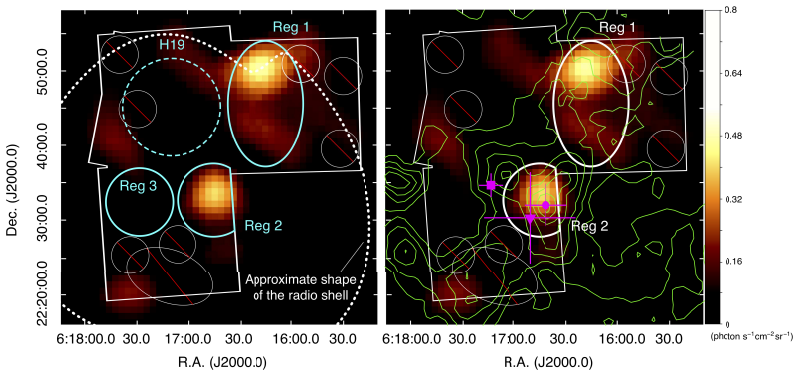
The paper's central claim is that the Fe I K-$\alpha$ line in IC 443, enhanced in two blob-like regions where the supernova remnant meets molecular clouds, is produced by low-energy cosmic-ray protons in the MeV band. Neutral iron atoms in the clouds are inner-shell ionized by these protons and emit at 6.4 keV; the large equivalent widths, >1.2 keV in Reg 1 and 0.7$^{+0.9}_{-0.6}$ keV in Reg 2, match the proton-bombardment expectation rather than the 0.2--0.4 keV expected for electron bombardment. The authors rule out X-ray irradiation from the pulsar wind nebula 1SAX J0617.1+2221 because the required flux would be two orders of magnitude above its observed flux. Applying a cosmic-ray escape model in which the same shock accelerates protons across energies, with the proton spectrum fixed by GeV and very-high-energy gamma-ray data, predicts a line intensity of $0.29^{+0.10}_{-0.11}$ photons s$^{-1}$ cm$^{-2}$ sr$^{-1}$, consistent with both measured regions; no significant line is found in a third region used as reference.
Load-bearing premise
The load-bearing premise is that enough ~10 MeV protons can travel from the shock into the molecular clouds and spread over the observed 4-arcmin region before they lose energy by ionizing gas, and the paper's own diffusion estimate falls short of this requirement by about a factor of 40, with the gap handled by invoking unmodelled cloud geometry or extended injection.
Editorial extensions
If this is right
- MeV cosmic-ray protons are accelerated together with GeV and TeV protons at the IC 443 shock, meaning the same acceleration mechanism populates the low-energy cosmic rays that ionize interstellar gas.
- Fe I K-alpha line imaging around molecular-cloud-interacting SNRs can act as a spatial probe of sub-GeV cosmic-ray escape, complementing gamma-ray and H3+ ionization-rate measurements.
- The gamma-ray spectrum of IC 443 requires a smaller diffusion coefficient than those inferred for W28 and W44, so middle-aged SNRs may differ in how they release low-energy cosmic rays.
- Because Reg 2 coincides with a dense molecular core and a gamma-ray clump, the data place escaping low-energy and high-energy cosmic rays in the same clouds, allowing a joint test of escape models.
Reading between the lines
- A testable extension is to map the 6.4 keV line at higher angular resolution: if the escape model is right, the line should trace the shock-cloud contact surface and fade within the roughly 500-yr ionization-cooling distance of 10 MeV protons, whereas a smoother or more extended profile would point to a larger diffusion coefficient inside the cloud than the model assumes.
- The roughly 40-fold gap between the diffusion coefficient needed to explain the 4-arcmin size of Reg 2 and the coefficient used in the model could be resolved if future instruments detect a brightness gradient across the line-emitting cloud; such a gradient would measure the effective diffusion coefficient in the molecular-cloud environment.
- The same method could be applied to other supernova remnants with both gamma-ray spectra and Fe I K-alpha detections to test whether co-acceleration of MeV and GeV-TeV protons is generic or peculiar to IC 443-like remnants.
Signed reviews
Editorial analysis
A structured set of objections, weighed in public.
Referee Report
Summary. The paper reports Suzaku XIS observations of IC 443 and constructs an Fe I K-alpha line intensity map. It identifies two blob-like enhancements, Reg 1 in the northwest and Reg 2 in the middle of the remnant, both associated with molecular clouds. Spectral fits yield line intensities of 0.273 +/- 0.119 and 0.344 +/- 0.277 photons s^-1 cm^-2 sr^-1 for Regs 1 and 2, with large equivalent widths. The authors argue that the line is produced by inner-shell ionization of neutral Fe by MeV protons leaking from the SNR shock into adjacent molecular clouds, and they compare the observed intensity with a prediction from a CR escape model fitted to gamma-ray data. They find consistency (predicted 0.29(+0.10/-0.11)) and conclude that MeV protons are accelerated together with GeV-TeV protons in the SNR.
Significance. If the detection and the quantitative comparison were robust, this paper would provide a rare direct probe of the long-missing MeV cosmic-ray population in an SNR, with implications for the co-acceleration of low- and high-energy protons. The analysis uses an observable (Fe I K-alpha line) that is independent of the gamma-ray data used to fit the CR model, which is a genuine strength, and the model is described in enough detail to be checked. The main caveats are the marginal significance of one of the two regions, the lack of a trials correction for source selection, and an admitted factor-of-40 discrepancy in the diffusion coefficient needed to explain the spatial extent of Reg 2. These issues do not refute the scenario but they currently prevent the paper from making a strong quantitative case for the escape model as fitted.
major comments (3)
- [Appendix, Eq. (A2) and following paragraph; Section 4.2]
- [Sections 3.1 and 3.2, Table 2]
- [Section 4.2 and Appendix]
minor comments (4)
- [Section 4.1]
- [Section 4.2]
- [Section 3.2]
- [Figure 1 and Appendix]
Circularity Check
No circularity: Fe I line prediction follows from gamma-ray-fitted escape model, with the line data used only as a posterior check.
full rationale
I walked the derivation chain. The Fe I K-alpha intensities in Regs 1 and 2 (Table 2: 0.273 +/- 0.119 and 0.344 +/- 0.277 photons s^-1 cm^-2 sr^-1) are measured from Suzaku spectra and are never used as fitting inputs to the CR escaping model. In the Appendix, the model parameters ECR,tot, s, pmax, chi, and delta are fitted exclusively to the Fermi, VERITAS, MAGIC, and AGILE gamma-ray spectra, after which the paper states: 'we calculate the Fe I K-alpha line intensity and find that it should be 0.29+0.10-0.11 photons s^-1 cm^-2 sr^-1.' Thus the line prediction is a forward calculation from a CR population constrained by gamma rays, not a renaming or refitting of the line flux. The Makino et al. (2019) model is applied rather than being the target result; it was developed for W28 and W44 and is externally falsifiable, so sharing authors does not make the citation circular. The admitted factor-40 mismatch between the diffusion coefficient required for Reg 2's 4-arcmin extent (D' >= 4e26 cm^2/s) and D(10 MeV) = 9e24 cm^2/s from equation (A2) is a quantitative consistency problem, but it is not circularity: it does not reduce the predicted line intensity to an observed line input. The observed-to-predicted comparison remains a genuine cross-check, so the circularity score is 0.
Assumptions & free parameters
free parameters (11)
- ECR_tot =
3.1e50 erg (+0.5/-0.5)
- s =
2.52 (+0.10/-0.20)
- pmax c =
4.0e13 eV (+3.9/-2.0)
- chi =
0.011 (+0.003/-0.002)
- delta =
0.58 (+0.07/-0.08)
- nH =
730 cm^-3
- fgas =
0.05
- L1, L2 =
12 pc, 15 pc
- tobs =
1.5e4 yr
- RSedov, tSedov, alpha =
2.1 pc, 210 yr, 6.5
- Distance to IC 443 =
1.5 kpc
assumptions (6)
- domain assumption The SNR evolves in the Sedov phase with the same parameters as assumed for W28 and W44 (RSedov=2.1 pc, tSedov=210 yr, alpha=6.5).
- domain assumption CRs with momenta above p_esc(t) have gradually escaped, and when the shock contacts MCs at t~tobs the confinement of lower-momentum CRs is broken so they escape together.
- domain assumption The MCs form a shell between 12 and 15 pc with density 730 cm^-3 and filling factor 0.05, based on private-communication CO data.
- domain assumption The gamma-ray spectra from Fermi, VERITAS, MAGIC, and AGILE trace the hadronic CR proton population in the same molecular clouds.
- domain assumption Atomic cross-sections for Fe K-shell ionization by protons are taken from Tatischeff et al. (2012), with peak response near 10 MeV.
- domain assumption The hard-band spectral decomposition relies on fixed parameters (kTe=0.6 keV, photon index Gamma=2.5, CXB from Kushino et al. 2002) adopted from prior studies.
Cite this review
Pith. "Pith review of Neutral iron line in the supernova remnant IC 443 and implications for MeV cosmic rays." pith.science (2026). https://pith.science/paper/LVVSKM66
@misc{pith2026190805119,
  author       = {Pith},
  title        = {Pith review of: Neutral iron line in the supernova remnant IC 443 and implications for MeV cosmic rays},
  year         = {2026},
  howpublished = {\url{https://pith.science/paper/LVVSKM66}},
  note         = {Machine review of arXiv:1908.05119}
}
abstract
We report a discovery of bright blob-like enhancements of an Fe I K$\alpha$ line in the northwest and the middle of the supernova remnant (SNR) IC 443. The distribution of the line emission is associated with molecular clouds interacting with the shock front, and is totally different from that of the plasma. The Fe I K$\alpha$ line has a large equivalent width. The most plausible scenario for the origin of the line emission is that the MeV protons accelerated in the shell leak into the molecular clouds and ionize the Fe atoms therein. The observed Fe I K$\alpha$ line intensity is consistent with the prediction of a theoretical model, in which MeV protons are accelerated along with GeV and TeV protons at the SNR.
Figures


Figures from the paper (1 more)

Reference graph
Works this paper leans on
- [1]
- [2]
- [3]
- [4]
- [5]
-
[6]
Atoyan, A. M., Aharonian, F. A., & V \"o lk, H. J.\ 1995, , 52, 3265
work page 1995
-
[7]
Bamba, A. et al. 2018, ApJ, 854, 71
work page 2018
-
[8]
Bocchino, F., & Bykov, A. M. 2001, A&A, 376, 248
work page 2001
Show all 50 references
-
[9]
Bocchino, F., & Bykov, A. M. 2003, A&A, 400, 203
2003
-
[10]
H., Chin, G., & Knapp, G
Cornett, R. H., Chin, G., & Knapp, G. R. 1977, A&A, 54, 889
1977
-
[11]
C., et al
Cummings, A. C., et al. 2016, ApJ, 831, 18
2016
-
[12]
2011 PASJ, 63, 535
Dogiel, V., Chernyshov, D., Koyama, K., Nobukawa, M., & Cheng, K -S. 2011 PASJ, 63, 535
2011
-
[13]
J., & Takahara, F
Fujita, Y., Ohira, Y., Tanaka, S. J., & Takahara, F. 2009, ApJL, 707, L179
2009
-
[14]
2010, ApJL, 712, L153
Fujita, Y., Ohira, Y., & Takahara, F. 2010, ApJL, 712, L153
2010
-
[15]
2011, MNRAS, 415, 3434
Fujita, Y., Takahara, F., Ohira, Y., & Iwasaki, K. 2011, MNRAS, 415, 3434
2011
-
[16]
2018, A&A, 615, A157
Greco, E., Miceli, M., Orlando, S., Peres, G., Troja, E., & Bocchino, F. 2018, A&A, 615, A157
2018
-
[17]
H. E. S. S. collaboration, 2018, A&A, 612, A1
2018
-
[18]
K., Nobukawa, & M., Koyama, K., PASJ, 71, 37
Hirayama, A., Yamauchi, S., Nobukawa, K. K., Nobukawa, & M., Koyama, K., PASJ, 71, 37
-
[19]
Indriolo, N. et al. 2010, ApJ, 724, 1357
2010
-
[20]
Indriolo, N., & McCall, B. J. 2012, ApJ, 745, 91
2012
-
[21]
\ 2007, PASJ, 59, S113
Ishisaki, Y., et al. \ 2007, PASJ, 59, S113
2007
-
[22]
2010, ApJ, 712, 1147
Jiang, B., Chen, Y., Wang, J., Su, Y., Zhou, X., Safi-Harb, S., & DeLaney, T. 2010, ApJ, 712, 1147
2010
-
[23]
S., & Mewe, R
Kaastra, J. S., & Mewe, R. 1993, A&A, 97, 443
1993
-
[24]
\ 2007, PASJ, 59, S23
Koyama, K., et al. \ 2007, PASJ, 59, S23
2007
-
[25]
\ 2002, PASJ, 54, 327
Kushino, A., et al. \ 2002, PASJ, 54, 327
2002
-
[26]
J., Koo, B
Lee, J. J., Koo, B. C., Yun, M. S., Stanimirovi\'c, S., Heiles, C., & Heyer, M. 2008, AJ, 135, 796
2008
-
[27]
K., Matsumoto, & H., Ohira, Y
Makino, K., Fujita, Y., Nobukawa, K. K., Matsumoto, & H., Ohira, Y. 2019, PASJ accepted
2019
-
[28]
1994, A&A, 286, 983
Mannheim, K., & Schlickeiser, R. 1994, A&A, 286, 983
1994
-
[29]
Matsumura, H., Tanaka, T., Uchida, H., Okon, H., & Tsuru, T. G. 2017, ApJ, 851, 73
2017
-
[30]
K., et al
Nobukawa, K. K., et al. 2018, ApJ, 854, 87
2018
-
[31]
Ohira, Y., Murase, K., & Yamazaki, R.\ 2011, , 410, 1577
2011
-
[32]
Ohnishi, T., et al.\ 2014, , 784, 74
2014
-
[33]
M., Clearfield, C
Olbert, C. M., Clearfield, C. R., Williams, N. E., Keohane. J. W., & Frail. D. A. 2001, ApJ, 554, L205
2001
-
[34]
E., Seward, F
Petre, R., Szymkowiak, A. E., Seward, F. D., & Willingale R. 1988, ApJ, 335, 215 56, 3614
1988
-
[35]
K., Uchiyama, H., Yamauchi, S., & Koyama, K
Saji, S., Matsumoto, H., Nobukawa, M., Nobukawa, K. K., Uchiyama, H., Yamauchi, S., & Koyama, K. 2018, PASJ, 70, 23
2018
-
[36]
Saji, S., Doctoral dissertation, Nagoya University, 2018
2018
-
[37]
2015, Revolution in Astronomy with ALMA: The Third Year, ed
Sano, H., et al. 2015, Revolution in Astronomy with ALMA: The Third Year, ed. Daisuke Iono, Ken’ichi Tatematsu, Al Wootten, & Leonardo Testi, ASP Conference Series, 499
2015
-
[38]
2014, PASJ, 66, 124
Sato, T., Koyama, K., Takahashi, T., Odaka, H., & Nakashima, S. 2014, PASJ, 66, 124
2014
-
[39]
J., et al
Serlemitsos, P. J., et al. \ 2007, PASJ, 59, S9
2007
-
[40]
K., Brickhouse, N
Smith, R. K., Brickhouse, N. S., Liedahl, D. A., & Raymond, J. C. 2001, ApJL, 556, L91
2001
-
[41]
W., & Moskalenko, I
Strong, A. W., & Moskalenko, I. V. 1998, ApJ, 509, 212
1998
-
[42]
2012, A&A, 546, A88
Tatischeff, V., Decourchelle, A., &Maurin, G. 2012, A&A, 546, A88
2012
-
[43]
Tavani, M., et al.\ 2010, , 710, L151
2010
-
[44]
\ 2008, PASJ, 60, S11
Tawa, N., et al. \ 2008, PASJ, 60, S11
2008
-
[45]
2006, ApJ, 649, 258
Troja, E., Bocchino, & Reale, F. 2006, ApJ, 649, 258
2006
-
[46]
2008, A&A, 485, 777
Troja, E., Bocchino, F., Miceli, M., & Reale, F. 2008, A&A, 485, 777
2008
-
[47]
S., Ozaki, M., & Yonetoku, D
Yamaguchi, H., Ozawa, M., Koyama, K., Masai, K., Hiraga, J. S., Ozaki, M., & Yonetoku, D. 2009, ApJL, 705, L6
2009
-
[48]
2014, ApJL, 785, L27
Yamaguchi, H., et al. 2014, ApJL, 785, L27
2014
-
[49]
Y., & Sallmen, S
Welsh, B. Y., & Sallmen, S. 2003, A&A, 408, 545
2003
-
[50]
Computer Modern (defalt font)
\@bibitem \@bib@author\@prev@author \@set@biblabel \@lbibitem[#1] \@bib@parse#1()\@nil \@set@biblabel \@bib@parse#1(#2)#3\@nil \@bib@author #1 @edef\@bib@year @space#2 \@empty \@set@biblabel#1 \@bib@author\@empty \@latex@warning Author name should be given for reference entry ...
Reviewed August 14, 2026 · model on record in the stance chip above.
Discussion (0). Continue with ORCID to comment.