REVIEW 2 major objections 5 minor 20 references
Investigation of Ultra-Luminous Infrared Galaxies as Obscured High-Energy Neutrino Source Candidates
T0 review · 2 major / 5 minor · reviewed 2026-08-14 · deepseek-v4-flash
Pith's one-line read The paper proposes that ULIRGs, the infrared-brightest galaxies, are prime candidates for the gamma-ray-hidden sources of IceCube's high-energy neutrinos.
desk verdict A clean sensitivity study for a new target class, but the 10-100 neutrino headline is conditional on treating 189 ULIRGs as standard candles. read the letter →
The pith
A machine-rendered reading of the paper's core claim, the machinery that carries it, and where it could break.
The reading
What carries the argument
The central mechanism is a time-integrated unbinned maximum-likelihood stacking analysis. Each of the 189 ULIRGs contributes a signal probability density function with a spatial and an energy component; the per-source PDFs are combined in a weighted sum, with detector weights R_k and theoretical weights W_k = $d_k^{{-2}}$ assigned from comoving distance under the assumption that ULIRGs are neutrino standard candles. The signal energy PDF depends on a common spectral index gamma, and the sensitivity and discovery potential are computed by injecting power-law pseudo-signals and scrambling data in right ascension to build the background test-statistic distribution.
What would settle it
The decisive check is the stacking search itself: if 8 years of IceCube data on the 189 selected ULIRGs yield a best-fit signal consistent with zero and a 90% upper limit below the sensitivity shown for gamma = 2.0, then the ULIRG population cannot be hiding a major share of the diffuse neutrino flux.
Extended reading notes
Core claim
The central claim is that ULIRGs are ideal gamma-ray obscured neutrino source candidates: they combine hadronic acceleration sites (starbursts and AGN) with abundant dust that both provides target material for pp neutrino production and absorbs the accompanying gamma rays. If this is right, the apparent tension between the diffuse neutrino flux measured by IceCube and the diffuse gamma-ray flux measured by Fermi-LAT disappears, because the gamma rays are hidden at the source. The paper demonstrates the first practical test: a stacking analysis of 189 unbiased, nearby ULIRGs with 8 years of IceCube data, whose sensitivity lies between 10 and 100 neutrinos in the energy range 10 GeV to 70 PeV depending on the spectral index.
Load-bearing premise
All 189 ULIRGs are treated as identical neutrino emitters, so their contributions are weighted only by distance ($d^{{-2}}$); if neutrino output actually varies from galaxy to galaxy, the computed sensitivities will not describe the real population.
Editorial extensions
If this is right
- A stacking analysis of 8 years of IceCube data can detect a cumulative neutrino signal from the 189 ULIRGs even if each individual galaxy is too faint to be seen on its own.
- A detection would identify ULIRGs as a new class of high-energy neutrino sources and would support the gamma-ray-obscured resolution of the IceCube and Fermi-LAT tension.
- A null result would set the first upper limits on the cumulative neutrino flux from ULIRGs, constraining hadronic acceleration and pp-channel production in these systems.
- The required number of neutrinos ranges from roughly 10 for hard spectra to around 100 for soft spectra, meaning the reach of the analysis depends strongly on the unknown spectral index gamma.
- Because the 189-object sample is unbiased and all-sky, the result applies to the ULIRG population as a whole rather than to a few exceptional sources.
Reading between the lines
- If neutrino luminosity actually scales with infrared luminosity instead of being identical across sources, a stacking analysis weighted by L_IR could be more sensitive than the equal-luminosity weighting used here; the paper's own luminosity distribution provides the input for such a test.
- A detection of neutrinos from these z < 0.35 galaxies would make ULIRGs a concrete contributor to the diffuse IceCube flux, and the same dust that absorbs gamma rays would be expected to reprocess the energy into a lower-energy electromagnetic cascade that future gamma-ray instruments could search for independently.
- If ULIRGs show no signal, the constraints would generalize to the broader class of infrared-luminous dusty galaxies, making them a natural next frontier for hidden-source searches.
Signed reviews
Editorial analysis
A structured set of objections, weighed in public.
Referee Report
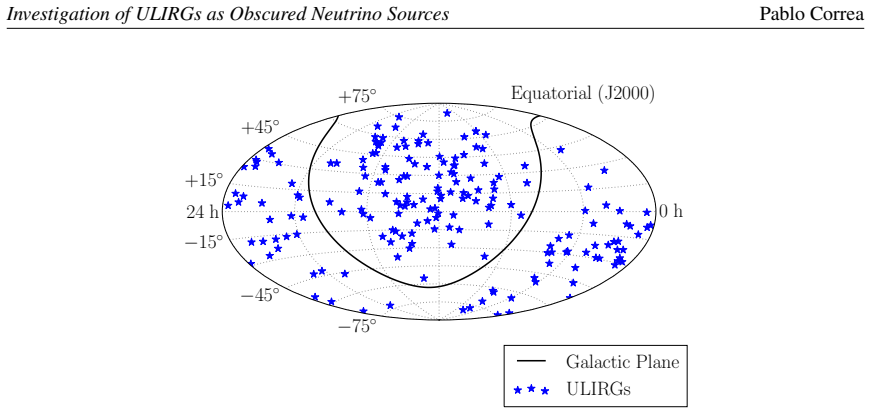
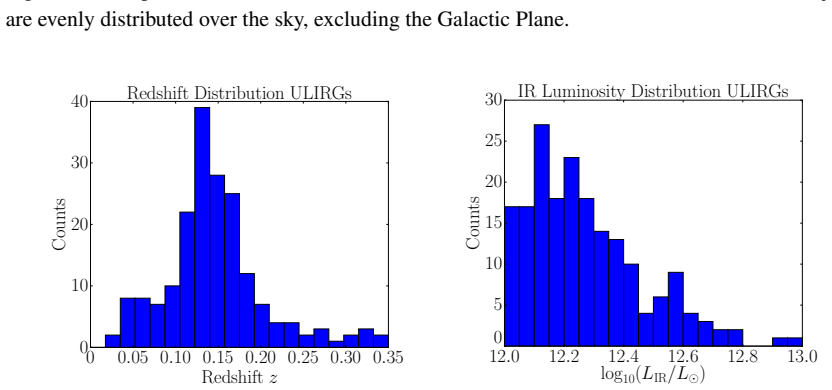
Summary. The paper motivates Ultra-Luminous Infrared Galaxies (ULIRGs) as candidate gamma-ray obscured sources of the IceCube diffuse neutrino flux. It constructs a sample of 189 ULIRGs from three IRAS-based catalogs, characterizes their redshift and infrared-luminosity distributions, and presents preliminary sensitivities for an 8-year IceCube time-integrated stacking analysis. Using an unbinned likelihood with a stacked signal PDF weighted by W_k = d_k^{-2} under an explicit neutrino standard-candle assumption, the authors report that the analysis is sensitive to roughly 10 to 100 neutrinos in the 10 GeV to 70 PeV range, depending on the assumed common spectral index. The paper argues that a non-detection would produce the first limits on the cumulative high-energy neutrino flux from ULIRGs and would constrain hadronic pp-interaction models in these dust-rich environments.
Significance. This is a useful first step: the paper presents the first IceCube source selection and sensitivity study for ULIRGs as a source class, and the methodological components—likelihood, test statistic, pseudo-experiments, signal injection, and detector-response convolution—are described clearly enough to be reproduced. The standard-candle weighting assumption and the common-spectral-index assumption are stated transparently, which is a strength. If the sensitivity estimates are confirmed by the subsequent analysis, a non-detection would yield meaningful constraints on pp-dominated hadronic emission in ULIRGs and would test the gamma-ray-obscured source scenario for the diffuse neutrino flux.
major comments (2)
- [Section 3.1, Eq. (3.1) and Fig. 4] The headline sensitivity of 10 to 100 neutrinos is obtained with weights W_k = d_k^{-2}, i.e., under the assumption that all 189 ULIRGs are neutrino standard candles. This weighting directly determines the stacked signal PDF in Eq. (3.1) and the conversion between flux normalization and n_nu in the right panel of Fig. 4. If the true neutrino luminosity scales with L_IR or is dominated by a minority of AGN-hosting systems, the quoted sensitivity describes a different source population and the 10-100 neutrino numbers are not robust. I recommend adding a robustness check with an alternative physically motivated weighting (for example W_k proportional to L_{IR,k} d_k^{-2}) for at least one spectral index, or explicitly stating in the abstract and conclusions that the sensitivity is conditional on the standard-candle model.
- [Section 2] The claim that the selected sample is 'by construction unbiased' is internally inconsistent with the description of the FSC catalog, whose ULIRGs require an available optical counterpart for redshift measurement. This introduces a selection effect that could bias the sample toward optically brighter or nearer sources. Because Section 4 repeats the unbiasedness claim as a strength of the sample, the authors should either justify it quantitatively with a comparison to the full IRAS flux-limited parent sample or soften the wording to 'flux-limited without full-sky completeness.'
minor comments (5)
- [Section 3.2] The sensitivity definition, 'the amount of injected signal required such that in 90% of the pseudo-experiments one obtains a p-value p <= 0.5,' is nonstandard; please clarify how it relates to the commonly used median 90% confidence-level sensitivity, since a reader may otherwise misinterpret the quoted 10-100 neutrino range as a standard 90% upper limit.
- [Section 3.1] The text 'the stacking is performed in the form of a weighed sum' contains a typo; it should read 'weighted sum.'
- [Section 3.2 and Fig. 4] The right-panel label 'Total number of ULIRG neutrinos' should specify that this is the number of neutrino events expected in the detector after convolution with the effective area, not the number emitted by the sources.
- [References] Several reference entries contain LaTeX spacing artifacts, such as 'F ermi-LA TCollaboration' and 'F ermi-LA T'; these should be corrected to 'Fermi-LAT Collaboration' and 'Fermi-LAT.'
- [Conclusions] The introduction mentions both p-gamma and pp channels, while the conclusions refer only to the pp-interaction channel; please specify that the pp channel is the dominant production mechanism in the dust-rich star-forming regions considered here, or otherwise keep the channel discussion consistent.
Circularity Check
No significant circularity: sensitivity curves are simulation-based, the source list is external, and the standard-candle weighting is a transparent model assumption rather than a fitted input.
full rationale
The paper's central output is a sensitivity/discovery-potential curve obtained by injecting simulated signals, Eq. (3.2) with chosen A and gamma, into pseudo-experiments and counting how many injected neutrinos are needed to reach p=0.5 or 5 sigma. This is not a fit to real data and does not reduce to any fitted parameter. The source catalog is assembled from independent IRAS-based catalogs [15, 16, 12], and the 189-object sample is documented with redshifts and luminosities. The stacking weights Wk = d_k^-2 follow from the explicitly stated standard-candle assumption that all ULIRGs have similar neutrino luminosity; that is a physical modeling assumption, not a circular re-use of the claimed result. The conversion from flux normalization A to expected number n_nu is just the convolution n_nu = integral Aeff dN/dE dt dOmega with the published IceCube effective area and livetime, so the sensitivity number is not re-derived from itself. Self-citations to IceCube detector and analysis papers [18, 19] provide detector response, data selection, and the unbinned likelihood framework; these are independent inputs used to characterize the analysis, not the target conclusion. No equation in the paper is equivalent to its own input by construction, and no fitted parameter is renamed as a prediction. The standard-candle assumption could be physically wrong, and the quoted 10-100 neutrino range is conditional on it, but that is a modeling risk rather than circular reasoning. Therefore the correct circularity finding is a clean non-finding, score 0.
Assumptions & free parameters
free parameters (1)
- common spectral index gamma =
scanned over [1.5, 3.5] in steps of 0.5; not fitted to data in this paper
assumptions (6)
- domain assumption ULIRGs host hadronic acceleration producing high-energy neutrinos via pp and pgamma channels.
- domain assumption All selected ULIRGs are neutrino standard candles with equal neutrino luminosity.
- domain assumption The neutrino spectrum from each ULIRG is an unbroken power law with a spectral index common to all sources.
- domain assumption The combined catalog of 189 ULIRGs is unbiased and complete enough to represent the local ULIRG population.
- domain assumption IceCube effective area, event selection, and background model from previous IceCube publications apply to this analysis.
- domain assumption Planck 2015 cosmological parameters are used to convert redshifts to comoving distances.
Cite this review
Pith. "Pith review of Investigation of Ultra-Luminous Infrared Galaxies as Obscured High-Energy Neutrino Source Candidates." pith.science (2026). https://pith.science/paper/IL3ZCTEQ
@misc{pith2026190805137,
  author       = {Pith},
  title        = {Pith review of: Investigation of Ultra-Luminous Infrared Galaxies as Obscured High-Energy Neutrino Source Candidates},
  year         = {2026},
  howpublished = {\url{https://pith.science/paper/IL3ZCTEQ}},
  note         = {Machine review of arXiv:1908.05137}
}
abstract
Ultra-Luminous Infrared Galaxies (ULIRGs) are the most luminous objects in the infrared sky. With infrared luminosities exceeding $10^{12}$ solar luminosities, ULIRGs contain strong star formation regions which could power hadronic acceleration. Moreover, a significant fraction of ULIRGs have been found to host Active Galactic Nuclei, which could also be a source of hadronic acceleration. Furthermore, such high infrared luminosities indicate that large amounts of dust are present in these objects. In the presence of hadronic acceleration, this dust not only represents an excellent target for high-energy neutrino production through the pp-channel, but it could also attenuate a significant fraction of the gamma rays that are produced in this process. This could relieve the apparent tension between the diffuse IceCube neutrino flux and the diffuse gamma-ray flux measured by Fermi-LAT. We present our source selection criteria and IceCube sensitivities in view of a search for high-energy neutrinos from these so far unexplored objects.
Figures

Figures from the paper (1 more)

Reference graph
Works this paper leans on
-
[1]
IceCube Collaboration, M. G. Aartsen et al., Science 342 (2013) 1242856
2013
-
[2]
IceCube Collaboration, M. G. Aartsen et al., Science 361 (2018) 147–151
2018
-
[3]
IceCube et al. Collaboration, M. G. Aartsen et al., Science 361 (2018) eaat1378
work page 2018
-
[4]
F ermi-LA TCollaboration, W. B. Atwood et al., The Astrophysical Journal 697 (2009) 1071–1102
work page 2009
-
[5]
IceCube Collaboration, M. G. Aartsen et al., The Astrophysical Journal 835 (2017) 45
work page 2017
-
[6]
F ermi-LA TCollaboration, M. Ackermann et al., Phys. Rev. Lett. 116 (2016) 151105
work page 2016
-
[7]
Bechtol et al., The Astrophysical Journal 836 (2017) 47
K. Bechtol et al., The Astrophysical Journal 836 (2017) 47
work page 2017
-
[8]
Murase, D
K. Murase, D. Guetta, and M. Ahlers, Phys. Rev. Lett. 116 (2016) 071101
2016
Show all 20 references
-
[9]
C. J. Lonsdale, D. Farrah, and H. E. Smith, Ultraluminous Infrared Galaxies, pp. 285–336. Springer Berlin Heidelberg, Berlin, Heidelberg, 2006
2006
-
[10]
NASA/IPAC Extragalactic Database, available at http://ned.ipac.caltech.edu
-
[11]
T. P. Robitaille and B. A. Whitney, The Astrophysical Journal 710 (2010) L11–L15
2010
-
[12]
Nardini et al., MNRAS 405 (2010) 2505–2520
E. Nardini et al., MNRAS 405 (2010) 2505–2520
2010
-
[13]
Hung et al., The Astrophysical Journal 791 (2014) 63
C.-L. Hung et al., The Astrophysical Journal 791 (2014) 63
2014
-
[14]
Neugebauer et al., The Astrophysical Journal Letters 278 (1984) L1–L6
G. Neugebauer et al., The Astrophysical Journal Letters 278 (1984) L1–L6
1984
-
[15]
D. B. Sanders et al., The Astronomical Journal 126 (2003) 1607–1664
2003
-
[16]
Kim and D
D.-C. Kim and D. B. Sanders, The Astrophysical Journal Supplement Series 119 (1998) 41–58
1998
-
[17]
M. W. Werner et al., The Astrophysical Journal Supplement Series 154 (2004) 1–9
2004
-
[18]
IceCube Collaboration, M. G. Aartsen et al., JINST 12 (2017) P03012
2017
-
[19]
Braun et al., Astroparticle Physics 29 (2008) 299 – 305
J. Braun et al., Astroparticle Physics 29 (2008) 299 – 305
2008
-
[20]
Planck Collaboration, P. A. R. Ade et al., A&A 594 (2016) A13. 8
2016
Reviewed August 14, 2026 · model on record in the stance chip above.
Discussion (0). Continue with ORCID to comment.