REVIEW 3 major objections 4 minor 37 references
Regularities in the spectrum of chaotic p-modes in rapidly rotating stars
T0 review · 3 major / 4 minor · reviewed 2026-08-14 · deepseek-v4-flash
Pith's one-line read This paper shows that chaotic pressure modes in rapidly rotating stars are organized into series with a nearly regular frequency spacing—a pseudo large separation—set by the mean acoustic travel time between surface rebounds.
desk verdict The paper mostly makes its case that chaotic p-modes in rapid rotators show a real pseudo large separation close to the island-mode spacing, but the semiclassical derivation leans on an unvalidated chord-to-periodic-orbit proxy and the main-peak position is quoted inconsistently. read the letter →
The pith
A machine-rendered reading of the paper's core claim, the machinery that carries it, and where it could break.
The reading
What carries the argument
The load-bearing object is the distribution of acoustic travel times of surface-to-surface chords, modelled as a sum of Gaussian packets $P_{n,\Omega}(T)=\frac{T_0}{\sqrt{2\pi n}\,\sigma_0}\exp\left(-\frac{(T-nT_0)^2}{2(\sqrt{n}\sigma_0)^2}\right)$, with $T_0$ the mean one-chord travel time and $\sigma_0$ its standard deviation. Inserted into the semiclassical form factor $K(T)\approx \sum_j A_j^2\,\delta(T-T_j)$—the diagonal approximation of periodic-orbit theory—this distribution makes the Fourier-transformed autocorrelation develop a peak at $2\pi/T_0$. The machinery also includes the meridional estimate $T_{\mathrm{av}}=2\left(\frac{2}{\pi}\int_0^{\pi/2}\tau(\theta)\,d\theta\right)$, which gives $\Delta_c$ without ray tracing.
What would settle it
Compute chaotic p-mode spectra in a rotating polytropic model with homogeneous (non-stratified) sound speed: the chord travel-time distribution then has $\sigma_0\approx 0.32\,T_0$, so the semiclassical theory predicts no autocorrelation peak, and a strong residual peak would falsify the proposed mechanism.
Extended reading notes
Core claim
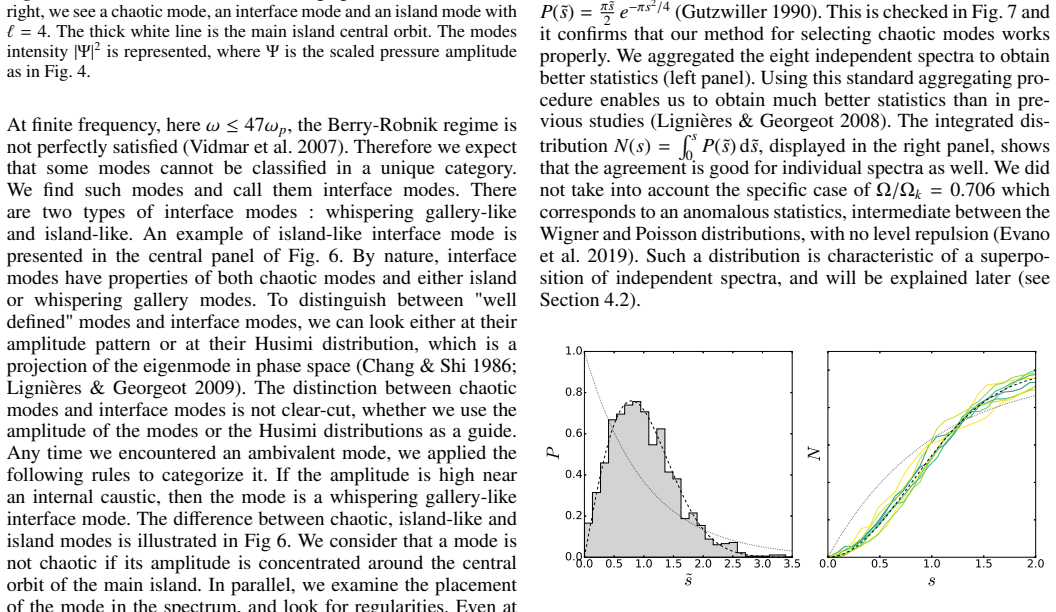
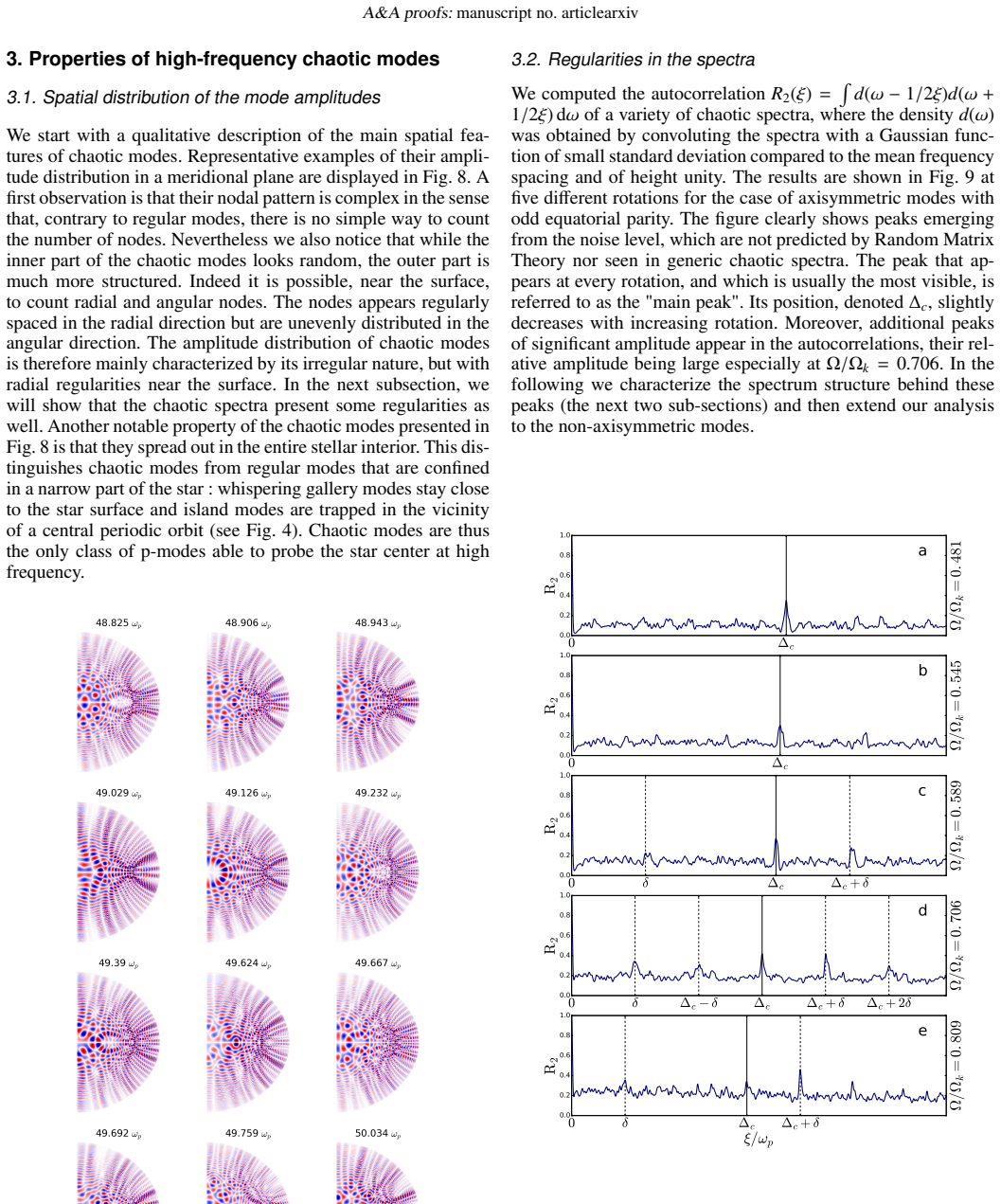
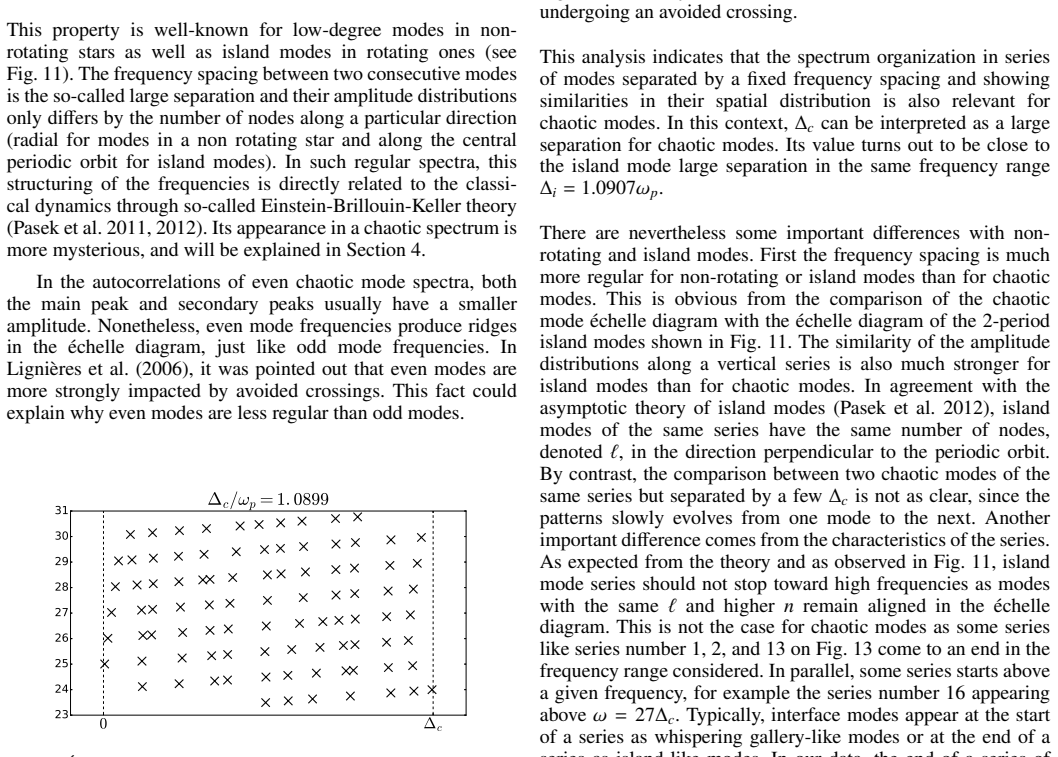
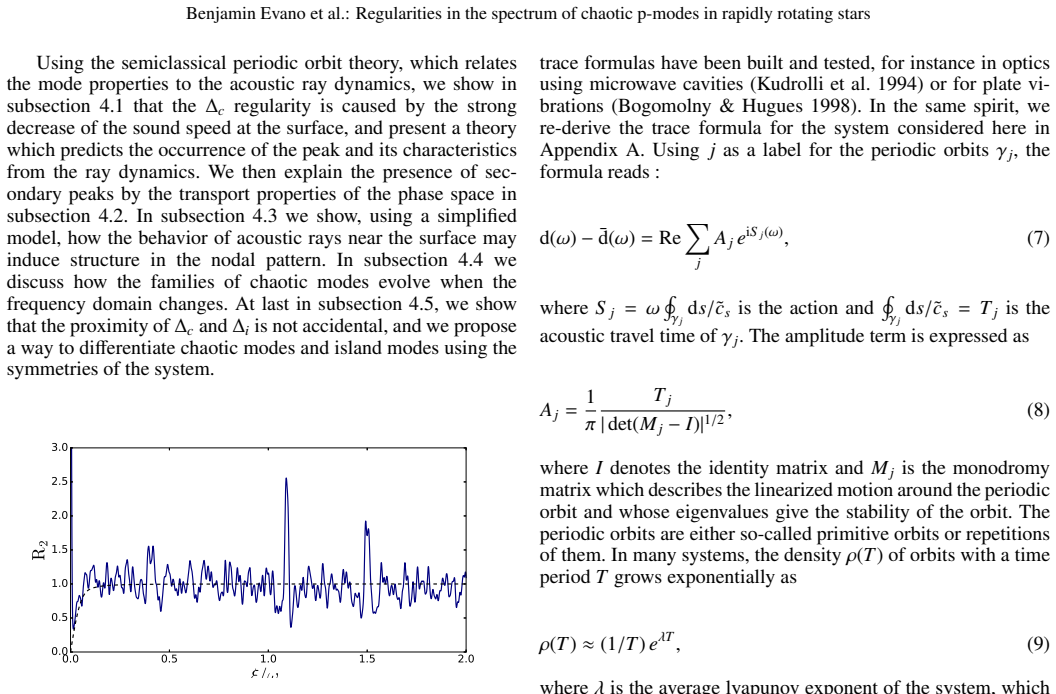
The central claim is that chaotic p-mode spectra in rapidly rotating stars contain reproducible order rather than being featureless. Frequency autocorrelations of numerically computed chaotic spectra show a main peak at a spacing $\Delta_c$, and échelle diagrams show frequencies falling into series whose consecutive members are separated by roughly $\Delta_c$ and share similar amplitude patterns. The semiclassical explanation is that the strong decrease of sound speed near the stellar surface makes the acoustic travel time of a surface-to-surface chord nearly path-independent: chord travel times cluster in narrow packets with mean $nT_0$ and width $\sqrt{n}\,\sigma_0$, with $\sigma_0\ll T_0$. In periodic-orbit theory this packet structure produces an autocorrelation peak at $\Delta_c\approx 2\pi/T_0$, whose height and width are controlled by $\sigma_0/T_0$. The same small spread explains why $\Delta_c$ nearly equals the island-mode large separation $\Delta_i$, while secondary autocorrelation peaks are attributed to partial barriers that trap chaotic rays near stable island chains.
Load-bearing premise
The theory assumes that the travel-time distribution of the actual periodic orbits that shape the spectrum is faithfully represented by the distribution of finite samples of surface-to-surface chord trajectories, modelled as Gaussian packets with means $nT_0$ and widths $\sqrt{n}\,\sigma_0$.
Editorial extensions
If this is right
- Fast rotators should show a single large separation $\Delta\approx\Delta_i\approx\Delta_c$, so autocorrelation peaks seen in observed delta Scuti-type stars may be produced partly by chaotic modes, not only by island modes.
- Because chaotic modes spread over the whole meridional plane, they probe the stellar core at high frequency, complementing whispering-gallery and island modes that remain confined near the surface or around particular orbits.
- The pseudo large separation can be estimated directly from the stellar model by averaging the radial acoustic time over the meridional plane and taking $2\pi/T_{\mathrm{av}}$, without computing the full mode spectrum.
- As rotation approaches the breakup rate, the ratio $\sigma_0/T_0$ grows, the chord travel-time packets overlap, and the chaotic spectrum becomes less regular, consistent with the decreasing peak height seen in the simulations.
- In a combined odd-and-even parity spectrum, chaotic modes should show no peak at half the large separation, whereas island modes do, offering a practical way to separate the two families.
Reading between the lines
- This extends beyond the paper: if $\Delta_c$ is governed mainly by the radial sound-speed profile, the same pseudo large separation should appear in any strongly stratified wave-bearing object, from gas-giant interiors to laboratory acoustic cavities with a sharp refractive-index gradient.
- This extends beyond the paper: the chord-packet proxy could be checked directly by numerically searching for true periodic orbits in the ray model and comparing their travel-time histogram with the Gaussian packets; a mismatch would not remove the numerical peak but would require a revised semiclassical derivation.
- This extends beyond the paper: if chaotic series are remnants of spherical-degree $\ell_s$ series, the pseudo large separation plus amplitude similarity may allow effective spherical degrees to be assigned to chaotic modes in observed spectra, widening the standard asteroseismic classification toolkit.
- This extends beyond the paper: the strength and position of secondary autocorrelation peaks could act as a seismic indicator of phase-space transport barriers around island chains, since the authors tie these peaks to partial barriers whose trapping efficiency varies with rotation.
Signed reviews
Editorial analysis
A structured set of objections, weighed in public.
Referee Report
Summary. The paper studies high-frequency chaotic p-modes in strongly rotating polytropic stellar models, using the 2D oscillation code TOP for mode frequencies and ray simulations for the acoustic dynamics. The authors report peaks in the frequency autocorrelation of chaotic spectra, interpret the main peak as a pseudo large separation Δc, and derive a semiclassical expression relating Δc to the mean one-chord acoustic travel time T0. They further attribute secondary peaks to phase-space partial barriers near stable islands, show that Δc is close to the island-mode large separation, and draw observational consequences for rapidly rotating δ Scuti stars. The numerical autocorrelation peaks and the agreement of the nearest-neighbor statistics with the Wigner surmise are independent, reproducible checks of the mode classification and of the spectral regularity.
Significance. If the central claim holds, the paper identifies a new, non-generic regularity in chaotic p-mode spectra of rotating stars and provides a physical explanation based on the strong radial variation of the sound speed. This is of clear asteroseismic interest because it suggests a unique large separation Δ ≈ Δi ≈ Δc for rapid rotators and offers a possible observational discriminator between island and chaotic modes (the half-separation peak). The paper's strengths are the use of independent numerical mode computations and ray simulations, a parameter-free prediction of the peak position from T0 rather than from a fit to the mode frequencies, and falsifiable statements about observable autocorrelation features. The main caveat is that the key semiclassical step identifies the periodic-orbit travel-time density with the n-chord Gaussian packet distribution without a direct validation, so the theoretical explanation of the numerical peak, though plausible, is not yet fully established.
major comments (3)
- [Sec. 4.1.2, Eq. (18)] The semiclassical prediction Δth_c ≈ 2π/T0 is derived from the form factor K(T), which in the trace formula is a sum over true periodic orbits, yet the travel-time density of periodic orbits is replaced by the n-chord Gaussian packet distribution P_n,Ω(T). The authors explicitly state that they cannot systematically find periodic orbits and only 'infer' their properties from chords. This proxy is load-bearing: if actual periodic orbits do not concentrate near nT0 with width sqrt(n)σ0, the predicted peak in the form factor can shift or disappear even though the numerical autocorrelation peak remains. The manuscript should either validate the proxy, for example by a direct search for a sample of short periodic orbits and a comparison of their travel-time distribution with Eq. (18), or clearly state that the agreement with the numerical peak is suggestive but not yet derived.
- [Sec. 4.1.1–4.1.2, Eqs. (9)–(10) and text after Eq. (18)] The derivation of K(T) ∝ T P_Ω(T) is internally inconsistent as written. Using Eq. (9) ρ(T) ≈ (1/T)e^{λT} and Eq. (10) A(T) ≈ (1/(πT))e^{-λT/2}, one obtains A^2(T)ρ(T) = (1/π^2 T^3) P_Ω(T), not T P_Ω(T). The stated result T P_Ω(T) follows only if the amplitude A(T) carries an additional factor proportional to T, as in Eq. (8) and in the standard Hannay–Ozorio derivation. This algebraic discrepancy needs to be corrected, since the rest of the argument relies on the functional form of the form factor.
- [Sec. 3.2.1 and Table 2] The main-peak position at Ω/Ωk = 0.589 is quoted as Δc = 1.0899ωp in the échelle-diagram analysis (Figs. 10 and 13), whereas Table 2 lists Δc = 1.1132ωp for the same rotation and symmetry class. This unreconciled difference of about 2% is comparable to the claimed agreement between Δc, Δth_c, and Δi, and it affects the validation of Eq. (19). The paper should report a single measurement procedure with associated uncertainties, or explain why two different values are used.
minor comments (4)
- [Sec. 4.1.2, text after Eq. (18)] The sentence 'One has to keep in mind that the dependency on Ω is not explicit but hidden in the values of T0 and σ0' leaves it unclear whether T0 and σ0 are measured from ray simulations at each rotation or fitted; the later text indicates they are measured, which is the correct and more convincing approach.
- [Appendix A, Eq. (A.30)] The label i is used for periodic orbits in the prefactor while j is used in the phase and in the summation; this typographical inconsistency should be corrected for clarity.
- [Sec. 4.1.1, Eq. (17)] The transition from the discrete form factor in Eq. (16), valid for short times below the Ehrenfest time, to the long-time form in Eq. (17) with exponential growth and decay would benefit from an explicit statement of the time regime in which the diagonal approximation and the Gaussian packet model are applied.
- [Sec. 4.2] The predicted position of secondary peaks at approximately Δc/3 is acknowledged to be a rough estimate at most rotation rates; the authors should make clear that this is a heuristic scaling argument rather than a quantitative prediction.
Circularity Check
No circularity: the predicted Δc is a parameter-free ray-model comparison, not a fit to the target frequencies.
full rationale
The central derivation is the semiclassical prediction Δth_c ≈ 2π/T0, where T0 and σ0 are the mean and width of the one-chord acoustic travel-time distribution computed from ray simulations (Eq. 18), while the numerical Δc is independently measured from the frequency autocorrelation of chaotic modes (Sec. 3.2, Fig. 9). The comparison in Fig. 17 and Table 2 is a genuine test: no parameter is fitted to the mode frequencies, and T0 is not defined in terms of Δc. The trace-formula step (Eqs. 7–17) is a standard semiclassical relation re-derived in Appendix A, and the Gaussian packet model for periodic-orbit travel times is an explicitly stated approximation rather than an assumption that already contains the target peak. Equation 19 gives an independent estimate of T0 from the mean acoustic time over the meridional plane, so the predicted peak position does not reduce to the measured autocorrelation peak. The citations to Lignières & Georgeot (2009) and Evano et al. (2019) provide the ray Hamiltonian, mode classification, and the companion observational finding of the peaks, but none of these citations assumes the pseudo-large-separation explanation. Thus no load-bearing step in the derivation reduces to its own input. A numerical inconsistency appears in the quoted Δc at Ω/Ωk = 0.589 (1.0899ωp in Sec. 3.2.1 versus 1.1132ωp in Table 2), but that is a consistency issue, not a circularity.
Assumptions & free parameters
free parameters (3)
- T0 (mean 1-chord acoustic travel time) =
5.19/omega_p at Omega/Omega_k=0.481; 6.30/omega_p at Omega/Omega_k=0.706
- sigma0 (standard deviation of 1-chord acoustic travel times) =
sigma0/T0 = 0.049 at Omega/Omega_k=0.481; 0.097 at Omega/Omega_k=0.809
- lmax threshold lc for chaotic/whispering-gallery separation =
Numerical value not stated; read from the gap in lmax histograms (Fig. 5)
assumptions (6)
- domain assumption Cowling approximation, neglect of Coriolis force, and neglect of buoyancy are valid for high-frequency p-modes.
- domain assumption A uniformly rotating, self-gravitating polytropic model (Gamma=5/3, mu=3) represents the oscillation physics of rapidly rotating massive and intermediate-mass stars.
- domain assumption Berry-Robnik decomposition: regular and chaotic modes form independent subspectra.
- ad hoc to paper The periodic-orbit travel-time density can be inferred from n-chord trajectories, modeled as Gaussian packets with means nT0 and widths sqrt(n)*sigma0 (Eq. 18).
- standard math Diagonal approximation for the form factor is valid up to the Ehrenfest time for the relevant orbits.
- domain assumption Partial barriers around the 2-period island chain trap chaotic trajectories long enough to isolate modes at the computed frequencies.
Cite this review
Pith. "Pith review of Regularities in the spectrum of chaotic p-modes in rapidly rotating stars." pith.science (2026). https://pith.science/paper/4AW6G6YD
@misc{pith2026190805143,
  author       = {Pith},
  title        = {Pith review of: Regularities in the spectrum of chaotic p-modes in rapidly rotating stars},
  year         = {2026},
  howpublished = {\url{https://pith.science/paper/4AW6G6YD}},
  note         = {Machine review of arXiv:1908.05143}
}
read the original abstract
Interpreting the oscillations of massive and intermediate mass stars remains a challenging task. In fast rotators, the oscillation spectrum of p-modes is a superposition of sub-spectra which correspond to different types of modes, among which island modes and chaotic modes are expected to be the most visible. In the case of island modes, a semi-analytic formula describing the asymptotic behavior of island modes has been obtained previously. We study the properties of high frequency chaotic p-modes in a polytropic model. Unexpected peaks appear in the frequency autocorrelations of the spectra. Our goal is to find a physical interpretation for these peaks and also to provide an overview of the mode properties. We use the 2D oscillation code TOP to produce the modes and acoustic ray simulations to explore the wave properties in the asymptotic regime. Using the tools developed in the field of quantum chaos (or wave chaos), we derive an expression for the frequency autocorrelation involving the travel time of acoustic rays. Chaotic mode spectra were previously thought to be irregular, i. e. described only through their statistical properties. Our analysis shows the existence, in chaotic mode spectra, of a pseudo large separation. This means that chaotic modes are organized in series, such that the modes in each series follow a nearly regular frequency spacing. The pseudo large separation of chaotic modes is very close to the large separation of island modes. Its value is related to the sound speed averaged over the meridional plane of the star. In addition to the pseudo large separation, other correlations appear in the numerically calculated spectra. We explain their origin by the trapping of acoustic rays near the stable islands.
Figures


Figures from the paper (13 more)







Reference graph
Works this paper leans on
-
[1]
Aerts, C., Christensen-Dalsgaard, J., & Kurtz, D. W. 2010, Asteroseismology, Astronomy & Astrophysics Library (Springer Netherlands)
work page 2010
-
[2]
Ballot, J., Lignières, F., & Reese, D. R. 2013, Numerical Exploration of Oscilla- tion Modes in Rapidly Rotating Stars, ed. M. Goupil, K. Belkacem, C. Neiner, F. Lignières, & J. J. Green, V ol. 865, 91
work page 2013
-
[3]
Berry, M. V . 1985, Proc. R. Soc. Lond. A, 400, 229
work page 1985
-
[4]
Berry, M. V . & Robnik, M. 1984, Journal of Physics A: Mathematical and Gen- eral, 17, 2413
work page 1984
- [5]
-
[6]
B., Georgeot, B., Giannoni, M.-J., & Schmit, C
Bogomolny, E. B., Georgeot, B., Giannoni, M.-J., & Schmit, C. 1992, Physical Review Letters, 69, 1477
work page 1992
-
[7]
B., Georgeot, B., Giannoni, M.-J., & Schmit, C
Bogomolny, E. B., Georgeot, B., Giannoni, M.-J., & Schmit, C. 1997, Physics Reports, 291, 219
work page 1997
-
[8]
Bogomolny, E. B. & Keating, J. P. 1996, Physical Review Letters, 77, 1472
work page 1996
Show all 37 references
-
[9]
1991, Random matrix theories and chaotic dynamics, M.-J
Bohigas, O. 1991, Random matrix theories and chaotic dynamics, M.-J. Gian- noni, A. V oros, and J. Zinn-Justin, Proceedings of the Les Houches Summer School of Theoretical Physics, LII (North-Holland, Amsterdam), 87–199
1991
-
[10]
1993, Physics Reports, 223, 43
Bohigas, O., Tomsovic, S., & Ullmo, D. 1993, Physics Reports, 223, 43
1993
-
[11]
Bowman, D. M. & Kurtz, D. W. 2018, Monthly Notices of the Royal Astronom- ical Society, 476, 3169
2018
-
[12]
& Shi, K.-J
Chang, S.-J. & Shi, K.-J. 1986, Physical Review A, 34, 7
1986
-
[13]
1977, Mecanique quantique (293 rue Lecourbe, 75015 Paris: Hermann)
Cohen-Tannoudji, C., Diu, B., & Laloe, F. 1977, Mecanique quantique (293 rue Lecourbe, 75015 Paris: Hermann)
1977
-
[14]
2017, Chaos: Classical and Quantum (http://chaosbook.org/)
Cvitanovic, P., Artuso, R., Mainieri, R., Tanner, G., & Vattay, G. 2017, Chaos: Classical and Quantum (http://chaosbook.org/)
2017
-
[15]
2019, EPL, 125, 49002 García Hernández, A., Martín-Ruiz, S., Monteiro, M
Evano, B., Georgeot, B., & Lignières, F. 2019, EPL, 125, 49002 García Hernández, A., Martín-Ruiz, S., Monteiro, M. J. P. F. G., et al. 2015, The Astrophysical Journal Letters, 811, L29 García Hernández, A., Moya, A., Michel, E., et al. 2009, Astronomy & Astro- physics, 506, 79...
2019
-
[16]
1993, Linear adiabatic stellar pulsation, J-P
Gough, D. 1993, Linear adiabatic stellar pulsation, J-P. Zahn and J. Zinn-Justin, Proceedings of the Les Houches Summer School of Theoretical Physics, XLVII (Elsevier, Amsterdam), 400–560
1993
-
[17]
Gutzwiller, M. C. 1990, Chaos in Classical and Quantum Mechanics, Interdisci- plinary Applied Mathematics (New York: Springer-Verlag)
1990
-
[18]
Hannay, J. H. & Ozorio De Almeida, A. M. 1984, Journal of Physics A: Mathe- matical and General, 17, 3429
1984
-
[19]
J., Kawaler, S
Hansen, C. J., Kawaler, S. D., & Trimble, V . 2004, Stellar Interiors: Physical
2004
-
[20]
1994, Physical Review E, 49, R11 Lignières, F
Kudrolli, A., Sridhar, S., Pandey, A., & Ramaswamy, R. 1994, Physical Review E, 49, R11 Lignières, F. & Georgeot, B. 2008, Physical Review E, 78, 016215 Lignières, F. & Georgeot, B. 2009, Astronomy & Astrophysics, 500, 1173 Lignières, F., Rieutord, M., & Reese, D. 2006, Astron...
1994
-
[21]
2004, Random Matrices (Elsevier) Article number, page 18 of 18 Benjamin Evano et al.: Regularities in the spectrum of chaotic p-modes in rapidly rotating stars
Mehta, M. 2004, Random Matrices (Elsevier) Article number, page 18 of 18 Benjamin Evano et al.: Regularities in the spectrum of chaotic p-modes in rapidly rotating stars
2004
-
[22]
2017, in European Physical Journal Web of Conferences, V ol
Michel, E., Dupret, M.-A., Reese, D., et al. 2017, in European Physical Journal Web of Conferences, V ol. 160, 03001
2017
-
[23]
M., Angelou, G
Mirouh, G. M., Angelou, G. C., Reese, D. R., & Costa, G. 2019, Monthly Notices of the Royal Astronomical Society: Letters, 483, L28
2019
-
[24]
1993, Chaos in Dynamical Systems (Cambridge University Press)
Ott, E. 1993, Chaos in Dynamical Systems (Cambridge University Press)
1993
-
[25]
Ouazzani, R.-M., Dupret, M.-A., & Reese, D. R. 2012, Astronomy & Astro- physics, 547, A75
2012
-
[26]
W., & Dupret, M.-A
Ouazzani, R.-M., Roxburgh, I. W., & Dupret, M.-A. 2015, Astronomy & Astro- physics, 579, A116 O’Connor, P., Gehlen, J., & Heller, E. J. 1987, Physical Review Letters, 58, 1296 Paparó, M., Benkö, J. M., Hareter, M., & Guzik, J. A. 2016, Astrophysical Jour- nal Supplement Series...
2015
-
[27]
Pasek, M., Georgeot, B., Lignières, F., & Reese, D. R. 2011, Physical Review Letters, 107, 121101
2011
-
[28]
Pasek, M., Lignières, F., Georgeot, B., & Reese, D. R. 2012, Astronomy & As- trophysics, 546, A11
2012
-
[29]
2006, Astronomy & Astrophysics, 455, 621
Reese, D., Lignières, F., & Rieutord, M. 2006, Astronomy & Astrophysics, 455, 621
2006
-
[30]
2008, Astronomy & Astrophysics, 481, 449
Reese, D., Lignières, F., & Rieutord, M. 2008, Astronomy & Astrophysics, 481, 449
2008
-
[31]
R., Lignières, F., Ballot, J., et al
Reese, D. R., Lignières, F., Ballot, J., et al. 2017, Astronomy & Astrophysics, 601, A130
2017
-
[32]
R., MacGregor, K
Reese, D. R., MacGregor, K. B., Jackson, S., Skumanich, A., & Metcalfe, T. S. 2009, Astronomy & Astrophysics, 506, 189
2009
-
[33]
R., Prat, V ., Barban, C., Veer-Menneret, C
Reese, D. R., Prat, V ., Barban, C., Veer-Menneret, C. v., & MacGregor, K. B. 2013, Astronomy & Astrophysics, 550, A77
2013
-
[34]
Schulman, L. S. 1996, Techniques and Applications of Path Integration (Wiley Classics Library)
1996
-
[35]
2011, Physical Review E, 84, 035202
Shim, J.-B., Wiersig, J., & Cao, H. 2011, Physical Review E, 84, 035202
2011
-
[36]
& Richter, K
Sieber, M. & Richter, K. 2001, Physica Scripta, 2001, 128
2001
-
[37]
2007, Journal of Physics A: Mathematical and Theoretical, 40, 13883 Article number, page 19 of 18
Vidmar, G., Stöckmann, H.-J., Robnik, M., et al. 2007, Journal of Physics A: Mathematical and Theoretical, 40, 13883 Article number, page 19 of 18
2007
Reviewed August 14, 2026 · model on record in the stance chip above.
Discussion (0). Continue with ORCID to comment.