REVIEW 3 major objections 4 minor 26 references
Search for high-energy neutrinos from AGN cores
T0 review · 3 major / 4 minor · reviewed 2026-08-14 · deepseek-v4-flash
Pith's one-line read Searching ten years of IceCube data, this paper asks whether accretion-disk cores of AGN, not their jets, produce the observed high-energy neutrinos, and reports that the expected contribution from radio-selected AGN cores falls short of…
desk verdict First IceCube stacking search specifically targeting non-jetted AGN cores, with a genuinely useful sample-selection method, but its 'not saturate' conclusion is a sensitivity projection, not a measured result. read the letter →
The pith
A machine-rendered reading of the paper's core claim, the machinery that carries it, and where it could break.
The reading
What carries the argument
The central machinery is an unbinned maximum-likelihood stacking analysis adapted from IceCube's point-source searches. Each AGN enters the signal probability density function weighted by its expected relative neutrino contribution, which is taken to be proportional to the measured soft X-ray flux (0.5–2 keV) as a proxy for accretion-disk luminosity. Source samples are built by positional cross-matching of the NVSS radio catalogue, the AllWISE infrared catalogue, and the 2RXS and XMMSL2 X-ray catalogues, with blazars removed using the 3LAC catalogue; for LLAGN an additional 'Seyfertness' probability is used as a weight. To compare with the diffuse flux, the total X-ray flux of all AGN is estimated using X-ray luminosity functions, and the required fraction of the IceCube diffuse neutrino flux is computed for a γ = 2 spectrum.
What would settle it
Perform the same stacking analysis with neutrino weights set by a different accretion-disk proxy, such as hard X-ray or mid-infrared luminosity, and compare the best-fit neutrino flux: if the result changes substantially, the linear X-ray scaling is falsified. Alternatively, if the unblinded best fit from a large AGN sample is consistent with zero while the model requires more than 100% of the IceCube diffuse flux at γ = 2, the AGN-core scenario is excluded.
Extended reading notes
Core claim
The central claim is quantitative: for radio-selected AGN cores (13,927 sources, weighted by 0.5–2 keV X-ray flux, and assuming a neutrino spectrum with spectral index γ = 2), the expected neutrino flux lies below the IceCube diffuse neutrino flux. Figure 5 shows the expected flux from the AGN sample (both 13,927 and 1,000 stacked sources) above the diffuse-flux line, so the paper states that the neutrinos expected from these AGN are not going to saturate the diffuse neutrino flux seen by IceCube. At the same time, the fraction of diffuse flux required for a 5σ discovery is below unity for much of the accessible stacked X-ray flux, so the search has the sensitivity to detect a sub-saturating contribution if AGN cores are responsible for a substantial part of the diffuse flux.
Load-bearing premise
The analysis assumes that each AGN's neutrino luminosity is proportional to its soft X-ray flux; if neutrino output depends on other factors such as black hole spin, disk state, or jet orientation, the stacking weights and the comparison to the diffuse flux would not be valid.
Editorial extensions
If this is right
- If AGN cores produce neutrinos in proportion to their X-ray flux, then radio-selected AGN cores alone contribute less than the full IceCube diffuse flux at γ = 2, so other source populations or a different production mechanism are needed to fill the gap.
- The analysis sensitivity is about three times better than the 5σ discovery potential, so the final unblinded search can constrain the AGN-core contribution to a level below the diffuse flux.
- Applying the same stacking procedure to the IR-selected AGN and LLAGN samples, and to softer neutrino spectra, is expected to yield tighter limits and will further test the accretion-disk origin of the diffuse neutrino flux.
Reading between the lines
- A null or sub-saturating result across all three AGN samples would argue that neutrino emission from accretion disks is subdominant, shifting attention to source classes whose neutrino output is not tightly correlated with X-ray luminosity, such as choked jets or star-forming galaxies.
- The assumed linear X-ray-to-neutrino scaling could itself be tested by splitting the stacked sample by X-ray hardness or by black-hole-mass estimates and checking whether the neutrino flux follows the same proportionality in each subset.
- The same X-ray-weighting scheme could be cross-checked with IceCube's high-energy starting events, which are less affected by atmospheric-muon backgrounds than muon-track samples.
- If a positive stacking signal emerges after unblinding, the per-source energy-flux/X-ray-flux ratio measured here would provide a direct calibration for future multi-messenger searches targeting AGN cores.
Signed reviews
Editorial analysis
A structured set of objections, weighed in public.
Referee Report
Summary. The paper, an IceCube Collaboration proceedings contribution for ICRC 2019, proposes a stacking search for high-energy neutrinos from the cores of active galactic nuclei (AGN). Three AGN samples are built from radio, infrared, and X-ray catalogues (NVSS, AllWISE, 2RXS/XMMSL2), with blazars removed, and sources are weighted by soft X-ray flux as a proxy for accretion-disk luminosity; the LLAGN sample is additionally weighted by a 'Seyfertness' probability. An unbinned maximum-likelihood ratio test is applied to ten years of IceCube data. The paper presents preliminary discovery-potential curves for the radio-selected sample and compares them with the IceCube diffuse flux, concluding that neutrinos from these AGN are 'not going to saturate' the observed diffuse flux. Unblinded results are deferred to a future publication.
Significance. The paper addresses an important open problem, the origin of the bulk of the IceCube astrophysical neutrino flux, and the source-selection strategy is thoughtful: cross-matching X-ray, radio, and infrared catalogues while removing gamma-ray blazars is a reasonable way to isolate AGN-core candidates. The statistical machinery is standard IceCube methodology, and the authors are transparent that the results are preliminary. If the central claim were actually measured, it would be a valuable constraint on AGN-core neutrino production. As it stands, however, the main conclusion is a sensitivity projection, not an observational result, so the paper's immediate value is as a forecast and a description of the analysis plan rather than as a measurement.
major comments (3)
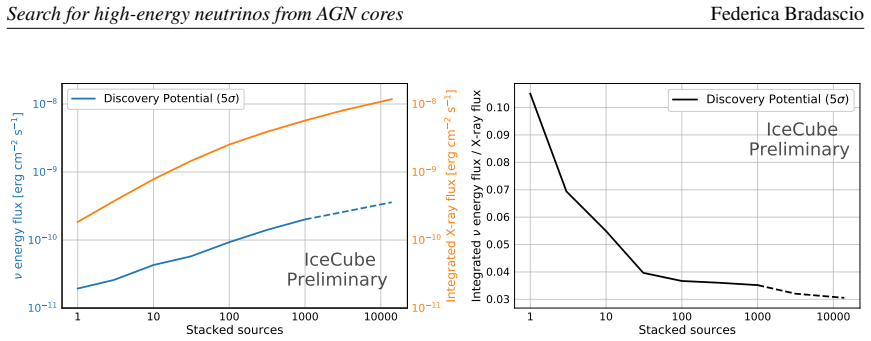
- [Section 5 and Figure 5] The statement that 'the neutrinos expected from these AGN are not going to saturate the diffuse neutrino flux seen by IceCube' is not supported by the plotted curves. The light-blue curves are discovery-potential curves (the flux required for a 5-sigma discovery in 50% of trials), as made explicit in Figure 2. A discovery-potential curve lying above the diffuse-flux line means that a population that emitted the full diffuse flux would not be detected at 5-sigma by this analysis; it does not measure or upper-bound the true neutrino output of the radio-selected AGN population. Because the analysis has not been unblinded, the saturation claim should be rephrased as a sensitivity statement, e.g., 'this analysis is not yet sensitive enough to detect a population that saturates the diffuse flux,' or removed entirely.
- [Section 5 and Figures 4/5] The label 'expected neutrino flux' in Figure 5 is misleading. No absolute normalization from the pp or p-gamma models of Section 2 is derived; the assumption L_nu is proportional to soft X-ray flux fixes only the relative weighting of sources, not the overall neutrino flux. The vertical placement of the 'expected flux' curves is therefore set by detector sensitivity (the discovery potential) and by the assumed diffuse-flux normalization, not by a neutrino-production model. The same issue affects Figure 4, where the plotted quantity is correctly described in the text as 'the fraction of the diffuse neutrino flux the AGN would have to produce in order for a discovery to be made' but could easily be misread as a measured fraction. Please relabel these curves as required fluxes or sensitivities and state explicitly that they are not predictions of the models discussed in Section 2.
- [Section 5 and Figure 2] The conclusion in Figure 5 uses the full radio-selected sample of 13,927 sources, but Figure 2 indicates that the discovery-potential values for the last two sub-samples, which include the full sample, are extrapolated (dashed line) because a larger number of trials is required. Thus the central comparison in Figure 5 rests on an extrapolated sensitivity value. The authors should either provide the required trials for the full sample, or clearly exclude the full-sample point from the conclusion and restrict the claim to the non-extrapolated sub-samples.
minor comments (4)
- [Section 2] The term 'Radiative Inefficient Acceleration Flows (RIAFs)' is incorrect; the standard term is 'Radiatively Inefficient Accretion Flows'.
- [Table 1] The 'Matched catalogues' row is garbled and should be cleaned up; for example, the three samples should read 'NVSS + 2RXS/XMMSL2', 'AllWISE + 2RXS/XMMSL2', and '2RXS + XMMSL2'.
- [Section 5] The phrase 'a softer neutrino spectrum, which is a better description of the IceCube diffuse flux' is vague; the specific spectral index intended should be stated.
- [Figure 3] The axis label 'log10S(0.5-2 keV)' should include units consistently, e.g., 'log10[S(0.5-2 keV)/erg cm^-2 s^-1]'.
Circularity Check
The 'not saturate' claim is the discovery-potential curve renamed as 'expected flux', so the central comparison reduces by construction.
-
self definitional
[Section 5 (Figures 2 and 5, discussion of expected flux)]
"The ratio of the two curves is shown in the right panel: it represents the expected neutrino flux per source. ... In Figure 5 the IceCube diffuse flux for γ = 2 (black horizontal line) is compared to the expected flux from the radio-selected AGN population, for 13,927 and 1,000 stacked sources (light blue lines). They lay above the solid black line, therefore the neutrinos expected from these AGN are not going to saturate the diffuse neutrino flux seen by IceCube."
The 'expected neutrino flux per source' in Figure 2 is defined as the ratio of the 5σ discovery potential to the integrated X-ray flux of the stacked sources. Figure 5 then scales that same quantity to the full AGN population and compares it with the IceCube diffuse flux, so the plotted 'expected flux' is just the discovery-potential curve rescaled by the ratio of total to stacked X-ray flux. The conclusion that these AGN will not saturate the diffuse flux is therefore not an independent model prediction or measurement; it is the discovery-potential comparison restated by construction. No absolute neutrino-normalization from the pp/pγ models is introduced, so the vertical placement is set by detector sensitivity, not by the source physics.
full rationale
The paper's sample selection, X-ray weighting, and likelihood stacking are self-contained and non-circular; the X-ray-flux proportionality is an assumed model input, not derived from the neutrino data. The only circular step is in the interpretive claim: 'expected neutrino flux' is defined as the discovery potential per X-ray flux, and this same sensitivity curve is then compared to the diffuse neutrino flux to conclude that AGN cores cannot saturate it. That conclusion is forced by the definition of the plotted quantity rather than by any measured or model-normalized flux. The paper itself labels the results preliminary and defers unblinded limits to a future publication, which confirms that the saturation statement is a sensitivity projection. The self-citation to the IceCube diffuse-flux measurement [26] is an external benchmark and does not by itself constitute circularity.
Assumptions & free parameters
free parameters (3)
- Spectral index gamma =
2 (assumed)
- Seyfertness threshold =
0.5
- X-ray/radio matching radius =
60 arcsec
assumptions (6)
- domain assumption Shakura-Sunyaev thin disk model for AGN cores
- domain assumption RIAF model for LLAGN
- domain assumption L_UV-L_X relation
- domain assumption X-ray luminosity functions
- domain assumption IceCube diffuse neutrino flux measurement
- standard math Standard likelihood ratio stacking method
Cite this review
Pith. "Pith review of Search for high-energy neutrinos from AGN cores." pith.science (2026). https://pith.science/paper/VIGXH3O6
@misc{pith2026190805170,
  author       = {Pith},
  title        = {Pith review of: Search for high-energy neutrinos from AGN cores},
  year         = {2026},
  howpublished = {\url{https://pith.science/paper/VIGXH3O6}},
  note         = {Machine review of arXiv:1908.05170}
}
read the original abstract
IceCube is a cubic-kilometer Cherenkov telescope operating at the South Pole. In 2013 IceCube discovered high-energy astrophysical neutrinos and has more recently found compelling evidence for a flaring blazar being a source of high-energy neutrinos. However, as blazars can only be responsible for a small fraction of the observed neutrino flux, the sources responsible for the majority of the detected neutrinos remain unknown. In this work, we explore the possibility that the observed neutrino flux is produced in the cores of Active Galactic Nuclei (AGN). Various models have predicted neutrino emission from the accretion disks of AGN. According to these models, the neutrino luminosity would not depend strongly on either the orientation or other parameters of the relativistic jet. Both jetted and non-jetted AGN could contribute to the neutrino flux. We perform a stacking analysis to test for correlation between various sub-populations of AGN and high-energy neutrinos using a decade of IceCube data. We select AGN based on their radio emission, infrared color properties, and X-ray flux using the NVSS, AllWISE, ROSAT and XMMSL2 catalogs. We use the accretion disk luminosity, estimated from the observed soft X-ray flux, to weight the contribution of selected galaxies to the neutrino signal.
Figures


Figures from the paper (2 more)


Reference graph
Works this paper leans on
-
[1]
IceCube Collaboration, M. G. Aartsen et al., JINST 12 (2017) P03012
2017
-
[2]
IceCube Collaboration, M. G. Aartsen et al., Science 342 (2013)
2013
-
[3]
IceCube Collaboration, M. G. Aartsen et al., Science 361 (2018). 7 Search for high-energy neutrinos from AGN cores Federica Bradascio Figure 5: Expected neutrino flux from the radio-selected AGN sample (in light blue) compared to the diffuse neu- trino flux with γ = 2 (solid black line). Plot adapted from [26]
work page 2018
-
[4]
Collaboration, M
IceCube et al. Collaboration, M. G. Aartsen et al., Science 361 (2018) eaat1378
2018
-
[5]
IceCube Collaboration, M. G. Aartsen et al., The Astrophysical Journal 835 (2017) 45
2017
-
[6]
Murase, D
K. Murase, D. Guetta, and M. Ahlers, Phys. Rev. Lett. 116 (2016) 071101
2016
- [7]
-
[8]
F. W. Stecker, C. Done, M. H. Salamon, and P. Sommers, Phys. Rev. Lett. 66 (1991) 2697–2700
work page 1991
Show all 26 references
-
[9]
Kalashev et al., Journal of Experimental and Theoretical Physics 120 (2015) 541–548
O. Kalashev et al., Journal of Experimental and Theoretical Physics 120 (2015) 541–548
2015
-
[10]
N. I. Shakura and R. A. Sunyaev, Astron. Astrophys. 24 (1973) 337–355
1973
-
[11]
L. C. Ho, Annual Review of Astronomy and Astrophysics 46 (2008) 475–539
2008
-
[12]
S. S. Kimura, K. Murase, and K. Toma, The Astrophysical Journal 806 (2015) 159
2015
-
[13]
Lusso and G
E. Lusso and G. Risaliti, The Astrophysical Journal 819 (2016) 154
2016
-
[14]
A. T. Steffen et al., The Astronomical Journal 131 (2006) 2826–2842
2006
-
[15]
et al., Astron
Boller, Th. et al., Astron. Astrophys. 588 (2016) A103
2016
-
[16]
Salvato et al., Monthly Notices of the Royal Astronomical Society 473 (2017) 4937–4955
M. Salvato et al., Monthly Notices of the Royal Astronomical Society 473 (2017) 4937–4955
2017
-
[17]
E. L. Wright et al., The Astronomical Journal 140 (2010) 1868–1881
2010
-
[18]
J. J. Condon et al., The Astronomical Journal 115 (1998) 1693–1716
1998
-
[19]
Ackermann et al., The Astrophysical Journal 810 (2015) 14
M. Ackermann et al., The Astrophysical Journal 810 (2015) 14
2015
-
[20]
and Véron, P., Astron
Véron-Cetty, M.-P. and Véron, P., Astron. Astrophys. 518 (2010) A10
2010
-
[21]
IceCube Collaboration, PoS(ICRC2019)851 (these proceedings)
-
[22]
IceCube Collaboration, M. G. Aartsen et al., The Astrophysical Journal 835 (2017) 151
2017
-
[23]
Miyaji, G
T. Miyaji, G. Hasinger, and M. Schmidt, Astron. Astrophys. 353 (2000) 25–40
2000
-
[24]
Ebrero et al., Astron
J. Ebrero et al., Astron. Astrophys. 493 (2009) 55
2009
-
[25]
Hasinger, T
G. Hasinger, T. Miyaji, and M. Schmidt, Astron. Astrophys. 441 (2005) 417–434
2005
-
[26]
IceCube Collaboration, M. G. Aartsen et al., The Astrophysical Journal 833 (2016) 3. 8
2016
Reviewed August 14, 2026 · model on record in the stance chip above.
Discussion (0). Continue with ORCID to comment.