REVIEW 2 major objections 4 minor 2 cited by
(Learned) Frequency Estimation Algorithms under Zipfian Distribution
T0 review · 2 major / 4 minor · reviewed 2026-08-14 · deepseek-v4-flash
Pith's one-line read This paper establishes tight expected-error bounds for Count-Min and Count-Sketch under Zipfian frequencies, showing that learned variants improve by a factor $\Theta(\log n / \log(n/B))$.
desk verdict Tight Count-Min analysis and new Count-Sketch upper bounds are real contributions, but the k>1 Count-Sketch lower bound rests on a fixable arithmetic error that currently leaves that part of Table 1 unsupported. read the letter →
The pith
A machine-rendered reading of the paper's core claim, the machinery that carries it, and where it could break.
The reading
What carries the argument
The mechanism that carries the Count-Sketch results is the random counter $S = \sum_{j=1}^n f_j \eta_j \sigma_j$, with $\eta_j$ a Bernoulli indicating a hash collision with the queried item and $\sigma_j$ an independent $\pm 1$ sign; Count-Sketch's estimate is the median of $k$ independent copies of $S$. The paper's main technical contribution is an anti-concentration analysis of $S$ inside a small interval around zero: an upper bound on $\Pr[S \in I]$ for a short interval $I$ drives the Count-Sketch lower bound, while a lower bound of $\Omega(tB)$ on $\Pr[S \in [-t,t]]$ for $t \le 1/(2B)$ drives the upper bound through a binomial/median argument. For Count-Min, the carry is a head/tail split of the Zipfian frequencies: items in $[B]$ contribute $O(1/B)$ to the error once there are at least two rows, and the tail $[n]\setminus[B]$ contributes $\Theta(\log(n/B)/B)$, with variance-based concentration inequalities giving the matching lower bound. The learned variants add a heavy-hitter oracle that removes the $B_h$ heaviest items from the hashed sketch, which is why their error is determined by the lighter tail and why a single row is then optimal.
What would settle it
Recompute the count in Section 4.2: among $\{1/j : 1 \le j \le B \log k\}$, how many values lie in an interval of length $1/(B\sqrt{k \log k})$? If the count is $\Theta(B(\log k)^{3/2}/\sqrt{k})$ rather than the claimed $\Theta(B \log k/\sqrt{k})$, then the anti-concentration probability in the proof is only $O(\sqrt{\log k}/\sqrt{k})$, and the $\Omega(\sqrt{k}/(B \log k))$ lower bound is not established by that argument. A direct simulation of Count-Sketch with $k = 3, 5, 7$ rows on Zipfian data can also compare empirical expected error against the claimed $\Theta(\sqrt{k}/B)$ upper and $\Omega(\sqrt{k}/(B \log k))$ lower bounds.
Extended reading notes
Core claim
On the paper's own terms, the central discovery is that under a Zipfian frequency vector $f_i = 1/i$, the expected estimation error is controlled by a clean split between the heavy head of the distribution and its light tail. For Count-Min, the light tail contributes $\Theta(\log(n/B)/B)$ regardless of $k$, while the heavy head contributes $O(1/B)$ once $k \ge 2$, yielding the tight bound $\Theta(k \log(kn/B)/B)$ when the $B$ total buckets are distributed over $k$ tables. For Count-Sketch, the paper studies the distribution of the counter $S = \sum_{j \ne i} f_j \eta_j \sigma_j$, where $\eta_j$ indicates whether $j$ collides with the queried item and $\sigma_j$ is a random sign; the median of $k$ independent copies of $S$ has expected deviation $\Theta(\log B/B)$ for $k = 1$ and, for odd $k \ge 3$, lies between $\Omega(\sqrt{k}/(B \log k))$ and $O(\sqrt{k}/B)$. The learned-Count-Sketch analysis shows that a perfect heavy-hitter oracle, which gives dedicated buckets to the $B_h$ heaviest items, reduces the per-item error to $\Theta(1/B)$ and the frequency-weighted error to $\Theta(\log(n/B)/(B \log n))$; with an oracle that misclassifies each item with probability $\delta$, the bound degrades smoothly and matches classic Count-Sketch when $\delta = 1$, while retaining the idealized bound for $\delta = O(1/\log B)$. Together these results imply that a constant number of rows, rather than $\Theta(\log n)$, minimizes expected error under Zipfian data.
Load-bearing premise
The analysis assumes exact Zipfian frequencies $f_i \propto 1/i$ and a query distribution aligned with them; separately, the Count-Sketch lower bound for $k > 1$ rests on a density count of the values $1/j$ inside an interval of length $1/(B\sqrt{k \log k})$, where the proof's displayed arithmetic appears to undercount by a $\sqrt{\log k}$ factor.
Editorial extensions
If this is right
- With Zipfian frequencies and total budget $B$, Count-Min should be run with $k = 2$ (or another small constant): the expected error is $\Theta(\log(n/B)/B)$, whereas $k = \Theta(\log n)$ pushes it to roughly $\Theta(\log^2 n/B)$.
- For Count-Sketch with odd $k$, $k = 3$ is asymptotically near-optimal, since the error is always $O(\sqrt{k}/B)$ and never better than $\Omega(\sqrt{k}/(B \log k))$ for $k \ge 3$.
- Learned Count-Sketch with one row and a perfect heavy-hitter oracle attains $\Theta(\log(n/B)/(B \log n))$, which is the best of the variants analyzed and is a $\Theta(\log n / \log(n/B))$ improvement over classic Count-Sketch.
- The learned advantage is not brittle: it survives an oracle that misclassifies each item with probability up to $O(1/\log B)$, and degrades to the classic sketch only as $\delta$ approaches 1.
- Because the per-item error bounds are proved uniformly, the same expected-error order applies under any query distribution, not just the frequency-proportional one assumed in the main text.
Reading between the lines
- One could use the asymptotic formula to build a simple parameter rule: $k = 2$ for Count-Min and $k = 3$ for Count-Sketch on Zipf-like production workloads, switching to $\Theta(\log n)$ rows only when worst-case per-item guarantees (rather than expected error) are required.
- The same head/tail split and anti-concentration approach should extend to other heavy-tailed distributions, such as Pareto or log-normal; verifying whether the $\Theta(\log n / \log(n/B))$ learned gap persists would be a direct next experiment.
- The noisy-oracle trade-off suggests an adaptive design the paper does not describe: estimate the oracle's error $\delta$ online and disable the learned routing when $\delta$ exceeds $O(1/\log B)$, since the theoretical advantage over classic Count-Sketch then disappears.
- The appendix's generalized-Zipf results for Count-Min (learning helps only when $\alpha > 1$) point to a possible phase transition for learned Count-Sketch as well, which the paper leaves open.
Signed reviews
Editorial analysis
A structured set of objections, weighed in public.
Referee Report
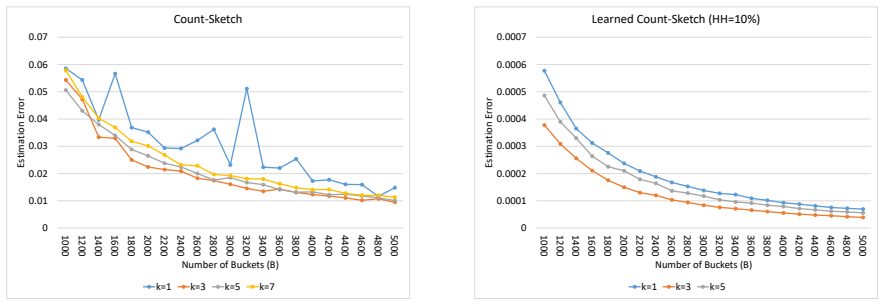
Summary. This paper analyzes the expected frequency-estimation error of Count-Min, Count-Sketch, and their learning-augmented variants under a Zipfian frequency distribution. The authors prove a tight bound of Θ(k log(kn/B)/B) for Count-Min with k rows and total B buckets, resolving a gap left by Hsu et al. (ICLR 2019). For Count-Sketch they provide the first such bounds: Θ(log B/B) for one row, and for odd k≥3 an upper bound O(√k/B) together with a claimed lower bound Ω(√k/(B log k)) after translating to the total-bucket formulation. They also analyze learned Count-Sketch with a perfect or noisy heavy-hitter oracle, and conclude that for minimizing expected error the number of hash rows should be a constant greater than 1, contrary to the common Θ(log n) choice. The paper includes experiments on synthetic Zipfian data that qualitatively support the main asymptotic statements.
Significance. If all bounds hold, this is a substantial contribution: the Count-Min bound is tight and short, the Count-Sketch analysis is the first for Zipfians, and the practical suggestion to use a small constant number of rows is actionable and well motivated. The proofs are self-contained and use standard concentration tools, and the experiments complement the asymptotics. However, the k>1 Count-Sketch lower bound, which is a load-bearing part of Table 1 and of the optimality claim for CS, rests on an arithmetic error that invalidates the proof as written. The CM upper/lower bounds and the k=1 CS bounds appear sound.
major comments (2)
- [Section 4.2, proof of Theorem 4.4 (lower bound)] The displayed interval-occupancy count contains an arithmetic error. The proof states that an interval of length 1/(B√(k log k)) contains at most (1/(B√(k log k)))·(B log k)^2 + 1 = B log k/√k + 1 values from {1/j : j∈[B log k]}, but the correct product is B (log k)^{3/2}/√k. Consequently the bound Pr[S∈I | |J|=r] ≤ 3/√k is not obtained; the ratio is O(√(log k)/√k). Substituting this into Eq. (6) gives Pr[S∈I] = O(√(log k)/√k), so p0 = 1/2 − O(√(log k)/√k). The subsequent Stirling/binomial argument then yields only k^{−Ω(1)} for the probability that at least half of the k counters exceed the threshold, not the required Ω(1). Thus the lower bound E[|f̃_i − s(i)f_i|] = Ω(1/(B√(k log k))) is not established as written.
- [Table 1 and Section 4, downstream claims] Because the proof of Theorem 4.4's lower bound fails, the k>1 Count-Sketch lower-bound entry Ω(k^{1/2}/(B log k)) in Table 1 is unsupported, and with it the claims that the CS bounds are nearly tight and that a constant number k>1 is optimal for expected CS error. These claims are central to the paper's advertised contributions. The authors should either repair the lower bound with a different anti-concentration argument (for example, one exploiting the variance scale Var[S]≈1/B^2) or state and prove a weaker lower bound that is actually established and adjust the conclusions accordingly.
minor comments (4)
- [Section 5.2, before Theorem 5.5] The sentence 'Setting B1 = Bh = Θ(B) and B2 = B−B2 = Θ(B)' contains a typo; it should read B2 = B−B1 = Θ(B).
- [Section 4.2, lower-bound proof] The notation X^(ℓ) is used in the final paragraph of the lower-bound proof without being redefined in that context; the reader must infer it from the upper-bound part of the proof. Please define it explicitly.
- [Section 4.2, lower-bound proof] The interval I is described as centered at s_ℓ(i)f_i, but the anti-concentration step that yields p0 = 1/2 − O(1/√k) requires a bound on the probability that the noise lies in an interval centered at 0. The argument is insensitive to the center, so the proof can be repaired by rewording, but as written it is confusing.
- [Theorem 5.5, proof] The choice N1 = [2B2]\[B2] is transparent only when B1 = B2; since the theorem allows B2 ≥ B1, the proof should explicitly state why this choice captures the relevant non-heavy items and how the case B2 > B1 is handled.
Circularity Check
No circularity found: the new Count-Min and Count-Sketch bounds and the learned-variant analyses are derived from first principles against external benchmarks; the only flagged issue is an arithmetic misstep in the Count-Sketch lower-bound proof, which is a correctness risk rather than a circular dependency.
full rationale
The paper's central derivations are self-contained. Theorem 3.1 for Count-Min is proved by a hash-collision union bound, Bennett's inequality, and a reduction of the general case to the n=B case, without using any fitted constant or the result being proved. The Count-Sketch single-row bound (Theorem 4.3) follows from an upper-bound lemma and a lower-bound lemma that are proved directly; the multi-row bounds (Theorem 4.4) use the external Littlewood-Offord and Minton-Price lemmas plus a median argument. The learned Count-Sketch results (Theorems 5.1, 5.5, 5.7) are proved from the same lemmas plus the Littlewood-Offord theorem, not by assuming the target bounds. Citations to [HIKV19], which shares two authors with the present paper, supply only the learned-Count-Min benchmark for comparison and a 'simple reduction' in Appendix A for the generalized-Zipf learned-Count-Min lower bound; these citations are not used to derive the paper's new CM/CS bounds. There is, however, a correctness concern that should be flagged separately: in Section 4.2, proof of Theorem 4.4 lower bound, the text states that an interval of length 1/(B sqrt(k log k)) contains at most (1/(B sqrt(k log k)))*(B log k)^2 + 1 = B log k / sqrt(k) + 1 of the values {1/j : j <= B log k}; the displayed arithmetic is wrong, since the correct count is B (log k)^{3/2}/sqrt(k). With the corrected count the anti-concentration bound becomes O(sqrt(log k)/sqrt(k)) rather than O(1/sqrt(k)), too weak to force the median outside the interval with constant probability, so Theorem 4.4's lower bound is not established as written. This is a mathematical gap, not a circular step, and it does not affect the circularity verdict: the derivation chain does not reduce any prediction to its inputs.
Assumptions & free parameters
assumptions (6)
- domain assumption Frequencies follow the exact Zipfian law f_i=1/i on a known universe of size n.
- domain assumption Hash functions h_l and sign functions s_l are truly random, with some upper bounds only needing O(log B)-independence.
- standard math Standard concentration inequalities (Bennett, Chernoff, Hoeffding) and anti-concentration results (Littlewood-Ossford, Erdos, Minton-Price Corollary 3.2) hold as cited.
- domain assumption The heavy-hitter oracle is perfect for the main learned-variant bounds, and for the noisy analysis it misclassifies each item independently with probability at most δ.
- domain assumption In learned sketches, heavy items receive unique exact buckets and the remaining items go to a sketch with B-B_h buckets, with B_h=Θ(B).
- domain assumption For Count-Sketch with k>1, k is odd and n≥kB, and Theorem 4.4 also assumes k≤B.
Cite this review
Pith. "Pith review of (Learned) Frequency Estimation Algorithms under Zipfian Distribution." pith.science (2026). https://pith.science/paper/KLSOFEMG
@misc{pith2026190805198,
  author       = {Pith},
  title        = {Pith review of: (Learned) Frequency Estimation Algorithms under Zipfian Distribution},
  year         = {2026},
  howpublished = {\url{https://pith.science/paper/KLSOFEMG}},
  note         = {Machine review of arXiv:1908.05198}
}
abstract
\begin{abstract} The frequencies of the elements in a data stream are an important statistical measure and the task of estimating them arises in many applications within data analysis and machine learning. Two of the most popular algorithms for this problem, Count-Min and Count-Sketch, are widely used in practice. In a recent work [Hsu et al., ICLR'19], it was shown empirically that augmenting Count-Min and Count-Sketch with a machine learning algorithm leads to a significant reduction of the estimation error. The experiments were complemented with an analysis of the expected error incurred by Count-Min (both the standard and the augmented version) when the input frequencies follow a Zipfian distribution. Although the authors established that the learned version of Count-Min has lower estimation error than its standard counterpart, their analysis of the standard Count-Min algorithm was not tight. Moreover, they provided no similar analysis for Count-Sketch. In this paper we resolve these problems. First, we provide a simple tight analysis of the expected error incurred by Count-Min. Second, we provide the first error bounds for both the standard and the augmented version of Count-Sketch. These bounds are nearly tight and again demonstrate an improved performance of the learned version of Count-Sketch. In addition to demonstrating tight gaps between the aforementioned algorithms, we believe that our bounds for the standard versions of Count-Min and Count-Sketch are of independent interest. In particular, it is a typical practice to set the number of hash functions in those algorithms to $\Theta (\log n)$. In contrast, our results show that to minimize the \emph{expected} error, the number of hash functions should be a constant, strictly greater than $1$.
Figures


Figures from the paper (1 more)

Forward citations
Cited by 2 Pith papers
-
Fair-Count-Min: Frequency Estimation under Equal Group-wise Approximation Factor
Fair-Count-Min partitions Count-Min columns among groups, allocating columns by group size for one hash row and by a binomial-minimum equation for multiple rows, aiming to equalize expected approximation factors.
-
Learning-Augmented Streaming Algorithms for Approximating MAX-CUT
With per-vertex oracle labels that match an optimal cut with probability 1/2+ε, a single-pass streaming algorithm achieves a (1/2+Ω(ε²))-approximation of the MAX-CUT value in poly(1/ε) words of space.
Reference graph
Works this paper leans on
-
[1]
A high-performance algorithm for identifying frequent items in data streams
[ABL+17] Daniel Anderson, Pryce Bevan, Kevin Lang, Edo Liberty, Lee Rhodes, and Justin Thaler. A high-performance algorithm for identifying frequent items in data streams. In Proceedings of the 2017 Internet Measurement Conference , pages 268–282,
work page 2017
-
[7]
Learning sublinear-time indexing for nearest neighbor search
[DIRW19] Yihe Dong, Piotr Indyk, Ilya Razenshteyn, and Tal Wagner. Learning sublinear-time indexing for nearest neighbor search. arXiv preprint arXiv:1901.08544 ,
arXiv 1901
-
[8]
The case for learned index structures
[KBC+18] Tim Kraska, Alex Beutel, Ed H Chi, Jeffrey Dean, and Neoklis Polyzotis. The case for learned index structures. In Proceedings of the 2018 International Conference on Management of Data , pages 489–504,
work page 2018
-
[10]
Heavy hitters via cluster-preserving clustering
[LNNT16] Kasper Green Larsen, Jelani Nelson, Huy L Nguyˆ en, and Mikkel Thorup. Heavy hitters via cluster-preserving clustering. In 2016 IEEE 57th Annual Symposium on Foundations of Computer Science (FOCS) , pages 61–70. IEEE,
work page 2016
-
[12]
Augmented sketch: Faster and more accurate stream processing
[RKA16] Pratanu Roy, Arijit Khan, and Gustavo Alonso. Augmented sketch: Faster and more accurate stream processing. In Proceedings of the 2016 International Conference on Management of Data , pages 1449–1463,
work page 2016
-
[2002]
Composable Sketches for Functions of Frequencies: Beyond the Worst Case
[CGP20] Edith Cohen, Ofir Geri, and Rasmus Pagh. Composable sketches for functions of frequencies: Beyond the worst case. arXiv preprint arXiv:2004.04772 ,
work page Pith review arXiv 2004
-
[2005]
Summarizing and mining skewed data streams
[CM05b] Graham Cormode and Shan Muthukrishnan. Summarizing and mining skewed data streams. In Proceedings of the 2005 SIAM International Conference on Data Mining , pages 44–55. SIAM,
work page 2005
-
[2011]
Online metric algorithms with untrusted predictions
[ACE+20] Antonios Antoniadis, Christian Coester, Marek Elias, Adam Polak, and Bertrand Simon. Online metric algorithms with untrusted predictions. arXiv preprint arXiv:2003.02144,
work page Pith review arXiv 2003
Show all 12 references
-
[2014]
A deep learning approach to structured signal recovery
[MPB15] Ali Mousavi, Ankit B Patel, and Richard G Baraniuk. A deep learning approach to structured signal recovery. In Communication, Control, and Computing (Allerton), 2015 53rd Annual Allerton Conference on , pages 1336–1343. IEEE,
2015
-
[2017]
Optimal algorithms for ski rental with soft machine-learned predic- tions
[Kod19] Rohan Kodialam. Optimal algorithms for ski rental with soft machine-learned predic- tions. arXiv preprint arXiv:1903.00092 ,
1903 arXiv
-
[2018]
Dispersion for data-driven algorithm design, online learning, and private optimization
[BDV18] Maria-Florina Balcan, Travis Dick, and Ellen Vitercik. Dispersion for data-driven algorithm design, online learning, and private optimization. In 2018 IEEE 59th Annual Symposium on Foundations of Computer Science (FOCS) , pages 603–614. IEEE,
2018
-
[2020]
Learning optimal search algorithms from data
[CGT+19] Shuchi Chawla, Evangelia Gergatsouli, Yifeng Teng, Christos Tzamos, and Ruimin Zhang. Learning optimal search algorithms from data. arXiv preprint arXiv:1911.01632,
1911 arXiv
Reviewed August 14, 2026 · model on record in the stance chip above.
Discussion (0). Continue with ORCID to comment.