REVIEW 4 major objections 6 minor 1 cited by
Surface rotation and photometric activity for Kepler targets I. M and K main-sequence stars
T0 review · 4 major / 6 minor · reviewed 2026-08-14 · deepseek-v4-flash
Pith's one-line read Wavelet-plus-autocorrelation analysis of Kepler light curves yields reliable rotation periods for 15,910 M and K dwarfs, 4,431 of them new, and shows faster rotators are more active.
desk verdict Solid catalog paper whose main asset is 15,910 rotation periods and Sph values, with 4,431 new detections; the interpretation of the fast-rotator branch is shakier than the catalog itself. read the letter →
The pith
A machine-rendered reading of the paper's core claim, the machinery that carries it, and where it could break.
The reading
What carries the argument
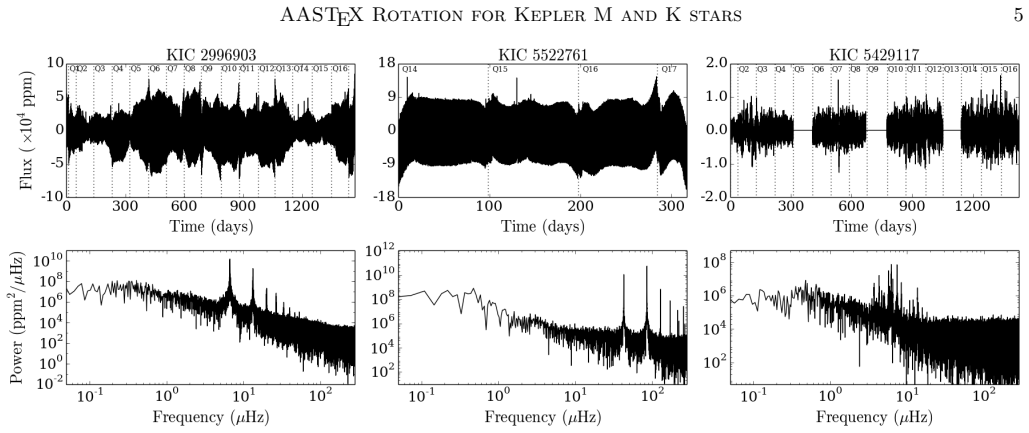
The object that carries the argument is the three-diagnostic rotation pipeline. First, a Morlet-wavelet time-frequency decomposition yields the wavelet power spectrum and, summed over time, the global wavelet power spectrum (GWPS); the rotation estimate is the central period of the highest fitted Gaussian peak, with the half-width as its uncertainty. Second, the autocorrelation function (ACF) of the light curve, smoothed with a Gaussian whose width is one tenth of the dominant Lomb-Scargle period, yields the highest significant peak as an independent period. Third, the composite spectrum (CS) is the product of the normalized GWPS and the normalized ACF resampled onto the same period grid, so that periods present in both methods are enhanced. A period is accepted when GWPS, ACF, and CS agree within $2\sigma$, the estimates agree within 20 percent across the appropriate high-pass filters, and the peak-height thresholds hold ($G_{\rm ACF} \geq 0.2$, $H_{\rm ACF} \geq 0.3$, $H_{\rm CS} \geq 0.15$). The companion object is the activity proxy $S_{\rm ph}$, defined as the standard deviation of light-curve sub-series of length $5 \times P_{\rm rot}$ with photon noise subtracted; it converts a measured period into a magnetic-activity measure and underlies the rotation–activity relation.
What would settle it
Take the fast-rotating K dwarfs with photometric activity above roughly 10,000 ppm — the group the paper itself cautions about — and obtain high-resolution spectra or Gaia astrometric orbits for about 100 of them. If more than a small fraction show binary motion, the fast-rotator branch of the activity–rotation relation, and part of the derived bimodal period distribution, is contaminated by synchronized binaries rather than single-star rotation. A purely photometric version of the same test: require every reported period to be recovered independently from the first and second halves of the light curve; stable spot modulation should persist across both halves, while quarter-dependent pollution would not.
Extended reading notes
Core claim
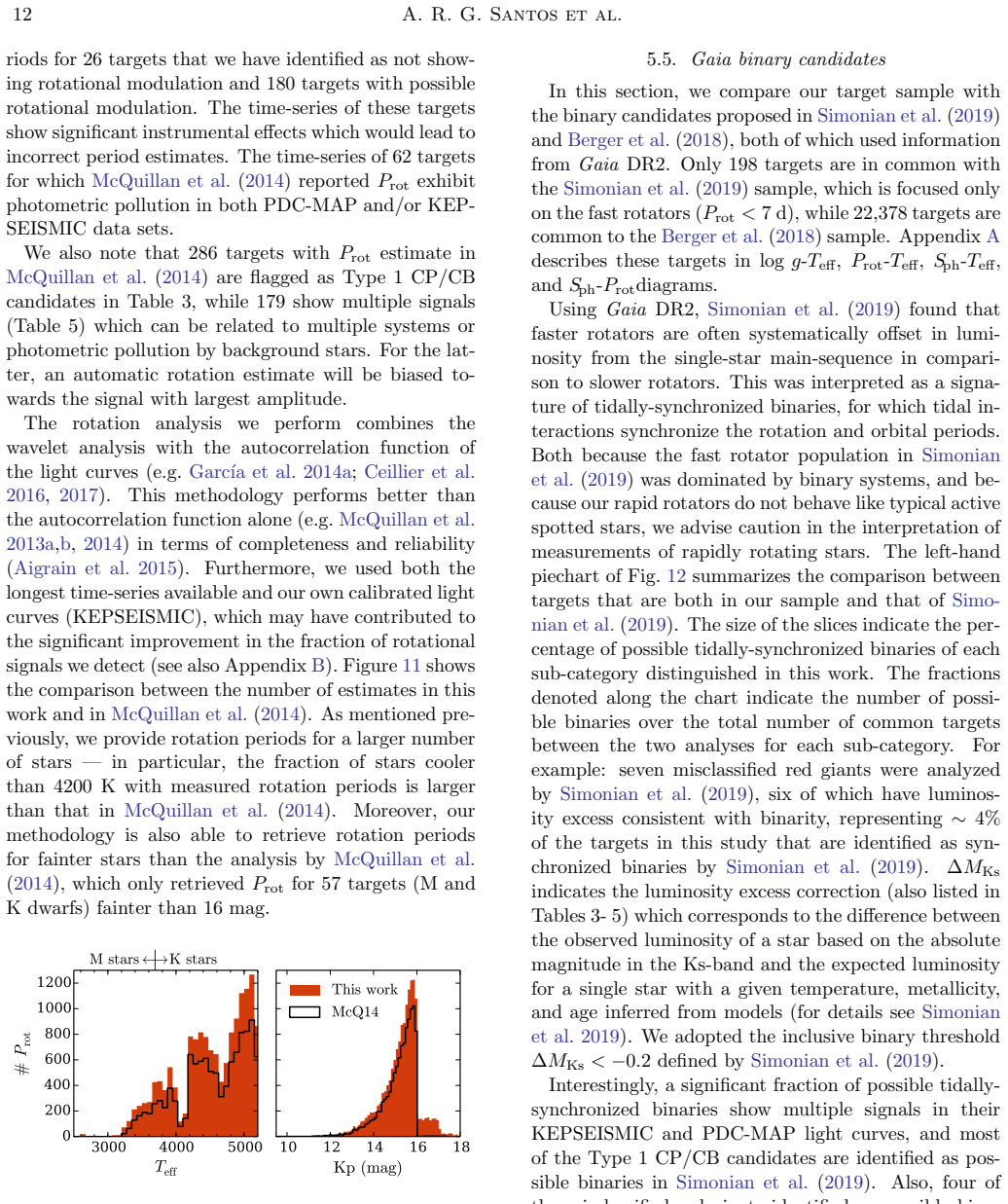
The paper's central claim is that its KEPSEISMIC light curves — its own calibration of Kepler pixel data, high-pass filtered at 20, 55, and 80 days — together with a three-diagnostic rotation pipeline yield reliable rotation-period estimates for 15,290 M and K dwarfs, with a further 620 flagged candidates (possible classical pulsators or close-in binaries, and multi-period sources) reported separately. Reliability is defined internally as agreement among the wavelet global power spectrum, the autocorrelation function, and the composite spectrum within $2\sigma$, plus agreement within 20 percent between different filters, plus peak-height thresholds; externally it is validated by 99.4 percent agreement within $2\sigma$ with the McQuillan et al. catalog across 11,209 common targets. The discovery is the catalog itself and the population statements built on it: the newly measured stars are on average cooler and fainter than previously cataloged rotators, rotation periods shorten as effective temperature and mass increase, the photometric activity proxy $S_{\rm ph}$ spans a wider range for hotter stars, $S_{\rm ph}$ grows as rotation speeds up, and the rotation-period distribution is bimodal. The paper also claims to clean the sample by removing 1,221 misclassified red giants, eclipsing binaries, RR Lyrae stars, and photometrically polluted light curves.
Load-bearing premise
The load-bearing premise is that each detected periodic brightness variation is starspot rotation, not pulsation, binarity, eclipses, or light from a nearby star; the paper itself flags 368 classical-pulsator/close-binary candidates, 270 multi-signal light curves, and a set of very fast rotators with unusually large activity as cases where this premise is uncertain.
Editorial extensions
If this is right
- The 4,431 newly reported periods extend rotation measurements to cooler and fainter M and K dwarfs, giving gyrochronology relations more calibration points at the low-mass end.
- Confirmation of the bimodal rotation-period distribution by an independent pipeline strengthens the case that the bimodality is a real feature of the low-mass field-star population rather than an artifact of one method.
- The K-dwarf anti-correlation between $S_{\rm ph}$ and rotation period ties photometric activity to spin rate and anchors comparisons with solar activity, which the paper quotes at 314.5 ppm at maximum and 67.4 ppm at minimum.
- Removal of 1,221 misclassified red giants and flagging of 368 pulsator/close-binary candidates changes the effective M and K dwarf population counts derived from the Kepler catalog.
- The catalog tables, with pollution and binarity flags, become a reference data set for stellar spin-down studies, exoplanet-host rotation, and tests of magnetic-braking models.
Reading between the lines
- If the pipeline resolves factor-of-two period ambiguities as well as the comparison with the prior catalog suggests, applying the same three-diagnostic scheme to older G and F dwarfs could sharpen the debate over weakened magnetic braking, since spurious half-rotation signals are exactly the kind of error that mimics faster-than-expected spin-down.
- A testable extension: the 3,562 targets with visible but unrecoverable spot modulation form a natural completeness sample, so modeling their detection failure as a function of brightness and period would let catalog users correct selection bias in the reported period distribution.
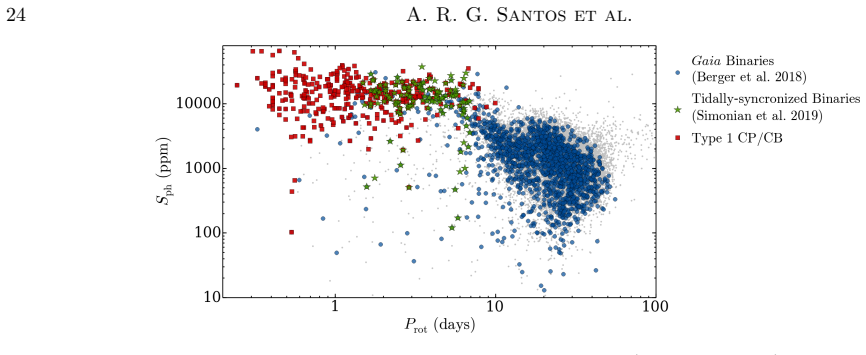
- Because the paper flags fast rotators with very large $S_{\rm ph}$ as possibly tidally synchronized binaries, gyrochronology or activity studies that use the fast-rotator branch should test how their conclusions change when high-activity fast rotators are excluded.
- The wider $S_{\rm ph}$ range at higher temperature, combined with the catalog's detection limits, suggests a re-interpretation test: if intermediate-period stars are under-detected because dark spots and bright faculae cancel, the bimodal gap should widen when the analysis is restricted to low-noise, high-amplitude light curves.
Signed reviews
Editorial analysis
A structured set of objections, weighed in public.
Referee Report
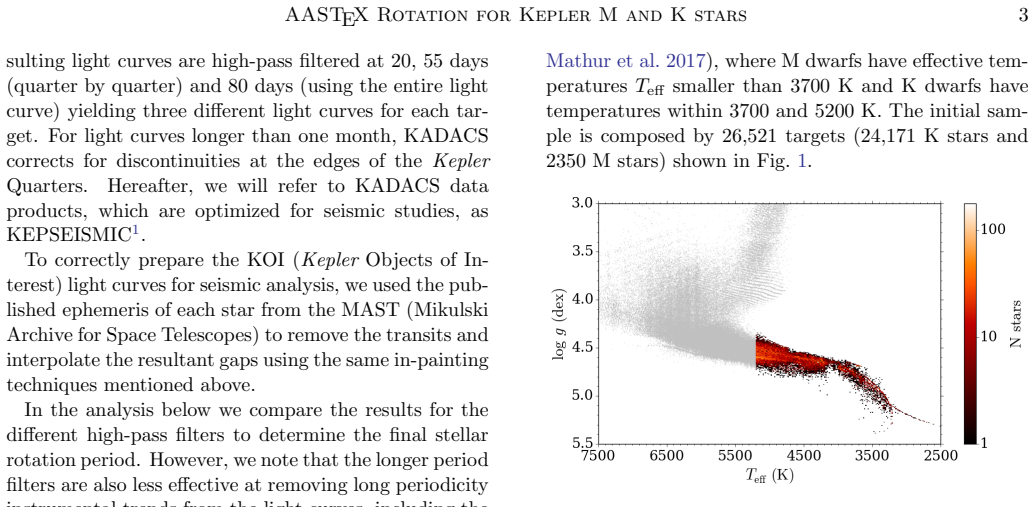
Summary. The manuscript presents a homogeneous rotation-period and photometric-activity catalog for 26,521 Kepler M and K main-sequence stars selected from KSPC DR25. Rotation periods are derived with a pipeline combining wavelet analysis, autocorrelation function, and composite spectrum applied to KEPSEISMIC light curves, with PDC-MAP light curves used as a cross-check. The authors report reliable periods for 15,910 targets, including 4,431 targets not in McQuillan et al. (2013b, 2014), and find 99.4% agreement within 2σ with that catalog for the 11,209 common targets. They also compute the photometric activity proxy Sph and report a mild decrease of rotation period with increasing temperature, an anti-correlation between Sph and rotation period for K dwarfs, and a bimodal rotation-period distribution. Potential polluters are identified and flagged, including classical pulsator/close-in binary candidates, multiple-signal systems, misclassified red giants, eclipsing binaries, and photometrically polluted light curves.
Significance. If the catalog is sound, this is a valuable community resource: it extends rotation measurements to fainter and cooler M and K dwarfs than the McQuillan et al. catalogs, adds roughly 4,400 new period estimates, and provides a homogeneous activity proxy tied to the rotation period. The methodology follows the pipeline previously benchmarked in Aigrain et al. (2015), and the agreement with an independent catalog on common targets is a strong validation of the period measurements. The Sph proxy has also been externally validated against solar and chromospheric activity data in prior work. The main scientific claims about bimodality and the Sph-Prot relation are consistent with earlier studies but are more fragile because they depend on the purity of the fast-rotator, high-Sph branch, as the authors themselves caution.
major comments (4)
- [§5.3 and §5.5] The physical conclusions of the paper, specifically the bimodal rotation-period distribution and the Sph-Prot anti-correlation for K dwarfs, are most sensitive to the fast-rotator, high-Sph branch. The authors state in §5.3 that fast rotators with very large Sph resemble Type 1 CP/CB candidates but have three or fewer harmonics and therefore are not flagged, and in §5.5 that approximately 70% of likely tidally-synchronized binaries have Sph above 10^4 ppm. Yet these targets remain in the main analysis and in Figs. 5-9 only some are excluded by the Berger/Simonian flags. This means an unknown fraction of the extreme fast-rotator branch may be contamination rather than single-star spot modulation. The paper needs a quantitative robustness test: for example, repeating the Prot and Sph distributions and the Sph-Prot correlation with all Berger et al. (2018) binary candidates, Simonian et al. (2019) synchronized binaries, and Type 1 CP/CB candidates excluded, and comparing with the full-sample results. Without such a test, the physical claims extend beyond what the current analysis can support.
- [§3.1.2] The catalog relies heavily on visual inspection: 6,324 of the 15,910 period estimates come from the visual check described in §3.1.2. The paper does not report any reproducibility or validation statistics for this subset, such as inter-inspector agreement, a blind test on simulated light curves, or a separate comparison with McQuillan et al. (2014) restricted to visually selected targets. Since the automatic selection thresholds are the only objective component and are applied to only ~60% of the catalog, the reliability of the remaining ~40% is not demonstrated. The authors should either provide such validation or flag the visually selected periods as lower confidence in the catalog tables.
- [§2.2 and Table 4] The red-giant removal, which removes 1,221 targets from the sample, depends on a companion paper described only as 'García et al. in prep' and on neural-network and machine-learning methods that are cited but not described in sufficient detail. Since misclassified red giants are a principal source of spurious periods, the reproducibility and correctness of this step are load-bearing for the catalog's purity. The manuscript should either summarize the red-giant identification criteria, provide a public list of the removed targets, or state that the companion paper will be submitted concurrently so that the criteria can be evaluated. As written, a reader cannot independently reproduce the red-giant mask.
- [§5.4] The comparison with McQuillan et al. (2013b, 2014) is reported as 99.4% agreement at 2σ for common targets, but the paper does not separate the agreement for automatically selected versus visually selected targets. Because the visual subset is subjective and forms a large fraction of the catalog, reporting the agreement separately for that subset would directly address whether the visual periods are as reliable as the automatic ones. This is a concrete and feasible analysis that would substantially strengthen the central claim.
minor comments (6)
- [Figure 5] The y-axis label in the left panels reads 'Franction' instead of 'Fraction'; please correct the typo.
- [Appendix A] The sentence 'we do not perform the rotation analysis for ... and and Type 2 and 3 CP/CB candidates' contains a doubled 'and'; please fix the wording.
- [§5] The text states that Type 1 CP/CB candidates and multiple-signal targets are 'neglected in Figs. 5-9', but Fig. 5 shows a 'Full sample' distribution in black whose definition is not precisely specified. Please clarify exactly which targets are included in the 'Full sample' curves of Fig. 5.
- [§2.2 and §5.5] Several references are to works described as 'in prep', including 'Szabó et al. in prep' and 'García et al. in prep'. These should be identified or, if unpublished, the relevant data should be made available in supplementary material.
- [§4] For the 1% of targets where the Jenkins et al. (2010) correction gives a negative Sph, the paper says the correction is instead computed from the flat component of the power density spectrum but does not specify how this alternative is implemented or whether the resulting Sph values are flagged. Please add a brief description.
- [§2.1] The high-pass filter choices of 20, 55, and 80 days are described, but the criterion for selecting the 'appropriate filter' in §3.1.1 is described in words; a compact table or equation summarizing the period-dependent filter priority would improve clarity.
Circularity Check
No circular derivation: rotation periods are benchmarked externally and the Sph-Prot relations are empirical outputs; self-citations to the pipeline and Sph are non-load-bearing.
full rationale
The central claim is the catalog of measured rotation periods plus the reported Sph-Prot and period-distribution trends. The period pipeline (wavelet + ACF + composite spectrum) is adopted from Ceillier et al. (2016, 2017), and Sph from Mathur et al. (2014), both involving overlapping authorship. But these self-citations are not the load-bearing evidence: the pipeline was ranked best in the simulation comparison of Aigrain et al. (2015), and the actual periods are checked against the independent McQuillan et al. (2013b, 2014) catalog, with ~99.4% agreement within 2 sigma for 11,209 common targets. The 4,431 newly reported periods and the bimodal distribution are empirical outputs, not parameters fitted to those conclusions. Sph is defined as the standard deviation of 5xProt subseries, but the Sph-Prot anti-correlation is not forced by construction: Prot is a periodicity measurement while Sph is a separate amplitude statistic, and using shorter subseries does not by itself produce larger standard deviations. The paper's own cautions about fast rotators with large Sph, Type 1 CP/CB candidates, multiple-signal targets, and tidally-synchronized binaries are contamination and interpretation caveats, not circularity: they weaken the physical interpretation of the fast-rotator branch but do not reduce any prediction to its input. No equation or selection rule in the paper equates a predicted quantity to the quantity used to define or fit it, so no specific circular reduction can be exhibited.
Assumptions & free parameters
free parameters (3)
- Automatic selection thresholds =
GACF >= 0.2, HACF >= 0.3, HCS >= 0.15
- High-pass filter cutoffs =
20, 55, and 80 days
- Rotation period regime boundaries for filter priority =
23 and 60 days
assumptions (5)
- domain assumption Brightness modulation with a period matching the pipeline detection is caused by starspots rotating on the stellar surface.
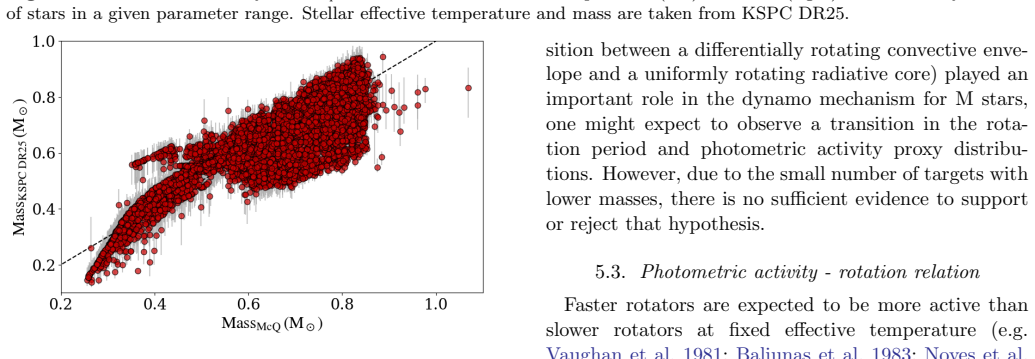
- domain assumption KSPC DR25 effective temperatures, masses, and surface gravities are accurate enough for sample selection and the Teff and mass trends.
- domain assumption Sph, defined as the standard deviation of subseries of length 5 times Prot, is a valid photometric activity proxy.
- domain assumption The red-giant and RR Lyrae removal lists are correct.
- standard math Wavelet power spectrum, ACF, and Lomb-Scargle periodogram are valid tools for period extraction in this context.
Cite this review
Pith. "Pith review of Surface rotation and photometric activity for Kepler targets I. M and K main-sequence stars." pith.science (2026). https://pith.science/paper/WL3S2X7P
@misc{pith2026190805222,
  author       = {Pith},
  title        = {Pith review of: Surface rotation and photometric activity for Kepler targets I. M and K main-sequence stars},
  year         = {2026},
  howpublished = {\url{https://pith.science/paper/WL3S2X7P}},
  note         = {Machine review of arXiv:1908.05222}
}
read the original abstract
Brightness variations due to dark spots on the stellar surface encode information about stellar surface rotation and magnetic activity. In this work, we analyze the Kepler long-cadence data of 26,521 main-sequence stars of spectral types M and K in order to measure their surface rotation and photometric activity level. Rotation-period estimates are obtained by the combination of a wavelet analysis and autocorrelation function of the light curves. Reliable rotation estimates are determined by comparing the results from the different rotation diagnostics and four data sets. We also measure the photometric activity proxy Sph using the amplitude of the flux variations on an appropriate timescale. We report rotation periods and photometric activity proxies for about 60 per cent of the sample, including 4,431 targets for which McQuillan et al. (2013a,2014) did not report a rotation period. For the common targets with rotation estimates in this study and in McQuillan et al. (2013a,2014), our rotation periods agree within 99 per cent. In this work, we also identify potential polluters, such as misclassified red giants and classical pulsator candidates. Within the parameter range we study, there is a mild tendency for hotter stars to have shorter rotation periods. The photometric activity proxy spans a wider range of values with increasing effective temperature. The rotation period and photometric activity proxy are also related, with Sph being larger for fast rotators. Similar to McQuillan et al. (2013a,2014), we find a bimodal distribution of rotation periods.
Figures

Figures from the paper (17 more)









Forward citations
Cited by 1 Pith paper
-
Hints of enhanced magnetic activity after the intermediate rotation period gap as traced by the chromospheric Ca ii infrared triplet
Main-sequence Kepler stars exhibit enhanced chromospheric Ca II IRT activity after the intermediate-period gap, paralleling the photospheric Sph signature.
Reference graph
Works this paper leans on
-
[1]
, " * write output.state after.block = add.period write newline
ENTRY address archivePrefix author booktitle chapter doi edition editor eprint howpublished institution journal key month note number organization pages publisher school series title misctitle type volume year version url label extra.label sort.label short.list INTEGERS output.state before.all mid.sentence after.sentence after.block FUNCTION init.state.co...
-
[2]
write newline
" write newline "" before.all 'output.state := FUNCTION format.doi doi empty "" "doi:" doi * if FUNCTION format.url url empty "" new.block "" url * "" * if FUNCTION format.eprint eprint empty "" archivePrefix empty "" archivePrefix ":" * if eprint field.or.null * if FUNCTION format.pid eprint empty format.doi format.eprint if FUNCTION n.dashify 't := "" t...
-
[3]
- [1] #1 = = ^ ^ ^ .\!\!^ d .\!\!^ h .\!\!^ m .\!\!^ s .\!\!^ @mss
thebibliography [1] 20pt to REFERENCES 6pt =0pt 10pt plus 3pt =0pt =0pt =1pt plus 1pt =0pt =0pt -12pt =13pt plus 1pt =20pt =13pt plus 1pt \@M =10000 =-1.0em =0pt =0pt 0pt =0pt =1.0em @enumiv\@empty 10000 10000 `\.\@m \@noitemerr \@latex@warning Empty `thebibliography' environment \@ifnextchar \@reference \@latexerr Missing key on reference command Each re...
2017
-
[4]
ӹ=::<==^z<_NC S D QXXc1VjyQ EEE)Nn fNVN HDUT 괕S xvM>? cE BBRR
thebibliography [1] 20pt to REFERENCES 6pt =0pt 10pt plus 3pt =0pt =0pt =1pt plus 1pt =0pt =0pt -12pt =13pt plus 1pt =20pt =13pt plus 1pt \@M =10000 =-1.0em =0pt =0pt 0pt =0pt =1.0em @enumiv\@empty 10000 10000 `\.\@m \@noitemerr \@latex@warning Empty `thebibliography' environment \@ifnextchar \@reference \@latexerr Missing key on reference command Each re...
2019
-
[5]
2016, AJ, 151, 101, 10.3847/0004-6256/151/4/101
Abdul-Masih , M., Pr s a, A., Conroy, K., et al. 2016, AJ, 151, 101, 10.3847/0004-6256/151/4/101
-
[6]
2015, MNRAS, 450, 3211, 10.1093/mnras/stv853
Aigrain, S., Llama, J., Ceillier, T., et al. 2015, MNRAS, 450, 3211, 10.1093/mnras/stv853
-
[7]
2016, , 587, A105, 10.1051/0004-6361/201527349
Amard , L., Palacios , A., Charbonnel , C., Gallet , F., & Bouvier , J. 2016, , 587, A105, 10.1051/0004-6361/201527349
-
[8]
2015, MNRAS, 450, 1787, 10.1093/mnras/stv423
Angus, R., Aigrain, S., Foreman-Mackey , D., & McQuillan, A. 2015, MNRAS, 450, 1787, 10.1093/mnras/stv423
Show all 91 references
-
[9]
2006, in Proceedings of SOHO 18/ GONG 2006/ HELAS I , Beyond the Spherical Sun , Vol
Baglin, A., Michel, E., Auvergne, M., & COROT Team . 2006, in Proceedings of SOHO 18/ GONG 2006/ HELAS I , Beyond the Spherical Sun , Vol. 624, 34.1
2006
-
[10]
L., Hartmann, L., Noyes, R
Baliunas, S. L., Hartmann, L., Noyes, R. W., et al. 1983, ApJ, 275, 752, 10.1086/161572
1983 doi
-
[11]
Barcel \'o Forteza, S., Roca Cort \'e s, T., Garc \'i a Hern \'a ndez, A., & Garc \'i a, R. A. 2017, A&A, 601, A57, 10.1051/0004-6361/201628675
2017 doi
-
[12]
Barnes , S. A. 2003, , 586, 464, 10.1086/367639
2003 doi
-
[13]
Barnes, S. A. 2007, ApJ, 669, 1167, 10.1086/519295
2007 doi
-
[14]
M., & Reiners, A
Basri, G., Walkowicz, L. M., & Reiners, A. 2013, ApJ, 769, 37, 10.1088/0004-637X/769/1/37
2013 doi
-
[15]
M., Batalha, N., et al
Basri, G., Walkowicz, L. M., Batalha, N., et al. 2011, AJ, 141, 20, 10.1088/0004-6256/141/1/20
2011 doi
-
[16]
A., Huber, D., Gaidos, E., & van Saders , J
Berger, T. A., Huber, D., Gaidos, E., & van Saders , J. L. 2018, ApJ, 866, 99, 10.3847/1538-4357/aada83
2018 doi
-
[17]
J., Koch, D., Basri, G., et al
Borucki, W. J., Koch, D., Basri, G., et al. 2010, Science, 327, 977, 10.1126/science.1185402
2010 doi
-
[18]
A., Guzik, J
Bradley, P. A., Guzik, J. A., Miles, L. F., et al. 2015, AJ, 149, 68, 10.1088/0004-6256/149/2/68
2015 doi
-
[19]
M., Latham, D
Brown, T. M., Latham, D. W., Everett, M. E., & Esquerdo, G. A. 2011, AJ, 142, 112, 10.1088/0004-6256/142/4/112
2011 doi
-
[20]
S., & Browning, M
Brun, A. S., & Browning, M. K. 2017, Living Rev. Solar Phys., 14, 4, 10.1007/s41116-017-0007-8
2017 doi
-
[21]
A., Davies, G
Bugnet, L., Garc \'i a, R. A., Davies, G. R., et al. 2018, A&A, 620, A38, 10.1051/0004-6361/201833106
2018 doi
-
[22]
A., Mathur , S., et al
Bugnet , L., Garc \' a , R. A., Mathur , S., et al. 2019, , 624, A79, 10.1051/0004-6361/201834780
2019 doi
-
[23]
A., et al
Ceillier, T., van Saders , J., Garc \'i a, R. A., et al. 2016, MNRAS, 456, 119, 10.1093/mnras/stv2622
2016 doi
-
[24]
2017, A&A, 605, A111, 10.1051/0004-6361/201629884
Ceillier, T., Tayar, J., Mathur, S., et al. 2017, A&A, 605, A111, 10.1051/0004-6361/201629884
2017 doi
-
[25]
1997, A&A, 327, 1039
Chabrier, G., & Baraffe, I. 1997, A&A, 327, 1039
1997
-
[26]
L., Huber, D., Bedding, T
Colman, I. L., Huber, D., Bedding, T. R., et al. 2017, MNRAS, 469, 3802, 10.1093/mnras/stx1056
2017 doi
-
[27]
L., Metcalfe, T
Creevey, O. L., Metcalfe, T. S., Schultheis, M., et al. 2017, A&A, 601, A67, 10.1051/0004-6361/201629496
2017 doi
-
[28]
Davenport, J. R. A. 2017, ApJ, 835, 16, 10.3847/1538-4357/835/1/16
2017 doi
-
[29]
Davenport, J. R. A., & Covey, K. R. 2018, ApJ, 868, 151, 10.3847/1538-4357/aae842
2018 doi
-
[30]
R., Chaplin, W
Davies, G. R., Chaplin, W. J., Farr, W. M., et al. 2015, MNRAS, 446, 2959, 10.1093/mnras/stu2331
2015 doi
-
[31]
D., & Charbonneau, D
Dressing, C. D., & Charbonneau, D. 2013, ApJ, 767, 95, 10.1088/0004-637X/767/1/95
2013 doi
-
[32]
R., & Pinsonneault , M
Epstein , C. R., & Pinsonneault , M. H. 2014, , 780, 159, 10.1088/0004-637X/780/2/159
2014 doi
-
[33]
1995, Sol
Fr \"o hlich, C., Romero, J., Roth, H., et al. 1995, Sol. Phys., 162, 101, 10.1007/BF00733428
1995 doi
-
[34]
H., Grec, G., Charra, J., et al
Gabriel, A. H., Grec, G., Charra, J., et al. 1995, Sol. Phys., 162, 61, 10.1007/BF00733427
1995 doi
-
[35]
Gaia Collaboration , Brown, A. G. A., Vallenari, A., et al. 2018, A&A, 616, A1, 10.1051/0004-6361/201833051
2018 doi
-
[36]
2013, , 556, A36, 10.1051/0004-6361/201321302
Gallet , F., & Bouvier , J. 2013, , 556, A36, 10.1051/0004-6361/201321302
2013 doi
-
[37]
A., Mathur, S., Salabert, D., et al
Garc \'i a, R. A., Mathur, S., Salabert, D., et al. 2010, Science, 329, 1032, 10.1126/science.1191064
2010 doi
-
[38]
A., Hekker, S., Stello, D., et al
Garc \'i a, R. A., Hekker, S., Stello, D., et al. 2011, MNRAS, 414, L6, 10.1111/j.1745-3933.2011.01042.x
2011
-
[39]
A., Ceillier, T., Salabert, D., et al
Garc \'i a, R. A., Ceillier, T., Salabert, D., et al. 2014 a , A&A, 572, A34, 10.1051/0004-6361/201423888
2014 doi
-
[40]
A., Mathur, S., Pires, S., et al
Garc \'i a, R. A., Mathur, S., Pires, S., et al. 2014 b , A&A, 568, A10, 10.1051/0004-6361/201323326
2014 doi
-
[41]
2018, MNRAS, 476, 3233, 10.1093/mnras/sty483
Hon, M., Stello, D., & Yu, J. 2018, MNRAS, 476, 3233, 10.1093/mnras/sty483
2018 doi
-
[42]
Hunter, J. D. 2007, Computing in Science & Engineering, 9, 90, 10.1109/MCSE.2007.55
2007 doi
-
[43]
M., Caldwell, D
Jenkins, J. M., Caldwell, D. A., Chandrasekaran, H., et al. 2010, ApJL, 713, L87, 10.1088/2041-8205/713/2/L87
2010 doi
-
[44]
2001--, SciPy : Open source scientific tools for Python
Jones, E., Oliphant, T., Peterson, P., et al. 2001--, SciPy : Open source scientific tools for Python
2001
-
[45]
2016, AJ, 151, 68, 10.3847/0004-6256/151/3/68
Kirk, B., Conroy, K., Pr s a, A., et al. 2016, AJ, 151, 68, 10.3847/0004-6256/151/3/68
2016 doi
-
[46]
W., et al
Kolenberg, K., Szab \'o , R., Kurtz, D. W., et al. 2010, ApJ, 713, L198, 10.1088/2041-8205/713/2/L198
2010 doi
-
[47]
Kraft , R. P. 1967, , 150, 551, 10.1086/149359
1967 doi
-
[48]
W., Hong, K., Koo, J.-R., & Park, J.-H
Lee, J. W., Hong, K., Koo, J.-R., & Park, J.-H. 2016, ApJ, 820, 1, 10.3847/0004-637X/820/1/1
2016 doi
-
[49]
Liu, Y., San Liang, X., & Weisberg, R. H. 2007, J. Atmos. Oceanic Technol., 24, 2093, 10.1175/2007JTECHO511.1
2007 doi
-
[50]
Lomb , N. R. 1976, , 39, 447, 10.1007/BF00648343
1976 doi
-
[51]
C., Vyhmeister, K., Hawley, S
Lurie, J. C., Vyhmeister, K., Hawley, S. L., et al. 2017, AJ, 154, 250, 10.3847/1538-3881/aa974d
2017 doi
-
[52]
E., & Hillenbrand, L
Mamajek, E. E., & Hillenbrand, L. A. 2008, ApJ, 687, 1264, 10.1086/591785
2008 doi
-
[53]
A., R \'e gulo, C., et al
Mathur, S., Garc \'i a, R. A., R \'e gulo, C., et al. 2010, A&A, 511, A46, 10.1051/0004-6361/200913266
2010 doi
-
[54]
S., Woitaszek, M., et al
Mathur, S., Metcalfe, T. S., Woitaszek, M., et al. 2012, ApJ, 749, 152, 10.1088/0004-637X/749/2/152
2012 doi
-
[55]
A., Ballot, J., et al
Mathur, S., Garc \'i a, R. A., Ballot, J., et al. 2014, A&A, 562, A124, 10.1051/0004-6361/201322707
2014 doi
-
[56]
M., et al
Mathur, S., Huber, D., Batalha, N. M., et al. 2017, ApJS, 229, 30, 10.3847/1538-4365/229/2/30
2017 doi
-
[57]
2013 a , MNRAS, 432, 1203, 10.1093/mnras/stt536
McQuillan, A., Aigrain, S., & Mazeh, T. 2013 a , MNRAS, 432, 1203, 10.1093/mnras/stt536
2013 doi
-
[58]
2013 b , ApJ, 775, L11, 10.1088/2041-8205/775/1/L11
McQuillan, A., Mazeh, T., & Aigrain, S. 2013 b , ApJ, 775, L11, 10.1088/2041-8205/775/1/L11
2013 doi
-
[59]
2014, ApJS, 211, 24, 10.1088/0067-0049/211/2/24
---. 2014, ApJS, 211, 24, 10.1088/0067-0049/211/2/24
2014 doi
-
[60]
A., Platais, I., et al
Meibom, S., Barnes, S. A., Platais, I., et al. 2015, Nat., 517, 589, 10.1038/nature14118
2015 doi
-
[61]
D., Stassun, K
Meibom, S., Mathieu, R. D., Stassun, K. G., Liebesny, P., & Saar, S. H. 2011 a , ApJ, 733, 115, 10.1088/0004-637X/733/2/115
2011 doi
-
[62]
A., Latham, D
Meibom, S., Barnes, S. A., Latham, D. W., et al. 2011 b , ApJL, 733, L9, 10.1088/2041-8205/733/1/L9
2011 doi
-
[63]
S., & Egeland, R
Metcalfe, T. S., & Egeland, R. 2019, ApJ, 871, 39, 10.3847/1538-4357/aaf575
2019 doi
-
[64]
S., Creevey, O
Metcalfe, T. S., Creevey, O. L., Do g an, G., et al. 2014, ApJS, 214, 27, 10.1088/0067-0049/214/2/27
2014 doi
-
[65]
T., Tovar, G., & Foreman-Mackey , D
Montet, B. T., Tovar, G., & Foreman-Mackey , D. 2017, ApJ, 851, 116, 10.3847/1538-4357/aa9e00
2017 doi
-
[66]
2015, MNRAS, 447, 2348, 10.1093/mnras/stu2561
Moskalik, P., Smolec, R., Kolenberg, K., et al. 2015, MNRAS, 447, 2348, 10.1093/mnras/stu2561
2015 doi
-
[67]
B., Gizon, L., Schunker, H., & Karoff, C
Nielsen, M. B., Gizon, L., Schunker, H., & Karoff, C. 2013, A&A, 557, L10, 10.1051/0004-6361/201321912
2013 doi
-
[68]
W., Hartmann, L
Noyes, R. W., Hartmann, L. W., Baliunas, S. L., Duncan, D. K., & Vaughan, A. H. 1984, ApJ, 279, 763, 10.1086/161945
1984 doi
-
[69]
A., et al
Pires, S., Mathur, S., Garc \'i a, R. A., et al. 2015, A&A, 574, A18, 10.1051/0004-6361/201322361
2015 doi
-
[70]
2011, A&A, 526, A69, 10.1051/0004-6361/201015435
Raskin, G., van Winckel , H., Hensberge, H., et al. 2011, A&A, 526, A69, 10.1051/0004-6361/201015435
2011 doi
-
[71]
J., Kuszlewicz, J., Hekker, S., & Shapiro, A
Reinhold, T., Bell, K. J., Kuszlewicz, J., Hekker, S., & Shapiro, A. I. 2019, A&A, 621, A21, 10.1051/0004-6361/201833754
2019 doi
-
[72]
2013, A&A, 560, A4, 10.1051/0004-6361/201321970
Reinhold, T., Reiners, A., & Basri, G. 2013, A&A, 560, A4, 10.1051/0004-6361/201321970
2013 doi
-
[73]
A., Jim \'e nez, A., et al
Salabert, D., Garc \'i a, R. A., Jim \'e nez, A., et al. 2017, A&A, 608, A87, 10.1051/0004-6361/201731560
2017 doi
-
[74]
A., Beck, P
Salabert, D., Garc \'i a, R. A., Beck, P. G., et al. 2016, A&A, 596, A31, 10.1051/0004-6361/201628583
2016 doi
-
[75]
Santos, A. R. G., Garc \'i a, R. A., Mathur, S., et al. 2018, in The 20th Cambridge Workshop on Cool Stars , Stellar Systems , and the Sun ( doi:10.5281/zenodo.1488167 ), 10.5281/zenodo.1488167
2018 doi
-
[76]
Scargle , J. D. 1982, , 263, 835, 10.1086/160554
1982 doi
-
[77]
2017, ApJS, 233, 23, 10.3847/1538-4365/aa97df
Serenelli, A., Johnson, J., Huber, D., et al. 2017, ApJS, 233, 23, 10.3847/1538-4365/aa97df
2017 doi
-
[78]
R., Basu, S., et al
Silva Aguirre, V., Davies, G. R., Basu, S., et al. 2015, MNRAS, 452, 2127, 10.1093/mnras/stv1388
2015 doi
-
[79]
Simonian, G. V. A., Pinsonneault, M. H., & Terndrup, D. M. 2019, ApJ, 871, 174, 10.3847/1538-4357/aaf97c
2019 doi
- [80]
-
[81]
C., Stumpe, M
Smith, J. C., Stumpe, M. C., Van Cleve, J. E., et al. 2012, PASP, 124, 1000, 10.1086/667697
2012 doi
-
[82]
C., Smith, J
Stumpe, M. C., Smith, J. C., Van Cleve, J. E., et al. 2012, PASP, 124, 985, 10.1086/667698
2012 doi
-
[83]
Torrence, C., & Compo, G. P. 1998, Bull. Amer. Meteor. Soc., 79, 61, 10.1175/1520-0477(1998)079<0061:APGTWA>2.0.CO;2
1998 doi
-
[84]
C., & Varoquaux, G
van der Walt, S., Colbert, S. C., & Varoquaux, G. 2011, CiSE, 13, 22
2011
-
[85]
2015, A&A, 574, A17, 10.1051/0004-6361/201424585
Van Reeth, T., Tkachenko, A., Aerts, C., et al. 2015, A&A, 574, A17, 10.1051/0004-6361/201424585
2015 doi
-
[86]
L., Ceillier, T., Metcalfe, T
van Saders , J. L., Ceillier, T., Metcalfe, T. S., et al. 2016, Nat., 529, 181, 10.1038/nature16168
2016 doi
-
[87]
L., Pinsonneault , M
van Saders , J. L., Pinsonneault , M. H., & Barbieri , M. 2019, , 872, 128, 10.3847/1538-4357/aafafe
2019 doi
-
[88]
H., Baliunas, S
Vaughan, A. H., Baliunas, S. L., Middelkoop, F., et al. 1981, ApJ, 250, 276, 10.1086/159372
1981 doi
-
[89]
Wilson, O. C. 1963, ApJ, 138, 832, 10.1086/147689
1963 doi
- [90]
- [91]
Reviewed August 14, 2026 · model on record in the stance chip above.
Discussion (0). Continue with ORCID to comment.