REVIEW 4 major objections 4 minor 1 cited by
Spectrophotometric templates for core collapse supernovae and their application in simulations of time-domain surveys
T0 review · 4 major / 4 minor · reviewed 2026-08-14 · deepseek-v4-flash
Pith's one-line read This paper builds a fully data-driven library of 67 core-collapse supernova spectral templates, extended into the near-UV, that reproduces observed photometry to about 0.02 mag in the optical and 0.1 mag in the near-UV, and uses it to…
desk verdict Useful library of 67 core-collapse SN templates with real code, but the 'fully data-driven' label and the in-sample UV validation are weaker than the abstract implies. read the letter →
The pith
A machine-rendered reading of the paper's core claim, the machinery that carries it, and where it could break.
The reading
What carries the argument
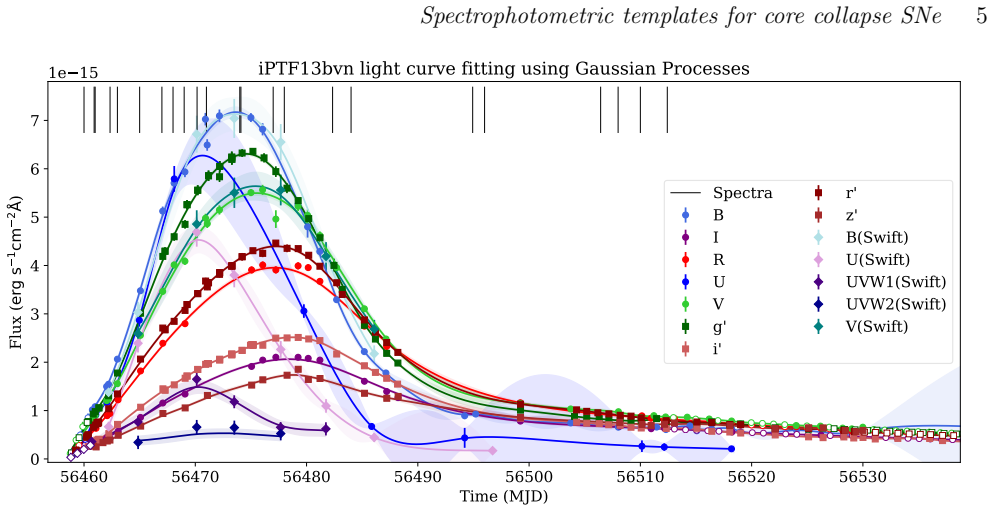
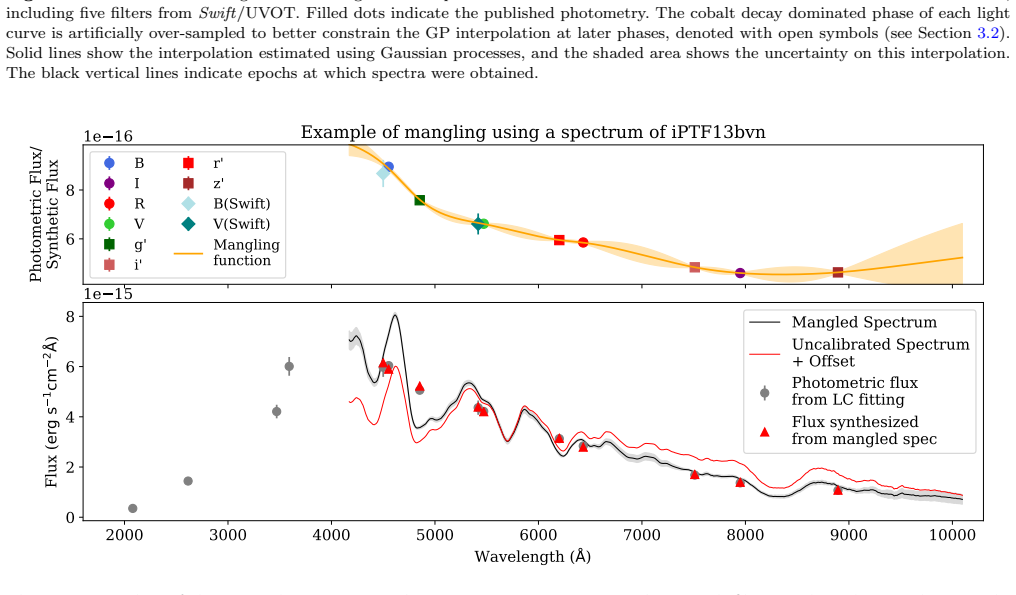
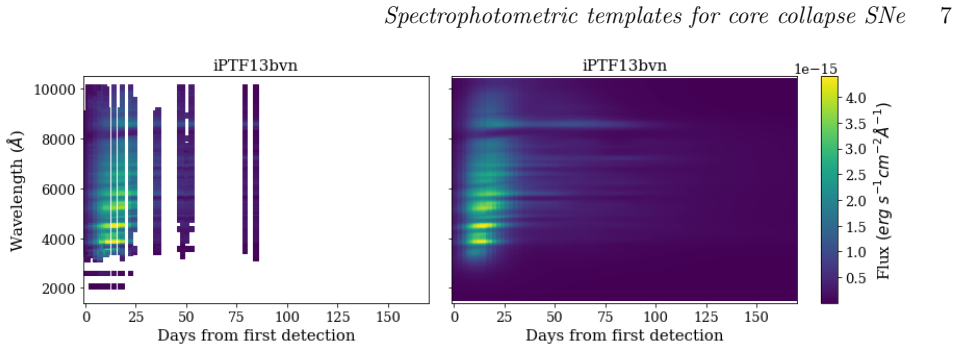
The load-bearing object is the two-dimensional Gaussian-process flux surface $f(t,\lambda)$, built by combining flux-calibrated spectra and broad-band photometry (including satellite UV filters) on a 60 \AA{} wavelength grid. A Matern 3/2 kernel with fixed length scales $\sigma_\lambda = 100\,$\AA{} and $\sigma_t = 30$ days interpolates the surface, and the GP mean is a sub-class average colour surface multiplied by the event's own V-band light curve. This one surface performs three jobs: it extends the optical spectra into the near-UV, it interpolates between sparsely sampled spectra, and it lets the code extrapolate additional daily spectra, which are then remangled so that synthetic and observed photometry agree in every filter.
What would settle it
Take a well-observed stripped-envelope event, rebuild its template with the near-UV photometry withheld, and compare the near-UV light curve predicted by the GP surface with the actual satellite UV measurements; if the withheld fluxes deviate systematically by more than about 0.1 mag across several events, the claim that the UV extension is faithful fails.
Extended reading notes
Core claim
The central claim is that a spectral template for a core-collapse supernova can be built entirely from its own multi-band photometry and sparse spectroscopy, with no parametric light-curve or SED model. Each event becomes its own template: Gaussian processes interpolate each light curve, a mangling step flux-calibrates each observed spectrum against the interpolated photometry, and a two-dimensional Gaussian process over time and wavelength combines spectra with near-UV photometry into a continuous flux surface $f(t,\lambda)$. Re-sampling that surface daily and remangling against photometry yields a spectral time series that reproduces the observed colours. The paper claims this near-UV-extended, event-by-event library preserves the diversity of core-collapse supernovae and is accurate enough for simulations of photometric surveys to $z\approx1$.
Load-bearing premise
The near-UV extension of every template leans on a sub-class average colour prior with fixed smoothing scales, so an event whose ultraviolet behaviour is genuinely unusual is pulled toward the average and its true UV diversity may be lost.
Editorial extensions
If this is right
- The library plugs directly into existing supernova simulation pipelines, so photometric SN Ia analyses can generate core-collapse contamination with event-level spectral diversity rather than a handful of averaged templates.
- At redshifts above about 0.4, the near-UV extension roughly doubles the predicted core-collapse contamination compared with optical-only templates, making the UV coverage essential for high-redshift contamination estimates.
- Luminosity functions tuned against one template library do not transfer cleanly to another; the paper's repeats give contamination fractions of 3.7, 9.5, and 7.5 per cent depending on the luminosity function and extinction treatment.
- Host-extinction-corrected templates combined with simulated dust overproduce bright contaminants by about a factor of three, indicating that the extinction model or luminosity function needs revisiting.
- Because the code is open-source and data-driven, the library can be extended to any future transient with well-sampled photometry and multiple spectra, growing the diversity coverage of the sample.
Reading between the lines
- A natural stress test not performed in the paper is a true out-of-sample UV validation: withhold the near-UV photometry from the GP surface for several well-observed events and compare the predicted UV light curves with the measured ones; the fixed prior would be expected to mask genuine UV outliers.
- The fixed GP length scales encode an assumption that the flux surface is smooth on 100 \AA{} and 30-day scales; transients with fast UV spectral evolution (early shock breakout or flash ionisation) may be smoothed over, which is a testable limitation when applying the code to other transients.
- The selection criteria (UV photometry, at least five spectra, pre-peak coverage) bias the library against faint or highly reddened events, and the paper notes its stripped-envelope templates have lower median host reddening than published samples; the claimed diversity is therefore the diversity of well-observed, relatively unobscured events.
- The UV extension is anchored by photometry rather than by a physical UV line-blanketing model, so at high redshift the simulated rest-frame UV colours inherit whatever the GP surface does between anchors; comparing simulated high-z colours with observed rest-frame UV colours of the same events would quantify that systematic.
Signed reviews
Editorial analysis
A structured set of objections, weighed in public.
Referee Report
Summary. The paper constructs a library of 67 rest-frame, daily-sampled spectral time-series templates for core-collapse supernovae, using literature photometry and spectroscopy. Light curves are interpolated with Gaussian processes, observed spectra are flux-calibrated by mangling to the photometry, and the wavelength coverage is extended into the near-UV with a two-dimensional GP interpolation that uses a sub-class average colour prior. Templates are optionally corrected for host-galaxy extinction and are provided in a form suitable for use with snana. The library is applied to simulate core-collapse contamination in a PS1-like photometric SN Ia sample, comparing three luminosity-function choices, and the results are compared with the observed Hubble-residual distribution.
Significance. If the validation caveats are addressed, this is a valuable community resource: it provides a larger, event-by-event template library than existing alternatives, retains object-to-object diversity, extends into the near-UV, and is released as open-source code with an example snana integration. The simulation application is an independent use of the templates in the sense that they are not tuned to the PS1 contamination data, and the paper honestly reports that the standard luminosity functions underproduce the observed contamination. The main scientific value lies in enabling more realistic simulations for photometric classification and SN Ia cosmology, but the headline claims about near-UV fidelity and usefulness up to z~1 currently rest on in-sample validation.
major comments (4)
- [§2.2.1] The near-UV extension is validated only in-sample. The prior for the two-dimensional GP is a sub-class average colour surface built from the same 67 SNe, with fixed length scales sigma_lambda=100 Å and sigma_t=30 days; for events with sparse UV photometry the posterior is pulled toward this sub-class average, so the library is likely to under-represent true UV diversity. The test described in §2.2.1 uses only SN 2013by and iPTF13bvn and does not quantify shrinkage for the remaining majority of events. Since §4.3 and Fig. 9 show that using the near-UV-extended templates changes the predicted contamination by a factor of two at z>0.4, the suitability claim up to z~1 should be qualified until the UV extension is tested on held-out events or through a cross-validation scheme.
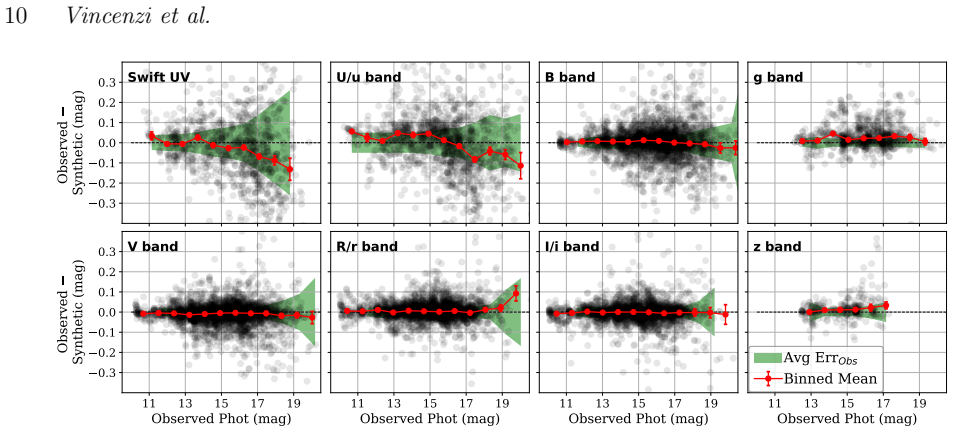
- [§3.2 / Fig. 7] The quoted photometric recovery of 0.02 mag in the optical and 0.1 mag in the near-UV is an in-sample test: the same extinction-corrected photometry used to construct each template, and subsequently forced to match through the remangling step in §2.2.2, is the photometry compared with the final synthetic template. This demonstrates internal consistency but not predictive accuracy on new events or on data deliberately withheld during construction. An out-of-sample test, such as leaving out a filter or an epoch during template construction and checking the residuals, would support the claimed accuracy; without it, the 0.1 mag near-UV figure should be described as a fitting residual rather than as an expected template error.
- [Appendix A / Fig. A2] The host-extinction corrections carry large, acknowledged systematic uncertainties—Na i D equivalent widths with large scatter, a fixed RV=3.1, and average reddening assumed for four SNe—yet the de-reddened templates are a central product used in the §4.2.1 simulations with the R14 luminosity functions. After corrections, the uvw1−V scatter of the templates remains about 0.5–0.7 mag for stripped-envelope SNe, and Fig. A4 shows that the median host reddening in the sample is factors of two to four below the Prentice et al. (2016) values for stripped-envelope types. The paper should quantify how these uncertainties propagate into the simulated contamination rates, or it should restrict the claims made for the de-reddened-template application.
- [Abstract and §2.1.2] The abstract and Section 5 state that the templates are built with no assumption of any parametric form or model for the light curves, but Section 2.1.2 explicitly uses the parametric power law f(t)=alpha(t-t0)^n for early phases, with n fixed to 1.5 for stripped-envelope SNe and 0.935 for hydrogen-rich SNe, and Eq. (3) adds a parametric shock-breakout component. The claim should be qualified to state that no parametric form is assumed over most of the light curve, or the early-rise parametrization should be integrated into the GP model; as written, the abstract overstates the data-driven nature of the method.
minor comments (4)
- [§4.3] The sentence describing Fig. 10 contains a typo: 'SNe Ib ans SNe Ic' should read 'SNe Ib and SNe Ic'.
- [Eq. (3)] The exponential term in Eq. (3) is ambiguous; writing exp[-(t-t0)/tau] or otherwise clarifying the functional form of the shock-breakout component would improve reproducibility.
- [Table 2] The column header 'Numb. of Ref. Spectra Host' appears to combine the spectrum count and the reddening reference into one heading; splitting these into two clearly labelled columns would prevent confusion.
- [§3.1.4] The classification scheme lists six sub-types but SN 1987A is also included as a template; the text should clarify whether SN 1987A is treated as a seventh class in simulations or is assigned to one of the six classes.
Circularity Check
Template library construction and PS1 application are largely independent, but the headline photometric-recovery check (Fig. 7) is in-sample and largely forced by the remangling calibration, so the quoted residuals are a consistency check rather than predictive validation.
-
fitted input called prediction
[Section 2.2.2 (remangling) and Section 3.2 / Fig. 7]
"We then adjust the extended spectra until the synthetic and observed photometry match. ... After testing our technique on the sample of 67 SNe described in Section 3.1, we compare the published observed photometry with the photometry synthesised from the final flux-calibrated, daily-sampled and near-UV extended spectral time-series. Our results are presented in Fig. 7. On average the observed photometry is recovered to within 0.02 magnitudes in most of the optical filters and to within 0.1 magnitudes in the near-UV."
The photometry compared in Fig. 7 is the same photometry used to construct the templates, and the remangling procedure explicitly forces synthetic fluxes to match that photometry ('adjust the extended spectra until the synthetic and observed photometry match'). The quoted 0.02 mag optical and 0.1 mag near-UV residuals are therefore a measure of how well the calibration loop closed, not an out-of-sample prediction of unseen photometry. The paper is transparent that the observed photometry is the same data used for the light-curve fitting, but the residual values are still presented as a validation metric and are largely guaranteed by construction.
full rationale
The central template-building chain (GP light-curve fits, mangling, 2D GP flux-surface interpolation, remangling) is data-driven and internally consistent; no equation in the construction reduces to a fitted parameter by definition. The near-UV prior is built from the same 67 SNe used to construct the templates, which can reduce UV diversity for sparsely observed events and deserves a caveat, but the final template is a combination of the prior and the individual SN data, not simply the prior. The PS1 contamination simulation is an external application: the templates are not tuned to the PS1 data, and the paper explicitly tests independent luminosity functions (L11, R14) as well as the J17-tuned ones, so the simulation results provide legitimate external evidence about template-library behavior. The main self-referential element is the Fig. 7 photometric recovery check, which is in-sample and strongly constrained by the remangling step; it is a useful sanity check but is presented without emphasizing that it is not a predictive test. Because the library's utility is further supported by the independent PS1 comparison and by the open-source code that can be applied to future transients, the overall circularity is modest rather than central.
Assumptions & free parameters
free parameters (7)
- Light-curve GP amplitude A and scale sigma =
Optimized per filter per SN via log-likelihood minimization; ~6% of light curves manually fixed
- Mangling GP length scale =
300 A (fixed)
- 2D GP wavelength scale sigma_lambda =
100 A (fixed)
- 2D GP time scale sigma_t =
30 days (fixed)
- Early rise power-law index n =
1.5 for stripped-envelope SNe, 0.935 for hydrogen-rich SNe
- Explosion time t0 for SNe with uncertain explosion epoch =
Fitted within bounds set by non-detections and discovery date
- Host galaxy E(B-V) for four SNe without reddening estimates =
Median extinction from Prentice et al. (2016), 0.081 mag
assumptions (6)
- domain assumption Photometry has been corrected for Milky Way and host galaxy extinction using a Cardelli et al. (1989) extinction law with R_V=3.1.
- ad hoc to paper The color evolution of core collapse SNe within a sub-class is similar enough that an average color surface can serve as a prior for individual events.
- domain assumption The empirical relation E(B-V)_host = 0.16 EW(Na I D) from Turatto et al. (2003) applies to the host galaxies of the sample.
- domain assumption The relative rates and luminosity functions measured locally (Shivvers et al. 2017; Li et al. 2011; Richardson et al. 2014) apply at higher redshifts.
- domain assumption The Gaussian process with Matern 3/2 kernel, constant zero mean, and interpolation-only use provides a faithful model of SN light curves and flux surfaces.
- domain assumption Spectral features not associated with the SN (host galaxy lines, telluric features) can be cleanly removed by sigma-clipping.
Cite this review
Pith. "Pith review of Spectrophotometric templates for core collapse supernovae and their application in simulations of time-domain surveys." pith.science (2026). https://pith.science/paper/OJ7M7466
@misc{pith2026190805228,
  author       = {Pith},
  title        = {Pith review of: Spectrophotometric templates for core collapse supernovae and their application in simulations of time-domain surveys},
  year         = {2026},
  howpublished = {\url{https://pith.science/paper/OJ7M7466}},
  note         = {Machine review of arXiv:1908.05228}
}
abstract
The design and analysis of time-domain sky surveys requires the ability to simulate accurately realistic populations of core collapse supernova (SN) events. We present a set of spectral time-series templates designed for this purpose, for both hydrogen-rich (type II, IIn, IIb) and stripped envelope (types Ib, Ic, Ic-BL) core collapse supernovae. We use photometric and spectroscopic data for 67 core collapse supernovae from the literature, and for each generate a time-series spectral template. The techniques used to build the templates are fully data-driven with no assumption of any parametric form or model for the light curves. The template-building code is open-source, and can be applied to any transient for which well-sampled multi-band photometry and multiple spectroscopic observations are available. We extend these spectral templates into the near-ultraviolet to $\lambda \lambda \sim 1600 \AA$ using observer-frame ultraviolet photometry. We also provide a set of templates corrected for host galaxy dust extinction, and provide a set of luminosity functions that can be used with our spectral templates in simulations. We give an example of how these templates can be used by integrating them within the popular SN simulation package $\textsc{snana}$, and simulating core collapse supernovae in photometrically-selected cosmological type Ia supernova samples, prone to contamination from core collapse events.
Figures

Figures from the paper (7 more)




Forward citations
Cited by 1 Pith paper
-
A Simulation Based Inference Approach to Modelling of Type Ia Supernova Populations
A simulation-based inference pipeline (Stjörnumál) fits SN Ia dust and intrinsic scatter models to DES 5-year data, enabling fast Bayesian model comparison across seven SN Ia population models.
Reference graph
Works this paper leans on
-
[1]
Ambikasaran S., Foreman-Mackey D., Greengard L., Hogg D. W., O'Neil M., 2015, @doi [IEEE Transactions on Pattern Analysis and Machine Intelligence] 10.1109/TPAMI.2015.2448083 , http://adsabs.harvard.edu/abs/2015ITPAM..38..252A 38
arXiv 2015
-
[2]
Anderson J. P., et al., 2014, @doi [ ] 10.1088/0004-637X/786/1/67 , https://ui.adsabs.harvard.edu/\#abs/2014ApJ...786...67A 786, 67
-
[3]
Anderson J. P., et al., 2018, @doi [Nature Astronomy] 10.1038/s41550-018-0458-4 , https://ui.adsabs.harvard.edu/abs/2018NatAs...2..574A 2, 574
-
[4]
R., et al., 2018, arXiv e-prints, http://adsabs.harvard.edu/abs/2018arXiv181204071A
Angus C. R., et al., 2018, arXiv e-prints, http://adsabs.harvard.edu/abs/2018arXiv181204071A
2018
-
[5]
Arcavi I., et al., 2011, @doi [ ] 10.1088/2041-8205/742/2/L18 , https://ui.adsabs.harvard.edu/abs/2011ApJ...742L..18A 742, L18
-
[6]
Arcavi I., et al., 2012, @doi [ ] 10.1088/2041-8205/756/2/L30 , https://ui.adsabs.harvard.edu/\#abs/2012ApJ...756L..30A 756, L30
-
[7]
Arcavi I., et al., 2017a, @doi [ ] 10.1038/nature24030 , https://ui.adsabs.harvard.edu/abs/2017Natur.551..210A 551, 210
-
[8]
Arcavi I., et al., 2017b, @doi [ ] 10.3847/2041-8213/aa5be1 , https://ui.adsabs.harvard.edu/\#abs/2017ApJ...837L...2A 837, L2
Show all 219 references
-
[9]
Astier P., et al., 2006, @doi [ ] 10.1051/0004-6361:20054185 , http://adsabs.harvard.edu/abs/2006A
2006 doi
-
[10]
Astropy Collaboration et al., 2013, @doi [ ] 10.1051/0004-6361/201322068 , http://adsabs.harvard.edu/abs/2013A
2013 doi
-
[11]
arXiv:1901.09962
Azalee Bostroem K., et al., 2019, arXiv e-prints, https://ui.adsabs.harvard.edu/\#abs/2019arXiv190109962A p. arXiv:1901.09962
2019 arXiv
-
[12]
Barbary K., et al., 2016, SNCosmo: Python library for supernova cosmology , Astrophysics Source Code Library ( @eprint ascl 1611.017 )
2016
-
[13]
Barbon R., Ciatti F., Rosino L., 1979, , http://adsabs.harvard.edu/abs/1979A
1979
-
[14]
Barbon R., Benetti S., Cappellaro E., Rosino L., Turatto M., 1990, , http://adsabs.harvard.edu/abs/1990A 79
1990
-
[15]
Barbon R., Benetti S., Cappellaro E., Patat F., Turatto M., Iijima T., 1995, , http://adsabs.harvard.edu/abs/1995A
1995
-
[16]
H., 2007, @doi [ ] 10.1086/517961 , https://ui.adsabs.harvard.edu/\#abs/2007ApJ...662.1148B 662, 1148
Baron E., Branch D., Hauschildt P. H., 2007, @doi [ ] 10.1086/517961 , https://ui.adsabs.harvard.edu/\#abs/2007ApJ...662.1148B 662, 1148
2007 doi
-
[17]
J., et al., 2013, @doi [ ] 10.1088/2041-8205/764/1/L13 , http://adsabs.harvard.edu/abs/2013ApJ...764L..13B 764, L13
Bayless A. J., et al., 2013, @doi [ ] 10.1088/2041-8205/764/1/L13 , http://adsabs.harvard.edu/abs/2013ApJ...764L..13B 764, L13
2013 doi
-
[18]
Bazin G., et al., 2009, @doi [ ] 10.1051/0004-6361/200911847 , http://adsabs.harvard.edu/abs/2009A
2009 doi
-
[19]
Ben-Ami S., et al., 2012, @doi [ ] 10.1088/2041-8205/760/2/L33 , http://adsabs.harvard.edu/abs/2012ApJ...760L..33B 760, L33
2012 doi
-
[20]
Ben-Ami S., et al., 2015, @doi [ ] 10.1088/0004-637X/803/1/40 , http://adsabs.harvard.edu/abs/2015ApJ...803...40B 803, 40
2015 doi
-
[22]
C., et al., 2018, @doi [ ] 10.1038/nature25151 , https://ui.adsabs.harvard.edu/abs/2018Natur.554..497B 554, 497
Bersten M. C., et al., 2018, @doi [ ] 10.1038/nature25151 , https://ui.adsabs.harvard.edu/abs/2018Natur.554..497B 554, 497
2018 doi
-
[23]
Betoule M., et al., 2014, @doi [ ] 10.1051/0004-6361/201423413 , http://adsabs.harvard.edu/abs/2014A
2014 doi
-
[24]
B., et al., 2014, @doi [ ] 10.1088/0067-0049/213/2/19 , http://adsabs.harvard.edu/abs/2014ApJS..213...19B 213, 19
Bianco F. B., et al., 2014, @doi [ ] 10.1088/0067-0049/213/2/19 , http://adsabs.harvard.edu/abs/2014ApJS..213...19B 213, 19
2014 doi
-
[25]
S., Milisavljevic D., Margutti R., Fesen R
Black C. S., Milisavljevic D., Margutti R., Fesen R. A., Patnaude D., Parker S., 2017, @doi [ ] 10.3847/1538-4357/aa8999 , http://adsabs.harvard.edu/abs/2017ApJ...848....5B 848, 5
2017 doi
-
[26]
Bose S., et al., 2013, @doi [ ] 10.1093/mnras/stt864 , http://adsabs.harvard.edu/abs/2013MNRAS.433.1871B 433, 1871
2013 doi
-
[27]
Bose S., et al., 2015a, @doi [ ] 10.1093/mnras/stv759 , http://adsabs.harvard.edu/abs/2015MNRAS.450.2373B 450, 2373
-
[28]
Bose S., et al., 2015b, @doi [ ] 10.1088/0004-637X/806/2/160 , http://adsabs.harvard.edu/abs/2015ApJ...806..160B 806, 160
-
[29]
Bose S., Kumar B., Misra K., Matsumoto K., Kumar B., Singh M., Fukushima D., Kawabata M., 2016, @doi [ ] 10.1093/mnras/stv2351 , http://adsabs.harvard.edu/abs/2016MNRAS.455.2712B 455, 2712
2016 doi
-
[30]
J., Breeveld A
Brown P. J., Breeveld A. A., Holland S., Kuin P., Pritchard T., 2014, @doi [ ] 10.1007/s10509-014-2059-8 , http://adsabs.harvard.edu/abs/2014Ap
2014 doi
-
[31]
J., Roming P
Brown P. J., Roming P. W. A., Milne P. A., 2015, @doi [Journal of High Energy Astrophysics] 10.1016/j.jheap.2015.04.007 , https://ui.adsabs.harvard.edu/\#abs/2015JHEAp...7..111B 7, 111
2015 doi
-
[32]
J., Breeveld A., Roming P
Brown P. J., Breeveld A., Roming P. W. A., Siegel M., 2016, @doi [ ] 10.3847/0004-6256/152/4/102 , http://adsabs.harvard.edu/abs/2016AJ....152..102B 152, 102
2016 doi
-
[33]
Bufano F., et al., 2009, @doi [ ] 10.1088/0004-637X/700/2/1456 , https://ui.adsabs.harvard.edu/\#abs/2009ApJ...700.1456B 700, 1456
2009 doi
-
[34]
Bufano F., et al., 2014, @doi [ ] 10.1093/mnras/stu065 , http://adsabs.harvard.edu/abs/2014MNRAS.439.1807B 439, 1807
2014 doi
-
[35]
Bullivant C., et al., 2018, @doi [ ] 10.1093/mnras/sty045 , http://adsabs.harvard.edu/abs/2018MNRAS.476.1497B 476, 1497
2018 doi
-
[36]
Buton C., et al., 2013, @doi [ ] 10.1051/0004-6361/201219834 , https://ui.adsabs.harvard.edu/\#abs/2013AA...549A...8B 549, A8
2013 doi
-
[37]
Campbell H., et al., 2013, @doi [ ] 10.1088/0004-637X/763/2/88 , http://adsabs.harvard.edu/abs/2013ApJ...763...88C 763, 88
2013 doi
-
[38]
Cao Y., et al., 2013, @doi [ ] 10.1088/2041-8205/775/1/L7 , http://adsabs.harvard.edu/abs/2013ApJ...775L...7C 775, L7
2013 doi
-
[39]
A., Clayton G
Cardelli J. A., Clayton G. C., Mathis J. S., 1989, @doi [ ] 10.1086/167900 , http://adsabs.harvard.edu/abs/1989ApJ...345..245C 345, 245
1989 doi
-
[40]
M., et al., 1987, @doi [ ] 10.1093/mnras/229.1.15P , http://adsabs.harvard.edu/abs/1987MNRAS.229P..15C 229, 15P
Catchpole R. M., et al., 1987, @doi [ ] 10.1093/mnras/229.1.15P , http://adsabs.harvard.edu/abs/1987MNRAS.229P..15C 229, 15P
1987 doi
-
[41]
M., et al., 1988, @doi [ ] 10.1093/mnras/231.1.75P , http://adsabs.harvard.edu/abs/1988MNRAS.231P..75C 231, 75p
Catchpole R. M., et al., 1988, @doi [ ] 10.1093/mnras/231.1.75P , http://adsabs.harvard.edu/abs/1988MNRAS.231P..75C 231, 75p
1988 doi
-
[42]
M., et al., 1989, @doi [ ] 10.1093/mnras/237.1.55P , https://ui.adsabs.harvard.edu/abs/1989MNRAS.237P..55C 237, 55P
Catchpole R. M., et al., 1989, @doi [ ] 10.1093/mnras/237.1.55P , https://ui.adsabs.harvard.edu/abs/1989MNRAS.237P..55C 237, 55P
1989 doi
-
[43]
Chen J., et al., 2014, @doi [ ] 10.1088/0004-637X/790/2/120 , http://adsabs.harvard.edu/abs/2014ApJ...790..120C 790, 120
2014 doi
-
[44]
J., et al., 2016, @doi [ ] 10.1017/pasa.2016.47 , http://adsabs.harvard.edu/abs/2016PASA...33...55C 33, e055
Childress M. J., et al., 2016, @doi [ ] 10.1017/pasa.2016.47 , http://adsabs.harvard.edu/abs/2016PASA...33...55C 33, e055
2016 doi
-
[45]
Chornock R., et al., 2013, @doi [ ] 10.1088/0004-637X/767/2/162 , http://adsabs.harvard.edu/abs/2013ApJ...767..162C 767, 162
2013 doi
-
[46]
N., 1990, Soviet Astronomy Letters, http://adsabs.harvard.edu/abs/1990SvAL...16..457C 16, 457
Chugai N. N., 1990, Soviet Astronomy Letters, http://adsabs.harvard.edu/abs/1990SvAL...16..457C 16, 457
1990
-
[47]
C., Brotherton M
Clocchiatti A., Wheeler J. C., Brotherton M. S., Cochran A. L., Wills D., Barker E. S., Turatto M., 1996, @doi [ ] 10.1086/177165 , http://adsabs.harvard.edu/abs/1996ApJ...462..462C 462, 462
1996 doi
-
[48]
Conley A., et al., 2008, @doi [ ] 10.1086/588518 , http://adsabs.harvard.edu/abs/2008ApJ...681..482C 681, 482
2008 doi
-
[49]
Dall'Ora M., et al., 2014, @doi [ ] 10.1088/0004-637X/787/2/139 , http://adsabs.harvard.edu/abs/2014ApJ...787..139D 787, 139
2014 doi
-
[50]
Dhungana G., et al., 2016, @doi [ ] 10.3847/0004-637X/822/1/6 , http://adsabs.harvard.edu/abs/2016ApJ...822....6D 822, 6
2016 doi
-
[51]
R., et al., 2011, @doi [ ] 10.1088/0004-637X/741/2/97 , http://adsabs.harvard.edu/abs/2011ApJ...741...97D 741, 97
Drout M. R., et al., 2011, @doi [ ] 10.1088/0004-637X/741/2/97 , http://adsabs.harvard.edu/abs/2011ApJ...741...97D 741, 97
2011 doi
-
[52]
R., et al., 2016, @doi [ ] 10.3847/0004-637X/821/1/57 , http://adsabs.harvard.edu/abs/2016ApJ...821...57D 821, 57
Drout M. R., et al., 2016, @doi [ ] 10.3847/0004-637X/821/1/57 , http://adsabs.harvard.edu/abs/2016ApJ...821...57D 821, 57
2016 doi
-
[53]
Elias-Rosa N., et al., 2010, @doi [ ] 10.1088/2041-8205/714/2/L254 , https://ui.adsabs.harvard.edu/\#abs/2010ApJ...714L.254E 714, L254
2010 doi
-
[54]
Ergon M., et al., 2014, @doi [ ] 10.1051/0004-6361/201321850 , http://adsabs.harvard.edu/abs/2014A
2014 doi
-
[55]
Faran T., et al., 2014a, @doi [ ] 10.1093/mnras/stu955 , http://adsabs.harvard.edu/abs/2014MNRAS.442..844F 442, 844
-
[56]
Faran T., et al., 2014b, @doi [ ] 10.1093/mnras/stu1760 , http://adsabs.harvard.edu/abs/2014MNRAS.445..554F 445, 554
-
[57]
P., 2008, @doi [ ] 10.1111/j.1365-2966.2007.12353.x , http://adsabs.harvard.edu/abs/2008MNRAS.384..449F 384, 449
Feroz F., Hobson M. P., 2008, @doi [ ] 10.1111/j.1365-2966.2007.12353.x , http://adsabs.harvard.edu/abs/2008MNRAS.384..449F 384, 449
2008
-
[59]
V., 1997, @doi [ ] 10.1146/annurev.astro.35.1.309 , http://adsabs.harvard.edu/abs/1997ARA
Filippenko A. V., 1997, @doi [ ] 10.1146/annurev.astro.35.1.309 , http://adsabs.harvard.edu/abs/1997ARA
1997 doi
-
[60]
V., Matheson T., Ho L
Filippenko A. V., Matheson T., Ho L. C., 1993, @doi [ ] 10.1086/187043 , http://adsabs.harvard.edu/abs/1993ApJ...415L.103F 415, L103
1993 doi
-
[61]
V., et al., 1995, @doi [ ] 10.1086/309659 , http://adsabs.harvard.edu/abs/1995ApJ...450L..11F 450, L11
Filippenko A. V., et al., 1995, @doi [ ] 10.1086/309659 , http://adsabs.harvard.edu/abs/1995ApJ...450L..11F 450, L11
1995 doi
-
[62]
Folatelli G., et al., 2006, @doi [ ] 10.1086/500531 , https://ui.adsabs.harvard.edu/\#abs/2006ApJ...641.1039F 641, 1039
2006 doi
-
[63]
J., et al., 2003, @doi [ ] 10.1086/378242 , http://adsabs.harvard.edu/abs/2003PASP..115.1220F 115, 1220
Foley R. J., et al., 2003, @doi [ ] 10.1086/378242 , http://adsabs.harvard.edu/abs/2003PASP..115.1220F 115, 1220
2003 doi
-
[64]
Fraser M., et al., 2013, @doi [ ] 10.1093/mnras/stt813 , http://adsabs.harvard.edu/abs/2013MNRAS.433.1312F 433, 1312
2013 doi
-
[65]
Fremling C., et al., 2014, @doi [ ] 10.1051/0004-6361/201423884 , http://adsabs.harvard.edu/abs/2014A
2014 doi
-
[66]
Fremling C., et al., 2016, @doi [ ] 10.1051/0004-6361/201628275 , http://adsabs.harvard.edu/abs/2016A
2016 doi
-
[67]
Gal-Yam A., 2016, preprint, http://adsabs.harvard.edu/abs/2016arXiv161109353G ( @eprint arXiv 1611.09353 )
2016 arXiv
-
[68]
O., Shemmer O., 2002, @doi [ ] 10.1046/j.1365-8711.2002.05535.x , http://adsabs.harvard.edu/abs/2002MNRAS.332L..73G 332, L73
Gal-Yam A., Ofek E. O., Shemmer O., 2002, @doi [ ] 10.1046/j.1365-8711.2002.05535.x , http://adsabs.harvard.edu/abs/2002MNRAS.332L..73G 332, L73
2002
-
[69]
Gal-Yam A., et al., 2008, @doi [ ] 10.1086/592744 , http://adsabs.harvard.edu/abs/2008ApJ...685L.117G 685, L117
2008 doi
-
[70]
J., et al., 1998, @doi [ ] 10.1038/27150 , http://adsabs.harvard.edu/abs/1998Natur.395..670G 395, 670
Galama T. J., et al., 1998, @doi [ ] 10.1038/27150 , http://adsabs.harvard.edu/abs/1998Natur.395..670G 395, 670
1998 doi
-
[71]
Galbany L., et al., 2016, @doi [ ] 10.3847/0004-6256/151/2/33 , http://adsabs.harvard.edu/abs/2016AJ....151...33G 151, 33
2016 doi
-
[72]
Gong Y., Cooray A., Chen X., 2010, @doi [ ] 10.1088/0004-637X/709/2/1420 , http://adsabs.harvard.edu/abs/2010ApJ...709.1420G 709, 1420
2010 doi
-
[73]
Gonz \'a lez-Gait \'a n S., et al., 2015, @doi [ ] 10.1093/mnras/stv1097 , http://adsabs.harvard.edu/abs/2015MNRAS.451.2212G 451, 2212
2015 doi
-
[74]
L., et al., 2014, @doi [ ] 10.1088/0004-637X/787/2/163 , http://adsabs.harvard.edu/abs/2014ApJ...787..163G 787, 163
Graham M. L., et al., 2014, @doi [ ] 10.1088/0004-637X/787/2/163 , http://adsabs.harvard.edu/abs/2014ApJ...787..163G 787, 163
2014 doi
-
[75]
Z., Margutti R., 2017, @doi [ ] 10.3847/1538-4357/835/1/64 , http://adsabs.harvard.edu/abs/2017ApJ...835...64G 835, 64
Guillochon J., Parrent J., Kelley L. Z., Margutti R., 2017, @doi [ ] 10.3847/1538-4357/835/1/64 , http://adsabs.harvard.edu/abs/2017ApJ...835...64G 835, 64
2017 doi
-
[76]
P., et al., 2017a, @doi [ ] 10.3847/1538-4357/aa8f52 , http://adsabs.harvard.edu/abs/2017ApJ...850...89G 850, 89
Guti \'e rrez C. P., et al., 2017a, @doi [ ] 10.3847/1538-4357/aa8f52 , http://adsabs.harvard.edu/abs/2017ApJ...850...89G 850, 89
-
[77]
P., et al., 2017b, @doi [ ] 10.3847/1538-4357/aa8f42 , http://adsabs.harvard.edu/abs/2017ApJ...850...90G 850, 90
Guti \'e rrez C. P., et al., 2017b, @doi [ ] 10.3847/1538-4357/aa8f42 , http://adsabs.harvard.edu/abs/2017ApJ...850...90G 850, 90
-
[78]
Guy J., et al., 2007, @doi [ ] 10.1051/0004-6361:20066930 , http://adsabs.harvard.edu/abs/2007A
2007 doi
-
[79]
Guy J., et al., 2010, @doi [ ] 10.1051/0004-6361/201014468 , http://adsabs.harvard.edu/abs/2010A
2010 doi
-
[80]
Hamuy M., et al., 2001, @doi [ ] 10.1086/322450 , http://adsabs.harvard.edu/abs/2001ApJ...558..615H 558, 615
2001 doi
-
[81]
H., et al., 2008, @doi [ ] 10.1051/0004-6361:20078859 , http://adsabs.harvard.edu/abs/2008A
Harutyunyan A. H., et al., 2008, @doi [ ] 10.1051/0004-6361:20078859 , http://adsabs.harvard.edu/abs/2008A
2008 doi
-
[82]
Hatano K., Branch D., Deaton J., 1998, @doi [ ] 10.1086/305903 , https://ui.adsabs.harvard.edu/\#abs/1998ApJ...502..177H 502, 177
1998 doi
-
[83]
Hicken M., et al., 2017, @doi [ ] 10.3847/1538-4365/aa8ef4 , http://adsabs.harvard.edu/abs/2017ApJS..233....6H 233, 6
2017 doi
-
[84]
Hlozek R., et al., 2012, @doi [ ] 10.1088/0004-637X/752/2/79 , http://adsabs.harvard.edu/abs/2012ApJ...752...79H 752, 79
2012 doi
-
[85]
Hosseinzadeh G., et al., 2018, @doi [ ] 10.3847/1538-4357/aac5f6 , http://adsabs.harvard.edu/abs/2018ApJ...861...63H 861, 63
2018 doi
-
[86]
Y., Conley A., Howell D
Hsiao E. Y., Conley A., Howell D. A., Sullivan M., Pritchet C. J., Carlberg R. G., Nugent P. E., Phillips M. M., 2007, @doi [ ] 10.1086/518232 , http://adsabs.harvard.edu/abs/2007ApJ...663.1187H 663, 1187
2007 doi
-
[87]
Huang F., et al., 2018, @doi [ ] 10.1093/mnras/sty066 , https://ui.adsabs.harvard.edu/\#abs/2018MNRAS.475.3959H 475, 3959
2018 doi
-
[88]
M., Davidson K., Jones T
Humphreys R. M., Davidson K., Jones T. J., Pogge R. W., Grammer S. H., Prieto J. L., Pritchard T. A., 2012, @doi [ ] 10.1088/0004-637X/760/1/93 , http://adsabs.harvard.edu/abs/2012ApJ...760...93H 760, 93
2012 doi
-
[89]
J., et al., 2009, @doi [ ] 10.1051/0004-6361/200912896 , https://ui.adsabs.harvard.edu/\#abs/2009A&A...508..371H 508, 371
Hunter D. J., et al., 2009, @doi [ ] 10.1051/0004-6361/200912896 , https://ui.adsabs.harvard.edu/\#abs/2009A&A...508..371H 508, 371
2009 doi
-
[92]
Inserra C., et al., 2013, @doi [ ] 10.1051/0004-6361/201220496 , http://adsabs.harvard.edu/abs/2013A
2013 doi
-
[93]
P., Angus C., Smith M., Sullivan M., 2018, @doi [ ] 10.3847/1538-4357/aaaaaa , http://adsabs.harvard.edu/abs/2018ApJ...854..175I 854, 175
Inserra C., Prajs S., Gutierrez C. P., Angus C., Smith M., Sullivan M., 2018, @doi [ ] 10.3847/1538-4357/aaaaaa , http://adsabs.harvard.edu/abs/2018ApJ...854..175I 854, 175
2018 doi
-
[94]
Ishida E. E. O., de Souza R. S., 2012, preprint, http://adsabs.harvard.edu/abs/2012arXiv1201.6676I ( @eprint arXiv 1201.6676 )
2012 arXiv
-
[95]
Izzo L., et al., 2019, @doi [ ] 10.1038/s41586-018-0826-3 , https://ui.adsabs.harvard.edu/abs/2019Natur.565..324I 565, 324
2019 doi
-
[96]
O., et al., 2017, @doi [ ] 10.3847/1538-4357/aa767b , http://adsabs.harvard.edu/abs/2017ApJ...843....6J 843, 6
Jones D. O., et al., 2017, @doi [ ] 10.3847/1538-4357/aa767b , http://adsabs.harvard.edu/abs/2017ApJ...843....6J 843, 6
2017 doi
-
[97]
O., et al., 2018, @doi [ ] 10.3847/1538-4357/aab6b1 , http://adsabs.harvard.edu/abs/2018ApJ...857...51J 857, 51
Jones D. O., et al., 2018, @doi [ ] 10.3847/1538-4357/aab6b1 , http://adsabs.harvard.edu/abs/2018ApJ...857...51J 857, 51
2018 doi
-
[98]
V., Feroz F., Hobson M
Karpenka N. V., Feroz F., Hobson M. P., 2013, @doi [ ] 10.1093/mnras/sts412 , http://adsabs.harvard.edu/abs/2013MNRAS.429.1278K 429, 1278
2013 doi
-
[99]
Kessler R., Scolnic D., 2017, @doi [ ] 10.3847/1538-4357/836/1/56 , http://adsabs.harvard.edu/abs/2017ApJ...836...56K 836, 56
2017 doi
-
[100]
Kessler R., et al., 2009, @doi [ ] 10.1086/605984 , http://adsabs.harvard.edu/abs/2009PASP..121.1028K 121, 1028
2009 doi
-
[101]
arXiv:1001.5210
Kessler R., Conley A., Jha S., Kuhlmann S., 2010a, arXiv e-prints, https://ui.adsabs.harvard.edu/\#abs/2010arXiv1001.5210K p. arXiv:1001.5210
-
[102]
Kessler R., et al., 2010b, @doi [Publications of the Astronomical Society of the Pacific] 10.1086/657607 , https://ui.adsabs.harvard.edu/\#abs/2010PASP..122.1415K 122, 1415
-
[103]
Khazov D., et al., 2016, @doi [ ] 10.3847/0004-637X/818/1/3 , http://adsabs.harvard.edu/abs/2016ApJ...818....3K 818, 3
2016 doi
-
[104]
G., et al., 2013, @doi [ ] 10.1088/0004-637X/766/2/84 , http://adsabs.harvard.edu/abs/2013ApJ...766...84K 766, 84
Kim A. G., et al., 2013, @doi [ ] 10.1088/0004-637X/766/2/84 , http://adsabs.harvard.edu/abs/2013ApJ...766...84K 766, 84
2013 doi
-
[105]
Krisciunas K., et al., 2009, @doi [ ] 10.1088/0004-6256/137/1/34 , https://ui.adsabs.harvard.edu/\#abs/2009AJ....137...34K 137, 34
2009 doi
-
[106]
Kumar B., et al., 2013, @doi [ ] 10.1093/mnras/stt162 , http://adsabs.harvard.edu/abs/2013MNRAS.431..308K 431, 308
2013 doi
-
[107]
A., Hlozek R
Kunz M., Bassett B. A., Hlozek R. A., 2007, @doi [ ] 10.1103/PhysRevD.75.103508 , http://adsabs.harvard.edu/abs/2007PhRvD..75j3508K 75, 103508
2007 doi
-
[108]
V., Connolly B
Kuznetsova N. V., Connolly B. M., 2007, @doi [ ] 10.1086/511814 , http://adsabs.harvard.edu/abs/2007ApJ...659..530K 659, 530
2007 doi
-
[109]
U., 1992, @doi [ ] 10.1086/116242 , http://adsabs.harvard.edu/abs/1992AJ....104..340L 104, 340
Landolt A. U., 1992, @doi [ ] 10.1086/116242 , http://adsabs.harvard.edu/abs/1992AJ....104..340L 104, 340
1992 doi
-
[111]
A., Cadonau R., Cerrito D., 1991, , http://adsabs.harvard.edu/abs/1991A
Leibundgut B., Tammann G. A., Cadonau R., Cerrito D., 1991, , http://adsabs.harvard.edu/abs/1991A
1991
-
[112]
C., et al., 2002, @doi [ ] 10.1086/324785 , http://adsabs.harvard.edu/abs/2002PASP..114...35L 114, 35
Leonard D. C., et al., 2002, @doi [ ] 10.1086/324785 , http://adsabs.harvard.edu/abs/2002PASP..114...35L 114, 35
2002 doi
-
[113]
V., Chornock R., Jha S., 2003, @doi [ ] 10.1086/376432 , http://adsabs.harvard.edu/abs/2003PASP..115..844L 115, 844
Li W., Filippenko A. V., Chornock R., Jha S., 2003, @doi [ ] 10.1086/376432 , http://adsabs.harvard.edu/abs/2003PASP..115..844L 115, 844
2003 doi
-
[115]
D., Peiris H
Lochner M., McEwen J. D., Peiris H. V., Lahav O., Winter M. K., 2016, @doi [ ] 10.3847/0067-0049/225/2/31 , http://adsabs.harvard.edu/abs/2016ApJS..225...31L 225, 31
2016 doi
-
[116]
Maguire K., et al., 2010, @doi [ ] 10.1111/j.1365-2966.2010.16332.x , http://adsabs.harvard.edu/abs/2010MNRAS.404..981M 404, 981
2010
-
[117]
Margutti R., et al., 2014, @doi [ ] 10.1088/0004-637X/780/1/21 , http://adsabs.harvard.edu/abs/2014ApJ...780...21M 780, 21
2014 doi
-
[118]
B., 2009, in Bohlender D
Markwardt C. B., 2009, in Bohlender D. A., Durand D., Dowler P., eds, Astronomical Society of the Pacific Conference Series Vol. 411, Astronomical Data Analysis Software and Systems XVIII. p. 251 ( @eprint arXiv 0902.2850 )
2009 arXiv
-
[119]
Matheson T., et al., 2000a, @doi [ ] 10.1086/301518 , http://adsabs.harvard.edu/abs/2000AJ....120.1487M 120, 1487
-
[120]
V., Ho L
Matheson T., Filippenko A. V., Ho L. C., Barth A. J., Leonard D. C., 2000b, @doi [ ] 10.1086/301519 , http://adsabs.harvard.edu/abs/2000AJ....120.1499M 120, 1499
-
[121]
C., et al., 2013a, @doi [ ] 10.1093/mnras/stt009 , http://adsabs.harvard.edu/abs/2013MNRAS.430.1801M 430, 1801
Mauerhan J. C., et al., 2013a, @doi [ ] 10.1093/mnras/stt009 , http://adsabs.harvard.edu/abs/2013MNRAS.430.1801M 430, 1801
-
[122]
C., et al., 2013b, @doi [ ] 10.1093/mnras/stt360 , http://adsabs.harvard.edu/abs/2013MNRAS.431.2599M 431, 2599
Mauerhan J. C., et al., 2013b, @doi [ ] 10.1093/mnras/stt360 , http://adsabs.harvard.edu/abs/2013MNRAS.431.2599M 431, 2599
-
[123]
A., et al., 2008, @doi [Science] 10.1126/science.1158088 , https://ui.adsabs.harvard.edu/abs/2008Sci...321.1185M 321, 1185
Mazzali P. A., et al., 2008, @doi [Science] 10.1126/science.1158088 , https://ui.adsabs.harvard.edu/abs/2008Sci...321.1185M 321, 1185
2008 doi
-
[124]
arXiv:1811.11771
Meza N., et al., 2018, arXiv e-prints, https://ui.adsabs.harvard.edu/\#abs/2018arXiv181111771M p. arXiv:1811.11771
2018 arXiv
-
[125]
Milisavljevic D., Fesen R., Nordsieck K., Pickering T., Gulbis A., O'Donoghue D., 2011, Central Bureau Electronic Telegrams, http://adsabs.harvard.edu/abs/2011CBET.2777....3M 2777, 3
2011
-
[126]
Milisavljevic D., et al., 2013a, @doi [ ] 10.1088/0004-637X/767/1/71 , http://adsabs.harvard.edu/abs/2013ApJ...767...71M 767, 71
-
[127]
Milisavljevic D., et al., 2013b, @doi [ ] 10.1088/2041-8205/770/2/L38 , https://ui.adsabs.harvard.edu/\#abs/2013ApJ...770L..38M 770, L38
-
[128]
Milisavljevic D., et al., 2015, @doi [ ] 10.1088/0004-637X/799/1/51 , http://adsabs.harvard.edu/abs/2015ApJ...799...51M 799, 51
2015 doi
-
[129]
Modjaz M., et al., 2006, @doi [ ] 10.1086/505906 , http://adsabs.harvard.edu/abs/2006ApJ...645L..21M 645, L21
2006 doi
-
[130]
P., Blondin S., Challis P., Matheson T., 2008, @doi [ ] 10.1086/593135 , http://adsabs.harvard.edu/abs/2008ApJ...687L...9M 687, L9
Modjaz M., Kirshner R. P., Blondin S., Challis P., Matheson T., 2008, @doi [ ] 10.1086/593135 , http://adsabs.harvard.edu/abs/2008ApJ...687L...9M 687, L9
2008 doi
-
[131]
Modjaz M., et al., 2009, @doi [ ] 10.1088/0004-637X/702/1/226 , http://adsabs.harvard.edu/abs/2009ApJ...702..226M 702, 226
2009 doi
-
[132]
Modjaz M., et al., 2014, @doi [ ] 10.1088/0004-6256/147/5/99 , http://adsabs.harvard.edu/abs/2014AJ....147...99M 147, 99
2014 doi
-
[133]
arXiv:1901.06384
M \"o ller A., de Boissi \`e re T., 2019, arXiv e-prints, https://ui.adsabs.harvard.edu/\#abs/2019arXiv190106384M p. arXiv:1901.06384
2019 arXiv
-
[134]
Morales-Garoffolo A., et al., 2014, @doi [ ] 10.1093/mnras/stu1837 , http://adsabs.harvard.edu/abs/2014MNRAS.445.1647M 445, 1647
2014 doi
-
[135]
Morales-Garoffolo A., et al., 2015, @doi [ ] 10.1093/mnras/stv1972 , https://ui.adsabs.harvard.edu/abs/2015MNRAS.454...95M 454, 95
2015 doi
-
[136]
L., Vagnozzi A., 2013, @doi [ ] 10.1016/j.newast.2012.09.003 , http://adsabs.harvard.edu/abs/2013NewA...20...30M 20, 30
Munari U., Henden A., Belligoli R., Castellani F., Cherini G., Righetti G. L., Vagnozzi A., 2013, @doi [ ] 10.1016/j.newast.2012.09.003 , http://adsabs.harvard.edu/abs/2013NewA...20...30M 20, 30
2013 doi
-
[137]
Nakaoka T., et al., 2018, @doi [ ] 10.3847/1538-4357/aabee7 , http://adsabs.harvard.edu/abs/2018ApJ...859...78N 859, 78
2018 doi
-
[138]
Nugent P., Kim A., Perlmutter S., 2002, @doi [ ] 10.1086/341707 , http://adsabs.harvard.edu/abs/2002PASP..114..803N 114, 803
2002 doi
-
[139]
B., Anupama G
Pandey S. B., Anupama G. C., Sagar R., Bhattacharya D., Sahu D. K., Pandey J. C., 2003, @doi [ ] 10.1046/j.1365-8711.2003.06148.x , http://adsabs.harvard.edu/abs/2003MNRAS.340..375P 340, 375
2003
-
[141]
Pastorello A., et al., 2008, @doi [ ] 10.1111/j.1365-2966.2008.13618.x , http://adsabs.harvard.edu/abs/2008MNRAS.389..955P 389, 955
2008
-
[143]
Pastorello A., et al., 2015, @doi [ ] 10.1093/mnras/stu2745 , http://adsabs.harvard.edu/abs/2015MNRAS.449.1921P 449, 1921
2015 doi
-
[144]
Patat F., Barbon R., Cappellaro E., Turatto M., 1994, , http://adsabs.harvard.edu/abs/1994A
1994
-
[145]
Patat F., et al., 2001, @doi [ ] 10.1086/321526 , http://adsabs.harvard.edu/abs/2001ApJ...555..900P 555, 900
2001 doi
-
[146]
B., et al., 2010, @doi [ ] 10.1038/nature09056 , http://adsabs.harvard.edu/abs/2010Natur.465..322P 465, 322
Perets H. B., et al., 2010, @doi [ ] 10.1038/nature09056 , http://adsabs.harvard.edu/abs/2010Natur.465..322P 465, 322
2010 doi
-
[147]
Perlmutter S., et al., 1999, @doi [ ] 10.1086/307221 , http://adsabs.harvard.edu/abs/1999ApJ...517..565P 517, 565
1999 doi
-
[148]
Pian E., et al., 2006, @doi [ ] 10.1038/nature05082 , http://adsabs.harvard.edu/abs/2006Natur.442.1011P 442, 1011
2006 doi
-
[149]
Pignata G., et al., 2009, Central Bureau Electronic Telegrams, http://adsabs.harvard.edu/abs/2009CBET.1731....1P 1731
2009
-
[150]
Pignata G., et al., 2011, @doi [ ] 10.1088/0004-637X/728/1/14 , http://adsabs.harvard.edu/abs/2011ApJ...728...14P 728, 14
2011 doi
-
[151]
L., Nakar E., 2013, @doi [ ] 10.1088/0004-637X/769/1/67 , https://ui.adsabs.harvard.edu/abs/2013ApJ...769...67P 769, 67
Piro A. L., Nakar E., 2013, @doi [ ] 10.1088/0004-637X/769/1/67 , https://ui.adsabs.harvard.edu/abs/2013ApJ...769...67P 769, 67
2013 doi
-
[153]
J., et al., 2016, @doi [ ] 10.1093/mnras/stw299 , https://ui.adsabs.harvard.edu/\#abs/2016MNRAS.458.2973P 458, 2973
Prentice S. J., et al., 2016, @doi [ ] 10.1093/mnras/stw299 , https://ui.adsabs.harvard.edu/\#abs/2016MNRAS.458.2973P 458, 2973
2016 doi
-
[154]
M., et al., 2018, @doi [ ] 10.3847/1538-3881/aabc4f , https://ui.adsabs.harvard.edu/#abs/2018AJ....156..123T 156, 123
Price-Whelan A. M., et al., 2018, @doi [ ] 10.3847/1538-3881/aabc4f , https://ui.adsabs.harvard.edu/#abs/2018AJ....156..123T 156, 123
2018 doi
-
[155]
A., Roming P
Pritchard T. A., Roming P. W. A., Brown P. J., Bayless A. J., Frey L. H., 2014, @doi [ ] 10.1088/0004-637X/787/2/157 , https://ui.adsabs.harvard.edu/\#abs/2014ApJ...787..157P 787, 157
2014 doi
-
[156]
Pun C. S. J., et al., 1995, @doi [ ] 10.1086/192185 , https://ui.adsabs.harvard.edu/abs/1995ApJS...99..223P 99, 223
1995 doi
-
[157]
E., 2006
Rasmussen C. E., 2006. MIT Press
2006
-
[158]
Rest A., et al., 2014, @doi [ ] 10.1088/0004-637X/795/1/44 , http://adsabs.harvard.edu/abs/2014ApJ...795...44R 795, 44
2014 doi
-
[159]
C., Baron E., 2002, @doi [ ] 10.1086/338318 , http://adsabs.harvard.edu/abs/2002AJ....123..745R 123, 745
Richardson D., Branch D., Casebeer D., Millard J., Thomas R. C., Baron E., 2002, @doi [ ] 10.1086/338318 , http://adsabs.harvard.edu/abs/2002AJ....123..745R 123, 745
2002 doi
-
[160]
L., Wright J., Maddox L., 2014, @doi [ ] 10.1088/0004-6256/147/5/118 , http://adsabs.harvard.edu/abs/2014AJ....147..118R 147, 118
Richardson D., Jenkins III R. L., Wright J., Maddox L., 2014, @doi [ ] 10.1088/0004-6256/147/5/118 , http://adsabs.harvard.edu/abs/2014AJ....147..118R 147, 118
2014 doi
-
[161]
W., 2014, Journal of the American Association of Variable Star Observers (JAAVSO), https://ui.adsabs.harvard.edu/\#abs/2014JAVSO..42..333R 42, 333
Richmond M. W., 2014, Journal of the American Association of Variable Star Observers (JAAVSO), https://ui.adsabs.harvard.edu/\#abs/2014JAVSO..42..333R 42, 333
2014
-
[162]
W., Treffers R
Richmond M. W., Treffers R. R., Filippenko A. V., Paik Y., Leibundgut B., Schulman E., Cox C. V., 1994, @doi [ ] 10.1086/116915 , http://adsabs.harvard.edu/abs/1994AJ....107.1022R 107, 1022
1994 doi
-
[163]
W., et al., 1996, @doi [ ] 10.1086/117785 , http://adsabs.harvard.edu/abs/1996AJ....111..327R 111, 327
Richmond M. W., et al., 1996, @doi [ ] 10.1086/117785 , http://adsabs.harvard.edu/abs/1996AJ....111..327R 111, 327
1996 doi
-
[164]
G., et al., 1998, @doi [ ] 10.1086/300499 , http://adsabs.harvard.edu/abs/1998AJ....116.1009R 116, 1009
Riess A. G., et al., 1998, @doi [ ] 10.1086/300499 , http://adsabs.harvard.edu/abs/1998AJ....116.1009R 116, 1009
1998 doi
-
[165]
A., Tonry J
Rodney S. A., Tonry J. L., 2009, @doi [ ] 10.1088/0004-637X/707/2/1064 , http://adsabs.harvard.edu/abs/2009ApJ...707.1064R 707, 1064
2009 doi
-
[166]
Roming P. W. A., et al., 2005, @doi [ ] 10.1007/s11214-005-5095-4 , https://ui.adsabs.harvard.edu/\#abs/2005SSRv..120...95R 120, 95
2005 doi
-
[167]
Roming P. W. A., et al., 2012, @doi [ ] 10.1088/0004-637X/751/2/92 , https://ui.adsabs.harvard.edu/abs/2012ApJ...751...92R 751, 92
2012 doi
-
[168]
Roy R., et al., 2011, @doi [ ] 10.1088/0004-637X/736/2/76 , http://adsabs.harvard.edu/abs/2011ApJ...736...76R 736, 76
2011 doi
-
[169]
Roy R., et al., 2013, @doi [ ] 10.1093/mnras/stt1148 , https://ui.adsabs.harvard.edu/\#abs/2013MNRAS.434.2032R 434, 2032
2013 doi
-
[170]
Rubin A., et al., 2016, @doi [ ] 10.3847/0004-637X/820/1/33 , http://adsabs.harvard.edu/abs/2016ApJ...820...33R 820, 33
2016 doi
-
[172]
K., Tanaka M., Anupama G
Sahu D. K., Tanaka M., Anupama G. C., Gurugubelli U. K., Nomoto K., 2009, @doi [ ] 10.1088/0004-637X/697/1/676 , http://adsabs.harvard.edu/abs/2009ApJ...697..676S 697, 676
2009 doi
-
[173]
K., Anupama G
Sahu D. K., Anupama G. C., Chakradhari N. K., 2013, @doi [ ] 10.1093/mnras/stt647 , http://adsabs.harvard.edu/abs/2013MNRAS.433....2S 433, 2
2013 doi
-
[174]
Sako M., et al., 2008, @doi [ ] 10.1088/0004-6256/135/1/348 , http://adsabs.harvard.edu/abs/2008AJ....135..348S 135, 348
2008 doi
-
[175]
Sako M., et al., 2011, @doi [ ] 10.1088/0004-637X/738/2/162 , http://adsabs.harvard.edu/abs/2011ApJ...738..162S 738, 162
2011 doi
-
[176]
E., et al., 2015, @doi [ ] 10.1088/0004-637X/799/2/208 , https://ui.adsabs.harvard.edu/\#abs/2015ApJ...799..208S 799, 208
Sanders N. E., et al., 2015, @doi [ ] 10.1088/0004-637X/799/2/208 , https://ui.adsabs.harvard.edu/\#abs/2015ApJ...799..208S 799, 208
2015 doi
-
[177]
Saunders C., et al., 2018, @doi [ ] 10.3847/1538-4357/aaec7e , https://ui.adsabs.harvard.edu/abs/2018ApJ...869..167S 869, 167
2018 doi
-
[178]
Savitzky A., Golay M. J. E., 1964, Analytical Chemistry, http://adsabs.harvard.edu/abs/1964AnaCh..36.1627S 36, 1627
1964
-
[179]
M., 1990, , http://adsabs.harvard.edu/abs/1990MNRAS.244..269S 244, 269
Schlegel E. M., 1990, , http://adsabs.harvard.edu/abs/1990MNRAS.244..269S 244, 269
1990
-
[180]
J., Finkbeiner D
Schlegel D. J., Finkbeiner D. P., Davis M., 1998, @doi [ ] 10.1086/305772 , http://adsabs.harvard.edu/abs/1998ApJ...500..525S 500, 525
1998 doi
-
[181]
Scolnic D., Kessler R., 2016, @doi [ ] 10.3847/2041-8205/822/2/L35 , https://ui.adsabs.harvard.edu/\#abs/2016ApJ...822L..35S 822, L35
2016 doi
-
[182]
M., et al., 2018, @doi [ ] 10.3847/1538-4357/aab9bb , http://adsabs.harvard.edu/abs/2018ApJ...859..101S 859, 101
Scolnic D. M., et al., 2018, @doi [ ] 10.3847/1538-4357/aab9bb , http://adsabs.harvard.edu/abs/2018ApJ...859..101S 859, 101
2018 doi
-
[183]
Shivvers I., et al., 2016, @doi [ ] 10.1093/mnras/stw1528 , http://adsabs.harvard.edu/abs/2016MNRAS.461.3057S 461, 3057
2016 doi
-
[184]
Shivvers I., et al., 2017, @doi [ ] 10.1088/1538-3873/aa54a6 , http://adsabs.harvard.edu/abs/2017PASP..129e4201S 129, 054201
2017 doi
-
[185]
Shivvers I., et al., 2019, @doi [ ] 10.1093/mnras/sty2719 , http://adsabs.harvard.edu/abs/2019MNRAS.482.1545S 482, 1545
2019 doi
-
[186]
M., et al., 2012, @doi [ ] 10.1111/j.1365-2966.2012.21270.x , http://adsabs.harvard.edu/abs/2012MNRAS.425.1789S 425, 1789
Silverman J. M., et al., 2012, @doi [ ] 10.1111/j.1365-2966.2012.21270.x , http://adsabs.harvard.edu/abs/2012MNRAS.425.1789S 425, 1789
2012
-
[187]
M., et al., 2017, @doi [ ] 10.1093/mnras/stx058 , http://adsabs.harvard.edu/abs/2017MNRAS.467..369S 467, 369
Silverman J. M., et al., 2017, @doi [ ] 10.1093/mnras/stx058 , http://adsabs.harvard.edu/abs/2017MNRAS.467..369S 467, 369
2017 doi
-
[188]
J., et al., 2015, @doi [ ] 10.1051/0004-6361/201425237 , http://adsabs.harvard.edu/abs/2015A
Smartt S. J., et al., 2015, @doi [ ] 10.1051/0004-6361/201425237 , http://adsabs.harvard.edu/abs/2015A
2015 doi
-
[189]
M., Foley R
Smith N., Chornock R., Li W., Ganeshalingam M., Silverman J. M., Foley R. J., Filippenko A. V., Barth A. J., 2008, @doi [ ] 10.1086/591021 , http://adsabs.harvard.edu/abs/2008ApJ...686..467S 686, 467
2008 doi
-
[190]
Sonbas E., et al., 2008, @doi [Astrophysical Bulletin] 10.1134/S1990341308030036 , http://adsabs.harvard.edu/abs/2008AstBu..63..228S 63, 228
2008 doi
-
[191]
C., Sahu D
Srivastav S., Anupama G. C., Sahu D. K., 2014, @doi [ ] 10.1093/mnras/stu1878 , http://adsabs.harvard.edu/abs/2014MNRAS.445.1932S 445, 1932
2014 doi
-
[192]
Stritzinger M., et al., 2009, @doi [ ] 10.1088/0004-637X/696/1/713 , http://adsabs.harvard.edu/abs/2009ApJ...696..713S 696, 713
2009 doi
-
[193]
D., et al., 2018a, @doi [ ] 10.1051/0004-6361/201730842 , http://adsabs.harvard.edu/abs/2018A
Stritzinger M. D., et al., 2018a, @doi [ ] 10.1051/0004-6361/201730842 , http://adsabs.harvard.edu/abs/2018A
-
[194]
D., et al., 2018b, @doi [ ] 10.1051/0004-6361/201730843 , https://ui.adsabs.harvard.edu/\#abs/2018A&A...609A.135S 609, A135
Stritzinger M. D., et al., 2018b, @doi [ ] 10.1051/0004-6361/201730843 , https://ui.adsabs.harvard.edu/\#abs/2018A&A...609A.135S 609, A135
-
[195]
Taddia F., et al., 2013, @doi [ ] 10.1051/0004-6361/201321180 , http://adsabs.harvard.edu/abs/2013A
2013 doi
-
[196]
Taddia F., et al., 2015, @doi [ ] 10.1051/0004-6361/201423915 , http://adsabs.harvard.edu/abs/2015A
2015 doi
-
[197]
Taddia F., et al., 2018, @doi [ ] 10.1051/0004-6361/201730844 , http://adsabs.harvard.edu/abs/2018A
2018 doi
-
[198]
Takaki K., et al., 2013, @doi [ ] 10.1088/2041-8205/772/2/L17 , https://ui.adsabs.harvard.edu/\#abs/2013ApJ...772L..17T 772, L17
2013 doi
-
[199]
Tak \'a ts K., et al., 2014, @doi [ ] 10.1093/mnras/stt2203 , https://ui.adsabs.harvard.edu/\#abs/2014MNRAS.438..368T 438, 368
2014 doi
-
[200]
Tak \'a ts K., et al., 2015, @doi [ ] 10.1093/mnras/stv857 , http://adsabs.harvard.edu/abs/2015MNRAS.450.3137T 450, 3137
2015 doi
-
[201]
Tartaglia L., et al., 2017, @doi [ ] 10.3847/2041-8213/aa5c7f , https://ui.adsabs.harvard.edu/\#abs/2017ApJ...836L..12T 836, L12
2017 doi
-
[202]
Taubenberger S., et al., 2006, @doi [ ] 10.1111/j.1365-2966.2006.10776.x , http://adsabs.harvard.edu/abs/2006MNRAS.371.1459T 371, 1459
2006
-
[203]
Taubenberger S., et al., 2009, @doi [ ] 10.1111/j.1365-2966.2009.15003.x , http://adsabs.harvard.edu/abs/2009MNRAS.397..677T 397, 677
2009
-
[205]
Terreran G., et al., 2016, @doi [ ] 10.1093/mnras/stw1591 , http://adsabs.harvard.edu/abs/2016MNRAS.462..137T 462, 137
2016 doi
-
[206]
Terreran G., et al., 2017, @doi [Nature Astronomy] 10.1038/s41550-017-0228-8 , https://ui.adsabs.harvard.edu/abs/2017NatAs...1..713T 1, 713
2017 doi
-
[207]
arXiv:1810.00001
The PLAsTiCC team et al., 2018, arXiv e-prints, https://ui.adsabs.harvard.edu/\#abs/2018arXiv181000001T p. arXiv:1810.00001
2018 arXiv
-
[208]
Tomasella L., et al., 2013, @doi [ ] 10.1093/mnras/stt1130 , http://adsabs.harvard.edu/abs/2013MNRAS.434.1636T 434, 1636
2013 doi
-
[209]
Tripp R., 1998, , http://adsabs.harvard.edu/abs/1998A
1998
-
[210]
Y., Volkov I
Tsvetkov D. Y., Volkov I. M., Sorokina E. I., Blinnikov S. I., Pavlyuk N. N., Borisov G. V., 2012, VizieR Online Data Catalog (other), https://ui.adsabs.harvard.edu/abs/2012yCatp012003201T 0120, J/other/PZ/32
2012
-
[211]
Turatto M., Benetti S., Cappellaro E., 2003, in Hillebrandt W., Leibundgut B., eds, From Twilight to Highlight: The Physics of Supernovae. p. 200 ( @eprint arXiv astro-ph/0211219 ), @doi 10.1007/10828549_26
2003 arXiv
-
[212]
D., Leibundgut B., 1996, @doi [ ] 10.1086/310323 , https://ui.adsabs.harvard.edu/\#abs/1996ApJ...471L..37V 471, L37
Vacca W. D., Leibundgut B., 1996, @doi [ ] 10.1086/310323 , https://ui.adsabs.harvard.edu/\#abs/1996ApJ...471L..37V 471, L37
1996 doi
-
[213]
Valenti S., et al., 2008, @doi [ ] 10.1086/527672 , http://adsabs.harvard.edu/abs/2008ApJ...673L.155V 673, L155
2008 doi
-
[214]
Valenti S., et al., 2011, @doi [ ] 10.1111/j.1365-2966.2011.19262.x , http://adsabs.harvard.edu/abs/2011MNRAS.416.3138V 416, 3138
2011
-
[215]
Valenti S., et al., 2012, @doi [ ] 10.1088/2041-8205/749/2/L28 , http://adsabs.harvard.edu/abs/2012ApJ...749L..28V 749, L28
2012 doi
-
[216]
Valenti S., et al., 2014, @doi [ ] 10.1093/mnrasl/slt171 , http://adsabs.harvard.edu/abs/2014MNRAS.438L.101V 438, L101
2014 doi
-
[217]
Valenti S., et al., 2015, @doi [ ] 10.1093/mnras/stv208 , https://ui.adsabs.harvard.edu/\#abs/2015MNRAS.448.2608V 448, 2608
2015 doi
-
[218]
Valenti S., et al., 2016, @doi [ ] 10.1093/mnras/stw870 , http://adsabs.harvard.edu/abs/2016MNRAS.459.3939V 459, 3939
2016 doi
-
[219]
D., et al., 2014, @doi [ ] 10.1088/0004-6256/147/2/37 , http://adsabs.harvard.edu/abs/2014AJ....147...37V 147, 37
Van Dyk S. D., et al., 2014, @doi [ ] 10.1088/0004-6256/147/2/37 , http://adsabs.harvard.edu/abs/2014AJ....147...37V 147, 37
2014 doi
-
[220]
R., Suntzeff N
Walker A. R., Suntzeff N. B., 1990, @doi [ ] 10.1086/132618 , https://ui.adsabs.harvard.edu/abs/1990PASP..102..131W 102, 131
1990 doi
-
[221]
A., et al., 1988, @doi [ ] 10.1093/mnras/234.1.5P , http://adsabs.harvard.edu/abs/1988MNRAS.234P...5W 234, 5P
Whitelock P. A., et al., 1988, @doi [ ] 10.1093/mnras/234.1.5P , http://adsabs.harvard.edu/abs/1988MNRAS.234P...5W 234, 5P
1988 doi
-
[222]
Yaron O., Gal-Yam A., 2012, @doi [ ] 10.1086/666656 , http://adsabs.harvard.edu/abs/2012PASP..124..668Y 124, 668
2012 doi
-
[223]
Yaron O., et al., 2017, @doi [Nature Physics] 10.1038/nphys4025 , https://ui.adsabs.harvard.edu/\#abs/2017NatPh..13..510Y 13, 510
2017 doi
-
[224]
Yuan F., et al., 2016, @doi [ ] 10.1093/mnras/stw1419 , http://adsabs.harvard.edu/abs/2016MNRAS.461.2003Y 461, 2003
2016 doi
-
[225]
Zhang J., et al., 2014, @doi [ ] 10.1088/0004-637X/797/1/5 , http://adsabs.harvard.edu/abs/2014ApJ...797....5Z 797, 5
2014 doi
-
[226]
Zwitter T., Munari U., Moretti S., 2004, , http://adsabs.harvard.edu/abs/2004IAUC.8413....1Z 8413
2004
-
[227]
write newline
" write newline "" before.all 'output.state := FUNCTION fin.entry write newline FUNCTION new.block output.state before.all = 'skip after.block 'output.state := if FUNCTION new.sentence output.state after.block = 'skip output.state before.all = 'skip after.sentence 'output.stat...
-
[228]
N., 2013, Journal of Improbable Astronomy, 1, 1
Author A. N., 2013, Journal of Improbable Astronomy, 1, 1
2013
-
[229]
D., 2015, Journal of Interesting Stuff, 17, 198
Jones C. D., 2015, Journal of Interesting Stuff, 17, 198
2015
-
[230]
B., 2014, The Example Journal, 12, 345 (Paper I)
Smith A. B., 2014, The Example Journal, 12, 345 (Paper I)
2014
Reviewed August 14, 2026 · model on record in the stance chip above.
Discussion (0). Continue with ORCID to comment.