REVIEW 44 references
Fractional Order Models of Arterial Windkessel as an Alternative in the Analysis of the Left Ventricular Afterload
T0 review · reviewed 2026-08-14 · deepseek-v4-flash
Pith's one-line read Replacing the ideal elastic capacitor with a fractional-order capacitor in two- and three-element Windkessel models improves fits to simulated aortic input impedance, but the physiological interpretation rests on fitted parameters and in-silico data.
The pith
A machine-rendered reading of the paper's core claim, the machinery that carries it, and where it could break.
The reading
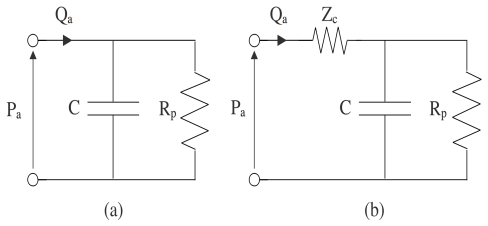
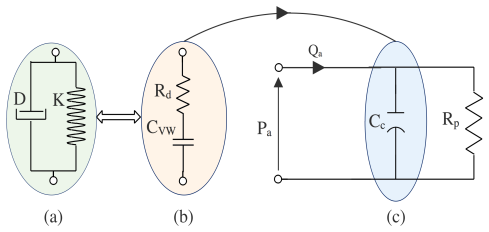
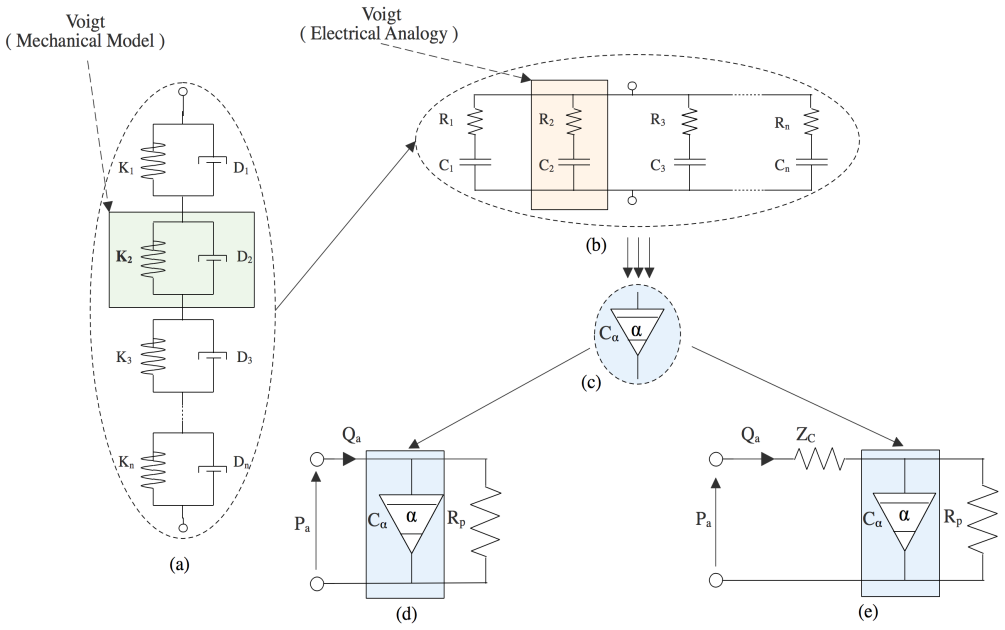
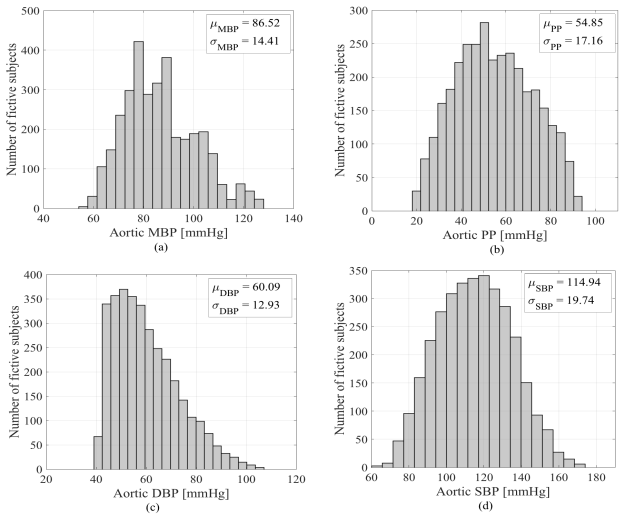
The authors replace the ideal capacitor with a fractional-order capacitor, an element whose behavior is controlled by an exponent alpha. Alpha equal to one gives the usual elastic capacitor, alpha equal to zero gives a pure resistor, and intermediate values blend resistance and capacitance. They derive the impedance formulas for a two-element and a three-element fractional Windkessel model, then fit them to an in-silico database of 3,325 virtual subjects generated by a validated one-dimensional hemodynamic model.
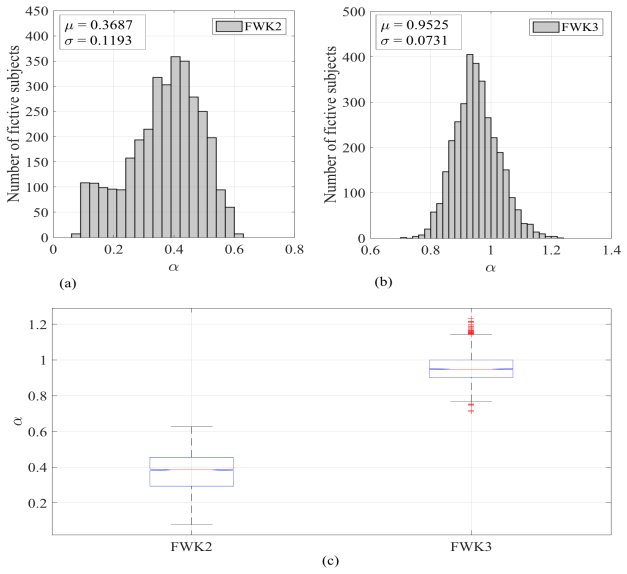
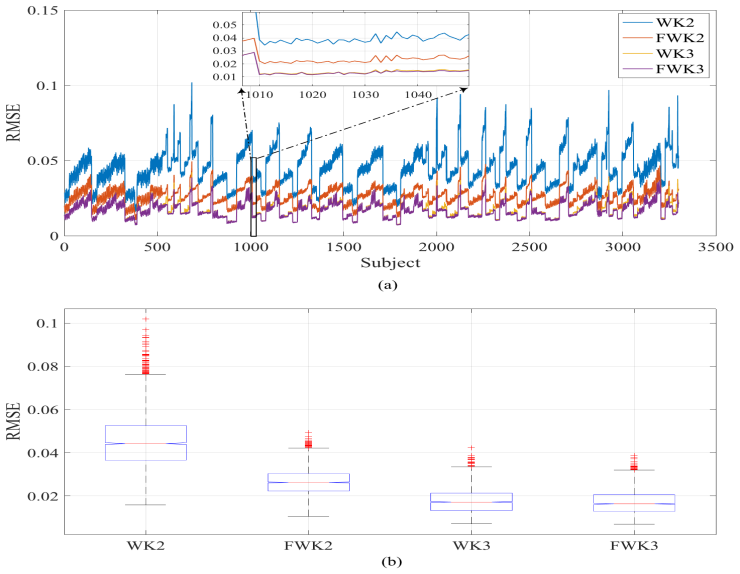
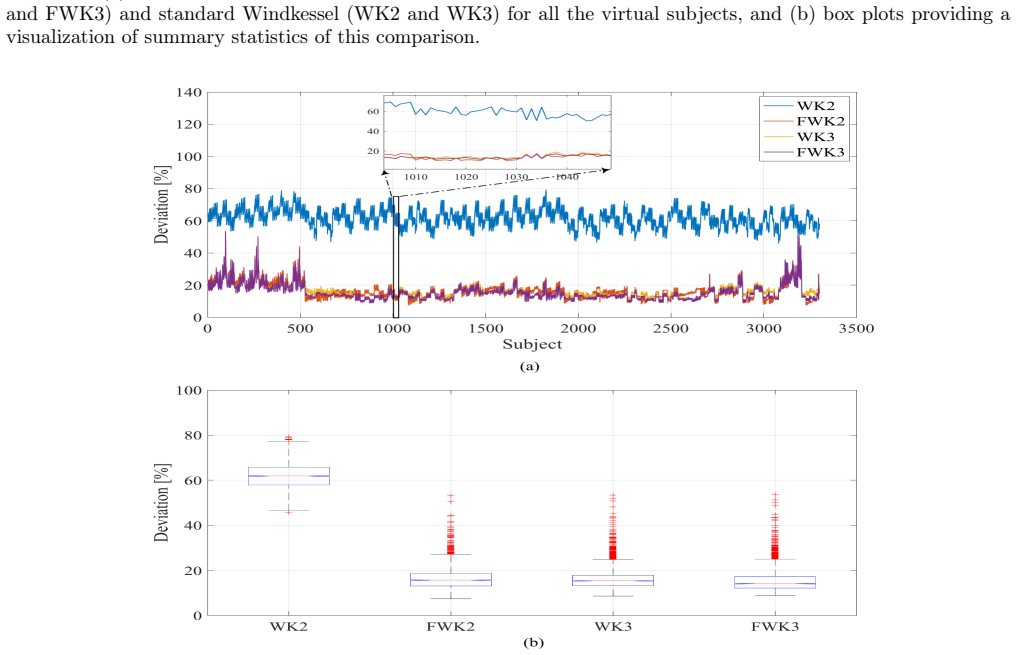
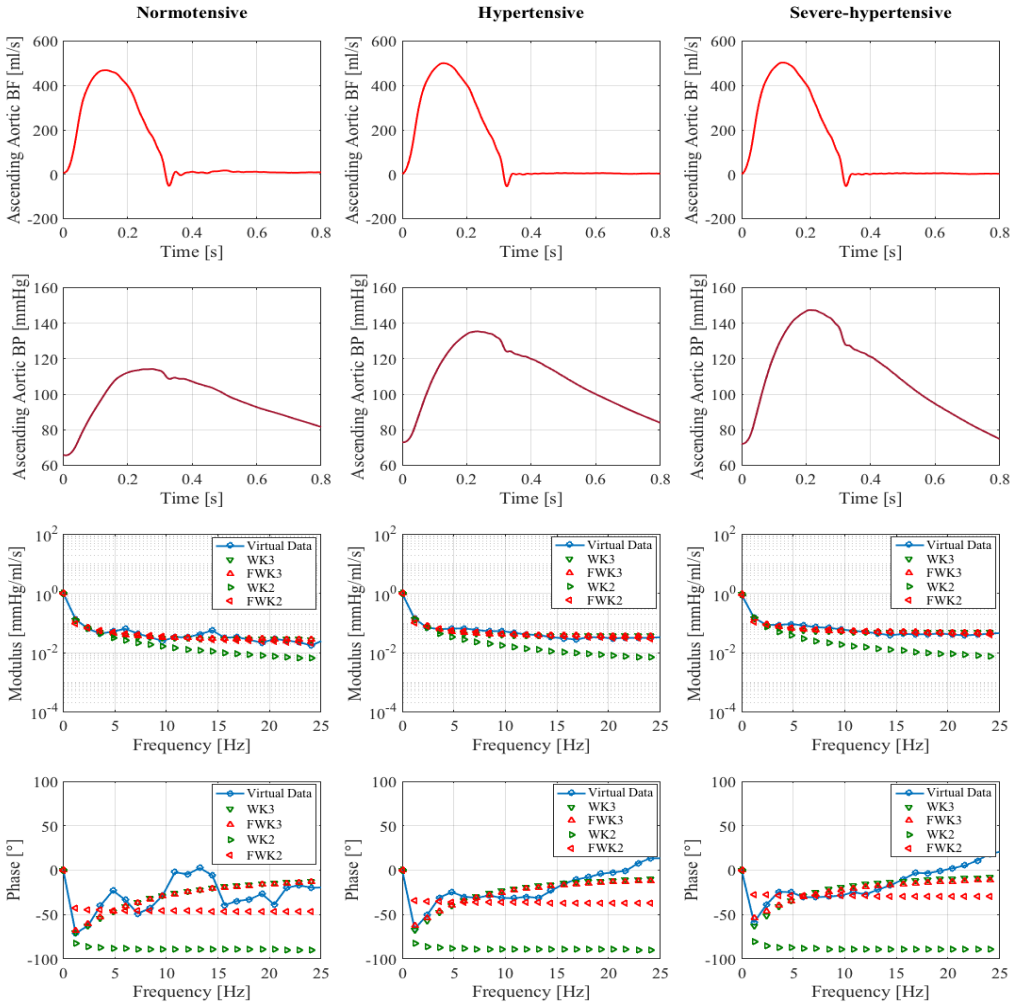
The fractional models fit the simulated impedance better than the classical two-element Windkessel, and the three-element fractional model is only slightly better than the classical three-element model. The fitted alpha values differ from one, which the authors interpret as evidence of arterial viscoelasticity, and they suggest alpha could act as a biomarker for arterial stiffness. The main limitation is that all validation comes from simulated data, the models have extra free parameters, and the viscoelastic interpretation is built on fitted exponents rather than on independent measurements.
Extended reading notes
Core claim
From the abstract: "the proposed fractional-order models overcame the limitations of the standard arterial Windkessel model and captured very well the real dynamic of the aortic input impedance modulus." The paper further concludes that the fractional differentiation order alpha "may have a powerful role, as a physiological bio-marker" (Section 5). If correct, fractional-order Windkessel models would estimate frequency-dependent arterial compliance and yield a single viscoelasticity index from pressure and flow measurements.
Load-bearing premise
The entire validation treats the Willemet et al. in-silico database (Section 3.3) as ground truth for aortic hemodynamics. That database was generated by an integer-order one-dimensional model, not by a fractional-order viscoelastic wall law, so the fitted alpha is an emergent best-fit exponent rather than an independently measured tissue property. If the virtual population does not faithfully reproduce human viscoelastic arterial behavior, the physiological conclusions about fractional-order behavior and the alpha biomarker collapse.
Signed reviews
Editorial analysis
A structured set of objections, weighed in public.
Assumptions & free parameters
free parameters (3)
- alpha (fractional order) for FWK2/FWK3 =
0.3687 +/- 0.0081 (FWK2); 0.9525 +/- 0.0050 (FWK3)
- tau_alpha (fractional time constant) =
Not reported explicitly; derived from C_eff via Eq. (32)
- Zc (characteristic impedance) for FWK3 =
0.03911 +/- 0.000639 (units not specified)
assumptions (5)
- domain assumption The aortic input impedance Zin(omega)=Pa(omega)/Qa(omega) computed from DFT of one cardiac cycle adequately represents the arterial system.
- domain assumption The in-silico virtual population generated by an integer-order 1D hemodynamic model is a valid ground truth for vascular mechanical properties.
- domain assumption A fractional-order capacitor (constant phase element) is a valid representation of arterial wall viscoelasticity, with alpha in (0,1).
- ad hoc to paper Effective compliance can be defined as Ceff = C_alpha * sin(alpha*pi/2).
- standard math The Laplace transform of the fractional derivative is s^alpha assuming null initial conditions.
invented entities (1)
-
Fractional-order capacitor C_alpha as total arterial compliance
Cite this review
Pith. "Pith review of Fractional Order Models of Arterial Windkessel as an Alternative in the Analysis of the Left Ventricular Afterload." pith.science (2026). https://pith.science/paper/OA7OLVLJ
@misc{pith2026190805239,
  author       = {Pith},
  title        = {Pith review of: Fractional Order Models of Arterial Windkessel as an Alternative in the Analysis of the Left Ventricular Afterload},
  year         = {2026},
  howpublished = {\url{https://pith.science/paper/OA7OLVLJ}},
  note         = {Machine review of arXiv:1908.05239}
}
read the original abstract
In this paper, a new fractional order generalization of the classical Windkessel arterial model is developed to describe the aortic input impedance as an assessment of the left ventricular after-load. The proposed models embeds fractional-order capacitor to describe the total arterial compliance. In this paper, we report our investigations on fractional calculus tools and demonstrate that fractional-order impedance can be used to determine the vascular properties and studying its dynamic effects. We conceived two fractional-order lumped parametric models: the fractional-order two-element Windkessel model and the fractional-order three-element Windkessel model. We compared these models to the classical Windkessel one using in-silico ascending aortic blood pressure and flow database of 3325 virtual subjects. Results showed that the proposed fractional-order models overcame the limitations of the standard arterial Windkessel model and captured very well the real dynamic of the aortic input impedance modulus. We also demonstrated that the proposed models could monitor the changes in the aortic input impedance for various arterial physiological states. Therefore, our models provide a new tool for "hemodynamic inverse problem" solving and offer a new, innovative way to better understand the viscoelastic effect, in terms of resistive behavior of the arterial motions.
Figures

Figures from the paper (12 more)




Reference graph
Works this paper leans on
-
[1]
Aboelkassem, Y. and Virag, Z. (2019). A hybrid windkessel-womersley model for blood flow in arteries. Journal of theoretical biology, 462:499–513
work page 2019
-
[2]
Bahloul, M. A. and Laleg-Kirati, T. M. (2018). Three-element fractional-order viscoelastic arterialwindkesselmodel. In 2018 40th Annual International Conference of the IEEE Engineering in Medicine and Biology Society (EMBC), pages 5261–5266. IEEE
work page 2018
-
[3]
Bahloul, M. A. and Laleg-Kirati, T. M. (2019). Two-element fractional-order windkessel model to assess the arterial input impedance. Inaccepted in 2019 41th Annual International Conference of the IEEE Engineering in Medicine and Biology Society (EMBC). IEEE
work page 2019
-
[4]
F., Tortoli, P., and Cachard, C
Balocco, S., Basset, O., Courbebaisse, G., Boni, E., Frangi, A. F., Tortoli, P., and Cachard, C. (2010). Estimation of the viscoelastic properties of vessel walls using a computational model and doppler ultrasound. Physics in Medicine & Biology, 55(12):3557
work page 2010
-
[5]
Borlaug, B. A. and Kass, D. A. (2011). Ventricular–vascular interaction in heart failure.Car- diology clinics, 29(3):447–459. 27
work page 2011
-
[6]
Burattini, R. and Natalucci, S. (1998). Complex and frequency-dependent compliance of vis- coelastic windkessel resolves contradictions in elastic windkessels.Medical engineering & physics, 20(7):502–514
work page 1998
-
[7]
Burattini, R., Natalucci, S., and Campbell, K. B. (1999). Viscoelasticity modulates resonance in the terminal aortic circulation.Medical engineering & physics, 21(3):175–185
work page 1999
-
[8]
Čanić, S., Tambača, J., Guidoboni, G., Mikelić, A., Hartley, C. J., and Rosenstrauch, D. (2006). Modeling viscoelastic behavior of arterial walls and their interaction with pulsatile blood flow. SIAM Journal on Applied Mathematics, 67(1):164–193
work page 2006
Show all 44 references
-
[9]
Capoccia, M. (2015). Development and characterization of the arterial w indkessel and its role during left ventricular assist device assistance.Artificial organs, 39(8):E138–E153
2015
-
[10]
and Armentano, R
Craiem, D. and Armentano, R. L. (2007). A fractional derivative model to describe arterial viscoelasticity. Biorheology, 44(4):251–263
2007
-
[11]
Craiem, D., Rojo, F., Atienza, J., Guinea, G., and Armentano, R. L. (2008a). Fractional calculus applied to model arterial viscoelasticity.Latin American applied research, 38(2):141– 145
2008
-
[12]
J., Atienza, J
Craiem, D., Rojo, F. J., Atienza, J. M., Armentano, R. L., and Guinea, G. V. (2008b). Fractional-order viscoelasticity applied to describe uniaxial stress relaxation of human arteries. Physics in medicine and biology, 53(17):4543
2008
-
[13]
C., Freed, A
Doehring, T. C., Freed, A. D., Carew, E. O., and Vesely, I. (2005). Fractional order viscoelastic- ity of the aortic valve cusp: an alternative to quasilinear viscoelasticity.Journal of biomechanical engineering, 127(4):700–708
2005
-
[14]
Elwakil, A. S. (2010). Fractional-order circuits and systems: An emerging interdisciplinary research area. IEEE Circuits and Systems Magazine, 10(4):40–50
2010
-
[15]
Freeborn, T. J. (2013). A survey of fractional-order circuit models for biology and biomedicine. IEEE Journal on emerging and selected topics in circuits and systems, 3(3):416–424. 28
2013
-
[16]
D., Nagatomi, J., Wood, S
Hemmer, J. D., Nagatomi, J., Wood, S. T., Vertegel, A. A., Dean, D., and LaBerge, M. (2009). Role of cytoskeletal components in stress-relaxation behavior of adherent vascular smooth muscle cells. Journal of biomechanical engineering, 131(4):041001
2009
-
[17]
P., Sen, M., and Semperlotti, F
Hollkamp, J. P., Sen, M., and Semperlotti, F. (2018). Model-order reduction of lumped pa- rameter systems via fractional calculus.Journal of Sound and Vibration, 419:526–543
2018
-
[18]
A., Gasser, T
Holzapfel, G. A., Gasser, T. C., and Stadler, M. (2002). A structural model for the viscoelastic behavior of arterial walls: continuum formulation and finite element analysis.European Journal of Mechanics-A/Solids, 21(3):441–463
2002
-
[19]
M., Machado, J
Ionescu, C. M., Machado, J. T., and De Keyser, R. (2011). Modeling of the lung impedance using a fractional-order ladder network with constant phase elements.IEEE Transactions on biomedical circuits and systems, 5(1):83–89
2011
-
[20]
and McKinley, G
Jaishankar, A. and McKinley, G. H. (2013). Power-law rheology in the bulk and at the inter- face: quasi-properties and fractional constitutive equations.Proceedings of the Royal Society A: Mathematical, Physical and Engineering Sciences, 469(2149):20120284
2013
-
[21]
Jumarie, G. (2006). Modified riemann-liouville derivative and fractional taylor series of nondif- ferentiable functions further results.Computers & Mathematics with Applications, 51(9-10):1367– 1376
2006
-
[22]
Kilbas, A. A. A., Srivastava, H. M., and Trujillo, J. J. (2006).Theory and applications of fractional differential equations, volume 204. Elsevier Science Limited
2006
-
[23]
Kobayashi, Y., Kato, A., Watanabe, H., Hoshi, T., Kawamura, K., and Fujie, M. G. (2012). Modeling of viscoelastic and nonlinear material properties of liver tissue using fractional calcu- lations. Journal of Biomechanical Science and Engineering, 7(2):177–187
2012
-
[24]
Machado, J. (2001). Discrete-time fractional-order controllers.Fractional Calculus and Applied Analysis, 4:47–66. 29
2001
-
[25]
Magin, R. L. (2006).Fractional calculus in bioengineering. Begell House Redding
2006
-
[26]
Milnor, W. (1989). Vascular impedance.Hemodynamics, 2nd Ed., Baltimore, MD, Williams & Wilkins, pages 167–203
1989
-
[27]
Milnor, W. R. (1975). Arterial impedance as ventricular afterload. Circulation Research, 36(5):565–570
1975
-
[28]
and Long, G
Naghibolhosseini, M. and Long, G. R. (2018). Fractional-order modelling and simulation of human ear. International Journal of Computer Mathematics, 95(6-7):1257–1273
2018
-
[29]
(2012).Circulatory system dynamics, volume 1
Noordergraaf, A. (2012).Circulatory system dynamics, volume 1. Elsevier
2012
-
[30]
F., Yaginuma, T., and Avolio, A
O’Rourke, M. F., Yaginuma, T., and Avolio, A. P. (1984). Physiological and pathophysiological implications of ventricular/vascular coupling.Annals of biomedical engineering, 12(2):119–134
1984
-
[31]
Podlubny, I. (1998).Fractional differential equations: an introduction to fractional derivatives, fractional differential equations, to methods of their solution and some of their applications, volume 198. Elsevier
1998
-
[32]
M., Berger, D
Quick, C. M., Berger, D. S., and Noordergraaf, A. (2001a). Constructive and destructive addition of forward and reflected arterial pulse waves.American Journal of Physiology-Heart and Circulatory Physiology, 280(4):H1519–H1527
2001
-
[33]
M., Berger, D
Quick, C. M., Berger, D. S., Stewart, R. H., Laine, G. A., Hartley, C. J., and Noordergraaf, A. (2006). Resolving the hemodynamic inverse problem.IEEE transactions on biomedical engi- neering, 53(3):361–368
2006
-
[34]
M., Young, W
Quick, C. M., Young, W. L., and Noordergraaf, A. (2001b). Infinite number of solutions to the hemodynamic inverse problem. American Journal of Physiology-Heart and Circulatory Physiology, 280(4):H1472–H1479
2001
-
[35]
Reesink, K. D. and Spronck, B. (2018). Constitutive interpretation of arterial stiffness in 30 clinical studies: a methodological review.American Journal of Physiology-Heart and Circulatory Physiology, 316(3):H693–H709
2018
-
[36]
K., Pantalos, G
Sharp, M. K., Pantalos, G. M., Minich, L., Tani, L. Y., McGough, E. C., and Hawkins, J. A. (2000). Aortic input impedance in infants and children. Journal of applied physiology, 88(6):2227–2239
2000
-
[37]
Shi, Y., Lawford, P., and Hose, R. (2011). Review of zero-d and 1-d models of blood flow in the cardiovascular system.Biomedical engineering online, 10(1):33
2011
-
[38]
Stergiopulos, N., Meister, J., and Westerhof, N. (1995). Evaluation of methods for estimation of total arterial compliance.American Journal of Physiology-Heart and Circulatory Physiology, 268(4):H1540–H1548
1995
-
[39]
CRC press
Vlachopoulos, C., O’Rourke, M., andNichols, W.W.(2011).McDonald’s blood flow in arteries: theoretical, experimental and clinical principles. CRC press
2011
-
[40]
J., and Chesler, N
Wang, Z., Golob, M. J., and Chesler, N. C. (2016). Viscoelastic properties of cardiovascular tissues. In Viscoelastic and viscoplastic materials. IntechOpen
2016
-
[41]
Westerhof, N., Lankhaar, J.-W., and Westerhof, B. E. (2009). The arterial windkessel.Medical & biological engineering & computing, 47(2):131–141
2009
-
[42]
I., and Westerhof, B
Westerhof, N., Stergiopulos, N., Noble, M. I., and Westerhof, B. E. (2019). Arterial input impedance. In Snapshots of Hemodynamics, pages 195–206. Springer
2019
-
[43]
Adatabaseofvirtualhealthysubjects to assess the accuracy of foot-to-foot pulse wave velocities for estimation of aortic stiffness
Willemet, M., Chowienczyk, P., andAlastruey, J.(2015). Adatabaseofvirtualhealthysubjects to assess the accuracy of foot-to-foot pulse wave velocities for estimation of aortic stiffness. American Journal of Physiology-Heart and Circulatory Physiology, 309(4):H663–H675
2015
-
[44]
Xiao, H., Tan, I., Butlin, M., Li, D., and Avolio, A. P. (2017). Arterial viscoelasticity: role in the dependency of pulse wave velocity on heart rate in conduit arteries.American Journal of Physiology-Heart and Circulatory Physiology. 31
2017
Reviewed August 14, 2026 · model on record in the stance chip above.
Discussion (0). Continue with ORCID to comment.