REVIEW 3 major objections 4 minor 32 references
Photon scattering from a cold, Gaussian atom cloud
T0 review · 3 major / 4 minor · reviewed 2026-08-14 · deepseek-v4-flash
Pith's one-line read The paper establishes that for sufficiently large Gaussian atomic clouds, the total and forward photon scattering rates from the full coupled point-dipole calculation are quantitatively reproduced by a continuous dielectric with the…
desk verdict Solid computational paper with a practical message for cold-atom experimenters; the only real weakness is missing error bars on the 4-configuration large-N averages. read the letter →
The pith
A machine-rendered reading of the paper's core claim, the machinery that carries it, and where it could break.
The reading
What carries the argument
The load-bearing object is the continuum electric susceptibility $\chi_e^{(\mathrm{ld})}(\Delta) = \frac{i\rho\sigma/k}{1-2i\Delta/\Gamma}$, with $\sigma = 6\pi/k^2$, placed into Maxwell's equation for the electric field. The paper solves that equation in the paraxial approximation, writing the field as $\vec{E} \simeq \hat{e}_x e^{ikz} E_0 \psi_x$, with $i\partial_z \psi_x = -\frac{1}{2k}\nabla_T^2\psi_x - \frac{k}{2}\chi_e\psi_x$; dropping the transverse Laplacian gives the eikonal solution $\psi_x = \exp\!\left(i\frac{k}{2}\int_{-\infty}^{z}\chi_e\,dz'\right)$, which is why the optical depth OD alone controls the lineshape whenever the eikonal approximation holds. The reference calculation is the coupled-dipole system with the point-dipole Green's function, solved by an iterative update that reaches $N = 2^{17}$ atoms, and the comparison is made on total scattering, integrated forward scattering, and small-angle angular scattering.
What would settle it
Recompute the total and forward scattering curves at $b_0 = 40$, $N = 2^{17}$ with tens of independent random configurations and plot the run-to-run spread; if the spread around the mean is comparable to or larger than the gap between the point-dipole and continuum curves, or if the mean shifts away from the continuum result, the central claim fails.
Extended reading notes
Core claim
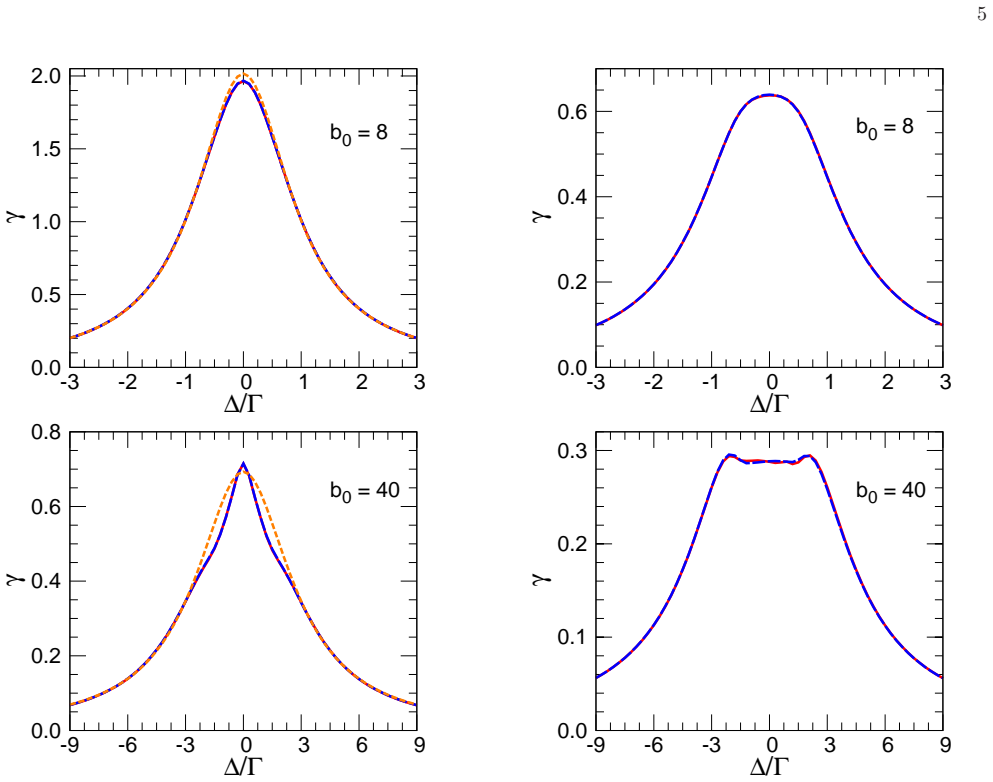
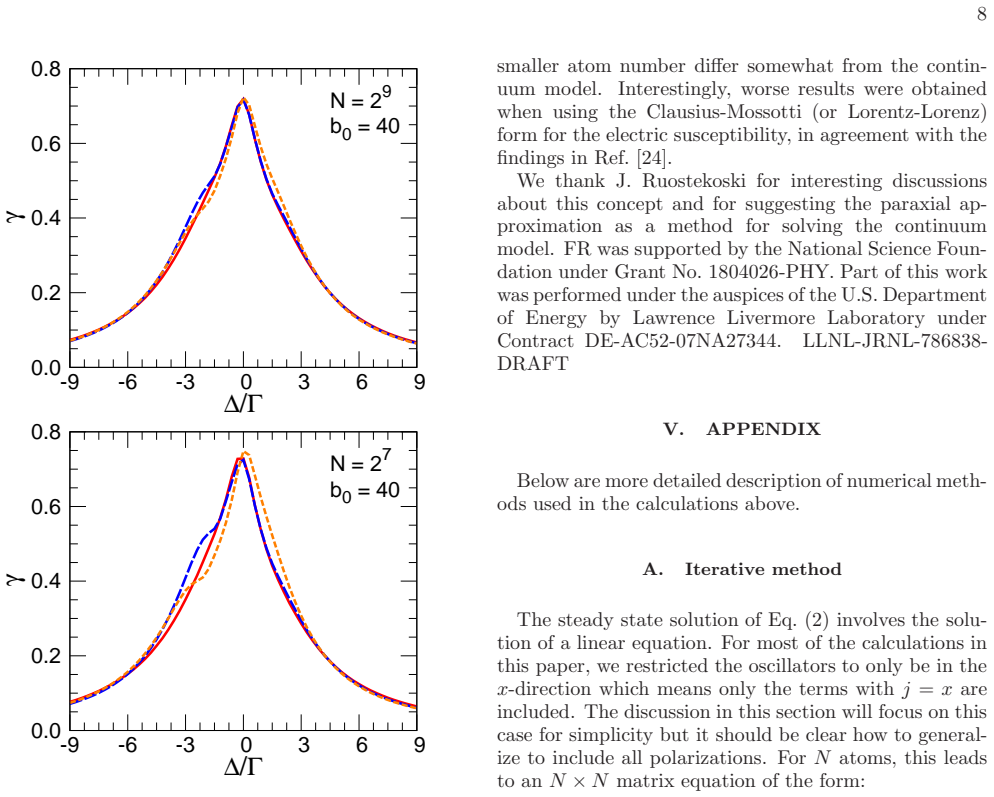
The central claim is that the photon scattering lineshape of a cold Gaussian cloud is controlled by the spatial distribution of induced polarization, and that a classical continuum dielectric correctly describes that distribution in three regimes. For dilute clouds the polarization is nearly uniform, and the lineshape is close to the broadened timed-Dicke Lorentzian; for denser clouds near-resonant light is absorbed at the front, producing a non-Lorentzian, $|\Delta|$-like lineshape that the eikonal approximation captures; and for wavelength-scale clouds red-detuned light refocuses toward the back, requiring the higher-order paraxial approximation. In all three regimes the continuum model with $\chi_e^{(\mathrm{ld})}$ reproduces the full point-dipole total and forward scattering up to $b_0 = 40$, so closely that the plotted curves are described as indistinguishable. At higher densities and small $N$, mean-field models fail because dipole-dipole correlations and diffraction perpendicular to the laser set in, and the Clausius-Mossotti susceptibility makes the disagreement worse rather than better.
Load-bearing premise
The claimed agreement rests on averaging over only four random configurations for the largest clouds, and no error bars or convergence test are reported, so if run-to-run fluctuations are significant the whole quantitative match could shift.
Editorial extensions
If this is right
- At fixed $b_0$ and $\xi = 1$, the total scattering lineshape for $N = 2^{17}$ is essentially the same as for $N = 2^{11}$, so in the eikonal regime the system is controlled by optical depth OD rather than by $N$ or density separately.
- At large $b_0$ the near-resonance total scattering narrows and develops a $|\Delta|$-shaped cusp, while the forward scattering rate plateaus near resonance, both because light cannot penetrate the cloud; the continuum model reproduces both effects.
- For elongated clouds with $\xi = 2$ and small $N$, red-detuned light can focus back into the cloud and produce an extra scattering hump at $\Delta < 0$, which the paraxial continuum calculation captures.
- The Clausius-Mossotti susceptibility consistently gives worse agreement than the low-density susceptibility for these stationary-atom clouds, so local-field corrections are not the right way to extend the continuum model.
Reading between the lines
- A natural next test, not performed here, is to push the same comparison past $b_0 = 40$ at fixed $N = 2^{17}$; since the iterative solver already handles $N = 2^{18}$ to $2^{19}$, the onset density of mean-field breakdown could be mapped directly.
- Because the eikonal regime depends only on OD, the paper's result implies that experiments comparing clouds of different $N$ at the same OD should see identical detuning curves, a clean observable check.
- The failure of Clausius-Mossotti suggests that a more promising route to extend the continuum model is a susceptibility that absorbs short-range pair correlations explicitly, rather than a local-field factor.
- The polarization inversion toward the back of the cloud at red detuning should be directly visible in spatially resolved imaging, not only in the scattering lineshape.
Signed reviews
Editorial analysis
A structured set of objections, weighed in public.
Referee Report
Summary. The paper compares two theoretical descriptions of weakly driven photon scattering from a frozen, Gaussian-distributed cloud of two-level atoms: a microscopic point-dipole model solved numerically for up to 2^17 atoms, and a continuum dielectric model solved in the eikonal or paraxial approximation. The authors identify three polarization regimes as the on-resonance optical depth b0 increases: nearly uniform polarization for dilute clouds, front-localized absorption for intermediate densities, and back-of-cloud refocusing for red detuning at large b0. They find that the continuum paraxial model quantitatively reproduces the total and forward scattering rates of the point-dipole model without adjustable parameters for b0 up to 40, that the eikonal approximation works in a lower-density regime, and that the Clausius-Mossotti local-field correction does not improve and often worsens agreement. They also present an iterative numerical method for solving the point-dipole equations with many atoms.
Significance. If the claimed agreement is robust, the paper is a valuable benchmark: it shows that a simple, parameter-free continuum dielectric calculation can capture non-Lorentzian lineshapes and forward-scattering plateaus in dense cold-atom clouds, and it clearly delineates the regime where mean-field local-field corrections fail because of atom-atom correlations. The paper also provides a concrete iterative algorithm for point-dipole simulations with more than 10^5 atoms and gives a systematic derivation of higher-order paraxial corrections. The false-prediction potential is high, because the continuum model is compared directly to the microscopic equations with nothing fit to make agreement happen.
major comments (3)
- [Sec. III A, Figs. 3, 4, 7, 8] The central quantitative claim—that the continuum paraxial model is indistinguishable from the point-dipole result for N=2^17—rests on disorder averages of only 4 configurations, since the text states the total number of atoms included across runs is 2^19. No error bars, standard deviations, or convergence metric are shown for these averages, so the visual claim of agreement is not quantitatively supported. Please add configuration-to-configuration variance estimates, or demonstrate convergence by increasing the number of runs, and state the resulting uncertainty in the plotted lineshapes.
- [Sec. III B, Fig. 8] In Fig. 8 the N=2^11 point-dipole result, which is averaged over 256 configurations, shows a noticeable difference from the continuum model at small |Δ| for ξ=2, while the N=2^17 result, averaged over only 4 configurations, is claimed to be in excellent agreement. Because the finite-N comparison is the only one with a reasonably large number of configurations, the text should quantify whether the N=2^11 discrepancy is a genuine finite-density continuum breakdown or partly a statistical fluctuation, and error bars on the N=2^17 curve are needed to support the assertion that the large-N curve is the more reliable comparison.
- [Sec. III A, forward scattering definition] The forward scattering rate is defined by integrating Eq. (4) up to an angle θmax chosen a posteriori so that the differential rate has decreased by two orders of magnitude from its maximum. This is a reasonable convention, but the robustness of the plateau and of the model comparison to the exact cutoff value is not demonstrated. Please show that the conclusions are insensitive to the specific choice of θmax, or state the sensitivity explicitly.
minor comments (4)
- [Figure captions 2, 3, 6, 7, 9] Several captions refer to the total scattering rate as 'Eq. (4)', but Eq. (4) is the differential rate dγ/dΩ; the total rate is Eq. (6). Please correct these cross-references.
- [Sec. III B, Fig. 6 caption] The figure caption contains the LaTeX artifact 'resizebox80mm!'; this should be removed.
- [Sec. IV, Conclusions] The word 'poralization' in the concluding paragraph should be 'polarization'.
- [Sec. III C, Fig. 9] The spelling 'Claussius-Mossotti' appears in the figure caption but the standard spelling 'Clausius-Mossotti' is used elsewhere in the text; please make the spelling consistent.
Circularity Check
No significant circularity: the continuum model is an independent, parameter-free comparison; self-citations are contextual only.
full rationale
The derivation chain is self-contained. The paper's central comparison is between the full point-dipole equations, Eq. (2), and the continuum dielectric model, Eqs. (7)-(14), with the susceptibility taken from the standard low-density form, Eq. (8), and no adjustable parameters. The continuum wavefunction is obtained by solving the paraxial/eikonal equations, not by fitting to the point-dipole results; the agreement reported in Figs. 3, 4, 7, and 8 is therefore an independent numerical cross-check. The expected superradiant width is cited from the authors' prior Ref. [8], but it is used only as context and to draw a Lorentzian reference curve whose height is fitted to the wings; the predicted curves in the figures come from the parameter-free paraxial calculation. No uniqueness theorem is imported, no ansatz is smuggled in via citation, and no quantity is defined in terms of the target result. The small number of configurations for the largest clouds is a statistical convergence concern, not a circularity, because it does not make the continuum prediction equivalent to the point-dipole input by construction.
Assumptions & free parameters
free parameters (1)
- forward scattering angular cutoff theta_max =
1 - 13.8/(k^2 r_f^2)
assumptions (5)
- domain assumption Frozen-atom approximation: atoms are stationary on the scattering timescale, so Eq. (2) with fixed positions describes the dynamics.
- domain assumption Two-state truncation: only the laser-polarization component a_x is kept for each atom.
- domain assumption Gaussian density profile Eq. (1) represents a cold atom cloud.
- domain assumption Paraxial approximation in Eq. (11) is accurate for the reported regimes except the small-N, dense cases in Fig. 9.
- domain assumption Ensemble averaging over random configurations reproduces the cold atom cloud scattering.
Cite this review
Pith. "Pith review of Photon scattering from a cold, Gaussian atom cloud." pith.science (2026). https://pith.science/paper/JAPALB3R
@misc{pith2026190805260,
  author       = {Pith},
  title        = {Pith review of: Photon scattering from a cold, Gaussian atom cloud},
  year         = {2026},
  howpublished = {\url{https://pith.science/paper/JAPALB3R}},
  note         = {Machine review of arXiv:1908.05260}
}
read the original abstract
We study the effect of a weakly driven atomic cloud's polarization distribution on its photon scattering lineshape. In doing this, we find three distinct polarization regimes. First, for dilute clouds, the polarization magnitude is relatively constant. Second, for denser clouds, polarization builds at the front of the cloud for near-resonant light. Third, when the cloud condenses to the point where its dimensions become comparable to the wavelength, light refocuses towards the back of the cloud for red detuning. For these regimes, we show which `mean-field' frameworks accurately describe the differing photon scattering lineshapes. Finally, for even denser clouds, mean field models become inaccurate and necessitate the full point dipole model that includes atom-atom correlations.
Figures


Figures from the paper (4 more)


Reference graph
Works this paper leans on
-
[1]
Coherence in spontaneous radiation pro- cesses,
R. H. Dicke, “Coherence in spontaneous radiation pro- cesses,” Phys. Rev. 93, 99 (1954)
1954
-
[2]
N. E. Rehler and J. H. Eberly, “Superradiance,” Phys. Rev. A 3, 1735 (1971)
work page 1971
-
[3]
Superradiance: An essay on the theory of collective spontaneous emission,
M. Gross and S. Haroche, “Superradiance: An essay on the theory of collective spontaneous emission,” Phys. Rep. 93, 301 (1982)
work page 1982
-
[4]
Super- radiance in inverted multilevel atomic clouds,
R. T. Sutherland and F. Robicheaux, “Super- radiance in inverted multilevel atomic clouds,” Phys. Rev. A 95, 033839 (2017)
work page 2017
-
[5]
Quantum field theory of cooperative atom response: low light intensity,
J. Ruostekoski and J. Javanainen, “Quantum field theory of cooperative atom response: low light intensity,” Phys. Rev. A 55, 513 (1997)
work page 1997
-
[6]
Directed spontaneous emission from an extended ensemble of n atoms: Timing is everything,
M. O. Scully, E. S. Fry, C. H. R. Ooi, and K. W´ odkiewicz, “Directed spontaneous emission from an extended ensemble of n atoms: Timing is everything,” Phys. Rev. Lett. 96, 010501 (2006)
work page 2006
-
[7]
Correlated spontaneous emission on the Volga,
M.O. Scully, “Correlated spontaneous emission on the Volga,” Laser Phys. 17, 635 (2007)
work page 2007
-
[8]
(see the b0 = 32 case); the red detuned light causes larger polarization for z > 0 through the center of the cloud whereas there is almost no polarization near the center of the cloud for zero detuning, causing the eikonal approximation —and the cloud’s dependence on OD —to break down. For all of the cases in Fig. 1, the continuum dielectric model reprodu...
Show all 32 references
-
[9]
Collec- tive dipole-dipole interactions in an atomic array,
R. T. Sutherland and F. Robicheaux, “Collec- tive dipole-dipole interactions in an atomic array,” Phys. Rev. A 94, 013847 (2016)
2016
-
[10]
Coher- ent forward broadening in cold atom clouds,
R. T. Sutherland and F. Robicheaux, “Coher- ent forward broadening in cold atom clouds,” Phys. Rev. A 93, 023407 (2016)
2016
-
[11]
Enhanced optical cross section via col- lective coupling of atomic dipoles in a 2d array,
R. J. Bettles, S. A. Gardiner, and C. S. Adams, “Enhanced optical cross section via col- lective coupling of atomic dipoles in a 2d array,” Phys. Rev. Lett. 116, 103602 (2016)
2016
-
[12]
Collective atomic scattering and motional effects in a dense coherent medium,
S. L. Bromley, B. Zhu, M. Bishof, X. Zhang, T. Both- well, J. Schachenmayer, T. L. Nicholson, R. Kaiser, S. F. Yelin, M. D. Lukin, et al. , “Collective atomic scattering and motional effects in a dense coherent medium,” Nat. Commun. 7, 11039 (2016)
2016
-
[14]
Cooperative sponta- neous emission as a many-body eigenvalue problem,
A. Svidzinsky and J.-T. Chang, “Cooperative sponta- neous emission as a many-body eigenvalue problem,” Phys. Rev. A 77, 043833 (2008)
2008
-
[15]
Light scattering from dense cold atomic media,
B. Zhu, J. Cooper, J. Ye, and A. M. Rey, “Light scattering from dense cold atomic media,” Phys. Rev. A 94, 023612 (2016)
2016
-
[16]
Degenerate Zee- man ground states in the single-excitation regime,
R. T. Sutherland and F. Robicheaux, “Degenerate Zee- man ground states in the single-excitation regime,” Phys. Rev. A 96, 053840 (2017)
2017
-
[17]
Absence of diffusion in certain random lattices,
P. W. Anderson, “Absence of diffusion in certain random lattices,” Phys. Rev. 109, 1492 (1958)
1958
-
[18]
Cooperative Lamb shift in a mesoscopic atomic ar- ray,
Z. Meir, O. Schwartz, E. Shahmoon, D. Oron, and R. Oz- eri, “Cooperative Lamb shift in a mesoscopic atomic ar- ray,” Phys. Rev. Lett. 113, 193002 (2014)
2014
-
[19]
Magnetic-field-driv en localization of light in a cold-atom gas,
S.E. Skipetrov and I.M. Sokolov, “Magnetic-field-driv en localization of light in a cold-atom gas,” Phys. Rev. Lett. 114, 053902 (2015)
2015
-
[20]
Observation of the critical regime near anderson local- ization of light,
M. St¨ orzer, P. Gross, C. M. Aegerter, and G. Maret, “Observation of the critical regime near anderson local- ization of light,” Phys. Rev. Lett. 96, 063904 (2006)
2006
-
[21]
Beitrge zur optik trber me- dien, speziell kolloidaler metallsungen,
G. Mie, “Beitrge zur optik trber me- dien, speziell kolloidaler metallsungen,” Annalen der Physik 330, 377–445 (1908)
1908
-
[22]
J. D. Jackson, Classical Electrodynamics, 3rd Edition (John Wiley & Sons, 1999)
1999
-
[23]
Role of dis- order in super- and subradiance of cold atomic clouds,
F. Cottier, R. Kaiser, and R. Bachelard, “Role of dis- order in super- and subradiance of cold atomic clouds,” Phys. Rev. A 98, 013622 (2018)
2018
-
[24]
Frequency shifts in emission and absorption by resonant systems of two-level atoms,
R. Friedberg, S. R. Hartmann, and J. T. Manassah, “Frequency shifts in emission and absorption by resonant systems of two-level atoms,” Phys. Rep. 7, 101 (1973)
1973
-
[25]
Light propaga- tion beyond the mean-field theory of standard optics,
J. Javanainen and J. Ruostekoski, “Light propaga- tion beyond the mean-field theory of standard optics,” Opt. Express 24, 993 (2016)
2016
-
[26]
Shifts of a resonance line in a dense atomic sample,
J. Javanainen, J. Ruostekoski, Y. Li, and S.-M. Yoo, “Shifts of a resonance line in a dense atomic sample,” Phys. Rev. Lett. 112, 113603 (2014)
2014
-
[27]
Controlled manipu- lation of light by cooperative response of atoms in an optical lattice,
S. D. Jenkins and J. Ruostekoski, “Controlled manipu- lation of light by cooperative response of atoms in an optical lattice,” Phys. Rev. A 86, 031602 (2012)
2012
-
[28]
Co- operative spontaneous emission of n atoms: Many-body eigenstates, the effect of virtual Lamb shift processes, and analogy with radiation of n classical oscillators,
A. A. Svidzinsky, J.-T. Chang, and M. O. Scully, “Co- operative spontaneous emission of n atoms: Many-body eigenstates, the effect of virtual Lamb shift processes, and analogy with radiation of n classical oscillators,” Phys. Rev. A 81, 053821 (2010)
2010
-
[29]
Stochas- tic methods for light propagation and recurrent scatter- ing in saturated and nonsaturated atomic ensembles,
M. D. Lee, S. D. Jenkins, and J. Ruostekoski, “Stochas- tic methods for light propagation and recurrent scatter- ing in saturated and nonsaturated atomic ensembles,” Phys. Rev. A 93, 063803 (2016)
2016
-
[30]
Coherence effects in scattering order expansion of light by atomic clouds,
M.-T. Rouabah, M. Samoylova, R. Bachelard, P. W. Courteille, R. Kaiser, and N. Piovella, “Coherence effects in scattering order expansion of light by atomic clouds,” J. Opt. Soc. Am. A 31, 1031 (2014)
2014
-
[31]
From Maxwell to paraxial wave optics,
M. Lax, W. H. Louisell, and W. B. McKnight, “From Maxwell to paraxial wave optics,” Phys. Rev. A 11, 1365 11 (1975)
1975
-
[32]
Loudon, The Quantum Theory of Light, 3rd Edition (Oxford University Press, New York, 2000)
R. Loudon, The Quantum Theory of Light, 3rd Edition (Oxford University Press, New York, 2000)
2000
-
[211]
4(1 + b0/ 4)Γ for the right column to accentuate the focusing effect
The detuning is set at ∆ = 0 for the left column and ∆ = − 0. 4(1 + b0/ 4)Γ for the right column to accentuate the focusing effect. The electric field is scaled by the incident fi eld and the density is scaled by the maximum density. for all laser detunings (see the b0 = 1 /8 cas...
Reviewed August 14, 2026 · model on record in the stance chip above.
Discussion (0). Continue with ORCID to comment.