REVIEW 3 major objections 4 minor 17 references
False Discovery Rate for Functional Data
T0 review · 3 major / 4 minor · reviewed 2026-08-14 · deepseek-v4-flash
Pith's one-line read The paper proves that a continuous Benjamini-Hochberg procedure controls the functional false discovery rate when the p-value function is positively regression dependent and the finite-grid approximation is regular.
desk verdict The fBH procedure is a genuine extension of BH to functional data with a credible control proof, but the theory only applies under an infinite-dimensional PRDS assumption that the applications do not check. read the letter →
The pith
A machine-rendered reading of the paper's core claim, the machinery that carries it, and where it could break.
The reading
What carries the argument
The load-bearing object is the cumulated p-value function $a(r)=\nu(\{s:p(s)\le r\})$, which compresses infinitely many pointwise tests into one sublevel-set curve. The fBH threshold is the largest crossing of $a(r)$ with the line $r/\alpha$, and the procedure rejects every point whose p-value lies below that crossing. The convergence proof works by applying ordinary weighted BH to $p$ evaluated on a dense uniform grid $S_k$, obtaining a discrete false-discovery proportion $Q_k$ that converges almost surely to the functional $Q$, so the finite-sample PRDS bound can be passed through the limit by dominated convergence.
What would settle it
Generate functional data on a one-dimensional domain with a known true-null region $U$, using pointwise test statistics from a Gaussian process with nonnegative covariance so the PRDS assumption is satisfied, and construct the p-value function accordingly. Apply the fBH procedure at level $\alpha$ on a sequence of increasingly fine uniform grids; across many replications the empirical functional false discovery proportion should not exceed $\alpha\nu(U)/\nu(T)$ if Theorem 3.9 is correct.
Extended reading notes
Core claim
On a domain $T$ with measure $\nu$, the paper defines $V$ as the set of points where a true null is rejected, $S$ as the set where a false null is rejected, and the functional false discovery rate as $\mathrm{fFDR}=\mathbb{E}[\nu(V)/(\nu(V\cup S))]$. The functional BH procedure rejects $H_0^t$ at all points $t$ with $p(t)\le \alpha^*$, where $\alpha^*$ is the largest $r$ such that the cumulated p-value function $a(r)=\nu(\{s:p(s)\le r\})$ satisfies $a(r)/\nu(T)\ge r/\alpha$. Theorem 3.9 states that if the p-value function is PRDS on the true-null set $U$ and the stated level-set regularity conditions hold with probability one, then $\mathrm{fFDR}\le \alpha\,\nu(U)/\nu(T)\le \alpha$. Equivalently, the adjusted p-value function $\tilde p(t)=\min_{s\ge p(t)} \nu(T)s/\nu(\{p\le s\})$ yields the same rejection region for every $\alpha$.
Load-bearing premise
The guarantee depends on the pointwise p-value function being positively regression dependent on the true-null region, so that raising a true-null p-value can never make rejection of the set easier.
Editorial extensions
If this is right
- A dense-grid application of ordinary BH converges to the infinite-domain fBH threshold, so local inference on curves and surfaces can be FDR-adjusted with standard software.
- The adjusted p-value function lets a researcher compute significance after correction for every $\alpha$ at once, rather than re-running the procedure threshold by threshold.
- Because fBH controls FDR rather than FWER, it is more sensitive than methods such as Fmax in the simulations, at the cost of only weak family-wise control.
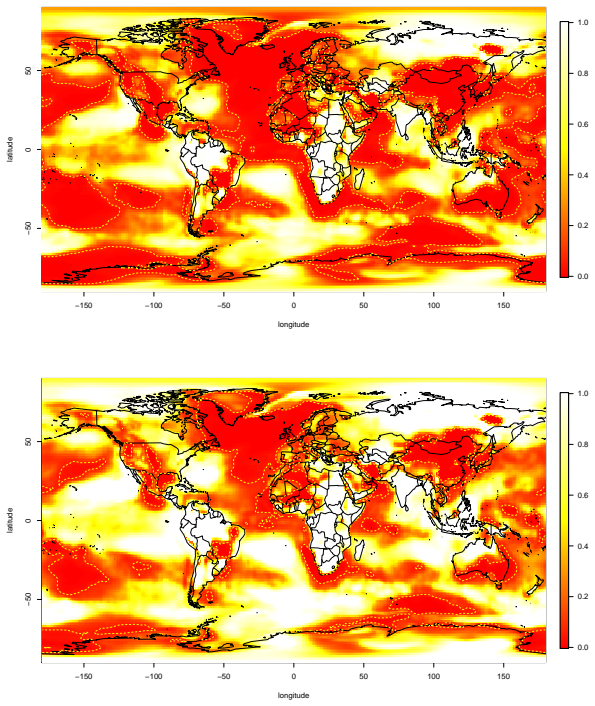
- With a weighted measure such as $\cos(\text{latitude})$ on the sphere, the procedure adapts to non-uniform domains; in the climate application 15.0% of Earth's area remains significant at the 5% level after adjustment, compared with 32.4% before.
Reading between the lines
- A useful next step would be a practical diagnostic for the PRDS assumption, since the paper's proof assumes it but does not check it in the simulations or the climate application.
- The same sublevel-set threshold construction could define functional analogues of weighted FDR, positive FDR, or q-value curves, giving a continuous-data counterpart to standard FDR-related quantities.
- The convergence result suggests a grid-selection rule: keep refining the grid until the fBH threshold and the measure of the rejection region stop changing, since the proof requires uniform approximation of p-value level sets.
Signed reviews
Editorial analysis
A structured set of objections, weighed in public.
Referee Report
Summary. The paper extends the Benjamini-Hochberg (BH) false discovery rate framework to functional data with a continuum of pointwise hypotheses. It defines a functional FDR via a measure-weighted proportion of false rejections, proposes a functional BH (fBH) procedure and an adjusted p-value function, and proves that, under positive regression dependence (PRDS) of the pointwise p-value process on the true-null set plus regularity conditions, fBH controls the functional FDR at level αν(U)/ν(T). The proof approximates the continuum by nested finite grids, applies the classical Benjamini-Yekutieli bound on each grid, and passes to the limit by dominated convergence. Two simulation studies (one 1D, one 2D) and an application to satellite temperature data are presented.
Significance. If the main theorem is correct, this is a useful and elegant contribution: it gives a principled, practically implementable way to control FDR for local inference on functional data, with the finite-grid approximation reducing to ordinary BH. The proof is self-contained and rests on the classical BY result rather than new model-specific machinery. The explicit assumptions are a strength, and the paper is careful to state what is needed for the guarantee. The main limitations are that the central definition is formally misstated, the load-bearing PRDS assumption is not checked in the simulations or the application, and the climate application may violate the uniformity-of-p-values assumption. These are fixable in revision and do not undermine the theoretical core.
major comments (3)
- [Section 3.2, Definition 3.3 (and Eqs. (3.4), (3.7))] The definition of α* as 'arg max_r [ν({s : p(s) ≤ r})/ν(T) ≥ α^{-1} r]' is not a well-posed maximization, because the bracketed expression is a logical condition rather than a numerical objective function. The intended definition appears to be α* = sup{r ∈ [0,1] : a(r) ≥ r/α}, with the supremum attained under assumption (a2). The same correction is needed for b_k in Propositions 3.5 and 3.7. As written, the central object of the procedure is formally undefined, and Theorem 3.9 cannot be evaluated as stated.
- [Sections 5.1, 5.2, and 6] The assumptions of Theorem 3.9 are not verified for the climate application. The pointwise p-values are obtained from one-sided t-tests in a linear model with 25 yearly observations per grid cell; if the errors are temporally autocorrelated, the p-values are not U(0,1) under H0, so the FDR bound does not apply. The paper also provides no diagnostic for the infinite-dimensional PRDS condition over the 64,800 grid points; Section 6 only asserts that 'a certain degree of positive association' is required. Consequently, the adjusted significance areas in Table 2 are not covered by the theorem. Please either re-frame the application as illustrative and outside the theorem's assumptions, or add checks (e.g., block/bootstrap or simulations with realistic dependence) that support the assumptions.
- [Section 3.5, Theorem 3.9] The assumption that 'p(t) is PRDS wrt the set of true null hypotheses with probability one' is stated as if PRDS were a sample-path property. PRDS is a property of the joint distribution of the p-value process (Definition 2.5), so 'with probability one' is inappropriate. What the proof needs is that, for each finite grid S_k, the joint law of {p(t) : t ∈ S_k} is PRDS on S_k ∩ U. This should be restated, because the finite-grid step applies Theorem 2.6 to those finite-dimensional laws.
minor comments (4)
- [Throughout] The acronym is inconsistently written as 'PDRS' in several places (e.g., Definition 2.5, Theorem 3.9, and Appendix A.1); it should be 'PRDS' uniformly.
- [Appendix, Lemma A.5] The text says that 'all hypotheses are rejected eventually' when b_k = 0 and min p(t) > 0, but the displayed conclusion #A_k = 0 means no hypotheses are rejected; the correct wording is 'all hypotheses are accepted eventually'.
- [Section 3.4.1] The phrase 'Qk behaves asymptotically as the functional false discovery proportion' is imprecise; it would be clearer to write 'Q_k → Q almost surely'.
- [Figure 4] The dotted lines with slopes 1 and 0.717 are mentioned in the caption but not labeled in the figure; adding a legend or explicit annotation would make the comparison with the nominal bounds much easier to read.
Circularity Check
No circularity: fFDR control is derived from the external Benjamini-Yekutieli PRDS theorem plus a limit argument.
full rationale
The central claim is self-contained. Theorem 3.9 obtains functional FDR control by defining finite-grid approximations Q_k through the ordinary BH procedure (Eq. 3.7), applying the external Benjamini-Yekutieli PRDS theorem (Theorem 2.6, [4]) to each finite grid, and passing to the limit via dominated convergence under regularity conditions (a1)-(a3) and grid approximation assumptions (3.5)-(3.6). The infinite-dimensional PRDS assumption is a direct extension of an independently established condition, not an input that already contains the target bound. No fitted parameter is later renamed as a prediction: the simulations use known generative models to evaluate performance, and the climate application computes pointwise p-values and applies the fBH adjustment without estimating the FDR bound from the data. The self-citations ([1], [12]) concern prior FWER methods used for comparison or motivation and are not load-bearing for the FDR control claim. The unverified PRDS condition for the climate data is a legitimate correctness/validity concern, but it is not circular reasoning.
Assumptions & free parameters
assumptions (5)
- standard math Benjamini and Yekutieli (2001) PRDS theorem: BH controls FDR at m0/m alpha for finite-dimensional PRDS p-values.
- domain assumption The pointwise p-value process p(t) is PRDS on U, the set of true null hypotheses, with probability one.
- domain assumption The grid sequence {S_k} uniformly approximates all level sets of p and p|U with probability one (Eqs. 3.5 and 3.6).
- domain assumption The p-value function satisfies (a1) level sets have zero measure, (a2) non-tangential crossing at alpha*, and (a3) min p(t)>0 if alpha*=0.
- domain assumption The measure nu is absolutely continuous with respect to Lebesgue with bounded strictly positive density f.
Cite this review
Pith. "Pith review of False Discovery Rate for Functional Data." pith.science (2026). https://pith.science/paper/WFPNHN7Q
@misc{pith2026190805272,
  author       = {Pith},
  title        = {Pith review of: False Discovery Rate for Functional Data},
  year         = {2026},
  howpublished = {\url{https://pith.science/paper/WFPNHN7Q}},
  note         = {Machine review of arXiv:1908.05272}
}
read the original abstract
Since Benjamini and Hochberg introduced false discovery rate (FDR) in their seminal paper, this has become a very popular approach to the multiple comparisons problem. An increasingly popular topic within functional data analysis is local inference, i.e., the continuous statistical testing of a null hypothesis along the domain. The principal issue in this topic is the infinite amount of tested hypotheses, which can be seen as an extreme case of the multiple comparisons problem. In this paper we define and discuss the notion of false discovery rate in a very general functional data setting. Moreover, a continuous version of the Benjamini-Hochberg procedure is introduced along with a definition of adjusted p-value function. Some general conditions are stated, under which the functional Benjamini-Hochberg procedure provides control of the functional FDR. Two different simulation studies are presented; the first study has a one-dimensional domain and a comparison with another state of the art method, and the second study has a planar two-dimensional domain. Finally, the proposed method is applied to satellite measurements of Earth temperature. In detail, we aim at identifying the regions of the planet where temperature has significantly increased in the last decades. After adjustment, large areas are still significant.
Figures


Figures from the paper (3 more)


Reference graph
Works this paper leans on
-
[1]
Abramowicz, K. , H¨ager, C. K. , Pini, A. , Schelin, L. , Sj¨ostedt de Luna, S. , and Vantini, S. (2018). Nonparametric inference for functional-on-scalar linear models applied to knee kinematic hop data after injury of the anterior cruciate ligament. Scandinavian Journal of Statistics
work page 2018
-
[2]
Benjamini, Y. and Hochberg, Y. (1995). Controlling the false discovery rate: a practical and powerful approach to multiple testing. Journal of the royal statistical society. Series B (Methodological), 289–300
work page 1995
-
[3]
Benjamini, Y. and Hochberg, Y. (1997). Multiple hypotheses testing with weights. Scan- dinavian Journal of Statistics 24, 3, 407–418
work page 1997
-
[4]
Benjamini, Y. and Yekutieli, D. (2001). The control of the false discovery rate in multiple testing under dependency. Annals of statistics , 1165–1188
work page 2001
-
[5]
Berlinet, A. and Thomas-Agnan, C.(2011). Reproducing kernel Hilbert spaces in probability and statistics. Springer Science & Business Media
work page 2011
-
[6]
Cheng, D. , Schwartzman, A., and others. (2017). Multiple testing of local maxima for detection of peaks in random fields. The Annals of Statistics 45, 2, 529–556
work page 2017
-
[7]
Efron, B., Tibshirani, R., Storey, J. D., and Tusher, V. (2001). Empirical bayes analysis of a microarray experiment. Journal of the American statistical association 96, 456, 1151–1160. 21
work page 2001
-
[8]
Freedman, D. and Lane, D. (1983). A nonstochastic interpretation of reported significance levels. J. Bus. Econ. Stat. 1, 4, 292–298
work page 1983
Show all 17 references
-
[9]
Heesen, P., Janssen, A., and others. (2015). Inequalities for the false discovery rate (fdr) under dependence. Electronic Journal of Statistics 9, 1, 679–716
2015
-
[10]
Holmes, A. P. , Blair, R. , Watson, J., and Ford, I. (1996). Nonparametric analysis of statistic images from functional mapping experiments. Journal of Cerebral Blood Flow & Metabolism 16, 1, 7–22
1996
-
[11]
and Kokoszka, P
Horv´ath, L. and Kokoszka, P. (2012). Inference for functional data with applications . Vol. 200. Springer Science & Business Media
2012
-
[12]
and Vantini, S
Pini, A. and Vantini, S. (2017). Interval-wise testing for functional data. Journal of Non- parametric Statistics 29, 2, 407–424
2017
-
[13]
Ramsay, J. O. and Silverman, B. W. (2005). Functional Data Analysis , Second ed. Springer
2005
-
[14]
Schwartzman, A., Gavrilov, Y., and Adler, R. J. (2011). Multiple testing of local maxima for detection of peaks in 1d. Annals of statistics 39, 6, 3290
2011
-
[15]
Storey, J. D. and others. (2003). The positive false discovery rate: a bayesian interpreta- tion and the q-value. The Annals of Statistics 31, 6, 2013–2035
2003
-
[16]
, Reich, B
Sun, W. , Reich, B. J. , Tony Cai, T. , Guindani, M. , and Schwartzman, A. (2015). False discovery control in large-scale spatial multiple testing. Journal of the Royal Statistical Society: Series B (Statistical Methodology) 77, 1, 59–83
2015
-
[17]
M., Ridgway, G
Winkler, A. M., Ridgway, G. R., Webster, M. A., Smith, S. M., and Nichols, T. E. (2014). Permutation inference for the general linear model. Neuroimage 92, 381–397. 22 Appendix A Proofs Proof of Proposition 3.5 and Proposition 3.7 A.1 Assumptions We begin by repeating the assu...
2014
Reviewed August 14, 2026 · model on record in the stance chip above.
Discussion (0). Continue with ORCID to comment.