REVIEW 1 major objections 4 minor 50 references
Non-Abelian chiral spin liquid on a simple non-Archimedean lattice
T0 review · 1 major / 4 minor · reviewed 2026-08-14 · deepseek-v4-flash
Pith's one-line read On the pentaheptite lattice, the Kitaev model is exactly solvable and its vortex-free ground state is a chiral non-Abelian spin liquid with Ising anyons.
desk verdict A genuinely new exactly solvable Kitaev model on the pentaheptite lattice with a plausible non-Abelian chiral spin liquid; the main soft spot is the unproven vortex-free ground-state conjecture, and the paper's own supplement reveals a specific competing flux sector whose energy was not checked at larger sizes. read the letter →
The pith
A machine-rendered reading of the paper's core claim, the machinery that carries it, and where it could break.
The reading
What carries the argument
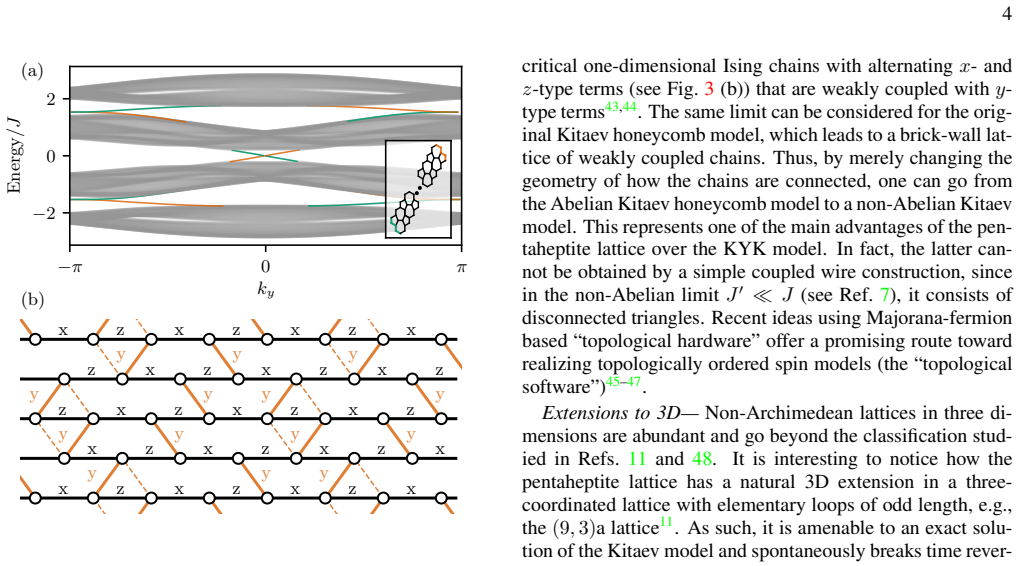
The load-bearing object is the set of conserved plaquette operators $W_{\rm pen}$ and $W_{\rm hep}$, products of bond operators $K_{ij}=\sigma_i^\alpha\sigma_j^\alpha$ around each pentagon and heptagon. These commute with the Hamiltonian and with each other, labelling flux sectors. Their odd length is what matters: time reversal conjugates the product, so the eigenvalues are $\pm i$ and time reversal flips the flux sector, meaning the choice of a sector spontaneously breaks the symmetry. Kitaev's Majorana representation then maps each sector to free Majorana fermions, and the Chern number of the filled band determines the anyon type: $|C|=1$ gives the chiral Ising non-Abelian phase. A coupled-wire limit ($J_z=J_x\gg J_y$) shows the phase can be viewed as weakly coupled critical Ising chains, explaining the transition from Abelian to non-Abelian behavior by a change in chain geometry.
What would settle it
A numerical or analytical calculation that finds, in the thermodynamic limit, a vortex configuration with lower energy than the vortex-free sector in phase $B$ would overturn the ground-state identification; for instance, a negative energy cost for separating a vortex pair at large distance would falsify it.
Extended reading notes
Core claim
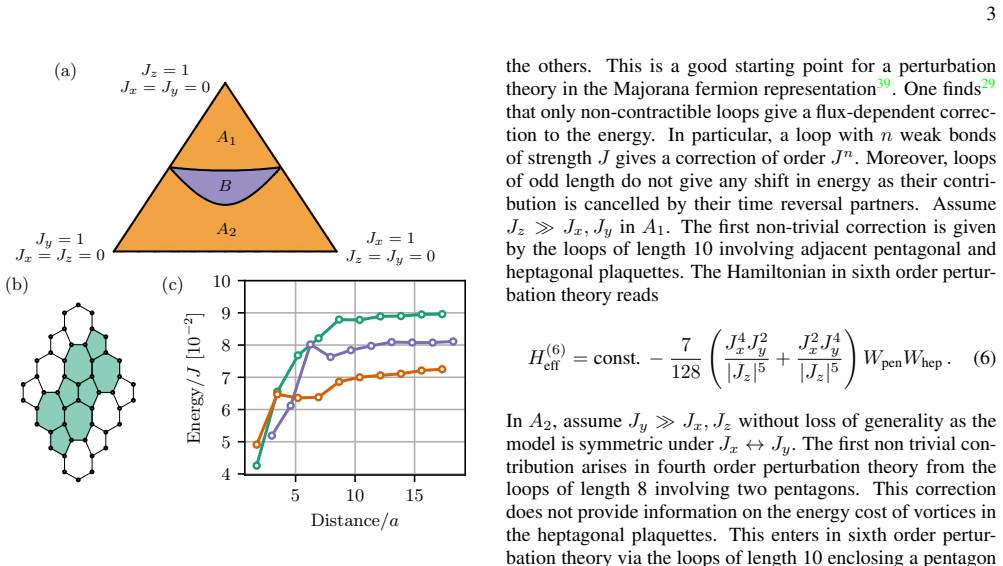
The central discovery is that the Kitaev model on the pentaheptite lattice admits a complete exact solution in every flux sector, and that its vortex-free ground state realizes Ising-type non-Abelian topological order with Chern number $|C|=1$. The odd-length loops make the plaquette eigenvalues $\pm i$ rather than $\pm 1$; the two flux configurations with all pentagons and heptagons in opposite imaginary states are degenerate and time-reversal partners. The phase diagram contains two Abelian $Z_2$ phases and the non-Abelian chiral phase $B$, separated by first-order transitions on the curves $J_z^2 = J_x^2 \pm \sqrt{2J_xJ_y + J_y^2}$. In phase $B$, vortices carry unpaired Majorana zero modes and the topological degeneracy for $2n$ vortices is $2^{n+1}$, matching Ising field theory.
Load-bearing premise
The claim rests on the conjecture that the vortex-free flux sector is the true ground state, which is supported by finite-size numerics and perturbation theory but not rigorously proven.
Editorial extensions
If this is right
- The pentaheptite Kitaev model is exactly solvable in every flux sector, giving a zero-field, spontaneous-time-reversal-breaking setting for Ising anyons without an external magnetic field.
- The phase diagram has three gapped phases, two Abelian $Z_2$ spin liquids and one non-Abelian chiral phase with Chern number $|C|=1$ and a chiral Majorana edge mode.
- Under sufficient uniaxial strain, $\alpha$-RuCl$_3$ may adopt the pentaheptite structure, suggesting a possible material platform for the chiral spin liquid.
- The same odd-loop mechanism extends to the three-coordinated $(9,3)a$ lattice in three dimensions, where the Kitaev model would also break time-reversal symmetry spontaneously.
Reading between the lines
- If the vortex-free ground-state conjecture survives larger-scale numerics, one predictable observable is a half-quantized thermal Hall conductance in phase $B$, a direct signature of the chiral Majorana edge.
- The coupled-wire perspective suggests that interpolating between honeycomb and pentaheptite geometries by a controlled density of Stone-Wales defects could tune a single material between Abelian and non-Abelian Kitaev physics.
- The argument is structural, so the prediction should transfer to any three-coordinated lattice whose elementary loops are all odd-length; checking one additional lattice of that type would test the mechanism without relying on the specific pentaheptite geometry.
Signed reviews
Editorial analysis
A structured set of objections, weighed in public.
Referee Report
Summary. The paper studies the Kitaev model on the pentaheptite lattice, a non-Archimedean lattice obtained by proliferating Stone-Wales defects in the honeycomb lattice. The authors identify conserved plaquette operators on the odd-length pentagons and heptagons, map the model to free Majorana fermions in each flux sector via the standard Kitaev construction, and analyze the phase diagram of the vortex-free sector. They find three gapped phases: two Abelian Z2 spin liquids (A1, A2) and a non-Abelian chiral spin liquid (B) with |C|=1, accompanied by spontaneous time-reversal symmetry breaking due to the imaginary plaquette eigenvalues. The identification of the vortex-free sector as the ground state is stated as a conjecture, supported by finite-size numerics and perturbation theory. The authors also present DFT calculations indicating that strained α-RuCl3 may adopt a pentaheptite structure, while explicitly leaving open whether Kitaev exchange remains relevant.
Significance. If the vortex-free sector is indeed the ground state, the paper provides a new exactly solvable model of a non-Abelian chiral spin liquid on a simple lattice without an external magnetic field, with spontaneous TRS breaking originating from odd-length loops. The analytical perturbation theory, Chern number computation, and edge-mode spectra are mutually consistent and support the Ising topological order assignment. The coupled-wire limit offers a transparent connection between Abelian and non-Abelian Kitaev phases. The paper is careful in flagging the flux-sector conjecture and in presenting extensive numerical evidence for vortex-pair energetics. The DFT result is appropriately qualified as a potential realization only. These strengths make the model worth further study; however, the missing energy comparison with the translation-invariant π-flux sector described in the Supplement is a serious gap.
major comments (1)
- [Identifying the ground state flux sector (Main Text) and 'Majorana Fermi surface' (Supplemental Material)] The central claim of a gapped non-Abelian chiral spin liquid requires the vortex-free flux sector to be the ground state. The authors state this as a conjecture and support it with finite-size enumeration, vortex-pair energies, and perturbation theory. However, the Supplemental Material describes a translation-invariant flux configuration with π flux in one heptagon and one pentagon per unit cell whose single-particle Majorana spectrum is gapless (Fig. S7(b)). The energy of this sector is never computed or compared with the vortex-free sector. Because this is a uniform periodic flux pattern, the L=10 vortex-cluster studies (Fig. 2(c) and Fig. S10) do not exclude it. If this sector is lower in energy, the physical ground state would be a gapless spin liquid rather than the claimed Ising non-Abelian phase. The authors should either compute the energy of this π-flux sector (e.g., on L=10 and extrapolate to the thermodynamic limit) and show that it is higher, or restrict the claim of non-Abelian order to the vortex-free sector as a metastable state.
minor comments (4)
- [Phase diagram (Main Text)] Typo in the sentence 'the gap in the Majorna single particle spectrum closes' – 'Majorna' should be 'Majorana'.
- [Supplemental Material, Eq. (S13)] Eq. (S13) writes the sixth-order contribution in the A2 phase as -7 J_x^2 J_y^4/(128 J_z^5) W5W7, but the denominator should be J_y^5 and the numerator J_z^4 to be consistent with the A2 limit and with Eq. (7) of the Main Text; as written, the expression does not match the integrand.
- [Supplemental Material, 'Vortex energies'] Typo: 'wether' should be 'whether'.
- [DFT calculations of α-RuCl3 (Supplemental Material)] The authors explicitly state that the determination of the Kitaev exchange in the pentaheptite structure 'goes beyond the scope of this work'; this is an honest limitation, but it would help to emphasize in the main text that the DFT result alone does not establish a material realization of the spin liquid.
Circularity Check
No circularity: the Kitaev-to-Majorana derivation and Chern-number analysis are self-contained; the ground-state flux-sector choice is an explicit conjecture backed by direct numerics, not a fitted input.
full rationale
The derivation chain is self-contained. The exact solvability follows from the standard Kitaev Majorana representation applied to the three-colorable bonds of pentaheptite; the conserved plaquette operators in Eq. (2) and the free-Majorana Hamiltonian in Eq. (3) are constructed directly from Eq. (1), with no target quantity inserted. The identification of the flux-free sector as the ground state is explicitly labeled a conjecture ('From our flux sector analysis, we conjecture that even for Eq. (1), the ground state is in the flux free sector') and is supported by L=2 full flux enumeration, L=10 vortex-cluster energy costs, and perturbation theory; it is not derived by assuming the Ising non-Abelian outcome. The Chern number |C|=1, the edge spectrum, and the topological degeneracies are independent computations, and the non-Abelian statistics are inferred from Kitaev's sixteen-fold way, an external result. The Supplement's 'Majorana Fermi surface' section (Fig. S7(b)) notes a translation-invariant pi-flux configuration whose Majorana spectrum is gapless and whose many-body energy is not computed; this is a genuine completeness gap in the ground-state conjecture, but it is not a circular reduction, since the conjecture is not assumed in that sector's construction. Self-citations (Refs. 13-15, 43-44, and related) occur in background or heuristic contexts and do not carry the central derivation. No fitted parameter is renamed as a prediction.
Assumptions & free parameters
assumptions (4)
- ad hoc to paper The ground state lies in the flux-free sector (W_hep = +i, W_pen = -i).
- standard math The Kitaev exact solution via Majorana fermions is valid for the pentaheptite lattice because bonds are three-colorable.
- standard math The physical subspace projection (even fermion parity per site) correctly reproduces the spin model's spectrum.
- domain assumption DFT with GGA-PBE correctly determines the relative stability of honeycomb vs Stone-Wales structures in alpha-RuCl3 under strain.
Cite this review
Pith. "Pith review of Non-Abelian chiral spin liquid on a simple non-Archimedean lattice." pith.science (2026). https://pith.science/paper/T6BXQD2H
@misc{pith2026190805280,
  author       = {Pith},
  title        = {Pith review of: Non-Abelian chiral spin liquid on a simple non-Archimedean lattice},
  year         = {2026},
  howpublished = {\url{https://pith.science/paper/T6BXQD2H}},
  note         = {Machine review of arXiv:1908.05280}
}
abstract
We extend the scope of Kitaev spin liquids to non-Archimedean lattices. For the pentaheptite lattice, which results from the proliferation of Stone-Wales defects on the honeycomb lattice, we find an exactly solvable non-Abelian chiral spin liquid with spontaneous time reversal symmetry breaking due to lattice loops of odd length. Our findings call for potential extensions of exact results for Kitaev models which are based on reflection positivity, which is not fulfilled by the pentaheptite lattice. We further elaborate on potential realizations of our chiral spin liquid proposal in strained $\alpha$-RuCl$_3$.
Figures

Reference graph
Works this paper leans on
-
[1]
P. Fazekas and P. W. Anderson, The Philosophical Magazine: A Journal of Theoretical Experimental and Applied Physics 30 , 423 (1974)
work page 1974
-
[2]
P. W. Anderson, Science 235 , 1196 (1987)
1987
-
[3]
Kalmeyer and R
V. Kalmeyer and R. B. Laughlin, Phys. Rev. Lett. 59 , 2095 (1987)
1987
- [4]
- [5]
-
[6]
Kitaev, Annals of Physics 321 , 2 (2006)
A. Kitaev, Annals of Physics 321 , 2 (2006)
2006
- [7]
- [8]
Show all 50 references
-
[9]
Barkeshli, H.-C
M. Barkeshli, H.-C. Jiang, R. Thomale, and X.-L. Qi, Phys. Rev. Lett. 114 , 026401 (2015)
2015
-
[10]
Hermanns, K
M. Hermanns, K. O'Brien, and S. Trebst, Phys. Rev. Lett. 114 , 157202 (2015)
2015
-
[11]
O'Brien, M
K. O'Brien, M. Hermanns, and S. Trebst, Phys. Rev. B 93 , 085101 (2016)
2016
- [12]
-
[13]
Greiter and R
M. Greiter and R. Thomale, Phys. Rev. Lett. 102 , 207203 (2009)
2009
-
[14]
Greiter, D
M. Greiter, D. F. Schroeter, and R. Thomale, Phys. Rev. B 89 , 165125 (2014)
2014
-
[15]
T. Meng, T. Neupert, M. Greiter, and R. Thomale, Phys. Rev. B 91 , 2411068(R) (2015)
2015
-
[16]
Lecheminant and A
P. Lecheminant and A. M. Tsvelik, Phys. Rev. B 95 , 140406(R) (2017)
2017
-
[17]
J.-Y. Chen, L. Vanderstraeten, S. Capponi, and D. Poilblanc, Phys. Rev. B 98 , 184409 (2018)
2018
-
[18]
Scharfenberger, R
B. Scharfenberger, R. Thomale, and M. Greiter, Phys. Rev. B 84 , 140404(R) (2011)
2011
-
[19]
O. I. Motrunich, Phys. Rev. B 72 , 045105 (2005)
2005
-
[20]
Knolle, D
J. Knolle, D. L. Kovrizhin, J. T. Chalker, and R. Moessner, Phys. Rev. Lett. 112 , 207203 (2014)
2014
-
[21]
Jackeli and G
G. Jackeli and G. Khaliullin, Phys. Rev. Lett. 102 , 017205 (2009)
2009
-
[22]
Singh, S
Y. Singh, S. Manni, J. Reuther, T. Berlijn, R. Thomale, W. Ku, S. Trebst, and P. Gegenwart, Phys. Rev. Lett. 108 , 127203 (2012)
2012
-
[23]
K. W. Plumb, J. P. Clancy, L. J. Sandilands, V. V. Shankar, Y. F. Hu, K. S. Burch, H.-Y. Kee, and Y.-J. Kim, Phys. Rev. B 90 , 041112(R) (2014)
2014
-
[24]
Hermanns, I
M. Hermanns, I. Kimchi, and J. Knolle, Annu. Rev. Condens. Matter Phys. 9 , 17 (2018)
2018
- [25]
-
[26]
E. H. Lieb, Phys. Rev. Lett. 62 , 1201 (1989)
1989
-
[27]
V. H. Crespi, L. X. Benedict, M. L. Cohen, and S. G. Louie, Phys. Rev. B 53 , R13303 (1996)
1996
-
[28]
M. Deza, P. W. Fowler, M. Shtogrin, and K. Vietze, Journal of Chemical Information and Computer Sciences 40 , 1325 (2000)
2000
-
[29]
see Supplemental Material at [URL will be inserted by the publisher] for details on the DFT calculations and detailed analysis of the model phases
-
[30]
Kresse and J
G. Kresse and J. Hafner, Phys. Rev. B 48 , 13115 (1993)
1993
-
[31]
Kresse and J
G. Kresse and J. Furthm \"u ller, Computational Materials Science 6 , 15 (1996)
1996
-
[32]
P. E. Bl\"ochl, Phys. Rev. B 50 , 17953 (1994)
1994
-
[33]
Kresse and D
G. Kresse and D. Joubert, Phys. Rev. B 59 , 1758 (1999)
1999
-
[34]
J. P. Perdew, K. Burke, and M. Ernzerhof, Phys. Rev. Lett. 77 , 3865 (1996)
1996
-
[35]
Biswas , Y
S. Biswas , Y. Li , S. M. Winter , J. Knolle , and R. Valenti , Phys. Rev. Lett. 123 , 237201 (2019)
2019
-
[36]
F. L. Pedrocchi, S. Chesi, and D. Loss, Phys. Rev. B 84 , 1 (2011)
2011
-
[37]
E. H. Lieb, Phys. Rev. Lett. 73 , 2158 (1994)
1994
-
[38]
Chesi, A
S. Chesi, A. Jaffe, D. Loss, and F. L. Pedrocchi, J. Math. Phys. 54 , (2013)
2013
-
[39]
Petrova, P
O. Petrova, P. Mellado, and O. Tchernyshyov, Phys. Rev. B 90 , 134404 (2014)
2014
-
[40]
Fukui, Y
T. Fukui, Y. Hatsugai, and H. Suzuki, J. Phys. Soc. Jpn. 74 , 1674 (2005)
2005
-
[41]
Moore and N
G. Moore and N. Read, Nucl. Phys. B 360 , 362 (1991)
1991
-
[42]
D. A. Ivanov, Phys. Rev. Lett. 86 , 268 (2001)
2001
-
[43]
Huang, J.-H
P.-H. Huang, J.-H. Chen, P. R. S. Gomes, T. Neupert, C. Chamon, and C. Mudry, Phys. Rev. B 93 , 205123 (2016)
2016
-
[44]
Huang, J.-H
P.-H. Huang, J.-H. Chen, A. E. Feiguin, C. Chamon, and C. Mudry, Phys. Rev. B 95 , 144413 (2017)
2017
-
[45]
E. Sagi, H. Ebisu, Y. Tanaka, A. Stern, and Y. Oreg, Phys. Rev. B 99 , 075107 (2019)
2019
-
[46]
L. A. Landau, S. Plugge, E. Sela, A. Altland, S. M. Albrecht, and R. Egger, Phys. Rev. Lett. 116 , 050501 (2016)
2016
-
[47]
Plugge, L
S. Plugge, L. A. Landau, E. Sela, A. Altland, K. Flensberg, and R. Egger, Phys. Rev. B 94 , 174514 (2016)
2016
-
[48]
Wells, Three dimensional nets and polyhedra , Wiley monographs in crystallography (Wiley, 9780471021513, 1977)
A. Wells, Three dimensional nets and polyhedra , Wiley monographs in crystallography (Wiley, 9780471021513, 1977)
1977
-
[49]
D. J. J. Farnell, O. G\"otze, J. Richter, R. F. Bishop, and P. H. Y. Li, Phys. Rev. B 89 , 184407 (2014)
2014
-
[50]
" 'skip if FUNCTION emphasize duplicate empty pop
" write newline FUNCTION fin.entry add.period write newline FUNCTION not #0 #1 if FUNCTION and 'skip pop #0 if FUNCTION or pop #1 'skip if FUNCTION field.or.null duplicate empty pop "" 'skip if FUNCTION emphasize duplicate empty pop "" " " swap * " " * if FUNCTION embolden dup...
Reviewed August 14, 2026 · model on record in the stance chip above.
Discussion (0). Continue with ORCID to comment.