REVIEW 2 major objections 7 minor 29 references
Oblique Shock Breakout from a Uniform Density Medium
T0 review · 2 major / 7 minor · reviewed 2026-08-14 · deepseek-v4-flash
Pith's one-line read Oblique shock breakout from a surface is exactly solvable up to a critical angle.
desk verdict A genuinely new analytic solution for oblique shock breakout, with a correctable range error for γ=4/3 and an applications section that over-sells exactness without the promised numerical check. read the letter →
The pith
A machine-rendered reading of the paper's core claim, the machinery that carries it, and where it could break.
The reading
What carries the argument
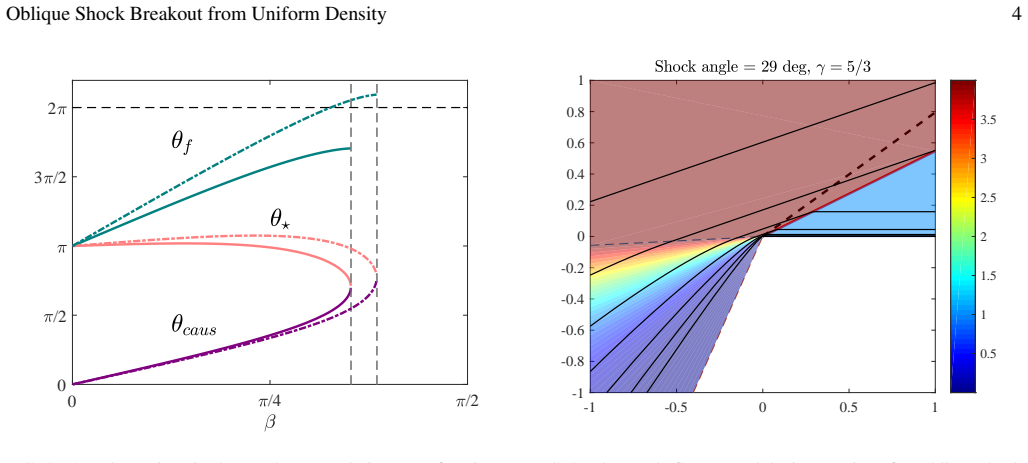
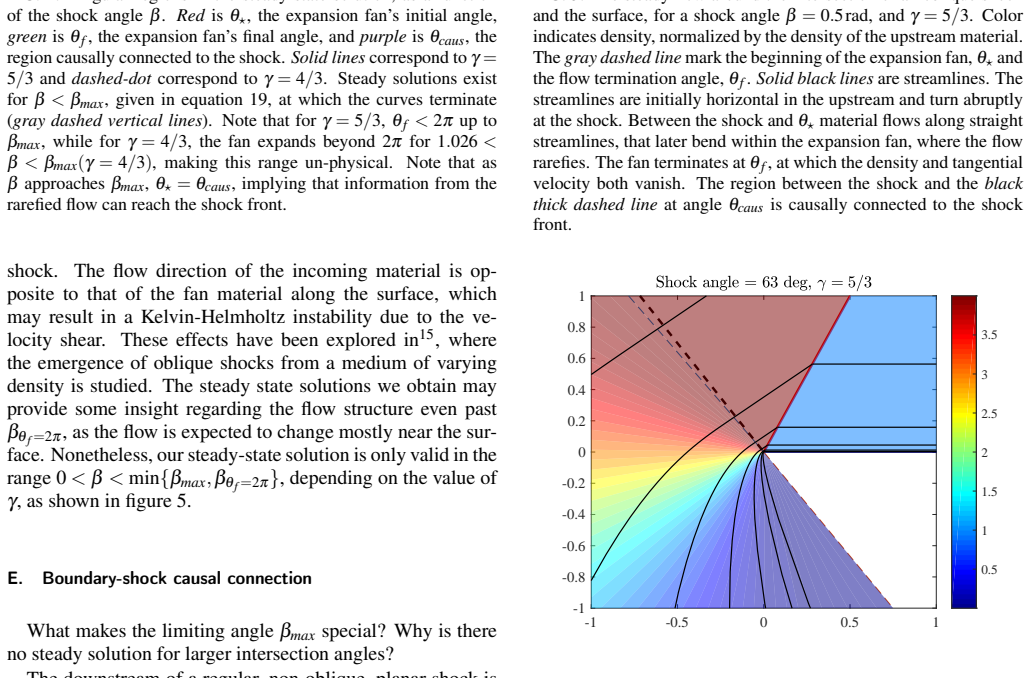
The key object is the Prandtl-Meyer expansion fan: a centered rarefaction wave in which the tangential velocity equals the local sound speed, $v_\theta=c_s$, so the governing equations reduce to $dv_\theta/d\theta=-(\gamma-1)/(\gamma+1)\,v_r$ and $dv_r/d\theta=v_\theta$. This fan carries the pressure drop to vacuum and sets the terminal flow angle $\theta_f$; matching it to the oblique-shock jump conditions yields all angles and the existence limit $\beta_{\max}$.
What would settle it
A numerical simulation of a spherical blast near a free surface in a uniform gas could measure the angle of the outermost ejecta envelope and the shock intersection angle at $t_{\max}$; if the envelope deviates from the ballistic trajectories of Eq. (24) for $\beta<\beta_{\max}$, the steady-state assumption fails. A laboratory underwater-explosion test measuring the ejecta spray angle versus $\beta$ would provide a direct experimental check.
Extended reading notes
Core claim
The central claim is that, in a frame moving with the shock-surface intersection point, a steady flow exists with all variables depending only on the polar angle, reducing the Euler equations to two coupled ordinary differential equations that can be solved in closed form. For shock angle $\beta$ below $\beta_{\max}=\arcsin\sqrt{(\gamma+1)/(2\gamma)}$, the solution is composed of uniform upstream flow, uniform shocked flow, and a Prandtl-Meyer expansion fan terminating at angle $\theta_f$ where the density vanishes and the velocity is purely radial. Applied to curved or time-dependent shocks, this local steady solution gives the exact lab-frame velocity of the fastest ejecta via $\mathbf{v}_{\rm terminal}=(\dot{R}/\sin\beta)[(1+\cos\theta_f)\hat{x}+\sin\theta_f\,\hat{y}]$, valid until the instantaneous intersection angle reaches $\beta_{\max}$.
Load-bearing premise
The applications assume that the local flow around a curved, time-dependent shock-surface intersection is exactly the planar steady-state solution, with no numerical validation or error estimate for curvature or transient effects.
Editorial extensions
If this is right
- For $\gamma=5/3$ steady oblique breakout solutions exist up to $63.4^\circ$, and for $\gamma=4/3$ up to $69.3^\circ$; beyond that, sound waves from the rarefied flow can catch up to the shock front.
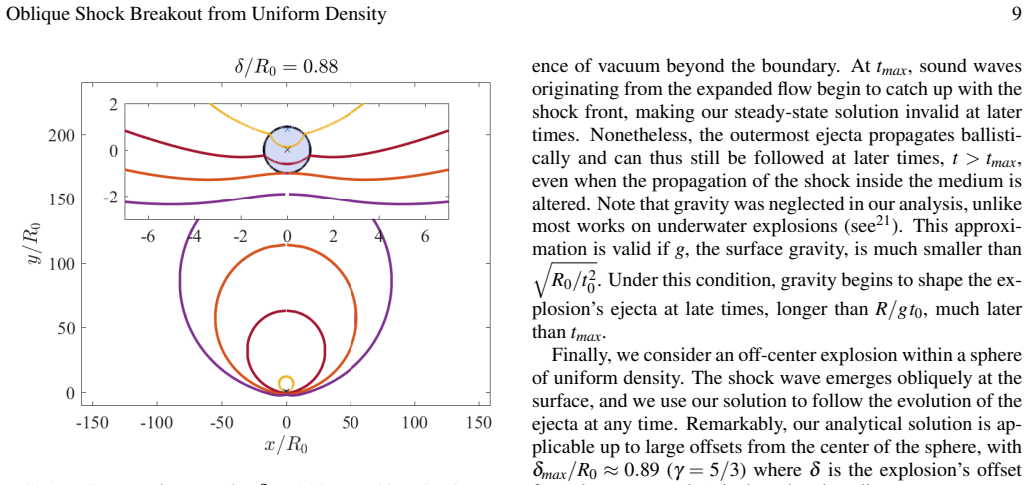
- The terminal ejecta velocity formula gives exact ballistic trajectories for the outermost ejecta from a spherical blast near a surface, valid until time $t_{\max}=t_0\,(2\gamma/(\gamma-1))^{5/4}$.
- The outermost ejecta envelope can be continued past $t_{\max}$ because the fastest material propagates ballistically, even though the shock inside the medium is then modified.
- For an off-center explosion in a uniform sphere, the solution remains applicable for offsets up to $\delta_{\max}/R_0=\sqrt{(\gamma+1)/(2\gamma)}$, which is about 0.89 for $\gamma=5/3$.
- In the limit $\beta\to0$, the solution smoothly reproduces the one-dimensional planar shock breakout result.
Reading between the lines
- The same steady-state fan structure should describe the local breakout region for relativistic oblique shocks, where the downstream is also supersonic; the critical angle would then become a function of the Lorentz factor rather than a constant.
- If the proposed criterion that the shock pins to the maximal angle holds, these steady solutions supply the boundary condition connecting the pre-breakout phase to the late-time self-similar cratering flow, which the paper does not explicitly construct.
- The predicted density contours behind the ejecta envelope could be tested directly in laboratory underwater-explosion experiments, where the free-surface angle and blast strength are controllable.
- For $\gamma<1.386$, the fan extends past $2\pi$ before $\beta_{\max}$ is reached; the paper notes this implies a precursor shock and shear layer, a regime that numerical simulations could cleanly verify or refute.
Signed reviews
Editorial analysis
A structured set of objections, weighed in public.
Referee Report
Summary. This paper studies the emergence of a planar, non-relativistic strong shock from a planar free surface at an oblique angle β in a uniform-density ideal gas with adiabatic index γ. In the frame moving with the shock-surface intersection point, the absence of a length scale makes the flow depend only on polar angle, reducing the Euler equations to ODEs. The authors construct an exact steady solution consisting of a uniform cold upstream, a uniform shocked slab, and a Prandtl-Meyer expansion fan that terminates at angle θf with cold radial flow at speed v0. They derive the limiting angle βmax=arcsin√((γ+1)/(2γ)) (Eq. 19), and note the additional restriction that for γ<1.386 the fan wraps past 2π before βmax, making the solution inadmissible above a lower angle (Sec. II.D). The steady solution is then applied locally to three problems: a bow shock breaking out of a plane, a strong point explosion near a surface, and an off-center explosion in a uniform sphere. For the latter two, the paper obtains formulas for the terminal ejecta velocity and envelope (Eqs. 24-25), up to a time tmax given by Eq. 26, and predicts features such as concavity of the ejecta envelope for large offsets.
Significance. The planar steady-state solution of Sec. II is a valuable analytic contribution. It is self-contained, parameter-free, and yields closed-form expressions for the flow structure, fan angles, and maximal obliquity. The derivation from the shock-jump conditions and Prandtl-Meyer theory is internally consistent (Eqs. 1-18), and the solution correctly reduces to the 1D breakout in the β→0 limit. If the local-planarity assumption for curved shocks is valid, the ejecta-envelope formulas are the first exact analytic description of oblique breakout ejecta and can be applied to supernova breakout, underwater explosions, and asteroid detonations. The paper also makes falsifiable predictions, such as the straight outer ejecta boundary for a bow shock and the concave envelope in Fig. 10. However, the strength of the applications is currently capped by unvalidated locality and causality assumptions, and by the γ=4/3 validity issue noted below.
major comments (2)
- [Abstract; Sec. II.D; Eq. (19); Fig. 5; Sec. III.C] The abstract states βmax=69.3° for γ=4/3, but Sec. II.D and Fig. 5 state that for γ<1.386 the steady solution exists only up to β_{θ_f=2π}<βmax because the expansion fan wraps past 2π; for γ=4/3 this occurs at β≈1.026 rad (58.8°). This internal contradiction also affects the γ=4/3 entry in Sec. III.C, where δmax/R0≈0.94 is derived from the inadmissible βmax. Please correct the abstract and all γ=4/3 applications to use min{βmax, β_{θ_f=2π}}, or explicitly justify why β>β_{θ_f=2π} is nevertheless considered admissible.
- [Sec. III.B, Eqs. (24)-(25) and (26); Sec. III.C] The claim that Eqs. (24)-(25) give the exact profile of the outermost breakout ejecta for curved, time-dependent shocks rests on two unvalidated assumptions: (i) the local flow near the shock-surface intersection is exactly the planar steady solution of Sec. II despite curvature and time dependence, and (ii) the Sedov-Taylor shock remains unchanged until tmax (Eq. 26) because no sound waves from the rarefied region reach it earlier. The only support offered for (ii) is the sentence "We addressed this question numerically, by investigating the 2D propagation of sound waves within the interior of a Sedov-Taylor explosion (not shown in this work)", which is an explicitly omitted calculation. These assumptions are load-bearing for the advertised exact envelope, so the authors should either supply the missing numerical test or provide a quantitative error estimate, or reframe the application claims as approximate.
minor comments (7)
- [Abstract] Typo: "degress" should be "degrees".
- [Sec. III.A] Typo: "vaccum" should be "vacuum".
- [Sec. II.E] Typo: "causallity" should be "causality".
- [Sec. IV] Typo: "a a set of" should be "a set of".
- [Sec. III.B] The sentence "An important difference between this work and Ref," has a missing citation number for the referenced works.
- [Sec. III.B] The assertion that sound waves passing through the origin arrive at the shock later than 3tmax is not derived; please provide a calculation or reference rather than relying on an unpublished numerical check.
- [Sec. II.D] The discussion of the fan wrapping mixes radians and degrees (e.g., "1.026 < β < βmax" in the figure caption); please use one unit convention consistently.
Circularity Check
No significant circularity: the planar steady-state solution is derived self-containedly from the flow equations, and the applications use external inputs (Sedov-Taylor solution, bow-shock shape) rather than importing the target result.
full rationale
The central derivation in Sec. II is self-contained. The steady-state flow equations (Eqs. 1-3) are obtained from the continuity and momentum equations under the stated self-similar ansatz; Eq. 6 follows algebraically, and the piecewise structure of the flow (uniform regions and Prandtl-Meyer fan) follows from solving those equations with the standard shock-jump boundary conditions. The critical angle beta_max (Eq. 19) is the solution of vp = csp from Eqs. (8)-(9), not a fitted or data-matching parameter. The expansion-fan angles theta_star and theta_f are determined by the boundary conditions and the ODE solution, and the terminal velocity formula in the applications (Eq. 24) is the transformation of that solution to the lab frame. No parameter is fitted to the quantity being predicted. The applications in Sec. III invoke the Sedov-Taylor solution as an external, standard input and assume, with an explicit timescale argument, that the local flow near the shock-surface intersection is the planar steady solution; that is an approximation whose accuracy is not circularly guaranteed. The only self-citations (e.g., Nakar & Sari 2010, 2012; Yalinewich & Sari 2016) are contextual or provide an external input (the parabolic bow-shock shape), not the derivation's load-bearing conclusion. The omitted numerical check regarding sound-wave propagation in the Sedov-Taylor interior is a missing validation, not a circular step; it does not make the derivation equivalent to its inputs. Accordingly, the circularity score is 0.
Assumptions & free parameters
assumptions (6)
- domain assumption The medium is a cold, inviscid, adiabatic ideal gas with polytropic equation of state P proportional to rho^gamma.
- domain assumption The flow in the steady-state frame depends only on the polar angle theta (no radial or time dependence).
- domain assumption The upstream material is cold and uniform, so strong-shock jump conditions apply at the shock.
- ad hoc to paper In the applications, the local flow near the shock-boundary intersection is exactly the planar steady-state solution even for curved shocks and curved surfaces.
- domain assumption The unbroken part of the shock continues to propagate as the Sedov-Taylor solution until t_max.
- domain assumption No steady solution exists for beta > beta_max; the flow becomes unsteady or subsonic.
Cite this review
Pith. "Pith review of Oblique Shock Breakout from a Uniform Density Medium." pith.science (2026). https://pith.science/paper/5MJI2BYV
@misc{pith2026190805301,
  author       = {Pith},
  title        = {Pith review of: Oblique Shock Breakout from a Uniform Density Medium},
  year         = {2026},
  howpublished = {\url{https://pith.science/paper/5MJI2BYV}},
  note         = {Machine review of arXiv:1908.05301}
}
abstract
The emergence of a shock from a medium with a free surface is an important process in various astrophysical phenomena. It generates the first light associated with explosions like supernovae and Gamma Ray Bursts. Most previous works considered planar or spherical geometries, where the shock front is parallel to the surface, and emerges simultaneously from all points. Here we study the hydrodynamics of an oblique planar shock breaking out from the planar surface of a uniform density ideal gas with adiabatic index $\gamma$. We obtain an analytic solution to the flow as a function of the angle between the plane of the shock and the surface $\beta$. We find steady state solutions (in a frame moving with the intersection point of the shock and the surface) up to some critical angle ($\beta_{max}=63.4$ degress for $\gamma=5/3$ and $\beta_{max}=69.3$ degrees for $\gamma=4/3$). We show how this analytic solution can be used in more complicated geometries where the shock is not planar, giving the exact profile of the outermost breakout ejecta. We apply our analytical results to a few realistic problems, such as underwater explosions, detonation under the surface of an asteroid, or off center detonations in a uniform sphere.
Figures

Figures from the paper (5 more)


Reference graph
Works this paper leans on
-
[1]
merlin.mbs aapmrev4-1.bst 2010-07-25 4.21a (PWD, AO, DPC) hacked
FUNCTION id.bst "merlin.mbs aapmrev4-1.bst 2010-07-25 4.21a (PWD, AO, DPC) hacked" ENTRY address archive archivePrefix author bookaddress booktitle chapter collaboration doi edition editor eid eprint howpublished institution isbn issn journal key language month note number organization pages primaryClass publisher school SLACcitation series title translat...
2010
-
[2]
merlin.mbs aipauth4-1.bst 2010-07-25 4.21a (PWD, AO, DPC) hacked
FUNCTION id.bst "merlin.mbs aipauth4-1.bst 2010-07-25 4.21a (PWD, AO, DPC) hacked" ENTRY address archive archivePrefix author bookaddress booktitle chapter collaboration doi edition editor eid eprint howpublished institution isbn issn journal key language month note number organization pages primaryClass publisher school SLACcitation series title translat...
2010
-
[3]
merlin.mbs aipnum4-1.bst 2010-07-25 4.21a (PWD, AO, DPC) hacked
FUNCTION id.bst "merlin.mbs aipnum4-1.bst 2010-07-25 4.21a (PWD, AO, DPC) hacked" ENTRY address archive archivePrefix author bookaddress booktitle chapter collaboration doi edition editor eid eprint howpublished institution isbn issn journal key language month note number organization pages primaryClass publisher school SLACcitation series title translati...
2010
-
[4]
merlin.mbs apsrev4-1.bst 2010-07-25 4.21a (PWD, AO, DPC) hacked
FUNCTION id.bst "merlin.mbs apsrev4-1.bst 2010-07-25 4.21a (PWD, AO, DPC) hacked" ENTRY address archive archivePrefix author bookaddress booktitle chapter collaboration doi edition editor eid eprint howpublished institution isbn issn journal key language month note number organization pages primaryClass publisher school SLACcitation series title translati...
2010
-
[5]
merlin.mbs apsrmp4-1.bst 2010-07-25 4.21a (PWD, AO, DPC) hacked
FUNCTION id.bst "merlin.mbs apsrmp4-1.bst 2010-07-25 4.21a (PWD, AO, DPC) hacked" ENTRY address archive archivePrefix author bookaddress booktitle chapter collaboration doi edition editor eid eprint howpublished institution isbn issn journal key language month note number organization pages primaryClass publisher school SLACcitation series title translati...
2010
-
[6]
author author S. A. \ Colgate ,\ title title Early Gamma Rays from Supernovae , \ 10.1086/152632 journal journal \ volume 187 ,\ pages 333--336 ( year 1974 ) NoStop
doi:10.1086/152632 1974
-
[7]
author author S. W. \ Falk ,\ title title Shock steepening and prompt thermal emission in supernovae , \ 10.1086/182810 journal journal \ volume 225 ,\ pages L133--L136 ( year 1978 ) NoStop
doi:10.1086/182810 1978
-
[8]
author author R. A. \ Chevalier ,\ title title The hydrodynamics of Type II supernovae , \ 10.1086/154557 journal journal \ volume 207 ,\ pages 872--887 ( year 1976 ) NoStop
doi:10.1086/154557 1976
Show all 29 references
-
[9]
author author C. D. \ Matzner \ and\ author C. F. \ McKee ,\ title title The Expulsion of Stellar Envelopes in Core-Collapse Supernovae , \ 10.1086/306571 journal journal \ volume 510 ,\ pages 379--403 ( year 1999 ) ,\ http://arxiv.org/abs/astro-ph/9807046 astro-ph/9807046 NoStop
1999 arXiv
-
[10]
author author A. M. \ Soderberg , author E. Berger , author K. L. \ Page , author P. Schady , author J. Parrent , author D. Pooley , author X.-Y. \ Wang , author E. O. \ Ofek , author A. Cucchiara , author A. Rau , author E. Waxman , author J. D. \ Simon , author D. C.-J. \ Bo...
-
[11]
author author P. A. \ Mazzali , author S. Valenti , author M. Della Valle , author G. Chincarini , author D. N. \ Sauer , author S. Benetti , author E. Pian , author T. Piran , author V. D'Elia , author N. Elias-Rosa , author R. Margutti , author F. Pasotti , author L. A. \ An...
-
[12]
Modjaz , author W
author author M. Modjaz , author W. Li , author N. Butler , author R. Chornock , author D. Perley , author S. Blondin , author J. S. \ Bloom , author A. V. \ Filippenko , author R. P. \ Kirshner , author D. Kocevski , author D. Poznanski , author M. Hicken , author R. J. \ Fol...
-
[13]
Nakar \ and\ author R
author author E. Nakar \ and\ author R. Sari ,\ title title Early Supernovae Light Curves Following the Shock Breakout , \ 10.1088/0004-637X/725/1/904 journal journal \ volume 725 ,\ pages 904--921 ( year 2010 ) ,\ http://arxiv.org/abs/1004.2496 arXiv:1004.2496 [astro-ph.HE] NoStop
2010 arXiv
-
[14]
author author R. A. \ Chevalier ,\ title title Self-similar solutions for the interaction of stellar ejecta with an external medium , \ 10.1086/160126 journal journal \ volume 258 ,\ pages 790--797 ( year 1982 ) NoStop
1982 doi
-
[15]
author author R. A. \ Chevalier \ and\ author C. Fransson ,\ title title Emission from circumstellar interaction in normal Type II supernovae , \ 10.1086/173557 journal journal \ volume 420 ,\ pages 268--285 ( year 1994 ) NoStop
1994 doi
-
[16]
Nakar \ and\ author R
author author E. Nakar \ and\ author R. Sari ,\ title title Relativistic Shock Breakouts - A Variety of Gamma-Ray Flares: From Low-luminosity Gamma-Ray Bursts to Type Ia Supernovae , \ 10.1088/0004-637X/747/2/88 journal journal \ volume 747 ,\ eid 88 ( year 2012 ) ,\ http://ar...
-
[17]
author author C. D. \ Matzner , author Y. Levin , \ and\ author S. Ro ,\ title title Oblique Shock Breakout in Supernovae and Gamma-Ray Bursts. I. Dynamics and Observational Implications , \ 10.1088/0004-637X/779/1/60 journal journal \ volume 779 ,\ eid 60 ( year 2013 ) ,\ htt...
-
[18]
u ber die str \
author author L. Prandtl ,\ title title Neue untersuchungen \"u ber die str \"o mende bewegung der gase und d \"a mpfe , \ @noop journal journal Physikalische Zeitschrift \ volume 8 ,\ pages 23--30 ( year 1907 ) NoStop
1907
-
[19]
U ber zweidimensionale bewegungsvorg \
author author T. Meyer ,\ @noop title \"U ber zweidimensionale bewegungsvorg \"a nge in einem gas, das mit \"u berschallgeschwindigkeit str \"o mt. diss. g \"o ttingen 1908; vdi-forsch , \ ( year 1908 ) NoStop
1908
-
[20]
Salbi , author C
author author P. Salbi , author C. D. \ Matzner , author S. Ro , \ and\ author Y. Levin ,\ title title Oblique Shock Breakout in Supernovae and Gamma-Ray Bursts. II. Numerical Solutions for Non-relativistic Pattern Speeds , \ 10.1088/0004-637X/790/1/71 journal journal \ volume...
-
[21]
Yalinewich \ and\ author R
author author A. Yalinewich \ and\ author R. Sari ,\ title title Asymptotic Steady-state Solution to a Bow Shock with an Infinite Mach Number , \ 10.3847/0004-637X/826/2/177 journal journal \ volume 826 ,\ eid 177 ( year 2016 ) ,\ http://arxiv.org/abs/1510.07594 arXiv:1510.075...
-
[22]
Taylor ,\ title title The Formation of a Blast Wave by a Very Intense Explosion
author author G. Taylor ,\ title title The Formation of a Blast Wave by a Very Intense Explosion. I. Theoretical Discussion , \ 10.1098/rspa.1950.0049 journal journal Proceedings of the Royal Society of London Series A \ volume 201 ,\ pages 159--174 ( year 1950 ) NoStop
1950
-
[23]
author author H. A. \ Bethe , author K. Fuchs , author J. O. \ Hirschfelder , author J. L. \ Magee , \ and\ author R. v. \ Neumann ,\ @noop title Blast wave , \ type Tech. Rep. \ ( institution LOS ALAMOS NATIONAL LAB NM ,\ year 1958 ) NoStop
1958
-
[24]
author author L. I. \ Sedov ,\ @noop title Similarity and Dimensional Methods in Mechanics, New York: Academic Press, 1959 \ ( year 1959 ) NoStop
1959
-
[25]
author author Y. B. \ Zel'dovich \ and\ author Y. P. \ Raizer ,\ @noop title New York: Academic Press, 1966/1967, edited by Hayes, W.D.; Probstein, Ronald F. \ ( year 1967 ) NoStop
1966
-
[26]
author author M. Holt ,\ title title Underwater explosions , \ 10.1146/annurev.fl.09.010177.001155 journal journal Annual Review of Fluid Mechanics \ volume 9 ,\ pages 187--214 ( year 1977 ) ,\ http://arxiv.org/abs/https://doi.org/10.1146/annurev.fl.09.010177.001155 https://do...
1977
-
[27]
FALADE \ and\ author M
author author A. FALADE \ and\ author M. HOLT ,\ title title Interaction of a strong blast wave with a free-surface , \ in\ @noop booktitle BULLETIN OF THE AMERICAN PHYSICAL SOCIETY ,\ Vol. volume 20 \ ( organization AMER INST PHYSICS CIRCULATION FULFILLMENT DIV, 500 SUNNYSIDE...
1975
-
[28]
FALADE \ and\ author M
author author A. FALADE \ and\ author M. HOLT ,\ title title Explosion-generated surface-waves , \ in\ @noop booktitle BULLETIN OF THE AMERICAN PHYSICAL SOCIETY ,\ Vol. volume 21 \ ( organization AMER INST PHYSICS CIRCULATION FULFILLMENT DIV, 500 SUNNYSIDE BLVD, WOODBURY … ,\ ...
1976
-
[29]
Zaslavskii ,\ title title On reflection of spherical shock wave in water from free surface , \ @noop journal journal Zh
author author B. Zaslavskii ,\ title title On reflection of spherical shock wave in water from free surface , \ @noop journal journal Zh. Prikl. Mekh. i Tekh. Fiz \ volume 4 ,\ pages 50--59 ( year 1963 ) NoStop
1963
Reviewed August 14, 2026 · model on record in the stance chip above.
Discussion (0). Continue with ORCID to comment.