REVIEW 4 major objections 5 minor 87 references
Metallicity has followed local gravitational potential of galaxies since z=3
T0 review · 4 major / 5 minor · reviewed 2026-08-14 · deepseek-v4-flash
Pith's one-line read This paper tests and confirms that gas metallicity tracks the local gravitational potential rather than total stellar mass, with the relation unchanged from z=0.16 to z=3.15.
desk verdict A careful, falsifiable test of the local-potential hypothesis that delivers a new 6σ gradient measurement, but the interpretation leans on an untested gravitational assumption. read the letter →
The pith
A machine-rendered reading of the paper's core claim, the machinery that carries it, and where it could break.
The reading
What carries the argument
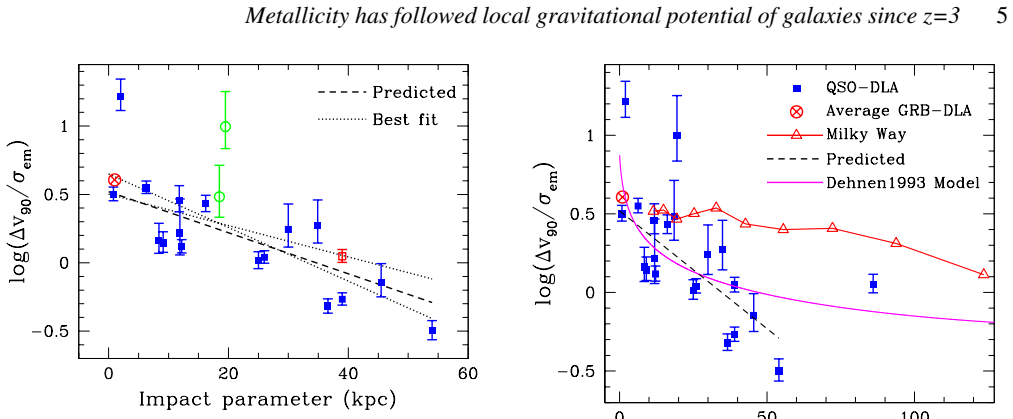
The load-bearing object is a cancellation identity: with metallicity gradient $\Gamma_{[M/H]}=-0.022$ dex kpc$^{-1}$ and the slope $\alpha_0=1.46$ of the $\Delta v_{90}$-metallicity relation, the hypothesis requires $\Gamma_{\Delta v_{90}}=\Gamma_{[M/H]}/\alpha_0\approx-0.015$ dex kpc$^{-1}$. The observable is $\log(\Delta v_{90}/\sigma_{\rm em})$ versus $b$, where $\Delta v_{90}$ is the velocity width containing 90 percent of the low-ion absorption optical depth and $\sigma_{\rm em}$ is the velocity dispersion of the host's emission lines; normalizing by $\sigma_{\rm em}$ removes the leading mass dependence. In the paper's equation 7 the two measured gradients cancel, leaving the central relation with a scatter that must arise from something other than impact parameter.
What would settle it
Measure spatially resolved rotation curves or stellar kinematics for the DLA/sub-DLA hosts and compare the absorption-line width at each impact parameter with the independently determined circular velocity at that radius; if $\Delta v_{90}$ does not scale with the local potential depth, the central claim would fail. A simpler check is to extend the sample beyond 60 kpc and see whether the $\log(\Delta v_{90}/\sigma_{\rm em})$ gradient and the metallicity gradient flatten together as the prediction requires.
Extended reading notes
Core claim
The paper's central claim is that both metallicity and the absorption velocity width $\Delta v_{90}$ follow the local gravitational potential in galaxy halos, and that this has been true since at least $z\approx3$. The quantitative result is a decline in the normalized width $\log(\Delta v_{90}/\sigma_{\rm em})$ with impact parameter $b$ at $\Gamma_{\Delta v_{90}}=-0.017\pm0.003$ dex kpc$^{-1}$, consistent with the value $-0.015$ dex kpc$^{-1}$ that makes the impact-parameter terms cancel in the $\Delta v_{90}$-metallicity relation. That cancellation means galaxies observed at random impact parameters are shifted along the same underlying relation rather than off it, so the observed mass-metallicity relation is not biased by unknown sightline radii. The paper finds no dependence of the slope on redshift, stellar mass, or $N({\rm H\,I})$, and interprets the lack of correlation between the absorber-host velocity offset and $\Delta v_{90}$ as evidence that DLA systems are ensembles of independent clouds spread through the halo rather than single bulk-moving clouds.
Load-bearing premise
The load-bearing premise is that the absorption width $\Delta v_{90}$ measures the depth of the local gravitational potential and the emission width $\sigma_{\rm em}$ measures the central potential; if those widths are instead set by turbulence, outflows, or line-of-sight geometry, the observed decline with radius would not prove that metallicity follows gravity.
Editorial extensions
If this is right
- The mass-metallicity relation can be read as a projection of a local potential-metallicity relation, so absorption-selected samples need no impact-parameter correction to recover the underlying relation.
- The relation has been stable from $z=0.16$ to $z=3.15$, meaning the local potential-metallicity link was already in place when the universe was roughly one-fifth of its present age.
- Because the impact-parameter terms cancel, the residual scatter in the $\Delta v_{90}$-metallicity relation is not caused by random sightline radii; it must have another physical origin.
- The velocity offset between absorption and emission being uncorrelated with $\Delta v_{90}$ favors the picture in which DLA complexes are ensembles of independent clouds spread along the pencil beam, with the total velocity width set by the halo potential.
- If the potential gradient flattens at large radius, the metallicity gradient must flatten the same way to keep the cancellation, predicting a coupled flattening beyond about 60 kpc.
Reading between the lines
- Inference: A direct test of causality would be to compare resolved metallicity maps of nearby galaxies with maps of the reconstructed gravitational potential from stellar kinematics; the local relation predicts that metallicity should track the potential at least as tightly as it tracks stellar mass surface density.
- Inference: If the two gradients are coupled, then expanding absorber samples beyond $b\approx60$ kpc should show both the velocity-width and metallicity gradients flattening together; a decoupling there would indicate that the inner-CGM cancellation is not universal.
- Inference: The paper's interpretation assumes the absorption width is a clean dynamical tracer, but comparing $\Delta v_{90}$ with an independent halo-mass estimate (for example from rotation or lensing) would show whether the width tracks the local potential or the total mass; if it tracks total mass, the local-potential reading needs revision.
Signed reviews
Editorial analysis
A structured set of objections, weighed in public.
Referee Report
Summary. The paper tests the hypothesis of Arabsalmani et al. (2015) that the mass-metallicity relation of DLA and GRB host galaxies is local, i.e., that metallicity follows local gravitational potential, by predicting that log(Δv90/σem) declines with impact parameter with slope -0.015 dex/kpc, derived as -Γ[M/H]/α0 with Γ[M/H] = -0.022 and α0 = 1.46. The authors compile 21 QSO-DLA/sub-DLA host galaxies with σem, b, Δv90, and N(HI), plus 9 GRB-DLAs, measure ΓΔv90 = -0.017 ± 0.003 dex/kpc (6σ) out to 54 kpc, and find agreement with the prediction. They also analyze the distribution of vrel and conclude that DLA absorbers are ensembles of sub-clouds distributed through the halo. The central interpretation is that both metallicity and Δv90 follow the local gravitational potential from z = 0.16 to z = 3.15.
Significance. If correct, this is a significant unification: it turns the absorption-line Δv90-[M/H] relation and the emission MZ relation into two projections of a local potential-metallicity relation, extending local MZ results to z ~ 3 and to impact parameters well beyond galaxy disks. The paper's strengths are the careful homogeneous reprocessing of heterogeneous archival data, the explicit falsifiable prediction, and the new direct measurement of ΓΔv90; the vrel analysis also provides independent information on absorber substructure. The claim, however, is conditional on the assumption that Δv90 and σem are purely gravitational, which is not independently established, and on the adopted slope α0; the quantitative agreement is therefore less secure than the abstract suggests.
major comments (4)
- [§4.2; supporting analysis in §3.3] The central claim that the measured slope of log(Δv90/σem) versus b represents a gravitational potential gradient rests on the assumption stated verbatim in §4.2: 'we here assume that σem and Δv90 are purely dictated by gravity.' The paper offers no independent test of this assumption. The vrel analysis in §3.3 favours a model of independent sub-clouds spread along the sightline, but an ensemble of clouds whose velocity dispersion is set by turbulence or outflow kinematics with a radial dependence would also produce a vrel distribution uncorrelated with the halo potential; it therefore does not validate the gravity-only interpretation. Without a discriminating test (for example, comparing low-ion and high-ion kinematics, checking for a correlation with star-formation or outflow indicators, or contrasting with simulations that include feedback), the 6σ slope is a kinematic correlation whose identification with the potential well is plausible but unproven. The title and abstract overstate the certainty of the physical interpretation.
- [§4.1, Eq. (6); §3.1] The predicted slope is not parameter-free: it is computed as ΓΔv90 = -Γ[M/H]/α0 using α0 = 1.46 and Γ[M/H] = -0.022 from previous fits (Møller et al. 2013; Christensen et al. 2014), and the present test sample overlaps the sample used to derive Γ[M/H]. The sensitivity to α0 is severe: with the alternative value α0 = 0.74 ± 0.21 (Neeleman et al. 2013), which the paper itself cites in §4.1, the required slope is -0.030, about 4.3σ away from the measured -0.017 ± 0.003. The agreement in §3.1 and §4.2 is therefore partly inherited from the adopted prior chains. I ask the authors to present the predicted slope as a function of α0 over the full published range, and to quantify how much of the 'confirmation' depends on that choice.
- [§4.2 and Fig. 2; §2.1] The claimed 6σ detection of ΓΔv90 rests on the combined sample that includes GRB-DLAs, all assigned the same median impact parameter b = 1.0 kpc, and on the average log(Δv90/σem) of nine GRB sightlines. The QSO-DLA-only fits shown in Fig. 2 give slopes of -0.011 and -0.020 with no quoted significance, so it is unclear whether the slope is detected at high significance without the GRB-DLA anchor. Because GRB-DLAs probe a different geometry along the sightline and are subject to different selection effects, the authors should report the slope, uncertainty, and significance for the QSO-DLA sample alone, and should discuss how excluding the b = 86 kpc object (which changes the low-redshift fit in Fig. 6) affects the claim that the slope extends to 40-60 kpc.
- [§3.4 and §2.1] The conclusion that there is no redshift evolution, and hence that the relation holds 'since z=3', is weakly supported. The sample has a degeneracy between redshift and N(HI): the 11 low-redshift hosts are mostly sub-DLAs and the 10 high-redshift hosts are mostly DLAs (§2.1). In Fig. 6 the low- and high-redshift slopes agree only after excluding the single b = 86 kpc object, and with 10 high-redshift objects the test has low power. 'No evidence for redshift dependence' is a defensible statement, but the abstract's 'since z = 3' should be softened to 'over the sampled redshift range' unless a more powerful joint fit in b, z, and N(HI) is added.
minor comments (5)
- [§4.2] The text refers to 'fit a line to the data points of log(Δv90/σem) vs. b in Fig. 3', but the linear fit is shown in Fig. 2; Fig. 3 shows projected profiles. The cross-reference should be corrected.
- [Fig. 3 caption] The caption says 'Predicted slope and average GRB-DLA are included as in Fig. 1'; it should refer to Fig. 2.
- [Fig. B1 caption] The sentence 'In Fig. B1(a) vi plot the standard Δv90-[M/H] relation' contains a typo: 'vi' should be 'we'.
- [Abstract] The phrase 'steep log scale slope of -0.015 dex/kpc' is awkward and could be rephrased as a 'logarithmic slope of log(Δv90/σem) with impact parameter of -0.015 dex/kpc'.
- [Table 1] Several vrel values are listed without errors (e.g., 0152-2001, 1436-0051A, 1228-1139); a note on how these are treated in the Fig. 5 analysis would improve reproducibility.
Circularity Check
Self-cited calibration sets the predicted slope; independent direct fit gives partial support
-
self citation load bearing
[Section 3.1 and Section 4.1 (Equations 5–7)]
"The metallicity gradient for DLA galaxies has been reported as Γ = −0.022±0.004 dex kpc−1 (Christensen et al. 2014) and Γ = −0.022 ± 0.001 dex kpc−1 (Rhodin et al. 2018), and the gradient of [M/H] vs log(Δv90) is 1.46 (Ledoux et al. 2006; Møller et al. 2013). In order to cancel each other out the gradient of log(Δv90) should be −0.022/1.46 = −0.015 dex kpc−1."
The predicted slope is the exact cancellation condition α0ΓΔv90 + Γ[M/H] = 0 defining the hypothesis (Eq. 5), and both inputs are self-cited fits (Christensen et al. 2014; Rhodin et al. 2018; Møller et al. 2013) from samples overlapping the present one (Sec. 4.2). Sec. 4.1 notes α0 ranges from 0.74 to 1.55 and adopts 1.46 'for internal consistency' with those prior papers. Hence the agreement in Eq. 7 is largely a consistency check of the authors' own calibration; the genuinely independent part is only the new direct fit of ΓΔv90.
full rationale
The paper's central quantitative test — the direct fit of the slope of log(Δv90/σem) versus impact parameter (Sec. 4.2, Fig. 8) — is a real new measurement and yields ΓΔv90 = −0.017 ± 0.003, consistent with the value needed for cancellation. If that were all, the derivation would be essentially non-circular. However, the numerical 'prediction' of −0.015 is not derived from an independent potential model; it is obtained by inserting the authors' own previously published Γ[M/H] = −0.022 (Christensen et al. 2014; Rhodin et al. 2018) and α0 = 1.46 (Møller et al. 2013) into the cancellation condition of Eq. 5. The paper explicitly acknowledges the current DLA sample has large overlap with the Christensen et al. (2014) sample, and it adopts α0 = 1.46 from a method-dependent range (0.74–1.55) purely for internal consistency with those prior papers. Thus the claimed agreement between predicted and measured slopes is partly a self-consistency of the authors' calibration, although the direct ΓΔv90 measurement gives the central claim some independent content. The further identification of the kinematic gradient with a gravitational potential gradient rests on the stated assumption that σem and Δv90 are 'purely dictated by gravity' (Sec. 4.2); that assumption is physically plausible but not independently demonstrated, and non-gravitational radial kinematics could in principle mimic the signal. On balance this is moderate self-citation with independent support, not a wholly circular derivation.
Assumptions & free parameters
free parameters (5)
- α0 (slope of Δv90-[M/H] relation) =
1.46
- Γ[M/H] (radial metallicity gradient) =
-0.022 dex/kpc
- GRB-DLA median impact parameter =
1.0 kpc
- ze(z) redshift evolution slope =
0.35 z (flattened above z=2.62)
- β intercept =
-3.33
assumptions (4)
- domain assumption Δv90 of the absorbing complex traces the depth of the local gravitational potential at the impact parameter.
- domain assumption σ_em of the integrated emission lines represents the central velocity dispersion and is purely gravitational.
- domain assumption The metallicity gradient Γ[M/H] is constant with radius, redshift, and mass across the inner CGM.
- domain assumption The redshift evolution of the Δv90-[M/H] relation (ze(z)) from Møller et al. (2013) is correct.
Cite this review
Pith. "Pith review of Metallicity has followed local gravitational potential of galaxies since z=3." pith.science (2026). https://pith.science/paper/VPMUJFYE
@misc{pith2026190805362,
  author       = {Pith},
  title        = {Pith review of: Metallicity has followed local gravitational potential of galaxies since z=3},
  year         = {2026},
  howpublished = {\url{https://pith.science/paper/VPMUJFYE}},
  note         = {Machine review of arXiv:1908.05362}
}
read the original abstract
The MZ relation between stellar mass (M*) and metallicity (Z) of nearby galaxies has been described as both a global and local property, i.e. valid also on sub-galaxy scales. Here we show that Z has remained a local property, following the gravitational potential, since z=3. In absorption the MZ relation has been well studied, and was in place already at z=5.1. A recent absorption study of GRB galaxies revealed a close match to Damped Ly{\alpha} (DLA) galaxies, surprising due to their vastly different impact parameters and leading the authors to suggest that local metallicity follows the local gravitational potential. In this paper we formulate an observational test of this hypothesis. The test, in essence, forms a prediction that the velocity dispersion of the absorbing gas in galaxy halos, normalized by the central velocity dispersion, must follow a steep log scale slope of -0.015 dex/kpc as a function of impact parameter out to at least 20-30 kpc. We then compile an archival data and literature based sample of galaxies seen in both emission and absorption suitable for the test, and find that current data confirm the hypothesis out to 40-60 kpc. In addition we show that the distribution of the velocity offsets between z em and z abs favours a model where DLA systems are composed of individual sub-clouds distributed along the entire path through the halo, and disfavours a model where they are one single cloud with a bulk motion and internal sub-structure.
Figures


Figures from the paper (2 more)


Reference graph
Works this paper leans on
-
[1]
, " * write output.state after.block = add.period write newline
ENTRY address author booktitle chapter edition editor howpublished institution journal key month note number organization pages publisher school series title type volume year label extra.label sort.label short.list INTEGERS output.state before.all mid.sentence after.sentence after.block FUNCTION init.state.consts #0 'before.all := #1 'mid.sentence := #2 '...
-
[2]
write newline
" write newline "" before.all 'output.state := FUNCTION n.dashify 't := "" t empty not t #1 #1 substring "-" = t #1 #2 substring "--" = not "--" * t #2 global.max substring 't := t #1 #1 substring "-" = "-" * t #2 global.max substring 't := while if t #1 #1 substring * t #2 global.max substring 't := if while FUNCTION word.in bbl.in " " * FUNCTION format....
-
[3]
Arabsalmani , M., M ller , P., Fynbo , J. P. U., Christensen , L., Freudling , W., Savaglio , S., & Zafar , T., 2015, , 446, 990
2015
-
[4]
A., et al
Arabsalmani , M., M ller , P., Perley , D. A., et al. , 2018, , 473, 3312
2018
-
[5]
J., & Scott , P., 2009, , 47, 481
Asplund , M., Grevesse , N., Sauval , A. J., & Scott , P., 2009, , 47, 481
2009
-
[6]
, 2018, , 478, 3120
Augustin , R., P \'e roux , C., M ller , P., et al. , 2018, , 478, 3120
2018
-
[7]
, 2005, , 364, 433
Battaglia , G., Helmi , A., Morrison , H., et al. , 2005, , 364, 433
2005
-
[8]
Belfiore , F., Maiolino , R., Tremonti , C., et al. , 2017, , 469, 151
work page 2017
Show all 87 references
-
[9]
Berg , T. A. M., Ellison , S. L., Prochaska , J. X., Venn , K. A., & Dessauges-Zavadsky , M., 2015, , 452, 4326
2015
-
[10]
Berg , T. A. M., Ellison , S. L., S \'a nchez-Ram \' rez , R., et al. , 2016, , 463, 3021
2016
-
[11]
Bird , S., Haehnelt , M., Neeleman , M., Genel , S., Vogelsberger , M., & Hernquist , L., 2015, , 447, 1834
2015
-
[12]
Bolzonella , M., Miralles , J.-M., & Pell \'o , R., 2000, , 363, 476
2000
-
[13]
T., Kacprzak , G
Bouch \'e , N., Murphy , M. T., Kacprzak , G. G., P \'e roux , C., Contini , T., Martin , C. L., & Dessauges-Zavadsky , M., 2013, Science, 341, 50
2013
-
[14]
C., & Rauch , M., 2005, , 620, 703
Chen , H.-W., Kennicutt , Jr., R. C., & Rauch , M., 2005, , 620, 703
2005
-
[15]
& Hjorth , J., 2017, , 470, 2599
Christensen , L. & Hjorth , J., 2017, , 470, 2599
2017
-
[16]
Christensen , L., M ller , P., Fynbo , J. P. U., & Zafar , T., 2014, MNRAS, 445, 225
2014
-
[17]
Christensen , L., M ller , P., Rhodin , N. H. P., Heintz , K. E., & Fynbo , J. P. U., 2019, submitted
2019
-
[18]
E., S \'a nchez , S
Christensen , L., Schulte-Ladbeck , R. E., S \'a nchez , S. F., Becker , T., Jahnke , K., Kelz , A., Roth , M. M., & Wisotzki , L., 2005, , 429, 477
2005
-
[19]
M., S \'a nchez , S
Christensen , L., Wisotzki , L., Roth , M. M., S \'a nchez , S. F., Kelz , A., & Jahnke , K., 2007, , 468, 587
2007
-
[20]
R., Kulkarni , V
Chun , M. R., Kulkarni , V. P., Gharanfoli , S., & Takamiya , M., 2010, AJ, 139, 296
2010
-
[21]
B., 2016, , 596, A97
De Cia , A., Ledoux , C., Mattsson , L., Petitjean , P., Srianand , R., Gavignaud , I., & Jenkins , E. B., 2016, , 596, A97
2016
-
[22]
Dehnen , W., 1993, , 265, 250
1993
-
[23]
S., Kurtz , M
Demleitner , M., Accomazzi , A., Eichhorn , G., Grant , C. S., Kurtz , M. J., & Murray , S. S., 2001, Astronomical Society of the Pacific Conference Series, 238, 321
2001
-
[24]
Fynbo , J. P. U., Geier , S. J., Christensen , L., et al. , 2013, MNRAS, 436, 361
2013
-
[25]
Fynbo , J. P. U., Laursen , P., Ledoux , C., et al. , 2010, , 408, 2128
2010
-
[26]
Fynbo , J. P. U., Ledoux , C., Noterdaeme , P., et al. , 2011, , 413, 2481
2011
-
[27]
Hernquist , L., 1990, , 356, 359
1990
-
[28]
Hewett , P. C. & Wild , V., 2007, MNRAS, 379, 738
2007
-
[29]
Jaffe , W., 1983, , 202, 995
1983
-
[30]
X., Smette , A., et al
Kanekar , N., Prochaska , J. X., Smette , A., et al. , 2014, , 438, 2131
2014
-
[31]
A., Smail , I., Oteo , I., Biggs , A
Klitsch , A., P \'e roux , C., Zwaan , M. A., Smail , I., Oteo , I., Biggs , A. D., Popping , G., & Swinbank , A. M., 2018, , 475, 492
2018
-
[32]
M., Dunkley , J., et al
Komatsu , E., Smith , K. M., Dunkley , J., et al. , 2011, , 192, 18
2011
-
[33]
Astrophysics Source Code Library
Krogager , J.-K., 2018, VoigtFit: Absorption line fitting for Voigt profiles . Astrophysics Source Code Library
2018
-
[34]
Krogager , J.-K., Fynbo , J. P. U., Ledoux , C., et al. , 2013, MNRAS, 433, 3091
2013
-
[35]
Krogager , J.-K., M ller , P., Fynbo , J. P. U., & Noterdaeme , P., 2017, , 469, 2959
2017
-
[36]
P., Meiring , J., Som , D., P \'e roux , C., York , D
Kulkarni , V. P., Meiring , J., Som , D., P \'e roux , C., York , D. G., Khare , P., & Lauroesch , J. T., 2012, , 749, 176
2012
-
[37]
Lane , W., Smette , A., Briggs , F., Rao , S., Turnshek , D., & Meylan , G., 1998, , 116, 26
1998
-
[38]
M., 1997, , 321, 733
Le Brun , V., Bergeron , J., Boisse , P., & Deharveng , J. M., 1997, , 321, 733
1997
-
[39]
Ledoux , C., Petitjean , P., Fynbo , J. P. U., M ller , P., & Srianand , R., 2006, A&A, 457, 71
2006
-
[40]
X., 2002, , 385, 778
Lopez , S., Reimers , D., D'Odorico , S., & Prochaska , J. X., 2002, , 385, 778
2002
-
[41]
D., Levan , A
Lyman , J. D., Levan , A. J., Tanvir , N. R., et al. , 2017, , 467, 1795
2017
-
[42]
, 2008, , 488, 463
Maiolino , R., Nagao , T., Grazian , A., et al. , 2008, , 488, 463
2008
-
[43]
D., Kulkarni , V
Meiring , J. D., Kulkarni , V. P., Lauroesch , J. T., P \'e roux , C., Khare , P., & York , D. G., 2009 a , , 393, 1513
2009
-
[44]
D., Kulkarni , V
Meiring , J. D., Kulkarni , V. P., Lauroesch , J. T., P \'e roux , C., Khare , P., York , D. G., & Crotts , A. P. S., 2008, , 384, 1015
2008
-
[45]
D., Lauroesch , J
Meiring , J. D., Lauroesch , J. T., Kulkarni , V. P., P \'e roux , C., Khare , P., & York , D. G., 2009 b , , 397, 2037
2009
-
[46]
D., Lauroesch , J
Meiring , J. D., Lauroesch , J. T., Kulkarni , V. P., P \'e roux , C., Khare , P., York , D. G., & Crotts , A. P. S., 2007, , 376, 557
2007
-
[47]
A., et al
M ller , P., Christensen , L., Zwaan , M. A., et al. , 2018, , 474, 4039
2018
-
[48]
M ller , P., Fynbo , J. P. U., & Fall , S. M., 2004, , 422, L33
2004
-
[49]
M ller , P., Fynbo , J. P. U., Ledoux , C., & Nilsson , K. K., 2013, MNRAS, 430, 2680
2013
-
[50]
& Warren , S
M ller , P. & Warren , S. J., 1993, , 270, 43
1993
-
[51]
J., Fall , S
M ller , P., Warren , S. J., Fall , S. M., Fynbo , J. U., & Jakobsen , P., 2002, , 574, 51
2002
-
[52]
M., Heckman , T
Moran , S. M., Heckman , T. M., Kauffmann , G., et al. , 2012, , 745, 66
2012
-
[53]
X., Christensen , L., Dessauges-Zavadsky , M., Fynbo , J
Neeleman , M., Kanekar , N., Prochaska , J. X., Christensen , L., Dessauges-Zavadsky , M., Fynbo , J. P. U., M ller , P., & Zwaan , M. A., 2018, , 856, L12
2018
-
[54]
X., Zwaan , M
Neeleman , M., Prochaska , J. X., Zwaan , M. A., et al. , 2016, , 820, L39
2016
-
[55]
M., Prochaska , J
Neeleman , M., Wolfe , A. M., Prochaska , J. X., & Rafelski , M., 2013, ApJ, 769, 54
2013
-
[56]
, 2012, A&A, 540, 63
Noterdaeme , P., Laursen , P., Petitjean , P., et al. , 2012, A&A, 540, 63
2012
-
[57]
Noterdaeme , P., Petitjean , P., Ledoux , C., Srianand , R., & Ivanchik , A., 2008, , 491, 397
2008
-
[58]
P., & York , D
P \'e roux , C., Bouch \'e , N., Kulkarni , V. P., & York , D. G., 2013, , 436, 2650
2013
-
[59]
P., York , D
P \'e roux , C., Bouch \'e , N., Kulkarni , V. P., York , D. G., & Vladilo , G., 2011 a , , 410, 2237
2011
-
[60]
---, 2011 b , , 410, 2251
2011
-
[61]
D., Kulkarni , V
P \'e roux , C., Meiring , J. D., Kulkarni , V. P., Khare , P., Lauroesch , J. T., Vladilo , G., & York , D. G., 2008, , 386, 2209
2008
-
[62]
, 2016, , 457, 903
P \'e roux , C., Quiret , S., Rahmani , H., et al. , 2016, , 457, 903
2016
-
[63]
L., Steidel , C
Pettini , M., Ellison , S. L., Steidel , C. C., Shapley , A. E., & Bowen , D. V., 2000, ApJ, 532, 65
2000
-
[64]
Prochaska, J. X. & Wolfe, A. M., 1997, ApJ, 487, 73
1997
-
[65]
, 2018, , 480, 5046
Rahmani , H., P \'e roux , C., Schroetter , I., et al. , 2018, , 480, 5046
2018
-
[66]
A., et al
Rahmani , H., P \'e roux , C., Turnshek , D. A., et al. , 2016, , 463, 980
2016
-
[67]
M., Belfort-Mihalyi , M., Turnshek , D
Rao , S. M., Belfort-Mihalyi , M., Turnshek , D. A., Monier , E. M., Nestor , D. B., & Quider , A., 2011, , 416, 1215
2011
-
[68]
M., Turnshek , D
Rao , S. M., Turnshek , D. A., & Nestor , D. B., 2006, ApJ, 636, 610
2006
-
[69]
Rhodin , N. H. P., Christensen , L., M ller , P., Zafar , T., & Fynbo , J. P. U., 2018, ArXiv e-prints
2018
-
[70]
C., Newman , A
Rudie , G. C., Newman , A. B., & Murphy , M. T., 2017, , 843, 98
2017
-
[71]
F., Rosales-Ortega , F
S \'a nchez , S. F., Rosales-Ortega , F. F., Iglesias-P \'a ramo , J., et al. , 2014, , 563, A49
2014
-
[72]
F., Rosales-Ortega , F
S \'a nchez , S. F., Rosales-Ortega , F. F., Jungwiert , B., et al. , 2013, , 554, A58
2013
-
[73]
F., P \'e rez , I., et al
S \'a nchez-Menguiano , L., S \'a nchez , S. F., P \'e rez , I., et al. , 2018, , 609, A119
2018
-
[74]
, 2012, , 420, 627
Savaglio , S., Rau , A., Greiner , J., et al. , 2012, , 420, 627
2012
-
[75]
P., Meiring , J., York , D
Som , D., Kulkarni , V. P., Meiring , J., York , D. G., P \'e roux , C., Lauroesch , J. T., Aller , M. C., & Khare , P., 2015, , 806, 25
2015
-
[76]
Srianand , R., Hussain , T., Noterdaeme , P., Petitjean , P., Kr \"u hler , T., Japelj , J., P \^a ris , I., & Kashikawa , N., 2016, , 460, 634
2016
-
[77]
Srianand , R., Noterdaeme , P., Ledoux , C., & Petitjean , P., 2008, , 482, L39
2008
-
[78]
C., Pettini , M., & Hamilton , D., 1995, , 110, 2519
Steidel , C. C., Pettini , M., & Hamilton , D., 1995, , 110, 2519
1995
-
[79]
A., Johnson , S., York , D
Straka , L. A., Johnson , S., York , D. G., Bowen , D. V., Florian , M., Kulkarni , V. P., Lundgren , B., & P \'e roux , C., 2016, , 458, 3760
2016
-
[80]
A., Heckman , T
Tremonti , C. A., Heckman , T. M., Kauffmann , G., et al. , 2004, ApJ, 613, 898
2004
-
[81]
Warren , S. J. & M ller , P., 1996, , 311, 25
1996
-
[82]
J., M ller , P., Fall , S
Warren , S. J., M ller , P., Fall , S. M., & Jakobsen , P., 2001, , 326, 759
2001
-
[83]
J., Warren , S
Weatherley , S. J., Warren , S. J., M ller , P., Fall , S. M., Fynbo , J. U., & Croom , S. M., 2005, , 358, 985
2005
-
[84]
Wolfe , A. M. & Prochaska , J. X., 1998, , 494, L15
1998
-
[85]
M., Prochaska , J
Wolfe , A. M., Prochaska , J. X., Jorgenson , R. A., & Rafelski , M., 2008, , 681, 881
2008
-
[86]
, 2016, , 827, 74
Wuyts , E., Wisnioski , E., Fossati , M., et al. , 2016, , 827, 74
2016
-
[87]
Zafar , T., M ller , P., P \'e roux , C., Quiret , S., Fynbo , J. P. U., Ledoux , C., & Deharveng , J.-M., 2017, , 465, 1613
2017
Reviewed August 14, 2026 · model on record in the stance chip above.
Discussion (0). Continue with ORCID to comment.