REVIEW 5 major objections 5 minor 24 references
Secure Coded Cooperative Computation at the Heterogeneous Edge against Byzantine Attacks
T0 review · 5 major / 5 minor · reviewed 2026-08-14 · deepseek-v4-flash
Pith's one-line read SC3 combines homomorphic hash verification with fountain-coded offloading so Byzantine workers cannot silently corrupt edge matrix computations, and does so with much lower task completion delay than a heavy-check-only baseline.
desk verdict A genuinely useful mechanism, but the central verification theorem is missing a compatibility condition (q | ψ) and is false as stated; the fix is simple, but the current security claims do not hold. read the letter →
The pith
A machine-rendered reading of the paper's core claim, the machinery that carries it, and where it could break.
The reading
What carries the argument
The load-bearing object is the homomorphic hash $h(a)=\mathrm{mod}(g^{\mathrm{mod}(a,q)},r)$, with $q$ and $r$ primes such that $q$ divides $r-1$ and $g=b^{(r-1)/q}$; it satisfies $h(\sum_i c_i a_i)=\prod_i h(a_i)^{c_i}$, so a hash of a linear combination of results can be assembled from hashes of the inputs. The paper combines this with fountain-coded task offloading and a two-phase verification: the light-weight check with $c_i\in\{-1,1\}$ filters grossly corrupted workers cheaply, and the heavy-weight check with $c_i\in F_q$, or $\log_2 q$ rounds of the light check, pins down residual corruption. The binary-search recovery module then verifies packets finely enough to keep non-corrupted packets from malicious workers. The hash's homomorphism is what makes verification possible without recomputation, and the coefficient choice is what sets detection probability.
What would settle it
Have one malicious worker return $y_i + q$ instead of $y_i$ for a single packet while all other packets are honest. Since $h(y_i+q)=h(y_i)$, both the light-weight and heavy-weight checks compute $\alpha_n=\beta_n$ and declare the packet verified, so the claimed detection-probability bounds fail for this attack.
Extended reading notes
Core claim
The central claim is that Byzantine corruption in coded cooperative computation can be detected and localized without recomputing tasks or discarding every packet from a suspected worker. Using the homomorphic hash $h(a)=\mathrm{mod}(g^{\mathrm{mod}(a,q)},r)$, the master can obtain the hash of a linear combination of returned results from the hashes of the input vector and the coding coefficients, so a mismatch with the locally computed value signals corruption. The light-weight check chooses coefficients from $\{-1,1\}$ and detects any attack pattern with probability at least $1/2$, while the heavy-weight check chooses coefficients in $F_q$ and detects any attack with probability $1-1/q$. Running the light check for $\log_2 q$ rounds matches the heavy check's detection probability and, when the worker's packet count is large enough, costs less. SC3 uses phase one to discard heavily corrupted workers and phase two with binary search to salvage uncorrupted packets from mildly corrupted workers; its completion delay is bounded above, and simulations place it well below an HW-only baseline.
Load-bearing premise
The scheme's detection probabilities assume that a Byzantine corruption changes a computed value by an amount that is not a multiple of the hash parameter $q$; if an adversary alters a result by $q$ or a multiple of $q$, every hash check passes and the attack is invisible.
Editorial extensions
If this is right
- A master can detect Byzantine corruption in offloaded matrix-vector products with probability at least $1/2$ using the light-weight check, and with probability $1-1/q$ using coefficients from $F_q$.
- Repeating the light-weight check $\log_2 q$ times achieves the same detection probability as the heavy-weight check, with lower computational cost whenever the per-worker packet count satisfies $Z_n \geq \frac{M(r)}{M(\psi)}(\log_2 q)^2$.
- SC3 can keep using non-corrupted packets returned by a malicious worker, so its task completion delay improves over schemes that discard all packets from any detected worker.
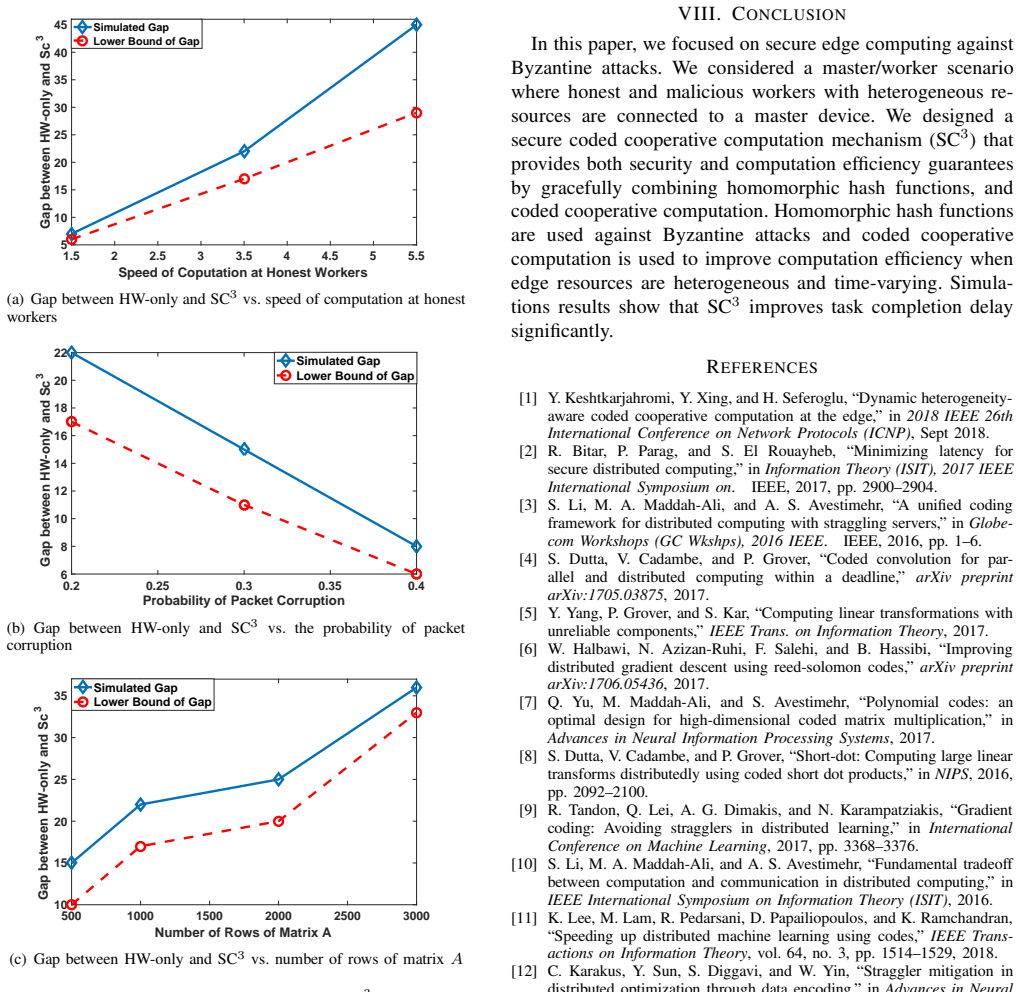
- The task completion delay of SC3 has a worst-case upper bound, and the delay gap over the HW-only baseline has a lower bound that grows with matrix size and with lower packet corruption probability.
- In simulations with 150 workers, tens of Byzantine workers, and packet corruption probability $\rho_c=0.3$, SC3's completion delay stays well below HW-only and close to the unsecured lower bound.
Reading between the lines
- The detection guarantees are conditional on adversarial alterations not being multiples of $q$: if a Byzantine worker changes a returned value by $q$ or any multiple of $q$, the hash in Eq. (1) is unchanged and neither check flags it. Choosing $q$ larger than any feasible corruption magnitude, or keeping $q$ secret, would close this hole, but the paper does not state such a requirement.
- Because the hash is homomorphic only over linear combinations, the same verification technique applies to any linear computation over a field, such as matrix-vector products, but not directly to nonlinear functions like neural-network activations.
- The $q$ parameter is a tunable security knob: an edge deployment could choose it per worker or per task based on the tolerated corruption risk and the worker's measured speed, interpolating between cheap weak checks and expensive strong checks.
- A direct testable extension would measure false-negative rates when an adversary deliberately corrupts by multiples of $q$, and compare them with the claimed $1-1/q$ bound in a real device-to-device edge testbed.
Signed reviews
Editorial analysis
A structured set of objections, weighed in public.
Referee Report
Summary. The paper proposes SC3, a secure coded cooperative computation mechanism for heterogeneous edge computing with Byzantine workers. The master encodes matrix rows with Fountain codes, offloads coded packets to workers dynamically, and verifies returned linear computations using a homomorphic hash function. Two verification tools are introduced: a light-weight (LW) check using coefficients in {-1,1} and a heavy-weight (HW) check using coefficients in a larger field F_q, together with a binary-search attack recovery module. The paper claims detection-probability guarantees for these checks, a delay upper bound and a delay-gap lower bound relative to a HW-only baseline, and simulation results showing significant task-completion-delay improvement. The core security analysis rests on the homomorphic hash in Eq. (1), and the delay analysis imports the dynamic packet-offloading result from the authors' prior work [1].
Significance. If the security conditions are stated and the proofs corrected, SC3 would be a practically motivated and useful combination of lightweight and heavyweight integrity checks with coded computation. The problem is well chosen, the algorithm is clearly structured, and the simulation comparison against HW-only and an unsecured lower bound gives a useful first evaluation. The paper does not provide machine-checked proofs or reproducible code, but the main contribution is the proposed mechanism and its analysis. However, as written, the load-bearing security claims rest on unstated modular-arithmetic compatibility conditions and several detection-probability statements are not valid without additional assumptions. The delay bounds also contain a non-integer factorial expression. These issues are fixable but require substantial revision of the theorems and proofs.
major comments (5)
- [Section II, Eq. (1) and Section III-A, Theorem 1] The hash function h(a) = g^{a mod q} mod r is homomorphic over integer addition, but the computation y = p·x is performed in F_ψ, so honest workers return y = (Σ_j p_j x_j) mod ψ. Consequently, the exponent in α_n is (Σ_i c_i y_i) mod q, while β_n uses (Σ_i c_i Σ_j p_{i,j} x_j) mod q. These exponents differ by a multiple of ψ, so the equality α_n = β_n for all honest workers holds only if q divides ψ (equivalently q = ψ when ψ is prime). The manuscript never states this compatibility condition; as written, even honest workers can fail the integrity check. For example, with ψ=5, q=3, r=7, g=2, p=(2,2), x=(2,2), and c=1, one obtains y=3 in F_5, so α = h(3) = 2^{3 mod 3} = 1, while β = h(2)^2·h(2)^2 = 4^4 mod 7 = 4. The theorem and all detection-probability lemmas that rely on it (Lemma 2, Proposition 3, Lemma 5) therefore need a stated q-ψ relation and a re-derivation under that condition.
- [Appendix D, Lemma 5] The proof of P_HW = 1 - 1/q assumes that for every corrupted packet the difference y_{n,i} - \tilde{y}_{n,i} is nonzero modulo q, so that Eq. (31) has a unique solution for c_j. If a Byzantine worker alters a result by a multiple of q, that difference is zero modulo q and Eq. (30) holds for every choice of coefficients, making the attack undetectable. The manuscript does not state that the adversary cannot produce such differences, nor does it relate q to the computation field size. Lemma 5 as stated is therefore false without an additional assumption, such as q = ψ with ψ prime and corrupted packets differing from honest values by nonzero field elements. This is a load-bearing issue because Lemma 5 underlies the claimed HW detection probability and the SC3 design.
- [Proposition 3 and Appendix C] The universal lower bound P_LW ≥ 0.5 is not valid for attacks in which the added/subtracted amount δ is a multiple of q. In that case the hash is unchanged and the detection probability is 0, not 0.5, regardless of coefficient selection. The proof's argument that the symmetric pairwise attack is the hardest case ignores this modulo-q zero-difference scenario. The proposition needs to be qualified (for example, under q=ψ with all corruptions nonzero in F_q) and the proof revised accordingly. This matters because the lower bound is used in the multi-round LW analysis of Theorem 7.
- [Theorem 7 and Appendix E] The statement that log_2(q) rounds of LW function have attack detection probability equal to that of HW function is only an approximation, not an equality. The proof says the per-round failure probability 'can be approximated as 1/2^K when Z_n >> log_2 K' and replaces a product of the form ∏ (2^{Z_n}-1-k)/(2^{Z_n}-k) by 2^{-K}. This product is not evaluated exactly, and the approximation requires unstated largeness conditions on Z_n. Moreover, the argument inherits the unsupported 0.5 lower bound from Proposition 3. The claimed equivalence and the complexity condition in Eq. (6) are therefore not established as stated.
- [Theorem 8 and Lemma 10] The upper bound in Eq. (8) and the definition of P in Lemma 10 use expressions such as (z_n ρ_c)! / (2^{z_n ρ_c} ((z_n ρ_c/2)!)^2), which involve factorials of non-integer quantities because z_n ρ_c is generally not an integer. This formula is imported from Lemma 2, which applies only to an even integer number of corrupted packets. The theorem also relies on the dynamic packet-offloading delay formula from [1] and on expected values of E[β_{n,i}] without stating the required distributional assumptions. The delay analysis needs to define P with appropriate integer rounding or an expectation over the number of corrupted packets, and the worst-case bound needs to be justified under those definitions.
minor comments (5)
- [Section II, Eq. (1)] The notation h(a) ≜ mod(g mod (a,q), r) is nonstandard and can be misread; it should be written as h(a) = g^{a mod q} mod r, which is what the proofs use.
- [Section II, Eq. (1)] The parameter φ is used to define the field F_φ from which q is selected, but φ is never formally defined; the relation between q, φ, and the computation-field size ψ should be stated explicitly.
- [Appendix A, proof of Theorem 1] The quotient q' in Eqs. (15)-(16) is denoted with a symbol that is visually nearly identical to the prime q; using a different symbol, such as m, would improve readability.
- [Appendix E, proof of Theorem 7] The proof refers to 'Lemma 3' when it means Proposition 3; the reference should be corrected.
- [Section VI, Fig. 3(c)] The caption says 'SC3P' instead of 'SC3' in the phrase 'the gap between HW-only and SC3P'.
Circularity Check
No definitional or fitted-input circularity; the security analysis is derived in-paper, and the main reuse of the authors' prior work is the cited dynamic packet-offloading delay formula, not a disguised prediction.
full rationale
The core security material is derived inside the paper: Theorem 1 states the homomorphic-hash verification, Lemmas 2 and 5 and Proposition 3 give detection probabilities from the random coefficient choices, and the attack-recovery binary search is defined directly on the packet sets. These results are not fitted to the simulation outputs; the simulations compare SC3 with the baselines after the analysis, so no prediction is a renamed fit. The only self-referential component is the dynamic packet-offloading module, which is explicitly attributed to the authors' own prior work [1], and its delay expression is imported into Theorem 8 and Lemma 9 as a cited building block. That is a normal citation of a published algorithm rather than a circular reduction: it does not define the security guarantees in terms of the delay result, and the novel Byzantine-detection and recovery content is independent of that formula. I also considered the modular-arithmetic objection that Theorem 1 implicitly requires q to divide the computation-field size for honest workers to pass; that is a mathematical correctness concern, not a circularity, so under the stated rules it does not increase the circularity score.
Assumptions & free parameters
free parameters (1)
- hash prime q =
not specified in paper
assumptions (4)
- domain assumption The dynamic packet ofloading policy from [1] results in per-round completion time (R+epsilon)/sum_n 1/E[beta_{n,i}], and this result transfers to the SC3 setting.
- ad hoc to paper Any Byzantine corruption produces a difference delta that is nonzero modulo q, and q is chosen or kept such that the adversary cannot force delta congruent to 0 mod q.
- standard math Fermat's little theorem and finite-field arithmetic are valid for the hash construction in Eq. (1).
- domain assumption Workers' per-packet computation delays beta_{n,i} are i.i.d. with known mean E[beta_{n,i}], and the master can estimate these means from ACK history.
Cite this review
Pith. "Pith review of Secure Coded Cooperative Computation at the Heterogeneous Edge against Byzantine Attacks." pith.science (2026). https://pith.science/paper/KGTWC2OH
@misc{pith2026190805385,
  author       = {Pith},
  title        = {Pith review of: Secure Coded Cooperative Computation at the Heterogeneous Edge against Byzantine Attacks},
  year         = {2026},
  howpublished = {\url{https://pith.science/paper/KGTWC2OH}},
  note         = {Machine review of arXiv:1908.05385}
}
read the original abstract
Edge computing is emerging as a new paradigm to allow processing data at the edge of the network, where data is typically generated and collected, by exploiting multiple devices at the edge collectively. However, offloading tasks to other devices leaves the edge computing applications at the complete mercy of an attacker. One of the attacks, which is also the focus of this work, is Byzantine attacks, where one or more devices can corrupt the offloaded tasks. Furthermore, exploiting the potential of edge computing is challenging mainly due to the heterogeneous and time-varying nature of the devices at the edge. In this paper, we develop a secure coded cooperative computation mechanism (SC3) that provides both security and computation efficiency guarantees by gracefully combining homomorphic hash functions and coded cooperative computation. Homomorphic hash functions are used against Byzantine attacks and coded cooperative computation is used to improve computation efficiency when edge resources are heterogeneous and time-varying. Simulations results show that SC3 improves task completion delay significantly.
Figures


Reference graph
Works this paper leans on
-
[1]
Dynamic heterogeneity- aware coded cooperative computation at the edge,
Y . Keshtkarjahromi, Y . Xing, and H. Seferoglu, “Dynamic heterogeneity- aware coded cooperative computation at the edge,” in 2018 IEEE 26th International Conference on Network Protocols (ICNP) , Sept 2018
work page 2018
-
[2]
Minimizing laten cy for secure distributed computing,
R. Bitar, P . Parag, and S. El Rouayheb, “Minimizing laten cy for secure distributed computing,” in Information Theory (ISIT), 2017 IEEE International Symposium on . IEEE, 2017, pp. 2900–2904
work page 2017
-
[3]
A unified co ding framework for distributed computing with straggling serve rs,
S. Li, M. A. Maddah-Ali, and A. S. Avestimehr, “A unified co ding framework for distributed computing with straggling serve rs,” in Globe- com W orkshops (GC Wkshps), 2016 IEEE . IEEE, 2016, pp. 1–6
work page 2016
-
[4]
Coded convolution for parallel and distributed computing within a deadline
S. Dutta, V . Cadambe, and P . Grover, “Coded convolution f or par- allel and distributed computing within a deadline,” arXiv preprint arXiv:1705.03875, 2017
work page Pith review arXiv 2017
-
[5]
Computing linear transfo rmations with unreliable components,
Y . Y ang, P . Grover, and S. Kar, “Computing linear transfo rmations with unreliable components,” IEEE Trans. on Information Theory , 2017
work page 2017
-
[6]
Improving Distributed Gradient Descent Using Reed-Solomon Codes
W. Halbawi, N. Azizan-Ruhi, F. Salehi, and B. Hassibi, “I mproving distributed gradient descent using reed-solomon codes,” arXiv preprint arXiv:1706.05436, 2017
work page Pith review arXiv 2017
-
[7]
Polynomial cod es: an optimal design for high-dimensional coded matrix multipli cation,
Q. Y u, M. Maddah-Ali, and S. Avestimehr, “Polynomial cod es: an optimal design for high-dimensional coded matrix multipli cation,” in Advances in Neural Information Processing Systems , 2017
work page 2017
-
[8]
Short-dot: Computi ng large linear transforms distributedly using coded short dot products,
S. Dutta, V . Cadambe, and P . Grover, “Short-dot: Computi ng large linear transforms distributedly using coded short dot products,” in NIPS, 2016, pp. 2092–2100
work page 2016
Show all 24 references
-
[9]
Gradient coding: Avoiding stragglers in distributed learning,
R. Tandon, Q. Lei, A. G. Dimakis, and N. Karampatziakis, “ Gradient coding: Avoiding stragglers in distributed learning,” in International Conference on Machine Learning , 2017, pp. 3368–3376
2017
-
[10]
Fundamen tal tradeoff between computation and communication in distributed comp uting,
S. Li, M. A. Maddah-Ali, and A. S. Avestimehr, “Fundamen tal tradeoff between computation and communication in distributed comp uting,” in IEEE International Symposium on Information Theory (ISIT) , 2016
2016
-
[11]
Speeding up distributed machine learning using codes,
K. Lee, M. Lam, R. Pedarsani, D. Papailiopoulos, and K. R amchandran, “Speeding up distributed machine learning using codes,” IEEE Trans- actions on Information Theory , vol. 64, no. 3, pp. 1514–1529, 2018
2018
-
[12]
Straggler mi tigation in distributed optimization through data encoding,
C. Karakus, Y . Sun, S. Diggavi, and W. Yin, “Straggler mi tigation in distributed optimization through data encoding,” in Advances in Neural Information Processing Systems , 2017, pp. 5434–5442
2017
-
[13]
Effective stragg ler mitigation: Which clones should attack and when?
M. F. Aktas, P . Peng, and E. Soljanin, “Effective stragg ler mitigation: Which clones should attack and when?” ACM SIGMETRICS Perfor- mance Evaluation Review , vol. 45, no. 2, pp. 12–14, 2017
2017
-
[14]
On-the-fly verification of rateless erasure codes for efficient content distributio n,
M. N. Krohn, M. J. Freedman, and D. Mazieres, “On-the-fly verification of rateless erasure codes for efficient content distributio n,” in IEEE Symposium on Security and Privacy, 2004. Proceedings. 2004 . IEEE, 2004, pp. 226–240
2004
-
[15]
Cooperative security for network coding file distribution
C. Gkantsidis and P . Rodriguez, “Cooperative security for network coding file distribution.” in INFOCOM, vol. 3, no. 2006, 2006
2006
-
[16]
Lt codes,
M. Luby, “Lt codes,” in The 43rd Annual IEEE Symposium on F ounda- tions of Computer Science, 2002. Proceedings. , Nov 2002, pp. 271–280
2002
-
[17]
Raptor codes,
A. Shokrollahi, “Raptor codes,” IEEE/ACM Transactions on Networking (TON), vol. 14, no. SI, pp. 2551–2567, 2006
2006
-
[18]
Fountain codes,
D. J. MacKay, “Fountain codes,” IEE Proceedings-Communications, vol. 152, no. 6, pp. 1062–1068, 2005
2005
-
[19]
MapReduce: simplified data pro cessing on large clusters,
J. Dean and S. Ghemawat, “MapReduce: simplified data pro cessing on large clusters,” Communications of the ACM, vol. 51, no. 1, pp. 107–113, 2008
2008
-
[20]
Coded map reduce,
S. Li, M. A. Maddah-Ali, and A. S. Avestimehr, “Coded map reduce,” in 2015 53rd Annual Allerton Conference on Communication, Con trol, and Computing (Allerton) . IEEE, 2015, pp. 964–971
2015
-
[21]
Coded computation over heterogeneous clusters,
A. Reisizadeh, S. Prakash, R. Pedarsani, and A. S. Avest imehr, “Coded computation over heterogeneous clusters,” IEEE Transactions on Infor- mation Theory , 2019
2019
-
[22]
Secure distributed computing with s traggling servers using polynomial codes,
H. Y ang and J. Lee, “Secure distributed computing with s traggling servers using polynomial codes,” IEEE Transactions on Information F orensics and Security, vol. 14, no. 1, pp. 141–150, Jan 2019
2019
-
[23]
Lagrange co ded computing: Optimal design for resiliency, security and pri vacy,
Q. Y u, N. Raviv, J. So, and A. S. Avestimehr, “Lagrange co ded computing: Optimal design for resiliency, security and pri vacy,” arXiv preprint, arXiv:1806.00939, 2018
2018 arXiv
-
[24]
Prac: Private and rateless adaptive coded co mputation at the edge,
R. Bitar, Y . Xing, Y . Keshtkarjahromi, V . Dasari, S. El R ouayheb, and H. Seferoglu, “Prac: Private and rateless adaptive coded co mputation at the edge,” in SPIE Defense + Commercial Sensing , 2019. APPENDIX A: P ROOF OF THEOREM 1 αn =h( Zn∑ i=1 ci ˜yn,i) (11) = mod ( g mo...
2019
Reviewed August 14, 2026 · model on record in the stance chip above.
Discussion (0). Continue with ORCID to comment.