REVIEW 2 major objections 4 minor 1 cited by
Nonparametric Identification of First-Price Auction with Unobserved Competition: A Density Discontinuity Framework
T0 review · 2 major / 4 minor · reviewed 2026-08-14 · deepseek-v4-flash
Pith's one-line read The winning bid alone can identify both the bidder-count distribution and the private-value distribution in a first-price auction.
desk verdict The density-discontinuity identification of unobserved N is new and the theorem is sound, but the full-support assumption is narrow and the version I read does not match its own abstract's empirical claims. read the letter →
The pith
A machine-rendered reading of the paper's core claim, the machinery that carries it, and where it could break.
The reading
What carries the argument
The load-bearing object is the unconditional winning-bid density $g(b)$, which is a finite mixture $g(b)=\sum_{n=\underline n}^{\overline n} p_n\, n\, G_n^{n-1}(b)\, g_n(b)$. Equilibrium bidding makes the conditional support upper bounds $b_n$ strictly increasing in $n$, and Corollary 2.1 shows each conditional density is positive at its upper boundary, $g_n(b_n)=1/((n-1)(\bar v-b_n))$. Hence $g$ has a jump at every $b_n$, with size $\Delta_n=n p_n/((n-1)(\bar v-b_n))$; the locations give the support of $N$, the sizes give the probabilities after $\bar v$ is solved from $\sum p_n=1$, and the iterative quantile mappings $V(\alpha)=B_n(\alpha)+\alpha B_n'(\alpha)/(n-1)$ and $B_n(\alpha)=\frac{n-1}{\alpha^{n-1}}\int_0^\alpha t^{n-2}V(t)\,dt$ extend identification of $V$ from the top quantile interval down to $\alpha=0$.
What would settle it
Simulate the benchmark model with $F$ uniform on $[0,1]$, buyers observing $N$, and $N$ taking values 2 and 4 with equal probability. The winning-bid density has jumps exactly at $b_2$ and $b_4$, so the paper's rule $\bar n = \underline n + \#\{\text{jumps}\} - 1$ returns $\bar n = 3$, and the estimated $p_3$ is positive although $P(N=3)=0$; this violates the true data-generating process and shows that Assumption N's full-support requirement is what carries the jump-counting step.
Extended reading notes
Core claim
The paper's central claim is Theorem 2.1: under Assumptions N and IPV, if buyers observe the number of active bidders $N$, then the private-value c.d.f. $F(\cdot)$ and the distribution of $N$ are identified from the winning-bid distribution alone. The argument uses the fact that the conditional bid quantile $B_n(\alpha)$ is strictly increasing in $n$, so the support upper bounds $b_n=B_n(1)$ satisfy $\underline v=b_{\underline n}<\cdots<b_{\overline n}<\bar v$, and that the conditional bid density is positive at each upper bound, $g_n(b_n)=1/((n-1)(\bar v-b_n))$. These ingredients force the unconditional winning-bid density to jump at every $b_n$, with jump size $\Delta_n=n p_n/((n-1)(\bar v-b_n))$. Jump locations identify the support of $N$, jump sizes identify the probabilities $p_n$ once the upper bound $\bar v$ is recovered from $\sum p_n=1$, and an iterative quantile argument extends identification of $V(\alpha)=F^{-1}(\alpha)$ from the top bid interval down to $\alpha=0$.
Load-bearing premise
Identification collapses if some intermediate number of bidders never occurs, because that number would produce no density jump, the support count would be wrong, and the iterative expansion down the bid distribution could not begin.
Editorial extensions
If this is right
- In markets where only transaction prices are recorded, competition intensity and bidder valuations become estimable without observing the number of bidders or any losing bids.
- When active buyers observe the number of competitors, endogenous participation through a reserve price or entry cost does not block identification from winning bids; when they do not observe it, identification requires an instrument or auxiliary observations such as unsold objects.
- The derived inequalities on jump sizes and locations provide a direct specification test: winning-bid data violating them cannot be rationalized by the benchmark model.
- Empirically, using the recorded number of bids as the competition level can overstate true competition; in the USFS timber data, most three-bid auctions behave as if only two bidders compete, and risk-aversion bounds move toward risk neutrality.
Reading between the lines
- The same jump-counting logic could identify any finite mixture whose components have strictly ordered support endpoints and positive densities at those endpoints, so the auction setting is one instance of a more general mixture-identification principle.
- If an intermediate bidder count has zero probability in the population, the jump count would misreport the support of $N$; a robust alternative would treat detected jumps as a subset of possible boundaries and use the jump-size inequalities to prune impossible configurations.
- The USFS finding that a third recorded bid is often non-competitive suggests a testable screen for passive or coordinated bidding in procurement data, since the model itself does not explain why the dominated bid occurs.
Signed reviews
Editorial analysis
A structured set of objections, weighed in public.
Referee Report
Summary. The paper studies nonparametric identification of first-price auction primitives when the analyst observes only winning bids and the number of active bidders is unobserved. Under the maintained assumptions that N is exogenous, independent of private values, has support equal to a full integer interval, and is observed by the bidders, it shows that discontinuities in the winning bid density at conditional bid upper bounds identify the support and probabilities of N, and that an iterative use of the equilibrium bid-quantile and value-quantile mappings identifies the private value distribution. The framework is then extended to endogenous participation through a reserve price or an entry cost, with and without bidder knowledge of participation, yielding testable restrictions for information and entry models. An empirical illustration using USFS timber auctions concludes that many reported three-bid auctions have only two competitive bidders and that risk-aversion estimates are sensitive to this form of unobserved competition.
Significance. If the identification result holds, it is a substantial contribution: the winning bid alone, through the location and size of density discontinuities, identifies both the distribution of competition and the private value distribution without instruments or multiple bids. The proofs are coherent and carefully structured; the jump formula (9) is correctly derived from the equilibrium conditions, and the iterative identification argument in Lemma 2.3 is rigorous. The extension to endogenous participation with testable restrictions for whether bidders observe competition is valuable and connects cleanly to the discrete-mixture literature. The empirical application is suggestive but not decisive because of the very small subsamples and the heuristic nature of the discontinuity-detection algorithm.
major comments (2)
- [Section 2.1, Lemma 2.2, Theorem 2.1] Assumption N requires P(N=k)>0 for every integer k between n and n. The identification of n as n plus the number of density discontinuities minus one, and the formulas for p_n in equations (11)-(12), rely on a jump appearing at every intermediate boundary b_k. If P(N=k)=0 for some intermediate k, no jump occurs at b_k, so the count understates n and the probabilities are assigned to an incorrect support. The iterative construction in Lemma 2.3 also fails, because Step 1 uses the interval [b_{n-1}, b_n] starting from the top boundary of the next-lower component. Since n and n are not directly observed, the data cannot distinguish a genuine support gap from a zero-probability support point, and the paper provides no test or relaxation of this condition. The abstract's claim that the resulting discontinuities identify the distribution of N therefore overstates robustness; the identified object is the distribution of N conditional on a full-interval support assumption.
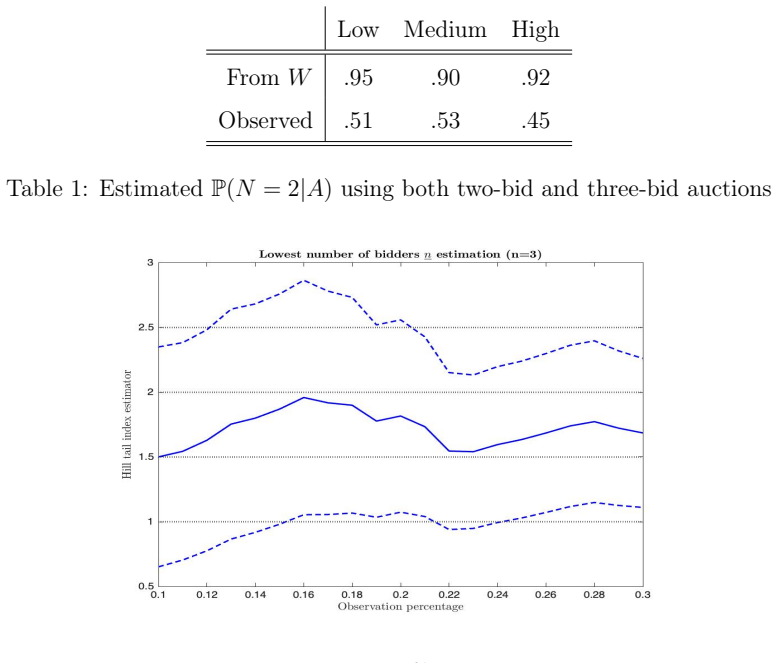
- [Section 4, Tables 1-3, Appendix] The empirical conclusions rest on very small subsamples (45, 53, and 44 auctions), a k-NN discontinuity-detection algorithm with hand-set bandwidths h0=0.2 and h1=0.5 and epsilon=0.01, and no reported standard errors or sensitivity analysis. The point estimates in Table 1 (e.g., 0.90-0.95 for unobserved competition versus 0.45-0.53 from observed bids) and the CRRA lower bound of 0.9 in Section 4.2 are therefore not robustly supported; the text itself acknowledges that the variance is likely to be very high. The paper should provide bootstrap confidence intervals and a sensitivity analysis over (h0, h1, epsilon, K, M) before drawing conclusions about non-competitive bidding or risk aversion.
minor comments (4)
- [Section 2.5.1] The text says 'Expression (9) allows for the identification of p1 = p2 = 1/2', but p_1 is undefined because the support of N starts at n=2; the intended statements concern p_2 and p_3.
- [Abstract and Section 4] The abstract included at the top of the submission mentions a parametric Bayesian estimation procedure and an application to Shanghai Government IT procurements, but the full text proposes no Bayesian procedure and applies the methods to USFS timber auctions. These statements should be reconciled.
- [Section 4.2] The sentence 'we obtain the best lower bound for the CRRA coefficient θ 0.9' should read 'a lower bound of θ = 0.9' or 'the best lower bound is 0.9'.
- [Appendix] The displayed formula for the critical value c(epsilon;h0) is difficult to parse because of the mixed square-root and logarithmic terms; please format it more clearly and define each term.
Circularity Check
No circularity: identification from winning-bid density jumps is self-contained; self-citations are standard and non-load-bearing.
full rationale
The derivation chain is self-contained. Section 2.2 derives the two equilibrium mappings, Eqs. (2) and (4), from the bidders' first-order conditions rather than importing them as black boxes. Section 2.4 derives the jump formula (9) from the mixture expression (10) and Corollary 2.1, and Section 2.5 solves for the upper value bound v and the probabilities p_n from the normalization sum p_n = 1 in Eqs. (11)-(12). Theorem 2.1 then combines Lemmas 2.2 and 2.3, with Lemma 2.3's recursion proven in Section 6.1. No target quantity, namely F(.) or the distribution of N, is fed back into the identifying equations. The authors' own prior work (Guerre-Perrigne-Vuong 2000, 2009; Liu-Luo 2016; Guerre-Gimenes 2019) is cited for the quantile framework, but the framework is re-derived in the text, so these self-citations are not load-bearing. The empirical risk-aversion bounds in Section 4.2 use the same jump equations to constrain theta, which is a valid inequality bound rather than a fitted parameter relabeled as a prediction. Footnote 1 explicitly notes an omitted proof, and the front abstract advertises a Bayesian estimation procedure absent from the body; these are completeness issues, not circularity. Assumption N's contiguous-support condition is substantive and may limit robustness, but an assumption's strength is not circularity. No equation in the paper reduces by construction to its own inputs.
Assumptions & free parameters
free parameters (5)
- h0 =
0.2
- h1 =
0.5
- epsilon =
0.01
- K =
2
- M =
21 to 65
assumptions (6)
- standard math Symmetric IPV first-price auction best responses are strictly increasing, continuously differentiable, and satisfy the differential equation V(alpha)=B_n(alpha)+alpha B_n'(alpha)/(n-1).
- domain assumption Assumption IPV: F has compact support [v,v] with density f continuous and strictly positive on [v,v].
- domain assumption Assumption N: N has support {n,...,n} with p_n>0 for all n=n,...,n.
- domain assumption Buyers observe the number of active bidders N before bidding in the benchmark model.
- domain assumption In endogenous participation models (Sections 3.1 and 3.2), the number of active bidders is binomial with parameter n and one minus the screening probability, following a threshold rule for reserve price or entry cost.
- domain assumption The instrument z affects only the reserve price R(z) or entry cost c(z), while the private value distribution and n are independent of z (Assumptions R and E).
Cite this review
Pith. "Pith review of Nonparametric Identification of First-Price Auction with Unobserved Competition: A Density Discontinuity Framework." pith.science (2026). https://pith.science/paper/QRBDDMYC
@misc{pith2026190805476,
  author       = {Pith},
  title        = {Pith review of: Nonparametric Identification of First-Price Auction with Unobserved Competition: A Density Discontinuity Framework},
  year         = {2026},
  howpublished = {\url{https://pith.science/paper/QRBDDMYC}},
  note         = {Machine review of arXiv:1908.05476}
}
abstract
We consider nonparametric identification of independent private value first-price auction models, in which the analyst only observes winning bids. Our benchmark model assumes an exogenous number of bidders $N$. We show that, if the bidders observe $N$, the resulting discontinuities in the winning bid density can be used to identify the distribution of $N$. The private value distribution can be nonparametrically identified in a second step. This extends, under testable identification conditions, to the case where $N$ is a number of potential buyers, who bid with some unknown probability. Identification also holds in presence of additive unobserved heterogeneity drawn from some parametric distributions. A parametric Bayesian estimation procedure is proposed. An application to Shanghai Government IT procurements finds that the imposed three bidders participation rule is not effective. This generates loss in the range of as large as $10\%$ of the appraisal budget for small IT contracts.
Figures


Figures from the paper (3 more)


Forward citations
Cited by 1 Pith paper
-
Does the ratio of Laplace transforms of powers of a function identify the function?
The ratio of Laplace transforms of powers of a function is injective on monotone right-analytic functions, and this yields an identification result for auction models with unobserved heterogeneity.
Reference graph
Works this paper leans on
-
[1]
Abrantes-Metz, R. & P. Bajari (2009). Screens for conspiracies and their mul- tiple applications.Antitrust 24, 66–71. An, Y., Y. Hu & M. Shum (2010).Estimatingfirst-priceauctionswithan unknown number of bidders: a misclassification approach.Journal of Econometrics157, 328–
work page 2009
-
[341]
Regression Discontinuity Designs
Athey, S. & P.A. Haile (2007). Nonparametric approaches to auctions.Handbook of Econometrics6A, 3847–3965. Bulow, J. & and P. Klemperer (1996). Auctions versus negotiations.American Economic Review86, 180–194. Campo, S., E. Guerre, I. Perrigne & Q. Vuong (2011). Semiparametric esti- mation of first-price auctions with risk-averse bidders.Review of Economic...
work page 2007
Reviewed August 14, 2026 · model on record in the stance chip above.
Discussion (0). Continue with ORCID to comment.