REVIEW 4 minor 6 references
Top-quark properties at ATLAS
T0 review · 0 major / 4 minor · reviewed 2026-08-14 · deepseek-v4-flash
Pith's one-line read ATLAS measures top-quark pole mass at 171.1 GeV with 0.7% uncertainty and finds ttbar spin correlations exceed NLO Monte Carlo predictions by 3.2 sigma.
desk verdict A faithful conference summary of two solid ATLAS top-quark measurements; the 3.2 sigma spin-correlation excess is real but template-dependent, and the paper is honest about that. read the letter →
The pith
A machine-rendered reading of the paper's core claim, the machinery that carries it, and where it could break.
The reading
What carries the argument
The central machinery is the use of normalized, shape-only differential distributions rather than absolute cross sections. For the mass measurement, the variable $\rho_s=2m_0/m_{t\bar{t}+1\text{-jet}}$ with $m_0=170$ GeV is measured in single-lepton $t\bar{t}+1$-jet events; the parton-level unfolded distribution is fitted to next-to-leading-order QCD-plus-parton-shower predictions parametrized by the pole mass, so the Monte Carlo generator is used only to correct for detector effects and not to define the mass. For spin correlations, the observable is the azimuthal opening angle $|\Delta\phi|$ between the charged leptons, which carry almost all the spin information because the top quark decays before spin decorrelation; templates with spin correlations switched on and off, generated with the same NLO generator, are fitted to the unfolded distribution to extract the fraction $f_{\text{SM}}$.
What would settle it
Recompute $f_{\text{SM}}$ using a full NNLO QCD calculation with top-quark decays as the spin-on template; if $f_{\text{SM}}$ moves to near one, the reported excess was missing higher-order corrections rather than new physics, while if it stays significantly above one the excess is robust.
Extended reading notes
Core claim
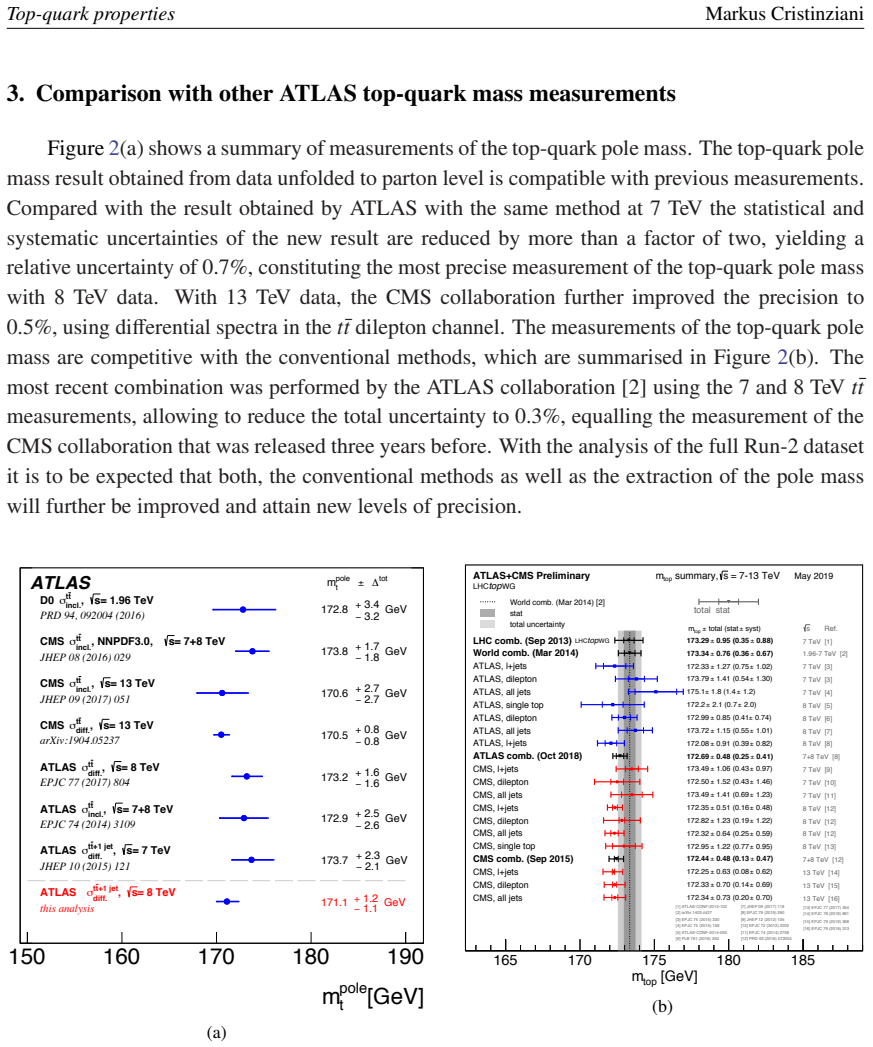
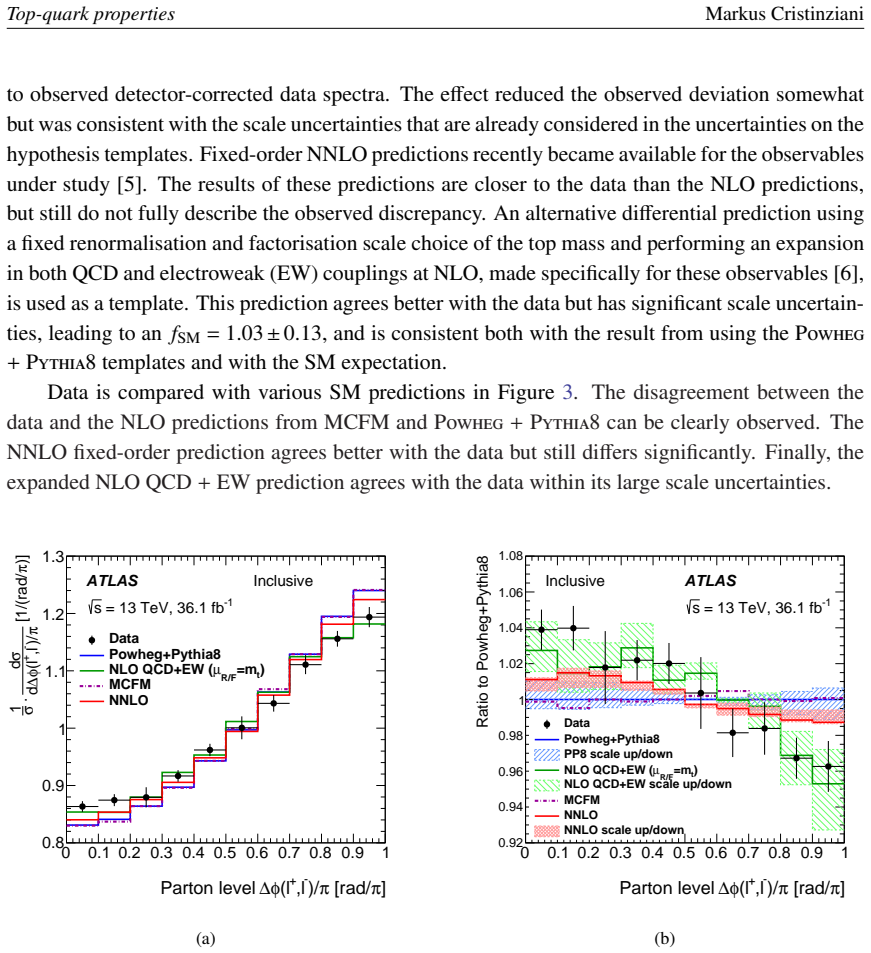
On its own terms, the paper establishes that normalized differential cross sections are powerful, scheme-clean top-quark observables. The $\rho_s=2m_0/m_{t\bar{t}+1\text{-jet}}$ distribution in $t\bar{t}+1$-jet events yields a top-quark pole mass $m_t^{\text{pole}}=171.1\pm0.4\,(\text{stat})\pm0.9\,(\text{syst})^{+0.7}_{-0.3}\,(\text{theo})$ GeV and, in the running-mass scheme, $m_t(m_t)=162.9\pm0.5\,(\text{stat})\pm1.0\,(\text{syst})^{+2.1}_{-1.2}\,(\text{theo})$ GeV; the larger theory uncertainty of the running mass is traced to renormalization and factorization scale dependence near the $t\bar{t}+1$-jet threshold. For spin correlations, the normalized $\Delta\phi$ distribution between the two leptons in $e\mu$ dilepton events shows a spin-correlation fraction $f_{\text{SM}}$ above one, meaning the data are more correlated than the NLO Monte Carlo templates, with a significance of 3.8 $\sigma$ before and 3.2 $\sigma$ after including theoretical uncertainties on the hypothesis templates; the excess does not depend significantly on the $t\bar{t}$ invariant mass, and one fixed-order NLO QCD-plus-electroweak prediction reproduces the data within its large scale uncertainties.
Load-bearing premise
The spin-correlation result assumes that the Monte Carlo generator's spin-on and spin-off templates correctly model the shape of the $\Delta\phi$ distribution; if that shape is wrong, the 3.2 $\sigma$ excess would be an artifact.
Editorial extensions
If this is right
- If the 171.1 GeV pole mass holds, Standard-Model consistency checks involving the top-quark, Higgs, and W-boson masses become tighter, with a precision competitive with direct reconstruction methods and a cleaner theoretical definition.
- If the running mass of 162.9 GeV holds, comparing the pole and running masses through the four-loop scheme conversion provides a test of perturbative QCD.
- If the high spin correlation persists, NLO Monte Carlo generators are missing something: either higher-order QCD or electroweak corrections in the templates, or new production mechanisms beyond the Standard Model.
- The measured $\Delta\phi$ distribution as a function of the $t\bar{t}$ invariant mass provides a differential discriminator: a BSM contribution would likely distort the mass dependence, whereas missing higher-order corrections would not.
- The published parton-level and particle-level unfolded distributions allow future theoretical calculations to be compared directly without redoing the measurement.
Reading between the lines
- If the spin-correlation excess is caused by missing higher-order corrections, a full NNLO calculation with spin correlations implemented as the spin-on template should bring $f_{\text{SM}}$ down toward one; the paper's own NNLO comparison already moves in that direction but does not fully close the gap.
- A natural extension would measure $f_{\text{SM}}$ separately in boosted and threshold regions; the four $t\bar{t}$-mass bins reported here suggest the excess is not concentrated at high invariant mass, which would constrain color-octet resonance models.
- Because the same lepton angular observable is measurable at both proton-proton and proton-antiproton colliders, comparing spin correlations across collider types could separate initial-state effects from intrinsic top-quark properties; this is not addressed in the present report.
- The mass measurement's sensitivity to threshold-scale effects can be sharpened by using the same $\rho_s$ observable with future higher-luminosity data, where the statistical uncertainty would allow finer binning in the most mass-sensitive region.
Signed reviews
Editorial analysis
A structured set of objections, weighed in public.
Referee Report
Summary. This proceedings paper summarizes two recent ATLAS measurements of top-quark properties: the extraction of the top-quark mass in the pole and MS-bar schemes from the normalised differential ttbar+1-jet cross section using 20.2 fb^-1 of 8 TeV data, and the measurement of ttbar spin correlations via the azimuthal opening angle between the two charged leptons in the dilepton channel using 36.1 fb^-1 of 13 TeV data. The mass measurement yields m_t^pole = 171.1 +/- 0.4 (stat) +/- 0.9 (syst) +0.7/-0.3 (theo) GeV and m_t(m_t) = 162.9 +/- 0.5 (stat) +/- 1.0 (syst) +2.1/-1.2 (theo) GeV. The spin-correlation analysis extracts the fraction of SM-like spin correlation f_SM from templates and reports a deviation of 3.2 sigma (3.8 sigma before theory uncertainties on the templates) from the NLO Monte Carlo expectation, while noting agreement with a fixed-order NLO QCD+EW prediction within large scale uncertainties.
Significance. If the results hold, the mass measurement provides a precise pole-mass determination in a well-defined mass scheme, with a total relative uncertainty of about 0.7%, the most precise from 8 TeV data. The spin-correlation measurement is a sensitive probe of potential BSM contributions to ttbar production and is important for testing SM predictions. A particular strength of the paper is its transparency: it explicitly reports that the observed spin-correlation excess is template-dependent, that NNLO reweighting reduces the deviation, and that an alternative fixed-order NLO QCD+EW template yields f_SM = 1.03 +/- 0.13, consistent with the SM. The stress-test concern about template dependence is therefore already addressed in the manuscript, and the paper does not overclaim a BSM signal.
minor comments (4)
- [Sec. 4 / Sec. 5] In Sec. 4 the text states 'The data and prediction agree within uncertainties for all kinematic observables studied,' while the Sec. 5 summary states 'None of the studied generators are able to reproduce the normalised Δφ distribution.' These statements should be reconciled, presumably by clarifying that the former refers to detector-level yields or inclusive cross-sections, not the parton-level normalized Δφ shape.
- [Sec. 4] The inclusive f_SM central value and its uncertainty are not reported, only the significance in units of sigma. Quoting the extracted f_SM (or at least the central value) would allow the reader to assess the size of the effect and to compare with the alternative-template result f_SM = 1.03 +/- 0.13.
- [Abstract / Sec. 4] The abstract says the spin correlation is 'significantly higher than predicted by the generators used'; consider adding 'NLO' before 'generators' or otherwise clarifying that the comparison is with a specific class of generators, since the summary itself notes agreement with a fixed-order NLO QCD+EW prediction.
- [Sec. 3] The claim that CMS 'further improved the precision to 0.5%' is ambiguous: Figure 2(a) shows a CMS 13 TeV direct mass measurement with total uncertainty 0.8 GeV, while the 0.5% figure appears to refer to the pole mass from differential cross sections. Please specify which CMS result is meant.
Circularity Check
No circularity: the paper is a conference summary of experimental measurements whose quoted results come from data, not from a derivation that reduces to its own inputs.
full rationale
The paper reports ATLAS measurements of the top-quark mass and t-tbar spin correlations. The mass extraction compares an unfolded differential cross section with fixed-order NLO+PS predictions parameterized by m_t^pole; the observable rho_s = 2m0/m_{t-tbar+jet} with m0 fixed to 170 GeV is not defined in terms of the fitted mass, and the fit is to data, so no fitted parameter is renamed as a prediction. The spin-correlation result is extracted by fitting two hypothesis templates (SM spin and no-spin) to unfolded data; the quoted f_SM and significance are genuine extractions, not identities. The paper cites ATLAS collaboration papers and fixed-order calculations [5,6], but these are experimental results and external theoretical predictions, not unverified self-citations that carry the argument. The paper even reports cross-checks showing that alternative templates and NNLO corrections affect the size of the deviation, which is a statement about model dependence rather than circularity. No equation in the paper equates a derived quantity with an input by construction, and no load-bearing step reduces to a self-citation chain.
Assumptions & free parameters
assumptions (3)
- domain assumption The NLO+PS prediction for ttbar+1-jet production (Ref [1]) provides an accurate description of the observable R, including interpolation between mass points.
- domain assumption The NLO Monte Carlo generators (Powheg+Pythia8 with and without spin correlations) provide reliable templates for extracting f_SM, with systematic uncertainties covering modeling deficiencies.
- domain assumption The Standard Model prediction for ttbar spin correlation is represented by the cited generators or fixed-order calculations.
Cite this review
Pith. "Pith review of Top-quark properties at ATLAS." pith.science (2026). https://pith.science/paper/3YYLXOSO
@misc{pith2026190805502,
  author       = {Pith},
  title        = {Pith review of: Top-quark properties at ATLAS},
  year         = {2026},
  howpublished = {\url{https://pith.science/paper/3YYLXOSO}},
  note         = {Machine review of arXiv:1908.05502}
}
abstract
Properties of the top-quark are presented, with emphasis on the most recent ATLAS measurements of the mass and $t\bar{t}$ spin correlations, obtained with proton-proton collision data collected at the Large Hadron Collider. Normalised differential distributions are used in both cases. For the extraction of the top-quark mass, $t\bar{t}+1$-jet single-lepton events are selected from the 20.2 fb$^{-1}$ 8 TeV dataset, and the unfolded distribution at parton level is compared with theoretical predictions to obtain $m_t^{\text{pole}} = 171.1^{+1.2}_{-1.1}$ GeV in the pole-mass scheme and $m_t(m_t) = 162.9^{+2.4}_{-1.6}$ GeV in the running-mass scheme. For the measurement of spin correlations in $t\bar{t}$ production, dilepton events are selected using 36.1 fb$^{-1}$ 13 TeV data. The azimuthal opening angle between the two leptons is measured inclusively and as a function of the invariant mass of the $t\bar{t}$ system. The observed degree of spin correlation is significantly higher than predicted by the generators used, but agrees well with the prediction of one of the fixed-order calculations.
Figures

Figures from the paper (1 more)

Reference graph
Works this paper leans on
-
[1]
ATLAS Collaboration, Measurement of the top-quark mass in t ¯t + 1-jet events collected with the ATLAS detector in pp collisions at √s = 8 TeV, submitted to JHEP, arXiv:1905.02302 [hep-ex]
work page Pith review arXiv 1905
-
[2]
ATLAS Collaboration, Measurement of the top quark mass in the t ¯t→ lepton+jets channel from√s = 8 TeV ATLAS data and combination with previous results , Eur. Phys. J. C79 (2019) 290, arXiv:1810.01772 [hep-ex]
arXiv 2019
- [3]
-
[4]
ATLAS Collaboration, Measurements of top-quark pair spin correlations in the e µ channel at√s = 13 TeV using pp collisions in the ATLAS detector , submitted to Eur. Phys. J. C, arXiv:1903.07570 [hep-ex]
arXiv 1903
-
[5]
A. Behring, M. Czakon, A. Mitov, A. S. Papanastasiou and R. Poncelet, Higher order corrections to spin correlations in top quark pair production at the LHC , arXiv:1901.05407 [hep-ph]
arXiv 1901
-
[6]
W. Bernreuther, D. Heisler and Z. G. Si, A set of top quark spin correlation and polarization observables for the LHC: Standard Model predictions and new physics contributions , JHEP 12 (2015) 026, arXiv:1508.05271 [hep-ph]. 9
arXiv 2015
Reviewed August 14, 2026 · model on record in the stance chip above.
Discussion (0). Continue with ORCID to comment.