REVIEW 2 major objections 5 minor 73 references
When very slow is too fast -- collapse of a predator-prey system
T0 review · 2 major / 5 minor · reviewed 2026-08-14 · deepseek-v4-flash
Pith's one-line read A smooth, slow decline in habitat quality can still tip a predator-prey system into sudden collapse, and the tipping threshold is a canard trajectory, not a bifurcation.
desk verdict A careful, convincing application of canard theory to R-tipping in a classic predator-prey model; the main gap is that all numerics sit at the lower edge of the cited time-scale separation range. read the letter →
The pith
A machine-rendered reading of the paper's core claim, the machinery that carries it, and where it could break.
The reading
What carries the argument
The key object is the folded saddle singularity on the fold curve of the critical manifold, together with the singular canard trajectory through it. Desingularization removes the zero denominator of the reduced slow flow at the fold, turning the folded singularity into a regular equilibrium of a rescaled system; the stable manifold of that equilibrium is the tipping threshold. The speed of the moving equilibrium, $|\dot e_3| = r/(1-\eta)^2$, carries the explanation of why a slow ramp can be too fast: for handling time $\eta$ close to one, even small $r$ makes the equilibrium sweep through phase space faster than the system can follow.
What would settle it
Numerically integrate the ramped system (9)-(11) at $\kappa = 0.08$, the upper end of the ecological range the paper cites, with $\eta=0.8$ and the initial state on the moving equilibrium $e_3(\varphi_0)$, for ramping rates on both sides of the predicted canard threshold. If the predicted collapse does not occur for $r$ above the threshold, or occurs for $r$ below it, the canard prediction does not carry over to weaker timescale separation.
Extended reading notes
Core claim
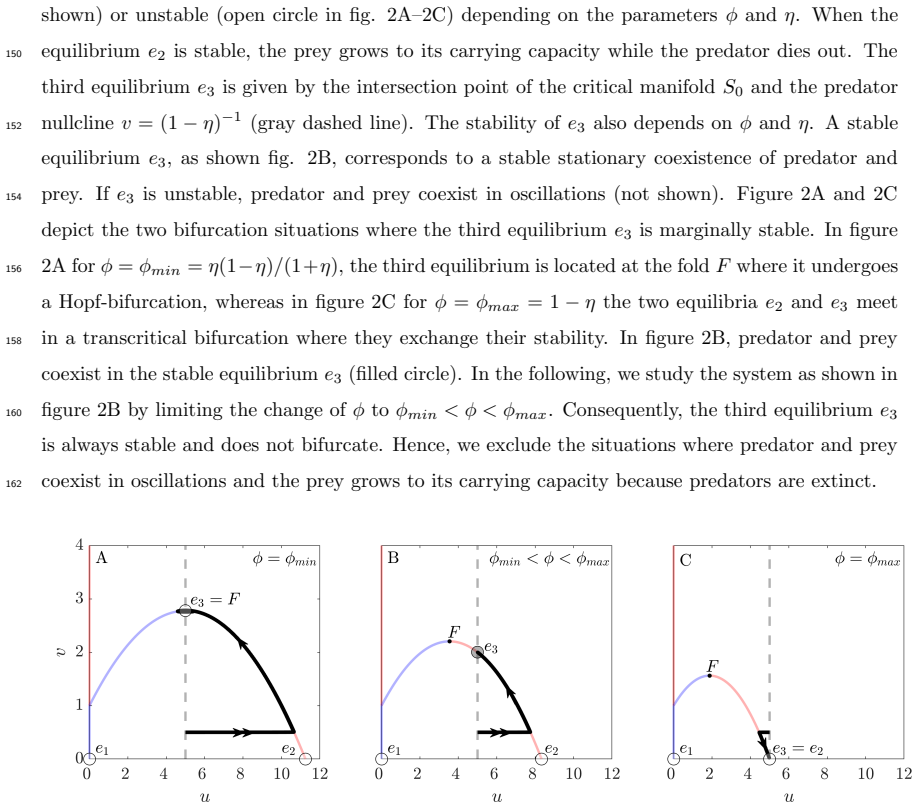
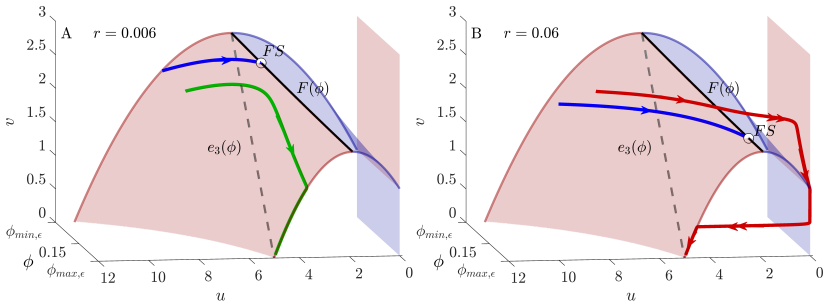
The central discovery is that the ramped Rosenzweig-MacArthur system—fast prey, slower predator, and a third equation that linearly increases $\phi$ (proportional to the inverse carrying capacity)—has a critical rate of environmental change below the slowest ecosystem timescale. When the ramping rate exceeds that critical rate, an initial state on the stable part of the folded critical manifold is drawn to the fold and jumps off in the fast direction, sending prey density to extremely low values while predator density remains high; the resulting overconsumption produces a temporary collapse of the prey population. This happens in a parameter range in which the coexistence equilibrium is linearly stable for every fixed $\phi$, so standard stability analysis would see no danger. The paper computes the boundary between tracking and tipping as the singular/maximal canard trajectory through the folded saddle singularity; it is generic because two slow variables (predator density and $\phi$) are present. The same threshold can be converted into a critical ramping rate and into a description of all collapse-prone initial states.
Load-bearing premise
The result rests on a strong timescale separation, $\kappa = 0.01$ in all simulations, because the canard threshold is an asymptotic object whose accuracy at finite $\kappa$ is not tested across the cited ecological range $\kappa \in [0.01,0.08]$.
Editorial extensions
If this is right
- An environmental change that never leaves the range where a stable coexistence equilibrium exists can still collapse the prey population, provided the rate of change crosses the canard threshold.
- The critical rate is not fixed by the ecosystem alone: it is smaller for longer predator handling times (inefficient predators) and larger for shorter handling times, following a highly nonlinear curve.
- For a fixed ramping rate, the paper gives the full set of initial predator and prey densities that are collapse-prone; increasing the rate expands that set and can turn a tracking initial state into a tipping one.
- The collapse is temporary in the deterministic model, but it leaves the prey at very low density, so with demographic or environmental noise the likely endpoint is extinction and breakdown of the system.
- Observed regime shifts may be rate-induced rather than bifurcation-induced, so classifying a transition by stability analysis alone can miss the actual mechanism.
Reading between the lines
- If the folded-saddle/canard mechanism is generic for systems with two slow variables, the same rate-induced collapse should appear in other population and ecosystem models whose critical manifold has a fold and whose environment is ramped; this could be tested in model families before field confirmation exists.
- The mathematical critical rate (where the trajectory crosses the fold) and the ecological critical rate (where prey density drops below a conservation threshold) can differ substantially, so management targets should state which threshold they are using.
- Adding noise to the ramped system should make the extinction probability depend on how long the prey spends at low density during the collapse; measuring that duration would quantify the extinction risk.
- Because tipping here occurs without any loss of linear stability, variance-based early-warning signals would not precede it; monitoring the rate of environmental change itself may be a more practical warning indicator.
Signed reviews
Editorial analysis
A structured set of objections, weighed in public.
Referee Report
Summary. The paper studies the three-dimensional slow-fast Rosenzweig-MacArthur model (Eqs. 9–11) in which the carrying capacity declines linearly in time (φ increases at rate r). For an initial condition on the coexistence equilibrium e3(φ0) close to the fold, the authors show numerically that there is a critical ramp rate between r = 0.005 and r = 0.006 at which the system switches from tracking the moving equilibrium to a rate-induced critical transition in which the prey density temporarily collapses. They explain the mechanism using geometric singular perturbation theory: the reduced dynamics on the folded critical manifold has a folded saddle singularity, and the singular canard emanating from it separates tracking from tipping. They derive the folded saddle coordinates analytically (Appendix E), compute the singular canard as the tipping threshold (Figs. 5–7), characterize the set of collapse-prone initial conditions, and study the dependence of the critical rate on the predator's handling time η (Appendices D and F). Numerical simulations of the original three-dimensional system confirm the predicted threshold at κ = 0.01.
Significance. The result is significant because it transfers the concept of rate-induced critical transitions to a canonical ecological model with an ecologically motivated forcing (declining resource/carrying capacity), and it produces an analytic, parameter-free tipping threshold (the singular canard) rather than a fitted quantity. The claim that collapse can occur for ramp rates slower than the slowest intrinsic timescale is counterintuitive and is well explained through the fast-moving equilibrium argument. The paper also gives falsifiable predictions: the critical rate as a function of η and the location of collapse-prone initial states. Strengths include the explicit derivation of the desingularized system, the folded-saddle analysis, and the direct numerical verification in the original system. The main weakness is the lack of validation across the ecological timescale-separation range cited in the paper.
major comments (2)
- [Section 3 and Figs. 3–7, D.1, F.1] All numerical simulations fix κ = 0.01, which is the lower bound of the ecological range κ ∈ [0.01, 0.08] cited from Edwards and Brindley (1999). The singular canard is a κ → 0 construction, and the distance between the singular and maximal canards is O(κ), with additional effects near the fold; at κ = 0.08 the time-scale separation is only about a factor of 12 and the normal-hyperbolicity assumptions weaken. Since the paper's quantitative predictions (critical rates, collapse-prone initial-state region) are used to draw conclusions for natural plankton systems across this whole range, the authors should simulate the original system (9)–(11) for at least two larger κ values (e.g., κ = 0.04 and κ = 0.08) and report how the tipping threshold and critical rates deviate from the singular-canard prediction. This is a load-bearing missing check for the ecological claim.
- [Section 4 and Fig. 6] The paper identifies the maximal canard as the tipping threshold but computes only the singular canard (κ = 0), and the verification in Fig. 6 is visual rather than quantitative. Because the threshold underpins the collapse-prone sets in Figs. 5–7 and the critical rates in Fig. F.1, I ask for a quantitative check at κ = 0.01, for example by bisection in u0 for fixed v0 and φ0 to locate the actual threshold in the original system and comparing it with the singular canard curve. This would also provide a baseline for the κ-robustness test requested above.
minor comments (5)
- [Appendix E, text after Eq. (E.16)] The stated time rescaling t = −2φη(u_F − u)s has the wrong sign; with that choice one would obtain du/ds = −Λ, whereas Eqs. (E.17)–(E.18) follow from t = +2φη(u_F − u)s. The desingularized equations appear correct, but the text should be fixed.
- [Title and Abstract] The phrase 'collapse of a predator-prey system' is stronger than the demonstrated dynamics, in which the prey density temporarily collapses and then the system recovers to the coexistence equilibrium (Section 3, Fig. 1C). The authors correctly state the temporary nature in the body and discuss the role of noise in converting it to extinction, but the title and abstract should be tempered (e.g., 'temporary collapse') to avoid overstating the deterministic result.
- [Section 1] The text near line 102 reads 'whitin a bounded φ-interval'; this should be 'within a bounded φ-interval'. Also, the citation '(S. Sakar and P.S. Dutta, unpublished manuscript)' is not listed in the reference list and should either be removed or given a full reference.
- [Appendix F and Fig. F.1] There are two typos: 'the back dashed line' should be 'the black dashed line', and the text uses 'black solid line' for two different curves in the same paragraph; please re-read the caption and surrounding text of Fig. F.1 for consistency.
- [Fig. 3B caption] The caption states u0 = (1−η)^−1 and v0 = (1−φ0u0)(1 + ηu0); it may help the reader to note explicitly that this initial condition is exactly the coexistence equilibrium e3(φ0) on the critical manifold.
Circularity Check
No significant circularity: the tipping threshold is derived from the model equations and confirmed by simulation, not fitted.
full rationale
The paper's central derivation is self-contained. The tipping threshold is obtained analytically from the ramped Rosenzweig-MacArthur system by forming the reduced system on the critical manifold, desingularizing it (Appendix E, Eqs. E.17-E.18), and identifying the folded saddle singularity and its stable manifold as the singular canard. No parameter is fitted to the observed collapse; the numerical simulations of the original system (Figs. 3, 4, 6, D.1, F.1) are used to confirm the analytically computed threshold, and the eigenvector approximation of the critical rate in Appendix F is explicitly checked against direct numerical simulation of the desingularized system and against the full-system collapse criterion. Citations to Wieczorek et al. (2011) and Perryman and Wieczorek (2014) supply the general fast-slow/canard framework, but the specific threshold for this model is computed from the model's own equations rather than imported as an unverified conclusion. The restriction of numerical verification to kappa = 0.01 and the possible sign typo in the desingularization rescaling are robustness or correctness concerns, not evidence that any prediction reduces by construction to an input. Accordingly, no circular step meeting the required standard is present.
Assumptions & free parameters
free parameters (6)
- kappa (timescale separation) =
0.01
- eta (handling time) =
0.8 (main figures), scanned 0.1-0.9
- phi_0 (initial resource level) =
0.1
- r (rate of environmental change) =
0.006 (demonstration), critical values computed
- u_e (conservation threshold) =
0.2
- epsilon (ramp buffer) =
1e-6
assumptions (5)
- standard math Fenichel normal hyperbolicity and the existence of slow manifolds for 0<kappa<<1
- standard math One-to-one correspondence between the singular canard and the maximal canard for a folded saddle singularity
- domain assumption The linear rate ramp dphi/dt = r is an adequate model of habitat-quality decline
- ad hoc to paper kappa = 0.01 is small enough for the asymptotic canard theory to apply quantitatively
- domain assumption Temporary collapse to near-zero prey density is an ecologically meaningful proxy for extinction risk
Cite this review
Pith. "Pith review of When very slow is too fast -- collapse of a predator-prey system." pith.science (2026). https://pith.science/paper/SX4WAQIN
@misc{pith2026190805507,
  author       = {Pith},
  title        = {Pith review of: When very slow is too fast -- collapse of a predator-prey system},
  year         = {2026},
  howpublished = {\url{https://pith.science/paper/SX4WAQIN}},
  note         = {Machine review of arXiv:1908.05507}
}
read the original abstract
Critical transitions or regime shifts are sudden and unexpected changes in the state of an ecosystem, that are usually associated with dangerous levels of environmental change. However, recent studies show that critical transitions can also be triggered by dangerous rates of environmental change. In contrast to classical regime shifts, such rate-induced critical transitions do not involve any obvious loss of stability, or a bifurcation, and thus cannot be explained by the linear stability analysis. In this work, we demonstrate that the well-known Rosenzweig-MacArthur predator-prey model can undergo a rate-induced critical transition in response to a continuous decline in the habitat quality, resulting in a collapse of the predator and prey populations. Rather surprisingly, the collapse occurs even if the environmental change is slower than the slowest process in the model. To explain this counterintuitive phenomenon, we combine methods from geometric singular perturbation theory with the concept of a moving equilibrium, and study critical rates of environmental change with dependence on the initial state and the system parameters. Moreover, for a fixed rate of environmental change, we determine the set of initial states that undergo a rate-induced population collapse. Our results suggest that ecosystems may be more sensitive to how fast environmental conditions change than previously assumed. In particular, unexpected critical transitions with dramatic ecological consequences can be triggered by environmental changes that (i) do not exceed any dangerous levels, and (ii) are slower than the natural timescales of the ecosystem. This poses an interesting research question whether regime shifts observed in the natural world are predominantly rate-induced or bifurcation-induced.
Figures


Figures from the paper (4 more)


Reference graph
Works this paper leans on
-
[1]
Aberhan, M. and Kiessling, W. (2015). Persistent ecological shifts in marine molluscan assemblages across the end-Cretaceous mass extinction . Proceedings of the National Academy of Science of the USA , 112:7207--7212
work page 2015
-
[2]
A., Matsuda, H., and Harada, Y
Abrams, P. A., Matsuda, H., and Harada, Y. (1993). Evolutionary unstable fitness maxima and stable fitness minima of continuous traits . Evolutionary Ecology , 7:465--487
work page 1993
-
[3]
Adam, T. C., Schmitt, R. J., Holbrook, S. J., Brooks, A. J., Edmunds, P. J., Carpenter, R. C., and Bernardi, G. (2011). Herbivory, connectivity, and ecosystem resilience: Response of a coral teef to a large-scale perturbation . PLoS ONE , 6(8):e23717
work page 2011
-
[4]
Agler, B. A., Kendell, S. J., Irons, D. B., and Klosiewski, S. (1999). Decline in marine bird populations in Prince William Sound, Alaska coincident with a climatic regime shift . Waterbirds: The International Journal of Waterbird Biology , 22(1):98--103
work page 1999
-
[5]
Ashwin, P., Wieczorek, S., Vitolo, R., and Cox, P. (2012). Tipping points in open systems: bifurcation, noise-induced and rate-dependet examples in the climate system . Philosophical Transactions of the Royal Society A , 370:1166--1184
work page 2012
-
[6]
Bathiany, S., Scheffer, M., van Nes, E. H., M.S., W., and Lenton, T. M. (2018). Abrupt climate change in an oscillating world . Scientific Reports , 8(1):5040
work page 2018
-
[7]
Bazykin, A. D. (1998). Nonlinear dynamics of interacting populations , volume 11. World Scientific Publishing Co. Pte. Ltd., Singapore
work page 1998
-
[8]
Berryman, A. A. (1992). The Orgins and Evolution of Predator-Prey Theory . Ecology , 73(5):1530--1535
work page 1992
Show all 73 references
-
[9]
Claussen, M., Bathiany, S., Brovkin, V., and Kleinen, T. (2013). Simulated climate–vegetation interaction in semi-arid regions affected by plant diversity . Nature Geoscience , 6:954
2013
-
[10]
Cortez, M. H. and Ellner, S. P. (2010). Understanding rapid evolution in predator-prey interactions using the theory of fast-slow dynamical systems . The American Naturalist , 176(5):109--127
2010
-
[11]
R., Aronson, R
Dudgeon, S. R., Aronson, R. B., Bruno, J. F., and Precht, W. F. (2010). Phase shifts and stable states on coral reefs . Marine Ecology Progress Series , 413:201--216
2010
-
[12]
and Roussarie, R
Dumortier, F. and Roussarie, R. (1996). Canard cycles and center manifolds (with an appendix by Chengzhi Li) . Memoirs of the American Mathematical Society, Providence, 577 edition
1996
-
[13]
Edwards, A. M. and Brindley, J. (1999). Zooplankton Mortality and the Dynamical Behaviour of Plankton Population Models . Bulletin of Mathematical Biology , 61:303--339
1999
-
[14]
J., Veraart, A
Faassen, E. J., Veraart, A. J., Nes, E. H. V., Dakos, V., L \" u rling, M., and Scheffer, M. (2015). Hysteresis in an experimental phytoplankton population . Oikos , (124):1617--1623
2015
-
[15]
Fenichel, N. (1979). Geometric singular perturbation theory for ordinary differential equations . Journal of Differential Equations , 31:53--98
1979
-
[16]
and Lindenmayer, D
Fischer, J. and Lindenmayer, D. B. (2007). Landscape modification and habitat fragmentation: a synthesis . Global Ecology and Biogeography , 16:265--280
2007
-
[17]
A., Coe, M
Foley, J. A., Coe, M. T., Scheffer, M., and Wang, G. (2003). Regime shifts in the Sahara and Sahel: interactions between ecological and climatic systems in Northern Africa . Ecosystems , 6(6):524--532
2003
-
[18]
Folke, C., Carpenter, S., Walker, B., Scheffer, M., Elmqvist, Thomas Gunderson , L., and Holling, C. S. (2004). Regime shifts, resilience, and biodiversity in ecosystem management . Annual Review of Ecology, Evolution, and Systematics , 35(1):557--581
2004
-
[19]
Ginzburg, L. R. (1998). Assuming reproduction to be a function of consumption raises doubts about some popular predator-prey models . Journal of Animal Ecology , 67(2):325--327
1998
-
[20]
K., Beusen, A., and Drecht, G
Goldewijk, K. K., Beusen, A., and Drecht, G. V. (2011). The HYDE 3.1 spatially explicit database of human-induced global land-use change over the past 12,000 years . Global Ecology and Biogeography , 20:73--86
2011
-
[21]
Gunderson, L. H. (2001). Managing surprising ecosystems in southern Florida . Ecological Economics , 37:371--378
2001
-
[22]
Hastings, A. (1997). Population biology . Springer, New York
1997
-
[23]
Hek, G. (2010). Geometric singular perturbation theory in biological practice . Journal of Mathematical Biology , 60:347--386
2010
-
[24]
N., Graham, N
Hempson, T. N., Graham, N. A. J., MacNeil, A. M., Hoey, A. S., and Wilson, S. K. (2018). Ecosystem regime shifts disrupt trophic structure . Ecological Applications , 28(1):191--200
2018
-
[25]
Holling, C. (1973). Resilience and stability of ecological systems . Annual Review of Ecology and Systematics , 4:1--23
1973
-
[26]
and Spahni, R
Joos, F. and Spahni, R. (2008). Rates of change in natural and anthropogenic radiative forcing over the past 20,000 years . Proceedings of the National Academy of Science of the USA , 105:1425--1430
2008
-
[27]
Jump, A. S. and Penuelas, J. (2005). Running to stand still: adaptation and the response of plants to rapid climate change . Ecological Letters , 8:1010--1020
2005
-
[28]
and Poggiale, J.-C
Kooi, B. and Poggiale, J.-C. (2018). Modelling, singular perturbation and bifurcation analyses of bitrophic food chains. Mathematical Biosciences , 301:93--110
2018
-
[29]
H., de los A.G
Kosten, S., Vernooij, M., van Nes, E. H., de los A.G. Sagrario , M., Clevers, J. G. P. W., and Scheffer, M. (2012). Bimodal transparency as an indicator for alternative states in South American lakes . Freshwater Biology , 57:1191--1201
2012
-
[30]
and Szmolyan, P
Krupa, M. and Szmolyan, P. (2001). Relaxation oscillation and canard explosion . Journal of Differential Equations , 174:312--368
2001
-
[31]
Lande, R. (1982). A quantitative genetic theory of life history evolution . Ecology , 63(3):607--615
1982
-
[32]
Lenton, T. M. (2013). Environmental Tipping Points . Annual Review of Environment and Resources , 38:1--29
2013
-
[33]
M., Held, H., Kriegler, E., Hall, J
Lenton, T. M., Held, H., Kriegler, E., Hall, J. W., Lucht, W., Rahmstorf, S., and Schellmhuber, H. J. (2008). Tipping elements in the Earth's climate system . Proceedings of the National Academy of Science of the USA , 105(6):1786--1793
2008
-
[34]
and Bascompte, J
Liephold, A. and Bascompte, J. (2003). The Allee effect, stochastic dynamics and the eradication of alien species . Ecology Letters , 6:133--140
2003
-
[35]
and Cox, P
Luke, C. and Cox, P. (2010). Soil carbon and climate change: From the Jenkinson effect to the compost-bomb instability . European Journal of Soil Science , 62:5--12
2010
-
[36]
May, R. (1977). Thresholds and breakpoints in ecosystems with a multiplicity of stable states . Nature , 269:471--477
1977
-
[37]
McCook, L. (1999). Macroalgae, nutrients and phase shifts on coral reefs: Scientific issues and management consequences for the Great Barrier Reef . Coral Reefs , 18:357--367
1999
-
[38]
Morris, J., Sundareshwar, P., Nietch, C., Kjerfve, B., and Cahoon, D. (2002). Response of coastal wetlands to rising sea level . Ecology , 83:2869--2877
2002
-
[39]
and Boitani, L
Mortelliti, A. and Boitani, L. (2008). Interaction of food resources and landscape structure in determining the probability of patch use by carnivores in fragmented landscapes . Landscape Ecology , 23:285--298
2008
-
[40]
Nes, E. H. V., Amaro, T., Scheffer, M., and Duineveld, G. C. A. (2007). Possible mechanisms for a marine benthic regime shift in the North Sea . Marine Ecology Progress Series , 330:39--47
2007
-
[41]
O'Keeffe, P. E. and Wieczorek, S. (2019). Tipping phenomena and points of no return in ecosystems: Beyond classical bifurcations. arXiv preprint arXiv:1902.01796
2019 arXiv
-
[42]
Parmesan, C., Ryrholm, N., Stefanescu, C., Hill, J., Thomas, C., Descimon, H., and Huntley, B. (1999). Polewards shifts in geographical ranges of butterfly species associated with regional warming . Nature , 399:579--583
1999
-
[43]
and Wieczorek, S
Perryman, C. and Wieczorek, S. (2014). Adapting to a changing environment: non-obvious thresholds in multi-scale systems . Proceedings of the Royal Society A , 470:20140226
2014
-
[44]
L., Jensen, O
Pinsky, M. L., Jensen, O. P., Ricard, D., and Palumbi, S. R. (2011). Unexpected patterns of fisheries collapse in the world’s oceans . Proceedings of the National Academy of Science of the USA , 108(20):8317--8322
2011
-
[45]
Poggiale, J.-C., Aldebert, C., Girardot, B., and Kooi, B. (2019). Analysis of a predator–prey model with specific time scales: a geometrical approach proving the occurrence of canard solutions. Journal of Mathematical Biology
2019
-
[46]
and Coomes, O
Ramankutty, N. and Coomes, O. T. (2016). Land-use regime shifts: an analytical framework and agenda for future land-use research . Ecology and Society , 21(2)
2016
-
[47]
and Muratori, S
Rinaldi, S. and Muratori, S. (1992). Slow-fast limit cycles in predator-prey models. Ecological Modelling , 61:287--308
1992
-
[48]
Rocha, J., Yletyinen, J., Biggs, R., Blenckner, T., and G., P. (2015). Marine regime shifts: drivers and impacts on ecosystems services . Philosophical Transactions of the Royal Society B , 370:20130273
2015
-
[49]
and MacArthur, R
Rosenzweig, M. and MacArthur, R. H. (1963). Graphical Representation and Stability Conditions of Predator-Prey Interactions . The American Naturalist , 97(895):209--223
1963
-
[50]
Rosenzweig, M. L. (1971). Paradox of enrichment: Destabilization of exploitation ecosystems in ecological time. Science , 171(3969):385--387
1971
-
[51]
A., Brovkin, V., Carpenter, S., Dakos, V., Held, H., van Nes, E
Scheffer, M., Bascompte, J., Brock, W. A., Brovkin, V., Carpenter, S., Dakos, V., Held, H., van Nes, E. H., Rietkerk, M., and Sugihara, G. (2009). Early-warning signals for critical transitions . Nature , 461:53--59
2009
-
[52]
and Carpenter, S
Scheffer, M. and Carpenter, S. (2003). Catastrophic regime shifts in ecosystems: linking theory to observation . Trend in Ecology and Evolution , 18(12):648--656
2003
-
[53]
A., Folke, C., and Walker, B
Scheffer, M., Carpenter, S., Foley, J. A., Folke, C., and Walker, B. (2001). Catastrophic shifts in ecosystems . Nature , 413:591--596
2001
-
[54]
R., Lenton, T
Scheffer, M., Carpenter, S. R., Lenton, T. M., Bascompte, J., Brock, W. A., Dakos, V., Koppel van de, J., van de Leemput, I. A., Levin, S. A., van Nes, E. H., Pascual, M., and Vandermeer, J. (2012). Anticipating critical transitions . Science , 338(6105):344--348
2012
-
[55]
Scheffer, M., Rinaldi, S., Gragnani, A., Mur, L., and van Nes, E. H. (1997). On the dominance of filamentous cyanobacteria in shallow, turbid lakes . Ecology , 78:272--282
1997
-
[56]
H., Holmgren, E., and Hughes, T
Scheffer, M., van Nes, E. H., Holmgren, E., and Hughes, T. (2008). Pulse-driven loss of top-down control: The critical rate hypthesis . Ecosystems , 11:226--237
2008
-
[57]
E., McGeoch, M
Selwood, K. E., McGeoch, M. A., and Mac Nally , R. (2015). The effects of climate change and land-use change on demographic rates and population viability . Biological Reviews , 90:837--853
2015
-
[58]
Sih, A. (2013). Understanding variation in behavioural responses to human-induced rapid environmental change: a conceptual overview . Animal Behaviour , 85:1077--1088
2013
-
[59]
O., and Harris, D
Sih, A., Ferrari, M. O., and Harris, D. J. (2011). Evolutionary and behavioural responses to human-induced rapid environmental change . Evolutionary Applications , 4:367--387
2011
-
[60]
Siteur, K., Eppinga, M., Doelman, A., Siero, E., and Rietkerk, M. (2016). Ecosystems off track: rate-induced critical transitions in ecological models . Oikos , 125:1689--1699
2016
-
[61]
J., Edmonds, J., Hartin, C
Smith, S. J., Edmonds, J., Hartin, C. A., Mundra, A., and Calvin, K. (2015). Near-term accelaration in the rate of termperature change . Nature Climate Change , 5:333--336
2015
-
[62]
Steele, J. H. (1996). Regime shifts in fisheries management . Fisheries Research , 25(1):19--23
1996
-
[63]
N., Gross, K
Suding, K. N., Gross, K. L., and Houseman, G. R. (2004). Alternative states and positive feedbacks in restoration ecology . Trend in Ecology and Evolution , 19(1):46--53
2004
-
[64]
and Wechselberger, M
Szmolyan, P. and Wechselberger, M. (2001). Canards in R \^ 3 . Journal of Differential Equations , 177:419--453
2001
-
[65]
and Lennon, J
Thomas, C. and Lennon, J. (1999). Birds extent their ranges northwards . Natrue , 399:213
1999
-
[66]
van Nes, E. H. and Scheffer, M. (2007). Slow recovery from perturbations as a generic indicator of a nearby catastrophic shift . The American Naturalist , 169(6):738--747
2007
-
[67]
Walther, G.-r., Post, E., Convey, P., Menzel, A., Parmesan, C., Beebee, T. J. C., Fromentin, J.-m., I, O. H.-g., and Bairlein, F. (2002). Ecological responses to recent climate change . Nature , 416:389--395
2002
-
[68]
Wechselberger, M., Mitry, J., and Rinzel, J. (2013). Canard Theory and Excitability . In Kloeden, P. and Poetzsche, C., editors, Nonautonomous dynamical systems in the life science , pages 89--132. Springer International Publishing, Berlin
2013
-
[69]
C., de Bettignies, T., Cure, K., Depcynski, M., Dufois, F., Fromont, J., Fulton, C
Wernberg, T., Bennett, S., Babock, R. C., de Bettignies, T., Cure, K., Depcynski, M., Dufois, F., Fromont, J., Fulton, C. J., Hovey, R. K., Harvey, E. S., Holmes, T. H., Kendrick, G. A., Radford, B., Santana-Garcon, J., Saunders, B. J., Smale, D. A., Thomsen, M. S., Tuckett, C...
2016
-
[70]
West, G. B. and Brown, J. H. (2005). The origin of allometric scaling laws in biology from genomes to ecosystems: towards a quantitative unifying theory of biological structure and organization . The Journal of Experimental Biology , 208:1575--1592
2005
-
[71]
Wieczorek, S., Ashwin, C., Luke, C., and Cox, P. (2011). Excitability in ramped systems: the compost-bomb instability . Proceedings of the Royal Society of London , 467:1243--1269
2011
-
[72]
P., Fussmann, G., and Hairston Jr
Yoshida, T., Jones, L., Ellner, S. P., Fussmann, G., and Hairston Jr. , N. (2003). Rapid evolution drives ecological dynamics in a predator-prey system . Nature , 424:303--306
2003
-
[73]
Zanette, L., Doyle, P., and Tremont, S. (2000). Food shortage in small fragments: evidence from an area-sensitive passerine . Ecology , 81:1654--1666
2000
Reviewed August 14, 2026 · model on record in the stance chip above.
Discussion (0). Continue with ORCID to comment.