REVIEW 3 major objections 4 minor 46 references
Enhancing the speed and sensitivity of a nonlinear optical sensor with noise
T0 review · 3 major / 4 minor · reviewed 2026-08-14 · deepseek-v4-flash
Pith's one-line read A bistable optical cavity can detect a shift of about 0.3% of its linewidth within roughly 10 nanoseconds, with the cavity's own noise doing the work.
desk verdict A clean, well-written numerical proposal for noise-assisted residence-time sensing in a bistable cavity, with a serious but checkable noise-correlation bug in Eq. (1) that the author must fix before the quantitative claims stand. read the letter →
The pith
A machine-rendered reading of the paper's core claim, the machinery that carries it, and where it could break.
The reading
What carries the argument
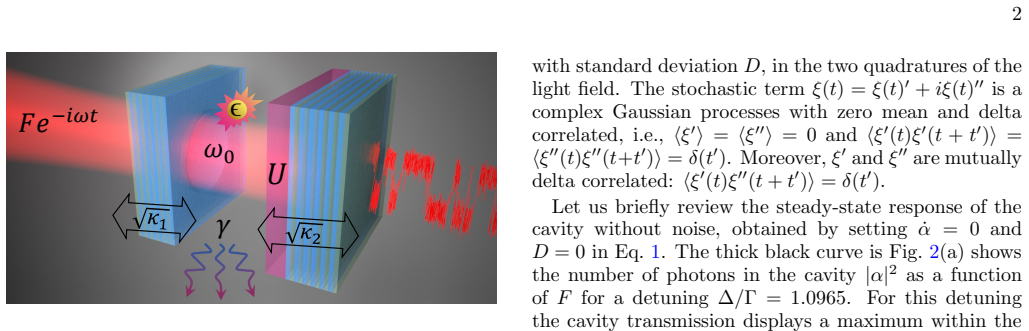
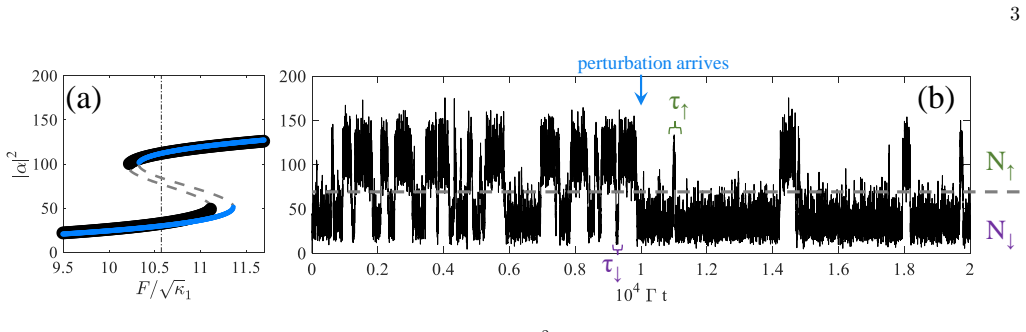
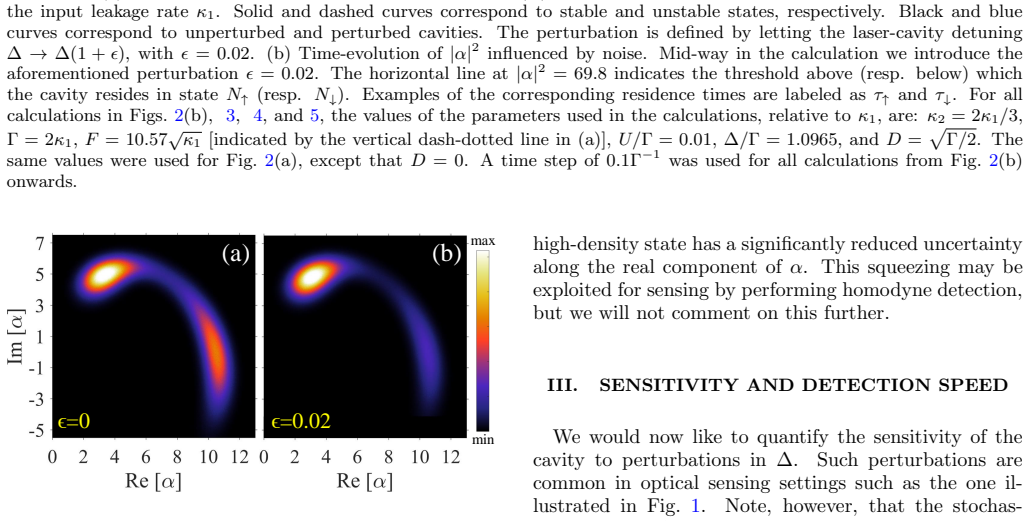
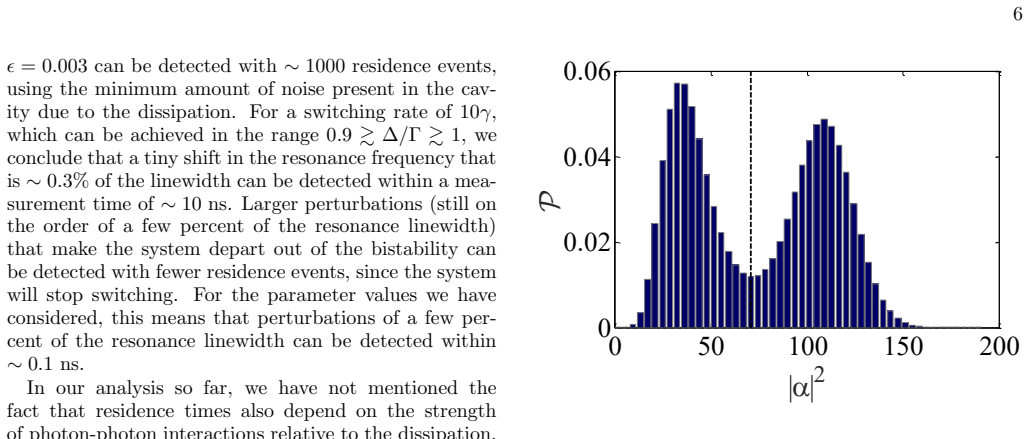
The load-bearing object is the residence-time difference (RTD) of a bistable optical cavity, generated by a stochastic mean-field equation for the intracavity field $\alpha$: $i\dot{\alpha} = (-\Delta - i\Gamma/2 + U(|\alpha|^2 - 1))\alpha + i\sqrt{\kappa_1}F e^{-i\omega t} + D\xi(t)$, with complex white noise $\xi(t)$ of standard deviation $D$. This is the truncated Wigner approximation, valid when the photon-photon interaction is weak compared with the loss rate, $U/\Gamma \ll 1$, as in the paper's choice $U/\Gamma = 0.01$. The RTD is defined by choosing a threshold photon number $N_{\mathrm{th}}$ at the minimum of the bimodal photon-number distribution, then measuring the intervals the system spends above and below that threshold. Classical barrier-escape theory supplies the interpretation: the perturbation tilts the effective double-well potential, and the asymmetry of the residence times is the readout. The detection threshold $|\delta\tau_0 - \delta\tau_\epsilon| > \sigma_0 + \sigma_\epsilon$ sets the number of switching events needed, and the paper's central numerical result is how that number depends on noise strength and perturbation size.
What would settle it
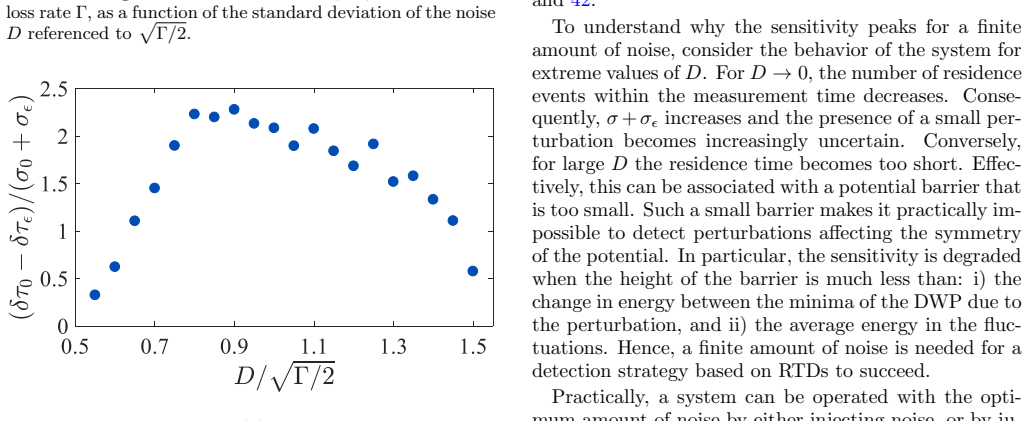
Fix a bistable cavity at the parameters of the paper's Fig. 7, apply a calibrated detuning perturbation $\epsilon = 0.003$, and measure residence-time statistics while varying the injected noise standard deviation $D$; the central claim predicts that within a fixed measurement window the detection metric $(|\delta\tau_0 - \delta\tau_\epsilon|)/(\sigma_0 + \sigma_\epsilon)$ rises and then falls with $D$. Observing that this metric increases monotonically with $D$, or that it peaks far from $D \approx 0.9\sqrt{\Gamma/2}$, would falsify the claim. A second, model-level check is to run a full quantum master equation at $U/\Gamma = 0.01$ and compare the residence-time distributions with the truncated Wigner predictions; significant disagreement would remove the numerical support.
Extended reading notes
Core claim
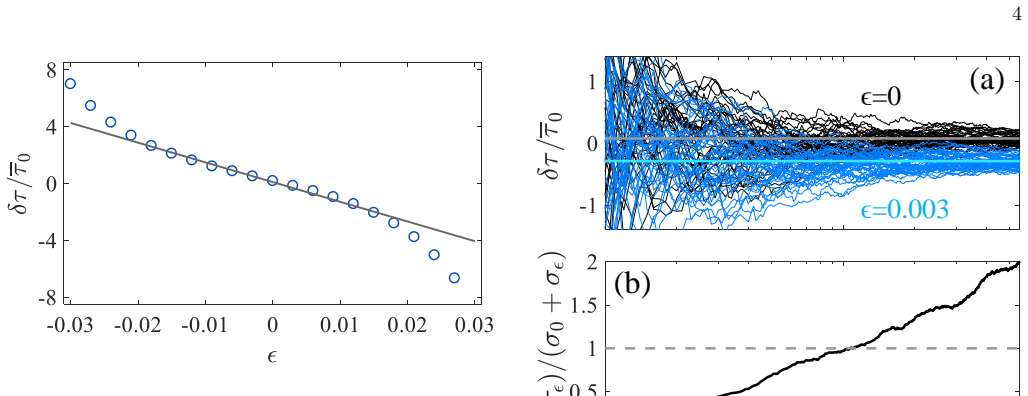
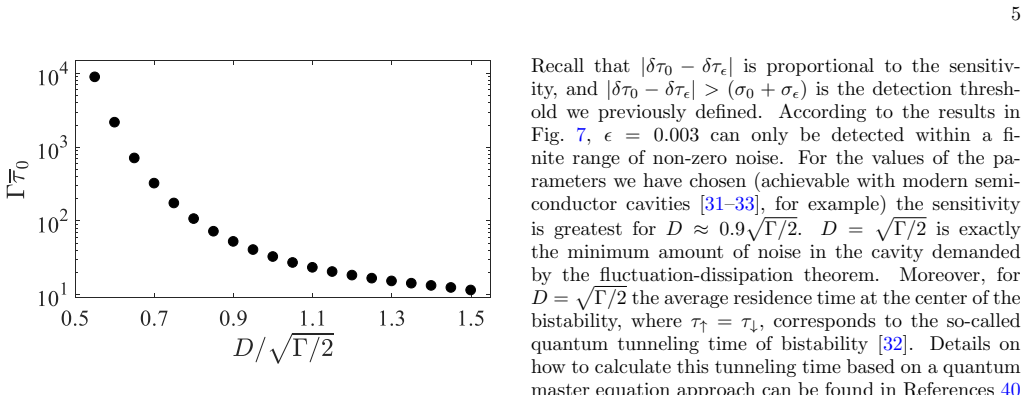
The central claim is that a bistable single-mode optical cavity acts as a residence-time-difference sensor whose performance improves with noise up to a point. The cavity is driven by a continuous laser; because of the Kerr nonlinearity and the chosen detuning, it has two stable photon-number states, and white noise makes it switch between them, like a particle escaping over a barrier between two wells. A perturbation $\epsilon$ to the resonance frequency (modelled as $\Delta \rightarrow \Delta(1+\epsilon)$) tilts the potential and shifts the average residence-time difference $\delta\tau = \tau_{\uparrow} - \tau_{\downarrow}$. For small $\epsilon$ the shift is linear, with a fitted sensitivity $S = 138.6 \pm 9$ s; using the detection criterion $|\delta\tau_0 - \delta\tau_\epsilon| > \sigma_0 + \sigma_\epsilon$, the paper finds that $\epsilon = 0.003$, roughly 0.3% of the linewidth, can be detected with about 1000 residence events, which for $\Gamma = 10$ GHz and a switching rate of $10\gamma$ corresponds to about 10 ns. Over a fixed measurement time, increasing the noise standard deviation $D$ shortens the residence times and raises the number of switching events, so detection speed rises monotonically with $D$, while sensitivity peaks near $D \approx 0.9\sqrt{\Gamma/2}$, just below the fluctuation-dissipation minimum $D = \sqrt{\Gamma/2}$.
Load-bearing premise
The results assume the semiclassical truncated Wigner equation with white noise is a faithful model of the cavity, which the paper itself says fails when the photon-photon interaction approaches the loss rate ($U/\Gamma \sim 1$).
Editorial extensions
If this is right
- A single-mode nonlinear resonator can serve as a detector of sub-linewidth resonance-frequency shifts without requiring any periodic modulation, lock-in detection, or heterodyne readout.
- The minimum noise set by the fluctuation-dissipation theorem is already enough to reach the sensing regime, so no additional engineered noise source is needed and the sensor can operate at low optical powers.
- For parameters typical of semiconductor cavities ($\Gamma = 10$ GHz, $U/\Gamma = 0.01$), perturbations of a few percent of the linewidth that push the system out of bistability could be detected within roughly 0.1 ns.
- The scheme transfers to any single-mode nonlinear resonator, including microdisks, ring resonators, photonic-crystal cavities, and levitated nanoparticles, with the caveat that thermally induced bistability limits the maximum speed.
- Operating above the sensitivity peak can be globally optimal: raising $D/\sqrt{\Gamma/2}$ from 0.8 to 1.2 lowers the residence-time shift by about 7% but increases the number of switching events per unit time by about 460%.
Reading between the lines
- The paper leaves implicit that deliberately injecting extra white noise beyond the fluctuation-dissipation minimum could trade a few percent of sensitivity for a large gain in events per second, pushing detection below the quoted 10 ns for the same perturbation.
- A neighbouring problem this bears on is exceptional-point sensing: the same residence-time readout could be applied to a bistable resonator operated near an exceptional point, where the linear-sensor noise limits discussed in the introduction are exactly what this scheme sidesteps.
- A testable extension is to repeat the analysis with coloured or non-Markovian noise, since real noise sources have finite correlation times; the monotone speed claim may hold only for white noise.
- The linear small-$\epsilon$ calibration curve combined with the nonlinear large-$\epsilon$ response implies the sensor could serve two modes: calibrated fine detection below about 1% linewidth shifts and fast threshold detection for few-percent shifts that quench switching.
Signed reviews
Editorial analysis
A structured set of objections, weighed in public.
Referee Report
Summary. The paper proposes a sensing scheme based on a bistable nonlinear optical cavity driven by noise. The cavity is driven into a bistable regime, and random switching between two states is monitored through residence times. A perturbation of the resonance frequency, modeled as a change in detuning, biases the residence-time difference (RTD), and the paper studies the sensitivity S = ∂δτ/∂ε and the number of residence events needed to detect a small perturbation. Using stochastic simulations in the truncated Wigner approximation with the xSPDE package, the author finds that the detection speed increases monotonically with the noise standard deviation D while the sensitivity peaks at a finite D, and claims that a detuning perturbation ε = 0.003 can be detected within about 10 ns at the minimum noise level D = sqrt(Γ/2). The appendix defines the threshold photon number separating the two states from the bimodal photon-number distribution.
Significance. If the central claims hold, the paper offers a conceptually interesting counterpoint to the usual view that noise degrades linear sensors: in a bistable cavity, adding noise can speed up detection, and there is an optimal noise level for sensitivity. The main strengths are the explicit definition of the detection threshold, the careful averaging over noise seeds, the clear discussion of statistical spread, and the honest acknowledgment that the truncated Wigner approximation breaks down for U/Γ ~ 1. However, the quantitative conclusions rest on a single parameter set and on a semiclassical stochastic model without experimental validation; moreover, as detailed below, the noise definition in Eq. (1) needs clarification because it is not the standard independent-quadrature noise, and the timing estimate for the ~10 ns claim appears internally inconsistent with the stated parameters.
major comments (3)
- [Eq. (1)] Equation (1) defines the complex Gaussian noise through ⟨ξ′(t)ξ′(t+t′)⟩ = ⟨ξ″(t)ξ″(t+t′)⟩ = δ(t′) and ⟨ξ′(t)ξ″(t+t′)⟩ = δ(t′). As written, the two quadrature noises are perfectly correlated rather than independent, making the diffusion anisotropic and the noise covariance matrix singular. Since the residence-time statistics, and hence the sensitivity S in Fig. 4, the detection threshold in Fig. 5, and the D-dependence in Figs. 6–7, are all extracted from this stochastic model, a nonzero cross-correlation can change Kramers escape rates and therefore every quantitative conclusion. Please state whether the simulations actually used independent quadrature noises. If they did, Eq. (1) must be corrected to ⟨ξ′(t)ξ″(t+t′)⟩ = 0; if they did not, the physically correct independent-quadrature case should be rerun to confirm that the reported results are unchanged.
- [§III, experimental-parameters paragraph] The conclusion that ε = 0.003 can be detected within ~10 ns follows from the statement that a switching rate of 10γ can be achieved. With the stated parameter ratios Γ = 2κ1 and κ2 = 2κ1/3, one obtains γ = Γ/6, so 10γ = (5/3)Γ. For Γ = 10 GHz, acquiring 1000 residence events at this rate would take about 600/Γ = 60 ns, not 10 ns. If “10γ” is a typo for “10Γ”, the sentence should be corrected; otherwise the timing estimate is internally inconsistent with the simulation parameters given in the caption of Fig. 2.
- [§IV and Figs. 2–7] The abstract and conclusion claim that the results hold for single-mode nonlinear resonators generally, but all simulations use a single parameter set: U/Γ = 0.01, Δ/Γ = 1.0965, F = 10.57√κ1, with D scanned only in Fig. 6 and Fig. 7. The paper itself notes that the truncated Wigner approximation fails for U/Γ ~ 1, yet no scan over Δ/Γ, U/Γ, or F is presented to support the generality of the optimal-noise and detection-speed conclusions. Please either add parameter scans in the relevant regime or explicitly restate the claims as valid only for the simulated regime rather than for arbitrary single-mode nonlinear resonators.
minor comments (4)
- [Eq. (1)] Equation (1) contains the factor e^{−iωt} even though the equation is written in a frame rotating at the driving frequency; either the frame transformation should be specified more carefully or the exponential should be removed.
- [Fig. 5 and surrounding text] The construction of the residence-time-difference distributions should be clarified: if each element corresponds to a different noise seed, it is not obvious how the number of residence events in Fig. 5(a) translates into the standard deviations σ0 and σϵ used in Fig. 5(b). A precise operational definition of σ0 and σϵ for a given number of events would help.
- [Fig. 5(b)] The detection criterion |δτ0 − δτϵ| > (σ0 + σϵ) is heuristic and is not connected to false-alarm or missed-detection probabilities; since the ~1000-event estimate is based on this criterion, a brief comment on how this relates to a receiver operating characteristic would improve the presentation.
- [§III, discussion of switching rates] The phrase “0.9 & ∆/Γ & 1” should be written as “0.9 < Δ/Γ < 1” and the switching rate should be expressed in terms of Γ consistently, given that γ was defined as an internal loss rate distinct from the total loss Γ.
Circularity Check
No significant circularity: the sensor figures are read out from stochastic simulations, not fitted or defined into the claims.
full rationale
The paper's central claims are derived from direct stochastic simulations of Eq. (1): residence-time difference (RTD) is computed from simulated switching trajectories, the sensitivity S is read as the slope of the simulated δτ versus ϵ curve, and the detection criterion (|δτ0−δτϵ|>(σ0+σϵ)) is a stated operational threshold applied to simulated RTD distributions. None of these outputs is used as an input to the model; the free parameters (F, U/Γ, Δ/Γ, D, ϵ) are chosen by hand and then scanned, so the noise dependence in Figs. 6 and 7 is an emergent result rather than a fitted assumption. The RTD sensing concept is attributed to prior external work (Gammaitoni and Bulsara, Kramers), and the author's own prior papers are used only for parameter regimes and contextual comparisons, not to force the quantitative conclusions. The estimate that ϵ=0.003 can be detected in ~10 ns follows arithmetically from the simulated ~1000 residence events and an assumed switching rate, so it is a time-scale conversion rather than a circular prediction. No equation is equivalent to another by construction, and no fitted parameter is renamed as a prediction. The manuscript's limitation that the truncated Wigner approximation breaks down for U/Γ~1 is an explicit model-validity caveat, not a circularity.
Assumptions & free parameters
free parameters (6)
- Detuning Δ/Γ =
1.0965
- Photon-photon interaction strength U/Γ =
0.01
- Driving amplitude F =
10.57√κ1
- Mirror leakage rates κ2 and Γ =
κ2 = 2κ1/3, Γ = 2κ1
- Noise standard deviation D =
√(Γ/2) for most runs, optimum ~0.9√(Γ/2)
- Fixed measurement time =
2×10^5 Γ^-1
assumptions (4)
- domain assumption Truncated Wigner approximation: Eq. 1 with complex white noise describes the dissipative Kerr cavity.
- standard math Optical bistability condition: Δ > √3 Γ/2 and U > 0 produce a bistable S-shaped response.
- standard math Fluctuation-dissipation theorem sets the minimum noise D = √(Γ/2).
- domain assumption Residence-time difference in a tilted double-well potential is a valid sensing observable, following Kramers and Gammaitoni-Bulsara.
Cite this review
Pith. "Pith review of Enhancing the speed and sensitivity of a nonlinear optical sensor with noise." pith.science (2026). https://pith.science/paper/NO3BZPIW
@misc{pith2026190805521,
  author       = {Pith},
  title        = {Pith review of: Enhancing the speed and sensitivity of a nonlinear optical sensor with noise},
  year         = {2026},
  howpublished = {\url{https://pith.science/paper/NO3BZPIW}},
  note         = {Machine review of arXiv:1908.05521}
}
read the original abstract
We demonstrate how noise can be turned into an advantage for optical sensing using a nonlinear cavity. The cavity is driven by a continuous wave laser into the regime of optical bistability. Due to the influence of fluctuations, the cavity randomly switches between two states. By analyzing residence times in these two states, perturbations to the resonance frequency of the cavity can be detected. Here, such an analysis is presented as a function of the strength of the perturbation and of the noise. By increasing the standard deviation of the noise, we find that the detection speed increases monotonically while the sensitivity peaks at a finite value of the noise strength. Furthermore, we discuss how noise-assisted sensing can be optimized in state-of-the-art experimental platforms, relying solely on the minimum amount of noise present in the cavity due to its dissipation. These results open new perspectives for the ultrafast detection of nanoparticles, contaminants, gases, or other perturbations to the resonance frequency of an optical resonator, at low powers and in noisy environments.
Figures
Figures from the paper (4 more)
Reference graph
Works this paper leans on
-
[1]
Kubo, The fluctuation-dissipation theorem, Rep
R. Kubo, The fluctuation-dissipation theorem, Rep. Prog. Phys. 29, 255 (1966)
1966
-
[2]
L. Gammaitoni and A. R. Bulsara, Noise activated non- linear dynamic sensors, Phys. Rev. Lett. 88, 230601 (2002)
work page 2002
-
[3]
H. Kramers, Brownian motion in a field of force and the diffusion model of chemical reactions, Physica 7, 284 (1940)
work page 1940
-
[4]
Gammaitoni, P
L. Gammaitoni, P. H¨ anggi, P. Jung, and F. Marchesoni, Stochastic resonance, Rev. Mod. Phys. 70, 223 (1998)
1998
-
[5]
B. Ando, S. Baglio, A. R. Bulsara, and V. Sacco, “Res- idence times difference” fluxgate magnetometers, IEEE Sensors Journal 5, 895 (2005)
work page 2005
-
[6]
S. Baglio, A. R. Bulsara, B. Ando, S. La Malfa, V. Mar- letta, C. Trigona, P. Longhini, A. Kho, V. In, J. D. Neff, G. W. Anderson, C. C. Obra, B. K. Meadows, and A. Palacios, Exploiting nonlinear dynamics in novel mea- surement strategies and devices: From theory to experi- ments and applications, IEEE T. Instrum. Meas. 60, 667 (2011)
work page 2011
-
[7]
A. R. Bulsara, C. Seberino, L. Gammaitoni, M. F. Karls- son, B. Lundqvist, and J. W. C. Robinson, Signal de- tection via residence-time asymmetry in noisy bistable devices, Phys. Rev. E 67, 016120 (2003)
work page 2003
-
[8]
A. Nikitin, N. G. Stocks, and A. R. Bulsara, Signal detec- tion via residence times statistics: Noise-mediated min- imization of the measurement error, Phys. Rev. E 68, 036133 (2003)
work page 2003
Show all 46 references
-
[9]
A. Dari, L. Bosi, and L. Gammaitoni, Nonlinear sensors: An approach to the residence time detection strategy, Phys. Rev. E 81, 011115 (2010)
2010
-
[10]
Nikitin, N
A. Nikitin, N. Stocks, and A. Bulsara, Bistable sensors based on broken symmetry phenomena: The residence time difference vs. the second harmonic method, Eur. Phys. J. 222, 2583 (2013)
2013
-
[11]
A. D. McFarland and R. P. Van Duyne, Single silver nanoparticles as real-time optical sensors with zeptomole sensitivity, Nano Lett. 3, 1057 (2003)
2003
-
[12]
Vollmer and S
F. Vollmer and S. Arnold, Whispering-gallery-mode biosensing: label-free detection down to single molecules, Nat. Methods 5, 591 (2008)
2008
-
[13]
J. Zhu, S. K. Ozdemir, Y.-F. Xiao, L. Li, L. He, D.-R. Chen, and L. Yang, On-chip single nanoparticle detection and sizing by mode splitting in an ultrahigh-q microres- onator, Nat. Photon. 4, 46 (2010)
2010
-
[14]
Offermans, M
P. Offermans, M. C. Schaafsma, S. R. K. Rodriguez, Y. Zhang, M. Crego-Calama, S. H. Brongersma, and J. Gmez Rivas, Universal scaling of the figure of merit of plasmonic sensors, ACS Nano 5, 5151 (2011)
2011
-
[15]
Zijlstra, P
P. Zijlstra, P. M. Paulo, and M. Orrit, Optical detection of single non-absorbing molecules using the surface plas- mon resonance of a gold nanorod, Nat. Nanotechnol. 7, 379 (2012)
2012
-
[16]
Shao, X.-F
L. Shao, X.-F. Jiang, X.-C. Yu, B.-B. Li, W. R. Clements, F. Vollmer, W. Wang, Y.-F. Xiao, and Q. Gong, De- tection of single nanoparticles and lentiviruses using mi- crocavity resonance broadening, Adv. Mater. 25, 5616 (2013)
2013
-
[17]
M. R. Foreman, J. D. Swaim, and F. Vollmer, Whispering gallery mode sensors, Adv. Opt. Photon. 7, 168 (2015)
2015
-
[18]
Rosenblum, Y
S. Rosenblum, Y. Lovsky, L. Arazi, F. Vollmer, and B. Dayan, Cavity ring-up spectroscopy for ultrafast sens- ing with optical microresonators, Nat. Commun. 6, 6788 (2015)
2015
-
[19]
Kelkar, D
H. Kelkar, D. Wang, D. Mart´ ın-Cano, B. Hoffmann, S. Christiansen, S. G¨ otzinger, and V. Sandoghdar, Sens- ing nanoparticles with a cantilever-based scannable opti- cal cavity of low finesse and sub- λ3 volume, Phys. Rev. Applied 4, 054010 (2015)
2015
-
[20]
Zhi, X.-C
Y. Zhi, X.-C. Yu, Q. Gong, L. Yang, and Y.-F. Xiao, Single nanoparticle detection using optical microcavities, Adv. Mater. 29, 1604920 (2017)
2017
-
[21]
Wiersig, Enhancing the sensitivity of frequency and energy splitting detection by using exceptional points: Application to microcavity sensors for single-particle de- tection, Phys
J. Wiersig, Enhancing the sensitivity of frequency and energy splitting detection by using exceptional points: Application to microcavity sensors for single-particle de- tection, Phys. Rev. Lett. 112, 203901 (2014)
2014
-
[22]
Chen, S ¸
W. Chen, S ¸. K. ¨Ozdemir, G. Zhao, J. Wiersig, and L. Yang, Exceptional points enhance sensing in an op- tical microcavity, Nature 548, 192 (2017)
2017
-
[23]
Zhong, J
Q. Zhong, J. Ren, M. Khajavikhan, D. N. Christodoulides, i. m. c. K. ¨Ozdemir, and R. El- Ganainy, Sensing with exceptional surfaces in order to combine sensitivity with robustness, Phys. Rev. Lett. 122, 153902 (2019)
2019
-
[24]
Langbein, No exceptional precision of exceptional- point sensors, Phys
W. Langbein, No exceptional precision of exceptional- point sensors, Phys. Rev. A 98, 023805 (2018)
2018
-
[25]
Lau and A
H.-K. Lau and A. A. Clerk, Fundamental limits and non- reciprocal approaches in non-hermitian quantum sensing, Nat. Commun. 9, 4320 (2018)
2018
-
[26]
N. A. Mortensen, P. A. D. Gon¸ calves, M. Khajavikhan, D. N. Christodoulides, C. Tserkezis, and C. Wolff, Fluc- tuations and noise-limited sensing near the exceptional point of parity-time-symmetric resonator systems, Op- tica 5, 1342 (2018)
2018
-
[27]
Gibbs, Optical Bistability: Controlling Light with Light, Quantum Electronics Series (Academic Press, 1985)
H. Gibbs, Optical Bistability: Controlling Light with Light, Quantum Electronics Series (Academic Press, 1985)
1985
-
[28]
V. R. Almeida and M. Lipson, Optical bistability on a silicon chip, Opt. Lett. 29, 2387 (2004)
2004
-
[29]
Notomi et al
M. Notomi et al. , Optical bistable switching action of Si high-Q photonic-crystal nanocavities, Opt. Express 13, 2678 (2005)
2005
-
[30]
Kerckhoff, M
J. Kerckhoff, M. A. Armen, and H. Mabuchi, Remnants of semiclassical bistability in the few-photon regime of cavity QED, Opt. Express 19, 24468 (2011)
2011
-
[31]
Abbaspour, G
H. Abbaspour, G. Sallen, S. Trebaol, F. Morier-Genoud, M. T. Portella-Oberli, and B. Deveaud, Effect of a noisy driving field on a bistable polariton system, Phys. Rev. B 92, 165303 (2015)
2015
-
[32]
S. R. K. Rodriguez, W. Casteels, F. Storme, N. Car- lon Zambon, I. Sagnes, L. Le Gratiet, E. Galopin, A. Lemaˆ ıtre, A. Amo, C. Ciuti, and J. Bloch, Probing a dissipative phase transition via dynamical optical hys- teresis, Phys. Rev. Lett. 118, 247402 (2017)
2017
-
[33]
T. Fink, A. Schade, S. H¨ ofling, C. Schneider, and A. Imamoglu, Signatures of a dissipative phase transi- tion in photon correlation measurements, Nat. Phys. 14, 365 (2018)
2018
-
[34]
A. A. P. Trichet, J. Foster, N. E. Omori, D. James, P. R. Dolan, G. M. Hughes, C. Vallance, and J. M. Smith, Open-access optical microcavities for lab-on-a-chip re- 8 fractive index sensing, Lab Chip 14, 4244 (2014)
2014
-
[35]
A. A. P. Trichet, P. R. Dolan, D. James, G. M. Hughes, C. Vallance, and J. M. Smith, Nanoparticle trapping and characterization using open microcavities, Nano Lett.16, 6172 (2016)
2016
-
[36]
M. H. Bitarafan and R. G. DeCorby, On-chip high-finesse Fabry-Perot microcavities for optical sensing and quan- tum information, Sensors 17, 1748 (2017)
2017
-
[37]
S. R. K. Rodriguez, V. Goblot, N. C. Zambon, A. Amo, and J. Bloch, Nonreciprocity and zero reflection in non- linear cavities with tailored loss, Phys. Rev. A99, 013851 (2019)
2019
-
[38]
Kiesewetter, R
S. Kiesewetter, R. Polkinghorne, B. Opanchuk, and P. D. Drummond, xSPDE: Extensible software for stochastic equations, SoftwareX 5, 12 (2016)
2016
-
[39]
Vogel and H
K. Vogel and H. Risken, Quasiprobability distributions in dispersive optical bistability, Phys. Rev. A 39, 4675 (1989)
1989
-
[40]
Casteels, R
W. Casteels, R. Fazio, and C. Ciuti, Critical dynami- cal properties of a first-order dissipative phase transition, Phys. Rev. A 95, 012128 (2017)
2017
-
[41]
Kay, Fundamentals of Statistical Signal Processing: Detection theory , Prentice Hall Signal Processing Series (Prentice-Hall PTR, 1998)
S. Kay, Fundamentals of Statistical Signal Processing: Detection theory , Prentice Hall Signal Processing Series (Prentice-Hall PTR, 1998)
1998
-
[42]
Risken, C
H. Risken, C. Savage, F. Haake, and D. F. Walls, Quan- tum tunneling in dispersive optical bistability, Phys. Rev. A 35, 1729 (1987)
1987
-
[43]
A. F. Adiyatullin, M. D. Anderson, H. Flayac, M. T. Portella-Oberli, F. Jabeen, C. Ouellet-Plamondon, G. C. Sallen, and B. Deveaud, Periodic squeezing in a polariton josephson junction, Nat. Commun. 8, 1329 (2017)
2017
-
[44]
Pickup, K
L. Pickup, K. Kalinin, A. Askitopoulos, Z. Hatzopoulos, P. G. Savvidis, N. G. Berloff, and P. G. Lagoudakis, Opti- cal bistability under nonresonant excitation in spinor po- lariton condensates, Phys. Rev. Lett.120, 225301 (2018)
2018
-
[45]
Carusotto and C
I. Carusotto and C. Ciuti, Quantum fluids of light, Rev. Mod. Phys. 85, 299 (2013)
2013
-
[46]
Ricci, R
F. Ricci, R. A. Rica, M. Spasenovi´ c, J. Gieseler, L. Rondin, L. Novotny, and R. Quidant, Optically lev- itated nanoparticle as a model system for stochastic bistable dynamics, Nat. Commun. 8, 15141 (2017)
2017
Reviewed August 14, 2026 · model on record in the stance chip above.
Discussion (0). Continue with ORCID to comment.