REVIEW 2 major objections 5 minor 56 references
Spectral substructured two-level domain decomposition methods
T0 review · 2 major / 5 minor · reviewed 2026-08-14 · deepseek-v4-flash
Pith's one-line read This paper moves two-level domain decomposition onto subdomain interfaces, proves convergence at lower memory cost, and shows that the standard spectral coarse space is not always the fastest choice.
desk verdict A genuinely useful substructured two-level DD framework with a real error in Theorem 4.8 and a proof gap in Theorem 4.4; the main idea still holds up. read the letter →
The pith
A machine-rendered reading of the paper's core claim, the machinery that carries it, and where it could break.
The reading
What carries the argument
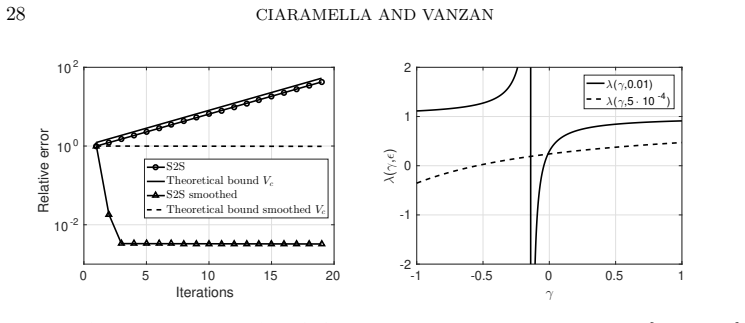
The load-bearing object is the two-level iteration operator $T := G^{n_2}(I - P A_c^{-1} R A) G^{n_1}$ on the interface space $\mathcal{H}$, where $G$ is the substructured Schwarz smoother and $I - P A_c^{-1} R A$ is the coarse-correction projection onto the coarse space $V_c$. Under the hypothesis that $A$ and $G$ share a complete eigenbasis with moduli $|\lambda_k|$ non-increasing, $T$ admits a block lower-triangular infinite-matrix representation whose diagonal block is $\operatorname{diag}(\lambda_{m+1}, \lambda_{m+2}, \dots)$; this representation is what yields $\rho(T) = |\lambda_{m+1}|$ for the spectral coarse space. The finer mechanism is the closed formula $\lambda(\varepsilon, \gamma)$, giving the nontrivial eigenvalue of $T$ for the perturbed coarse space $\operatorname{span}\{\psi_1 + \varepsilon \psi_2\}$ as a function of the perturbation $\varepsilon$ and the overlap $\gamma = \langle \psi_1, \psi_2 \rangle$; its monotonicity, zeros, and vertical asymptote determine exactly when the spectral choice is suboptimal and when the method diverges.
What would settle it
In the two-channel jumping-coefficient experiment of Section 6.3, the paper reports $\lambda_1 = 0.999$, $\lambda_2 = -0.9989$, $\lambda_3 = -0.99863$, $\lambda_4 = 0.99861$, $\lambda_5 = 0.2392$ and predicts the two-level spectral radius $\rho(T) = 1.2322$ for the coarse space $\operatorname{span}\{\psi_1 + 0.01\psi_5\}$. Computing $\rho(T)$ directly for that coarse space, and tracing $\rho(T)$ for the family $\operatorname{span}\{\psi_1 + \varepsilon \psi_2\}$ as $\varepsilon$ varies, would settle both the claim that a perturbed coarse space can reach $|\lambda_3| < |\lambda_2|$ and the claim that a poorly chosen perturbation makes the iteration diverge.
Extended reading notes
Core claim
The paper establishes that a two-level domain decomposition iteration can be formulated and analyzed entirely on subdomain interfaces, with iteration operator $T := G^{n_2}(I - P A_c^{-1} R A) G^{n_1}$ acting on interface functions. For the spectral coarse space $V_c = \operatorname{span}\{\psi_1, \dots, \psi_m\}$, built from the $m$ dominant eigenfunctions of the one-level operator $G$, the analysis yields $\rho(T) = |\lambda_{m+1}| < 1$ whenever $A$ and $G$ share a complete eigenbasis (Theorems 4.3 and 4.5). The central conceptual result, Theorem 4.6, is that this spectral coarse space is not asymptotically optimal in general: for the one-dimensional coarse space $\operatorname{span}\{\psi_1 + \varepsilon \psi_2\}$, a nonzero perturbation $\varepsilon$ strictly reduces the spectral radius when the two eigenvalues have opposite signs or the eigenvectors are non-orthogonal, while a poorly chosen perturbation can make the iteration diverge. The paper adds a remedy — replacing $V_c$ by $G^r V_c$, the coarse space smoothed by $r$ applications of the iteration operator — which restores convergence and improves the representation of slow modes (Corollary 4.7). On the numerical side, it proposes a PCA/SVD procedure and a deep neural network optimization of $\rho(T)$ for building coarse spaces, and validates the method on Poisson and high-contrast diffusion problems.
Load-bearing premise
The analysis assumes that the smoother and the problem operator share one complete set of eigenvectors, with the slower modes also the larger ones; when that shared basis does not exist, as for overlapping Schwarz methods with strongly jumping coefficients, the predicted rate $\rho(T) = |\lambda_{m+1}|$ is not guaranteed.
Editorial extensions
If this is right
- For elliptic problems in two and three dimensions, S2S methods match the convergence rate of volume two-level methods while storing restriction and prolongation operators of size $O(1/h^2)$ instead of $O(1/h^3)$, and the equivalent implementations S2S-B1 and S2S-B2 avoid the extra residual computation so each steady-state iteration costs a single smoothing application.
- With the spectral coarse space, the asymptotic convergence factor is exactly the modulus of the $(m+1)$-st eigenvalue of the interface smoother, $\rho(T) = |\lambda_{m+1}| < 1$, whenever the smoother and the operator share a complete eigenbasis, covering self-adjoint operators and finite-dimensional non-symmetric operators (Theorems 4.3 and 4.5).
- When the dominant eigenvalues have opposite signs or the eigenvectors are non-orthogonal, a non-spectral coarse space can strictly outperform the spectral one; the numerical experiments confirm this, with the DNN-built coarse space converging fastest in the two-subdomain Poisson setting.
- A coarse space that poorly represents the dominant modes can make the two-level iteration diverge even though the one-level iteration converges; replacing the coarse space by $G^r V_c$, its image under $r$ smoothing steps, restores convergence and improves the approximation of slow modes (Corollary 4.7).
- For local, per-subdomain coarse functions the convergence factor is governed by products of the local eigenvalues: $\rho(T) = |\theta_1(m+1)\, \theta_2(m+1)|^{(n_1+n_2)/2}$ when $n_1$ and $n_2$ share parity, with the other parity inserting one extra factor $\max\{|\theta_1(m+1)|, |\theta_2(m+1)|\}$ (Theorem 4.8).
Reading between the lines
- The paper leaves implicit the higher-dimensional version of its one-dimensional result: for $m > 1$ the minimizer of $\rho(T)$ should generically not be the span of the top $m$ eigenvectors, so learned coarse spaces (DNN, PCA) can be strictly better than the spectral space, not merely cheaper to build.
- The divergence mechanism of Theorem 4.6 suggests a safeguard the authors do not state: for any black-box or learned coarse space, one can certify safety during construction by monitoring $\rho(T)$ or by substituting $G^r V_c$ for $V_c$, making coarse-space generation self-validating.
- Because substructured coarse functions are one spatial dimension smaller than volume functions, the PCA and DNN generation procedures become tractable in three-dimensional regimes where their volume analogues are prohibitive; a multilevel S2S, with each level itself substructured, would compound the memory savings.
Signed reviews
Editorial analysis
A structured set of objections, weighed in public.
Referee Report
Summary. The manuscript introduces 'spectral two-level substructured' (S2S) domain decomposition methods, in which both the smoothing iteration and the coarse correction are carried out on the interface/skeleton space rather than in the volume. After deriving the substructured Schwarz formulation, the authors write the two-level iteration operator as T = G^{n2}(I - P A_c^{-1} R A)G^{n1} and analyze it under the hypothesis that A and G share a complete eigenbasis (H2-H4). They prove that with the spectral coarse space the spectral radius is |λ_{m+1}|, study one-dimensional perturbations of the coarse space (Theorem 4.6), treat local coarse spaces built from common eigenfunctions of the two subdomain blocks (Theorem 4.8), and propose PCA- and neural-network-based construction of the coarse space. Numerical experiments on Poisson and high-contrast diffusion problems compare S2S variants with the volume SHEM method. The main claims are that S2S matches standard convergence at lower memory/communication cost and that spectral coarse spaces need not be asymptotically optimal.
Significance. The paper's conceptual contribution is genuinely useful: it gives a single framework that connects substructured Schwarz smoothers with Galerkin coarse correction, and it provides explicit, checkable formulas for the two-level spectral radius in the diagonalizable case. Theorem 4.6 and Corollary 4.7 are the strongest part of the paper; they give precise, falsifiable conditions under which the spectral coarse space is suboptimal or even causes divergence, and the numerical experiment in Section 6.3 confirms the predicted value ρ(T)=1.2322. The PCA and DNN constructions are well motivated, and the implementation tricks in the appendix are practical. The paper does not ship code or machine-checked proofs, but the algebraic derivations are explicit enough to be reproduced. If the error in Theorem 4.8 and the gap in Theorem 4.4 are repaired, this would be a solid contribution to the domain-decomposition literature.
major comments (2)
- [Theorem 4.8, Section 4.3] The formula for the 'otherwise' case is not the spectral radius and is false when θ1(m+1) and θ2(m+1) differ and n1+n2 is odd. For k>m the coarse correction acts as the identity on the k-th mode, because R projects onto the first m Fourier coefficients; hence T equals G^{n1+n2} on the tail space, for every parity. The 2×2 block of G on mode k is [[0,θ1(k)],[θ2(k),0]], whose spectral radius is (|θ1(k)θ2(k)|)^{1/2}. For example, take m=1, n1=1, n2=0, θ1(2)=0.81, θ2(2)=0.01; the tail block has eigenvalues ±0.09, so ρ(T)=0.09, while Theorem 4.8 predicts max{0.81,0.01}=0.81. The error enters in the sentence 'a similar direct calculation leads to ||T^n||_op = |π^{n(n1+n2)}(m+1)|': for odd powers the max-norm of G^n is not the n-th power of the single-step max-norm, so the parity-dependent expression is an operator norm, not a spectral radius. The correct statement is ρ(T)=|θ1(m+1)θ2(m+1)|^{(n1+n2)/2} for all parities. Because the numerical tests in Section 6 use equal subdomains (θ1=θ2), they cannot detect the discrepancy.
- [Theorem 4.4, Section 4.2] The proof uses the identity [I-P A_c^{-1} R A]^* = [I- A P A_c^{-1} R] after 'Since A and G are self adjoint'. This identity requires P=R^* with respect to the inner product in which the adjoint is taken. In the manuscript, P and R are defined via ⟨·,·⟩ in (3.1), whereas the theorem assumes {ψ_k} is orthonormal with respect to a possibly different inner product ⟨⟨·,·⟩⟩ and takes adjoints with respect to ⟨⟨·,·⟩⟩. If ⟨⟨·,·⟩⟩≠⟨·,·⟩, the adjoint of R under ⟨⟨·,·⟩⟩ is not the map P, and the claimed simplification ~T=diag(0,Λ_m) does not follow. The statement can be repaired by assuming that the same inner product is used for P,R and for the orthonormal eigenbasis, or by redefining P as the ⟨⟨·,·⟩⟩-adjoint of R. Without such a repair, Theorem 4.4 is unsupported, although the spectral-radius statement of Theorem 4.3 remains valid.
minor comments (5)
- [Equation (4.12)] In the γ=0 case the squared denominator is written as (λ̃2 ε² + λ̃2_1)²; this appears to be a typo for (λ̃2 ε² + λ̃1)².
- [Lemma 5.1, Section 5.1] The matrix P_l = U_l Σ_l V_l^T has size N_s×q (if U_l is N_s×l and V_l is q×l), while G^r X is N_s×N_s, so the norm comparison is dimensionally inconsistent; please clarify how P_l is embedded in N_s×N_s before stating the bound.
- [Section 6.3] The high-contrast many-subdomain runs are outside the diagonalizability and monotone-eigenvalue hypotheses (H2)-(H3) under which Theorems 4.3-4.8 are proved; the text should state explicitly that the robustness observed there is an empirical finding, not a consequence of the theorems. The observation in Section 6.3 that the PCA method can diverge for small r further underscores this point.
- [Table 6.3] The phrase 'S2S-EHM' appears in Table 6.3, while the text uses 'S2S-HEM'; please unify the nomenclature.
- [Hypothesis (H3)] The inequality |λ_k|≤|λ_{k-1}| is not defined for k=1; state the monotonicity condition for k≥2.
Circularity Check
No significant circularity: the convergence factors are derived from explicit eigenbasis hypotheses and direct matrix computations, while the PCA and DNN procedures are presented as coarse-space optimizations rather than fitted predictions.
full rationale
The paper's central derivation chain is self-contained and does not reduce to its own inputs. The two-level iteration operator is explicitly defined in Eq. (3.4) as T = G^{n2}(I - P A_c^{-1} R A) G^{n1}, and the main convergence theorems are proved from stated hypotheses on the common eigenbasis of A and G. In particular, Theorem 4.5 derives rho(T) = |lambda_{m+1}| from the block-triangular infinite-matrix representation (4.4) and the nilpotency of the coarse block, rather than assuming this equality; the nilpotency itself is justified by Theorem 4.2. Theorem 4.6 gives an explicit rational function lambda(epsilon, gamma) obtained by direct 2x2 computation, and its conclusions follow from monotonicity and continuity arguments, not from fitting. The PCA procedure in Section 5.1 is explicitly an algorithm to approximate the image of the smoother and is not dressed as a prediction; Lemma 5.1 is an SVD approximation bound. The DNN approach in Section 5.2 is framed as minimizing an estimator of the spectral radius, i.e., an optimization, and its numerical results are reported as such. Although the paper cites several works by its own authors, those citations concern standard PSM convergence, scalability context, and existing coarse-space methods; none is the load-bearing step that forces the paper's main convergence formulas. The external optimality reference [55] is used only to contextualize the energy-norm optimality of spectral coarse spaces. Accordingly, no circular step can be exhibited with the required specific reduction, and the honest finding is no significant circularity.
Assumptions & free parameters
free parameters (5)
- PCA sample count q =
q = 2 * dim(Vc)
- PCA smoother steps r =
r = 2 for two-subdomain Poisson; r = 2, 4, 6 for alpha = 10^2, 10^4, 10^6 in the multi-channel test
- DNN rollout depth k =
k = 4
- DNN sample count N =
N = Ns
- Coarse space dimension m =
4/16 (2D), 36/84/132 (many subdomains), 84/132/180 (jumping coefficients)
assumptions (7)
- domain assumption A and G share the same complete set of linearly independent eigenvectors (H2, Section 4)
- domain assumption Eigenvalues of G satisfy 0 < |lambda_k| < 1 and are non-increasing in modulus (H3, Section 4)
- domain assumption Coarse space containment Vc subset span{psi_1..psi_tilde_m} with no tail component (H4, Section 4)
- domain assumption Subdomain problems in the substructured PSM are solved exactly (Section 2, before Algorithm 3.1)
- ad hoc to paper For Theorem 4.4, the eigenbasis is orthogonal with respect to the inner product used in R (implicit)
- domain assumption For local coarse functions, G1 and G2 share an orthonormal eigenbasis (Section 4.3)
- standard math Well-posedness of the elliptic problem (2.1) with bounded Lipschitz domain and L^2 data
Cite this review
Pith. "Pith review of Spectral substructured two-level domain decomposition methods." pith.science (2026). https://pith.science/paper/LT6VAGDF
@misc{pith2026190805537,
  author       = {Pith},
  title        = {Pith review of: Spectral substructured two-level domain decomposition methods},
  year         = {2026},
  howpublished = {\url{https://pith.science/paper/LT6VAGDF}},
  note         = {Machine review of arXiv:1908.05537}
}
read the original abstract
Two-level domain decomposition (DD) methods are very powerful techniques for the efficient numerical solution of partial differential equations (PDEs). A two-level domain decomposition method requires two main components: a one-level preconditioner (or its corresponding smoothing iterative method), which is based on domain decomposition techniques, and a coarse correction step, which relies on a coarse space. The coarse space must properly represent the error components that the chosen one-level method is not capable to deal with. In the literature most of the works introduced efficient coarse spaces obtained as the span of functions defined on the entire space domain of the considered PDE. Therefore, the corresponding two-level preconditioners and iterative methods are defined in volume. In this paper, a new class of substructured two-level methods is introduced,for which both domain decomposition smoothers and coarse correction steps are defined on the interfaces (or skeletons). This approach has several advantages. On the one hand, the required computational effort is cheaper than the one required by classical volumetric two-level methods. On the other hand, it allows one to use some of the well-known efficient coarse spaces proposed in the literature. While analyzing in detail the new substructured methods, we present a new convergence analysis for two-level iterative methods, which covers the proposed substructured framework. Further, we study the asymptotic optimality of coarse spaces both theoretically and numerically using deep neural networks. Numerical experiments demonstrate the effectiveness of the proposed new numerical framework.
Figures


Figures from the paper (4 more)


Reference graph
Works this paper leans on
-
[1]
J. Aarnes and T. Y. Hou , Multiscale domain decomposition methods for elliptic problems with high aspect ratios , Acta Math. Appl. Sin., 18 (2002), pp. 63–76
work page 2002
-
[2]
P. Bjorstad, M. J. Gander, A. Loneland, and T. Rahman , Does SHEM for Additive Schwarz work better than predicted by its condition number estimate? , Domain Decompo- sition Methods in Science and Engineering XXIV, LNCSE, Springer, – (2018), pp. 129–138
work page 2018
-
[3]
M. Brezina, R. F algout, S. MacLachlan, T. Manteuffel, S. McCormick, and J. Ruge , Adaptive smoothed aggregation (α SA) multigrid, SIAM Rev., 47 (2005), pp. 317–346
work page 2005
-
[4]
F. Chaouqui, G. Ciaramella, M. J. Gander, and T. V anzan , On the scalability of classical one-level domain-decomposition methods, Vietnam J. Math., 46 (2018), pp. 1053–1088
work page 2018
-
[5]
F. Chaouqui, M. J. Gander, and K. Repiquet , A coarse space to remove the logarithmic dependency in Neumann-Neumann methods , Domain Decomposition Methods in Science and Engineering XXIV, LNCSE, Springer, – (2018), pp. 159–168
work page 2018
-
[6]
F. Chaouqui, M. J. Gander, and K. Santugini-Repiquet , A local coarse space correction leading to a well-posed continuous neumann-neumann method in the presence of cross points, in Domain Decomposition Methods in Science and Engineering XXV, Cham, 2020, Springer, pp. 83–91
work page 2020
-
[7]
G. Ciaramella and M. J. Gander , Iterative Methods and Preconditioners for Systems of Linear Equations, in preparation
-
[8]
G. Ciaramella and M. J. Gander , Analysis of the parallel Schwarz method for growing chains of fixed-sized subdomains: Part I , SIAM J. Numer. Anal., 55 (2017), pp. 1330–1356
work page 2017
Show all 56 references
-
[9]
Ciaramella and M
G. Ciaramella and M. J. Gander , Analysis of the parallel Schwarz method for growing chains of fixed-sized subdomains: Part II , SIAM J. Numer. Anal., 56 (3) (2018), pp. 1498–1524
2018
-
[10]
Ciaramella and M
G. Ciaramella and M. J. Gander , Analysis of the parallel Schwarz method for growing chains of fixed-sized subdomains: Part III , Electron. Trans. Numer. Anal., 49 (2018), pp. 201–243
2018
-
[11]
Ciaramella and M
G. Ciaramella and M. J. Gander , Happy 25th anniversary DDM! ... But how fast can the Schwarz method solve your logo? , in Domain Decomposition Methods in Science and Engineering XXV, Cham, 2020, Springer, pp. 92–99
2020
-
[12]
Ciaramella, M
G. Ciaramella, M. J. Gander, L. Halpern, and J. Salomon , Methods of reflections: re- lations with schwarz methods and classical stationary iterations, scalability and precondi- tioning., SMAI J. Comput. Appl. Math., 5 (2019), pp. 161–193
2019
-
[13]
Ciaramella, M
G. Ciaramella, M. J. Gander, and P. Mamooler , The domain decomposition method of Bank and Jimack as an optimized Schwarz method , in Domain Decomposition Methods in Science and Engineering XXV, Cham, 2020, Springer, pp. 285–293
2020
-
[14]
Ciaramella, M
G. Ciaramella, M. Hassan, and B. Stamm , On the scalability of the Schwarz method , SMAI J. Comput. Appl. Math., 6 (2019)
2019
-
[15]
Ciaramella, M
G. Ciaramella, M. Hassan, and B. Stamm , On the scalability of the parallel Schwarz method in one-dimension , in Domain Decomposition Methods in Science and Engineering XXV, Cham, 2020, Springer, pp. 151–158. 32 CIARAMELLA AND VANZAN
2020
-
[16]
Ciaramella and R
G. Ciaramella and R. M. H ¨ofer, Non-geometric convergence of the classical alternating Schwarz method , in Domain Decomposition Methods in Science and Engineering XXV, Cham, 2020, Springer, pp. 193–201
2020
-
[17]
C. R. Dohrmann, A. Klawonn, and O. B. Widlund , A family of energy minimizing coarse spaces for overlapping Schwarz preconditioners , in Domain Decomposition Methods in Science and Engineering XVII, 2008, pp. 247–254
2008
-
[18]
Dolean, P
V. Dolean, P. Jolivet, and F. Nataf , An Introduction to Domain Decomposition Methods , SIAM, Philadelphia, PA, 2015
2015
-
[19]
Dolean, F
V. Dolean, F. Nataf, R. Scheichl, and N. Spillane , Analysis of a two-level Schwarz method with coarse spaces based on local Dirichlet-to-Neumann maps , Comput. Meth. in Appl. Math., 12 (2012), pp. 391–414
2012
-
[20]
Dubois, M
O. Dubois, M. J. Gander, S. Loisel, A. St-Cyr, and D. B. Szyld , The optimized Schwarz method with a coarse grid correction , SIAM J. Sci. Comput., 34 (2012), pp. 421–458
2012
-
[21]
Efendiev, J
Y. Efendiev, J. Galvis, R. Lazarov, and J. Willems , Robust domain decomposition pre- conditioners for abstract symmetric positive definite bilinear forms , ESAIM Math. Model. Numer. Anal., 46 (2012), pp. 1175–1199
2012
-
[22]
Friedman , Foundations of Modern Analysis , Dover Books on Mathematics Series, Dover, 1982
A. Friedman , Foundations of Modern Analysis , Dover Books on Mathematics Series, Dover, 1982
1982
-
[23]
Galvis and Y
J. Galvis and Y. Efendiev , Domain decomposition preconditioners for multiscale flows in high-contrast media, Multiscale Model. Sim., 8 (2010), pp. 1461–1483
2010
-
[24]
Galvis and Y
J. Galvis and Y. Efendiev , Domain decomposition preconditioners for multiscale flows in high contrast media: Reduced dimension coarse spaces , Multiscale Model. Sim., 8 (2010), pp. 1621–1644
2010
-
[25]
M. J. Gander , Optimized Schwarz methods, SIAM J. Numer. Anal., 44 (2006), pp. 699–731
2006
-
[26]
M. J. Gander , Schwarz methods over the course of time , Electron. Trans. Numer. Anal., 31 (2008), pp. 228–255
2008
-
[27]
M. J. Gander , On the influence of geometry on optimized Schwarz methods , SeMA Journal, 53 (2011), pp. 71–78
2011
-
[28]
M. J. Gander, L. Halpern, and K. Repiquet , A new coarse grid correction for RAS/AS , in Domain Decomposition Methods in Science and Engineering XXI, Springer, 2014, pp. 275– 283
2014
-
[29]
M. J. Gander, L. Halpern, and K. Repiquet , On optimal coarse spaces for domain decom- position and their approximation, accepted for Domain Decomposition Methods in Science and Engineering XXIV, LNCSE, Springer, (2018), pp. 271–280
2018
-
[30]
M. J. Gander and A. Loneland , SHEM: An optimal coarse space for RAS and its multiscale approximation, in Domain Decomposition Methods in Science and Engineering XXIII, Springer, 2017, pp. 313–321
2017
-
[31]
M. J. Gander, A. Loneland, and T. Rahman , Analysis of a new harmonically enriched mul- tiscale coarse space for domain decomposition methods, preprint arXiv:1512.05285, (2015)
2015 arXiv
-
[32]
M. J. Gander and B. Song , Complete, optimal and optimized coarse spaces for additive Schwarz, in Domain Decomposition Methods in Science and Engineering XXIV, Springer, 2018
2018
-
[33]
M. J. Gander and S. V an Criekingen , New coarse corrections for optimized restricted addi- tive Schwarz using petsc , in Domain Decomposition Methods in Science and Engineering XXV, Cham, 2020, Springer, pp. 483–490
2020
-
[34]
M. J. Gander and T. V anzan , Multilevel optimized Schwarz methods , SIAM J. Sci. Comp., 42 (2020), pp. A3180–A3209
2020
-
[35]
M. J. Gander and Y. Xu , Optimized Schwarz methods for circular domain decompositions with overlap, SIAM J. Numer. Anal., 52 (2014), pp. 1981–2004
2014
-
[36]
G. H. Golub and C. F. V an Loan , Matrix Computations (Fourth Edition) , Johns Hopkins Studies in the Mathematical Sciences, Johns Hopkins University Press, Baltimore, MD, 2013
2013
-
[37]
I. G. Graham, P. O. Lechner, and R. Scheichl , Domain decomposition for multiscale PDEs, Numer. Math., 106 (2007), pp. 589–626
2007
-
[38]
Greenbaum , Iterative Methods for Solving Linear Systems , Frontiers in Applied Mathe- matics, SIAM, Philadelphia PA, 1997
A. Greenbaum , Iterative Methods for Solving Linear Systems , Frontiers in Applied Mathe- matics, SIAM, Philadelphia PA, 1997
1997
-
[39]
Gubisch and S
M. Gubisch and S. Volkwein , Chapter 1: Proper Orthogonal Decomposition for Linear- Quadratic Optimal Control , SIAM, Computational Science & Engineering, Philadelphia, PA, 2017, pp. 3–63
2017
-
[40]
Hackbusch, Multi-Grid Methods and Applications , Series in Computational Mathematics, Springer Berlin Heidelberg, 2013
W. Hackbusch, Multi-Grid Methods and Applications , Series in Computational Mathematics, Springer Berlin Heidelberg, 2013
2013
-
[41]
Hackbusch , Iterative solution of large sparse systems of equations , vol
W. Hackbusch , Iterative solution of large sparse systems of equations , vol. 95 of Applied SUBSTRUCTURED 2-LEVEL DD METHODS 33 mathematical sciences, Springer, Cham, second edition ed., 2016
2016
-
[42]
Heinlein, A
A. Heinlein, A. Klawonn, J. Knepper, and O. Rheinbach , Multiscale coarse spaces for overlapping Schwarz methods based on the ACMS space in 2D , Electron. Trans. Numer. Anal., 48 (2018), pp. 156–182
2018
-
[43]
M. F. Hutchinson , A stochastic estimator of the trace of the influence matrix for Laplacian smoothing splines, Commun. Stat.-Simul. C., 18 (1989), pp. 1059–1076
1989
-
[44]
Katrutsa, T
A. Katrutsa, T. Daulbaev, and I. Oseledets , Deep multigrid: learning prolongation and restriction matrices, arXiv preprint arXiv:1711.03825, (2017)
2017 arXiv
-
[45]
Klawonn, P
A. Klawonn, P. Radtke, and O. Rheinbach , FETI-DP methods with an adaptive coarse space, SIAM J. Numer. Anal., 53 (2015), pp. 297–320
2015
-
[46]
Lax , Functional Analysis, Pure and Applied Mathematics: A Wiley Series of Texts, Mono- graphs and Tracts, Wiley, 2002
P. Lax , Functional Analysis, Pure and Applied Mathematics: A Wiley Series of Texts, Mono- graphs and Tracts, Wiley, 2002
2002
-
[47]
Lions and E
J. Lions and E. Magenes , Non-homogeneous Boundary Value Problems and Applications (Vol I), Die Grundlehren der mathematischen Wissenschaften, Springer-Verlag Berlin Heidel- berg, 1972
1972
-
[48]
P. L. Lions , On the Schwarz alternating method. I , First international symposium on domain decomposition methods for partial differential equations, (1988), pp. 1–42
1988
-
[49]
P. L. Lions , On the Schwarz alternating method. II. Stochastic interpretation and other prop- erties, in Second International Symposium on Domain Decomposition Methods for Partial Differential Equations, 1989, pp. 47–70
1989
-
[50]
Quarteroni and A
A. Quarteroni and A. V alli , Domain Decomposition Methods for Partial Differential Equa- tions, Numerical Mathematics and Scientific Computation, Oxford Science Publications, 1999
1999
-
[51]
Spillane, V
N. Spillane, V. Dolean, P. Hauret, F. Nataf, C. Pechstein, and R. Scheichl , A robust two-level domain decomposition preconditioner for systems of PDEs , C. R. Math., 349 (2011), pp. 1255 – 1259
2011
-
[52]
Spillane, V
N. Spillane, V. Dolean, P. Hauret, F. Nataf, C. Pechstein, and R. Scheichl , Abstract robust coarse spaces for systems of PDEs via generalized eigenproblems in the overlaps , Numer. Math., 126 (2014), pp. 741–770
2014
-
[53]
Tartar, An Introduction to Sobolev Spaces and Interpolation Spaces , Lecture Notes of the Unione Matematica Italiana, Springer Berlin Heidelberg, 2007
L. Tartar, An Introduction to Sobolev Spaces and Interpolation Spaces , Lecture Notes of the Unione Matematica Italiana, Springer Berlin Heidelberg, 2007
2007
-
[54]
Toselli and O
A. Toselli and O. Widlund , Domain Decomposition Methods: Algorithms and Theory, vol. 34 of Series in Computational Mathematics, Springer, New York, 2005
2005
-
[55]
Xu and L
J. Xu and L. Zikatanov , Algebraic multigrid methods, Acta Numer., 26 (2017), pp. 591–721
2017
-
[56]
Zampini and X
S. Zampini and X. Tu , Multilevel balancing domain decomposition by constraints deluxe al- gorithms with adaptive coarse spaces for flow in porous media , SIAM J. Sci. Comput., 39 (2017), pp. A1389–A1415
2017
Reviewed August 14, 2026 · model on record in the stance chip above.
Discussion (0). Continue with ORCID to comment.