REVIEW 1 major objections 4 minor 20 references
A sharp threshold phenomenon in string graphs
T0 review · 1 major / 4 minor · reviewed 2026-08-14 · deepseek-v4-flash
Pith's one-line read Every string graph with fewer than one quarter of all possible intersections contains two large mutually disjoint curve families, and the quarter is sharp.
desk verdict Proves the 1/4 threshold for anticomplete pairs in string graphs; strong and original, though the admissibility definition in Lemma 7 has a fixable typo. read the letter →
The pith
A machine-rendered reading of the paper's core claim, the machinery that carries it, and where it could break.
The reading
What carries the argument
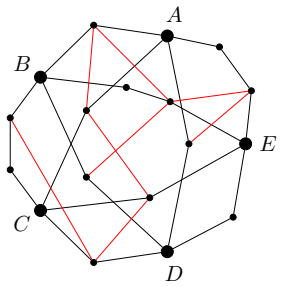
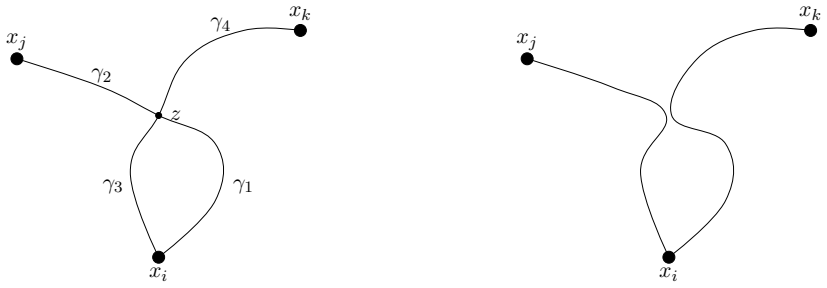
The machinery rotates around weak-subdivisions of $K_5$: replace the ten edges of $K_5$ by internally disjoint paths, then allow extra edges only between vertices lying on paths that correspond to adjacent edges of $K_5$. Lemma 5 shows no string graph contains such a graph as an induced subgraph: choosing one point on each branch curve, the paths between them form a drawing of $K_5$ whose only crossings are between adjacent edges, and an uncrossing operation repeatedly eliminates those crossings, producing a planar drawing of $K_5$, a contradiction. The other half is a graph-theoretic embedding and extremal argument. Starting from the given sparse string graph, a graph regularity lemma produces a reduced weighted graph; the proof defines $(H,\epsilon_1)$-admissible subgraphs of that weighted graph and shows, via an embedding lemma, that any such admissible subgraph yields an induced weak-2-subdivision of a partial subdivision of $K_5$ in the original graph. The extremal core is a weighted graph $Q$ whose total weight $\varphi(Q)$ is at least $\frac14$ unless an admissible subgraph exists; the case analysis for up to seven parts, including a rearrangement inequality in the seven-part case, supplies the $\frac14$ bound.
What would settle it
Exhibit a string graph whose vertex set cannot be split into two equal linear-size anticomplete sets while its edge count is at most $(\frac14-\varepsilon)\frac{n^2}{2}$; or, more locally, produce a string graph containing an induced weak-subdivision of $K_5$. The second would directly disprove Lemma 5, the load-bearing geometric step.
Extended reading notes
Core claim
The central discovery is a sharp threshold at edge density $\frac14$. Theorem 2 states that for every $\varepsilon>0$ there is $\delta>0$ so that every string graph on $n$ vertices with at most $(\frac14-\varepsilon)\frac{n^2}{2}$ edges contains an anticomplete pair of linear size, meaning disjoint equal sets $A,B$ with $|A|=|B|\ge\delta n$ and $E(A,B)=\varnothing$. The paper also proves that $\frac14$ cannot be improved: for every $n$ there are string graphs with at most $(\frac14+\varepsilon)\frac{n^2}{2}$ edges in which every anticomplete pair has size $O(\frac1\varepsilon\log n)$. The route is to reduce the geometric statement to a graph-theoretic dichotomy: a sparse graph that is $\delta$-full and has uniform lower density on all large induced subgraphs must contain an induced weak-subdivision of $K_5$, while string graphs cannot contain such an induced subgraph.
Load-bearing premise
The load-bearing premise is Lemma 5: no string graph contains an induced weak-subdivision of $K_5$, proved by an uncrossing operation that removes crossings between adjacent edges of a drawn $K_5$; if that operation is invalid in some drawing, the reduction from curve families to the graph-theoretic dichotomy would fail.
Editorial extensions
If this is right
- The threshold $\frac14$ is optimal: above it, string graphs can be built with only $O(\varepsilon^{-1}\log n)$-size anticomplete pairs, so no linear bound survives.
- The geometric input enters only through the forbidden weak-subdivision lemma, so any hereditary class of graphs that excludes induced weak-subdivisions of $K_5$ obeys the same $\frac14$ threshold for linear anticomplete pairs.
- The paper proves a weaker $K_t$ version: graphs with fewer than $\frac{1}{2(t-1)}\frac{n^2}{2}$ edges and no induced weak-subdivision of $K_t$ contain linear anticomplete pairs.
- The four-part clique construction behind the sharpness example shows how to pack nearly one quarter of all intersections while suppressing large disjoint subfamilies.
Reading between the lines
- The same machinery gives a template for other topological intersection graphs: whenever a class forbids induced weak-subdivisions of $K_t$ at the conjectured threshold $1/(t-1)$, the corresponding curve-intersection threshold follows.
- The extremal weighted graph $Q$ resembles a density version of Ramsey-type phenomena, suggesting the testable extension that replacing $K_5$ by any fixed graph $H$ yields threshold $1/(\chi(H)-1)$ for linear anticomplete pairs.
- A computational probe at moderate $n$ could sample string graphs just below density $1/4$ and measure the largest anticomplete pair; the predicted worst-case growth is $O(\log n)$ in $\varepsilon^{-1}$, which would be distinguishable from any linear lower bound.
Signed reviews
Editorial analysis
A structured set of objections, weighed in public.
Referee Report
Summary. The paper proves that 1/4 is the sharp threshold for the density of string graphs to force a linear-sized anticomplete pair. Specifically, for every ε>0 there exists δ>0 such that any string graph on n vertices with at most (1/4−ε)n^2/2 edges contains two disjoint sets A,B each of size at least δn with no edges between them; conversely, for every n there are string graphs with at most (1/4+ε)n^2/2 edges whose largest anticomplete pair has size O((1/ε) log n). The proof reduces the geometric statement to a purely graph-theoretic theorem (Theorem 6) using Lee's separator theorem (Lemma 4) and the fact that string graphs avoid induced weak-subdivisions of K5 (Lemma 5). Theorem 6 is then proved via the Szemerédi regularity lemma, an embedding lemma (Lemma 7) that turns an admissible weighted subgraph of the reduced graph into an induced weak-2-subdivision of a small graph H, and an extremal lemma (Lemmas 9–10) showing that any weighted graph of total weight below (1/4−ε)k^2/2 contains an admissible subgraph for some partial subdivision of K5 on at most 8 vertices. The extremal analysis culminates in Proposition 13, a weighted Turán-type statement whose proof includes a detailed case analysis for the 7-vertex case in the appendix.
Significance. If correct, the result resolves a conjecture of Pach and Tomon and extends their x-monotone threshold result to all string graphs, a notable step for intersection graphs of arbitrary curves. The proof is technically substantial: it combines a topological uncrossing argument, Lee's separator theorem, the regularity method, and a new weighted extremal graph lemma. The paper is carefully structured, and the s=7 case of Proposition 13 is treated in an appendix rather than omitted. I checked the interaction between the admissibility definition (§2.2) and the thin-edge case of Lemma 7; the printed definition contains exactly the sum w(b(x)b(z)) + w(b(y)b(z)) that the embedding proof needs, so the potentially circular or under-specified step flagged in the stress-test does not materialize. The sharpness construction is cited from earlier work of Pach–Tomon and Pach–Tóth rather than reproved, which is appropriate. The main new graph-theoretic contribution, Proposition 13, is presented with enough detail to be verified, and the paper appears to be a genuine advance.
major comments (1)
- [§2.2 and Lemma 7] The stress-test concern that the admissibility definition does not imply the inequality used in Lemma 7's thin-edge case does not land. The definition on page 7 states: if xy ∈ E(H), x ≺ y, and b(x)b(y) is ε1-thin, then w(b(x)b(z)) + w(b(y)b(z)) < 1 − ε1 for every z with x ≺ z. This is precisely the condition invoked in Case 2 of Lemma 7, where a < b and i ∈ {a+1,…,h}\{b} gives w(ai) + w(bi) ≤ 1 − ε1. Thus the embedding lemma is justified as written, subject to the ε1-thin typo noted below.
minor comments (4)
- [§2.2, definition of ε1-thin] The definition says an edge is ε1-thin if w(xy) ≤ λ, but the intended threshold is ε1, as used throughout the proof (e.g., Lemma 9 treats w(f) ≤ ε1 as thin). As printed, a literal reader would not be able to apply the admissibility condition in Lemma 7's Case 2, since w(ab) < ε1 does not imply w(ab) ≤ λ. Please correct λ to ε1.
- [Proposition 12, Case 2] The weight-replacement operation w′(f) = w(yu) for f = xu or f = zu is undefined when u ∈ {x,y,z} (e.g., for f = xy it would require w(yy)). The intended meaning is to copy the neighborhood of y onto x and z while keeping the edges among {x,y,z} fixed except that xz is set to weight 1. Please make this explicit to avoid ambiguity.
- [Appendix, Case 2 of s=7 analysis] In the sentence 'let the edge s of this cycle be c1c2, c2c3, c3c4', the word 'cycle' should presumably be 'path', since C was identified as a path of length 3. This is a typographical slip that should be corrected.
- [Abstract and Section 1] The abstract contains the phrase 'there at most (1/4+ε)n^2/2 pairs' with a missing 'are'; also the proof of Lemma 5 refers to 'the edges of this cycle' where 'path' is meant in one place. These are minor wording issues.
Circularity Check
No significant circularity: the proof reduces geometry to a new graph-theoretic statement via independent external tools and self-contained lemmas.
full rationale
I traced the derivation chain of Theorem 2. The high-level route is: Lee's separator theorem (Theorem 1, external) gives Lemma 4; a self-contained uncrossing argument gives Lemma 5 (string graphs contain no induced weak-subdivision of K5); combining these reduces Theorem 2 to a new graph-theoretic statement, Theorem 6. The proof of Theorem 6 then proceeds through the Regularity Lemma, the embedding Lemma 7, and the weighted-graph Lemmas 9, 10 and Proposition 13. Each of these is argued directly from definitions; no lemma assumes the conclusion of Theorem 2. The threshold value 1/4 is not imported as a fitted or assumed quantity but is derived in Proposition 13 from the structure of graphs with no H-admissible subgraph. The sharpness example uses the independent Pach–Tóth realization theorem for graphs partitionable into four cliques and a standard probabilistic construction; it does not rely on the main theorem. Self-citations occur (Pach–Tomon [14] is the conjectured x-monotone threshold and Pach–Tóth [15] is used in the sharpness construction), but they are not load-bearing in the sense of making the derivation circular: the central graph-theoretic contribution is proved rather than assumed, and the external citations are used as genuine independent inputs. I also checked the skeptical concern about the admissibility definition versus the inequality used in Lemma 7, Case 2: that is a possible typographical or correctness issue in the printed definition, not a case of the paper defining one quantity in terms of another or fitting a parameter to a predicted output. Therefore the circularity score is 0.
Assumptions & free parameters
assumptions (5)
- standard math Szemerédi Regularity Lemma: every graph has a λ-regular partition into a bounded number of parts.
- standard math Lee's separator theorem for string graphs: every string graph with m edges has a separator of size O(√m).
- domain assumption Every string graph can be represented by curves with finitely many crossings, and intersections can be assumed to be crossings (Schaefer-Stefankovič).
- standard math Graphs whose vertex set partitions into four cliques are intersection graphs of convex sets (Pach-Tóth).
- standard math The probabilistic construction yielding graphs with a four-part clique partition, edge density (1/4 + ε)n²/2, and largest anticomplete pair O((1/ε) log n).
Cite this review
Pith. "Pith review of A sharp threshold phenomenon in string graphs." pith.science (2026). https://pith.science/paper/73YMAQ43
@misc{pith2026190805550,
  author       = {Pith},
  title        = {Pith review of: A sharp threshold phenomenon in string graphs},
  year         = {2026},
  howpublished = {\url{https://pith.science/paper/73YMAQ43}},
  note         = {Machine review of arXiv:1908.05550}
}
abstract
We prove that for every $\epsilon>0$ there exists $\delta>0$ such that the following holds. Let $\mathcal{C}$ be a collection of $n$ curves in the plane such that there are at most $(\frac{1}{4}-\epsilon)\frac{n^{2}}{2}$ pairs of curves $\{\alpha,\beta\}$ in $\mathcal{C}$ having a nonempty intersection. Then $\mathcal{C}$ contains two disjoint subsets $\mathcal{A}$ and $\mathcal{B}$ such that $|\mathcal{A}|=|\mathcal{B}|\geq \delta n$, and every $\alpha\in \mathcal{A}$ is disjoint from every $\beta\in\mathcal{B}$. On the other hand, for every positive integer $n$ there exists a collection $\mathcal{C}$ of $n$ curves in the plane such that there at most $(\frac{1}{4}+\epsilon)\frac{n^{2}}{2}$ pairs of curves $\{\alpha,\beta\}$ having a nonempty intersection, but if $\mathcal{A},\mathcal{B}\subset \mathcal{C}$ are such that $|\mathcal{A}|=|\mathcal{B}|$ and $\alpha\cap \beta=\emptyset$ for every $(\alpha,\beta)\in \mathcal{A}\times\mathcal{B}$, then $|\mathcal{A}|=|\mathcal{B}|=O(\frac{1}{\epsilon}\log n)$.
Figures

Figures from the paper (3 more)


Reference graph
Works this paper leans on
-
[1]
Benzer, On the topology of the genetic fine structure, Proc
S. Benzer, On the topology of the genetic fine structure, Proc. Nat. Acad. Sci. 45 (1959): 1607–1620
work page 1959
-
[2]
Pure pairs. II. Excluding all subdivisions of a graph
M. Chudnovsky, A. Scott, P. Seymour, S. Spirkl, Sparse graphs without linear anticomplete pairs, arXiv:1804.01060 (2018)
work page Pith review arXiv 2018
-
[3]
Fox, A bipartite analogue of Dilworth’s theorem, Order 23 (2006): 197–209
J. Fox, A bipartite analogue of Dilworth’s theorem, Order 23 (2006): 197–209. 18
work page 2006
-
[4]
J. Fox, J. Pach, A separator theorem for string graphs and its applications, Combin. Probab. Comput. 19 (3) (2010): 371–390
work page 2010
-
[5]
J. Fox, J. Pach, String graphs and incomparability graphs, Advances in Mathematics 230 (2012): 1381–1401
work page 2012
-
[6]
J. Fox, J. Pach, Applications of a new separator theorem for string graphs, Combin. Probab. Comput. 23 (1) (2014): 66–74
work page 2014
-
[7]
J. Fox, J. Pach, C. D. T´ oth,Tur´ an-type results for partial orders and intersection graphs of convex sets, Israel Journal of Mathematics 178 (2010): 29–50
work page 2010
-
[8]
J. Fox, J. Pach, Cs. T´ oth,Intersection patterns of curves, J. Lond. Math. Soc. 83 (2011): 389–406
work page 2011
Show all 20 references
-
[9]
G. H. Hardy, J. E. Littlewood, G. P´ olya, Inequalities, Cambridge University Press (1952): Section 10.2, Theorem 368
1952
-
[10]
J. R. Lee, Separators in region intersection graphs, in: 8th Innovations in Theoretical Comp. Sci. Conf. (ITCS 2017), LIPIcs 67 (2017): 1–8
2017
-
[11]
Lipton, R
J. Lipton, R. E. Tarjan, A separator theorem for planar graphs, SIAM J. Appl. Math. 36 (2) (1979): 177–189
1979
-
[12]
Matouˇ sek,Near-optimal separators in string graphs, Combinatorics, Probability & Computing 23 (1) (2014): 135–139
J. Matouˇ sek,Near-optimal separators in string graphs, Combinatorics, Probability & Computing 23 (1) (2014): 135–139
2014
-
[13]
J. Pach, B. A. Reed, Y. Yuditsky, Almost all string graphs are intersection graphs of plane convex sets , in: 34th Symposium on Computational Geometry (SoCG 2018): 68:1–14. Discrete & Computational Geometry, to appear
2018
-
[14]
J. Pach, I. Tomon, Ordered graphs and large bi-cliques in intersection graphs of curves, to appear in European Journal of Combinatorics (2019)
2019
-
[15]
J. Pach, G. T´ oth. How many ways can one draw a graph?, Combinatorica 26 (2006): 559–576
2006
-
[16]
Schaefer, D
M. Schaefer, D. ˇStefankoviˇ c,Decidability of string graphs, J. Comput. System Sci. 68 (2004): 319–334
2004
-
[17]
F. W. Sinden, Topology of thin film RC-circuits, Bell System Technological Journal (1966): 1639–1662
1966
-
[18]
Szemer´ edi,Regular partitions of graphs, in Proc
E. Szemer´ edi,Regular partitions of graphs, in Proc. Colloque Inter. CNRS (J.-C. Bermond, J.-C. Fournier, M. Las Vergnas, D. Sotteau, eds.) (1978): 399–401
1978
-
[19]
Tur´ an,On an extremal problem in graph theory, Matematikai ´ es Fizikai Lapok (in Hungarian) 48 (1941): 436–452
P. Tur´ an,On an extremal problem in graph theory, Matematikai ´ es Fizikai Lapok (in Hungarian) 48 (1941): 436–452. 19 Appendix - Proof of Proposition 13, s = 7 Suppose that s = 7. First, we show that if Q contains either a cycle of length 6 or 7, we have φ(Q) ≥ 1 4 . Indeed,...
1941
-
[20]
If c1c2 is not an edge, then there are at least three edges between c1 and C, so there are two consecutive vertices of C joined to c1
In both cases Q[B ∪ {a}] contains a cycle C of length 5. If c1c2 is not an edge, then there are at least three edges between c1 and C, so there are two consecutive vertices of C joined to c1. But then C ∪ {c1} contains a cycle of length 6, so we are done. Therefore, we can sup...
Reviewed August 14, 2026 · model on record in the stance chip above.
Discussion (0). Continue with ORCID to comment.