REVIEW 3 major objections 4 minor 13 references
The strange properties of the infinite power tower
T0 review · 3 major / 4 minor · reviewed 2026-08-14 · deepseek-v4-flash
Pith's one-line read The infinite power tower converges exactly for $e^{-e} \le x \le e^{1/e}$ and cycles between two values below that range.
desk verdict A competent, honest classroom guide to classical power-tower results — no new math, and a few rigor gaps the author already admits, but worth referee time for a teaching venue. read the letter →
The pith
A machine-rendered reading of the paper's core claim, the machinery that carries it, and where it could break.
The reading
What carries the argument
The load-bearing object is the recursive sequence $y_{n+1}=x^{y_n}$ with $y_1=x$, whose limit defines the tower. Its fixed points solve $y=x^y$, and because the derivative of $x^y$ at a fixed point equals $\ln y$, the condition $|\ln y|<1$ separates attracting from repelling fixed points and yields the open convergence interval $e^{-e}<x<e^{1/e}$. The 2-cycle is governed by the double-step recursion $y_{n+2}=x^{x^{y_n}}$, whose stable fixed points satisfy $y=x^{x^y}$; the paper uses this equation to plot the two alternating branches and to locate the pitchfork bifurcation where the double-step curve first meets the identity line in two new points.
What would settle it
Iterate $y_{n+1}=x^{y_n}$ from $y_1=x$ at $x=1/16$ and separate even and odd terms after many steps: the paper predicts they converge to $1/2$ and $1/4$. If either parity subsequence fails to settle on those values, the 2-cycle claim is false; likewise, at $x=e^{-e}$ the same iteration should converge to $1/e$, and failure there would falsify the endpoint claim.
Extended reading notes
Core claim
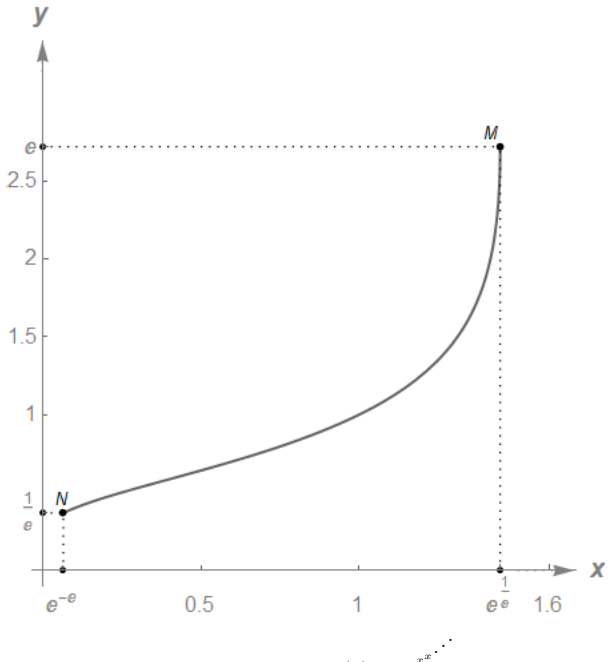
The paper's central claim is that the infinite power tower $y=f(x)=x^{x^{x^{\cdots}}}$ converges exactly on the closed interval $e^{-e}\le x\le e^{1/e}$, and there takes values $1/e\le y\le e$. On this interval the limit is the attracting fixed point of the recursion $y_{n+1}=x^{y_n}$, encoded by the equation $y=x^y$; the author locates the interval by requiring $|\ln y|<1$ at the fixed point. Below the lower endpoint, for $0<x<e^{-e}$, the fixed point becomes unstable and the tower instead approaches a stable 2-cycle whose two alternating values $a$ and $b$ satisfy $a=x^b$ and $b=x^a$, equivalently $y=x^{x^y}$. The paper also identifies the transition at $x=e^{-e}$ as a pitchfork bifurcation and gives the fixed points in the closed form $y=W(-\ln x)/(-\ln x)$ via the Lambert $W$ function.
Load-bearing premise
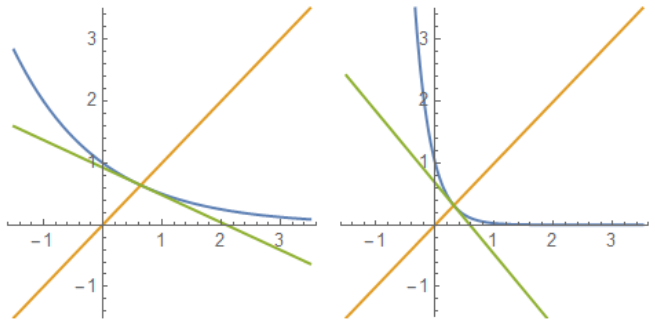
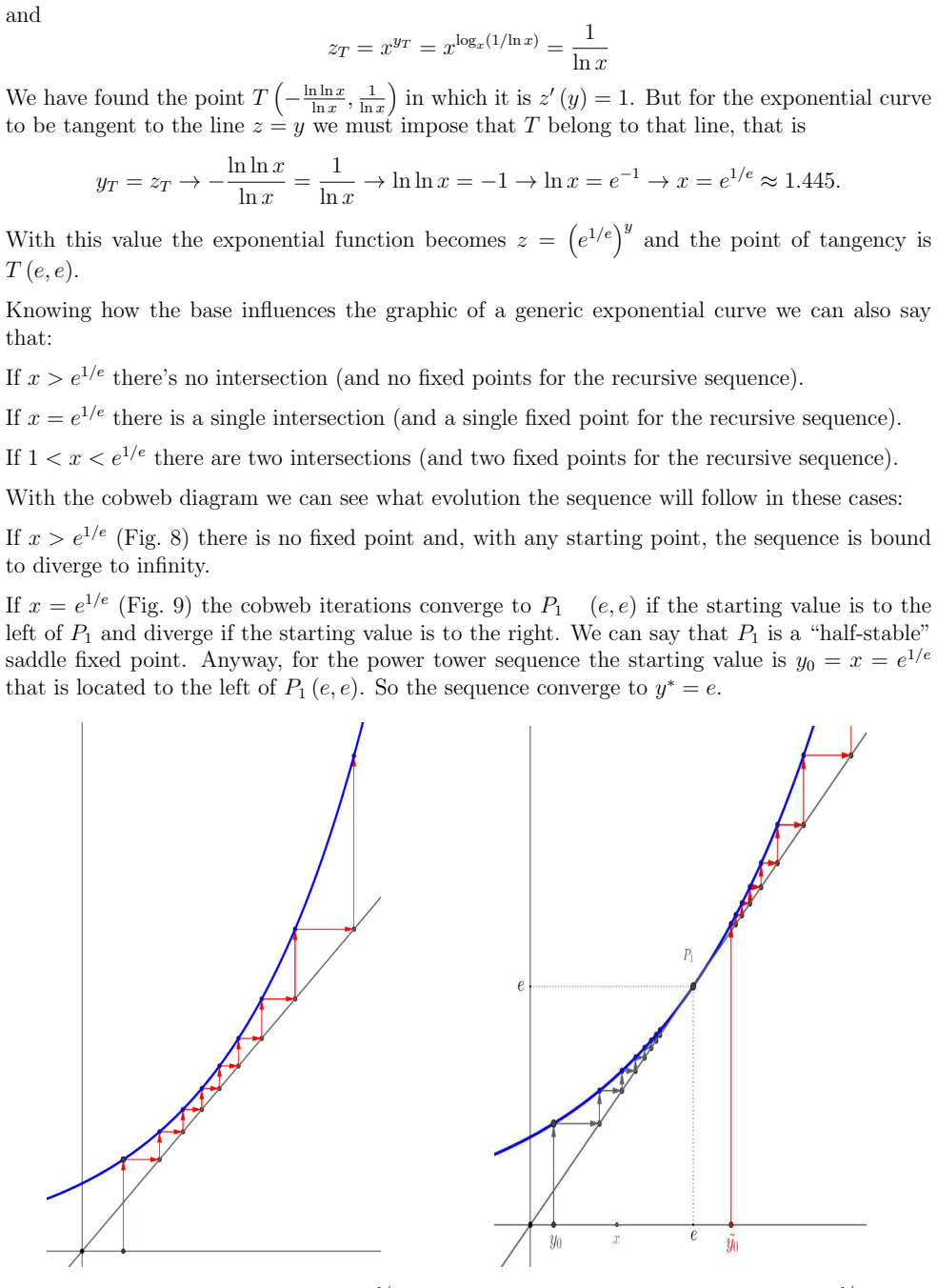
The closed-interval claim for convergence at $x=e^{-e}$ and $x=e^{1/e}$ rests on cobweb diagrams rather than on the paper's stated fixed-point theorem, which only guarantees convergence when the derivative is bounded strictly below $1$ in absolute value.
Editorial extensions
If this is right
- For every base in $[e^{-e},e^{1/e}]$, the tower has a finite value between $1/e$ and $e$, equal to the unique fixed point of $y=x^y$.
- For every base in $(0,e^{-e})$, even and odd partial towers converge to two distinct values $a$ and $b$ satisfying $a=x^b$ and $b=x^a$; the equation $y=x^{x^y}$ also has a middle branch that is not realized by the tower because it sits outside the convergence region.
- As $x\to 0^+$, the two realized branches tend to $1$ and $0$, so the infinite tower has no single limit at $x=0$.
- The change at $x=e^{-e}$ is a pitchfork bifurcation: the stable fixed point becomes unstable and a stable 2-cycle appears.
- The fixed points can be written explicitly as $y=W(-\ln x)/(-\ln x)$ with the Lambert $W$ function.
Reading between the lines
- The paper leaves the parity limits at $x\to 0$ (even heights tending to $1$, odd heights to $0$) as an unproved conjecture; a proof by induction using the double-step equation $y=x^{x^y}$ is a natural next step.
- The same double-step analysis could be applied to iterated exponentials with a fixed starting exponent $\alpha$, recovering the classical family $r, r^\alpha, r^{r^\alpha},\dots$ and testing whether the 2-cycle condition takes the same form.
- Because the endpoint convergence is argued graphically rather than by the stated fixed-point theorem, a formal one-sided convergence proof for $x=e^{-e}$ and $x=e^{1/e}$ would complete the closed-interval claim.
Signed reviews
Editorial analysis
A structured set of objections, weighed in public.
Referee Report
Summary. The paper presents an expository investigation of the infinite power tower y = f(x) = x^{x^{x^{...}}}, intended as a model for inquiry-based teaching. It derives the fixed-point equation y = x^y, the convergence condition |ln y| < 1, and concludes that the tower converges for e^{-e} ≤ x ≤ e^{1/e} with values in [1/e, e]. For 0 < x < e^{-e}, it asserts that the tower does not converge but approaches a stable 2-cycle, with the two branches described by y = x^{x^y}. The paper also includes historical material on Lambert, Euler, and Lagrange, and uses Euler's parameterization to describe the 2-cycle values.
Significance. The mathematical content, if fully supported, is correct and classical: the convergence interval and the period-doubling behavior are established results in the theory of iterated exponentials. The paper's pedagogical orientation and historical narrative are valuable, and several derivations are explicit and reproducible, notably the reduction to fixed points, the use of the Lambert W function, and the parametric description of the 2-cycle values via y1 = p^{p/(1-p)}, y2 = p^{1/(1-p)}. However, the manuscript's expository goals are not matched by complete proofs for two load-bearing claims: the inclusion of the endpoints in the convergence interval and the assertion that a stable 2-cycle exists for every 0 < x < e^{-e}. These are supported only by graphical or numerical evidence, as the paper itself acknowledges at several points.
major comments (3)
- [§6 and §7] The derivation in §6 establishes |ln y| < 1, which gives only the open interval e^{-e} < x < e^{1/e}. The closed interval claim e^{-e} ≤ x ≤ e^{1/e} stated in §7 and Table 1 relies on the cobweb diagrams in Figures 9 and 21, but the fixed-point convergence theorem in §5 requires λ = max |r'(y)| < 1, which fails at the endpoints where |r'(y)| = 1. The manuscript needs a formal argument (for example, a separate endpoint analysis) or an explicit caveat that endpoint convergence is observed graphically rather than proved.
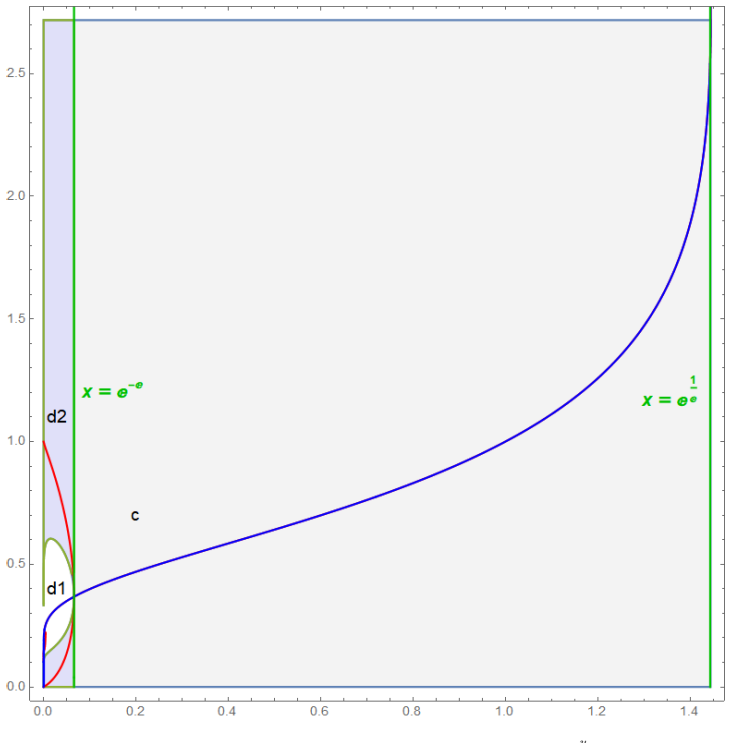
- [§8 and Table 1] The claim that a stable 2-cycle exists for all 0 < x < e^{-e} is supported by the derived condition |x^{x^y+y} ln^2 x| < 1, but after this condition the manuscript states that an explicit boundary cannot be found and instead invokes the Mathematica RegionPlot in Fig. 16. The derivative test is not evaluated at the cycle points as a function of x, so the written argument does not rule out a repelling 2-cycle or other dynamics in part of the interval. Since Table 1 and the conclusions assert convergence to the 2-cycle for the whole interval, this is a load-bearing gap; a proof or a clearly labeled conjectural status is needed.
- [§8, limit x→0] The manuscript derives lim_{x→0} f_2(x) = 1 and lim_{x→0} f_3(x) = 0, and then states that the extension to all even and odd heights 'can't prove this conjecture with simple tools and leave this problem to a later time.' Nevertheless, the row for x→0+ in Table 1 and the discussion near Eq. (??) treat the limits y1→0 and y2→1 as established. The paper should either supply a proof of the conjecture for all n or explicitly mark the x→0+ row as conjectural.
minor comments (4)
- [§5] The fixed-point theorem is stated 'without a complete and rigorous proof'; for an expository paper it would be helpful to include at least a sketch of the contraction argument, since the theorem is used repeatedly.
- [Throughout] There are several typographical errors, including 'L'Hpital' (missing ô), 'whit' for 'with', and missing accents in 'Geogebra' and 'Mathematica'; a careful copyedit is recommended.
- [Figures] Several figures, especially the cobweb diagrams in §7 and the RegionPlot in Fig. 16, are small and hard to read; enlarging them and adding axis labels with variable names would improve accessibility for the intended audience.
- [References] The historical references are useful, but some URLs (e.g., the MathWorld and Wikipedia links) lack access dates, and the citation style is inconsistent; the manuscript should follow a single reference format.
Circularity Check
No significant circularity: the claims are derived from the recursive definition and standard fixed-point analysis, not from fitted inputs or self-supporting citations.
full rationale
The paper's derivation begins with the explicit recursive definition y_{n+1} = x^{y_n} and the fixed-point equation y = x^y, then obtains the convergence condition from |d/dy(x^y)| = |ln y| < 1. The interval e^{-e} < x < e^{1/e} and the corresponding y-range follow from this derivative test, with the endpoints handled by separate cobweb arguments. The 2-cycle discussion derives the branch equations y_2 = x^{y_1}, y_1 = x^{y_2} and the Euler parameterization y_1 = p^{p/(1-p)}, y_2 = p^{1/(1-p)}; the parameter p is a free variable, not a fitted quantity. No parameter is fitted to a subset of data and then renamed as a prediction, and no load-bearing step is justified by a self-citation. The use of a Mathematica RegionPlot for the double-iteration region and the informal endpoint arguments are potential rigor gaps, but they are not circular: they do not assume the conclusion they are meant to establish. All historical citations are to Euler, Lambert, Lagrange, and standard published references, not to the author's own prior work. Thus the derivation chain is self-contained as a mathematical exposition, and any weaknesses are soundness or completeness issues rather than circularity.
Assumptions & free parameters
assumptions (3)
- standard math Fixed point convergence criterion: if r and r' are continuous on [a,b], r maps [a,b] into itself, and max |r'| < 1, then the iteration converges to the unique fixed point.
- ad hoc to paper Endpoint convergence at x=e^{-e} and x=e^{1/e} follows from the cobweb pictures even though |r'| = 1 there.
- ad hoc to paper Convergence of the double-step recursion y_{n+2}=x^{x^{y_n}} in the gray region of Fig. 16, used to describe the 2-cycle and the x to 0 limit.
Cite this review
Pith. "Pith review of The strange properties of the infinite power tower." pith.science (2026). https://pith.science/paper/IE7B5OOJ
@misc{pith2026190805559,
  author       = {Pith},
  title        = {Pith review of: The strange properties of the infinite power tower},
  year         = {2026},
  howpublished = {\url{https://pith.science/paper/IE7B5OOJ}},
  note         = {Machine review of arXiv:1908.05559}
}
abstract
In this article we investigate some "unexpected" properties of the "Infinite Power Tower". \[y = f(x) = {x^{{x^{{x^{{x^ {\mathinner{\mkern2mu\raise1pt\hbox{.}\mkern2mu \raise4pt\hbox{.}\mkern2mu\raise7pt\hbox{.}\mkern1mu}} }}}}}}}\] The material collected here is also intended as a potential guide for teachers of high-school/undergraduate students interested in planning an activity of investigative mathematics in the classroom, where the knowledge is gained through the active, creative and cooperative use of diversified mathematical tools (and some ingenuity). The activity should possibly be carried on with a laboratorial style, with no preclusions on the paths chosen and undertaken by the students and with little or no information imparted from the teacher's desk. The teacher should then act just as a guide and a facilitator. The mathematical requisites to follow this path are: functions, properties of exponentials and logarithms, sequences, limits and derivatives. The topics presented should then be accessible to undergraduate or "advanced high school" students.
Figures


Figures from the paper (15 more)









Reference graph
Works this paper leans on
-
[1]
r (y) and r′ (y) are continuous on [a,b ]
-
[2]
if a≤y≤b → a≤r (y)≤b (meaning that r (y) is a contraction mapping)
-
[3]
λ = max a≤y≤b |r′ (y)|< 1 Then a) There exists a unique solution y∗∈ [a,b ] of the equation y =r (y). b) For any initial starting value y0∈ [a,b ] the sequence will converge to the unique fixed point: lim n→∞ yn =y∗ The convergence/divergence character of the fixed points can be interpreted graphically with the so called “ cobweb′′ construction. In the foll...
-
[4]
Anyway, for the power tower sequence the starting value is y0 = x and it’s located to the left of y∗
-
[5]
In fact, for the fixed point holds the relation y∗ 1 = xy∗ 1 → x = (y∗ 1)1/y∗ 1 and if we set x < y∗ 1 it must be (y∗ 1)1/y∗ 1 < y∗
-
[6]
Taking the logarithms of both sides we have ln ( y∗ 1)1/y∗ 1 < lny∗ 1 that is 1/y∗ 1 ln (y∗ 1)< lny∗ 1→ 1/y∗ 1 < 1→y∗ 1 > 1. So it is x<y ∗ 1 if y∗ 1 > 1. But since z =xy is increasing and it’s z (0) = 1, the first intersection of the exponential with the line z =y must have a value z >1. This implies (since y =z) that y >1. So it is y∗ 1 > 1 and x<y ∗
-
[7]
To complete our analysis let’s see what happens with 0 < x <1
The sequence converges to y∗ 1. To complete our analysis let’s see what happens with 0 < x <1. In this case the exponential curvez =xy is decreasing and there can be only one single intersection point with the linez =y and a corresponding single fixed point. Anyway some interesting unexpected things are going to happen when we start analyzing the stability...
- [8]
Show all 13 references
-
[9]
c” in the figure), while the white area (“d1
=xy lnx we must solve the inequalityxy lnx> −1 withy =xy meaningx =y1/y. It will then be y lny1/y >−1→ lny >−1→y >e−1→x =y1/y >e−e We can then say that the fixed point is attractive for e−e≤x< 1 and that we’ll have a 2-cycle for 0 <x<e −e. Fig. 11: Cobweb iterations in the case...
-
[10]
if a is a number, the successor S (a) of a is a number
-
[11]
zero is not the successor of a number
-
[12]
two numbers of which the successors are equal are themselves equal
-
[13]
Observationes variae in mathesin puram
If a set K of numbers contains zero and also the successor of every number in K, then every number is in K(induction axiom). Peano’s axioms are the basis of the arithmetic of natural numbers, where the operations of addition, multiplication and exponentiation can be defined. Ye...
1996
Reviewed August 14, 2026 · model on record in the stance chip above.
Discussion (0). Continue with ORCID to comment.