REVIEW 2 major objections 4 minor 28 references
A hypothesis test of feasibility for external pilot trials assessing recruitment, follow-up and adherence rates
T0 review · 2 major / 4 minor · reviewed 2026-08-14 · deepseek-v4-flash
Pith's one-line read The paper proposes that an external pilot trial's go/no-go decision be a formal hypothesis test on recruitment, follow-up and adherence, with type I and II error rates controlled by pilot sample size and critical value.
desk verdict A genuinely useful new framework for pilot trial progression decisions, but the advertised error rates rest on an unproven boundary assumption and a heuristic optimizer, so treat the numbers with caution. read the letter →
The pith
A machine-rendered reading of the paper's core claim, the machinery that carries it, and where it could break.
The reading
What carries the argument
The central object is the function $x(\varphi)=\varphi_a\mu\sqrt{\varphi_f E[N\mid\varphi_r]}/\sqrt{4\sigma^2+2\mu^2\varphi_a(1-\varphi_a)}$, the standardized signal that determines definitive-trial power, where $E[N\mid\varphi_r]$ is the expected number of participants recruited under the definitive design. The method uses $x(\hat\varphi)$ as the pilot test statistic, so hypotheses are level sets of $x$ and the decision is 'go' when $x(\hat\varphi)>c$. The sampling machinery is the pilot power function $h(n_p,c,\varphi)=\Pr[x(\hat\varphi)>c\mid n_p,\varphi]$, built from a negative-binomial distribution for recruitment refusals and binomial or multinomial distributions for follow-up and adherence; error rates are the maxima of $h$ and $1-h$ over null and alternative regions. That reduction turns the choice of pilot sample size and critical value into a multi-objective optimization problem rather than a rule of thumb.
What would settle it
For the TIGA-CUB setting with $n_p=50$ and $c=2.6422$, evaluate $h(n_p,c,\varphi)$ at parameter triples strictly inside the null region $\Phi_0$ rather than only on the boundary $x(\varphi)=x_0$; if any interior triple gives a go probability larger than the reported type I error, the claimed error control is not guaranteed.
Extended reading notes
Core claim
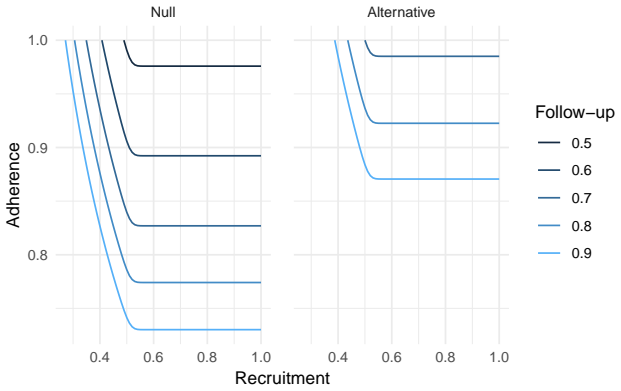
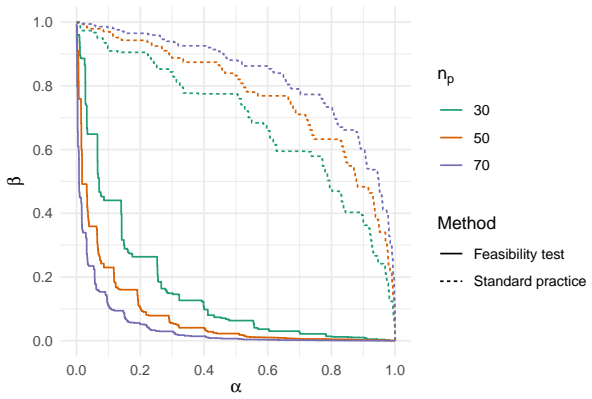
The paper claims that an external pilot trial's progression decision can be redesigned as a test of feasibility, with hypotheses defined by the power of the planned definitive trial. The definitive trial's power is $g(\varphi)=\Phi(x(\varphi)-z_{1-\alpha})$, where $\varphi=(\varphi_r,\varphi_f,\varphi_a)$ are the recruitment, follow-up and adherence rates. Choosing power thresholds $p_0$ and $p_1$ partitions the parameter space into a null region $\Phi_0=\{x(\varphi)\le x_0\}$ of infeasible trials and an alternative region $\Phi_1=\{x(\varphi)\ge x_1\}$ of feasible trials. The pilot proceeds if and only if $x(\hat\varphi)>c$, where $\hat\varphi$ is the pilot estimate and $c$ a critical value. The paper then computes the type I and II error rates $\alpha(n_p,c)=\max_{\varphi\in\Phi_0}\Pr[x(\hat\varphi)>c\mid\varphi,n_p]$ and $\beta(n_p,c)=\max_{\varphi\in\Phi_1}\Pr[x(\hat\varphi)\le c\mid\varphi,n_p]$, so $n_p$ and $c$ can be chosen prospectively to balance sampling cost against both errors. Re-designing TIGA-CUB shows the original 30-per-arm pilot has poor operating characteristics, roughly 50 per arm gives type I around 0.09 with type II around 0.23, and independent progression criteria, even with unlimited pilot size, have error rates no better than a coin toss. Extending the test to estimate an unknown outcome standard deviation raises both error rates, so a larger pilot is needed to maintain the same guarantees.
Load-bearing premise
The entire design rests on the assumption that the worst combinations of recruitment, follow-up and adherence rates sit exactly on the boundary where the planned trial's power equals the chosen threshold; if they sit inside the region instead, the reported error rates are too low.
Editorial extensions
If this is right
- A pilot team can pre-specify the decision rule as 'go if $x(\hat\varphi)>c$' and choose $n_p$ and $c$ from the calculated type I and type II error curves, making sample-size justification part of the same calculation.
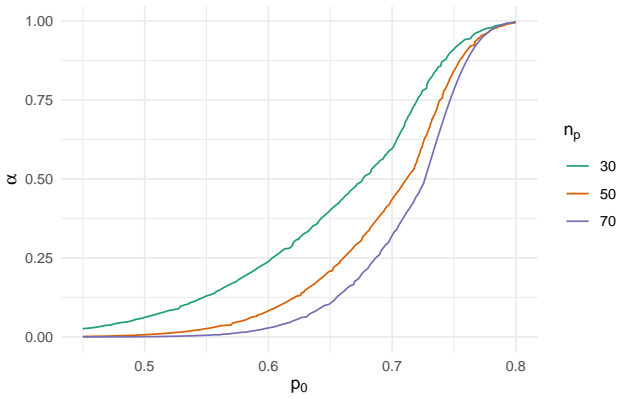
- In the settings modelled, increasing the pilot from 30 to 50 participants per arm materially improves error rates, and values around 50 per arm keep type II error close to 0.2 while holding type I error near 0.1 when $p_1=0.8$ and $p_0\le0.65$.
- Conventional independent progression criteria, which require all three estimated rates to pass their own thresholds, had error rates no better than a coin toss in the authors' scenarios, and larger pilot samples did not fix this.
- If the pilot must also estimate the outcome standard deviation, both error rates rise; maintaining the same error control requires increasing sample size, for example from 50 to 70 per arm in the illustrative setting.
- The formulation extends to designs whose power can be written as a function of the pilot-estimated parameters, including binary outcomes by normal approximation and cluster-randomised trials with known variance components.
Reading between the lines
- The authors' critique of independent progression criteria is a caution about conjunctive decision rules generally: requiring every estimated rate to clear a threshold creates a reverse-multiplicity effect, so a natural design heuristic is to define the decision on the downstream quantity of interest, power, rather than on each process estimate separately.
- Because the error rates are explicit, funders and trial oversight committees could specify an acceptable probability of investing in an underpowered trial, and the pilot size would follow from that tolerance; this gives a concrete way to translate risk appetite into a sample size.
- Extending the binary stop/go rule to a stop/modify/go decision could be done with two critical values, and the same error-rate calculations would show whether the intermediate decision actually improves long-run decisions or just adds a third action with unmeasured consequences.
Signed reviews
Editorial analysis
A structured set of objections, weighed in public.
Referee Report
Summary. The paper proposes a formal hypothesis-testing framework for progression decisions in external pilot trials. Feasibility of the planned definitive trial is quantified by its power, expressed as a function of recruitment, follow-up, and adherence rates. The null and alternative hypotheses correspond to the definitive trial power being below p0 or above p1. The test statistic is the plug-in estimate of the feasibility measure, x(φ̂), obtained from the pilot data. The authors show how the type I and II error rates of this test can be computed by enumerating the pilot sampling distribution and solving a bi-objective optimization for pilot sample size and critical value. The method is illustrated by re-designing TIGA-CUB and compared with conventional independent progression criteria, which are shown to have error rates no better than a coin toss in the considered scenarios. An extension incorporates an unknown outcome standard deviation. The paper includes a derivation of the definitive trial power and a reproducible implementation in R.
Significance. If the error-rate calculations were certified, this would be a valuable contribution to the design of external pilot trials, which currently rely on ad hoc progression criteria with little formal justification. Strengths of the paper include a careful modelling of the pilot data distribution, an explicit link between feasibility and definitive trial power, a complete implementation provided in the supplementary materials, and a concrete demonstration that conventional independent PCs can behave poorly. The main limitation is that the reported worst-case error rates rely on a heuristic optimizer without a proof that the optima are attained, which leaves the central design recommendation conditional.
major comments (2)
- [Section 3.4, Eq. (2)] The advertised type I and II error rates are defined as suprema of h(np,c,φ) over the composite null and alternative hypotheses, but the numerical solution uses NSGA-II, a stochastic metaheuristic with no global optimality guarantee. The paper does not prove that h(np,c,φ) is monotone in φ, nor that the suprema are attained on the boundary surfaces x(φ)=x0 and x(φ)=x1; the boundary-attainment assumption is stated only for the conventional PC method in Section 3.5, not for the proposed test. If the true maxima lie in the interior of Φ0 or Φ1, the curves in Figures 2–4 are lower bounds rather than worst-case error rates, in which case the recommendation that np≈50 per arm is sufficient is not supported. Please either prove monotonicity of h in each component of φ (which would justify restricting the search to the boundary surfaces and allow a grid-based certified search as in Section 3.5) or use a certified global optimization method and report the resulting maxima.
- [Section 2 and Section 3.3] The sampling model for the pilot is internally inconsistent. Section 2 defines S ∼ NB(np, φr) for the number of eligible patients who decline while recruiting to a target pilot sample size of np, whereas Section 3.3 defines the estimated recruitment rate as φ̂r = 2np/(2np + S) and states that np is the sample size per arm. These two statements are compatible only if S ∼ NB(2np, φr), i.e., if the pilot recruits until 2np consenting participants are obtained. Since the sampling distribution of S enters every probability calculation, the ambiguity must be resolved: please define clearly whether np is per arm or total and align the negative binomial specification in Section 2 with the estimator used in Section 3.3 and in the code.
minor comments (4)
- [Section 3.1] The term 'one-sided type I error rate' is confusing because the definitive trial is described as a two-arm z-test and Section 4 uses a two-sided test at the 0.05 level; since the power formula uses z_{1-α}, the precise meaning of α (one-sided or per-sided) should be stated.
- [Section 3.3] The densities pf(.) and pa(.) in the simplified formula for h are not defined explicitly; please state that they are binomial densities for the total number followed up across both arms and the number of adherers, respectively.
- [Data availability statement] The data availability statement says the code is 'freely available at' but no URL is printed in the manuscript; please include the repository link.
- [Section 6] In the formula for h(np,c,φ,σ), the conditioning set of the sample variance density should be defined; as written, p̂σ²(σ̂² | s, a, f, φ) appears to depend on s and a, whereas the preceding text indicates that σ̂²|f follows a scaled chi-square distribution.
Circularity Check
No circularity: the test statistic is the plug-in estimator of the power function used to define the hypotheses, but the error rates are computed from the model's sampling distribution rather than fitted, and the sole self-citation is a non-load-bearing pointer to future work.
full rationale
The paper's derivation chain is self-contained. Feasibility is defined through the definitive-trial power g(φ)=Φ(x(φ)−z_{1−α}) with x(φ) derived from the trial model in the appendix; the hypotheses Φ0={x(φ)≤x0} and Φ1={x(φ)≥x1} are fixed by user-specified thresholds p0 and p1; the test statistic is the plug-in x(φ̂), and the pilot operating characteristic h(np,c,φ) is obtained by enumerating the sampling distribution of the pilot estimators (Eq. 1) rather than by fitting any parameter to pilot data. The reported type I and II error rates therefore follow from the stated model, not from the inputs by definition. The only self-citation, reference [26], appears in the Discussion as a mention that treatment effect could be a future extension and is not used to justify any central claim. The heuristic NSGA-II maximization and the inconsistency between S∼NB(np,φ_r) and φ̂_r=2np/(2np+s) are correctness or robustness concerns about whether the advertised error rates are exact, but they are not circularity: the paper does not rename a fitted quantity as a prediction or import a load-bearing conclusion from its own prior work.
Assumptions & free parameters
free parameters (6)
- p0 =
0.65 (illustrative)
- p1 =
0.8 (illustrative)
- mu (treatment effect) =
0.3 (illustrative)
- sigma^2 (outcome variance) =
1 (illustrative)
- ne (eligible patients) =
1000 (illustrative)
- nt (target sample size) =
514 (illustrative)
assumptions (6)
- domain assumption Per-arm sample size of the definitive trial exceeds 30, so the sampling distributions of group means are normal.
- domain assumption Follow-up rate is constant across intervention and control arms.
- domain assumption Non-adherence is absolute, so non-adherers receive no treatment effect.
- domain assumption The definitive trial primary analysis is a complete-case intention-to-treat z-test.
- ad hoc to paper The maximum error rates over the composite hypotheses occur on the boundary surfaces x(phi)=x0 and x(phi)=x1.
- ad hoc to paper In the unknown-variance extension, sigma is restricted to sigma>sigma_star to avoid degenerate error rates.
Cite this review
Pith. "Pith review of A hypothesis test of feasibility for external pilot trials assessing recruitment, follow-up and adherence rates." pith.science (2026). https://pith.science/paper/Q3AILATL
@misc{pith2026190805562,
  author       = {Pith},
  title        = {Pith review of: A hypothesis test of feasibility for external pilot trials assessing recruitment, follow-up and adherence rates},
  year         = {2026},
  howpublished = {\url{https://pith.science/paper/Q3AILATL}},
  note         = {Machine review of arXiv:1908.05562}
}
read the original abstract
The power of a large clinical trial can be adversely affected by low recruitment, follow-up and adherence rates. External pilot trials estimate these rates and use them, via pre-specified decision rules, to determine if the definitive trial is feasible and should go ahead. There is little methodological research underpinning how these decision rules, or the sample size of the pilot, should be chosen. In this paper we propose a hypothesis test of the feasibility of a definitive trial, to be applied to the external pilot data and used to make progression decisions. We quantify feasibility by the power of the planned trial, as a function of recruitment, follow-up and adherence rates. We use this measure to define hypotheses to test in the pilot, propose a test statistic, and show how the error rates of this test can be calculated for the common scenario of a two-arm parallel group definitive trial with a single normally distributed primary endpoint. We use our method to re-design TIGA-CUB, an external pilot trial comparing a psychotherapy with treatment as usual for children with conduct disorders. We then extend our formulation to include using the pilot data to estimate the standard deviation of the primary endpoint. and incorporate this into the progression decision.
Figures
Figures from the paper (1 more)

Reference graph
Works this paper leans on
-
[1]
Ben G. O. Sully, Steven A. Julious, and Jon Nicholl. A reinvestigation of recruitment to randomised, controlled, multicenter trials: a review of trials funded by two uk funding agencies. Trials, 14(1):166, Jun 2013
work page 2013
-
[2]
Michael P. Fay, M. Elizabeth Halloran, and Dean A. Follmann. Accou nting for variability in sample size estimation with applications to nonadheren ce and estimation of variance and effect size. Biometrics, 63(2):465–474, dec 2006
work page 2006
-
[3]
M Teare, Munyaradzi Dimairo, Neil Shephard, Alex Hayman, Amy W hite- head, and Stephen Walters. Sample size requirements to estimate k ey de- sign parameters from external pilot randomised controlled trials: a simula- tion study. Trials, 15(1):264, 2014
work page 2014
-
[4]
Developing and evaluating complex intervention s: the 20 new medical research council guidance
Peter Craig, Paul Dieppe, Sally Macintyre, Susan Michie, Irwin Naz areth, and Mark Petticrew. Developing and evaluating complex intervention s: the 20 new medical research council guidance. BMJ: British Medical Journal , 337, 9 2008
work page 2008
-
[5]
Eldridge, Gillian A
Sandra M. Eldridge, Gillian A. Lancaster, Michael J. Campbell, Leha na Thabane, Sally Hopewell, Claire L. Coleman, and Christine M. Bond. Defining feasibility and pilot studies in preparation for randomised con - trolled trials: Development of a conceptual framework. PLOS ONE , 11(3):e0150205, mar 2016
2016
-
[6]
Informing efficient randomised controlled trials: exp lo- ration of challenges in developing progression criteria for internal p ilot stud- ies
Kerry N L Avery, Paula R Williamson, Carrol Gamble, Elaine O’Connell Francischetto, Chris Metcalfe, Peter Davidson, Hywel Williams, and Jane M Blazeby. Informing efficient randomised controlled trials: exp lo- ration of challenges in developing progression criteria for internal p ilot stud- ies. BMJ Open , 7(2):e013537, feb 2017
2017
-
[7]
CONSORT 2010 statement: extension to randomised pilot and feasibility trials
Sandra M Eldridge, Claire L Chan, Michael J Campbell, Christine M Bon d, Sally Hopewell, Lehana Thabane, and Gillian A Lancaster. CONSORT 2010 statement: extension to randomised pilot and feasibility trials. BMJ, page i5239, oct 2016
2010
-
[8]
Research for patient benefit (rfpb) programme guidance on applying for feasibility studies, 2017
National Institute for Health Research. Research for patient benefit (rfpb) programme guidance on applying for feasibility studies, 2017
2017
Show all 28 references
-
[9]
Richard H. Browne. On the use of a pilot sample for sample size dete rmi- nation. Statistics in Medicine , 14(17):1933–1940, 1995
1933
-
[10]
Steven A. Julious. Sample size of 12 per group rule of thumb for a pilot study. Pharmaceutical Statistics, 4(4):287–291, 2005
2005
-
[11]
The size of a pilot study for a clinical tr ial should be calculated in relation to considerations of precision and effic iency
Julius Sim and Martyn Lewis. The size of a pilot study for a clinical tr ial should be calculated in relation to considerations of precision and effic iency. Journal of Clinical Epidemiology , 65(3):301–308, mar 2012
2012
-
[12]
How big should the pilot study for my cluste r randomised trial be? Statistical Methods in Medical Research , 2015
Sandra M Eldridge, Ceire E Costelloe, Brennan C Kahan, Gillian A Lan - caster, and Sally M Kerry. How big should the pilot study for my cluste r randomised trial be? Statistical Methods in Medical Research , 2015
2015
-
[13]
Estimating the sample size for a pilot randomised trial to min- imise the overall trial sample size for the external pilot and main trial for a continuous outcome variable
Amy L Whitehead, Steven A Julious, Cindy L Cooper, and Michael J Campbell. Estimating the sample size for a pilot randomised trial to min- imise the overall trial sample size for the external pilot and main trial for a continuous outcome variable. Statistical Methods in Medica...
2015
-
[14]
Are pilot trials useful for predicting randomisat ion and attrition rates in definitive studies: A review of publicly funded tr ials
Cindy L Cooper, Amy Whitehead, Edward Pottrill, Steven A Julious , and Stephen J Walters. Are pilot trials useful for predicting randomisat ion and attrition rates in definitive studies: A review of publicly funded tr ials. Clinical Trials, 0(0):1740774517752113, 2018. PMID: 29361833
2018
-
[15]
Power and sample size when mult iple endpoints are considered
Stephen Senn and Frank Bretz. Power and sample size when mult iple endpoints are considered. Pharmaceut. Statist. , 6(3):161–170, 2007. 21
2007
-
[16]
Challenge of multiple co-primary endpoints: a new approach
Christy Chuang-Stein, Paul Stryszak, Alex Dmitrienko, and Wa lter Offen. Challenge of multiple co-primary endpoints: a new approach. Statistics in Medicine, 26(6):1181–1192, 2007
2007
-
[17]
Lancaster, Susanna Dodd, and Paula R
Gillian A. Lancaster, Susanna Dodd, and Paula R. Williamson. Design and analysis of pilot studies: recommendations for good practice. Journal of Evaluation in Clinical Practice , 10(2):307–312, 2004
2004
-
[18]
What is a pilot or feasibility study? a review of current practice and ed i- torial policy
Mubashir Arain, Michael Campbell, Cindy Cooper, and Gillian Lancas ter. What is a pilot or feasibility study? a review of current practice and ed i- torial policy. BMC Medical Research Methodology, 10(1):67, 2010
2010
-
[19]
A tutorial on pilot studies: the what, why and how
Lehana Thabane, Jinhui Ma, Rong Chu, Ji Cheng, Afisi Ismaila, Lorena Rios, Reid Robson, Marroon Thabane, Lora Giangregorio, and Char les Goldsmith. A tutorial on pilot studies: the what, why and how. BMC Medical Research Methodology, 10(1):1, 2010
2010
-
[20]
K. Deb, A. Pratap, S. Agarwal, and T. Meyarivan. A fast and elit ist multi- objective genetic algorithm: NSGA-II. IEEE Transactions on Evolutionary Computation, 6(2):182–197, apr 2002
2002
-
[21]
mco: Multiple Criteria Optimization Algorithms and Re- lated Functions, 2014
Olaf Mersmann. mco: Multiple Criteria Optimization Algorithms and Re- lated Functions, 2014. R package version 1.0-15.1
2014
-
[22]
Rcpp: Seamless R and C ++ integration
Dirk Eddelbuettel and Romain Fran¸ cois. Rcpp: Seamless R and C ++ integration. Journal of Statistical Software , 40(8):1–18, 2011
2011
-
[23]
Elizabeth Edginton, Rebecca Walwyn, Kayleigh Burton, Robert C icero, Liz Graham, Sadie Reed, Sandy Tubeuf, Maureen Twiddy, Alex Wright - Hughes, Lynda Ellis, Dot Evans, Tom Hughes, Nick Midgley, Paul Wallis, and David Cottrell. TIGA-CUB – manualised psychoanalytic child psy- c...
2017
-
[24]
Sample size and power calculation s for medical studies by simulation when closed form expressions are not a vail- able
Sabine Landau and Daniel Stahl. Sample size and power calculation s for medical studies by simulation when closed form expressions are not a vail- able. Statistical Methods in Medical Research , 22(3):324–345, 2013
2013
-
[25]
Donald R. Jones. A taxonomy of global optimization methods bas ed on response surfaces. Journal of Global Optimization , 21(4):345–383, 2001
2001
-
[26]
D. T. Wilson, R. E. Walwyn, J. Brown, A. J. Farrin, and S. R. Brow n. Statistical challenges in assessing potential efficacy of complex inte rven- tions in pilot or feasibility studies. Statistical Methods in Medical Research, 25(3):997–1009, jun 2015
2015
-
[27]
Conaway and Gina R
Mark R. Conaway and Gina R. Petroni. Designs for phase II trials allowing for a trade-off between response and toxicity. Biometrics, 52(4):pp. 1375– 1386, 1996. 22
1996
-
[28]
Peter F. Thall. Some geometric methods for constructing decis ion criteria based on two-dimensional parameters. Journal of Statistical Planning and Inference, 138(2):516–527, feb 2008. Appendix Recall that the sample means are ¯Y1 = A F1 µ + 1 F1 F1∑ i=1 ei, 1, ¯Y0 = 1 F0 F0∑ ...
2008
Reviewed August 14, 2026 · model on record in the stance chip above.
Discussion (0). Continue with ORCID to comment.