REVIEW 1 major objections 6 minor 1 cited by
An Improved Compact Embedding Theorem for Degenerate Sobolev Spaces
T0 review · 1 major / 6 minor · reviewed 2026-08-14 · deepseek-v4-flash
Pith's one-line read This paper proves that degenerate matrix-weighted Sobolev spaces embed compactly into weighted Lebesgue spaces on compact subsets whenever the domain carries local Poincaré and Sobolev inequalities with gain factor $\sigma>1$, for every…
desk verdict The abstract compact embedding theorem is in good shape; the advertised application has a real but likely fixable gap where a key Sobolev hypothesis is left unverified. read the letter →
The pith
A machine-rendered reading of the paper's core claim, the machinery that carries it, and where it could break.
The reading
What carries the argument
The engine of the proof is a pair of local inequalities imposed on the quasimetric space $(\Omega,\rho)$: a local Poincaré property of order $p$, whose constant can be made arbitrarily small as the ball radius shrinks (Definition 2.4), and a local Sobolev property of order $p$ with gain $\sigma>1$, which bounds the $L^{p\sigma}_v$ norm on each small $\rho$-ball by the $QH^{1,p}$ norm (Definition 2.6). These are combined with the local geometric doubling condition (Definition 2.1), which supplies finite coverings of compact sets by $\rho$-balls with bounded overlap, and with an interpolation inequality that transfers Cauchy behavior from $L^p_v$ to $L^q_v$ for $p<q<p\sigma$. The named object that carries the new range is the gain factor $\sigma$: it is exactly the exponent beyond $p$ that the local Sobolev inequality provides, and the upper endpoint $p\sigma$ is where the compact embedding stops.
What would settle it
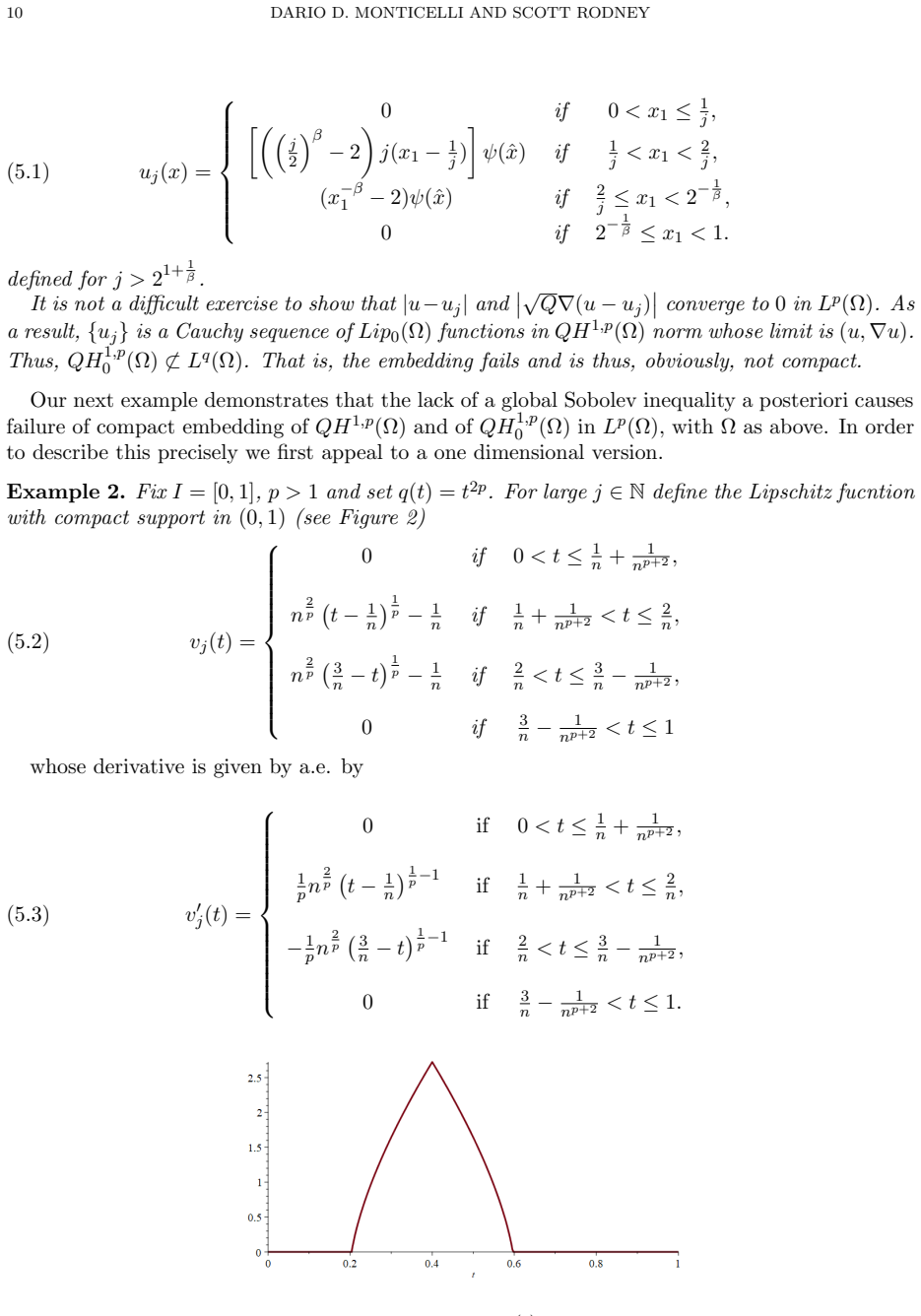
To test the claim, inspect whether the proof's cover of a compact set $E$ by Euclidean balls $D(x,s)$ contained in $\rho$-balls $B(x,r)$ can fail for a quasimetric such as $\rho(x,y)=|x-y|^\beta$ with $\beta>1$ on the unit cube; if the local Poincaré and Sobolev properties hold for that $\rho$ but the compact embedding into $L^q$ for some $p<q<p\sigma$ fails, the theorem would be false. The paper's own Example 1 already gives a concrete failure of the global analogue: with $Q=\operatorname{Diag}(x_1^2,1,\dots,1)$ on the cube, a function lies in $QH^{1,p}_0$ but not in $L^q$, showing local hypotheses do not imply global compactness.
Extended reading notes
Core claim
The central claim is Theorem 1.4: let $1<p<\infty$ and let $\rho$ be a quasimetric on $\Omega$ whose open balls satisfy the local geometric doubling condition; if $(\Omega,\rho)$ admits a local Poincaré inequality of order $p$ and a local Sobolev property of order $p$ with gain factor $\sigma>1$, then $QH^{1,p}(v,\mu;\Omega)$ is compactly embedded in $L^q_v(\mu;E)$ for any $E$ compactly contained in $\Omega$ and any $q\in[1,p\sigma)$. The proof covers $E$ by finitely many small $\rho$-balls, uses the Poincaré inequality to control oscillations and weak convergence to control ball averages for $q=p$, then uses the Sobolev inequality plus a partition of unity to gain integrability up to $p\sigma$ and interpolates for $p<q<p\sigma$. Corollaries extend the result to the zero-boundary space $QH^{1,p}_0$, to $q<p$ on all of $\Omega$, and to $q\le p$ on compact subsets; with a global Sobolev property the embedding becomes global on $\Omega$.
Load-bearing premise
The theorem depends on the domain supporting a local Sobolev inequality whose gain exponent $\sigma$ is strictly larger than 1 and a local Poincaré inequality whose constant tends to zero as the ball radius shrinks, uniformly on compact sets; if either fails, the conclusion that compactness holds for $q$ above $p$ is not obtained.
Editorial extensions
If this is right
- For any compact $E$ and any $1\le q<p\sigma$, $QH^{1,p}(v,\mu;\Omega)$ embeds compactly into $L^q_v(\mu;E)$ under the two local hypotheses (Theorem 1.4).
- The zero-boundary space $QH^{1,p}_0(v,\mu;E)$ also embeds compactly into $L^q_v(\mu;E)$ for every $q\in[1,p\sigma)$ (Corollary 1.5).
- Without the Sobolev gain, compactness still holds into $L^q_v(\mu;\Omega)$ for $1\le q<p$ and into $L^q_v(\mu;E)$ for $1\le q\le p$ (Theorem 1.6).
- If the Sobolev property is global, both $QH^{1,p}_0$ and $QH^{1,p}$ embed compactly into $L^q_v(\mu;\Omega)$ for all $q\in[1,p\sigma)$ (Theorem 1.7).
- For $p$-admissible weights $w\le\tau$ satisfying the Chanillo–Wheeden balance condition, the degenerate $p$-Laplacian solution spaces embed compactly into $L^r_\tau(E)$ for some $r>p$ (Theorem 1.8).
Reading between the lines
- The same local-compactness mechanism should transfer to Carnot–Carathéodory or other sub-Riemannian geometries, where a quasimetric with local geometric doubling and local Sobolev/Poincaré inequalities is the natural structure; the proof appears to use only those inequalities, not the Euclidean structure.
- The sharpness examples suggest a useful dichotomy: compactness on compact subsets is a purely local phenomenon, while compactness on the whole domain is tied to a global Sobolev inequality; this may guide existence proofs for degenerate elliptic problems on rough domains.
- One could test numerically or by explicit construction whether the upper exponent $p\sigma$ is sharp: build weights where the local Sobolev gain is exactly $\sigma$ and see whether the embedding into $L^{p\sigma}_v(E)$ fails, which would confirm the endpoint in Theorem 1.4 is best possible.
Signed reviews
Editorial analysis
A structured set of objections, weighed in public.
Referee Report
Summary. This paper studies compact embeddings of matrix-weighted Sobolev spaces QH^{1,p}(v,µ;Ω), defined as completions of Lipschitz functions with respect to the norm (1.1). The main result, Theorem 1.4, states that if (Ω,ρ) is a locally geometrically doubling quasimetric space supporting a local Poincaré inequality of order p and a local Sobolev property of order p with gain σ>1, then QH^{1,p}(v,µ;Ω) embeds compactly into L^q_v(µ;E) for every E⋐Ω and 1≤q<pσ. Corollary 1.5 gives the analogous statement for QH^{1,p}_0 on E, Theorem 1.6 treats the range q<p globally and q≤p locally without the Sobolev hypothesis, and Theorem 1.7 extends to all of Ω under a global Sobolev property. Section 4 applies Theorem 1.4 to p-admissible weights w≤τ satisfying the Chanillo–Wheeden balance condition, yielding Theorem 1.8; Section 5 provides two examples showing that global compactness can fail under only local hypotheses. The proof of Theorem 1.4 is internally coherent; in particular, the q>p step is justified because Definition 2.1 requires ρ-balls to be Euclidean open, so each B(x,r) contains a small Euclidean ball D(x,s), contrary to one possible reading of the proof. The principal weakness is in Section 4, where the verification of the local Sobolev hypothesis (Definition 2.6) is deferred to the reader.
Significance. If correct, the main theorem is a genuine improvement over the compactness results in [CRW, Section 3], because it requires only local Poincaré and Sobolev inequalities and avoids global doubling assumptions and Myers–Serrin type identifications. The abstract-completion framework is clean, the proof for 1≤q≤p is elementary and sound, and the counterexamples in Section 5 usefully delineate why global compactness fails under local hypotheses. The paper would be strengthened by completing the verification of the local Sobolev property in the two-weight application; once that is done, the advertised Theorem 1.8 would follow.
major comments (1)
- [§4, proof of Theorem 1.8] The proof of Theorem 1.8 requires the pair (Ω, Euclidean metric) to satisfy both hypotheses of Theorem 1.4. Section 4 explicitly verifies the local Poincaré property (Definition 2.4) from the two-weight Poincaré inequality and the balance condition, but for the local Sobolev property it says only: "The argument giving Definition 2.6 is similar and left to the reader." This is load-bearing, because the exponent q>p in Theorem 1.8 is exactly pσ with σ>1, and σ>1 comes solely from Definition 2.6. The missing verification is plausible: take ρ to be the Euclidean distance, apply the Chanillo–Wheeden/CMN local Sobolev inequality with the exponent q>p from the balance condition, and use w|ξ|^p≤|√Qξ|^p to replace the w-weighted gradient term by the Q-weighted one, obtaining a finite constant C(D)=C r τ(D)^{1/q}w(D)^{-1/p} for each small Euclidean ball. However, the authors should include this derivation in the manuscript rather than deferring it, since Theorem 1.8 is the advertised concrete payoff of the abstract Theorem 1.4.
minor comments (6)
- [§1, roadmap] The introduction states that the two-weight application is given in Section 3 and the counterexample in Section 4, but these appear in Sections 4 and 5, respectively.
- [§3.1, q>p step] The notation D(x,s) for Euclidean balls is used without being defined; please define it explicitly when it first appears.
- [§5, Example 2] In equations (5.2) and (5.3), the formulas for v_j(t) use n in place of the sequence index j; this should be corrected to avoid confusion.
- [§5, Example 1] The map u is declared as u:Ω→R^n, but its values are scalar; the codomain should be R.
- [References] The reference [HyM] contains the editorial note "CHECK!!!" and lacks complete publication data; this should be cleaned up before submission.
- [Theorem 1.7] Theorem 1.7 is stated without a full proof; even if it follows from Remark 3.1 and interpolation, a few lines of justification would make the paper more self-contained.
Circularity Check
No circular derivation: Theorem 1.4 proves compactness from local Sobolev/Poincaré hypotheses; self-citations are technical, not load-bearing.
full rationale
The central result is a conditional compactness theorem: Theorem 1.4 takes local Poincaré (Definition 2.4) and local Sobolev with gain sigma>1 (Definition 2.6) as hypotheses and derives compact embedding into L^q for q<p*sigma. The conclusion is not one of the hypotheses; the proof uses the local inequalities to control oscillation on small rho-balls, weak convergence for averages, and interpolation between L^p and L^(p*sigma). No fitted parameter is later called a prediction, and no quantity is defined in terms of the target embedding. The cited [CRW] covering lemma is geometric and independent of the embedding claim; although [CRW] shares an author, the lemma's assumptions do not include the target result, so the citation is real support rather than circular. The paper's own limitations are non-circular gaps: Section 4 verifies only the Poincaré part and says 'The argument giving Definition 2.6 is similar and left to the reader,' leaving the local Sobolev verification unproved; Theorem 1.7 is stated without proof; and Lemma 2.3 is cited rather than reproved. These are omissions or risks, not instances of a derivation reducing to its inputs. The proof of the q>p range uses Euclidean balls D(x,s) subset B(x,r); this is justified because Definition 2.1 requires rho-balls to be open in R^n, so no unstated metric comparability is needed. Overall the derivation chain is self-contained under its hypotheses, with at most a minor self-citation to a technical lemma.
Assumptions & free parameters
assumptions (5)
- domain assumption The quasimetric rho has open balls, is locally geometrically doubling (Definition 2.1), and supports local Poincare and Sobolev inequalities (Definitions 2.4, 2.6).
- domain assumption The weight v satisfies v0(x)=||Q(x)||^{p/2}_{op} <= c2 v(x) in Omega.
- ad hoc to paper Euclidean balls can be chosen inside rho-balls so that D(x,s) is a subset of B(x,r) in the proof of Theorem 1.4.
- standard math Rademacher-Stepanov theorem and completeness of L^p_Q spaces.
- domain assumption Two-weight Poincare and Sobolev inequalities for p-admissible weights from [CMN].
Cite this review
Pith. "Pith review of An Improved Compact Embedding Theorem for Degenerate Sobolev Spaces." pith.science (2026). https://pith.science/paper/QB6P5NVM
@misc{pith2026190805642,
  author       = {Pith},
  title        = {Pith review of: An Improved Compact Embedding Theorem for Degenerate Sobolev Spaces},
  year         = {2026},
  howpublished = {\url{https://pith.science/paper/QB6P5NVM}},
  note         = {Machine review of arXiv:1908.05642}
}
abstract
This short note investigates the compact embedding of degenerate matrix weighted Sobolev spaces into weighted Lebesgue spaces. The Sobolev spaces explored are defined as the abstract completion of Lipschitz functions in a bounded domain $\Omega$ with respect to the norm: $$\|f\|_{QH^{1,p}(v,\mu;\Omega)} = \|f\|_{L^p_v(\Omega)} + \|\nabla f\|_{\mathcal{L}^p_Q(\mu;\Omega)}$$ where the weight $v$ is comparable to a power of the pointwise operator norm of the matrix valued function $Q=Q(x)$ in $\Omega$. Following our main theorem, we give an explicit application where degeneracy is controlled through an ellipticity condition of the form $$w(x)|\xi|^p \leq \left(\xi\cdot Q(x)\xi\right)^{p/2}\leq \tau(x)|\xi|^p$$ for a pair of $p$-admissible weights $w\leq \tau$ in $\Omega$. We also give explicit examples demonstrating the sharpness of our hypotheses.
Figures

Forward citations
Cited by 1 Pith paper
-
Compact Embedding Theorem Associated with Classical Weight Functions in Two Variables
Proves density and compact embedding of matrix-weighted Sobolev space into L2(Ω, ρ) for classical weights on 2D domains, with application to degenerate Helmholtz eigenvalues via variational methods.
Reference graph
Works this paper leans on
-
[1]
S. Chanillo and R. L. Wheeden, Weighted Poincar\'e and Sobolev Inequalities and Estimates for Weighted Peano Maximal Functions, Amer. J. Math. 107 (5) (1985), pp. 1191-1226
work page 1985
-
[2]
D. Cruz-Uribe, K. Moen, and V. Naibo, Regularity of solutions to degenerate p-Laplacian equations, J. Math. Anal. App. volume 401[1] (2013), pp. 458-478
work page 2013
-
[3]
Seng-Kee Chua and R. L. Wheeden, Existence of weak solutions to degenerate p-Laplacian equations and integral formulas, J. Diff. Eq. Volume 263[12] (2017), pp. 8186-8228
work page 2017
-
[4]
Seng-Kee Chua, S. Rodney and R. L. Wheeden, A compact embedding theorem for generalized Sobolev spaces, Pacific J. Math. 265 (2013), pp. 17-57
work page 2013
-
[5]
Non-homogeneous Tb theorem and random dyadic cubes on metric measure spaces
T. Hytönen and H. Martikainen, Non-homogeneous Tb theorem and random dyadic cubes on metric measure spaces, preprint, arXiv:0911.4387, 2009. CHECK!!!
work page Pith review arXiv 2009
-
[6]
D. D. Monticelli and S. Rodney, Existence and Spectral Theory for Weak Solutions of Neumann and Dirichlet Problems for Linear Degenerate Elliptic Operators with Rough Coefficients, J. Differential Equations Vol. 259[8] (2015), pp. 4009-4044
work page 2015
-
[7]
D. D. Monticelli, S. Rodney and R. L. Wheeden, Boundedness of weak solutions of degenerate quasilinear equations with rough coefficients, J. Diff. Int. Eq. 25 (2012), pp. 143--200
work page 2012
-
[8]
D. D. Monticelli, S. Rodney and R. L. Wheeden, H arnack's inequality and H \"older continuity for weak solutions of degenerate quasilinear equations with rough coefficients, Nonlinear Analysis (2015), http://dx.doi.org/10.1016/j.na.2015.05.029
Show all 11 references
-
[9]
Rodney, Existence of Weak Solutions of Linear Subelliptic Dirichlet Problems With Rough Coefficients, Can
S. Rodney, Existence of Weak Solutions of Linear Subelliptic Dirichlet Problems With Rough Coefficients, Can. J. Math. 64, no. 6 (2012), pp. 1395--1414
2012
-
[10]
E. T. Sawyer and R. L. Wheeden, Degenerate Sobolev spaces and regularity of subelliptic equations, Trans. Amer. Math. Soc., 362 (2010), pp. 1869--1906
2010
-
[11]
Cruz-Uribe (OFS), S
D. Cruz-Uribe (OFS), S. Rodney, and E. Rosta, Poincar\'e Inequalities and Neumann Problems for the p -Laplacian, Bul. CMS. 2018
2018
Reviewed August 14, 2026 · model on record in the stance chip above.
Discussion (0). Continue with ORCID to comment.