REVIEW 3 major objections 5 minor 4 references
Further searches of the Higgs scalar sector at the ESS
T0 review · 3 major / 5 minor · reviewed 2026-08-14 · deepseek-v4-flash
Pith's one-line read The paper argues that a muon collider built as an extension of the Lund spallation source could deliver about 12,000 clean Higgs events per year at the Higgs mass, provided ionization cooling reaches its target compression.
desk verdict Rubbia's ESS muon collider paper has a strong physics case and an honest limitation statement, but the 12,000 events/year headline rests on an unproven cooling extrapolation that should be the central referee issue. read the letter →
The pith
A machine-rendered reading of the paper's core claim, the machinery that carries it, and where it could break.
The reading
What carries the argument
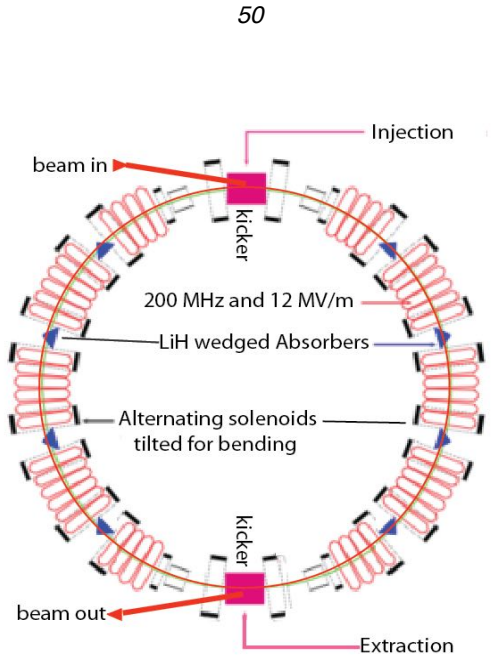
The machinery is ionization cooling. Muons pass through liquid-hydrogen wedges, losing momentum in all three dimensions through ionization; radio-frequency cavities restore only the longitudinal momentum, so the transverse emittance shrinks until multiple Coulomb scattering balances the cooling at an equilibrium emittance. The paper's rate estimate is carried by the merit factor $M=(\text{initial 6D emittance})/(\text{final 6D emittance})\times\text{transmission}$, which must be about 15,000, and by the luminosity formula $L=fN_+N_-/(4\pi\varepsilon_{\text{rms}}\beta^*)$, with $\beta^*=5$ cm at the two collision points. Cooling takes place in a sequence of rings, notably the RFOFO ring of alternating tilted solenoids whose simulation gives a merit factor of 162 after 16 turns; the paper assumes that doubling the number of turns plus a linear pre-cooling stage reaches equilibrium. A recirculating linear accelerator with nine passes carries the muons from 2.5 GeV to 62.5 GeV, and the final collider ring has a 60 m radius at about 7 T.
What would settle it
Run the proposed Initial Cooling Experiment with an RFOFO-like ring at 250 MeV/c for 32 turns and measure the six-dimensional merit factor; if it falls substantially short of about 15,000—for instance if the equilibrium transverse emittance stays above the $0.4\pi$ mm rad target at acceptable transmission—then the luminosity and 12,000-events-per-year figure collapse. A second decisive test is a measurement of the achievable beam-energy spread at 62.5 GeV: if the relative spread cannot reach $R=0.003\%$, the effective Higgs cross section drops by roughly a factor of two to four, and the physics reach is correspondingly reduced.
Extended reading notes
Core claim
The central claim is that a muon collider built as an extension of the ESS proton linac can operate as a Higgs factory in the s-channel: with about $2.9\times10^{12}$ positive and $1.9\times10^{12}$ negative muons per bunch after cooling and acceleration to 62.5 GeV, two interaction points reach $L = 4.0\times10^{31}\,\text{cm}^{-2}\text{s}^{-1}$ and accumulate roughly 12,000 Higgs events per year at $\sqrt{s}=125.5$ GeV. This event rate, together with the very favourable signal-to-background ratio of the $H\to WW^*$ channel (about 100:1) and the near-background-free environment, would allow direct measurement of the Higgs total width and the muon Yukawa coupling, and high-precision study of the main decay modes. The author also describes a higher-energy option at $\sqrt{s}\approx700$ GeV for Higgs-strahlung, vector-boson fusion, and double-Higgs processes, and notes that parametric-resonance ionization cooling, if it works, could raise the luminosity or cut the required proton intensity by about an order of magnitude.
Load-bearing premise
The load-bearing premise is that ionization cooling can squeeze the muon beams by a factor of about 15,000 in six-dimensional phase space, even though the best simulated cooling ring achieves only 162 after 16 turns and the full end-to-end system has not been simulated.
Editorial extensions
If this is right
- If the cooling target is met, the ESS muon collider would deliver roughly 12,000 Higgs events per year at each interaction point in an essentially background-free environment, enabling a direct measurement of the Higgs width and the muon Yukawa coupling.
- The same compact footprint—a 60 m collider radius at 7 T plus the existing spallation-source linac—would allow a staged program in which the Initial Cooling Experiment de-risks the full machine at modest cost.
- A successful measurement of the Higgs mass via the $(g-2)$ precession of polarized muons to about 100 keV would make the resonance scan and line-shape measurement far sharper than what hadron colliders can provide.
- If parametric-resonance ionization cooling succeeds at the required intensity, the luminosity could increase or the required proton rate could drop by roughly an order of magnitude.
- The higher-energy option at $\sqrt{s}\approx700$ GeV would extend the programme to Higgs-strahlung, vector-boson fusion, and double-Higgs production with a ring radius of about 220 m, still far smaller than proposed electron-positron circular colliders.
Reading between the lines
- A reader should treat the Initial Cooling Experiment not as a small demo but as the decisive test of the whole proposal, since every downstream number scales linearly with the achieved merit factor.
- The energy-spread requirement of $R=0.003\%$ is as important as luminosity: if the muon beam energy cannot be controlled to about 100 keV via the $(g-2)$ frequency measurement, the effective s-channel Higgs cross section drops from roughly 22 pb toward 10 pb, eroding the event-rate advantage.
- The decay-electron shower power of about 1.6 kW/m from muon decays will dominate machine and detector shielding design; even with perfect cooling, managing this background is an engineering constraint the paper acknowledges but does not fully solve.
- If the cooling chain works at the spallation source, the same muon-production and cooling infrastructure could be shared with a neutrino programme, so a successful cooling demonstration would strengthen both projects together.
Signed reviews
Editorial analysis
A structured set of objections, weighed in public.
Referee Report
Summary. This manuscript (arXiv:1908.05664) proposes a staged extension of the European Spallation Source (ESS) into a muon-collider complex called ESSmuSB, aimed at studying the Higgs scalar sector. The proton-beam section (Sec. 8) envisions operating the ESS linac at doubled duty cycle, accumulating H- ions via charge-exchange injection, and compressing 2.5 x 10^14 protons into ~2 ns bunches at 56 Hz. The muon-production section (Sec. 9) uses a 20 T solenoid field for pion capture from a mercury target, followed by drift, bunching, and phase rotation to ~250 MeV/c. Section 10 describes a cooling chain (linear transverse pre-cooling, 6D cooling in RFOFO-type rings, and high-field solenoidal cooling) targeting normalized emittances of 0.4 mm mrad (transverse) and 1.0 mm mrad (longitudinal), i.e., a 6D compression factor of 75,000 with merit ~15,000. Section 11 proposes recirculating-linac acceleration to 62.5 GeV, and Sec. 12 presents the collider: a 350 m ring with beta* = 5 cm, two interaction points, L = 4.0 x 10^31 cm^-2 s^-1 per IP (averaged over the 56 Hz store cycle), and ~12,000 s-channel Higgs events per year at sqrt(s) = 125.5 GeV with beam energy resolution R = 0.003%. A ~700 GeV option and a parametric-ionization-cooling (PIC) upgrade are sketched, and Sec. 14 proposes a modest Initial Cooling Experiment to validate muon cooling before full-scale construction.
Significance. If the assumed cooling performance were achieved, the physics case would be compelling: s-channel mu+ mu- -> H production at the tens-of-pb level with very small backgrounds would permit a direct measurement of the Higgs total width and the muon Yukawa coupling, complementing the LHC and e+e- programs. The luminosity arithmetic is transparent and reproducible from Table 3: f = 29,970/s, N = 2.41 x 10^12, epsilon_rms = 0.62 x 10^-4 cm rad, beta* = 5 cm give L ~ 4 x 10^31 cm^-2 s^-1, and the 12,000 events/yr follows from L x 3 x 10^-35 cm^2 x 10^7 s. The manuscript deserves credit for proposing a concrete, falsifiable experimental milestone (the RFOFO-based Initial Cooling Experiment of Sec. 14), for explicitly flagging its own open problems (the missing integrated cooling design in Sec. 10; foil/laser stripping R&D in Sec. 8; the 'bold extrapolations' for PIC in Sec. 13), and for a balanced historical account of the US muon-cooling literature.
major comments (3)
- [Section 10 (pp. 31-38, Fig. 28, Eq. (3))] The central quantitative claims rest on a 6D phase-space compression of 75,000 (from epsilon_perp = 20 mm mrad and epsilon_L = 30 mm mrad to 0.4 and 1.0 mm mrad, i.e., merit ~15,000 after a factor-5 transmission loss), yet the only simulated cooling point cited is the RFOFO ring with 6D merit 162 after 16 turns (Fig. 28; Ref. [48]). The bridging sentence — that 'doubling the number of turns of the RFOFO cooling ring will ensure — with the addition of the required phase of linear pre-cooling — the required compression to attain equilibrium of emittances' (p. 38) — does not close the gap. Stacking the evidence as generously as possible: the linear pre-cooler takes epsilon_perp from 20 to 3 mm mrad per plane (p. 32), contributing at most 6.7^2 ~ 45 to the 6D volume reduction (and the text states this stage grows the longitudinal emittance, so its 6D contribution is less); combining with the RFOFO merit of 162 gives ~7 x 10^3, an order of magnitude below 7.5 x 10^4. Doubling the ring turns cannot supply a factor ~10: the same paragraph states that after 16 turns the emittances were already 'at equilibrium', and at equilibrium the cooling decrement vanishes (Eq. (3)), so extra turns add only decay losses (at 250 MeV/c the ~5.6 micro-s lifetime is ~47 ring turns, so 16 extra turns cost ~25-30% intensity). Since N_mu after cooling enters L linearly, this issue is load-bearing, and the paper itself acknowledges (p. 33) that 'an integrated design including the full complexity of the beam transports, reacceleration and bunching, and including nonlinear beam dynamics coupled with the ionization interactions, are still missing.' The manuscript should either present a simulation-based path to the required merit factor or re-state L = 4 x 10^31 cm^-2 s^-1 and the 12,000 events/yr as conditional targets with the scaling in merit factor made explicit.
- [Table 2] Table 2 contains internal inconsistencies that must be corrected before it can serve as the muon budget. Applying the stated stage survival factors to the negative-muon column yields 1.34 x 10^13 mu-/pulse after linear transverse pre-cooling (0.7 x 1.91 x 10^13) and 8.02 x 10^12 mu-/pulse after RFOFO cooling before merging, whereas the table prints 1.34 x 10^12 and 8.02 x 10^13, respectively; the subsequent rows (6.42 x 10^12, 3.85 x 10^12, 2.70 x 10^12, 1.89 x 10^12) agree only with the corrected values, confirming order-of-magnitude transcription errors. In addition, the quoted 'Total survival factor of the process 0.07' equals neither the product of the tabulated stage factors (0.7 x 0.6 x 0.8 x 0.6 x 0.7 x 0.7 = 0.099) nor that product times the 0.8 front-end survival stated in Sec. 9 (~0.079); the basis for 0.07 should be stated explicitly.
- [Section 9 (p. 27)] The pion yields that seed the entire muon budget — 6.72 x 10^13 and 4.15 x 10^13 pi+/pi- per pulse at all angles, and 2.97 x 10^13 and 1.91 x 10^13 forward with 50-600 MeV/c — are attributed to 'a GEANT4 simulation at the ESS', but the simulation geometry, physics list, scoring, statistical uncertainty, and any benchmark against published hadroproduction data are not shown, and no reference is supplied. Because the final muon intensities, the luminosity, and the event rate all scale linearly with these yields, the paper should either present the yield distribution with its input assumptions or explicitly label these numbers as assumptions and quantify the sensitivity of L and the event rate to a plausible range of pion yields.
minor comments (5)
- [Table 3 vs. Section 4] Table 3 converts luminosity to event rate with a 'Nominal Higgs cross section' of 3.0 x 10^-35 cm^2 (30 pb), while Section 4 and the concluding remarks quote an effective s-channel cross section of 22 pb with ISR and BES effects included at R = 0.003%; at 22 pb the headline would be ~8,800 events/yr rather than 12,000. The table, the text, and the event count should be harmonized.
- [Section 12 (Table 3)] The luminosity formula L = f N+ N- / (4 pi epsilon_rms beta*) contains no hourglass factor, yet the quoted longitudinal invariant emittance (1.9 mm mrad, once its convention is fixed) and the required R = 3 x 10^-5 imply a collision sigma_z of order 10 cm, comparable to or larger than beta* = 5 cm; the paper should state the collision-bunch longitudinal parameters, explain how the ~30 cm rms bunch at 250 MeV/c (which grows adiabatically with sqrt(gamma) during acceleration) is re-bunched, and include the resulting hourglass correction.
- [Section 14 (pp. 50-51)] The ring period is quoted as 162.51 ns and also as being 'accurately adjusted to 40 RF cycles' at 234.8 MHz, but 40 cycles at 234.8 MHz is 170.4 ns; the two statements disagree by about 5%.
- [Throughout] The text contains several garbled or duplicated passages that impede reading: the abstract truncates and repeats sentences ('...only capable to perform Ho related measurements...', 'should be investigated Ho has a spin zero'), 'Louvillian' appears for 'Liouvillian' (Secs. 9, 10, 12), a stray bracket appears in 'RFOFO ring of 45 m circumference]' (Sec. 14), and 'conference of about 45 meters' should read 'circumference'. The reference list also needs cleanup: [36] is used twice (JUNO and RENO-50), [56] contains a stray '[14]', and [63]-[64] are not cited in the text.
- [Section 12] The origin of the factor 54 in f = 54 x 555 = 29,970 s^-1 (as opposed to the 56 proton-collision rate per second) is not explained; the effective-turns bookkeeping (555 ~ half the turns in one muon lifetime in the 350 m ring) is otherwise clear.
Circularity Check
No circularity found: the luminosity and event-rate claims rest on stated assumptions and externally simulated cooling parameters, not on fitting the target result back into the inputs.
full rationale
The derivation chain from proton pulses to Higgs event rate is not circular. The luminosity is computed with the standard formula L = f N+ N-/(4π ε_rms β*) using N± = 2.41e12, ε_rms = 0.673e-4 π cm rad, and β* = 5 cm as stated inputs; none of these is fitted to the quoted 12,000 events/yr. The muon intensities in Table 2 are obtained by multiplying the GEANT4 pion production rate by an explicit chain of transmission efficiencies, and the paper does not invert the event rate to recover any of those efficiencies. The final equilibrium emittances (ε⊥ = 0.4π mm rad, εL = 1.0π mm rad) are imported from the COOL 2007/RFOFO simulations (Refs. 13, 48) and used as input assumptions, not derived from the luminosity target. The most vulnerable step—asserting that doubling the RFOFO turns gives the required merit factor—is an extrapolation from Ref. 48's merit figure of 162 and is explicitly acknowledged as not yet integrated: the paper states that 'an integrated design including the full complexity of the beam transports, reacceleration and bunching, and including nonlinear beam dynamics coupled with the ionization interactions, are still missing.' A weak or unsupported extrapolation is a correctness risk, not a circular reduction. Self-citations appear only in historical and background contexts (e.g., Ref. 12) and are not load-bearing for the luminosity or event-rate claims. No equation in the paper defines its prediction in terms of its conclusion, and no fitted parameter is renamed as a prediction. The design is therefore self-contained in the circularity sense, with the cooling feasibility question left honestly open to the proposed Initial Cooling Experiment.
Assumptions & free parameters
free parameters (5)
- Stage survival factors (Table 2) =
0.7, 0.6, 0.8, 0.6, 0.7, 0.7
- Cooling merit factor =
~15,000
- Equilibrium normalized emittances =
0.4 pi mm rad transverse, 1.0 pi mm rad longitudinal
- Proton bunching factor b =
1/60
- Beam energy resolution R =
0.003%
assumptions (5)
- domain assumption The observed 125.5 GeV Higgs boson is Standard Model-like, with total width about 4.2 MeV and standard branching fractions.
- domain assumption The ESS linac can be upgraded to 28 Hz, operate with H- ions, and feed accumulator and compressor rings with charge-exchange injection.
- domain assumption Ionization cooling can reach normalized equilibrium emittances of 0.4 pi mm rad transverse and 1.0 pi mm rad longitudinal, with an overall merit factor near 15,000.
- domain assumption The pion and muon yields are those from an unshown GEANT4 simulation of a 30 cm mercury target in a 20 T solenoid.
- domain assumption Pressurized hydrogen-filled RF cavities can sustain gradients up to 330 MV/m at 50 atm and 77 K.
Cite this review
Pith. "Pith review of Further searches of the Higgs scalar sector at the ESS." pith.science (2026). https://pith.science/paper/GC4KI5I4
@misc{pith2026190805664,
  author       = {Pith},
  title        = {Pith review of: Further searches of the Higgs scalar sector at the ESS},
  year         = {2026},
  howpublished = {\url{https://pith.science/paper/GC4KI5I4}},
  note         = {Machine review of arXiv:1908.05664}
}
read the original abstract
Recent decades have witnessed remarkable confirmations of the Standard Model (SM) describing the Electro-Weak and Strong Interactions. The Higgs boson was observed at CERN-LHC at 7-8 TeV and 13 TeV. The HL-LHC, a major luminosity upgrade has been recently approved. The HL-LHC may be already an early "Higgs factory", however only capable to perform Ho related measurements with rather large uncertainties because of persisting backgrounds and uncertainties. New projects using leptons rather than hadrons should be investigated Ho has a spin zero and its coupling is proportional to the square of the lepton mass, greatly enhancing the production from pairs of muons. A mu+mu- Collider may operate at a much higher magnetic field respect to the e+e- Collider and it has a smaller radius, easily fitting within one existing European site. However muons are unstable particles: they must be produced in sufficient amounts from pions of a proton beam, cooled and quickly accelerated to the required energies. The scenario is here primarily concentrated to further developments of the European Spallation Source (ESS) under construction in the Lund site as the most intense future source of spallation neutrons. As a initial part of the program, muon cooling should be experimentally demonstrated with the much cheaper and simpler Initial Cooling Experiment.
Figures


Figures from the paper (26 more)




Reference graph
Works this paper leans on
-
[2]
The first term is the ionization loss and the second term is the multiple scattering
with b* the value of the betatron function at the crossing point, mµ and bµ the values relative to the muon for the radiation length Xo in cm and dE/dz the ionization loss.in MeV/cm. The first term is the ionization loss and the second term is the multiple scattering. The Bethe Bloch parameters for several materials are shown in Table 1. The cooling proce...
-
[3]
The invariant, normalized equilibrium r.m.s. emittance (eV,H) with and the corresponding actual transverse emittance (eV,H /bg) are function of the muon momentum. For liquid H2 and cooling at b*= 10 cm, dεH,Vdz=εH,Vβ2EdEdz+β*13.6 MeV/c()2β2EmµXo2→0εV,H→β*13.6 MeV/c()22βµmµ1XodEdz()ε=σxσθ=sqrtx2θX2−xθX2() 34 eV,H ≤ 370 mm mr at 250 MeV/c. In the case of Li...
-
[4]
where the first term is the intrinsic energy loss, the second is the wedge shaped absorber and the third the straggling contribution. Therewhere fA is the fraction of the transport length occupied by the absorber, which has an energy absorption coefficient ; h is the chromatic dispersion at the absorber and d and are the thickness and radial tilt of the a...
-
[5]
where Xo is the radiation length, mec2 the electron mass and a the fine structure constant. Reaching the equilibrium conditions, the above indicated straggling contribution is exactly balanced by the first two terms. Since this increases as g2 + 1, cooling at low energies is desired. For 200 MeV/c, 120 MeV, 0.88c, we find 1.2 km and 4.6 MeV/gr cm2. Balanc...
arXiv 2012
Reviewed August 14, 2026 · model on record in the stance chip above.
Discussion (0). Continue with ORCID to comment.