REVIEW 2 major objections 4 minor 20 references
On a Fractional Schr\"odinger equation in the presence of Harmonic potential
T0 review · 2 major / 4 minor · reviewed 2026-08-14 · deepseek-v4-flash
Pith's one-line read For 0<σ<2s/N, the fractional Schrödinger equation with a harmonic trap has nonnegative, radial, decreasing ground-state standing waves, orbitally stable when the Cauchy problem is unique.
desk verdict A plausible extension of ground-state theory to fractional NLS with a harmonic trap, but the proof of the main existence theorem rests on a faulty compactness lemma. read the letter →
The pith
A machine-rendered reading of the paper's core claim, the machinery that carries it, and where it could break.
The reading
What carries the argument
The central object is the weighted Sobolev space $\Sigma_s(\mathbb{R}^N)=\{u\in H^s(\mathbb{R}^N): \|u\|_{L^2}+\|\nabla^s u\|_{L^2}+\|xu\|_{L^2}<\infty\}$, whose norm includes the harmonic potential. Its compact embedding into $L^p$ for $2\le p<2N/(N-2s)$ is what lets a minimizing sequence for $I_c$ converge strongly, overcoming the lack of compactness on $\mathbb{R}^N$. The fractional Gagliardo\textendash Nirenberg inequality supplies the $L^{2\sigma+2}$ bound that keeps the energy finite below the threshold $\sigma<2s/N$. Schwarz symmetrization then converts any minimizer into a radial, radially decreasing one without raising the energy. For stability, the machinery is a standard compactness-based variational argument: the set of minimizers at fixed mass is shown to be stable under the flow whenever the Cauchy problem is well posed with conserved mass and energy.
What would settle it
Translate a fixed compactly supported bump: $u_n(x)=\varphi(x-ne_1)$ is bounded in $H^s(\mathbb{R}^N)$ but has no convergent subsequence in $L^p(\mathbb{R}^N)$, so the proof's appeal to compactness of $H^s$ on the whole space is demonstrably false; a correct proof must use the $\|xu\|_{L^2}$ weight, for example by showing that $\|u_n\|_{\Sigma_s}\to\infty$ for such translations.
Extended reading notes
Core claim
The central claim is Theorem 2.1: for $0<\sigma<2s/N$, the constrained minimization problem $I_c=\inf\{J(u): u\in\Sigma_s(\mathbb{R}^N),\ \|u\|_{L^2}=c\}$ admits a minimizer, and that minimizer is a nonnegative, radial, radially decreasing ground state solution of $(-\Delta)^s u+|x|^2u-|u|^{2\sigma}u=\lambda u$. The mechanism is that the harmonic potential makes the embedding $\Sigma_s(\mathbb{R}^N)\hookrightarrow L^p(\mathbb{R}^N)$ compact for $2\le p<2N/(N-2s)$, so minimizing sequences converge; the fractional Gagliardo\textendash Nirenberg inequality bounds the energy below precisely when $\sigma<2s/N$. Theorem 2.2 then asserts orbital stability of the set of minimizers, conditional on uniqueness and on conservation of mass and energy for the Cauchy problem. Numerical sections complement the existence result by solving the constrained problems with normalized gradient flow and split-step Fourier methods, and by probing the critical range $2s/N\le\sigma<2s/(N-2s)$ through an alternative minimization with fixed $L^{2\sigma+2}$ norm.
Load-bearing premise
The argument's load-bearing premise is Lemma 3.1's claim that the weighted space $\Sigma_s(\mathbb{R}^N)$ sits compactly inside the Lebesgue spaces $L^p(\mathbb{R}^N)$; as written, the proof of that lemma appeals to a compactness of $H^s$ on the whole space that is false, so the extraction of a convergent minimizing sequence is not justified until that point is repaired.
Editorial extensions
If this is right
- For every mass $c>0$ and exponent $0<\sigma<2s/N$, the constrained problem (8) has a minimizer, so the elliptic equation (6) has a nonnegative, radial, radially decreasing ground-state solution for some Lagrange multiplier $\lambda$.
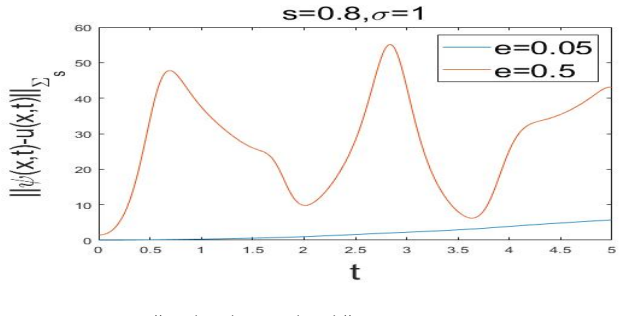
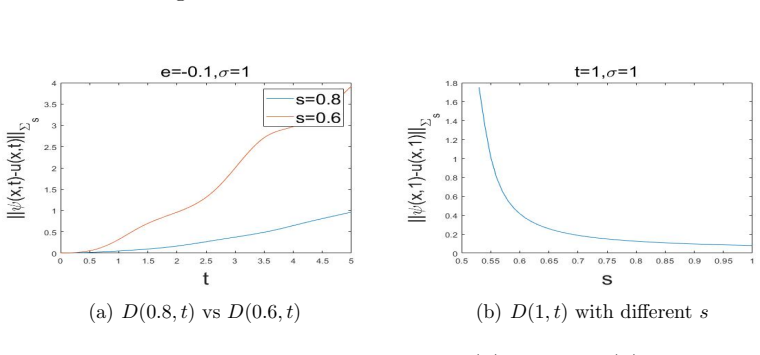
- Because the minimizer set is compact in $\Sigma_s(\mathbb{R}^N)$, the standing waves $e^{-i\lambda t}u(x)$ form an orbitally stable family whenever the Cauchy problem is well posed with conserved mass and energy.
- The threshold $\sigma=2s/N$ is sharp for the original minimization: above it the energy is unbounded below, and the paper's alternative fixed-$L^{2\sigma+2}$ formulation gives standing waves numerically up to the $L^2$-supercritical threshold $\sigma<2s/(N-2s)$.
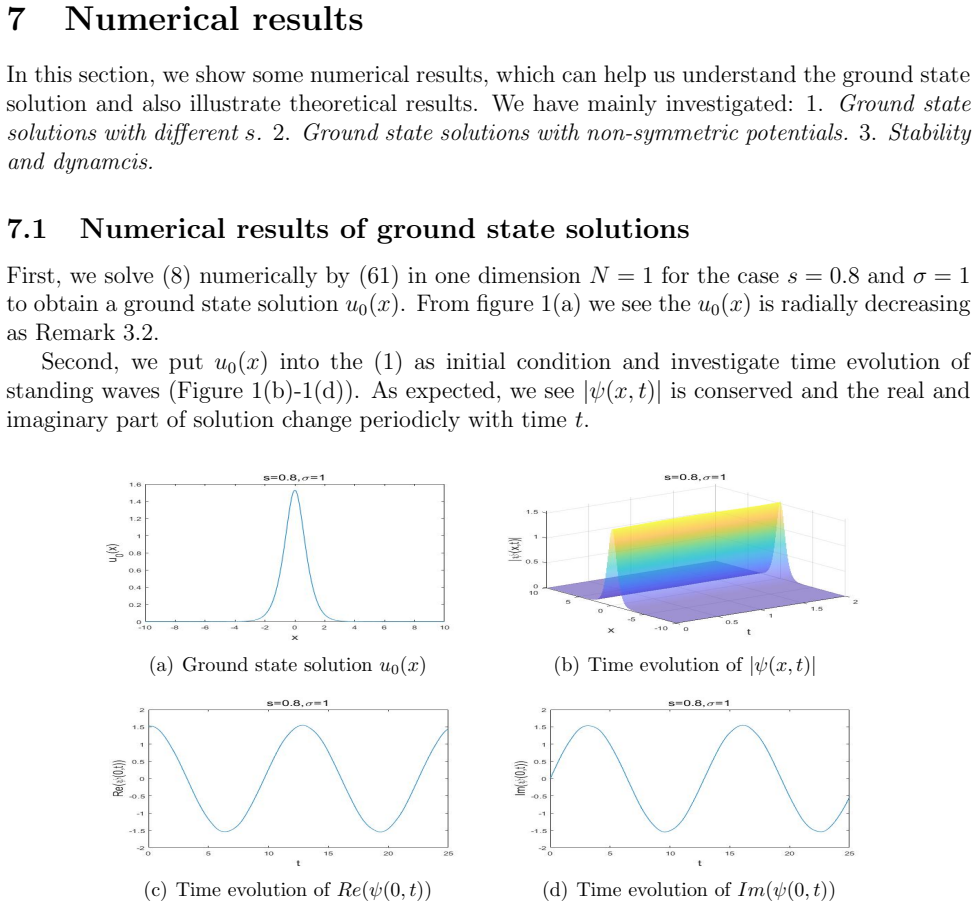
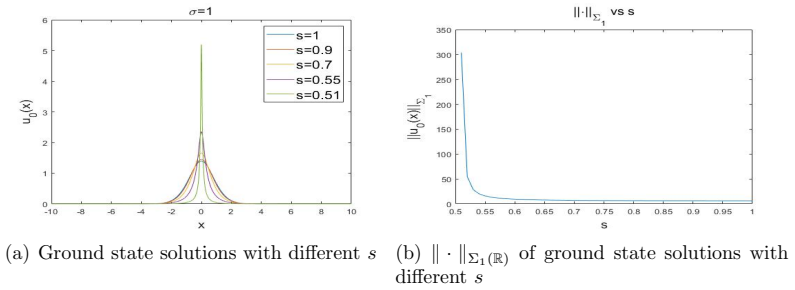
- Numerical experiments indicate that as $s$ decreases toward $\sigma N/2$, ground states become more peaked, the energy diverges to $-\infty$ at fixed mass, and orbital stability degrades.
Reading between the lines
- An editorial repair of Lemma 3.1: a correct compactness proof should split $\mathbb{R}^N$ into a ball and its complement, use the tail bound $\|u\|_{L^2(|x|>R)}\le R^{-1}\|xu\|_{L^2}$, then take a diagonal subsequence; the false step in the paper is a proof gap, not evidence against the theorem.
- The convergence $\lambda_c\to\lambda_0$ as $c\to0$ seen numerically is consistent with $\lambda_0$ being the lowest eigenvalue of the linear operator $(-\Delta)^s+|x|^2$; proving this would connect the nonlinear ground states to the linear spectrum.
- The non-radial numerical ground states for asymmetric potentials suggest the radial symmetry theorem depends essentially on the potential being radial; extending existence to general trapping potentials would require new rearrangement tools.
Signed reviews
Editorial analysis
A structured set of objections, weighed in public.
Referee Report
Summary. The paper studies the fractional nonlinear Schrödinger equation with a harmonic potential, Eq. (1). It introduces the weighted Hilbert space Σ_s(R^N), Eq. (10), and studies the constrained minimization of the energy functional J on the mass sphere S_c, Eq. (8). Theorem 2.1 claims that for 0<σ<2s/N this problem admits a nonnegative, radial, radially decreasing minimizer; Theorem 2.2 claims orbital stability of the associated ground states under a uniqueness/well-posedness assumption on the Cauchy problem. The second half of the paper develops split-step Fourier spectral and normalized-gradient-flow numerical methods, reports numerical ground states over a wider parameter range, and studies dynamics and stability numerically.
Significance. If the existence and stability theorems are established, the paper would provide a natural variational treatment of fractional NLS with a harmonic trap, extending known results for the Gross-Pitaevskii equation (s=1) and for fractional NLS without potential. The numerical section is broad and gives useful heuristics on the role of s, σ, and the trapping potential. The central existence proof, however, has a gap in Lemma 3.1: the compactness argument rests on a false Sobolev embedding statement, and no alternative proof is supplied. The result is likely repairable, and the stability theorem is explicitly conditional on an unproved well-posedness assumption, so the manuscript's claims are defensible as conditional statements but not yet fully proved as written.
major comments (2)
- [Section 3, Lemma 3.1] The proof of compactness for p>2 relies on the assertion that H^s(R^N) is compactly embedded into L^p(R^N) for 2<p<2N/(N-2s). This is false on the unbounded domain R^N, where translation invariance prevents compactness. Moreover, the stated range 2≤p<2N/(N-2s) is empty when N≤2s, while Theorem 2.1 allows such values (e.g., N=1, s=0.8, σ=1). The lemma is used in the proof of Theorem 2.1 to extract a subsequence converging strongly in L^{2σ+2}, and again in Theorem 4.1. As written, these subsequence extractions are unsupported. The compactness of the weighted space Σ_s(R^N) is likely true, but a correct proof must be supplied, and the statement must be modified to handle the case N≤2s.
- [Section 6, Eqs. (62)-(63)] The paper claims existence of ground states for the range 2s/N ≤ σ < 2s/(N-2s) via the constrained problem (62)-(63), and states 'Similar to Lemma 3.2 and Theorem 2.1, there exists a local minimizer'. This is not a proof; no rigorous argument is given that the auxiliary problem has a minimizer or that it yields a solution to (65). If the paper intends to claim existence in this range, a complete proof is needed. As it stands, those results are numerical evidence only and should be labeled as such.
minor comments (4)
- [Section 3, Lemma 3.2, Eq. (15)] The exponent θ in the fractional Gagliardo-Nirenberg inequality appears to be misprinted as θ = Ns/(2s(σ+1)), which simplifies to N/(2(σ+1)). The subsequent definitions p = 1/(θ(1+σ)) and q = 1/(1-θ(1+σ)) are consistent only if θ = Nσ/(2s(σ+1)). Please correct this typo.
- [Theorems 2.2 and 4.1] The orbital-stability theorem is conditional on an assumed uniqueness and well-posedness result for the Cauchy problem (1). The paper is explicit about this, but the abstract and introduction should state clearly that stability is proved only under this assumption, and it would be helpful to cite or prove local well-posedness in Σ_s(R^N).
- [Section 2, Eqs. (11)-(13)] The Lagrange multiplier argument is presented formally. Since Theorem 2.1 only asserts existence of a minimizer of (8), this is not a flaw for the theorem as stated, but the paper repeatedly calls these minimizers 'ground state solutions'; a precise statement connecting minimizers to solutions of (6) would strengthen the paper.
- [Throughout] There are numerous typographical and notational errors: in Lemma 3.2 the integral set is written as Ω but should be R^N; 'Figure 7.2' in Section 7.2 should presumably be 'Figure 10'; the caption of Figure 10 says 'δ = 1' but should be 'σ = 1'; and 'Abosolute value' should be 'Absolute value'. The manuscript would benefit from a careful proofreading pass.
Circularity Check
No significant circularity: the variational existence proof is self-contained up to cited external inequalities; no prediction reduces by construction to a fitted input.
full rationale
The paper's central claim is Theorem 2.1: existence of a nonnegative, radial, radially decreasing minimizer for the constrained problem (8). The proof proceeds by standard direct methods: Lemma 3.2 bounds minimizing sequences via the fractional Gagliardo-Nirenberg inequality cited from [12]; Lemma 3.1 supplies compact embedding of the weighted space; and the minimizer is then symmetrized using rearrangement results from [14] and equality cases quoted from [9]. None of these cited results is the target theorem, and the paper does not fit any parameter and then 'predict' a quantity determined by that fit. The stability result, Theorem 2.2/4.1, is explicitly conditional on a uniqueness-and-conservation assumption for the Cauchy problem, so its conclusion is not hidden in the hypothesis. The numerical section is presented as illustration and comparison, not as the derivation of the existence theorem. The proof of Lemma 3.1 as written invokes a false statement about compactness of H^s on all of R^N, and Remark 3.1 over-claims convergence in the full Σ_s norm; these are correctness gaps, not circularity. The self-citations (e.g., [9], [12], [13], [14]) are external published results used as lemmas with their own stated assumptions, and they do not redefine the main conclusion. Therefore no circular step meeting the evidentiary standard is present.
Assumptions & free parameters
assumptions (4)
- standard math Fractional Gagliardo-Nirenberg inequality (15)
- standard math Symmetrization inequalities for the fractional Laplacian and the harmonic potential (23)-(24)
- ad hoc to paper Compact embedding of H^s(R^N) into L^p(R^N) for 2<p<2N/(N-2s)
- domain assumption Global well-posedness and uniqueness of the Cauchy problem (1) with conserved mass (3) and energy (4)
Cite this review
Pith. "Pith review of On a Fractional Schr\"odinger equation in the presence of Harmonic potential." pith.science (2026). https://pith.science/paper/UMAFPWSV
@misc{pith2026190805719,
  author       = {Pith},
  title        = {Pith review of: On a Fractional Schr\"odinger equation in the presence of Harmonic potential},
  year         = {2026},
  howpublished = {\url{https://pith.science/paper/UMAFPWSV}},
  note         = {Machine review of arXiv:1908.05719}
}
read the original abstract
In this paper, we establish the existence of ground state solutions for a fractional Schr\"odinger equation in the presence of a harmonic trapping potential. We also address the orbital stability of standing waves. Additionally, we provide interesting numerical results about the dynamics and compare them with other types of Schr\"odinger equations. Our results explain the effect of each term of the Schr\"odinger equation : The fractional power, the power of the nonlinearity and the harmonic potential.
Figures

Figures from the paper (8 more)





Reference graph
Works this paper leans on
-
[9]
F. Hadj Selem, H. Hajaiej, P. Markowich, and S. Trabelsi , Variational approach to the orbital stability of standing waves of the gross-pitaevskii equation , Milan Journal of Mathematics, 82 (2014)
work page 2014
- [15]
-
[1]
F. J. Almgren and E. H. Lieb , Symmetric decreasing rearrangement is sometimes continuous, Journal of the American Mathematical Society, 2 (1989), pp. 683–773. 19 (a) Standing waves when s = 0.5 (b) Absolute value of ground state solution w s = 0.5 (c) Time evolution of Re(ψ(0,t )) (d) Time evolution of Im(ψ(0,t )) (e) Blow up of solution with ψ0(x,t ) = ...
work page 1989
- [2]
-
[3]
R. Carles and H. Hajaiej , Complementary study of the standing wave solutions of the gross-pitaevskii equation in dipolar quantum gases , Bulletin of the London Mathematical Society, 47 (2014)
work page 2014
-
[4]
T. Cazenave and P.-L. Lions , Orbital stability of standing waves for some nonlinear schr¨ odinger equations, Communications in Mathematical Physics, 85 (1982)
work page 1982
-
[5]
X. Chang , Ground state solutions of asymptotically linear fractional schrdinger equation , Journal of Mathematical Physics, 54 (2013)
work page 2013
-
[6]
M. Cheng , Bound state for the fractional schrdinger equation with unbounded potential , Journal of Mathematical Physics, 53 (2012)
work page 2012
Show all 20 references
-
[7]
Duo and Y
S. Duo and Y. Zhang , Mass-conservative fourier spectral methods for solving the frac- tional nonlinear schrdinger equation , Computers and Mathematics with Applications, (2016)
2016
-
[8]
Fibich and X.-P
G. Fibich and X.-P. W ang , Stability of solitary waves for nonlinear schr¨ odinger equa- tions with inhomogeneous nonlinearities , Physica D: Nonlinear Phenomena, 175 (2003), p. 96108
2003
-
[10]
H. Hajaiej , On the optimality of the assumptions used to prove the existence and sym- metry of minimizers of some fractional constrained variational problems , Annales Henri Poincar´ e, 14 (2013), pp. 1425–1433
2013
-
[11]
Hajaiej, P
H. Hajaiej, P. A. Markowich, and S. Trabelsi , Minimizers of a class of constrained vectorial variational problems: Part i. , Milan Journal of Mathematics, 82 (2014), pp. 81– 98
2014
-
[12]
Hajaiej, L
H. Hajaiej, L. Molinet, T. Ozawa, and B. W ang , Sufficient and necessary con- ditions for the fractional gagliardo-nirenberg inequalities and applications to navier-stokes and generalized boson equations, RIMS Kokyuroku Bessatsu, (2010)
2010
-
[13]
Hajaiej and C
H. Hajaiej and C. Stuart , On the variational approach to the stability of standing waves for the nonlinear schrdinger equation , Advanced Nonlinear Studies, 4 (2004)
2004
-
[14]
Hajaiej and C
H. Hajaiej and C. A. Stuart , Symmetrization inequalities for composition operators of carathodory type, Proceedings of the London Mathematical Society, 87 (2003), p. 396418
2003
-
[16]
Laskin , Fractional quantum mechanics and l´ evy path integrals, Physics Letters A, 268 (2000), pp
N. Laskin , Fractional quantum mechanics and l´ evy path integrals, Physics Letters A, 268 (2000), pp. 298–305
2000
-
[17]
Laskin , Fractional schr¨ odinger equation, Phys
N. Laskin , Fractional schr¨ odinger equation, Phys. Rev. E, 66 (2002), p. 056108
2002
-
[18]
Rose and M
H. Rose and M. Weinstein , On the bound states of the nonlinear schrdinger equation with a linear potential , Physica D: Nonlinear Phenomena, 30 (1988), pp. 207–218. 21
1988
-
[19]
Zhang , Stability of standing waves for nonlinear schrdinger equations with unbounded potentials, Zeitschrift fr angewandte Mathematik und Physik, 51 (2000), p
J. Zhang , Stability of standing waves for nonlinear schrdinger equations with unbounded potentials, Zeitschrift fr angewandte Mathematik und Physik, 51 (2000), p. 498
2000
-
[20]
F. Zhao, L. Zhao, and Y. Ding , Existence and multiplicity of solutions for a non- periodic schrdinger equation , Nonlinear Analysis-theory Methods and Applications, 69 (2008), pp. 3671–3678. 22
2008
Reviewed August 14, 2026 · model on record in the stance chip above.
Discussion (0). Continue with ORCID to comment.