REVIEW 5 minor 62 references
Bourgeois contact structures: tightness, fillability and applications
T0 review · 0 major / 5 minor · reviewed 2026-08-14 · deepseek-v4-flash
Pith's one-line read The Bourgeois construction always yields a universally tight contact 5-manifold, whatever the input open book.
desk verdict A substantial paper that very likely delivers on its main claims; the step to check carefully is the cap-exclusion argument in Lemma 17. read the letter →
The pith
A machine-rendered reading of the paper's core claim, the machinery that carries it, and where it could break.
The reading
What carries the argument
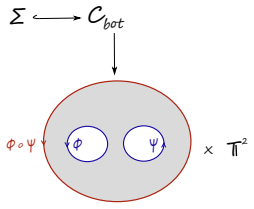
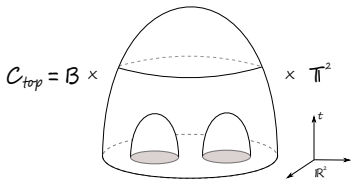
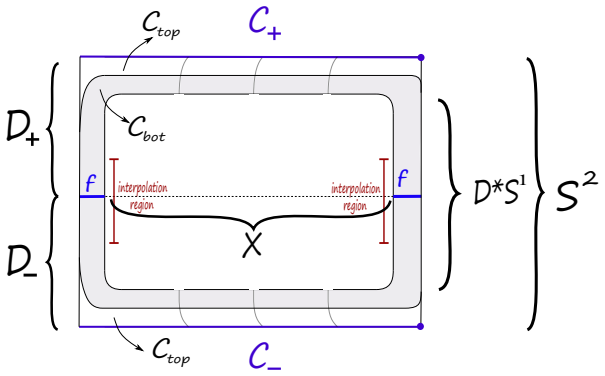
The argument rides on three interlocking objects. The Bourgeois construction itself turns open book data $(\Sigma,\varphi)$ into the contact form $\beta = \alpha + \Phi_1 dq_1 - \Phi_2 dq_2$ on $OBD(\Sigma,\varphi) \times T^2$. Theorem 9 builds a pseudo-Liouville symplectic cobordism from $BO(\Sigma,\psi) \sqcup BO(\Sigma,\varphi)$ to $BO(\Sigma,\psi \circ \varphi)$, a torus-stabilized version of the standard open book composition cobordism; the cobordism is exact but its Liouville vector field is not inward pointing at the concave ends. The Factorization Lemma splits any monodromy on a non-sporadic surface into two factors whose open book bindings have infinite order in $\pi_1$, using quasi-homomorphisms on mapping class groups and Thurston's hyperbolic Dehn filling theorem; combined with the cobordism this reduces tightness to excluding holomorphic caps via Reeb dynamics. For fillability, the central mechanism is a capping construction: attach a symplectic handle with two J-invariant co-cores to a strong filling, producing a moduli space of holomorphic spheres whose evaluation forces the homology of the page and torus to survive in the filling.
What would settle it
One concrete way to test the central claim is to search for an abstract open book on a surface whose Bourgeois 5-manifold is overtwisted, or a strong symplectic filling of some $BO(\Sigma,\varphi)$ in which the page does not inject in rational homology; either example would directly refute Theorem A or Theorem B. A narrower check is to attempt to construct a monodromy on a non-sporadic surface that admits no factorization into two factors with infinite-order binding components.
Extended reading notes
Core claim
The central claim, Theorem A, is that for every abstract open book $(\Sigma^2,\varphi)$ the Bourgeois contact 5-manifold $BO(\Sigma,\varphi)$ is universally tight: its universal cover is tight. This holds with no assumption on the original contact 3-manifold $OBD(\Sigma,\varphi)$, so even overtwisted inputs are converted into tight outputs. Theorem B states that if $BO(\Sigma,\varphi)$ has a strong symplectic filling $W$, then the page inclusion $\Sigma \to W$ is injective in rational homology and the Bourgeois torus $T^2 \to W$ is injective in integer homology; in particular the monodromy $\varphi$ is forced to be trivial in homology in many cases. Corollaries include: for rational homology sphere inputs only the standard $S^3$ case is strongly fillable; planar pages with nonzero same-sign Dehn twist monodromy give weakly but not strongly fillable 5-manifolds; positive stabilizations are never strongly fillable; and $S^*T^n$ has a unique symplectically aspherical strong filling up to diffeomorphism.
Load-bearing premise
The load-bearing premise is the factorization step: every monodromy of a surface that is not a disc, annulus, or pair of pants can be written as a composition of two monodromies for which every binding component of the resulting open books has infinite order in the fundamental group; if any such monodromy resisted this splitting, the proof of Theorem A for those pages would collapse.
Editorial extensions
If this is right
- In dimension 5, every Bourgeois contact manifold is universally tight; in particular no Bourgeois structure can serve as an overtwisted example, even when built from an overtwisted 3-manifold.
- A strong filling of $BO(\Sigma,\varphi)$ must rationally contain the page and integrally contain the $T^2$ factor; hence if the underlying 3-manifold is a rational homology sphere, strong fillability forces the page to be a disc and the monodromy trivial, so the manifold is $S^3$.
- Bourgeois structures over planar pages with monodromy a non-trivial product of same-sign Dehn twists are weakly but not strongly fillable, giving many 5-dimensional examples of this fillability gap.
- Positive stabilization of any open book produces a Bourgeois manifold that is not strongly fillable; combined with known weak fillability this yields weakly but not strongly fillable contact structures in every odd dimension.
- The standard contact unit cotangent bundle $S^*T^n$ has exactly one symplectically aspherical strong filling up to diffeomorphism, namely $D^*T^n$.
Reading between the lines
- If the same tightness mechanism works in higher dimensions, the Bourgeois construction becomes a general source of rigid contact manifolds from flexible ones; the paper leaves this as an open question, not an established fact.
- Theorem B gives a concrete test for the paper's Question 36: the likely answer is that strong fillability forces the monodromy to be smoothly trivial, and even-dimensional cotangent pages where some power of the Dehn–Seidel twist is smoothly trivial would be the sharp test case.
- Because the capping argument only uses the $S^1$-invariant structure behind the Bourgeois form, a similar homology-injection obstruction should hold for other $S^1$-invariant contact manifolds built by the same double-and-glue recipe.
Signed reviews
Editorial analysis
A structured set of objections, weighed in public.
Referee Report
Summary. The paper studies contact structures obtained from Bourgeois' construction on V × T^2. Its main result, Theorem A, states that for every abstract open book (Σ^2, φ), the Bourgeois contact 5-manifold BO(Σ, φ) is universally tight, regardless of whether the original contact 3-manifold is tight or overtwisted. The proof combines a pseudo-Liouville cobordism between Bourgeois manifolds with the same page (Theorem 9), a factorization lemma for mapping classes of non-sporadic surfaces (Lemma 10) proved via Bestvina–Fujiwara quasi-homomorphisms and Thurston hyperbolic Dehn filling, and a holomorphic-curve argument (Lemma 17) that rules out holomorphic caps using a Stokes identity. The paper also proves a strong fillability obstruction (Theorem B): for a strong symplectic filling W of BO(Σ, φ), the page Σ injects in rational homology and the T^2 factor injects in integer homology. This obstruction is used to produce weakly but not strongly fillable contact manifolds in all odd dimensions, including planar examples (Theorem D), positive stabilizations (Corollary F), and the explicit family BO(D^*S^n, τ^k) (Theorems H and I), giving a negative answer to a question of Lisi–Marinković–Niederkrüger. Finally, Theorem J classifies symplectically aspherical strong fillings of the unit cotangent bundle S^*T^n up to diffeomorphism, via a capping construction, a moduli space of holomorphic spheres, and an s-cobordism argument.
Significance. If the results are correct, this is a substantial and influential paper. Theorem A is a striking 'tightening' statement: the Bourgeois construction turns any contact 3-manifold, even an overtwisted one, into a universally tight 5-manifold, with no dependence on the rigid or flexible nature of the input. Theorem B gives a very general and powerful obstruction to strong fillability, and the corollaries provide the first weakly-but-not-strongly fillable examples in all odd dimensions as well as a large new class in dimension 5. The paper is careful in separating the semi-positive case from the general polyfold case, explicitly flags the inconclusive even-even case in Theorem I, and acknowledges the independent overlap with Geiges–Kwon–Zehmisch [22]. The proofs are detailed and make use of established tools rather than ad hoc assumptions. The polyfold-dependent part of the argument is clearly identified. This paper will likely become a reference for the study of Bourgeois contact structures.
minor comments (5)
- [Section 5, Lemma 17] The Stokes contradiction 0 < ∫_c Ω = ∫_{−γ} ν < 0 relies on the boundary of the holomorphic cap being a single Reeb orbit oriented as −γ and on the positivity ∫_γ ν > 0. Both assertions are correct — negative boundary components of a strong cobordism are oriented opposite to the contact orientation, and Item 2 of Theorem 9 gives ν|_{B_q} = λ_−|_{B_q} — but the orientation convention should be stated explicitly, since the proof of the non-sporadic case of Theorem A reduces to this step.
- [Section 6, Lemma 23] In the proof of Lemma 23, the exponents in the displayed term are off by one: on the manifold [0,1] × ∂X × S^2 of real dimension 2n+2, the top power of a symplectic form is n+1, not n+2, and the top power of dλ_Σ on Σ of dimension 2n−2 is n−1, not n. The sentence should read (dβ+ω_S)^{n+1} and (dλ_Σ)^{n−1} ∧ dt ∧ dx ∧ ω_S. The conclusion is unaffected, but the current indices are formally zero by dimension count.
- [Section 7 and Introduction, Theorem J] Theorem J in the Introduction states n ≥ 3, but Section 7 begins with n ≥ 2 and the proof as written appears to cover n ≥ 2. Please reconcile the stated range and verify that the s-cobordism step is valid for the intended range.
- [Section 5, proof of Theorem A] In the universal tightness argument, the sentence 'tightness on finite covers is equivalent to tightness on the universal cover' would benefit from a short justification: a compact overtwisted disk or Plastikstufe in the universal cover descends to some finite cover because its stabilizer has finite index, so overtwistedness in the universal cover would contradict tightness of all finite covers.
- [Section 5, Lemma 17] The symbol C is used both for the compact pseudo-Liouville cobordism and for its compactification obtained by adding ideal contact boundaries. Using a different notation, e.g. \bar C, for the compactification would remove a potentially confusing ambiguity in the discussion of the holomorphic cap c.
Circularity Check
No circularity found: the central results are derived from explicit cobordism constructions, external geometric-group-theory and hyperbolic geometry theorems, and standard holomorphic curve compactness, rather than from fitted parameters or self-referential definitions.
full rationale
The derivation chain for Theorem A is self-contained with respect to its stated hypotheses. The proof factors the monodromy via Lemma 10, which is established using Bestvina–Fujiwara quasi-homomorphisms and Thurston's hyperbolic Dehn filling theorem, and then applies Lemma 17, whose cap-exclusion argument uses the explicitly constructed pseudo-Liouville cobordism of Theorem 9 and its stated primitive data. The contradiction 0 < ∫_c Ω = ∫_{-γ} ν < 0 is a property of the constructed cobordism, not a restatement of tightness. Theorem B is proved by a capping construction and moduli-space arguments; the injectivity conclusions are derived, not assumed. Theorem J is supported by independent concurrent work [22]. The paper cites the authors' earlier work [25] and [49], but these citations are contextual or technical (e.g., for related examples and SOBD terminology) and are not load-bearing for the main results. No fitted parameter is renamed as a prediction, no uniqueness theorem is imported from the authors' prior work to force a choice, and no known result is merely relabeled. The most delicate step, Lemma 17, is a genuine geometric argument about holomorphic caps in a pseudo-Liouville cobordism, and any concern about it is a correctness risk, not circularity.
Assumptions & free parameters
assumptions (8)
- standard math Giroux correspondence: every closed contact manifold is supported by an open book, and contact structures correspond to stable equivalence classes of open books.
- standard math Overtwisted contact manifolds in dimension at least 5 are characterized by the existence of a Plastikstufe.
- standard math Thurston's hyperbolic Dehn filling theorem: sufficiently large slopes on a hyperbolic 3-manifold yield hyperbolic Dehn fillings whose cores are geodesics.
- standard math Bestvina-Fujiwara WPD and bounded cohomology results on mapping class groups provide a pseudo-Anosov element with a homogeneous quasi-homomorphism vanishing on finite-order and reducible elements.
- domain assumption Hofer-Wysocki-Zehnder polyfold Fredholm theory for closed Gromov-Witten moduli spaces gives abstract perturbations, transversality, and Stokes theorem.
- standard math Semipositivity holds automatically for 6-dimensional symplectic manifolds, and pseudo-cycle theory applies.
- standard math The s-cobordism theorem, with vanishing Whitehead group for Z^n, classifies h-cobordisms of S*T^n.
- standard math Residual finiteness of fundamental groups of closed 3-manifolds.
Cite this review
Pith. "Pith review of Bourgeois contact structures: tightness, fillability and applications." pith.science (2026). https://pith.science/paper/VVI2T2UG
@misc{pith2026190805749,
  author       = {Pith},
  title        = {Pith review of: Bourgeois contact structures: tightness, fillability and applications},
  year         = {2026},
  howpublished = {\url{https://pith.science/paper/VVI2T2UG}},
  note         = {Machine review of arXiv:1908.05749}
}
abstract
Given a contact structure on a manifold $V$ together with a supporting open book decomposition, Bourgeois gave an explicit construction of a contact structure on $V \times \mathbb{T}^2$. We prove that all such structures are universally tight in dimension $5$, independent on whether the original contact manifold is itself tight or overtwisted. In arbitrary dimensions, we provide obstructions to the existence of strong symplectic fillings of Bourgeois manifolds. This gives a broad class of new examples of weakly but not strongly fillable contact $5$-manifolds, as well as the first examples of weakly but not strongly fillable contact structures in all odd dimensions. These obstructions are particular instances of more general obstructions for $\mathbb S^1$-invariant contact manifolds. We also obtain a classification result in arbitrary dimensions, namely that the unit cotangent bundle of the $n$-torus has a unique symplectically aspherical strong filling up to diffeomorphism.
Figures

Figures from the paper (1 more)
Reference graph
Works this paper leans on
-
[41]
Lisi, S., Marinkovi´ c, A., Niederkr¨ uger, K.: On properties of Bourgeois contact structures. ArXiv e-prints (2018)
work page 2018
-
[22]
Geiges, H., Kwon, M., Zehmisch, K.: Diffeomorphism type of symplectic fillings of unit cotangent bundles. ArXiv e-prints (2019)
work page 2019
-
[1]
Albers, P., Hofer, H.: On the Weinstein conjecture in higher dimensions. Comment. Math. Helv. 84(2), 429–436 (2009). DOI 10.4171/CMH/167. URL https://doi.org/10.4171/CMH/167
-
[2]
Avdek, R.: Liouville hypersurfaces and connect sum cobordisms. ArXiv e-prints (2012)
work page 2012
-
[3]
Barth, K., Geiges, H., Zehmisch, K.: The diffeomorphism type of symplec- tic fillings. ArXiv e-prints (2016)
work page 2016
-
[4]
Bestvina, M., Fujiwara, K.: Bounded cohomology of subgroups of mapping class groups. Geom. Topol. 6, 69–89 (2002). DOI 10.2140/gt.2002.6.69. URL https://doi.org/10.2140/gt.2002.6.69
-
[5]
Bestvina, M., Fujiwara, K.: Quasi-homomorphisms on mapping class groups. Glas. Mat. Ser. III 42(62)(1), 213–236 (2007). DOI 10.3336/ gm.42.1.15. URL https://doi.org/10.3336/gm.42.1.15
-
[6]
Borman, M., Eliashberg, Y., Murphy, E.: Existence and classification of overtwisted contact structures in all dimensions. Acta Math. 215(2), 281– 361 (2015). DOI 10.1007/s11511-016-0134-4. URL https://doi.org/10. 1007/s11511-016-0134-4
Show all 62 references
-
[7]
ProQuest LLC, Ann Arbor, MI (2002)
Bourgeois, F.: A Morse-Bott approach to contact homology. ProQuest LLC, Ann Arbor, MI (2002). Thesis (Ph.D.)–Stanford University
2002
-
[8]
Bourgeois, F.: Odd dimensional tori are contact manifolds. Int. Math. Res. Not. (30), 1571–1574 (2002). DOI 10.1155/S1073792802205048. URL https://doi.org/10.1155/S1073792802205048
2002 doi
-
[9]
Bowden, J., Crowley, D., Stipsicz, A.I.: Contact structures on M×S2. Math. Ann. 358(1-2), 351–359 (2014). DOI 10.1007/s00208-013-0963-9. URL https://doi.org/10.1007/s00208-013-0963-9
2014 doi
-
[10]
Calegari, D.: scl, MSJ Memoirs , vol. 20. Mathematical Society of Japan, Tokyo (2009). DOI 10.1142/e018. URL https://doi.org/10.1142/e018 47
2009 doi
-
[11]
In: Proceedings of the G¨ okova Geometry-Topology Conference 2015, pp
Casals, R., Murphy, E.: Contact topology from the loose viewpoint. In: Proceedings of the G¨ okova Geometry-Topology Conference 2015, pp. 81–
2015
-
[12]
Casals, R., Murphy, E., Presas, F.: Geometric criteria for overtwistedness. J. Amer. Math. Soc. 32(2), 563–604 (2019). DOI 10.1090/jams/917. URL https://doi.org/10.1090/jams/917
2019 doi
-
[13]
Cerf, J.: La stratification naturelle des espaces de fonctions diff´ erentiables r´ eelles et le th´ eor` eme de la pseudo-isotopie. Inst. Hautes´Etudes Sci. Publ. Math. (39), 5–173 (1970)
1970
-
[14]
ArXiv Mathematics e-prints (2002)
Cieliebak, K.: Subcritical Stein manifolds are split. ArXiv Mathematics e-prints (2002)
2002
-
[15]
Ding, F., Geiges, H.: Contact structures on principal circle bundles. Bull. Lond. Math. Soc. 44(6), 1189–1202 (2012). DOI 10.1112/blms/bds042. URL https://doi.org/10.1112/blms/bds042
2012 doi
-
[16]
Eliashberg, Y.: Classification of overtwisted contact structures on 3- manifolds. Invent. Math.98(3), 623–637 (1989). DOI 10.1007/BF01393840. URL https://doi.org/10.1007/BF01393840
1989 doi
-
[17]
In: Geom- etry of low-dimensional manifolds, 2 (Durham, 1989), London Math
Eliashberg, Y.: Filling by holomorphic discs and its applications. In: Geom- etry of low-dimensional manifolds, 2 (Durham, 1989), London Math. Soc. Lecture Note Ser., vol. 151, pp. 45–67. Cambridge Univ. Press, Cambridge (1990)
1990
-
[18]
Etnyre, J.B.: Planar open book decompositions and contact structures. Int. Math. Res. Not. (79), 4255–4267 (2004). DOI 10.1155/S1073792804142207. URL https://doi.org/10.1155/S1073792804142207
2004 doi
-
[19]
Farb, B., Margalit, D.: A primer on mapping class groups, Princeton Math- ematical Series, vol. 49. Princeton University Press, Princeton, NJ (2012)
2012
-
[20]
Gay, D.T.: Four-dimensional symplectic cobordisms containing three- handles. Geom. Topol. 10, 1749–1759 (2006). DOI 10.2140/gt.2006.10
2006 doi
-
[21]
Geiges, H.: An introduction to contact topology, Cambridge Studies in Advanced Mathematics, vol. 109. Cambridge University Press, Cambridge (2008). DOI 10.1017/CBO9780511611438. URL https://doi.org/10. 1017/CBO9780511611438
2008 doi
-
[23]
Geiges, H., Stipsicz, A.I.: Contact structures on product five-manifolds and fibre sums along circles. Math. Ann. 348(1), 195–210 (2010). DOI 10.1007/s00208-009-0472-z. URL https://doi.org/10.1007/ s00208-009-0472-z 48
2010 doi
-
[24]
Ghiggini, P., Honda, K.: Giroux torsion and twisted coefficients
-
[25]
Mathematische Annalen (2019)
Gironella, F.: On some examples and constructions of contact manifolds. Mathematische Annalen (2019). DOI 10.1007/s00208-019-01895-4. URL https://doi.org/10.1007/s00208-019-01895-4
2019 doi
-
[26]
Giroux, E.: Structures de contact en dimension trois et bifurcations des feuilletages de surfaces. Invent. Math. 141(3), 615–689 (2000). DOI 10. 1007/s002220000082. URL https://doi.org/10.1007/s002220000082
2000 doi
-
[27]
In: Proceedings of the International Congress of Mathemati- cians, Vol
Giroux, E.: G´ eom´ etrie de contact: de la dimension trois vers les dimensions sup´ erieures. In: Proceedings of the International Congress of Mathemati- cians, Vol. II (Beijing, 2002), pp. 405–414. Higher Ed. Press, Beijing (2002)
2002
-
[28]
arXiv e-prints arXiv:1708.08855 (2017)
Giroux, E.: Ideal Liouville Domains - a cool gadget. arXiv e-prints arXiv:1708.08855 (2017)
2017 arXiv
-
[29]
Cambridge University Press, Cambridge (2002)
Hatcher, A.: Algebraic topology. Cambridge University Press, Cambridge (2002)
2002
-
[30]
In: Combinatorial group theory and topology (Alta, Utah, 1984), Ann
Hempel, J.: Residual finiteness for 3-manifolds. In: Combinatorial group theory and topology (Alta, Utah, 1984), Ann. of Math. Stud. , vol. 111, pp. 379–396. Princeton Univ. Press, Princeton, NJ (1987)
1987
-
[31]
Hofer, H.: Pseudoholomorphic curves in symplectizations with applications to the Weinstein conjecture in dimension three. Invent. Math.114(3), 515– 563 (1993). DOI 10.1007/BF01232679. URL https://doi.org/10.1007/ BF01232679
1993 doi
-
[32]
Hofer, H., Wysocki, K., Zehnder, E.: A general Fredholm theory. III. Fred- holm functors and polyfolds. Geom. Topol. 13(4), 2279–2387 (2009). DOI 10.2140/gt.2009.13.2279. URL https://doi.org/10.2140/gt.2009.13. 2279
2009 doi
-
[33]
Hofer, H., Wysocki, K., Zehnder, E.: Integration theory on the zero sets of polyfold Fredholm sections. Math. Ann. 346(1), 139–198 (2010). DOI 10. 1007/s00208-009-0393-x. URL https://doi-org.ezproxy.lib.monash. edu.au/10.1007/s00208-009-0393-x
2010 doi
-
[34]
Hofer, H., Wysocki, K., Zehnder, E.: Applications of polyfold theory I: The polyfolds of Gromov-Witten theory. Mem. Amer. Math. Soc. 248(1179), v+218 (2017). DOI 10.1090/memo/1179. URL https:// doi-org.ezproxy.lib.monash.edu.au/10.1090/memo/1179
2017 doi
-
[35]
Hofer, H., Wysocki, K., Zehnder, E.: Polyfold and fredholm theory (2017)
2017
-
[36]
Huang, Y.: On plastikstufe, bordered Legendrian open book and over- twisted contact structures. J. Topol. 10(3), 720–743 (2017). DOI 10.1112/topo.12020. URL https://doi.org/10.1112/topo.12020 49
2017 doi
-
[37]
Internat
Klukas, M.: Open books and exact symplectic cobordisms. Internat. J. Math. 29(4), 1850026, 19 (2018). DOI 10.1142/S0129167X1850026X. URL https://doi.org/10.1142/S0129167X1850026X
2018 doi
-
[38]
Pure Appl
Krylov, N.A.: Relative mapping class group of the trivial and the tangent disk bundles over the sphere. Pure Appl. Math. Q. 3(3, Special Issue: In honor of Leon Simon. Part 2), 631–645 (2007). DOI 10.4310/PAMQ.2007. v3.n3.a1. URL https://doi.org/10.4310/PAMQ.2007.v3.n3.a1
2007 doi
-
[39]
Kwon, M., van Koert, O.: Brieskorn manifolds in contact topology. Bull. Lond. Math. Soc. 48(2), 173–241 (2016). DOI 10.1112/blms/bdv088. URL https://doi.org/10.1112/blms/bdv088
2016 doi
-
[40]
Latschev, J., Wendl, C.: Algebraic torsion in contact manifolds. Geom. Funct. Anal. 21(5), 1144–1195 (2011). DOI 10.1007/s00039-011-0138-3. URL https://doi.org/10.1007/s00039-011-0138-3 . With an appendix by Michael Hutchings
2011 doi
-
[42]
arXiv e-prints arXiv:1810.12017 (2018)
Lisi, S., Van Horn-Morris, J., Wendl, C.: On symplectic fillings of spinal open book decompositions I: Geometric constructions. arXiv e-prints arXiv:1810.12017 (2018)
2018 arXiv
-
[43]
Lutz, R.: Sur la g´ eom´ etrie des structures de contact invariantes. Ann. Inst. Fourier (Grenoble)29(1), xvii, 283–306 (1979). URL http://www.numdam. org/item?id=AIF_1979__29_1_283_0
1979
-
[44]
ArXiv e-prints (2016)
Martelli, B.: An Introduction to Geometric Topology. ArXiv e-prints (2016)
2016
-
[45]
Massot, P., Niederkr¨ uger, K., Wendl, C.: Weak and strong fillability of higher dimensional contact manifolds. Invent. Math. 192(2), 287–373 (2013). DOI 10.1007/s00222-012-0412-5. URL https://doi.org/10. 1007/s00222-012-0412-5
2013 doi
-
[46]
McDuff, D.: Groupoids, branched manifolds and multisections. J. Sym- plectic Geom. 4(3), 259–315 (2006). URL http://projecteuclid.org. ezproxy.lib.monash.edu.au/euclid.jsg/1180135649
2006
-
[48]
52, second edn
McDuff, D., Salamon, D.: J-holomorphic curves and symplectic topology, American Mathematical Society Colloquium Publications , vol. 52, second edn. American Mathematical Society, Providence, RI (2012)
2012
-
[49]
PhD thesis, HU-Berlin edoc server, DOI: 10.18452/19849 (2017) 50
Moreno, A.: Algebraic Torsion in higher-dimensional contact manifolds. PhD thesis, HU-Berlin edoc server, DOI: 10.18452/19849 (2017) 50
2017 doi
-
[50]
https://mathoverflow.net/questions/146067/pseudo-anosovs-with-given- action-on-homology (2013)
Mosher, L.: Pseudo-Anosovs with given action on homology. https://mathoverflow.net/questions/146067/pseudo-anosovs-with-given- action-on-homology (2013)
2013
-
[51]
Niederkr¨ uger, K.: The plastikstufe—a generalization of the overtwisted disk to higher dimensions. Algebr. Geom. Topol.6, 2473–2508 (2006). DOI 10.2140/agt.2006.6.2473. URL https://doi.org/10.2140/agt.2006.6. 2473
2006 doi
-
[52]
In: Contact and symplectic topology, Bolyai Soc
Niederkr¨ uger, K.: Higher dimensional contact topology via holomor- phic disks. In: Contact and symplectic topology, Bolyai Soc. Math. Stud., vol. 26, pp. 173–244. J´ anos Bolyai Math. Soc., Budapest (2014). DOI 10.1007/978-3-319-02036-5 \ 5. URL https://doi.org/10.1007/ 978-...
2014 doi
-
[53]
Niederkr¨ uger, K., Presas, F.: Some remarks on the size of tubular neigh- borhoods in contact topology and fillability. Geom. Topol. 14(2), 719–754 (2010). DOI 10.2140/gt.2010.14.719. URL https://doi.org/10.2140/ gt.2010.14.719
2010 doi
-
[54]
Topology Appl
Ozbagci, B.: Explicit horizontal open books on some Seifert fibered 3- manifolds. Topology Appl. 154(4), 908–916 (2007). DOI 10.1016/j.topol. 2006.10.004. URL https://doi.org/10.1016/j.topol.2006.10.004
2007 doi
-
[55]
Presas, F.: A class of non-fillable contact structures. Geom. Topol. 11, 2203–2225 (2007). DOI 10.2140/gt.2007.11.2203. URL https://doi.org/ 10.2140/gt.2007.11.2203
2007 doi
-
[56]
Scott, P.: The geometries of 3-manifolds. Bull. London Math. Soc. 15(5), 401–487 (1983). DOI 10.1112/blms/15.5.401. URL https://doi.org/10. 1112/blms/15.5.401
1983 doi
-
[57]
Turk- ish J
Stipsicz, A.I.: Gauge theory and Stein fillings of certain 3-manifolds. Turk- ish J. Math. 26(1), 115–130 (2002)
2002
-
[58]
ArXiv Mathematics e-prints (1998)
Thurston, W.: Hyperbolic Structures on 3-manifolds, II: Surface groups and 3-manifolds which fiber over the circle. ArXiv Mathematics e-prints (1998)
1998
-
[59]
Thurston, W.P.: Three-dimensional geometry and topology. Vol. 1, Prince- ton Mathematical Series , vol. 35. Princeton University Press, Princeton, NJ (1997). Edited by Silvio Levy
1997
-
[60]
Duke Math
Wendl, C.: Strongly fillable contact manifolds and J-holomorphic foliations. Duke Math. J. 151(3), 337–384 (2010). DOI 10.1215/00127094-2010-001. URL https://doi.org/10.1215/ 00127094-2010-001
2010 doi
-
[61]
arXiv e-prints arXiv:1612.01009 (2016) 51
Wendl, C.: Lectures on symplectic field theory. arXiv e-prints arXiv:1612.01009 (2016) 51
2016 arXiv
-
[115]
G¨ okova Geometry/Topology Conference (GGT), G¨ okova (2016)
2016
-
[1749]
URL https://doi.org/10.2140/gt.2006.10.1749
2006 doi
Reviewed August 14, 2026 · model on record in the stance chip above.
Discussion (0). Continue with ORCID to comment.