REVIEW 3 major objections 5 minor 13 references
Power Adaptation for Distributed Detection in Energy Harvesting WSNs with Finite-Capacity Battery
T0 review · 3 major / 5 minor · reviewed 2026-08-14 · deepseek-v4-flash
Pith's one-line read The paper derives a lookup-table transmit power map that maximizes the approximate J-divergence at the fusion center of an energy-harvesting wireless sensor network, under battery causality, outage, and average-power constraints.
desk verdict The power map in Eq. (20) is not optimal for the stated model, because Eq. (7) computes battery transitions as if the sensor's local decision always matches the true hypothesis (Pfn=0, Pdn=1). read the letter →
The pith
A machine-rendered reading of the paper's core claim, the machinery that carries it, and where it could break.
The reading
What carries the argument
The load-bearing object is the transmit-power map, a lookup table over sensor, channel-quantization bin, and battery state. The argument couples two computations: the per-sensor J-divergence $J_n(\mu_{n,l}, p_{n,l,k})$ of (12), obtained by matching the mean and variance of the Gaussian-mixture received density, and the battery-state probabilities $\psi_{n,k}$ of (7), which evolve under the energy arrival and consumption processes. The objective is convex when the local detection probabilities lie in the set $\mathcal{S}$, so a multiplier method applies; the stationarity equation yields $p'_{n,l,k}$, and clamping by $k e_u/T_s$ and $\Phi_{n,k}$ enforces the causality and outage constraints. The steady-state $\psi$ is computed by a fixed-point iteration that alternates between solving for the map and updating the transition probabilities.
What would settle it
Simulate the actual battery Markov chain with the same parameters but with local decisions made by flipping a coin: transmit with probability $P_{fn}$ under $H_0$ and with probability $P_{dn}$ under $H_1$, then compare the long-run battery distribution with the one from Eq. (7); any discrepancy beyond Monte Carlo error shows the map is not optimal for the model with imperfect local decisions.
Extended reading notes
Core claim
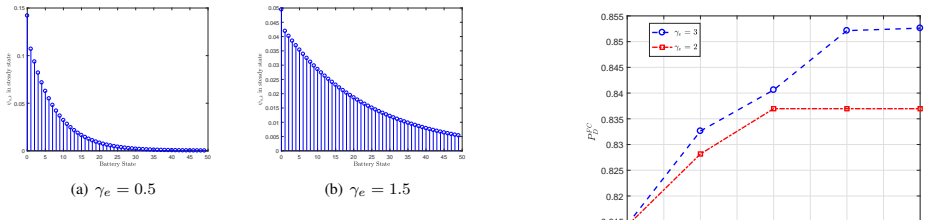
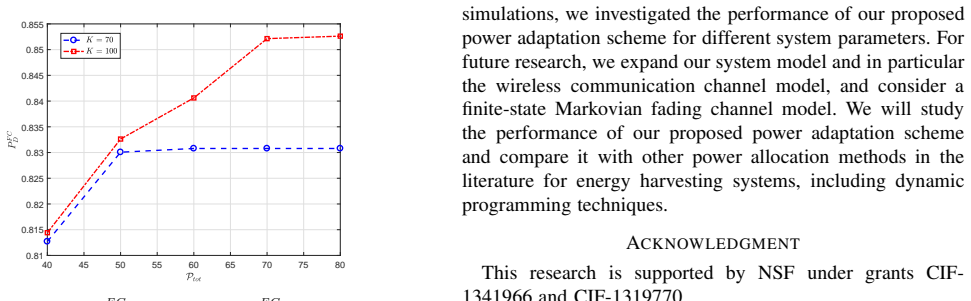
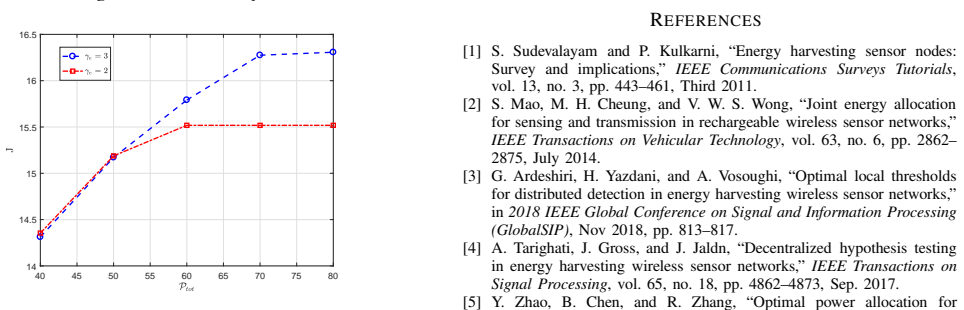
The paper's central claim is that the optimal transmit power map has the explicit form $p^*_{n,l,k} = \min\{k e_u/T_s,\, \Phi_{n,k},\, [p'_{n,l,k}]_+\}$, where $p'_{n,l,k}$ is the power obtained from the stationarity equation of the J-divergence objective and $\Phi_{n,k}$ is the closed-form battery-outage bound. This map solves the constrained problem of maximizing the sum over sensors, channel bins, and battery states of the approximate per-sensor J-divergence $J_n(\mu_{n,l}, p_{n,l,k})$, weighted by the channel-bin probabilities $\pi_{n,l}$ and the steady-state battery probabilities $\psi_{n,k}$. The battery probabilities are not assumed known; they are obtained by iterating the transition law, recomputing the map, and repeating until convergence. Simulations show the fusion-center detection probability rises with the power budget and saturates when the budget exceeds what harvesting and battery capacity can support.
Load-bearing premise
The battery transition probabilities in Eq. (7) assume each sensor's local decision always matches the true hypothesis, so the map is exactly optimal only when local detection errors are ignored.
Editorial extensions
If this is right
- Each sensor implements the optimal policy from a precomputed lookup table indexed by battery state and quantized channel gain; no per-slot centralized computation is needed.
- Detection probability at the fusion center increases with the total power budget and saturates once the budget exceeds what the battery and energy arrivals can deliver.
- Higher energy arrival rate or larger battery capacity push the saturation point to a larger power budget, meaning the system can use more average power before the constraint becomes inactive.
- The results extend J-divergence power allocation from non-harvesting sensors with perfect channel state to energy-harvesting sensors with finite batteries and limited feedback.
Reading between the lines
- The battery transition law in Eq. (7) treats the H0 branch as never consuming energy and the H1 branch as always consuming one transmission; because local decisions are imperfect, the steady-state $\psi$ used in the objective is only an approximation. Recomputing the map with the exact transition probabilities would be a direct test of how much the approximation costs.
- The same three-way clamped map structure would carry over to non-exponential energy arrivals: only $\Phi_{n,k}$ and the transition recursion change, so the approach is a template for other harvesting statistics.
- Because the map is computed offline and depends only on steady-state statistics, it could be re-derived infrequently as channel or harvesting statistics drift, making it suitable for slowly varying environments.
Signed reviews
Editorial analysis
A structured set of objections, weighed in public.
Referee Report
Summary. The paper considers a wireless sensor network of N energy-harvesting sensors with finite-capacity batteries that perform binary distributed detection and send their local decisions to a fusion center over fading channels with quantized feedback. The authors approximate the J-divergence at the fusion center by moment-matching Gaussian densities, formulate an optimization problem for the transmit power map p_{n,l,k} as a function of each sensor's battery state and quantized channel gain, and derive the closed-form map in Eq. (20) subject to causality, battery outage, and total average power constraints. They propose a fixed-point iteration (Algorithm 2) to compute steady-state battery probabilities and evaluate the scheme via Neyman-Pearson simulations.
Significance. The paper addresses a relevant and timely problem: distributed detection in energy-harvesting WSNs with finite batteries and limited feedback. The proposed solution is attractively explicit: a closed-form power map, a concrete algorithm for steady-state battery probabilities, and simulation results with a Neyman-Pearson fusion rule. However, the central derivation contains load-bearing errors in the battery transition model and in the J-divergence objective. If these are corrected, the overall approach may be salvageable, but the numerical results and the claimed optimality in the present form do not follow from the stated model. The paper does not provide machine-checked proofs or code, so the correctness rests entirely on the derivations as written.
major comments (3)
- [II-B, Eq. (7)] The battery state recursion in Eq. (7) conditions on the true hypothesis rather than on the local decision u_n. The no-transmission branch is weighted by Π0 and the transmission branch by Π1, which is exact only when Pfn=0 and Pdn=1. Since transmission occurs exactly when u_n=1, the correct weights are Π0(1-Pfn)+Π1(1-Pdn) for the no-transmission branch and Π0Pfn+Π1Pdn for the transmission branch. The paper defines Pfn and Pdn in Section II-A and uses Pfn=[0.2,0.1], Pdn=[0.9,0.75] in Section V, so the omission is material. Because ψ_n,k computed by Algorithm 2 is used to weight the objective and the total average power constraint in Eq. (18), the map in Eq. (20) is not optimal for the stated model; Algorithm 2 converges to the invariant distribution of a different Markov chain with perfect local decisions.
- [IV, Eqs. (14)-(16)] The battery outage constraint has the same structural error. Eq. (14) writes Pr(b^{t+1}>η b^t | b^t,l) = Π0 F_E(k e_u(η-1)) + Π1 F_E(k e_u(η-1)+α^t_{n,l,k}), which again assumes no transmission under H0 and transmission under H1. A correct expression must account for the local decision probabilities: under H0 the transmission branch has probability Pfn, and under H1 the no-transmission branch has probability 1-Pdn. Consequently, the derived upper bound Φ_n,k in Eq. (16) and constraint (ii) in Eq. (18) are not valid for the model with imperfect local decisions.
- [III, Eq. (12)] Substituting the stated means and variances m_n,H0, m_n,H1, Σ_n,H0, Σ_n,H1 into Eq. (11) gives first-term numerator coefficient Pdn(1-Pdn)+(Pdn-Pfn)^2 = Pdn -2PfnPdn + Pfn^2 and second-term coefficient Pfn(1-Pfn)+(Pdn-Pfn)^2 = Pdn^2 -2PfnPdn + Pfn. The paper's A_n and C_n are the reverse of these expressions (and equal only in the trivial limit). Since Eq. (12) is the objective maximized in Eq. (18), the power map in Eq. (20) does not solve the stated J-divergence maximization even leaving the battery issue aside.
minor comments (5)
- [III, Eq. (11)] The J-divergence formula in Eq. (11) omits the factor 1/2 and the constant term involving ln(Σ0/Σ1); while this affine transformation does not change the argmax, the J values plotted in Figs. 7-8 are not the true J-divergence values.
- [Throughout] The text contains numerous proofreading and typesetting artifacts, such as 'task ed', 'storin g', 'transmi t', and 'Jules' instead of 'Joules'.
- [II-A] The paper does not specify how the local decision rule Γ_n and the probabilities Pfn and Pdn are chosen; they are treated as fixed parameters, but no relation to the observation model or thresholds is given.
- [Algorithm 2] The convergence of the fixed-point iteration to a steady-state distribution is asserted but not analyzed; a brief discussion of contraction or numerical evidence would improve the paper.
- [Figure 3] The caption of Fig. 3 is grammatically incomplete and would benefit from a full sentence describing the axes and the meaning of the plotted map.
Circularity Check
No significant circularity: the derivation is a standard constrained optimization with externally imported convexity result, and the battery-state distribution is obtained by a fixed-point iteration rather than by construction.
full rationale
The paper's derivation chain is not circular. The J-divergence approximation in Eq. (12) and the convexity result in Theorem 1 are imported from Zhang, Poor, and Chiang [10], an external source, and the local decision probabilities Pf_n/Pd_n used there are not themselves derived from the paper's transmit-power map. The optimal map in Eq. (20) is the closed-form KKT solution of Eq. (18) for a fixed battery-state distribution psi, and psi is subsequently obtained by the fixed-point iteration in Algorithm 2 using the transition in Eq. (7). This is a standard self-consistency computation, not a definitional equivalence: the unknown power map p* and the unknown battery distribution psi are distinct objects, and neither is introduced as the conclusion of the other. There is no fitted parameter being renamed as a prediction, no author-uniqueness theorem invoked to force the ansatz, and no self-citation carrying a load-bearing premise. The main manuscript caveat is a modeling-consistency issue rather than a circularity: Eq. (7) and Eq. (14) weight the transmit/no-transmit battery branches by Pi_0 and Pi_1, which is exact only if each local decision equals the true hypothesis, whereas the paper defines Pf_n > 0 and Pd_n < 1 and uses those probabilities in Eq. (12) and in the simulations. That makes the steady-state psi and the resulting optimality certificate mismatched with the stated stochastic model, but it is an internal correctness gap: Eq. (7) is not obtained by assuming the target conclusion, and Eq. (20) does not reduce to an input of the problem by construction. Under the required quote-and-reduction standard, no circular step can be exhibited.
Assumptions & free parameters
free parameters (2)
- Channel quantization thresholds µ_{n,l} =
[0, 0.1, 0.3, 0.6, 1.2, ∞] for all sensors
- Battery outage parameters η and ζ_n =
η=0.2, ζ_n=0.9
assumptions (5)
- domain assumption Energy arrival process is exponential i.i.d. with rate γ_e, and energy harvested in slot t is available in slot t+1.
- domain assumption Channel gains are constant within an observation period and are quantized by the fusion center; sensors know the quantized gain.
- ad hoc to paper Local decision probabilities Pfn and Pdn do not affect battery state transition; the H0/H1 branches in Eq. (7) are weighted only by Π_0 and Π_1.
- domain assumption The J-divergence of Gaussian mixtures is approximated by the J-divergence of moment-matched Gaussian densities, and Theorem 1 from [10] guarantees convexity for (Pdn, Pfn) in the set S.
- ad hoc to paper The fixed point of Algorithm 2 gives the steady-state battery probabilities used in the objective.
Cite this review
Pith. "Pith review of Power Adaptation for Distributed Detection in Energy Harvesting WSNs with Finite-Capacity Battery." pith.science (2026). https://pith.science/paper/VHK7WH2U
@misc{pith2026190805755,
  author       = {Pith},
  title        = {Pith review of: Power Adaptation for Distributed Detection in Energy Harvesting WSNs with Finite-Capacity Battery},
  year         = {2026},
  howpublished = {\url{https://pith.science/paper/VHK7WH2U}},
  note         = {Machine review of arXiv:1908.05755}
}
read the original abstract
We consider a wireless sensor network, consisting of N heterogeneous sensors and a fusion center (FC), that is tasked with solving a binary distributed detection problem. Each sensor is capable of harvesting randomly arrived energy and storing it in a finite capacity battery. Sensors are informed of their fading channel states, via a bandwidth-limited feedback channel from the FC. Each sensor has the knowledge of its current battery state and its channel state (quantized channel gain). Our goal is to study how sensors should choose their transmit powers such that J-divergence of the received signal densities under two hypotheses at the FC is maximized, subject to certain (battery and power) constraints. We derive the optimal power map, which depends on the energy arrival rate, the battery capacity, and the battery states probabilities at the steady state. Using the optimal power map, each sensor optimally adapts its transmit power, based on its battery state and its channel state. Our simulation results demonstrate the performance of our proposed power adaptation scheme for different system parameters.
Figures



Figures from the paper (4 more)

Reference graph
Works this paper leans on
-
[1]
Energy harvesting sens or nodes: Survey and implications,
S. Sudevalayam and P . Kulkarni, “Energy harvesting sens or nodes: Survey and implications,” IEEE Communications Surveys Tutorials , vol. 13, no. 3, pp. 443–461, Third 2011
work page 2011
-
[2]
Joint energy alloc ation for sensing and transmission in rechargeable wireless sens or networks,
S. Mao, M. H. Cheung, and V . W. S. Wong, “Joint energy alloc ation for sensing and transmission in rechargeable wireless sens or networks,” IEEE Transactions on V ehicular Technology , vol. 63, no. 6, pp. 2862– 2875, July 2014
work page 2014
-
[3]
Optimal loca l thresholds for distributed detection in energy harvesting wireless se nsor networks,
G. Ardeshiri, H. Y azdani, and A. V osoughi, “Optimal loca l thresholds for distributed detection in energy harvesting wireless se nsor networks,” in 2018 IEEE Global Conference on Signal and Information Proce ssing (GlobalSIP), Nov 2018, pp. 813–817
work page 2018
-
[4]
Decentralized hyp othesis testing in energy harvesting wireless sensor networks,
A. Tarighati, J. Gross, and J. Jaldn, “Decentralized hyp othesis testing in energy harvesting wireless sensor networks,” IEEE Transactions on Signal Processing, vol. 65, no. 18, pp. 4862–4873, Sep. 2017
work page 2017
-
[5]
Optimal power allocation for an energy harvesting estimation system,
Y . Zhao, B. Chen, and R. Zhang, “Optimal power allocation for an energy harvesting estimation system,” in 2013 IEEE International Conference on Acoustics, Speech and Signal Processing , May 2013, pp. 4549–4553
work page 2013
-
[6]
Optimal energy allocation for wire less communications with energy harvesting constraints,
C. K. Ho and R. Zhang, “Optimal energy allocation for wire less communications with energy harvesting constraints,” IEEE Transactions on Signal Processing , vol. 60, no. 9, pp. 4808–4818, Sep. 2012
work page 2012
-
[7]
H. Y azdani, X. Gong, and A. V osoughi, “Beam selection and discrete power allocation in opportunistic cognitive radi o systems with limited feedback using ESPAR antennas,” 2019. [Online]. Av ailable: http://arxiv.org/abs/1903.10482
work page Pith review arXiv 2019
-
[8]
Throughput maxim ization for energy harvesting cognitive radio networks with finite hori zon,
F. Zhang, T. Jing, Y . Huo, and K. Jiang, “Throughput maxim ization for energy harvesting cognitive radio networks with finite hori zon,” in 2017 9th International Conference on Wireless Communications a nd Signal Processing (WCSP), Oct 2017, pp. 1–7
work page 2017
Show all 13 references
-
[9]
Finite-state markov channel b ased modeling of rf energy harvesting systems,
D. Altinel and G. K. Kurt, “Finite-state markov channel b ased modeling of rf energy harvesting systems,” IEEE Transactions on V ehicular Technology, vol. 67, no. 2, pp. 1713–1725, Feb 2018
2018
-
[10]
Optimal power alloc ation for distributed detection over mimo channels in wireless senso r networks,
X. Zhang, H. V . Poor, and M. Chiang, “Optimal power alloc ation for distributed detection over mimo channels in wireless senso r networks,” IEEE Transactions on Signal Processing , vol. 56, no. 9, pp. 4124–4140, Sep. 2008
2008
-
[11]
Power allocation for distributed detection systems in wireless sensor netwo rks with limited fusion center feedback,
X. Guo, Y . He, S. Atapattu, S. Dey, and J. S. Evans, “Power allocation for distributed detection systems in wireless sensor netwo rks with limited fusion center feedback,” IEEE Transactions on Communications, vol. 66, no. 10, pp. 4753–4766, Oct 2018
2018
-
[12]
Early detection of apnea-br adycardia episodes in preterm infants based on coupled hidden markov m odel,
S. Masoudi, N. Montazeri, M. B. Shamsollahi, D. Ge, A. Be uche, P . Pladys, and A. I. Hernandez, “Early detection of apnea-br adycardia episodes in preterm infants based on coupled hidden markov m odel,” in IEEE International Symposium on Signal Processing and Info rmation Tec...
2013
-
[13]
Transmis- sion with energy harvesting nodes in fading wireless channe ls: Optimal policies,
O. Ozel, K. Tutuncuoglu, J. Y ang, S. Ulukus, and A. Y ener , “Transmis- sion with energy harvesting nodes in fading wireless channe ls: Optimal policies,” IEEE Journal on Selected Areas in Communications , vol. 29, no. 8, pp. 1732–1743, Sep. 2011
2011
Reviewed August 14, 2026 · model on record in the stance chip above.
Discussion (0). Continue with ORCID to comment.