REVIEW 3 major objections 4 minor 21 references
On the inverse scattering from anisotropic periodic layers and transmission eigenvalues
T0 review · 3 major / 4 minor · reviewed 2026-08-14 · deepseek-v4-flash
Pith's one-line read This paper proves that a single series test over the eigensystem of the near-field operator decides membership in the support of an anisotropic periodic layer, and that the quasi-periodic transmission problem has infinitely many…
desk verdict Worth a careful referee, but the central factorization has a sign error that propagates into the main characterization; fixable, but as written the proof of Theorem 3.6 does not go through. read the letter →
The pith
A machine-rendered reading of the paper's core claim, the machinery that carries it, and where it could break.
The reading
What carries the argument
The argument turns on the factorization $WN = H^* T H$, where $N$ is the near-field operator, $W$ is an explicit block weight matrix with a bounded inverse, $H$ is a compact injective map from sequence data into the layer, and $T$ is a contrast operator defined by $T f = (\mathrm{Re}\,Q)^{-1/2} Q((\mathrm{Re}\,Q)^{-1/2} f + \nabla u)$. Under Assumption 3.1, $T$ is injective, has negative semidefinite imaginary part (strictly negative on nonzero vectors), and differs from a coercive operator by a compact perturbation; the range identity theorem then gives $\operatorname{Range}(H^*) = \operatorname{Range}((WN)_\sharp^{1/2})$. The quasi-periodic Green function provides test vectors $r_n(z)$ whose Rayleigh coefficients are known explicitly, so membership of $z$ in $D$ is read off from the finiteness of the eigensystem sum. For the eigenvalue half, the key object is $L_k$, defined by a Riesz representation from a Hermitian sesquilinear form; its self-adjointness, coercivity at $k=0$, and compactness of $L_k - L_0$ allow the standard counting argument for transmission eigenvalues, and a family of disjoint balls inside $D$ produces the infinite-dimensional subspaces on which $L_k$ is non-positive.
What would settle it
Take a non-absorbing anisotropic periodic layer ($\operatorname{Im} Q = 0$) and compute the near-field operator $N$; if the series in (19) converges at some point outside $D$ or diverges at some point inside $D$, the characterization fails. For the eigenvalue result, discretize $L_k$ for a layer with $A$ a constant positive-definite multiple of the identity: the theorem predicts infinitely many real eigenvalues, so observing only finitely many sign changes of $L_k$ would falsify Theorem 4.3.
Extended reading notes
Core claim
The central discovery is a complete characterization and a countable spectrum. Theorem 3.6 says that, under the absorbing-contrast Assumption 3.1, a point $z$ lies in the support $D$ exactly when the series $\sum_j |\langle r_n(z), \psi_{n,j}\rangle|_{\ell^2(\mathbb{Z})^2}^2 / \lambda_j$ is finite, where $(\lambda_j, \psi_{n,j})$ is an orthonormal eigensystem of the self-adjoint positive operator $(WN)_\sharp^{1/2}$ built from the measured near-field operator $N$. This is an if-and-only-if test, so it is both a uniqueness proof and a pixel-by-pixel imaging criterion. Theorem 4.3 states that, for a non-absorbing layer ($\operatorname{Im} Q = 0$) with uniformly positive contrast and quasi-periodicity parameter $\alpha$ not an integer, there exist infinitely many transmission eigenvalues. The proof uses an operator $L_k$ on $H^1_{0,\alpha}(D)$ that is self-adjoint, coercive at $k=0$, and compactly different from $L_0$; positivity for small $k$ and non-positivity on an $M_\epsilon$-dimensional subspace built from disjoint balls force the eigenvalue count to grow without bound. Together the two theorems give the first factorization-method justification and transmission-eigenvalue existence result for the anisotropic periodic-layer setting.
Load-bearing premise
The inverse-scattering result collapses if the contrast is not absorbing: the proof needs $\operatorname{Im} Q$ strictly negative definite so that $T$ is injective and the range identity theorem applies, and the paper explicitly notes this assumption excludes transmission eigenvalues.
Editorial extensions
If this is right
- The series test is a yes/no criterion for every point, so the layer's support can be imaged pixel by pixel from the measured near-field operator without knowing the contrast's amplitude.
- Because the criterion is an equivalence, the near-field operator determines the support $D$ uniquely among layers satisfying Assumption 3.1.
- The proof requires near-field data taken from both sides of the layer, and the numerical examples show that evanescent modes are needed for resolution.
- The infinite sequence of real transmission eigenvalues gives countable material-dependent fingerprints that are in principle recoverable from scattering data.
- The absorbing assumption behind the factorization and the transparency assumption behind the eigenvalue result delimit two complementary regimes: one for imaging, one for material probing.
Reading between the lines
- Because the proof of Lemma 3.5 is deferred to the half-space analogue, the self-containedness of the full-space argument rests on trusting that the half-space estimates carry over; a reader should verify the sign and coercivity estimates for the full-space Dirichlet-to-Neumann maps directly.
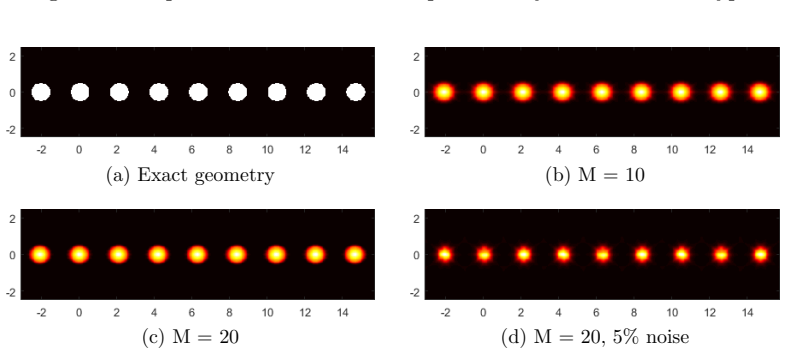
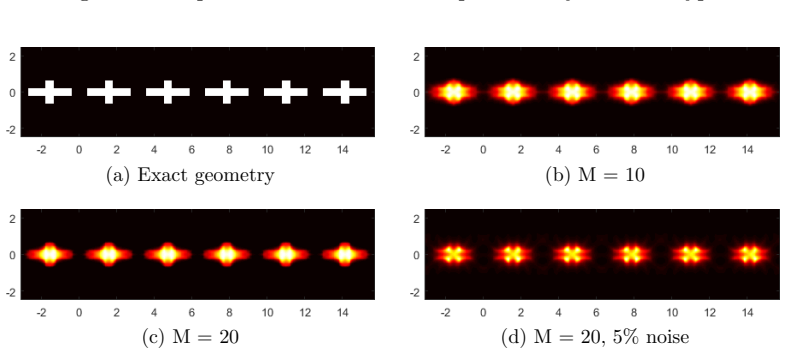
- The paper reports stable reconstructions for ball- and cross-type layers but noise-sensitive ones for piecewise-linear and sinusoidal layers, and offers no justification; this suggests the imaging functional's stability depends on layer topology, which is a testable hypothesis.
- The factorization structure $WN = H^* T H$ appears portable to full Maxwell biperiodic problems, where $W$ would encode polarization-dependent Dirichlet-to-Neumann data; the paper does not attempt this.
- The disjoint-ball counting argument for transmission eigenvalues hints that the number of eigenvalues grows with the volume of $D$; a Weyl-type asymptotic is a natural next step.
Signed reviews
Editorial analysis
A structured set of objections, weighed in public.
Referee Report
Summary. The paper studies two problems for a 2D anisotropic periodic layer in TM polarization: the inverse scattering problem of reconstructing the support D of the contrast from near-field data, and the interior transmission eigenvalue problem for non-absorbing anisotropic periodic layers. For the inverse problem, the authors propose a factorization method based on the two-sided near-field operator N and prove a characterization of D in terms of an eigensystem of a symmetrized operator (WN)_♯. They also provide numerical reconstructions for several layer geometries. For the transmission eigenvalue problem, they formulate a quasi-periodic interior transmission eigenvalue problem and prove the existence of infinitely many real transmission eigenvalues under the assumption Im Q = 0 and α ∉ Z.
Significance. If correct, the factorization result would provide a unique and computationally simple characterization of the shape of anisotropic periodic layers from near-field data, extending earlier half-space results to the full-space two-sided setting. The transmission eigenvalue existence result for quasi-periodic eigenfunctions is new and appears to be essentially sound. The paper is clearly written and the numerical experiments, despite the selection issue noted below, illustrate the method. However, the central factorization theorem in Section 3 contains a sign error that, as written, invalidates the range-identity argument, and key lemmas are stated without proof. The transmission eigenvalue part of the paper is the stronger contribution; the inverse part needs substantial correction before the claims can be accepted.
major comments (3)
- [§3.2, Lemma 3.4] There is a sign error in the factorization. From (7), B_A(u,v) = -∫_D Q(ReQ)^{-1/2} f·∇v. Since A = I + Q, B_A(u,v) = B_I(u,v) + ∫_D Q∇u·∇v, and using (18) we obtain B_I(u,v) = -∫_D (ReQ)^{1/2} Tf·∇v. Therefore the unique solution of (7) satisfies Gf = -E Tf, not Gf = E Tf as claimed in the proof of Lemma 3.4. Consequently Lemma 3.4 should read WN = -H^* T H. This is load-bearing: with Im T ≤ 0 from Lemma 3.5(b), the identity WN = -H^* T H gives Im(WN) = -H^*(Im T)H ≥ 0, so the operator (WN)_♯ = |Re WN| - Im WN used in Theorem 3.6 need not be positive definite, and the range identity theorem [14] cannot be applied as written. The proof of Lemma 3.4 drops the minus sign when rewriting (7) as an identity for B_I; this must be corrected, and the definition of ♯ or T must be adjusted accordingly.
- [§3.1, Eq. (17)] The Rayleigh coefficients of the quasi-periodic Green's function (16) are not those given in (17). For x2 > h, the coefficient of e^{iα_n x1 + iβ_n(x2-h)} in G is r+_n(z) = i/(4πβ_n) e^{-iα_n z1} e^{iβ_n(h-z2)}, and for x2 < -h it is r-_n(z) = i/(4πβ_n) e^{-iα_n z1} e^{iβ_n(z2+h)}. Equation (17) has the opposite sign in the z2-dependent phase, i.e., it gives the coefficients of the incoming (conjugate) Green's function. Since Lemma 3.3 and the test functional in Theorem 3.6 both use r_n(z), the characterization of D is not justified unless this formula is corrected and the proof of Lemma 3.3 is checked with the correct phase.
- [§3.2, Lemma 3.5 and Theorem 3.6] These statements are load-bearing for the central inverse-scattering claim, yet they are not proved in the manuscript. Lemma 3.5 states that the proofs 'are omitted here, following [18]', and Theorem 3.6 states that 'the proof is similar to [18]'. The full-space two-sided problem has a different measurement operator, a different weighting operator W, and different boundary terms than the half-space problem in [18]; the sign issues identified above show that the adaptation is not automatic. Please provide complete proofs of Lemma 3.5 and Theorem 3.6, or a detailed step-by-step mapping to [18] that accounts for all sign conventions and the two-sided nature of the data.
minor comments (4)
- [§3.1, Eq. (14)] The matrix W in (14) does not match the formula for H^* in (11). To have H^* = W E, the first row of W should be ( ~w+_n, ~w+_n ), not ( ~w+_n, ~w-_n ). The determinant and invertibility argument are unaffected.
- [§3.1, Lemma 3.3] In the proof of the z ∈ D direction, the displayed formula should read (Ef)_n = ( \hatΦ^+_n, \hatΦ^-_n )^T rather than ( \hatΦ^+_n, \hatΦ^+_n )^T.
- [§5, Numerical examples] Figures 2(d) and 3(d) are described as the best results out of 10 numerical experiments, and the worst cases are stated to show no reasonable reconstruction. As presented, this does not give a robust measure of the method's performance. Please report median or typical reconstructions and show at least one representative non-best case, or explain the selection criterion.
- [Abstract and §6] There are minor language and typographical issues, e.g., 'transmission eigenvalues in scattering have recently attracted' in the abstract and 'Lipchitz' in Section 6; these should be corrected.
Circularity Check
No circular reduction; central results rest on external theorems, with a minor self-citation for omitted half-space analogues.
full rationale
Walking the derivation chain: the factorization method in Theorem 3.6 is assembled from Lemma 3.3 (characterization through Range(H*)), Lemma 3.4 (factorization WN = H*TH), the external range identity theorem [14], and the analytic properties of H and T in Lemma 3.5. The adjoint H* is computed explicitly, Lemma 3.3 has a direct proof, and Lemma 3.4 derives the factorization from N = GH and H* = WE rather than postulating it. Lemma 3.5 and Theorem 3.6 are explicitly deferred to [18] ('The proofs for these properties can be done following their analogues of the half-space case [18] and therefore are omitted here'; 'The proof is similar to that of the half space case [18]'). This is a self-citation by a coauthor, and it is load-bearing in the sense that central details are not written out. However, [18] is a published half-space analogue with different geometry and assumptions, not the target full-space periodic-layer result, so the citation supplies independent support rather than a circular reduction. The transmission eigenvalue result in Theorem 4.3 uses the standard Cakoni-Kirsch theory [8] and constructs non-positivity of L_k from the smallest transmission eigenvalue of a constant-coefficient ball problem; that auxiliary existence is a known external fact, not the theorem being proved. No parameter is fitted and then renamed as a prediction, and no step reduces to an input by definition. The numerical section uses the authors' own forward solver [17] to generate synthetic data, but this is a consistency demonstration rather than a derivation. The score of 2 reflects only the minor self-citation for omitted proof details; no circularity is present. Any alleged sign inconsistency in the factorization would be a correctness issue, not a circularity issue, and does not affect this assessment.
Assumptions & free parameters
free parameters (1)
- Singular value truncation threshold =
5e-4
assumptions (8)
- standard math Uniform ellipticity of the matrix A and well-posedness of the direct scattering problem for all but a discrete set of wave numbers k.
- domain assumption Assumption 3.1: D is a Lipschitz domain, the contrast Q is complex symmetric with Re Q positive definite and Im Q negative definite, and (Re Q)^{+/-1/2} are bounded.
- domain assumption The complement Omega \ D has at most two unbounded connected components (Assumption 3.1).
- domain assumption alpha not in Z so that non-zero constants are not quasi-periodic and the Poincare inequality holds for H1_alpha(D) (Lemma 4.1).
- domain assumption In Section 4 the scatterer is non-absorbing (Im Q = 0) with Q uniformly positive definite, and D is a graph-type Lipschitz domain with no holes touching the vertical boundaries.
- standard math The range identity theorem from Kirsch-Grinberg [14].
- standard math The existence of infinitely many transmission eigenvalues for the constant-coefficient ball problem (30)-(31), from Cakoni-Kirsch [8].
- standard math Rellich compact embedding and the spectral theorem for compact self-adjoint operators.
Cite this review
Pith. "Pith review of On the inverse scattering from anisotropic periodic layers and transmission eigenvalues." pith.science (2026). https://pith.science/paper/JPNY3EGU
@misc{pith2026190805801,
  author       = {Pith},
  title        = {Pith review of: On the inverse scattering from anisotropic periodic layers and transmission eigenvalues},
  year         = {2026},
  howpublished = {\url{https://pith.science/paper/JPNY3EGU}},
  note         = {Machine review of arXiv:1908.05801}
}
read the original abstract
This paper is concerned with the inverse scattering and the transmission eigenvalues for anisotropic periodic layers. For the inverse scattering problem, we study the Factorization method for shape reconstruction of the periodic layers from near field scattering data. This method provides a fast numerical algorithm as well as a unique determination for the shape reconstruction of the scatterer. We present a rigorous justification and numerical examples for the factorization method. The transmission eigenvalue problem in scattering have recently attracted a lot of attentions. Transmission eigenvalues can be determined from scattering data and they can provide information about the material parameters of the scatterers. In this paper we formulate the interior transmission eigenvalue problem and prove the existence of infinitely many transmission eigenvalues for the scattering from anisotropic periodic layers.
Figures


Figures from the paper (2 more)
Reference graph
Works this paper leans on
-
[18]
D.-L. Nguyen , Shape identification of anisotropic diffraction gratings for TM- polarized electromagnetic waves, Appl. Anal., 93 (2014), pp. 1458–1476
work page 2014
-
[19]
T.-P. Nguyen , Differential imaging of local perturbations in anisotropic periodic media, Inverse Problems, accepted (2019)
work page 2019
-
[14]
A. Kirsch and N. Grinberg , The Factorization Method for Inverse Problems , Oxford Lecture Series in Mathematics and its Applications 36, Oxford University Press, 2008
work page 2008
-
[1]
T. Arens and N. Grinberg , A complete factorization method for scattering by periodic structures, Computing, 75 (2005), pp. 111–132
work page 2005
-
[2]
T. Arens and A. Kirsch , The factorization method in inverse scattering from periodic structures, Inverse Problems, 19 (2003), pp. 1195–1211
work page 2003
-
[3]
G. Bao, T. Cui, and P. Li , Inverse diffraction grating of Maxwell’s equations in biperiodic structures, Optics Express, 22 (2014), pp. 4799–4816
work page 2014
-
[4]
A.-S. Bonnet-Bendhia and F. Starling , Guided waves by electromagnetic gratings and non-uniqueness examples for the diffraction problem , Math. Meth. Appl. Sci., 17 (1994), pp. 305–338
work page 1994
- [5]
Show all 21 references
-
[6]
, Inverse Scattering Theory and Transmission Eigenvalues , SIAM, 2016
2016
-
[7]
Cakoni, H
F. Cakoni, H. Haddar, and I. Harris , Homogenization of the transmission eigenvalue problem for periodic media and application to the inverse problem , In- verse Probl. Imaging, 9 (2015), pp. 1025–1049
2015
-
[8]
Cakoni and A
F. Cakoni and A. Kirsch , On the interior transmission eigenvalue problem , Int. Jour. Comp. Sci. Math., 3 (2010), pp. 142–167
2010
-
[9]
Elschner and G
J. Elschner and G. Hu , An optimization method in inverse elastic scatter- ing for one-dimensional grating profiles , Commun. Comput. Phys., 12 (2012), pp. 1434–1460
2012
-
[10]
Haddar and T.-P
H. Haddar and T.-P. Nguyen , Sampling methods for reconstructing the ge- ometry of a local perturbation in unknown periodic layers , Comput. Math. Appl., 74 (2017), pp. 2831–2855
2017
-
[11]
Harris, F
I. Harris, F. Cakoni, and J. Sun , Transmission eigenvalues and non- destructive testing of anisotropic magnetic materials with voids , Inverse Problems, 30 (2014), p. 035016
2014
-
[12]
Kleefeld and L
A. Kleefeld and L. Pieronek , Computing interior transmission eigenvalues for homogeneous and anisotropic media , Inverse Problems, 34 (2018), p. 105007
2018
-
[13]
Jiang and P
X. Jiang and P. Li , Inverse electromagnetic diffraction by biperiodic dielectric gratings, Inverse Problems, 33 (2017), p. 085004. 20
2017
-
[15]
Kirsch and A
A. Kirsch and A. Lechleiter , The inside-outside duality for scattering prob- lems by inhomogeneous media , Inverse Problems, 29 (2013), p. 104011
2013
-
[16]
Lechleiter and D.-L
A. Lechleiter and D.-L. Nguyen , Factorization method for electromagnetic inverse scattering from biperiodic structures , SIAM J. Imaging Sci., 6 (2013), pp. 1111–1139
2013
-
[17]
, A trigonometric Galerkin method for volume integral equations arising in TM grating scattering, Adv. Comput. Math., 40 (2014), pp. 1–25
2014
-
[20]
Sandfort, The factorization method for inverse scattering from periodic in- homogeneous media, PhD thesis, Karlsruher Institut f¨ ur Technologie, 2010
K. Sandfort, The factorization method for inverse scattering from periodic in- homogeneous media, PhD thesis, Karlsruher Institut f¨ ur Technologie, 2010
2010
-
[21]
J. Yang, B. Zhang, and R. Zhang , A sampling method for the inverse trans- mission problem for periodic media , Inverse Problems, 28 (2012), p. 035004. 21
2012
Reviewed August 14, 2026 · model on record in the stance chip above.
Discussion (0). Continue with ORCID to comment.