REVIEW 4 major objections 3 minor 49 references
Entanglement Fidelity Ratio for Elastic Collisions in Non-Ideal Two-Temperature Dense Plasma
T0 review · 4 major / 3 minor · reviewed 2026-08-14 · deepseek-v4-flash
Pith's one-line read In non-ideal dense plasma, the entanglement fidelity ratio for elastic collisions falls as collision energy and temperature rise and grows as density rises, with the electron-ion ratio vanishing in the infinite-temperature limit while…
desk verdict New analytic EFR expressions for non-ideal dense plasma, but the Coulomb reference term and high-T limit are internally inconsistent; wait for a corrected version. read the letter →
The pith
A machine-rendered reading of the paper's core claim, the machinery that carries it, and where it could break.
The reading
What carries the argument
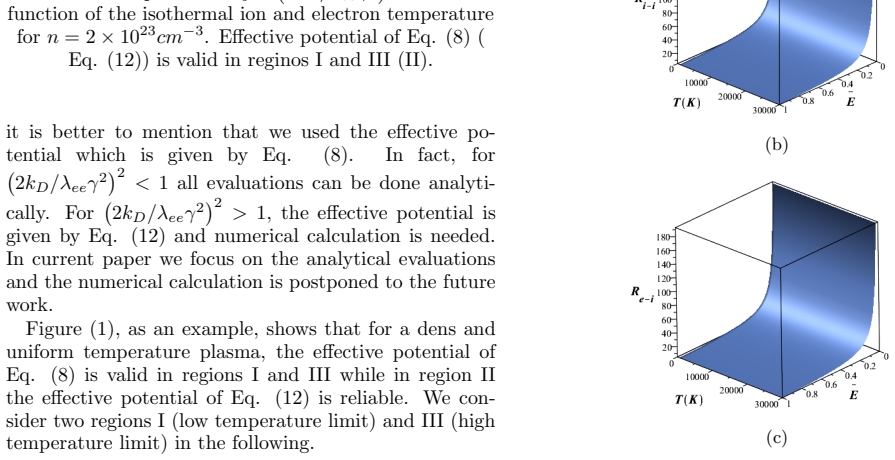
The carrying object is the entanglement fidelity ratio $R_{\alpha\beta}$, defined in Eq. (18) as the ratio of the entanglement fidelity for the effective screened potential $\phi_{\alpha\beta}(r)$ to that for the pure Coulomb potential. The fidelity itself comes from the partial-wave expression in Eq. (6): essentially the absolute square of the spatial integral of the scattered wavefunction divided by $1+|\int r^2\phi(r)j_0(kr)\,dr|^2$, with the divergent normalization cancelled by taking the ratio. The plasma enters through an effective potential that includes quantum diffraction and symmetry effects, with Debye-type screening lengths for electrons and ions, and the integrals are evaluated analytically using $\int_0^\infty e^{-Cr}\sin(kr)\,dr = k/(k^2+C^2)$. The analysis is restricted to parameter regions where the potential of Eq. (8) is valid, namely $(2k_D/\lambda_{ee}\gamma^2)^2<1$, covering the low-temperature and high-temperature branches treated in the paper.
What would settle it
Numerically compute the full partial-wave scattered state for one of the effective potentials, keeping the wavefunction normalization explicitly, and compare the resulting entanglement fidelity with the ratio formula of Eq. (18); a mismatch would show that the divergent normalization does not cancel as assumed. Experimentally, measuring the two-particle momentum correlations left by elastic collisions in a dense plasma with known density and temperature across the high-temperature range should reveal $R_{ei}\to0$ with $R_{ee}$ and $R_{ii}$ staying positive, so observing all three ratios vanish at high temperature, or $R_{ei}$ staying positive, would refute the central claim.
Extended reading notes
Core claim
The central claim is that the entanglement fidelity ratio for elastic scattering in a non-ideal dense plasma is a monotone decreasing function of the scaled collision energy $\bar{E}$ and, in the high-temperature region, of temperature, and an increasing function of density. For the electron-ion channel the ratio approaches zero at infinite temperature, whereas the electron-electron and ion-ion ratios remain positive, meaning only the unlike-species entanglement is destroyed by classical thermal motion. In the low-temperature region the ratio is independent of temperature, while in the high-temperature region it rises as the inverse temperature $\bar{\beta}$ grows. For a two-temperature plasma, lowering either temperature increases the ratio, and the electron-ion entanglement is more sensitive to the electron temperature. These results are expressed quantitatively by the closed formulas $R_{ee}$, $R_{ii}$, and $R_{ei}$ in Eqs. (20), (22), and (23).
Load-bearing premise
The whole calculation depends on the adopted formula for collisional entanglement fidelity, taken as proportional to the absolute square of the integral of the scattered wavefunction, and on the ratio step that cancels the divergent normalization factor; if that formula or that cancellation is not physically valid, the computed entanglement fidelity ratios do not describe entanglement.
Editorial extensions
If this is right
- In the low-temperature region, the entanglement fidelity ratio is independent of temperature and falls monotonically as the scaled collision energy grows, so low-energy projectiles carry the strongest entanglement signal.
- In the high-temperature region, the ratio rises with the inverse temperature $\bar{\beta}$ and falls with $r_s$ (inverse density), so cooling or compressing the plasma enhances entropy generation through collisions.
- At fixed collision energy and density, lowering either the electron or ion temperature increases the ratio, with the electron-ion channel responding more strongly to the electron temperature.
- At infinite temperature, only the electron-ion entanglement fidelity ratio vanishes; the electron-electron and ion-ion ratios remain positive, and in the isothermal high-temperature limit $R_{ii}=R_{ee}>R_{ei}$.
Reading between the lines
- Because the ratio construction cancels the divergent normalization, the same approach could be applied to other screened potentials, including the oscillatory potential of Eq. (12) in the intermediate temperature region II, where numerical work would test whether the monotone behavior persists or gives way to oscillations.
- The nonzero athermal limit for same-species collisions suggests that the entanglement fidelity ratio might serve as a measurable marker for quantum degeneracy or exchange symmetry in dense plasmas, since the electron-ion channel does not show this residual signal.
- If one interprets entanglement fidelity as a probe of environmental decoherence, these results imply that a cold, dense plasma is a strongly entangling environment, which could affect the coherence of particles inside plasma-embedded quantum devices.
Signed reviews
Editorial analysis
A structured set of objections, weighed in public.
Referee Report
Summary. The paper studies the entanglement fidelity ratio (EFR) for elastic electron-electron, ion-ion, and electron-ion collisions in a non-ideal dense two-temperature plasma. The authors adopt the entanglement fidelity formula of Mishima et al., combine it with the Ramazanov effective potential that includes quantum diffraction and symmetry effects, and derive closed-form expressions for the EFR in two temperature regions. They claim that the EFR decreases with collision energy and (in the high-temperature region) with temperature, increases with density, that electron-electron and ion-ion EFRs behave identically, and that only the electron-ion EFR vanishes in the infinite-temperature limit.
Significance. If correct, the results would provide an analytically tractable connection between quantum-information concepts (entanglement fidelity) and plasma screening, potentially useful for characterizing quantum effects in dense plasmas. The paper's use of a realistic effective potential and its attempt to obtain closed-form expressions are commendable, and the authors do not fit free parameters to data, so the framework is falsifiable. However, the printed analytic formulas are internally inconsistent with the defining ratio in Eq. (18), and the claimed high-temperature asymptotic behavior is contradicted by the same equations. These issues undermine the central quantitative and qualitative conclusions, so the paper in its present form cannot be considered a reliable contribution.
major comments (4)
- [Sec. IV, Eqs. (18)-(23)] The Coulomb benchmark in Eq. (18) is inconsistent with the EFR formulas in Eqs. (20), (22), and (23). For V_C(r)=-Ze^2/r, the integral in the denominator of Eq. (18) yields |(2\mu k/\hbar^2)\int r^2 V_C j_0(kr) dr|^2 = 4/\bar E, using \bar E = E/(Z^2 Ry). The paper instead places 1+4\bar E in the numerators of Eqs. (20)-(23), i.e., the energy enters inverted. This changes the energy dependence of every plotted curve and invalidates the claimed monotonic decrease of the EFR with collision energy.
- [Sec. IV.B and Sec. V] The high-temperature limit reported in the Conclusions is not reproduced by the printed equations. In the isothermal T→∞ limit, \bar\lambda_{ee}^2→0, B^2→0, and the electron-ion Ramazanov potential reduces to the pure Coulomb potential up to O(\lambda_{ei}^3) corrections; Eq. (18) therefore gives R_{ei}→1. Direct evaluation of Eqs. (23)-(24) in the same limit gives F→-1 and hence R_{ei}→1, not 0. The statement that 'only the EFR of electron-ion interaction vanishes in infinite temperature limit' is thus contradicted by the model's own equations.
- [Sec. IV.B, Fig. 7] The displayed equality R_{ee}=R_{ii} at high temperatures does not follow from the printed formulas. In the T→∞ limit, Eq. (20) tends to (1+4\bar E)/(1+16\bar E) whereas Eq. (22) has a different denominator structure and approaches 1+4\bar E (or a different \bar E-dependent expression depending on the omitted reduction). The figure's degeneracy is therefore an unexplained result that appears to rely on an unshown and possibly incorrect numerical evaluation.
- [Sec. II, Eq. (6)] The normalization integral in Eq. (6), \int_0^\infty dr\, r^2 j_0(kr) = k^{-1}\int_0^\infty dr\, r\sin(kr), diverges. The paper's EFR in Eq. (18) formally cancels this divergent factor, but this is a cancellation of an undefined quantity and requires an explicit regularization scheme. Without such a justification, the physical meaning of the EFR ratio is not rigorously established.
minor comments (3)
- [Eq. (21)] The definition \bar E = 2E\hbar^2/(Z^2\mu^2 e^4) is dimensionally inconsistent; the right-hand side has dimensions of energy divided by mass. The standard reduced-mass Rydberg gives \bar E = E/(Z^2 Ry) = 2E\hbar^2/(Z^2\mu e^4), so the printed formula appears to contain a typographical extra factor of \mu.
- [Sec. IV] The paper states that 'all evaluations can be done analytically' but does not show the derivation from Eq. (18) to Eqs. (20)-(24). Given the inconsistency noted above, the omitted steps are essential and must be presented in full.
- [Throughout] There are numerous typos and grammatical errors, including 'dens plasma' in the title and text, 'regin' for 'region', 'Therefor' in Sec. IV, and 'iterations' instead of 'interactions' in the caption of Fig. 7. These should be corrected in any revision.
Circularity Check
No significant circularity: the EFR formulas are derived from externally cited scattering and plasma-potential results, with no fitted parameters and no load-bearing self-citations.
full rationale
The derivation is not circular. The EFR is defined by Eq. (18) as the ratio of the entanglement fidelity for the effective potential to that for the pure Coulomb potential. The effective potential in Eq. (8) is imported from Ramazanov et al. (Ref. [24]) as an external plasma-model result, and the scattering-based EF formula in Eq. (6) is imported from Mishima et al. (Ref. [42]); neither is derived from the paper's own conclusions. No parameter is fitted to data and no quantity is renamed as a prediction: Eqs. (20), (22), and (23) are direct integrals of the externally supplied potential with the externally supplied formula, using the standard integral relation (19). The same-species and electron-ion comparisons are arithmetic consequences of these inputs rather than restatements of the inputs. The only self-citations are Refs. [30] and [31], which are listed in the introduction as examples of application areas and are not used to justify the EF formalism or the effective potential; they are therefore not load-bearing. The validity of the Mishima EF formula is a modeling assumption imported from the external literature, not circular reasoning. The internal algebraic inconsistencies noted in the skeptic summary, including the apparent Coulomb factor and the high-temperature limit, are correctness risks rather than circular reductions, and per the hard rules they do not raise the circularity score.
Assumptions & free parameters
assumptions (5)
- domain assumption Effective potential of Ramazanov et al. (Eq. 8) describes non-ideal dense plasma with quantum diffraction and symmetry effects.
- domain assumption Entanglement fidelity is given by f_k proportional to the absolute square of the spatial integral of the scattered wavefunction (Eq. 6, from Mishima et al. [42]), with the normalization cancelled in the ratio.
- domain assumption Low-energy elastic scattering is dominated by the s-wave partial wave, l = 0.
- standard math The divergent normalization integral in the numerator of Eq. (6) cancels when taking the ratio to Coulomb scattering.
- domain assumption Only the regime (2kD divided by le gamma squared) squared less than 1 is treated analytically; the complementary regime is deferred to future numerical work.
Cite this review
Pith. "Pith review of Entanglement Fidelity Ratio for Elastic Collisions in Non-Ideal Two-Temperature Dense Plasma." pith.science (2026). https://pith.science/paper/C6COKFAX
@misc{pith2026190805847,
  author       = {Pith},
  title        = {Pith review of: Entanglement Fidelity Ratio for Elastic Collisions in Non-Ideal Two-Temperature Dense Plasma},
  year         = {2026},
  howpublished = {\url{https://pith.science/paper/C6COKFAX}},
  note         = {Machine review of arXiv:1908.05847}
}
read the original abstract
The quantum diffraction and symmetry effects on the entanglement fidelity (EF) of different elastic electron-electron, ion-ion and electron-ion interactions are investigated in non-ideal dense plasma. The partial wave analysis and an effective screened interaction potential including quantum mechanical diffraction and symmetry effects are employed to obtain the EF in a non-ideal dense plasma. We show that collision energy and temperatures of electron and ion have a destroying role in the entanglement. In fact, by decreasing the temperature of any kind of particles, the quantum effects become dominant and the entanglement grows up. Also, increase in the density of plasma leads to the enhancement of entanglement ratio.
Figures


Figures from the paper (4 more)


Reference graph
Works this paper leans on
-
[1]
J. L. Ball, I. Fuentes-Schuller, and F. P. Schuller, Physics Letters A 359, 550 (2006)
work page 2006
-
[2]
(11) It is worth mentioning that the effective potential in Eq
Also, A , B and Cαβ have been defined as A2 = γ2 2 1 + √ 1− ( 2kD λeeγ2 )2 , (9) B2 = γ2 2 1− √ 1− ( 2kD λeeγ2 )2 , (10) Cαβ = kD 2λαβ 2−ki 2λee 2 λee 2/λαβ 2− 1 . (11) It is worth mentioning that the effective potential in Eq. (8) is valid for ( 2kD/λeeγ2)2 < 1. For the case( 2kD/λeeγ2)2 > 1, the effective potential takes the following form [24]...
-
[3]
(18) Using Eq.(8), we can evaluate the entanglement fidelity ratio (EFR) for electron-electron interaction. In order to derive the evaluating the integrals, we use the following integral relation ∫ ∞ 0 exp(−Cr) sin(kr)dr = k k2 +C2. (19) Therefor, we obtain Re−e (EFR for electron-electron interaction) as follows Re−e ( ¯E,ne,Te,ni,Ti ) = 1 + 4 ¯E 1 + 4 ¯E ...
-
[4]
I. Fuentes, R. B. Mann, E. Martin-Martinez, and S. Moradi, Physical Review D 82, 045030 (2010)
work page 2010
- [5]
-
[6]
H. Mohammadzadeh, Z. Ebadi, H. Mehri-Dehnavi, B. Mirza, and R. R. Darabad, Quantum Information Processing 14, 4787 (2015). 9
work page 2015
-
[7]
M. Farahmand, H. Mohammadzadeh, and H. Mehri- Dehnavi, International Journal of Modern Physics A 32, 1750066 (2017)
work page 2017
-
[8]
H. Mohammadzadeh, M. Farahmand, and M. Maleki, Physical Review D 96, 024001 (2017)
work page 2017
Show all 49 references
-
[9]
Fuentes-Schuller and R
I. Fuentes-Schuller and R. B. Mann, Physical review let- ters 95, 120404 (2005)
2005
-
[10]
T. G. Downes, I. Fuentes, and T. Ralph, Physical review letters 106, 210502 (2011)
2011
-
[11]
Mehri-Dehnavi, B
H. Mehri-Dehnavi, B. Mirza, H. Mohammadzadeh, and R. Rahimi, Annals of Physics 326, 1320 (2011)
2011
-
[12]
Farahmand, H
M. Farahmand, H. Mohammadzadeh, R. Rahimi, and H. Mehri-Dehnavi, Annals of Physics 383, 389 (2017)
2017
-
[13]
˙Zyczkowski, P
K. ˙Zyczkowski, P. Horodecki, M. Horodecki, and R. Horodecki, Physical Review A 65, 012101 (2001)
2001
-
[14]
Nha and H
H. Nha and H. Carmichael, Physical review letters 93, 120408 (2004)
2004
-
[15]
Schliemann, A
J. Schliemann, A. Khaetskii, and D. Loss, Journal of Physics: Condensed Matter 15, R1809 (2003)
2003
-
[16]
Shevelko and H
V. Shevelko and H. Tawara, Atomic multielectron pro- cesses, Vol. 23 (Springer Science & Business Media, 2013)
2013
-
[17]
H. F. Beyer and V. P. Shevelko, Introduction to the physics of highly charged ions (CRC Press, 2016)
2016
-
[18]
Fujimoto, in Plasma Polarization Spectroscopy (Springer, 2008) pp
T. Fujimoto, in Plasma Polarization Spectroscopy (Springer, 2008) pp. 29–49
2008
-
[19]
Ramazanov and K
T. Ramazanov and K. Dzhumagulova, Physics of Plasmas 9, 3758 (2002)
2002
-
[20]
Ramazanov, K
T. Ramazanov, K. Galiyev, K. Dzhumagulova, G. R¨ opke, and R. Redmer, Contributions to Plasma Physics 43, 39 (2003)
2003
-
[21]
Ramazanov, K
T. Ramazanov, K. Dzhumagulova, and Y. A. Omar- bakiyeva, Physics of plasmas 12, 092702 (2005)
2005
-
[22]
Ramazanov and K
T. Ramazanov and K. Turekhanova, Physics of plasmas 12, 102502 (2005)
2005
-
[23]
Kvasnica, Czechoslovak Journal of Physics B 23, 888 (1973)
J. Kvasnica, Czechoslovak Journal of Physics B 23, 888 (1973)
1973
-
[24]
Ramazanov and S
T. Ramazanov and S. Kodanova, Physics of Plasmas 8, 5049 (2001)
2001
-
[25]
Kvasnica and J
J. Kvasnica and J. Hor´ aˇ cek, Czechoslovak Journal of Physics B 25, 325 (1975)
1975
-
[26]
Ramazanov, Z
T. Ramazanov, Z. A. Moldabekov, and M. Gabdullin, Physical Review E 92, 023104 (2015)
2015
-
[27]
Filinov, V
A. Filinov, V. Golubnychiy, M. Bonitz, W. Ebeling, and J. Dufty, Physical Review E 70, 046411 (2004)
2004
-
[28]
Deutsch, Y
C. Deutsch, Y. Furutani, and M.-M. Gombert, Physics Reports 69, 85 (1981)
1981
-
[29]
Kremp, T
D. Kremp, T. Bornath, M. Bonitz, and M. Schlanges, Physical Review E 60, 4725 (1999)
1999
-
[30]
Marklund and P
M. Marklund and P. K. Shukla, Reviews of modern physics 78, 591 (2006)
2006
-
[31]
L¨ ower, R
T. L¨ ower, R. Sigel, K. Eidmann, I. F¨ oldes, S. H¨ uller, J. Massen, G. Tsakiris, S. Witkowski, W. Preuss, H. Nishimura, et al. , Physical review letters 72, 3186 (1994)
1994
-
[32]
Roozehdar Mogaddam, N
R. Roozehdar Mogaddam, N. Sepehri Javan, K. Javidan, and H. Mohammadzadeh, Physics of Plasmas 25, 112104 (2018)
2018
-
[33]
Roozehdar Mogaddam, N
R. Roozehdar Mogaddam, N. Sepehri Javan, K. Javidan, and H. Mohammadzadeh, Physics of Plasmas 26, 062112 (2019)
2019
-
[34]
Tahir, A
N. Tahir, A. Shutov, A. Zharkov, A. Piriz, and T. St¨ ohlker, Physics of Plasmas18, 032704 (2011)
2011
-
[35]
French, A
M. French, A. Becker, W. Lorenzen, N. Nettelmann, M. Bethkenhagen, J. Wicht, and R. Redmer, The As- trophysical Journal Supplement Series 202, 5 (2012)
2012
-
[36]
Opher, L
M. Opher, L. O. Silva, D. E. Dauger, V. K. Decyk, and J. M. Dawson, Physics of Plasmas 8, 2454 (2001)
2001
-
[37]
Jung, Physics of Plasmas 8, 3842 (2001)
Y.-D. Jung, Physics of Plasmas 8, 3842 (2001)
2001
-
[38]
Markowich, C
P. Markowich, C. Ringhofer, and C. Schmeiser, Vienna, New York (1990)
1990
-
[39]
Manfredi, Fields Inst
G. Manfredi, Fields Inst. Commun 46, 263 (2005)
2005
-
[40]
Xiang and S.-J
Y. Xiang and S.-J. Xiong, Physical Review A 76, 014301 (2007)
2007
-
[41]
Falaye, K
B. Falaye, K. Oyewumi, O. Falaiye, C. Onate, O. Oluwadare, and W. Yahya, Laser Physics Letters 16, 045204 (2019)
2019
-
[42]
S. J. Akhtarshenas, H. Mohammadi, S. Karimi, and Z. Azmi, Quantum Information Processing 14, 247 (2015)
2015
-
[43]
Fedorov, M
M. Fedorov, M. Efremov, A. Kazakov, K. Chan, C. Law, and J. Eberly, Physical Review A 69, 052117 (2004)
2004
-
[44]
Mishima, M
K. Mishima, M. Hayashi, and S. Lin, Physics Letters A 333, 371 (2004)
2004
-
[45]
Jung, Physics of Plasmas 18, 114503 (2011)
Y.-D. Jung, Physics of Plasmas 18, 114503 (2011)
2011
-
[46]
R. G. Newton, Scattering theory of waves and particles (Springer Science & Business Media, 2013)
2013
-
[47]
B. M. Smirnov, Plasma Processes and Plasma Kinetics: 580 Worked Out Problems for Science and Technology (John Wiley & Sons, 2008)
2008
-
[48]
Y. V. Arkhipov, F. Baimbetov, and A. Davletov, Phys- ical Review E 83, 016405 (2011)
2011
-
[49]
Gericke, J
D. Gericke, J. Vorberger, K. W¨ unsch, and G. Gregori, Physical Review E 81, 065401 (2010)
2010
Reviewed August 14, 2026 · model on record in the stance chip above.
Discussion (0). Continue with ORCID to comment.