REVIEW 3 major objections 5 minor 70 references
Forward-Selected Panel Data Approach for Program Evaluation
T0 review · 3 major / 5 minor · reviewed 2026-08-14 · deepseek-v4-flash
Pith's one-line read Forward selection of controls keeps the usual t-test valid when candidate controls vastly outnumber time periods, even with dense coefficients.
desk verdict Original and careful work on post-selection inference in the Hsiao-Ching-Wan framework, but the load-bearing restricted eigenvalue assumption is not as natural as the paper claims; still deserves a serious referee. read the letter →
The pith
A machine-rendered reading of the paper's core claim, the machinery that carries it, and where it could break.
The reading
What carries the argument
The load-bearing object is the forward selection algorithm, a greedy $R$-squared maximization that sequentially adds the control unit producing the largest drop in sum of squared residuals, up to a user-chosen $R$. The inference machinery around it has four parts: a restricted eigenvalue condition on the population Gram matrices of any selected control set, a geometric strong-mixing condition that makes pre-treatment selection asymptotically independent of post-treatment outcomes, a Berry-Esseen bound for heterogeneous time series applied to projection errors, and the submodularity ratio from greedy-algorithm analysis, which controls how much each greedy step closes the gap to the best $u$-variable subset. The key structural fact is that variable selection uses only pre-treatment data, so conditioning on the selected set does not produce the non-standard post-selection distributions that arise when selection and testing share one sample.
What would settle it
Simulate panels from a factor model with cross-sectionally correlated idiosyncratic errors, e.g. a shared local factor among blocks of control units, so that some $R$-sized subset of controls is nearly collinear and Assumption 1 fails; if the empirical size of the fsPDA t-statistic under the null departs systematically from the nominal 5% as $T$ grows, the restricted eigenvalue condition is doing the load-bearing work. Alternatively, in the watch-import application, compute the minimum eigenvalue of the empirical pre-treatment covariance matrix over subsets of size $R$ around the selected set; a near-zero value would flag the condition as unverified for that dataset.
Extended reading notes
Core claim
The core discovery is that the usual t-statistic, computed after forward-selecting at most $R$ control units from the pre-treatment subsample, is uniformly asymptotically standard normal under the null, even when $N$ grows much faster than $T$ and the high-dimensional coefficients may all be non-zero. The same pre/post-treatment split that makes post-selection inference valid also powers an efficacy result: with probability tending to one, the regression variance achieved by forward selection is at most the best $u$-variable subset variance plus an arbitrarily small tolerance, as long as $R/u$ tends to infinity. The paper therefore claims that consistent estimation of the full high-dimensional coefficient vector is unnecessary; recovering linear projection coefficients on a small forward-selected subset suffices for correct test size.
Load-bearing premise
The result stands on the assumption that every collection of at most $(1+\delta_1)R$ control units has a population covariance matrix with minimum eigenvalue bounded away from zero, so no small group of candidate controls is nearly collinear; if a nearly collinear group exists, both the uniform normality and the greedy near-optimality guarantees can fail.
Editorial extensions
If this is right
- Practitioners can include hundreds or thousands of candidate controls without exhaustive model search, because forward selection requires only a linear number of OLS regressions rather than enumeration of every subset.
- The post-selection t-statistic can be compared with standard normal critical values, so no bootstrap or repeated data-splitting is needed for valid inference.
- The validity holds in dense models where every control has a non-zero coefficient, a setting where Lasso-type sparsity assumptions fail.
- The greedy-selected model is nearly optimal in prediction variance: with $R/u$ tending to infinity, its regression variance is within an arbitrarily small tolerance of the best $u$-variable subset.
- Because the generic inference theorem applies to any pre-treatment-only selection rule, the paper also justifies treating AIC/AICC-selected models as fixed in panel-data-approach inference.
Reading between the lines
- The same pre/post-treatment split that powers Theorem 1 likely extends to other pre-treatment-only model choices, such as choosing the number of factors or the HAC lag by information criteria, giving uniform normal inference in settings the paper does not address.
- A practitioner-facing diagnostic suggests itself: compute the empirical minimum eigenvalue of the selected controls' pre-treatment Gram matrix; values near zero would signal that the restricted eigenvalue condition, and hence normal inference, is unreliable for that dataset.
- The variance-efficiency result positions fsPDA as a general counterfactual prediction engine, so it may be competitive with synthetic-control weighting for forecasting post-treatment outcomes even outside hypothesis testing.
- For applications with staggered treatment timing, the clean separation between selection and testing periods breaks, so the uniform normality result would need a new argument rather than direct application.
Editorial analysis
A structured set of objections, weighed in public.
Referee Report
Summary. The paper proposes a forward-selected panel data approach (fsPDA) for program evaluation: control units are selected greedily from pre-treatment data, and the usual t-statistic computed on post-treatment data is used to test the null of zero average treatment effect. The main theoretical results are Theorem 1, which gives uniform asymptotic normality of this t-statistic for any data-driven set selected from pre-treatment data under Assumptions 1–4 plus the rate condition T1^{-1}R^4 log^2 N log^4 T2 → 0, and Theorem 2, which states that forward selection achieves, with probability tending to one, a pre-treatment sample variance no worse than the best u-variable subset variance plus an arbitrarily small tolerance when R/u → ∞. The paper also presents Monte Carlo simulations comparing fsPDA with Lasso and an empirical application to the effect of China's anti-corruption campaign on luxury watch imports.
Significance. If the results are correct, the paper makes a useful contribution: it offers a computationally feasible variable-selection method for the panel data approach that can in principle handle many more control units than time periods, and its uniform post-selection inference result does not require sparsity of the underlying regression coefficients. The proofs are detailed and appear structurally coherent, and the paper is accompanied by replication material and an R package. The central caveat is that the main results rest on a strong restricted eigenvalue condition whose connection to the motivating factor model is not as automatic as Remark 2 suggests, and the paper's own empirical application does not satisfy the rate conditions of Theorem 1. These issues limit the advertised scope of the results but do not by themselves invalidate the conditional theorems.
major comments (3)
- [Section 3.1, Assumption 1 and Remark 2] Assumption 1 is load-bearing for Lemma 1(b), Lemma A.2, and Theorem 2, but it is not a consequence of the motivating factor model under standard approximate-factor assumptions. For example, let e_jt = g_t + v_jt for j = 1,...,R with g_t and v_jt independent, Var(g_t) = ρ, Var(v_jt) = 1 − ρ; then the idiosyncratic block has covariance ρ11' + (1 − ρ)I_R with minimum eigenvalue 1 − ρ, which can be arbitrarily close to zero while the largest eigenvalue of the full idiosyncratic covariance is bounded. This DGP is still of the form (1), so Remark 2's appeal to Bai (2003) does not establish Assumption 1. Since the proofs divide by η_u and the greedy-progress bound in Lemma A.2 depends on this quantity, the restricted eigenvalue condition needs either a primitive justification in terms of the idiosyncratic-error covariance or a clearly stated assumption, and the empirical application should provide some evidence that it holds for N = 88, T1 = 35, and the selected R = 3.
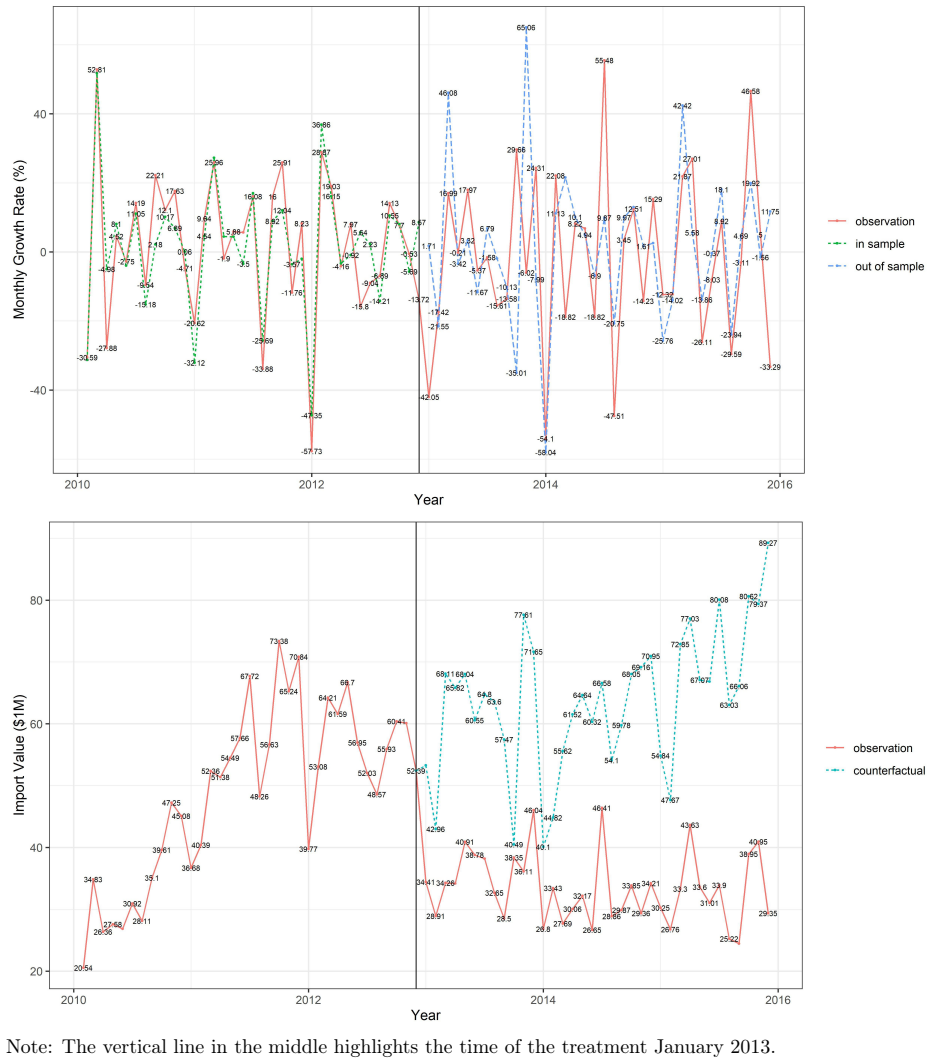
- [Theorem 1 and Section 5.2] The headline asymptotic normality result requires T1^{-1} R^4 log^2 N log^4 T2 → 0. In the empirical application, T1 = 35, T2 = 36, N = 88, and R = 3, so the left-hand side is roughly (81 × 20.1 × 164)/35 ≈ 7600, which is very far from zero. Thus the theoretical guarantee does not cover the paper's own application, and the statement that fsPDA has an 'asymptotic guarantee' in that setting is not supported. The application can of course be read as an illustration, but the discrepancy between the theory and the reported numbers should be acknowledged explicitly.
- [Section 4, modified BIC and choice of R] Theorems 1 and 2 treat R as a deterministic sequence satisfying Assumption 1 and the rate conditions, but the implemented procedure chooses R by the modified BIC with constants that the paper itself describes as 'admittedly ad hoc' (Section 4, equations for R and λ). No theorem shows that the data-driven R satisfies the conditions of Theorem 1 or Theorem 2, so the validity of the procedure as actually run is not established. This is a gap between theory and implementation, not merely a presentation issue, because the selected R directly enters the rate conditions and the restricted eigenvalue assumption.
minor comments (5)
- [Section 1, notation] The notation E^(1)[x_t] is defined twice with different meanings: first as the average of expectations T1^{-1}∑ E[x_t] and then as the sample mean T1^{-1}∑ x_t. These should use distinct symbols, for example E^(1) and ·E^(1), because the proofs rely on the distinction between population and sample quantities.
- [Section 5.1, footnote 7] The footnote says that 7 categories are excluded, but the list contains 8 categories (codes 22, 24, 33, 42, 43, 71, 91, and 97). The arithmetic 95 − 7 = 88 is consistent with the text, but the list is inconsistent with the stated count.
- [Section 3.3, Theorem 2 and Section 2.3] Theorem 2 concerns the pre-treatment sample variance of the selected model, while the quantity relevant for post-treatment prediction is the post-treatment prediction error. The paper's claim that the small σ̂^2 from Theorem 2 'improves the statistical efficiency' of the test is not directly supported unless the pre- and post-treatment covariance structures are linked.
- [Table 1] The header 'No. of Sel. varaibles' contains a typo and should read 'No. of Sel. variables'.
- [Section 4, Remark 4] The modified BIC constants 1 and 2 for forward selection and Lasso are chosen by the authors; the paper should state more clearly that the tuning procedure is heuristic and not covered by the theorems, rather than presenting the simulation comparison as a direct test of the theory.
Circularity Check
No significant circularity: the post-selection inference and forward-selection guarantees are derived from stated regularity conditions and external results, not from the target conclusions.
full rationale
The paper's central claims are (i) Theorem 1 / Corollary 1: after forward selection of at most R control units using pre-treatment data, the usual t-statistic for the ATE is asymptotically standard normal, and (ii) Theorem 2: forward selection achieves, with high probability, a prediction variance no worse than the best u-variable subset up to a small tolerance when R/u tends to infinity. Neither claim reduces to its own input. Control units are selected exclusively from the pre-treatment sample, while the t-statistic is evaluated on post-treatment data; Assumption 4 then makes the two blocks asymptotically independent. No parameter is fit to post-treatment outcomes and then renamed a prediction. Assumption 1 is a high-level restricted eigenvalue condition on population Gram submatrices, and while Remark 2 connects it to Bai (2003)'s factor-model assumption, that is an external regularity justification, not a self-citation or a restatement of the theorem's conclusion. The greedy-progress bound in Lemma A.2 relies on the external submodularity-ratio result of Das and Kempe (2011), and the proof of Theorem 2 explicitly decomposes the sample error from the population greedy progress, using Lemma 1 rather than assuming the target bound. The only self-citations (Shi 2016; Phillips and Shi 2021) appear in the literature review and are not load-bearing. The modified BIC tuning constants in simulations are admittedly ad hoc but affect the number of selected units, not the form of the limiting distribution; they do not smuggle in either theorem. Overall, the derivation is self-contained conditional on the stated high-level assumptions.
Assumptions & free parameters
free parameters (3)
- Number of forward-selected controls R =
3 in the empirical application; 6 to 9 as medians in simulations
- Modified BIC constant for fsPDA =
1
- Modified BIC constant for Lasso =
2
assumptions (6)
- domain assumption Factor model (5) and the induced linear projection representation (3) for the treated unit outcome.
- domain assumption Assumption 1: minimum eigenvalue of the population Gram matrix of any subset of at most floor((1+delta1)R) controls is bounded below by a universal constant.
- domain assumption Assumption 2: uniform convergence of pre-treatment sample second moments to population second moments at rate sqrt(log N / T1), with bounded second moments.
- domain assumption Assumption 3: post-treatment regularity, including uniform convergence of sample means and second moments, bounded fourth moments, and long-run variance bounded away from zero and absolutely summable.
- domain assumption Assumption 4: geometric uniform (phi-)mixing of the underlying factor and idiosyncratic error processes.
- standard math Submodularity ratio bound from Das and Kempe (2011) and the Berry-Esseen bound for alpha-mixing time series from Sunklodas (1984, 2000).
Cite this review
Pith. "Pith review of Forward-Selected Panel Data Approach for Program Evaluation." pith.science (2026). https://pith.science/paper/MIHMNQIO
@misc{pith2026190805894,
  author       = {Pith},
  title        = {Pith review of: Forward-Selected Panel Data Approach for Program Evaluation},
  year         = {2026},
  howpublished = {\url{https://pith.science/paper/MIHMNQIO}},
  note         = {Machine review of arXiv:1908.05894}
}
read the original abstract
Policy evaluation is central to economic data analysis, but economists mostly work with observational data in view of limited opportunities to carry out controlled experiments. In the potential outcome framework, the panel data approach (Hsiao, Ching and Wan, 2012) constructs the counterfactual by exploiting the correlation between cross-sectional units in panel data. The choice of cross-sectional control units, a key step in its implementation, is nevertheless unresolved in data-rich environment when many possible controls are at the researcher's disposal. We propose the forward selection method to choose control units, and establish validity of the post-selection inference. Our asymptotic framework allows the number of possible controls to grow much faster than the time dimension. The easy-to-implement algorithms and their theoretical guarantee extend the panel data approach to big data settings.
Figures


Figures from the paper (1 more)
Reference graph
Works this paper leans on
-
[1]
author Abadie, A. , author Diamond, A. , author Hainmueller, J. , year 2010 . title Synthetic control methods for comparative case studies: Estimating the effect of california?s tobacco control program . journal Journal of the American Statistical Association volume 105
work page 2010
-
[2]
author Abadie, A. , author Gardeazabal, J. , year 2003 . title The economic costs of conflict: A case study of the basque country . journal American Economic Review , pages 113--132
work page 2003
-
[3]
author Andrews, D. , year 1991 . title Heteroskedasticity and autocorrelation consistent covariant matrix estimation . journal Econometrica volume 59 , pages 817--858
work page 1991
-
[4]
author Bai, C. , author Li, Q. , author Ouyang, M. , year 2014 . title Property taxes and home prices: A tale of two cities . journal Journal of Econometrics volume 180 , pages 1--15
work page 2014
-
[5]
, year 2003
author Bai, J. , year 2003 . title Inferential theory for factor models of large dimensions . journal Econometrica volume 71 , pages 135--171
2003
-
[6]
author Bai, J. , author Ng, S. , year 2009 . title Boosting diffusion indices . journal Journal of Applied Econometrics volume 24 , pages 607--629
work page 2009
-
[7]
author Banerjee, A.V. , author Duflo, E. , year 2009 . title The experimental approach to development economics . journal Annual Review of Economics volume 1 , pages 151--178
work page 2009
-
[8]
author Belloni, A. , author Chen, D. , author Chernozhukov, V. , author Hansen, C. , year 2012 . title Sparse models and methods for optimal instruments with an application to eminent domain . journal Econometrica volume 80 , pages 2369--2429
work page 2012
Show all 70 references
-
[9]
, author Chernozhukov, V
author Belloni, A. , author Chernozhukov, V. , author Fern \'a ndez-Val, I. , author Hansen, C. , year 2017 . title Program evaluation and causal inference with high-dimensional data . journal Econometrica volume 85 , pages 233--298
2017
-
[10]
, author Chernozhukov, V
author Belloni, A. , author Chernozhukov, V. , author Kato, K. , year 2014 . title Uniform post-selection inference for least absolute deviation regression and other z-estimation problems . journal Biometrika volume 102 , pages 77--94
2014
-
[11]
, author G \"o tze, F
author Bentkus, V. , author G \"o tze, F. , author Tikhomoirov, A. , year 1997 . title Berry-esseen bounds for statistics of weakly dependent samples . journal Bernoulli volume 3 , pages 329--349
1997
-
[12]
, author Brown, L
author Berk, R. , author Brown, L. , author Buja, A. , author Zhang, K. , author Zhao, L. , year 2013 . title Valid post-selection inference . journal The Annals of Statistics volume 41 , pages 802--837
2013
-
[13]
, author Ritov, Y
author Bickel, P. , author Ritov, Y. , author Tsybakov, A. , year 2009 . title Simultaneous analysis of Lasso and Dantzig selector . journal Annals of statistics volume 37 , pages 1705--1732
2009
-
[14]
, year 2001
author Breiman, L. , year 2001 . title Random forests . journal Machine Learning volume 45 , pages 5--32
2001
-
[15]
, year 2006
author B \"u hlmann, P. , year 2006 . title Boosting for high-dimensional linear models . journal The Annals of Statistics volume 34 , pages 559--583
2006
-
[16]
, author van de Geer, S
author B \"u hlmann, P. , author van de Geer, S. , year 2011 . title Statistics for high-dimensional data: methods, theory and applications . publisher Springer Science & Business Media
2011
-
[17]
, author Masini, R
author Carvalho, C. , author Masini, R. , author Medeiros, M.C. , year 2018 . title Arco: an artificial counterfactual approach for high-dimensional panel time-series data . journal Journal of econometrics volume 207 , pages 352--380
2018
-
[18]
, author Chen, Z
author Chen, J. , author Chen, Z. , year 2008 . title Extended bayesian information criteria for model selection with large model spaces . journal Biometrika volume 95 , pages 759--771
2008
-
[19]
, author Kempe, D
author Das, A. , author Kempe, D. , year 2011 . title Submodular meets spectral: greedy algorithms for subset selection, sparse approximation and dictionary selection , in: booktitle Proceedings of the 28th International Conference on International Conference on Machine Learni...
2011
-
[20]
, author Kempe, D
author Das, A. , author Kempe, D. , year 2018 . title Approximate submodularity and its applications: subset selection, sparse approximation and dictionary selection . journal The Journal of Machine Learning Research volume 19 , pages 74--107
2018
-
[21]
, year 1994
author Davidson, J. , year 1994 . title Stochastic limit theory: An introduction for econometricians . publisher Oxford University Press
1994
-
[22]
, author Fang, H
author Ding, H. , author Fang, H. , author Lin, S. , author Shi, K. , year 2017 . title Equilibrium Consequences of Corruption on Firms: Evidence from China's Anti-Corruption Campaign . type Technical Report . University of Pennsylvania, working Paper
2017
-
[23]
, author Zhang, L
author Du, Z. , author Zhang, L. , year 2015 . title Home-purchase restriction, property tax and housing price in china: A counterfactual analysis . journal Journal of Econometrics volume 188 , pages 558--568
2015
-
[24]
, author Glennerster, R
author Duflo, E. , author Glennerster, R. , author Kremer, M. , year 2007 . title Using randomization in development economics research: A toolkit . journal Handbook of Development Economics volume 4 , pages 3895--3962
2007
-
[25]
, author Hastie, T
author Efron, B. , author Hastie, T. , author Johnstone, I. , author Tibshirani, R. , year 2004 . title Least angle regression . journal The Annals of statistics volume 32 , pages 407--499
2004
-
[26]
, author Li, R
author Fan, J. , author Li, R. , year 2001 . title Variable selection via nonconcave penalized likelihood and its oracle properties . journal Journal of the American Statistical Association volume 96 , pages 1348--1360
2001
-
[27]
, author Sun, D
author Fithian, W. , author Sun, D. , author Taylor, J. , year 2014 . title Optimal inference after model selection . journal arXiv preprint arXiv:1410.2597
2014 arXiv
-
[28]
, author Medeiros, M
author Fonseca, Y. , author Medeiros, M. , author Vasconcelos, G. , author Veiga, A. , year 2018 . title Boost: Boosting smooth trees for partial effect estimation in nonlinear regressions . journal arXiv preprint arXiv:1808.03698
2018 arXiv
-
[29]
, author Hsiao, C
author Fujiki, H. , author Hsiao, C. , year 2015 . title Disentangling the effects of multiple treatments --- measuring the net economic impact of the 1995 great hanshin-awaji earthquake . journal Journal of Econometrics volume 186 , pages 66--73
2015
-
[30]
, author Vega-Bayo, A
author Gardeazabal, J. , author Vega-Bayo, A. , year 2017 . title An empirical comparison between the synthetic control method and hsiao et al.'s panel data approach to program evaluation . journal Journal of Applied Econometrics volume 32 , pages 983--1002
2017
-
[31]
, author Lenza, M
author Giannone, D. , author Lenza, M. , author Primiceri, G.E. , year 2021 . title Economic predictions with big data: The illusion of sparsity . journal Econometrica note (forthcoming)
2021
-
[32]
, author Kozbur, D
author Hansen, C. , author Kozbur, D. , author Misra, S. , year 2018 . title Targeted undersmoothing . type Technical Report . working paper
2018
-
[33]
, author Tibshirani, R
author Hastie, T. , author Tibshirani, R. , author Friedman, J. , year 2009 . title The elements of statistical learning: Data mining, inference, and prediction . publisher Springer-Verlag
2009
-
[34]
, year 2009
author H \"o rmann, S. , year 2009 . title Berry-esseen bounds for econometric time series . journal Latin American Journal of Probability and Mathematical Statistics volume 6 , pages 377--397
2009
-
[35]
, author Ching, S.H
author Hsiao, C. , author Ching, S.H. , author Wan, S.K. , year 2012 . title A panel data approach for program evaluation: measuring the benefits of political and economic integration of hong kong with mainland china . journal Journal of Applied Econometrics volume 27 , pages 705--740
2012
-
[36]
, author Zhou, Q
author Hsiao, C. , author Zhou, Q. , year 2019 . title Panel parametric, semiparametric, and nonparametric construction of counterfactuals . journal Journal of Applied Econometrics volume 34 , pages 463--481
2019
-
[37]
, author Montanari, A
author Javanmard, A. , author Montanari, A. , year 2018 . title Debiasing the lasso: Optimal sample size for gaussian designs . journal The Annals of Statistics volume 46 , pages 2593--2622
2018
-
[38]
, author Shao, Q.M
author Jing, B.Y. , author Shao, Q.M. , author Wang, Q. , year 2003 . title Self-normalized cram \'e r-type large deviations for independent random variables . journal The Annals of Probability volume 31 , pages 2167--2215
2003
-
[39]
, year 2016
author Jirak, M. , year 2016 . title Berry-esseen theorems under weak dependence . journal The Annals of Probability volume 44 , pages 2024--2063
2016
-
[40]
, author Chen, H
author Ke, X. , author Chen, H. , author Hong, Y. , author Hsiao, C. , year 2017 . title Do china's high-speed-rail projects promote local economy? journal China Economic Review volume 44 , pages 203--226
2017
-
[41]
, author Callot, L
author Kock, A.B. , author Callot, L. , year 2015 . title Oracle inequalities for high dimensional vector autoregressions . journal Journal of Econometrics volume 186 , pages 325--344
2015
-
[42]
, author Anderson, H.M
author Koo, B. , author Anderson, H.M. , author Seo, M.H. , author Yao, W. , year 2019 . title High-dimensional predictive regression in the presence of cointegration . journal Journal of Econometrics volume forthcoming
2019
-
[43]
, year 2017
author Kozbur, D. , year 2017 . title Testing-based forward model selection . journal American Economic Review volume 107 , pages 266--69
2017
-
[44]
, year 2018
author Kozbur, D. , year 2018 . title Sharp convergence rates for forward regression in high-dimensional sparse linear models . type Technical Report
2018
-
[45]
, author Li, W
author Lan, X. , author Li, W. , year 2018 . title Swiss watch cycles: Evidence of corruption during leadership transition in china . journal Journal of Comparative Economics volume 46 , pages 1234--1252
2018
-
[46]
, year 2009
author Leeb, H. , year 2009 . title Conditional predictive inference post model selection . journal The Annals of Statistics volume 37 , pages 2838--2876
2009
-
[47]
, author P \"o tscher, B.M
author Leeb, H. , author P \"o tscher, B.M. , year 2005 . title Model selection and inference: Facts and fiction . journal Econometric Theory volume 21 , pages 21--59
2005
-
[48]
, author P \"o tscher, B.M
author Leeb, H. , author P \"o tscher, B.M. , year 2006 . title Can one estimate the conditional distribution of post-model-selection estimators? journal The Annals of Statistics volume 34 , pages 2554--2591
2006
-
[49]
, author Bell, D.R
author Li, K.T. , author Bell, D.R. , year 2017 . title Estimation of average treatment effects with panel data: Asymptotic theory and implementation . journal Journal of Econometrics volume 197 , pages 65--75
2017
-
[50]
, author Morck, R
author Lin, C. , author Morck, R. , author Yeung, B. , author Zhao, X. , year 2016 . title Anti-corruption reforms and shareholder valuations: Event study evidence from China . type Technical Report . National Bureau of Economic Research
2016
-
[51]
, author Spindler, M
author Luo, Y. , author Spindler, M. , year 2016 . title High-dimensional l_2 boosting: Rate of convergence . journal arXiv preprint arXiv:1602.08927
2016 arXiv
-
[52]
, author Mendes, E.F
author Medeiros, M.C. , author Mendes, E.F. , year 2016 . title l1-regularization of high-dimensional time-series models with non-gaussian and heteroskedastic errors . journal Journal of Econometrics volume 191 , pages 255--271
2016
-
[53]
, author West, K.D
author Newey, W.K. , author West, K.D. , year 1987 . title A simple, positive semi-definite, heteroskedasticity and autocorrelation consistent covariance matrix . journal Econometrica , pages 703--708
1987
-
[54]
, author Peng, Y
author Ouyang, M. , author Peng, Y. , year 2015 . title The treatment-effect estimation: A case study of the 2008 economic stimulus package of china . journal Journal of Econometrics volume 188 , pages 545--557
2015
-
[55]
, author Tian, G.G
author Pan, X. , author Tian, G.G. , year 2017 . title Political connections and corporate investments: Evidence from the recent anti-corruption campaign in china . journal Journal of Banking & Finance , pages 105108
2017
-
[56]
, author Shi, Z
author Phillips, P.C. , author Shi, Z. , year 2021 . title Boosting: Why you can use the hp filter . journal International Economic Review note Forthcoming
2021
-
[57]
, year 2016
author Shi, Z. , year 2016 . title Econometric estimation in high-dimensional moment equalities . journal Journal of Econometrics volume 195 , pages 104--119
2016
-
[58]
, year 1984
author Sunklodas, J. , year 1984 . title On the rate of convergence in the central limit theorem for strongly mixing random variables . journal Lithuanian Mathematical Journal volume 24 , pages 182--190
1984
-
[59]
, year 2000
author Sunklodas, J. , year 2000 . title Approximation of distributions of sums of weakly dependent random variables by the normal distribution , in: booktitle Limit Theorems of Probability Theory . publisher Springer , pp. pages 113--165
2000
-
[60]
, year 1996
author Tibshirani, R. , year 1996 . title Regression shrinkage and selection via the lasso . journal Journal of the Royal Statistical Society. Series B (Methodological) volume 58 , pages 267--288
1996
-
[61]
, author Rinaldo, A
author Tibshirani, R.J. , author Rinaldo, A. , author Tibshirani, R. , author Wasserman, L. , year 2018 . title Uniform asymptotic inference and the bootstrap after model selection . journal Annals of Statistics volume 46 , pages 1255--1287
2018
-
[62]
, author Athey, S
author Wager, S. , author Athey, S. , year 2018 . title Estimation and inference of heterogeneous treatment effects using random forests . journal Journal of the American Statistical Association volume 113 , pages 1228--1242
2018
-
[63]
, author Xie, Y
author Wan, S.K. , author Xie, Y. , author Hsiao, C. , year 2018 . title Panel data approach vs synthetic control method . journal Economics Letters volume 164 , pages 121--123
2018
-
[64]
, year 2009
author Wang, H. , year 2009 . title Forward regression for ultra-high dimensional variable screening . journal Journal of the American Statistical Association volume 104 , pages 1512--1524
2009
-
[65]
, author Li, B
author Wang, H. , author Li, B. , author Leng, C. , year 2009 . title Shrinkage tuning parameter selection with a diverging number of parameters . journal Journal of the Royal Statistical Society: Series B (Statistical Methodology) volume 71 , pages 671--683
2009
-
[66]
, author Yano, G
author Xu, G. , author Yano, G. , year 2016 . title How does anti-corruption affect corporate innovation? evidence from recent anti-corruption efforts in china . journal Journal of Comparative Economics volume 45 , pages 498--519
2016
-
[67]
, author Huang, J
author Zhang, C.H. , author Huang, J. , year 2008 . title The sparsity and bias of the lasso selection in high-dimensional linear regression . journal The Annals of Statistics volume 36 , pages 1567--1594
2008
-
[68]
, author Duan, S
author Zhong, W. , author Duan, S. , author Zhu, L. , year 2020 . title Forward additive regression for ultrahigh-dimensional nonparametric additive models . journal Statistica Sinica volume 30 , pages 175--192
2020
-
[69]
, author Zhu, L
author Zhou, T. , author Zhu, L. , author Xu, C. , author Li, R. , year 2020 . title Model-free forward screening via cumulative divergence . journal Journal of the American Statistical Association volume 115 , pages 1393--1405
2020
-
[70]
, year 2006
author Zou, H. , year 2006 . title The adaptive L asso and its oracle properties . journal Journal of the American Statistical Association volume 101 , pages 1418--1429
2006
Reviewed August 14, 2026 · model on record in the stance chip above.
Discussion (0). Continue with ORCID to comment.