REVIEW 4 major objections 6 minor 39 references
Evolution of cooperation in networks with well-connected cooperators
T0 review · 4 major / 6 minor · reviewed 2026-08-14 · deepseek-v4-flash
Pith's one-line read Degree-assorted Poisson networks keep cooperation alive at every temptation level when cooperators occupy the hubs.
desk verdict A well-specified simulation study with a real and interesting reversal—degree-assorted Poisson networks can keep cooperation high when cooperators occupy hubs—but the persistence claim needs stationarity checks before it is fully load-bearing. read the letter →
The pith
A machine-rendered reading of the paper's core claim, the machinery that carries it, and where it could break.
The reading
What carries the argument
The mechanism that carries the argument is the combination of degree-assorted network topology and a single strategy-update rule: synchronous proportional imitation, where a node copies a neighbour's strategy with probability proportional to the fitness difference divided by the larger of the two degrees (Eq. 3). Degree assortativity is created by a rewiring algorithm that repeatedly reconnects nodes of similar degree, producing clusters of degree-similar nodes connected by bridge areas. With perfect cooperation-degree correlation, cooperators sit in the high-degree clusters, and the bridges between clusters are the points where defectors' spread is held back. The fitness inequality behind this appears in Appendix A: in the Prisoner's Dilemma, a cooperator with $d$ neighbours of whom $n$ cooperate has higher fitness than a defector with $n'$ cooperator neighbours only if $n > b n'$, so a defector needs many cooperator neighbours to outcompete a cooperator. This makes the bridge nodes, which have few cooperator neighbours, poor places for defection to cross.
What would settle it
Run the same simulations on degree-assorted Poisson networks with perfect cooperator-degree correlation but asynchronous updating or a Fermi update rule, and check whether the average final cooperator fraction at $b=2$ drops below the paper's roughly 20 percent level; if it does, the barrier effect is an artefact of the specific update rule rather than a property of degree-assorted structure.
Extended reading notes
Core claim
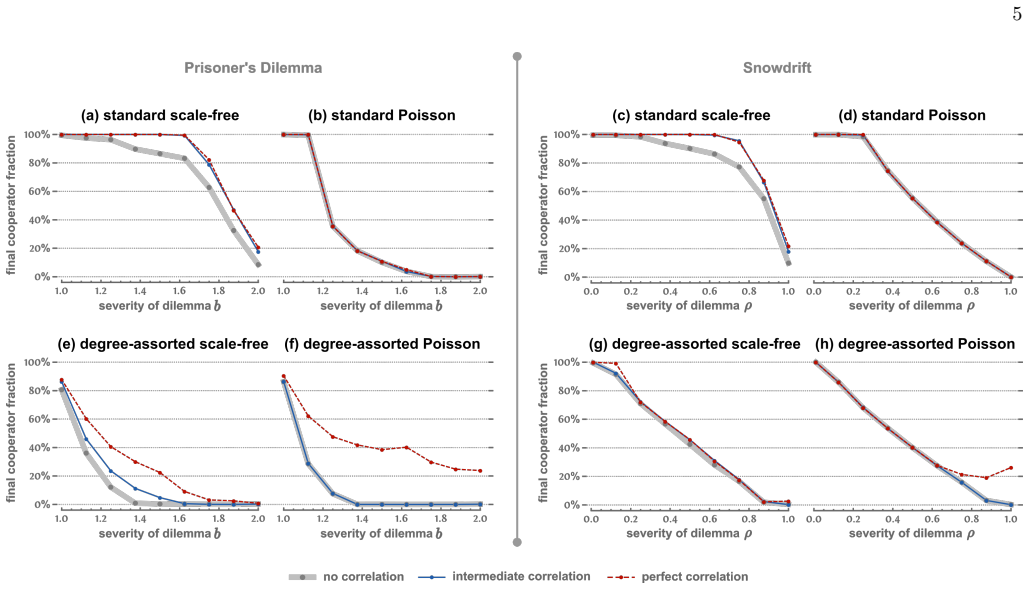
The paper's central claim is that correlation between cooperativeness and node degree is a real evolutionary force, but only when the network's wiring lets that correlation translate into protected clusters. In standard networks, placing cooperators on high-degree nodes helps only in scale-free networks, where hubs can act as strong role models; in standard Poisson networks, the degree advantage of cooperators is too small to change final outcomes. In networks with increased degree assortativity, however, nodes of similar degree are connected to each other, and when cooperators deterministically occupy all high-degree nodes, the bridge areas between clusters become barriers that stop the defector strategy from spreading from one cluster to the next. The dynamics show defectors rapidly taking over a cluster, then stalling at the bridges, which leaves high final cooperator fractions and produces a characteristic step-like rise in the average degree of defectors. The same mechanism explains the fragility under intermediate correlation: stochastic placement seeds a few defectors inside cooperator clusters, and these Trojan horses let defection start from within, bypassing the barriers.
Load-bearing premise
The load-bearing assumption is that individuals update strategies synchronously by proportional imitation with normalization by the larger degree; the claimed barrier effect may not survive other common update rules, which the paper does not test.
Editorial extensions
If this is right
- In degree-assorted Poisson networks with perfect cooperator-degree correlation, average final cooperation stays above roughly 20 percent for every temptation parameter $b>1$ in the Prisoner's Dilemma, and can exceed cooperation in scale-free networks.
- Stochastic (intermediate) correlation between cooperativeness and degree removes most of this benefit when degree assortativity is high, because the few defectors seeded inside cooperator clusters act as Trojan horses.
- The apparent rule that higher degree heterogeneity promotes cooperation is not universal; under degree assortativity and perfect correlation, Poisson (low-heterogeneity) networks can outperform scale-free ones.
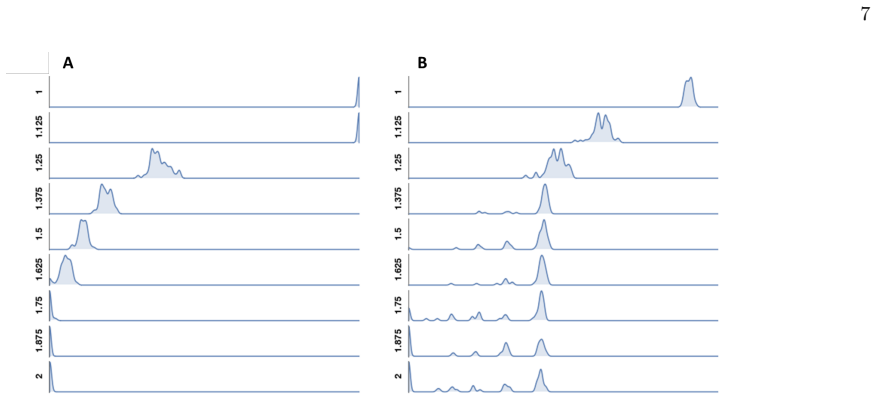
- The bridge-barrier dynamics produce multi-peaked distributions of final cooperator fractions and stepwise increases in defector average degree, giving signature statistics that can be checked in runs or experiments.
- The results are relevant to the design of network cooperation experiments, since initial random placement of cooperators can create chance correlations with degree that materially shift outcomes in degree-assorted networks.
Reading between the lines
- A natural test: replacing synchronous updating with asynchronous proportional imitation may weaken the bridge barriers, because a single defector at a bridge node could be copied before the cluster-wide fitness advantage reasserts itself; the paper reports results only for synchronous updating.
- The Trojan-horse vulnerability suggests a sharper prediction than the paper states explicitly: deliberately placing one or two defectors on bridge nodes rather than randomly inside a cluster should collapse the barrier almost immediately, whereas the same number placed elsewhere would barely matter.
- The same mechanism might be exploited in network design: if a planner controls initial placement, assigning cooperative individuals to the highest-degree nodes in an assortative network is a cheap way to keep cooperation alive, but only if no defectors are seeded inside the cooperator clusters.
- Because real animal and human networks show both degree assortativity and long-term structural stability, a relevant empirical check is to measure whether cooperative individuals in real populations actually sit on higher-degree nodes; if they do, the model predicts bridge positions should show distinctive strategy-transition dynamics.
Signed reviews
Editorial analysis
A structured set of objections, weighed in public.
Referee Report
Summary. This paper uses agent-based simulation to study how the initial correlation between an individual's propensity to cooperate and its network degree affects the evolution of cooperation in the Prisoner's Dilemma and Snowdrift games. The authors consider standard Erdős-Rényi (Poisson) and Barabási-Albert (scale-free) networks, as well as degree-assorted versions generated with the Xulvi-Brunet-Sokolov algorithm, and three levels of strategy-degree correlation: none, intermediate (stochastic by degree), and perfect (deterministic assignment of cooperators to the highest-degree nodes). The main finding is that in degree-assorted Poisson networks with perfect strategy-degree correlation, cooperation persists at levels above about 20% for all b>1 in the Prisoner's Dilemma, and can even exceed the cooperation levels of scale-free networks, because bridge areas between clusters of similar degree act as barriers to the spread of defection. This effect is absent under intermediate correlation, which the authors attribute to 'Trojan horses,' i.e., defectors placed within cooperator clusters.
Significance. If the main result is robust, it challenges the common view that scale-free degree heterogeneity is always the most effective network property for promoting cooperation and highlights a novel mechanism—strategy-position correlations interacting with degree assortativity—that could be relevant for interpreting experiments and real-world social networks. The paper is strong in its clarity: the model is standard and precisely specified (Sections II and V), the assignment procedures are explicit, and the simulation protocol is conventional. The authors also provide a useful analytical condition (Eq. 6) for when a cooperator outperforms a defector. However, the central claim about persistence of cooperation rests on a finite simulation horizon without a stationarity check, the main quantitative results lack error bars or statistical tests, and the proposed bridge-barrier mechanism is supported only by qualitative evidence. These are significant limitations that should be addressed before the results can be accepted as stated.
major comments (4)
- [Sections II.D and V.A; Figs. 2f, 4, 5] The central persistence claim, that degree-assorted Poisson networks with perfect strategy-degree correlation maintain cooperation above about 20% for all b>1, is measured at tmax=10^4 by averaging the cooperator fraction over the last 100 timesteps, but no stationarity check is reported. The paper's own diagnostics indicate that the system is still evolving: Fig. 4 shows final cooperator fractions clustered in distinct peaks corresponding to defector invasions stopped at different bridges, and Fig. 5 shows the average defector degree increasing in rapid steps separated by long periods of no change. The text in Section IV states that a defector cluster 'might eventually overcome' a bridge. This suggests that the barriers may delay, rather than prevent, the spread of defection, and that the reported plateau above 20% could erode if the simulation were run longer. Please provide a stationarity test (e.g., longer runs, or a quantitative analysis of waiting times at bridges) or demonstrate that the remaining bridges are stable indefinitely.
- [Fig. 2 and Section III] The main quantitative claims—that strategy-degree correlation has no effect in standard Poisson networks, that perfect correlation gives a large enhancement in degree-assorted Poisson networks, and that cooperation in assorted Poisson networks can exceed that in scale-free networks—are based on mean final cooperator fractions over 50 replicates plotted without error bars, confidence intervals, or significance tests. Given that Fig. 4 shows strongly multimodal distributions of final fractions, mean values may not be representative, and differences between curves could be driven by rare replicates. The authors should report a measure of variability (e.g., error bars, interquartile ranges, or bootstrap confidence intervals) and perform appropriate statistical comparisons to support these comparisons.
- [Figs. 3-5 and Section IV] The bridge-barrier mechanism is inferred from a single illustrative simulation run (Fig. 3) and from aggregate patterns (Figs. 4 and 5), but no quantitative evidence is provided that bridge areas actually slow or stop the spread of defection. For example, the authors could measure the time spent by the defector front at bridges, compare invasion speeds in assorted versus non-assorted networks, or test the fitness condition in Eq. (6) for nodes located at bridges. Without such quantitative analysis, the mechanism remains a post hoc interpretation rather than a demonstrated cause of the observed enhancement.
- [Section V.A, Eq. (3)] All simulations use a single strategy-update rule: synchronous proportional imitation with the specific normalization in Eq. (3). This rule is known to interact strongly with degree heterogeneity, and it is plausible that the reported enhancement, especially the strong effect in degree-assorted Poisson networks, is specific to this update dynamics. To support the broad conclusion that correlations between cooperativeness and social connectedness affect the evolution of cooperation, the authors should test at least one alternative update rule (e.g., asynchronous updating, the Fermi rule, or birth-death dynamics) and show that the central results are robust.
minor comments (6)
- [Section V.C] The capitalization in 'We use the following strategy assignment procedures' should be lowercase 'we' to be consistent with the surrounding text style.
- [Fig. 2] The three curves in each panel are distinguished only by a legend; consider using different line styles or markers as well, so that the figure is readable in grayscale print.
- [Fig. 4] The distributions in Fig. 4 combine final fractions for all game parameter values into one histogram; separating panels by b or rho would be more informative, since the distinct peaks likely correspond to different parameter regimes.
- [Appendix A, Eq. (7)] The sentence 'The inequality is always fulfilled for d = n'(1+rho)/(1-rho)' is confusing because the condition is stated as an equality; clarify that the inequality holds when d exceeds this threshold value.
- [Reference [32]] Reference [32] is a note rather than a citation; it should be moved into the main text or a footnote.
- [Section II.D] Please clarify whether the 50 replications for each setting use independent network realizations or the same network with different initial strategy assignments, as this affects the interpretation of the variability.
Circularity Check
No significant circularity: simulation results are generated forward from stated update rule and initial conditions; the bridge-barrier account is a post hoc interpretation, not an input-dependent derivation.
full rationale
The paper's claims are obtained by forward agent-based simulation with a fixed update rule (Eq. 3), fixed payoff matrices, standard network generators and an external rewiring algorithm [31]. No free parameter is fitted to a target cooperation curve; the outcome variable (mean final cooperator fraction over the last 100 of 10^4 timesteps) is measured, not derived from the inputs by construction. The random, stochastic-by-degree, and deterministic-by-degree initial assignments are experimental manipulations, not fitted quantities. The bridge-barrier mechanism is extracted from the same simulation output (Figs. 3-5), so it is an interpretation rather than an independent verification, but this does not make the derivation circular: the explanation does not define the outcome, and the outcome does not presuppose the explanation. The only self-citation ([33], a giraffe social-network stability study) is peripheral support for the static-network assumption and is not load-bearing for the central cooperation results. No uniqueness theorem, ansatz, or fitted parameter is smuggled in. Concerns about stationarity at tmax=10^4 affect the robustness of the claimed effect, not its circularity. Therefore no specific circular step can be exhibited.
Assumptions & free parameters
assumptions (4)
- domain assumption The synchronous proportional imitation update rule (Eq. 3) with normalization by max degree and D captures realistic strategy evolution.
- domain assumption The Xulvi-Brunet-Sokolov rewiring with p=1 and k=10L log L iterations produces degree-assorted networks whose bridge areas are representative of increased degree assortativity.
- domain assumption Final cooperator fractions after 10^4 timesteps (average of last 100 over 50 replications) represent long-term evolutionary outcomes.
- domain assumption Static networks, with link structure fixed during strategy evolution, approximate the relevant real-world social systems.
Cite this review
Pith. "Pith review of Evolution of cooperation in networks with well-connected cooperators." pith.science (2026). https://pith.science/paper/2Q3FQFBE
@misc{pith2026190805923,
  author       = {Pith},
  title        = {Pith review of: Evolution of cooperation in networks with well-connected cooperators},
  year         = {2026},
  howpublished = {\url{https://pith.science/paper/2Q3FQFBE}},
  note         = {Machine review of arXiv:1908.05923}
}
read the original abstract
Cooperative behavior constitutes a key aspect of human society and non-human animal systems, but explaining how cooperation evolves represents a major scientific challenge. It is now well established that social network structure plays a central role for the viability of cooperation. However, not much is known about the importance of the positions of cooperators in the networks for the evolution of cooperation. Here, we investigate how the spread of cooperation is affected by correlations between cooperativeness and individual social connectedness (such that cooperators occupy well-connected network positions). Using simulation models, we find that these correlations enhance cooperation in standard scale-free networks but not in standard Poisson networks. In contrast, when degree assortativity is increased such that individuals cluster with others of similar social connectedness, we find that Poisson networks can maintain high levels of cooperation, which can even exceed those of scale-free networks. We show that this is due to dynamics where bridge areas between social clusters act as barriers to the spread of defection. We also find that this positive effect on cooperation is sensitive to the presence of Trojan horses (defectors placed within cooperator clusters), which allow defection to invade. The results provide new knowledge about the conditions under which cooperation may evolve, and are also relevant to consider in regard to the design of cooperation studies.
Figures


Figures from the paper (2 more)

Reference graph
Works this paper leans on
-
[20]
Xiaojie Chen, Feng Fu, and Long Wang, “Influence of different initial distributions on robust cooperation in scale-free networks: A comparative study,” Physics Let- ters A 372, 1161–1167 (2008)
work page 2008
-
[18]
Roles of mixing patterns in cooperation on a scale-free networked game,
Zhihai Rong, Xiang Li, and Xiaofan Wang, “Roles of mixing patterns in cooperation on a scale-free networked game,” Phys. Rev. E 76, 027101 (2007)
work page 2007
-
[1]
Gerald G Carter and Gerald S Wilkinson, “Food shar- ing in vampire bats: reciprocal help predicts donations more than relatedness or harassment,” Proceedings of the Royal Society B: Biological Sciences 280, 20122573 (2013)
work page 2013
-
[2]
Generalized reci- procity in rats,
Claudia Rutte and Michael Taborsky, “Generalized reci- procity in rats,” PLoS biology 5, e196 (2007)
work page 2007
-
[3]
Tit for tat in sticklebacks and the evolution of cooperation,
Manfred Milinski, “Tit for tat in sticklebacks and the evolution of cooperation,” Nature 325, 433 (1987)
work page 1987
-
[4]
Bernhard Voelkl, Steven J Portugal, Markus Uns¨ old, James R Usherwood, Alan M Wilson, and Johannes 10 Fritz, “Matching times of leading and following sug- gest cooperation through direct reciprocity during v- formation flight in ibis,” Proceedings of the National Academy of Sciences 112, 2115–2120 (2015)
work page 2015
-
[5]
Kin selection and social insects,
David C Queller and Joan E Strassmann, “Kin selection and social insects,” Bioscience 48, 165–175 (1998)
work page 1998
-
[6]
Prisoner’s dilemma in an rna virus,
Paul E. Turner and Lin Chao, “Prisoner’s dilemma in an rna virus,” Nature 398, 441 (1999)
work page 1999
Show all 39 references
-
[7]
How did cooperative behavior evolve?
Elizabeth Pennisi, “How did cooperative behavior evolve?” Science 309, 93–93 (2005)
2005
-
[8]
Evolutionary games and spatial chaos,
Martin A. Nowak and Robert M. May, “Evolutionary games and spatial chaos,” Nature 359, 826 (1992)
1992
-
[9]
Scale-free networks provide a unifying framework for the emergence of coop- eration,
F. C. Santos and J. M. Pacheco, “Scale-free networks provide a unifying framework for the emergence of coop- eration,” Phys. Rev. Lett. 95, 098104 (2005)
2005
-
[10]
Evolutionary dynamics of social dilemmas in structured heterogeneous populations,
Francisco C Santos, Jorge M Pacheco, and Tom Lenaerts, “Evolutionary dynamics of social dilemmas in structured heterogeneous populations,” Proceedings of the National Academy of Sciences 103, 3490–3494 (2006)
2006
-
[11]
A simple rule for the evolution of cooperation on graphs and social networks,
Hisashi Ohtsuki, Christoph Hauert, Erez Lieberman, and Martin A Nowak, “A simple rule for the evolution of cooperation on graphs and social networks,” Nature 441, 502 (2006)
2006
-
[12]
Enhancement of cooperation in highly clus- tered scale-free networks,
Salvatore Assenza, Jes´ us G´ omez-Garde˜ nes, and Vito Latora, “Enhancement of cooperation in highly clus- tered scale-free networks,” Physical Review E 78, 017101 (2008)
2008
-
[13]
Jens Krause, Richard James, Daniel W Franks, and Dar- ren P Croft, Animal social networks (Oxford University Press, USA, 2015)
2015
-
[14]
Evolutionary games on graphs,
Gy¨ orgy Szab´ o and G´ abor F´ ath, “Evolutionary games on graphs,” Physics Reports 446, 97 – 216 (2007)
2007
-
[15]
Evolutionary game theory: Temporal and spatial effects beyond replicator dynamics,
Carlos P. Roca, Jos´ e A. Cuesta, and Angel S´ anchez, “Evolutionary game theory: Temporal and spatial effects beyond replicator dynamics,” Physics of Life Reviews 6, 208 – 249 (2009)
2009
-
[16]
A new route to the evolution of cooperation,
Francisco C Santos and Jorge M Pacheco, “A new route to the evolution of cooperation,” Journal of evolutionary biology 19, 726–733 (2006)
2006
-
[17]
The role of diversity in the evolu- tion of cooperation,
Francisco C Santos, Flavio L Pinheiro, Tom Lenaerts, and Jorge M Pacheco, “The role of diversity in the evolu- tion of cooperation,” Journal of theoretical biology 299, 88–96 (2012)
2012
-
[19]
Social structure of primate interaction networks facilitates the emergence of cooperation,
Bernhard Voelkl and Claudia Kasper, “Social structure of primate interaction networks facilitates the emergence of cooperation,” Biology Letters 5, 462–464 (2009)
2009
-
[21]
Coordination and cooperation in lo- cal, random and small world networks: Experimental evidence,
Alessandra Cassar, “Coordination and cooperation in lo- cal, random and small world networks: Experimental evidence,” Games and Economic Behavior 58, 209–230 (2007)
2007
-
[22]
Social experiments in the mesoscale: Humans playing a spatial prisoner’s dilemma,
Jelena Gruji´ c, Constanza Fosco, Lourdes Araujo, Jos´ e A Cuesta, and Angel S´ anchez, “Social experiments in the mesoscale: Humans playing a spatial prisoner’s dilemma,” PloS one 5, e13749 (2010)
2010
-
[23]
Heterogeneous networks do not promote cooperation when humans play a prisoner’s dilemma,
Carlos Gracia-L´ azaro, Alfredo Ferrer, Gonzalo Ruiz, Al- fonso Taranc´ on, Jos´ e A Cuesta, Angel S´ anchez, and Yamir Moreno, “Heterogeneous networks do not promote cooperation when humans play a prisoner’s dilemma,” Proceedings of the National Academy of Sciences 109, 12922...
2012
-
[24]
Static network structure can sta- bilize human cooperation,
David G Rand, Martin A Nowak, James H Fowler, and Nicholas A Christakis, “Static network structure can sta- bilize human cooperation,” Proceedings of the National Academy of Sciences 111, 17093–17098 (2014)
2014
-
[25]
The logic of an- imal conflict,
J Maynard Smith and George R Price, “The logic of an- imal conflict,” Nature 246, 15 (1973)
1973
-
[26]
John Maynard Smith, Evolution and the Theory of Games (Cambridge University Press, Cambridge, England, 1982)
1982
-
[27]
Assortative mixing in networks,
Mark EJ Newman, “Assortative mixing in networks,” Physical review letters 89, 208701 (2002)
2002
-
[28]
Spatial struc- ture often inhibits the evolution of cooperation in the snowdrift game,
Christoph Hauert and Michael Doebeli, “Spatial struc- ture often inhibits the evolution of cooperation in the snowdrift game,” Nature 428, 643 (2004)
2004
-
[29]
On the evolution of ran- dom graphs,
Paul Erd˝ os and Alfr´ ed R´ enyi, “On the evolution of ran- dom graphs,” Publ. Math. Inst. Hung. Acad. Sci 5, 17–60 (1960)
1960
-
[30]
Emergence of scaling in random networks,
Albert-L´ aszl´ o Barab´ asi and R´ eka Albert, “Emergence of scaling in random networks,” Science 286, 509–512 (1999)
1999
-
[31]
Reshuffling scale- free networks: From random to assortative,
R. Xulvi-Brunet and I. M. Sokolov, “Reshuffling scale- free networks: From random to assortative,” Phys. Rev. E 70, 066102 (2004)
2004
-
[32]
Note that this is reminiscent of probability-proportional- to-degree sampling without replacement
-
[33]
Seasonal variation and stability across years in a social network of wild giraffe,
Steffen G Prehn, Barbara E Laesser, Cecilie G Clausen, Kristina Jønck, Torben Dabelsteen, and Josefine B Brask, “Seasonal variation and stability across years in a social network of wild giraffe,” Animal Behaviour 157, 95–104 (2019)
2019
-
[34]
The influence of demographic varia- tion on social network stability in wild vervet monkeys,
Christele Borgeaud, Sebastian Sosa, Cedric Sueur, and Redouan Bshary, “The influence of demographic varia- tion on social network stability in wild vervet monkeys,” Animal behaviour 134, 155–165 (2017)
2017
-
[35]
Bats are able to maintain long-term social relationships despite the high fission–fusion dynamics of their groups,
Gerald Kerth, Nicolas Perony, and Frank Schweitzer, “Bats are able to maintain long-term social relationships despite the high fission–fusion dynamics of their groups,” Proceedings of the Royal Society B: Biological Sciences 278, 2761–2767 (2011)
2011
-
[36]
The response of a sleepy lizard social network to al- tered ecological conditions,
Stephanie S Godfrey, Andrew Sih, and C Michael Bull, “The response of a sleepy lizard social network to al- tered ecological conditions,” Animal Behaviour 86, 763– 772 (2013)
2013
-
[37]
Cooper- ation, social networks, and the emergence of leadership in a prisoner’s dilemma with adaptive local interactions,
Mart´ ın G Zimmermann and V´ ıctor M Egu´ ıluz, “Cooper- ation, social networks, and the emergence of leadership in a prisoner’s dilemma with adaptive local interactions,” Physical Review E 72, 056118 (2005)
2005
-
[38]
Cooperation prevails when individuals adjust their social ties,
Francisco C Santos, Jorge M Pacheco, and Tom Lenaerts, “Cooperation prevails when individuals adjust their social ties,” PLoS computational biology 2, e140 (2006)
2006
-
[39]
Josef Hofbauer and Karl Sigmund, Evolutionary games and population dynamics (Cam- bridge university press, 1998). 11 VII. APPENDIX A: NEIGHBOURHOODS AND FITNESS Consider a cooperator node of degree d with n cooperator neighbours and a defector node of degree d′ with n′ coopera...
1998
Reviewed August 14, 2026 · model on record in the stance chip above.
Discussion (0). Continue with ORCID to comment.