REVIEW 4 major objections 4 minor 49 references
Homophily on social networks changes evolutionary advantage in competitive information diffusion
T0 review · 4 major / 4 minor · reviewed 2026-08-14 · deepseek-v4-flash
Pith's one-line read In a competitive SIS model of information diffusion, homophily-induced echo chambers reverse which information wins, but only when the initially losing information has the stronger transmission rate; a leader that merely holds population…
desk verdict Simulation-based reversal result is genuinely new, but the 'only when' necessary condition is overclaimed and the symmetric-recovery assumption is unjustified. read the letter →
The pith
A machine-rendered reading of the paper's core claim, the machinery that carries it, and where it could break.
The reading
What carries the argument
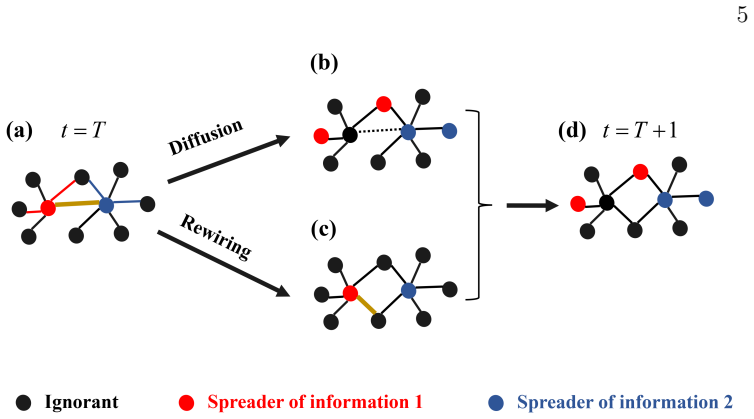
The central object is the joint probability distribution $f_t(A, x)$ over the network adjacency matrix and the node-state vector, evolved by the coupled equation (12) that sums, over all system states, the product of a state-transition probability and a rewiring probability. The load-bearing factor is the rewiring transition probability $p_{A\to B}$ of Eq. (11), which encodes homophily: surviving $S_1$-$S_2$ links keep probability $(1-p)^{L^*}$, while each broken link rewires from an $S_1$ endpoint with probability $p/(2(I+S_1))$ or from an $S_2$ endpoint with probability $p/(2(I+S_2))$. This factor is what turns homophily into echo-chamber formation and ultimately into the reversal condition; the microscopic Markov-chain equations (1)-(4) supply the $p=0$ baseline phase diagram against which reversals are defined.
What would settle it
Run a systematic sweep of transmission rates $\lambda_1$, $\lambda_2$, forgetting rate $\mu$, preference $\alpha$, and rewiring probability $p$, searching for a combination in which the initially winning information has the higher transmission rate yet the final sign of $S_1 - S_2$ flips as $p$ increases. The paper's own checks in Fig. 7(d)-(f) and Appendix A found no such case; a single counterexample would settle the claim.
Extended reading notes
Core claim
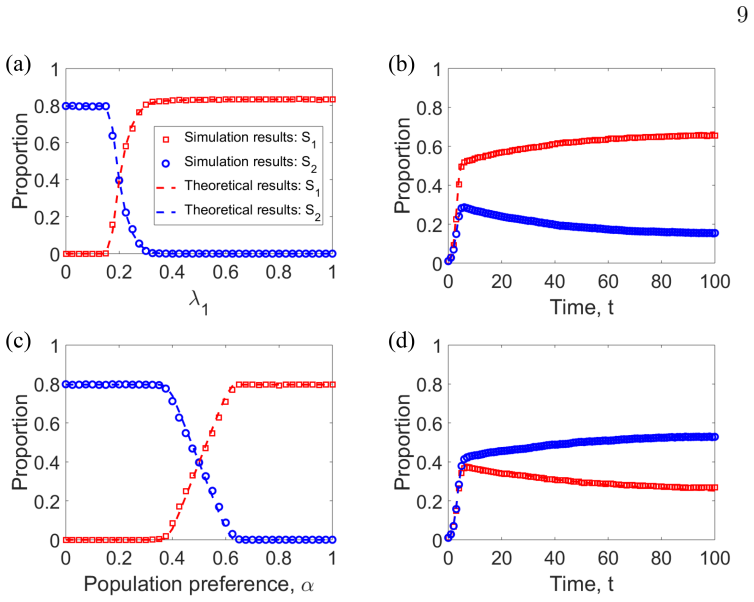
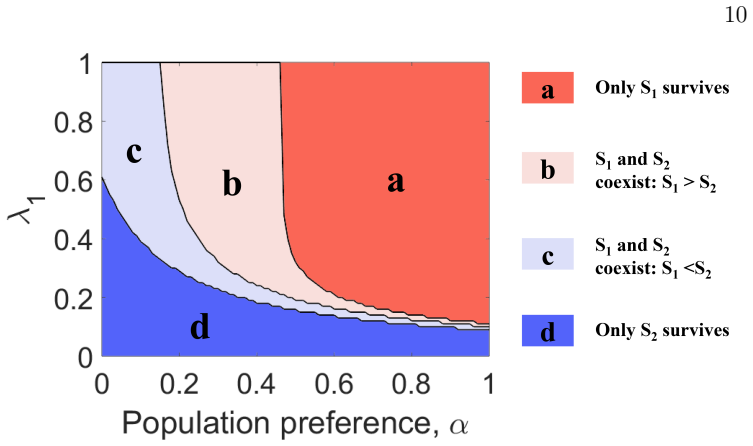
On the paper's own terms, the discovery is a necessary condition for homophily to reverse a competitive diffusion outcome. Two exclusive pieces of information spread on an undirected network: a spreader of information 1 transmits with probability $\lambda_1$, a spreader of information 2 with probability $\lambda_2$, an ignorant who receives both simultaneously picks information 1 with probability $\alpha$, and each link between $S_1$ and $S_2$ rewires with probability $p$ toward like-minded or ignorant nodes. Without rewiring, the Markov-chain equations (1)-(4) reproduce a four-region phase diagram where the final sign of $S_1 - S_2$ is set by the balance of transmission rates and population preference. With rewiring, homophily first strengthens the leader's edge and then, as echo chambers form, protects the disadvantaged information from extinction. Across the paper's simulations, the sign of $S_1 - S_2$ flips only when the initial loser has the higher transmission probability and the initial winner holds only a population preference; when the winner is also the faster spreader, no tested combination produces a reversal.
Load-bearing premise
The central claim rests on two premises: the 'reversal only for the faster-spreading underdog' condition is inferred from a finite set of simulations over chosen parameter combinations rather than proved, and the rewiring probability in Eq. (11) ignores multiple edges and loops, which becomes questionable at $p = 1$ where correlated echo-chamber clusters form; if either premise fails, the reversal condition as stated could collapse.
Editorial extensions
If this is right
- An initially unpopular piece of information can beat a preferred rival when it spreads faster, because strong homophily shields it from extinction while its higher transmission rate keeps invading the newly formed like-minded clusters.
- Weak homophily amplifies the leader's advantage, while strong homophily erodes it, so the same rewiring mechanism works for or against the majority depending on the rewiring strength $p$.
- The range of transmission rates over which the slower information survives widens as $p$ grows, meaning stronger echo-chamber formation keeps both pieces of information alive instead of letting one go extinct.
- For anyone designing a competing strategy, the model says to invest in transmission ability over population preference, since only diffusion advantage can be converted into a full reversal.
Reading between the lines
- The 'only when' condition rests on a finite set of simulations over chosen parameters, so a natural test is whether it survives on degree-heterogeneous networks such as scale-free topologies, or with degree-dependent rewiring, where echo-chamber clusters form differently.
- If the asymmetry generalizes, it offers an empirical handle on real online debates: under strong homophily, content with a higher resharing rate should prevail even when initially unpopular, while initially popular but slowly spreading content should erode over time.
- Because the model keeps transmission rates fixed, an extension that lets them adapt to local cluster density could reveal whether echo chambers make the faster information unbeatable or fragment the network enough to preserve coexistence.
Signed reviews
Editorial analysis
A structured set of objections, weighed in public.
Referee Report
Summary. The paper studies competitive diffusion of two mutually exclusive pieces of information on a social network, modeled by a modified SIS process with a generalized population-preference parameter α and a homophily-induced rewiring mechanism. The authors derive microscopic Markov-chain equations for the no-rewiring case (Eqs. (1)–(4)), present a phase diagram for the joint effect of diffusion advantage and population preference, and then use simulations to show that rewiring-based homophily creates echo chambers, protects disadvantaged information from extinction, and can even reverse the final winner. Their headline claim, stated in the abstract and in Section 4.2, is that such reversals happen only when the initially disadvantaged information has a stronger transmission rate λ while the initially winning information has only a population-preference advantage. The evidence for this necessary condition consists of the parameter sweeps in Fig. 7 and the complementary cases in Appendix A.
Significance. If the reversal condition is correct, it is a useful and non-obvious design principle for competitive information campaigns: diffusion speed, not population preference, is what makes a disadvantaged message capable of overturning an initial advantage under homophily. The paper also contributes a clear extension of the competitive SIS model to include both population preference and adaptive rewiring, and the no-rewiring phase diagram in Fig. 3 is a valuable reference result. The authors report agreement between the Markov-chain theory and simulations in the p=0 case, and they carefully visualize the emergence of echo-chamber structures. However, the central 'only when' claim is a universal statement over the model's parameter space, and the evidence provided is a finite set of simulation sweeps without error bars or an analytical derivation. The claim is therefore not yet established at the level of rigor the paper's abstract and conclusions assert.
major comments (4)
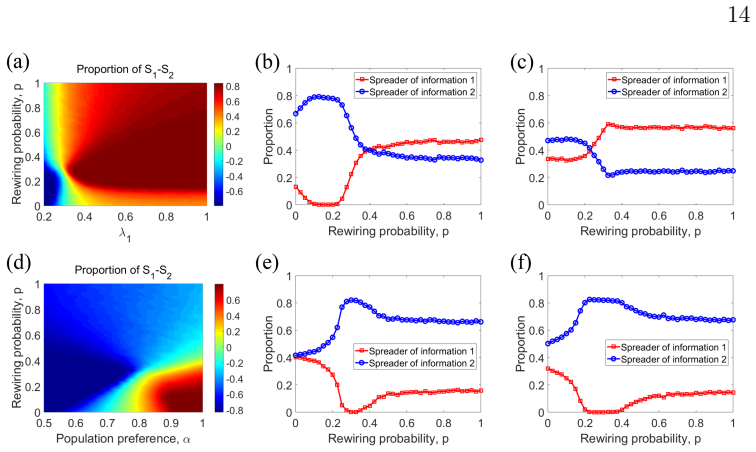
- [Section 4.2, Fig. 7 and Appendix A] The necessary condition 'reversals may happen only when the initially disadvantaged information has stronger transmission ability' is a universal claim over the model's parameter space, but it is supported only by a small set of simulations. Figure 7(a) shows reversal in the narrow interval λ1∈[0.227,0.33] for one fixed choice (λ2=0.2, μ=0.2, α=0.3), while the no-reversal side rests on Fig. 7(d)–(f) and just three Appendix A cases (two with μ=0.2 and one with μ=0.1). No exhaustive sweep, no analytical argument, and no error bars are provided. To support a necessary condition, the authors should either derive the condition analytically or perform a systematic scan over the full parameter ranges of λ1, λ2, μ, α, and p, with statistical confidence intervals.
- [Section 4, paragraph 1] The statement 'without loss of generality, we set μ1=μ2=μ' is not justified and is load-bearing for the central claim. In a competitive SIS model the effective persistence of an information is set by both λ and μ; an information with lower λ but a much smaller forgetting rate μ can be more persistent than one with higher λ. Since the abstract and Section 4.2 define 'stronger transmission ability' through λ alone, the universal 'only when' statement would be false if homophily can reverse a population-preference disadvantage for an information that has lower λ but longer memory. The authors should remove the 'without loss of generality' phrase and explore asymmetric recovery rates, or explicitly restrict the claim to μ1=μ2.
- [Fig. 7(a) and simulation methodology] The reversal region in Fig. 7(a) is narrow (λ1 just above λ2), and the paper reports only that 'the numerical simulation results ... is the average of 100 times' without showing error bars, standard deviations, or any statistical test. Without this information it is not clear whether the sign change in S1−S2 is statistically separated from coexistence fluctuations, especially near λ1≈0.227 and λ1≈0.33 where the effect appears marginal. The authors should provide error bars or per-realization distributions for the final proportions in the reversal and no-reversal regimes.
- [Section 3.2, Eq. (11)] Equation (11) is an approximation for the rewiring process that ignores multiple edges and loops, as the authors acknowledge. This approximation is used in the theoretical framework (Eq. (12)), but it is not validated for p=1, where correlated echo-chamber clusters form and the graph may deviate substantially from the sparse, locally tree-like assumption. Even though the reversal claim is based on simulations, the theoretical framework in Section 3.2 would be more convincing if the accuracy of Eq. (11) were tested against the actual rewiring process for large p, for example by comparing the predicted state probabilities with simulation outcomes in the cases shown in Figs. 4 and 7.
minor comments (4)
- [Section 4.2, Fig. 7(d)] The text says 'we study the circumstance where information 1 owns population preference but has no diffusion advantage' with parameters λ1=0.2, λ2=0.4, but the initial winner for α<0.745 is information 2, which has the diffusion advantage. Please clarify the description to match the parameter choices.
- [Section 4.2] There are several typographical and grammatical issues, including 'stablely advantaged' (should be 'stably advantaged'), 'the reversing phenomenon does not happen any more' (should be 'no longer happens'), and inconsistent use of 'diffusion advantage' vs. 'diffusion advantage.' A careful language edit is needed.
- [Throughout] The symbol δ in Eq. (5) is defined as an indicator function, but the notation δ(xj(t)−1) is ambiguous because δ(0)=1 and δ(x)=0 otherwise; please use a clearer indicator notation such as 1_{xj(t)=1}.
- [Appendix A] The caption of Fig. A1 says 'no reversal happens when the initial winning information takes diffusion advantage, regardless of the population preference,' but only three parameter combinations are shown. Please state explicitly that this is a limited check, not a proof.
Circularity Check
No significant circularity: the reversal condition is an emergent simulation result, not an input, fitted parameter, or self-citation chain.
full rationale
The paper's derivation chain is self-contained. The competitive SIS model with population preference is defined in Section 2 and its microscopic Markov chain equations (1)-(4) are derived without reference to the reversal conclusion. The homophily extension in equations (5)-(12) is a dynamical model of rewiring, with the acknowledged approximation in Eq. (11) noted by the authors. The headline claim in Section 4.2 that reversals happen only when the initially disadvantaged information has stronger transmission ability is presented as an emergent outcome of simulations over selected parameter combinations (Fig. 7 and Appendix A), not as a quantity fitted to data or as a consequence of a self-citation. No prediction is reverse-engineered from the conclusion, and no parameter is fitted to the target result. The same-group citation [46] for the forgetting probability is a modeling convention, not load-bearing evidence for the central claim. The 'without loss of generality' setting of mu1 = mu2 and the sparse parameter sweep in Appendix A bear on the generality and statistical support of the 'only when' conclusion, but they are correctness risks, not circularity.
Assumptions & free parameters
free parameters (5)
- λ1 =
swept, e.g., 0.2 to 1 in Fig. 7; reversal window 0.227 to 0.33
- λ2 =
0.2 (0.4 in Fig. 7d-f)
- μ =
0.2 (0.1 in Appendix A1)
- α =
0.3, 0.45, 0.55, 0.7, 0.745 in selected runs
- p =
0 to 1 in sweeps; p=1 for echo-chamber visualization
assumptions (4)
- domain assumption Neighbor-state independence in the microscopic Markov chain: qS1_i(t) is written as a product over neighbors of (1 - λ1 a_ij pS1_j(t)).
- domain assumption Exclusiveness and stubbornness: individuals support only one information at a time and spreaders are never persuaded directly by the other information.
- domain assumption Rewiring targets only same-state or ignorant nodes, with probabilities p/(2(I+S1)) and p/(2(I+S2)), ignoring multiple edges and loops.
- domain assumption µ1 = µ2 = µ.
Cite this review
Pith. "Pith review of Homophily on social networks changes evolutionary advantage in competitive information diffusion." pith.science (2026). https://pith.science/paper/DOJDSCWR
@misc{pith2026190805992,
  author       = {Pith},
  title        = {Pith review of: Homophily on social networks changes evolutionary advantage in competitive information diffusion},
  year         = {2026},
  howpublished = {\url{https://pith.science/paper/DOJDSCWR}},
  note         = {Machine review of arXiv:1908.05992}
}
read the original abstract
Competitive information diffusion on large-scale social networks reveals fundamental characteristics of rumor contagions and has profound influence on public opinion formation. There has been growing interest in exploring dynamical mechanisms of the competing evolutions recently. Nevertheless, the impacts of population homophily, which determines powerful collective human behaviors, remains unclear. In this paper, we incorporate homophily effects into a modified competitive ignorant-spreader-ignorant (SIS) rumor diffusion model with generalized population preference. Using microscopic Markov chain approach, we first derive the phase diagram of competing diffusion results and examine how competitive information spreads and evolves on social networks. We then explore the detailed effects of homophily, which is modeled by a rewiring mechanism. Results show that homophily promotes the formation of divided "echo chambers" and protects the disadvantaged information from extinction, which further changes or even reverses the evolutionary advantage, i.e., the difference of final proportions of the competitive information. We highlight the conclusion that the reversals may happen only when the initially disadvantaged information has stronger transmission ability, owning diffusion advantage over the other one. Our framework provides profound insight into competing dynamics with population homophily, which may pave ways for further controlling misinformation and guiding public belief systems. Moreover, the reversing condition sheds light on designing effective competing strategies in many real scenarios.
Figures
Figures from the paper (4 more)


Reference graph
Works this paper leans on
-
[1]
Castellano C, Fortunato S and Loreto V 2009 Rev. Mod. Phys. 81 591
work page 2009
-
[2]
Chang H C H and Fu F 2018 New J. Phys. 20 095001
work page 2018
-
[3]
Pei S, Muchnik L, Andrade Jr J S, Zheng Z and Makse H A 2014 Sci. Rep. 4 5547
work page 2014
-
[4]
Zhang Z K, Liu C, Zhan X X, Lu X, Zhang C X and Zhang Y C 2016 Physics Reports 651 1–34
work page 2016
-
[5]
Gomez S, Diaz-Guilera A, Gomez-Gardenes J, Perez-Vicente C J, Moreno Y and Arenas A 2013 Phys. Rev. Lett. 110 028701
work page 2013
-
[6]
Li W, Tang S, Pei S, Yan S, Jiang S, Teng X and Zheng Z 2014Physica A: Statistical Mechanics and its Applications 397 121–128
-
[7]
Vosoughi S, Roy D and Aral S 2018 Science 359 1146–1151
work page 2018
-
[8]
Series A, Containing papers of a mathematical and physical character 115 700–721
Kermack W O and McKendrick A G 1927 Proceedings of the royal society of london. Series A, Containing papers of a mathematical and physical character 115 700–721
work page 1927
Show all 49 references
-
[9]
Watts D J 2002 Proc. Nat. Acad. Sci. 99 5766–5771
2002
-
[10]
Liu C, Zhan X X, Zhang Z K, Sun G Q and Hui P M 2015 New J. Phys. 17 113045
2015
-
[11]
Li W, Tang S, Fang W, Guo Q, Zhang X and Zheng Z 2015 Phys. Rev. E 92 042810
2015
-
[12]
Pei S and Makse H A 2013 J. Stat. Mech.-Theory Exp. 2013 P12002
2013
-
[13]
T¨ or¨ ok J and Kert´ esz J 2017Sci. Rep. 7 16743
-
[14]
Alon N, Feldman M, Procaccia A D and Tennenholtz M 2010 Information Processing Letters 110 221–225
2010
-
[15]
Liu Y, Diao S M, Zhu Y X and Liu Q 2016 Physica A: Statistical Mechanics and its Applications 461 543–553 REFERENCES 17
2016
-
[16]
Crokidakis N 2013 J. Stat. Mech.-Theory Exp. 2013 P07008
2013
-
[17]
Zhang N, Huang H, Su B, Zhao J and Zhang B 2014 Physica A: Statistical Mechanics and Its Applications 415 333–346
2014
-
[18]
Friedkin N E and Bullo F 2017 Proc. Nat. Acad. Sci. 114 11380–11385
2017
-
[19]
Del Vicario M, Bessi A, Zollo F, Petroni F, Scala A, Caldarelli G, Stanley H E and Quattrociocchi W 2016 Proc. Nat. Acad. Sci. 113 554–559
2016
-
[20]
Ben-Avraham D 2011 Phys. Rev. E 83 050101
2011
-
[21]
Liggett T M 2013 Stochastic interacting systems: contact, voter and exclusion processes vol 324 (springer science & Business Media)
2013
-
[22]
Nowak A, Szamrej J and Latan´ e B 1990Psychological review 97 362
-
[23]
Lambiotte R and Redner S 2008 EPL (Europhysics Letters) 82 18007
2008
-
[24]
Shao J, Havlin S and Stanley H E 2009 Phys. Rev. Lett. 103 018701
2009
-
[25]
Trpevski I, Stanoev A, Koseska A and Kocarev L 2014 New J. Phys. 16 113063
2014
-
[26]
Bovet A and Makse H A 2019 Nat. Commun. 10 7
2019
-
[27]
Grinberg N, Joseph K, Friedland L, Swire-Thompson B and Lazer D 2019 Science 363 374–378
2019
-
[28]
Funk S and Jansen V A 2010 Phys. Rev. E 81 036118
2010
-
[29]
Sahneh F D and Scoglio C 2014 Phys. Rev. E 89 062817
2014
-
[30]
Sanz J, Xia C Y, Meloni S and Moreno Y 2014 Phys. Rev. X 4 041005
2014
-
[31]
Newman M E 2005 Phys. Rev. Lett. 95 108701
2005
-
[32]
Karrer B and Newman M E 2011 Phys. Rev. E 84 036106
2011
-
[33]
Leventhal G E, Hill A L, Nowak M A and Bonhoeffer S 2015 Nat. Commun. 6 6101
2015
-
[34]
Zhang Y, Zhou S, Zhang Z, Guan J and Zhou S 2013 Phys. Rev. E 87 032133
2013
-
[35]
Stanoev A, Trpevski D and Kocarev L 2014 PloS one 9 e95669
2014
-
[36]
Jie R, Qiao J, Xu G and Meng Y 2016 Physica A: Statistical Mechanics and its Applications 454 129–142
2016
-
[37]
Trpevski D, Tang W K and Kocarev L 2010 Phys. Rev. E 81 056102
2010
-
[38]
Wang Y, Xiao G and Liu J 2012 New J. Phys. 14 013015
2012
-
[39]
Boutyline A and Willer R 2017 Political Psychology 38 551–569
2017
-
[40]
Flaxman S, Goel S and Rao J M 2016 Public opinion quarterly 80 298–320
2016
-
[41]
Aiello L M, Barrat A, Schifanella R, Cattuto C, Markines B and Menczer F 2012 ACM Transactions on the Web (TWEB) 6 9
2012
-
[42]
Colleoni E, Rozza A and Arvidsson A 2014 Journal of communication 64 317–332
2014
-
[43]
Granell C, G´ omez S and Arenas A 2014 Phys. Rev. E 90 012808
2014
-
[44]
Pei S, Muchnik L, Tang S, Zheng Z and Makse H A 2015 PloS one 10 e0126894
2015
-
[45]
Souza S and Goncalves S 2012 Phys. Rev. E 85 056103
2012
-
[46]
Wang X, Li W, Liu L, Pei S, Tang S and Zheng Z 2017 Phys. Rev. E 96 032304 REFERENCES 18
2017
-
[47]
Ghaderi J and Srikant R 2014 Automatica 50 3209–3215
2014
-
[48]
Burghardt K, Rand W and Girvan M 2016 Phys. Rev. E 93 032305
2016
-
[49]
Gu B, Konana P, Raghunathan R and Chen H M 2014 Information Systems Research 25 604–617
2014
Reviewed August 14, 2026 · model on record in the stance chip above.
Discussion (0). Continue with ORCID to comment.