REVIEW 3 major objections 5 minor 24 references
Ten years of All-sky Neutrino Point-Source Searches
T0 review · 3 major / 5 minor · reviewed 2026-08-14 · deepseek-v4-flash
Pith's one-line read Ten years of IceCube data produce a 3.3-sigma population excess toward four Northern neutrino source candidates, led by NGC 1068 at 2.9 sigma.
desk verdict Careful, honest proceedings with a new 10-year sample; the 3.3σ population signal is fragile and its scrambling null is unvalidated, but the NGC 1068 hint is real and deserves follow-up. read the letter →
The pith
A machine-rendered reading of the paper's core claim, the machinery that carries it, and where it could break.
The reading
What carries the argument
The load-bearing machinery is the unbinned maximum-likelihood-ratio test statistic comparing a point-like signal plus diffuse background against a background-only null, maximizing the number of signal events $\hat{n}_s$ and the spectral index $\hat{\gamma}$ at each trial direction. Background trials are produced by re-assigning each event a right ascension drawn uniformly over the sky while keeping all other event properties fixed; the pre-trial $p$-value at each position comes from the resulting test-statistic distribution, and post-trial significance comes from comparing the largest data fluctuation with the distribution of largest fluctuations in background trials. For the catalog population study, a cumulative binomial probability $p_{\rm bkg}$ is computed for finding $k$ sources with pre-trial $p$-values below a threshold $p_k$, with $k$ scanned to maximize sensitivity and a trial factor applied for the scan. This machinery converts the raw clustering of events into every quoted $p$-value and significance in Table 2.
What would settle it
Rerun the Northern catalog population analysis on the same ten-year sample after removing all events below 10 TeV or after applying a stricter track-quality cut; if the pre-trial p-value distribution at the four candidate directions becomes uniform, the 3.3-sigma excess would be attributable to low-energy or mis-reconstructed events rather than an astrophysical population. Conversely, if an independent event selection preserves or strengthens the excess, and a further few years of data push the combined significance past 5-sigma, the population claim would be confirmed.
Extended reading notes
Core claim
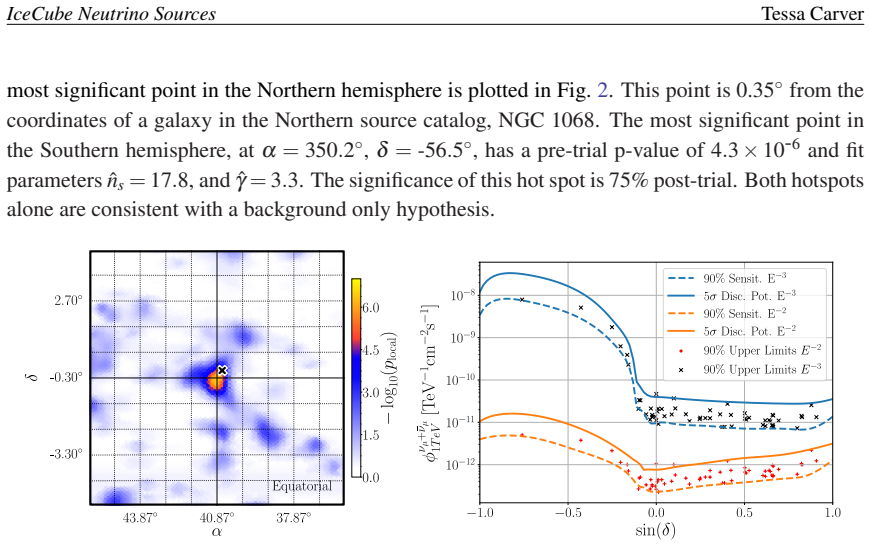
The paper's central claim is that after ten years of IceCube data, the strongest evidence for point-like neutrino emission is collective rather than single-source. In the Northern catalog of 97 objects, NGC 1068 shows the most significant excess, with a pre-trial $p$-value of $1.8\times10^{-5}$ ($4.1\sigma$) and a post-trial significance of $2.9\sigma$; its best-fit spectrum is soft, $\hat{\gamma}=3.2$, with $\hat{n}_s=50.4$ signal events. The all-sky scan's hottest Northern spot lies $0.35^\circ$ from NGC 1068, and injection simulations with an $E^{-3.2}$ spectrum show that such an offset is a plausible statistical fluctuation. The population study finds its strongest signal for $k=4$ sources with pre-trial $p=3.3\times10^{-5}$ and post-trial $p=4.8\times10^{-4}$ ($3.3\sigma$), from excesses at NGC 1068, TXS 0506+056, PKS 1424+240, and GB6 J1542+6129; removing TXS 0506+056 leaves a $2.25\sigma$ post-trial excess from the remaining three. The paper concludes that some point-like sources could be starting to emerge from the background, with more data or future detectors needed to confirm or rule them out.
Load-bearing premise
All quoted p-values rest on the assumption that randomly re-assigning each event a new right ascension produces a faithful background-only sky, and that the atmospheric muon and neutrino backgrounds, including mis-reconstructed Southern muons leaking into the North, are accurately modeled.
Editorial extensions
If this is right
- If the $3.3\sigma$ Northern population excess is real, the four candidate sources constitute the first resolved population of point-like neutrino emitters, meaning part of the diffuse astrophysical neutrino flux is produced by discrete objects rather than only by a truly diffuse mechanism.
- The $2.9\sigma$ excess at NGC 1068, combined with the simulated plausibility of the $0.35^\circ$ offset, makes this Seyfert II galaxy the strongest single candidate to monitor as more IceCube data accumulate.
- Because the population excess remains at $2.25\sigma$ after removing TXS 0506+056, the signal is not carried by a single flaring source, but its significance depends on several modest excesses and could disappear if any one of them is a fluctuation.
- The Southern catalog and the all-sky scan show no comparable signal, so any emerging point-source population is currently evident only in the Northern hemisphere, where IceCube's track sensitivity is highest.
- The paper's sensitivity projection implies that a future detector with an order-of-magnitude better discovery potential would be able to confirm or exclude neutrino fluxes at the level of the best-fit fluxes of these four sources.
Reading between the lines
- Because the four excess sources belong to different classes of active galactic nuclei—one Seyfert II and three blazars—the population result, if real, would suggest that neutrino production is a common property of active galactic nuclei rather than a single subclass; the paper itself does not draw this conclusion.
- A useful control experiment would be to rerun the population analysis with a source catalog built without gamma-ray flux weighting, or with a differently selected gamma-ray source list; if the $3.3\sigma$ excess persists under a differently selected catalog, it would be harder to attribute to selection bias.
- The population statistic counts sources below a p-value threshold but does not use the measured source fluxes simultaneously; a joint likelihood fit of the four candidate fluxes and a common spectral index could provide a stronger and more interpretable test of the same hypothesis.
- The $0.35^\circ$ hotspot offset suggests that future all-sky scans should include energy-dependent point-spread functions or extended-source templates, since a soft-spectrum point source can shift the reconstructed maximum noticeably.
Signed reviews
Editorial analysis
A structured set of objections, weighed in public.
Referee Report
Summary. This proceedings paper from the IceCube Collaboration analyzes roughly ten years of track-like muon-neutrino data to search for point-like astrophysical sources. Three searches are presented: an all-sky scan, a search over a 110-source catalog selected from Fermi and TeVCat, and a catalog population study. The most significant Northern all-sky hotspot is located 0.35 degrees from NGC 1068 with a pre-trial p-value of 3.5e-7 and a post-trial significance of 9.9%. The source-catalog search finds a 2.9 sigma post-trial excess at NGC 1068, and the population study reports a 3.3 sigma post-trial excess driven by four Northern catalog sources (NGC 1068, TXS 0506+056, PKS 1424+240, and GB6 J1542+6129). The population excess drops to 2.25 sigma when TXS 0506+056 is removed. The Southern sky shows no significant excess. The paper concludes that no individual source is firmly established but that some point-like sources may be emerging from the background.
Significance. If the population result holds, this is one of the strongest current hints of a population of point-like neutrino sources, with NGC 1068 as the leading single candidate. The analysis is a careful update of standard IceCube methods and documents an improved event selection with better angular resolution and sensitivity. The paper is transparent in reporting the drop to 2.25 sigma when TXS 0506+056 is removed and in discussing the offset between the all-sky hotspot and the catalog position of NGC 1068. However, the statistical evidence is modest, the central 3.3 sigma claim depends on an unvalidated background-scrambling assumption, and the population-study statistic is not specified in enough detail to be independently reproduced from the proceedings text.
major comments (3)
- [§2 Data Selection and §3 All-Sky Scan] The background-only p-values quoted in Table 2, including the 3.3 sigma population result, are calibrated by assigning each event a new right ascension uniformly on the sky while preserving all other properties. The paper states in §2 that poorly reconstructed Southern atmospheric muons still constitute a non-negligible Northern background. The validity of the RA-scrambling null therefore requires that this residual muon contamination be RA-isotropic after reconstruction and selection. This is not established in the manuscript; atmospheric muons are known to exhibit local-azimuth and sidereal anisotropies, and the BDT selection could imprint a declination- and energy-dependent RA pattern on the surviving events. I ask for a closure test, for example a simulated-leakage study verifying that scrambled trials reproduce the observed event properties, or a demonstration that the Northern catalog pre-trial p-values are uniform after excluding the flagged sources.
- [§3 Catalog Population Study] The population-study statistic is not fully specified. The displayed equation for the cumulative binomial probability pbkg is missing from the text, and the procedure for scanning k and the threshold pk is described only verbally, so the post-trial correction of 4.8e-4 cannot be reproduced from the proceedings. Please provide the exact binomial formula, the range and step of the scan, whether pk is chosen a priori or from the data, and the number of background trials used for the post-trial correction.
- [§3 Source Catalog Searches and Table 2] The 3.3 sigma population excess is driven by four sources, one of which, TXS 0506+056, was already known from the IceCube-170922A flare. The authors disclose that removing TXS reduces the post-trial significance to 2.25 sigma, which is commendable, but this fragility means the evidence for a population of new sources is weak. The conclusion that 'some of the first point-like sources could potentially be emerging from the background' should be tempered accordingly, and a sentence should quantify how much of the 3.3 sigma is independent of the previously known TXS association.
minor comments (5)
- [§3 All-Sky Scan and Source Catalog Searches] The best-fit values for the number of signal events ns and spectral index gamma are quoted without any uncertainties; please provide confidence intervals or state explicitly that uncertainties are not reported in this proceedings.
- [Table 1] The date range for the IC86-2012-18 row contains a typo, reading '2012/04/26 1 2018/07/10'; it should be '2012/04/26 – 2018/07/10'.
- [§3 Source Catalog Searches] The text reads 'EightFermi-LAT sources' where 'Eight Fermi-LAT sources' is intended; please fix the missing space.
- [References] Several references lack complete publication details, for example [10] and [20]; please add volume, page, and DOI information where available.
- [§4 Conclusions] The conclusion states that there is 'no evidence for an astrophysical neutrino source' while the abstract and §3 report a 3.3 sigma inconsistency with background; please clarify that 'no evidence' refers to individual sources and not to the collective population excess.
Circularity Check
No significant circularity: the reported p-values come from data-versus-background-trials comparisons, and the only known-source inclusion (TXS 0506+056) is disclosed and tested by removal.
full rationale
The paper's derivation chain is self-contained as a statistical analysis: data events are selected with an updated BDT, a likelihood-ratio test compares signal-plus-background to background-only at each sky position or catalog source, and pre-trial and post-trial p-values are obtained by comparing the observed test statistic with background-only trials in which each event is assigned a uniform right ascension. No parameter is fitted to the final claim and then renamed a prediction. The source catalog is constructed from independent Fermi-LAT and TeVCat gamma-ray measurements, not from the neutrino p-values. The population study uses the already-computed pre-trial p-values and a cumulative binomial calculation, which is a standard order-statistics test rather than a circular reuse of the claimed excess. The one potentially self-referential element, including TXS 0506+056 in the population excess after its prior flaring-source evidence, is explicitly disclosed and the authors perform an a-posteriori removal test giving 2.25 sigma; this transparency prevents it from being load-bearing circularity. Concerns about the validity of RA scrambling for misreconstructed southern muons are legitimate systematic/correctness risks, not circularity under the stated criteria, because the null distribution is not defined in terms of the claimed result.
Assumptions & free parameters
free parameters (4)
- Signal normalization n_s =
NGC 1068: 61.5 (all-sky spot), 50.4 (catalog search)
- Signal spectral index gamma =
NGC 1068: 3.4 (all-sky spot), 3.2 (catalog search)
- Catalog membership thresholds =
not applicable
- Population study p-value threshold p_k =
scanned over k=1..N
assumptions (5)
- domain assumption Background trials obtained by uniform right-ascension scrambling reproduce the true background distribution.
- domain assumption Neutrino sources are point-like and emit a single power-law spectrum.
- standard math Maximum-likelihood test statistic can be converted to p-values using a fitted chi-square distribution from Monte Carlo trials.
- domain assumption The Fermi 3FGL and TeVCat catalogs are unbiased tracers of neutrino source candidates.
- domain assumption Atmospheric muon contamination is accurately modeled after BDT selection.
Cite this review
Pith. "Pith review of Ten years of All-sky Neutrino Point-Source Searches." pith.science (2026). https://pith.science/paper/NYCIA2K7
@misc{pith2026190805993,
  author       = {Pith},
  title        = {Pith review of: Ten years of All-sky Neutrino Point-Source Searches},
  year         = {2026},
  howpublished = {\url{https://pith.science/paper/NYCIA2K7}},
  note         = {Machine review of arXiv:1908.05993}
}
abstract
These proceedings present the results of point-like neutrino source searches using ~10 yrs of IceCube data from Apr.~6, 2008 to Jul.~10, 2018. We evaluate the significance of an astrophysical signal from a point-like source looking for an excess of clustered neutrino events with energies above ~1 TeV among the background of atmospheric muons and neutrinos. We perform a full sky scan, a search based on a selected source catalog, and a catalog population study. The most significant location in the Northern hemisphere from the full-sky scan is compatible with the Seyfert galaxy NGC 1068. This object had also been identified in the source catalog search which finds a 2.9 $\sigma$ excess after accounting for statistical trials. The combination of this result along with excesses observed at the coordinates of three other sources, including TXS 0506+056, suggests that collectively correlations with sources in the Northern catalog are inconsistent with background at the level of 3.3 $\sigma$. These results motivate further interest in such point-like sources which should become observable or ruled out after accumulation of more data or with future detectors.
Figures

Reference graph
Works this paper leans on
-
[1]
V . F. Hess,Phys. Z. 13 (1912) 1084–1091
work page 1912
-
[2]
IceCube Collaboration, M. G. Aartsen et al., Astrophys. J. 833 (2016) 3
2016
-
[3]
IceCube Collaboration, M. G. Aartsen et al., arXiv:1710.01191
-
[4]
7 IceCube Neutrino Sources Tessa Carver
Aartsen, M., et al., Science 342 (2013) 1242856. 7 IceCube Neutrino Sources Tessa Carver
work page 2013
-
[5]
IceCube Collaboration, M. G. Aartsen et al., Phys. Rev. Lett. 113 (2014) 101101
2014
-
[6]
Abbasi et al., Astrophys
IceCube Collaboration, R. Abbasi et al., Astrophys. J. 732 (2011) 18
2011
-
[7]
IceCube Collaboration, M. G. Aartsen et al., Astrophys. J. 779 (2013) 132
2013
-
[8]
IceCube Collaboration, M. G. Aartsen et al., Astrophys. J. 796 (2014) 109
2014
Show all 24 references
-
[9]
IceCube Collaboration, M. G. Aartsen et al., Astrophys. J. 835 (2017) 151
2017
-
[10]
IceCube Collaboration, M. G. Aartsen et al., Eur . Phys. J. C.(2018)
2018
-
[11]
IceCube Collaboration, M. G. Aartsen et al., JINST 12 (2017) P03012
2017
-
[12]
IceCube Collaboration, M. G. Aartsen et al., Astrophys. J. 846 (2017) 136
2017
-
[13]
Ahrens et al., Nucl
AMANDA Collaboration, J. Ahrens et al., Nucl. Instrum. Meth. A524 (2004) 169–194
2004
-
[14]
M. G. Aartsen et al., Nucl. Instrum. Meth. A736 (2014) 143–149
2014
-
[15]
Braun, J
J. Braun, J. Dumm, F. De Palma, C. Finley, A. Karle, and T. Montaruli, Astropart. Phys. 29 (2008) 299–305
2008
-
[16]
Acero et al., Astrophys
Fermi-LA TCollaboration, F. Acero et al., Astrophys. J. Suppl. 218 (2015) 23
2015
-
[17]
Loeb and E
A. Loeb and E. Waxman, JCAP 0605 (2006) 003
2006
-
[18]
Murase, M
K. Murase, M. Ahlers, and B. C. Lacki, Phys. Rev. D88 (2013) 121301
2013
-
[19]
S. P. Wakely and D. Horan, International Cosmic Ray Conference 3 (2008) 1341–1344
2008
-
[20]
IceCube Collaboration, M. G. Aartsen et al., Science 361 (2018) 147–151
2018
-
[21]
Ackermann et al., Astrophys
Fermi-LA TCollaboration, M. Ackermann et al., Astrophys. J. 755 (2012) 164
2012
-
[22]
Wojaczy ´nski, A
R. Wojaczy ´nski, A. Nied´ zwiecki, F.-G. Xie, and M. Szanecki,Astr . & Astrop.584 (Dec, 2015) A20
2015
-
[23]
Lamastra, N
A. Lamastra, N. Menci, F. Fiore, L. A. Antonelli, S. Colafrancesco, D. Guetta, and A. Stamerra, Astron. Astrophys. 607 (2017) A18
2017
-
[24]
van Santen, PoS(ICRC2017)991 (2018)
IceCube Gen2 Collaboration, J. van Santen, PoS(ICRC2017)991 (2018). 8
2018
Reviewed August 14, 2026 · model on record in the stance chip above.
Discussion (0). Continue with ORCID to comment.