REVIEW 3 major objections 4 minor 86 references
An algorithm for real and complex rational minimax approximation
T0 review · 3 major / 4 minor · reviewed 2026-08-14 · deepseek-v4-flash
Pith's one-line read AAA-Lawson, a two-step algorithm built from greedy support-point selection and iteratively reweighted least squares, computes near-minimax rational approximations for complex functions and arbitrary domains in fractions of a second.
desk verdict A practical algorithm for complex rational minimax approximation that deserves serious peer review, but the 'few percent of minimax' claim needs a systematic audit. read the letter →
The pith
A machine-rendered reading of the paper's core claim, the machinery that carries it, and where it could break.
The reading
What carries the argument
The central object is the barycentric rational representation $r(z)=\sum_{k=0}^n \alpha_k/(z-t_k)\big/\sum_{k=0}^n \beta_k/(z-t_k)$ in noninterpolatory mode, where the $t_k$ are support points chosen greedily by AAA and the coefficients $\alpha_k,\beta_k$ are free parameters. Every rational function of degree $n$ has such a representation, and it is numerically stable even when poles cluster exponentially near singularities. The optimization machinery is Lawson-type iteratively reweighted least squares: at each step the current residual $e_j$ at each sample point becomes a weight $w_j\leftarrow w_j|e_j|$, and the next coefficients solve the minimal-singular-value problem for the weighted Cauchy matrix in (3.6). At the $n+1$ sample points that coincide with support points, the infinite terms are replaced by the L'Hôpital-style values $(f_j\beta_{k_j}-\alpha_{k_j})^2$. This combination turns the nonlinear minimax problem into a short sequence of linear algebra problems.
What would settle it
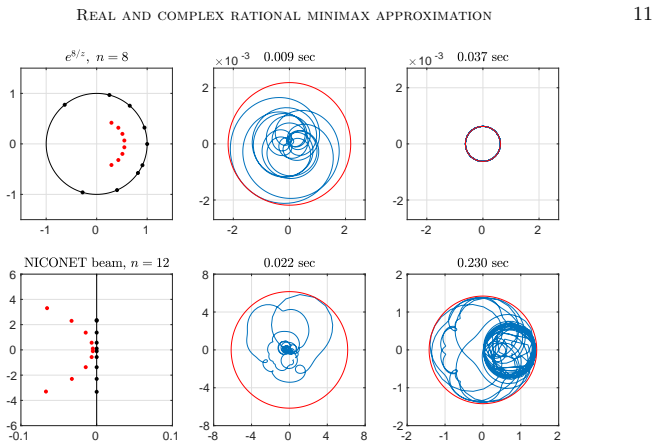
Run AAA-Lawson on $e^z$ on the unit circle with degree 5 and 500 equispaced points, and compare the returned error with the Hankel singular-value lower bound $\sigma_6 = 9.944144081\times 10^{-11}$. The paper reports an error of $9.944364\times 10^{-11}$; if a re-run yields an error more than a few percent above $\sigma_6$, the central near-optimality claim fails for this representative case, and if it falls below $\sigma_6$, the lower bound itself is contradicted.
Extended reading notes
Core claim
The paper's central claim is that one algorithm, AAA-Lawson, can solve rational minimax approximation problems on essentially arbitrary discrete domains—complex or real, connected or disconnected—at laptop speed and near-minimax accuracy. The key step is a switch from the interpolatory barycentric representation used by AAA to a noninterpolatory alpha-beta mode in which numerator and denominator coefficients are freed from the support-point values and optimized directly. The optimization is then carried out by Lawson iteration: a sequence of weighted least-squares problems, each solved as a minimal singular value problem for a Cauchy matrix, with weights updated by the current pointwise error. The paper argues that this combination inherits the numerical stability of AAA while improving typical errors by factors of roughly 2 to 20, and it documents the claim on 22 worked examples spanning analytic, meromorphic, singular, and nonanalytic functions.
Load-bearing premise
The entire method rests on the finite sample set standing in faithfully for the continuous domain; if the sample points are too sparse near a singularity, the computed minimax answer can miss the true one.
Editorial extensions
If this is right
- Complex rational minimax approximation becomes a routine computation: problems on disks, ellipses, squares, arcs, annuli, unions of domains, and random point clouds can be solved in fractions of a second.
- Approximations with exponentially clustered poles near boundary singularities become computable, supporting applications in conformal mapping, model order reduction, and Laplace and Helmholtz solving.
- For smooth real-interval problems, the established real-interval minimax solvers remain preferable, but AAA-Lawson extends minimax computation to unbounded intervals, disjoint intervals, and endpoint singularities where those methods struggle.
- The algorithm is available as a one-line command with a degree parameter, so non-specialists can obtain near-minimax rational fits without implementing optimality conditions.
Reading between the lines
- Editorial inference: the same barycentric-plus-IRLS pattern should transfer to weighted minimax problems and to type $(m,n)$ with $m\neq n$, extensions the paper notes but does not implement.
- Editorial inference: the near-circular error curves observed on analytic complex examples make winding number a cheap, automatic certificate of near-optimality, even where uniqueness theory is unavailable.
- Editorial inference: period-2 oscillations in the weight update, one of the paper's named failure modes, might be suppressed by underrelaxation or momentum; this is a testable modification the paper mentions only in passing.
- Editorial inference: for real-interval problems where established minimax methods work, AAA-Lawson is unlikely to replace them, but it may serve as a reliable fallback and as an initializer for harder cases such as endpoint singularities and unbounded intervals.
Signed reviews
Editorial analysis
A structured set of objections, weighed in public.
Referee Report
Summary. The paper introduces the AAA-Lawson algorithm for rational minimax approximation in the complex plane and on real intervals. The method first runs the AAA algorithm to select support points and obtain an initial barycentric rational approximant, then applies a Lawson/IRLS iteration to adjust the barycentric coefficients by solving a sequence of weighted linear least-squares problems (Eqs. (3.4)–(3.7)). The authors claim that, for a wide range of problems, the method converges in a fraction of a second on a laptop to an approximation whose error is within a few percent of the minimax value. The paper presents fourteen complex and eight real numerical examples, with comparisons to the Ellacott–Williams method, Chebfun's minimax command, and Carathéodory–Fejér lower bounds. Section 6 discusses six failure modes and explicitly states that no comprehensive convergence proof is available.
Significance. If the near-optimality claim is substantiated, the paper fills a genuine gap: there are few practical algorithms for complex rational minimax approximation, and the AAA-Lawson algorithm is simple, uses a numerically stable barycentric representation, and is available in Chebfun. The paper's strengths include the breadth of examples, honest discussion of failure modes, and external validation against independent benchmarks in several cases. The main weakness is that the headline quantitative claim is not systematically demonstrated, and at least one reported example contradicts the 'within a few percent' phrasing. This is a potentially important practical contribution, but the empirical evidence needs to be tightened before the central claim can be accepted as stated.
major comments (3)
- [Section 1 and Fig. 5.2] The central claim that AAA-Lawson converges 'to an approximation with an error within a few percent of the minimax value' is not supported as stated. In the |x| example of Fig. 5.2, the reported AAA-Lawson error is 1.23e-4 versus 1.07e-4 from Chebfun minimax, a 15% excess. For most complex examples in Section 4, no independent minimax error is reported; near-optimality is inferred visually from near-circular error curves, an argument that the paper itself describes as unproved in the final paragraph of Section 4. I request a systematic audit: a table listing, for every example, the computed error and the best available independent upper or lower bound (CF, EW, Chebfun minimax, or a refined-grid re-run), together with a revised wording of the claim calibrated to the observed ratios.
- [Section 3 and Section 6, failure mode 1] The algorithm minimizes over a discrete sample set Z (Eq. (3.4)), while the paper claims to approximate the continuum minimax problem. Section 6 acknowledges 'Discretization too coarse' as a failure mode but provides neither an a priori condition nor an a posteriori check relating the grid to the gap between discrete and continuous minimax errors. In particular, the tanh-clustered grids used near singularities are chosen heuristically. Please add a grid-refinement check or an estimate of the discretization error, and state how the reported errors are verified with respect to the continuum.
- [Section 3 and Fig. 4.4] The default termination criterion of 20 Lawson steps is admitted to be insufficient in at least one case: the second row of Fig. 4.4 states that the maximum error is attained at 20 points only if 'a few hundred' Lawson steps are taken, not with the default 20 steps. Since the headline claim concerns default-mode computation in a fraction of a second, the paper should either provide a principled stopping rule or explicitly document, for each example, the number of Lawson steps used and whether the default mode produced the reported error. This is necessary to support the claim that the method is near-optimal in default operation.
minor comments (4)
- [Section 5, Fig. 5.2] The text says that the |x| approximation shows '12 poles lining up along a branch cut,' but the degree n used for this example is not stated in the text; the number of poles should be consistent with the stated degree.
- [Section 4, Fig. 4.4] The phrase '10,000 times larger' in the discussion of the second row is used without an explicit reference to the first row's error; please make the comparison explicit.
- [Abstract] There is a typographical spacing error in 'the re appear' in the abstract.
- [Section 4] The sentence 'The codes of this section and the next are available in the supplementary materials' should give a specific version or release date of the Chebfun implementation so that the numerical results are reproducible.
Circularity Check
No significant circularity found: the AAA-Lawson claims are benchmarked against external CF lower bounds and Chebfun minimax, and the self-citations provide initialization rather than a forced conclusion.
full rationale
The derivation chain is self-contained in the sense required by the circularity analysis. Step (I) of the algorithm uses the AAA algorithm [51] only to obtain an initial rational approximant and support points; the near-optimality claim is not obtained from AAA alone. Step (II) solves the linearized IRLS problem (3.4)-(3.7) by a minimal singular value computation, and the weights are updated by the standard Lawson rule (3.7). No parameter is fitted to a target and then renamed as a prediction. The paper's key quantitative evidence is external: in Fig. 4.1 the AAA-Lawson error 9.944364e-11 is compared with the Caratheodory-Fejer lower bound sigma_6 = 9.944144081e-11, an independent benchmark computed from Taylor coefficients; in Fig. 5.2 the |x| result 1.23e-4 is honestly compared with Chebfun minimax's 1.07e-4, showing a gap rather than forcing agreement. The self-citations to [51] and [21] are references to prior algorithmic building blocks, not to a uniqueness theorem or an unstated ansatz that makes the conclusion true by definition. The paper explicitly disclaims a convergence theorem ('we do not have a result comprehensive enough to report here'), so no theorem is being imported from the authors' prior work. Concerns that the 'within a few percent' headline is not systematically established, or that the discrete-continuum gap is not quantified, are correctness and evidentiary risks, not circularity. Score 1 reflects the presence of minor self-referential context without any load-bearing circular step.
Assumptions & free parameters
free parameters (3)
- Number of Lawson steps =
20 default, user-specified via 'lawson' option
- Grid clustering parameters =
tanh(linspace(-12,12,n)) with n varying per example
- Underrelaxation parameter =
not specified
assumptions (3)
- standard math Every degree n rational function can be represented in the barycentric form (3.2) with arbitrary distinct support points (Theorem 3.1).
- domain assumption The discrete sample set Z represents the continuum in the supremum norm accurately enough that the discrete minimax solution is close to the continuous one.
- ad hoc to paper The IRLS/Lawson iteration for the linearized barycentric problem converges to a local minimum of the nonlinear minimax problem.
Cite this review
Pith. "Pith review of An algorithm for real and complex rational minimax approximation." pith.science (2026). https://pith.science/paper/AA5EL5HD
@misc{pith2026190806001,
  author       = {Pith},
  title        = {Pith review of: An algorithm for real and complex rational minimax approximation},
  year         = {2026},
  howpublished = {\url{https://pith.science/paper/AA5EL5HD}},
  note         = {Machine review of arXiv:1908.06001}
}
read the original abstract
Rational minimax approximation of real functions on real intervals is an established topic, but when it comes to complex functions or domains, there appear to be no algorithms currently in use. Such a method is introduced here, the {\em AAA-Lawson algorithm,} available in Chebfun. The new algorithm solves a wide range of problems on arbitrary domains in a fraction of a second of laptop time by a procedure consisting of two steps. First, the standard AAA algorithm is run to obtain a near-best approximation and a set of support points for a barycentric representation of the rational approximant. Then a "Lawson phase" of iteratively reweighted least-squares adjustment of the barycentric coefficients is carried out to improve the approximation to minimax.
Figures


Figures from the paper (7 more)




Reference graph
Works this paper leans on
-
[1]
Alpert, L
B. Alpert, L. Greengard, and T. Hagstrom, Rapid evaluation of nonreflecting boundary kernels for time-domain wave propagation, SIAM J. Numer. Anal., 37 (2000), pp. 1138– 1164
2000
-
[2]
A. C. Antoulas, Approximation of Large-Scale Dynamical Systems, SIAM, 2005
2005
-
[3]
A. C. Antoulas, et al., A tutorial introduction to the Loewner framework for model r eduction, Model Reduction and Approximation: Theory and Algorithms, 15 (2017), 335
2017
-
[4]
A. P. Austin, P. Kravanja, and L. N. Trefethen, Numerical algorithms based on analytic function values at roots of unity, SIAM J. Numer. Anal., 52 (2014), pp. 1795–1821
2014
-
[5]
Barrodale, L
I. Barrodale, L. M. Delves, and J. C. Mason, Linear Chebyshev approximation of complex- valued functions, Math. Comput., 32 (1978), pp. 853–863
1978
-
[6]
Beckermann and A
B. Beckermann and A. Townsend, Bounds on the singular values of matrices with displace- ment structure, SIAM Rev., 61 (2019), pp. 319–344
2019
- [7]
-
[8]
M. Berljafa and S. G ¨uttel, The RKFIT algorithm for nonlinear rational approximation, SIAM J. Sci. Comput., 39 (2017), pp. A2049–A2071
work page 2017
Show all 86 references
-
[9]
Berrut and L
J.-P. Berrut and L. N. Trefethen, Barycentric Lagrange interpolation, SIAM Rev., 46 (2004), pp. 501–517
2004
-
[10]
Braess, Nonlinear Approximation Theory, Springer, 1986
D. Braess, Nonlinear Approximation Theory, Springer, 1986
1986
-
[11]
Chahlaoui and P
Y. Chahlaoui and P. V an Dooren, A collection of benchmark examples for model reduc- tion of linear time invariant dynamical systems, EPrint 2008.22, Manchester Institute for Mathematical Sciences, U. of Manchester, 2002
2008
-
[12]
Chen and T
X. Chen and T. W. Parks, Design of IIR filters in the complex domain, IEEE Trans. Acoust. Speech Sign. Proc., 38 (1990), pp. 910–920
1990
-
[13]
A. K. Cline, Rate of convergence of Lawson ’s algorithm, Math. Comp., 26 (1972), pp. 167–176
1972
-
[14]
W. J. Cody G. Meinardus, and R. S. V arga, Chebyshev rational approximation to e− x in [0, +∞ ) and applications to heat-conduction problems, J. Approx. Th., 2 (1969), pp. 50–65
1969
-
[15]
Cooper, Rational Approximation of Discrete Data with Asymptotic Be haviour, PhD thesis, U
P. Cooper, Rational Approximation of Discrete Data with Asymptotic Be haviour, PhD thesis, U. Huddersfield, 2007
2007
-
[16]
Daubechies, R
I. Daubechies, R. DeVore, M. Fornasier, and C. S. G ¨unt¨urk, Iteratively reweighted least squares minimization for sparse recovery, Commun. Pure Appl. Math., 63 (2010), pp. 1–38
2010
-
[17]
A Driscoll, A MATLAB toolbox for Schwarz–Christoffel mapping, ACM Trans
T. A Driscoll, A MATLAB toolbox for Schwarz–Christoffel mapping, ACM Trans. Math. Softw., 22 (1996), pp. 168–186. 18 Nakatsukasa and Trefethen
1996
-
[18]
T. A. Driscoll, N. Hale, and L. N. Trefethen, eds., Chebfun User’s Guide, Pafnuty Pub- lications, Oxford, 2014; see also www.chebfun.org
2014
-
[19]
Ellacott and J
S. Ellacott and J. Williams, Linear Chebyshev approximation in the complex plane using Lawson ’s algorithm,Math. Comput., 30 (1976), pp. 35–44
1976
-
[20]
Ellacott and J
S. Ellacott and J. Williams, Rational Chebyshev approximation in the complex plane, SIAM J. Numer. Anal., 13 (1976), pp. 310–323
1976
-
[21]
Filip, Y
S.-I. Filip, Y. Nakatsukasa, L. N. Trefethen, and B. Beckermann , Rational minimax approximation via adaptive barycentric representations, SIAM J. Sci. Comput., 40 (2018), pp. A2427–A2455
2018
-
[22]
Fischer and J
B. Fischer and J. Modersitzki, An algorithm for complex linear approximation based on semi-infinite programming, Numer. Algs., 5 (1993), pp. 287–297
1993
-
[23]
M. S. Floater and K. Hormann, Barycentric rational interpolation with no poles and high rates of approximation, Numer. Math., 107 (2007), pp. 315–331
2007
-
[24]
Gaier, Lectures on Complex Approximation, Birkh¨ auser, 1987
D. Gaier, Lectures on Complex Approximation, Birkh¨ auser, 1987
1987
-
[25]
T. W. Gamelin , Uniform Algebras, Prentice-Hall, 1969
1969
-
[26]
Glashoff and K
K. Glashoff and K. Roleff, A new method for Chebyshev approximation of complex-valued functions, Math. Comp., 36 (1981), pp. 233–239
1981
-
[27]
Gopal and L
A. Gopal and L. N. Trefethen, Representation of conformal maps by rational functions, Numer. Math., 142 (2019), pp. 359–382
2019
-
[28]
Gopal and L
A. Gopal and L. N. Trefethen, New Laplace and Helmholtz solvers, Proc. Nat. Acad. Sci., 116 (2019), p. 10223
2019
-
[29]
Gopal and L
A. Gopal and L. N. Trefethen, Solving Laplace problems with corner singularities via rat ional functions, SIAM J. Numer. Anal., to appear
-
[30]
Gugergin, A
S. Gugergin, A. C. Antoulas, and C. Beattie, H2 model reduction for large-scale linear dynamical systems, SIAM J. Matrix Anal. Appl., 30 (2008), pp. 609–638
2008
-
[31]
Gustavsen and A
B. Gustavsen and A. Semlyen, Rational approximation of frequency domain responses by vector fitting, IEEE Trans. Power Deliv., 14 (1999), pp. 1052–1061
1999
-
[32]
M. H. Gutknecht, Non-strong uniqueness in real and complex Chebyshev approx imation, J. Approx. Th., 23 (1978), pp. 204–213
1978
-
[33]
M. H. Gutknecht, Algebraically solvable approximation problems, unpublished manuscript, 1983, available at people.maths.ox.ac.uk/trefethen/gutknecht83.pdf
1983
-
[34]
M. H. Gutknecht and L. N. Trefethen, Nonuniqueness of best rational Chebyshev approxi- mations on the unit disk, J. Approx. Th., 39 (1983), pp. 275–288
1983
-
[35]
Hayashi, L
E. Hayashi, L. N. Trefethen, and M. H. Gutknecht, The CF table, Constr. Approx., 6 (1990), pp. 195–223
1990
-
[36]
Henrici, Applied and Computational Complex Analysis, v
P. Henrici, Applied and Computational Complex Analysis, v. 1, Wiley, 1974
1974
-
[37]
A. C. Ionit, ˘a, Lagrange Rational Interpolation and its Applications to Ap proximation of Large- Scale Dynamical Systems, PhD thesis, Rice University, 2013
2013
-
[38]
Istace and J.-P
M.-P. Istace and J.-P. Thiran, On computing best Chebyshev complex rational approximants , Numer. Algs., 5 (1993), pp. 299–308
1993
-
[39]
Klotz, Gewisse rationale Tschebyscheff-Approximationen in der ko mplexen Ebene, J
V. Klotz, Gewisse rationale Tschebyscheff-Approximationen in der ko mplexen Ebene, J. Ap- prox. Th., 19 (1977), pp. 51–60
1977
-
[40]
A. N. Kolmogorov, A remark on the polynomials of P. L. Chebyshev deviating the l east from a given function, Uspehi Mat. Nauk, 3 (1948), pp. 216–221 (Russian)
1948
-
[41]
Krabs and G
W. Krabs and G. Opfer, Eine Method zur L¨ osung des komplexen Approximationsproblem mit einer Anwendung auf konforme Abbildungen, Z. Angew. Math. M ech., 55 (1975), pp. T208– T211
1975
-
[42]
C. L. Lawson, Contributions to the Theory of Linear Least Maximum Approxi mations, PhD thesis, UCLA, 1961
1961
-
[43]
C. M. Lee and F. D. K. Roberts, A comparison of algorithms for rational ℓ∞ approximation, Math. Comput., 27 (1973), pp. 111–121
1973
-
[44]
Li and J
J.-R. Li and J. White, Low-rank solution of Lyapunov equations, SIAM Rev., 46 (2004), pp. 693–713
2004
-
[45]
L. Lin, M. Chen, C. Yang, and L. He, Accelerating atomic orbital-based electronic structure calculation via pole expansion and selected inversion, J. Phys.: Condensed Matt., 25 (2019), 295501
2019
-
[46]
Lietaert, J
P. Lietaert, J. P ´erez, B. V andereycken, and K. Meerbergen, Automatic ratio- nal approximation and linearization of nonlinear eigenval ue problems, arXiv preprint arXiv:1801.08622.2018
2018 arXiv
-
[47]
K. N. Lungu, Best approximations by rational functions, Math. Notes, 10 (1971), 431–433
1971
-
[48]
H. J. Maehly, Methods for fitting rational approximations, parts II and III, J. ACM, 10 (1963), pp. 257–277. Real and complex rational minimax approximation 19
1963
-
[49]
meinardus and D
G. meinardus and D. Schwedt, Nicht-lineare Approximationen, Arc. Rat. Mech. Anal., 17 (1964), pp. 297–326
1964
-
[50]
J. E. Moussa, Minimax rational approximation of the Fermi–Dirac distrib ution, J. Chem. Phys., 145 (2016), 164108
2016
-
[51]
Nakatsukasa, O
Y. Nakatsukasa, O. S `ete, and L. N. Trefethen, The AAA algorithm for rational approxi- mation, SIAM J. Sci. Comput., 40 (2018), pp. A1494–A1522
2018
-
[52]
D. J. Newman, Rational approximation to |x|, Mich. Math. J., 11 (1964), pp. 11–14
1964
-
[53]
Opfer, An algorithm for the construction of best approximations ba sed on Kolmogorov’s criterion, J
G. Opfer, An algorithm for the construction of best approximations ba sed on Kolmogorov’s criterion, J. Approx. Th., 23 (1978), pp. 299–317
1978
-
[54]
A. V. Oppenheim and R. W. Schafer, Discrete-Time Signal Processing, Pearson, 2014
2014
-
[55]
M. R. Osborne, Finite algorithms in optimization and data analysis, Wiley, 1985
1985
-
[56]
M. R. Osborne and G. A. W atson, An algorithm for minimax approximation in the nonlinear case, Comput. J., 12 (1969), pp. 63–68
1969
-
[57]
E. Y. Remes, On approximations in the complex domain, Dokl. Akad. Nauk SSSR, 77 (1951), pp. 965–968 (Russian)
1951
-
[58]
J. R. Rice, The Approximation of Functions, v. 2, Addison-W esley, 1969
1969
-
[59]
J. R. Rice and K. H. Usow, The Lawson algorithm and extensions, Math. Comput., 22 (1968), pp. 118–127
1968
-
[60]
Runge, Zur Theorie der eindeutigen analytischen Functionen, Acta Math
C. Runge, Zur Theorie der eindeutigen analytischen Functionen, Acta Math. 6 (1885), 229– 244
-
[61]
Ruttan, A characterization of best complex rational approximants i n a fundamental case, Constr
A. Ruttan, A characterization of best complex rational approximants i n a fundamental case, Constr. Approx., 1 (1985), pp. 287–296
1985
-
[62]
E. B. Saff and R. S. V arga, Nonuniqueness of best approximating complex rational func tions, Bull. AMS, 83 (1977), pp. 375–377
1977
-
[63]
E. B. Saff and R. S. V arga, On the zeros and poles of Pad´ e approximants to ez. III, Numer. Math., 30 (1978), pp. 241–266
1978
-
[64]
Schneider and W
C. Schneider and W. Werner, Some new aspects of rational interpolation, Math. Comput., 47 (1986), pp. 285–299
1986
-
[65]
Singer, The Theory of Best Approximation and Functional Analysis, SIAM, 1974
I. Singer, The Theory of Best Approximation and Functional Analysis, SIAM, 1974
1974
-
[66]
Stahl, Best uniform rational approximation of |x| on [− 1, 1], Russian Acad
H. Stahl, Best uniform rational approximation of |x| on [− 1, 1], Russian Acad. Sci. Sb. Math. 76 (1993), pp. 461–487
1993
-
[67]
Stahl, The convergence of Pad´ e approximants to functions with bra nch points, J
H. Stahl, The convergence of Pad´ e approximants to functions with bra nch points, J. Approx. Th., 91 (1997), pp. 139–204
1997
-
[68]
Szeg ˝o, ¨Uber eine Eigenschaft der Exponentialreihe, Sitzungsber
G. Szeg ˝o, ¨Uber eine Eigenschaft der Exponentialreihe, Sitzungsber. Berl. Math. Ges., 23 (1924), pp. 50–64
1924
-
[69]
P. T. P. Tang, A fast algorithm for linear complex Chebyshev approximatio ns, Math. Comput., 51 (1988), pp. 721–739
1988
-
[70]
Thiran and M.-P
J.-P. Thiran and M.-P. Istace, Optimality and uniqueness conditions in complex rational Chebyshev approximation with examples, Constr. Approx., 9 (1993), pp. 83–103
1993
-
[71]
Tonelli, I polinomi d’approssimazione di Tchebychev, Ann
L. Tonelli, I polinomi d’approssimazione di Tchebychev, Ann. di Mat. Pura ed Appl., 15 (1908), pp.47-119
1908
-
[72]
L. N. Trefethen, Chebyshev Approximation in the Complex Plane, undergraduate thesis, Harvard College, 1977
1977
-
[73]
L. N. Trefethen, Near-circularity of the error curve in complex Chebyshev ap proximation, J. Approx. Th., 31 (1981), pp. 344–367
1981
-
[74]
L. N. Trefethen, Rational Chebyshev approximation on the unit disk, Numer. Math., 37 (1981), pp. 297–320
1981
-
[75]
L. N. Trefethen, J. A. C. Weideman, and T. Schmelzer, Talbot quadratures and rational approximations, BIT Numer. Math., 46 (2006), pp. 653–670
2006
-
[76]
L. N. Trefethen, Approximation Theory and Approximation Practice, SIAM, 2013
2013
-
[77]
L. N. Trefethen, Rational approximation of the Fermi–Dirac function, Chebfun example at chebfun.org/examples/approx/FermiDirac.html, July, 2019
2019
-
[78]
V an Deun and L
J. V an Deun and L. N. Trefethen, A robust implementation of the Carath´ eodory–Fej´ er method for rational approximation, BIT Numer. Math., 51 (20 11), pp. 1039–1050
-
[79]
J. L. W alsh, The existence of rational functions of best approximation, Trans. AMS, 33 (1931), pp. 668–689
1931
-
[80]
J. L. W alsh, Interpolation and Approximation by Rational Functions in t he Complex Domain, 5th ed., Amer. Math. Soc., 1969
1969
-
[81]
G. A. W atson, Approximation Theory and Numerical Methods, Wiley, New York, 1980
1980
-
[82]
Werner, Tschebyscheff-Approximation im Bereich der rationalen Fun ktionen bei Vorliegen einer guten Ausgangsn¨ aherung,Arch
H. Werner, Tschebyscheff-Approximation im Bereich der rationalen Fun ktionen bei Vorliegen einer guten Ausgangsn¨ aherung,Arch. Ration. Mech. Anal., 10 (1962), pp. 205–219
1962
-
[83]
Werner, Die konstruktive Ermittlung der Tschebyscheff-Approximie renden im Bereich der 20 Nakatsukasa and Trefethen rationalen Funktionen, Arch
H. Werner, Die konstruktive Ermittlung der Tschebyscheff-Approximie renden im Bereich der 20 Nakatsukasa and Trefethen rationalen Funktionen, Arch. Ration. Mech. Anal., 11 (1962), pp. 368–384
1962
-
[84]
Werner, Polynomial interpolation: Lagrange versus Newton, Math
W. Werner, Polynomial interpolation: Lagrange versus Newton, Math. Comput., 43 (1984), pp. 205–217
1984
-
[85]
Williams, Characterization and computation of rational Chebyshev ap proximations in the complex plane, SIAM J
J. Williams, Characterization and computation of rational Chebyshev ap proximations in the complex plane, SIAM J. Numer. Anal., 16 (1979), pp. 819–827
1979
-
[86]
Zalcman , Analytic Capacity and Rational Approximation, Lect
L. Zalcman , Analytic Capacity and Rational Approximation, Lect. Notes Math. 50, Springer, 1968
1968
Reviewed August 14, 2026 · model on record in the stance chip above.
Discussion (0). Continue with ORCID to comment.