REVIEW 1 major objections 5 minor 30 references
Shape Optimization of Rotating Electric Machines using Isogeometric Analysis and Harmonic Stator-Rotor Coupling
T0 review · 1 major / 5 minor · reviewed 2026-08-14 · deepseek-v4-flash
Pith's one-line read This paper claims that the rotor shape of a 6-pole permanent magnet synchronous machine can be optimized through isogeometric analysis with harmonic stator-rotor coupling, reducing the total harmonic distortion of the electromotive force…
desk verdict Solid IGA shape-optimization paper with real validation; the unspecified harmonic index set in the THD objective is the flaw to fix before trusting the 75% claim. read the letter →
The pith
A machine-rendered reading of the paper's core claim, the machinery that carries it, and where it could break.
The reading
What carries the argument
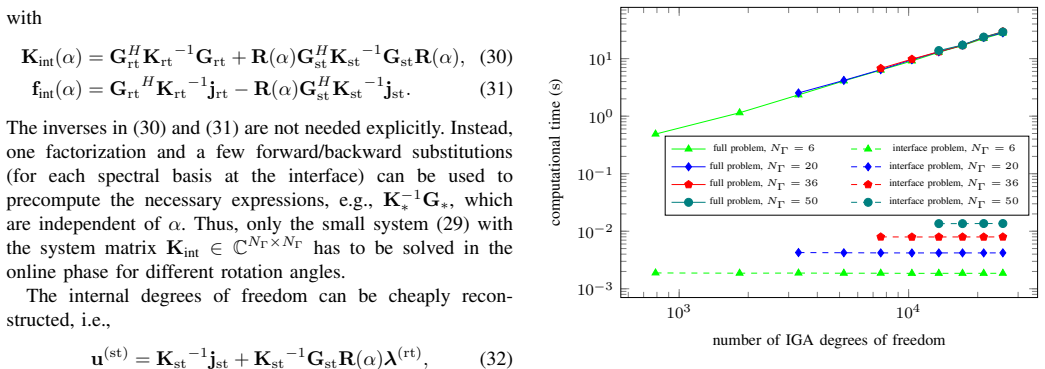
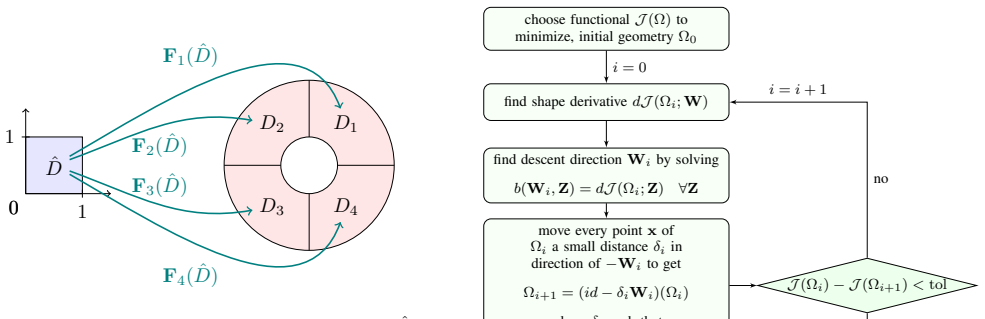
The central machinery is the harmonic stator-rotor coupling: the rotor and stator are separate multipatch IGA domains, and continuity of the magnetic vector potential across the air gap is enforced by Lagrange multipliers expanded in Fourier harmonics $e^{-i\ell_k\theta}$. This produces a saddle-point system whose interface part is a small Schur complement, $K_{\mathrm{int}}(\alpha) = G_{\mathrm{rt}}^H K_{\mathrm{rt}}^{-1} G_{\mathrm{rt}} + R(\alpha) G_{\mathrm{st}}^H K_{\mathrm{st}}^{-1} G_{\mathrm{st}} R(\alpha)$, where the rotation angle $\alpha$ enters only through the diagonal matrix $R(\alpha)$. For optimization, the shape derivative (equation 20) converts the THD objective into a descent vector field, and an $H^1$-type Riesz lifting with bilinear form $b(W,Z)=\int_D (DW:DZ + W\cdot Z)\,dx$ extracts the update direction. Only the small interface problem is re-solved for each of the 120 rotor positions, which is why the per-iteration cost stays low.
What would settle it
Recompute the THD of the original and optimized geometries with the Fourier sum extended to every harmonic resolvable by the 120-step time discretization, using the published machine geometry; if the reduction from 0.099 to 0.025 shrinks below 75 percent, or if an unlisted high-order harmonic dominates the optimized spectrum, the central quantitative claim fails.
Extended reading notes
Core claim
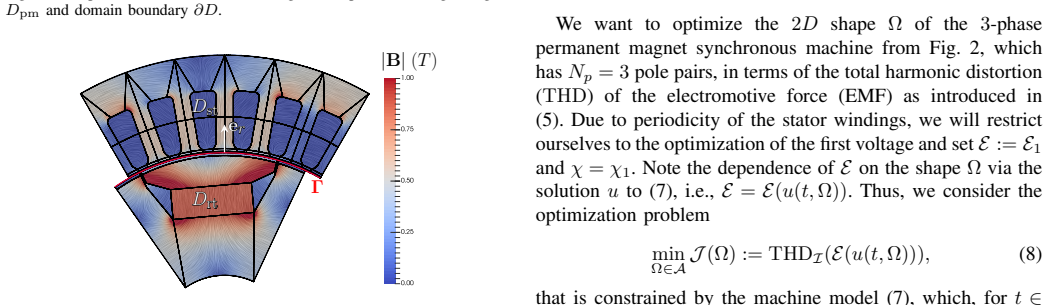
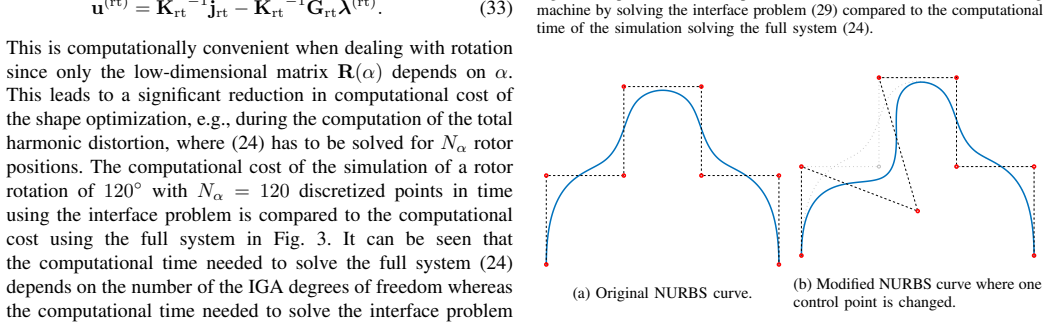
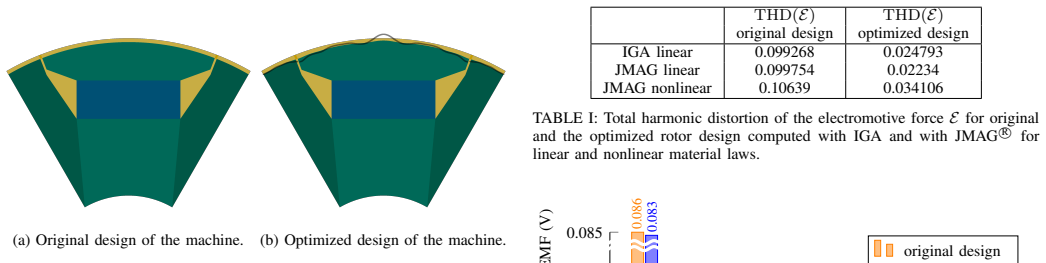
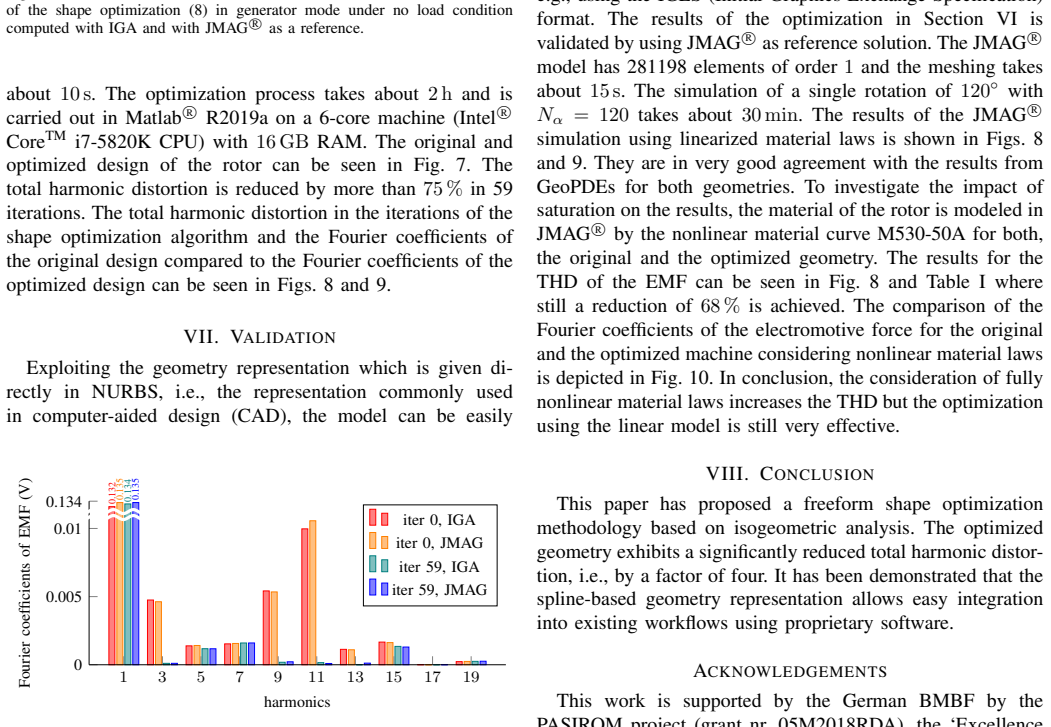
The central discovery is that harmonic stator-rotor coupling makes shape optimization of a rotating machine tractable in an isogeometric setting. The simulation splits into an offline phase that factors the stator and rotor stiffness matrices once and an online phase where only a small interface system in the Fourier coefficients of the magnetic field is solved for each rotor angle. The shape derivative of the THD objective is derived through shape calculus with an adjoint equation, and the resulting descent field moves the NURBS control points of the rotor. With 59 iterations the IGA model lowers THD(E) from 0.099268 to 0.024793; an independent finite-element computation gives 0.099754 to 0.02234 with linear materials and 0.10639 to 0.034106 with nonlinear materials. The optimized geometry suppresses the dominant Fourier harmonics of the electromotive force while leaving the permanent magnets unchanged.
Load-bearing premise
The load-bearing premise is that the index set $I$ of harmonics used in the THD objective really covers the harmonics that matter; the paper defines $I$ in the model section but never states which set the numerical optimization used.
Editorial extensions
If this is right
- If the central claim is right, gradient-based shape optimization of rotating machines no longer requires remeshing on every geometry update.
- The optimized rotor cuts EMF total harmonic distortion by a factor of about four, and the independent validation shows the improvement is not a quirk of the IGA discretization.
- With nonlinear magnetic materials the same optimized shape still gives a 68 percent THD reduction, suggesting the linear-model design remains effective under saturation.
- Because the optimized design is delivered as a NURBS geometry, it can be exported directly into standard CAD and CAE workflows.
Reading between the lines
- An implication the authors leave implicit: the same adjoint-based shape derivative can be applied to other design objectives, such as torque ripple or cogging torque, without changing the coupling machinery.
- A reader should not treat the 75 percent figure as the total harmonic distortion until the harmonic index set $I$ is specified; re-running with all harmonics included is the natural test.
- A testable extension would start the descent from several different initial rotor shapes to see whether the optimized design is a stable local optimum or depends on the starting geometry.
- The near-constant online cost in the number of IGA degrees of freedom suggests the method scales to finer discretizations and possibly 3D extensions where classical moving-band methods become expensive.
Signed reviews
Editorial analysis
A structured set of objections, weighed in public.
Referee Report
Summary. This paper develops and demonstrates an isogeometric-analysis-based shape optimization workflow for a 6-pole permanent-magnet synchronous machine. The stator and rotor are discretized as separate multipatch NURBS domains and coupled through harmonic basis functions on the air-gap interface, allowing efficient evaluation of many rotor positions. The optimization objective is the total harmonic distortion (THD) of the electromotive force, computed from the flux linkage over 120 rotor positions; the shape derivative is obtained by an adjoint approach, and descent directions are computed by solving an auxiliary vector problem. The authors report a reduction of THD by more than 75% after 59 iterations, and they validate the optimized geometry with independent JMAG simulations using both linear and nonlinear material models. The central claim is the method's ability to produce a robust, independently confirmed reduction in EMF distortion.
Significance. If the reported results hold, the paper makes a useful contribution: it combines exact IGA geometry, harmonic stator-rotor coupling, and adjoint shape calculus in a way that is substantially faster than solving the full system for each rotor position, and it demonstrates the workflow on a realistic machine with an independent commercial-solver check. The JMAG validation with linear and nonlinear materials is a particular strength, as is the availability of the geometry data via the Zenodo DOI in [28]. The main obstacle to accepting the quantitative claim is the unspecified harmonic index set I in the THD objective; once that is clarified, the contribution should be judged on its engineering value and the quality of the numerical comparison.
major comments (1)
- [II, Eq. (4); VI, Table I and Fig. 8] The optimization problem (8) minimizes THD_I(E(u(t,Omega))), where I is introduced in Section II as an index set of frequencies to consider, with the remark that one may disregard frequencies that cannot be diminished by shape optimization. Section VI and Table I report the THD values for the original and optimized designs and state that the THD is reduced by more than 75%, but they never specify which I was used in the optimization or in the reported numbers. Figure 9 shows Fourier coefficients only up to harmonic 19, whereas with N_alpha=120 the discrete Fourier representation contains coefficients up to order 60. If the implemented I is a proper subset, the claimed reduction applies to that restricted functional and not necessarily to the total THD, and the JMAG comparison in Fig. 8 validates only the same restricted functional. Please state I explicitly, and in addition report the total THD (with all available harmonics included) for the original and optimized geometries for both IGA and JMAG.
minor comments (5)
- [III-B, Eq. (19)] In Eq. (19), the coefficient B_k is written with (M_a)_{k,j}, but from the definition it should be (M_b)_{k,j}; the derivative formula below uses M_b correctly. Please correct the typo.
- [IV-B] Please state the harmonic orders l_k used for the N_Gamma=36 coupling basis. The number 36 alone does not determine the approximation space, and the choice may affect the accuracy of the Fourier coefficients that feed the objective.
- [V] The admissible set A and the set of control points that are allowed to move are not specified. For reproducibility, state which control points are design variables and how the descent field W from Eq. (39) is transferred to control-point displacements.
- [I] The sentence claiming for the first time shape optimization of a rotating electric machine discretized with IGA is stronger than reference [5] supports; please qualify this claim in light of [5] and related work.
- [VI, Fig. 9] The Fourier-coefficient plots show only odd harmonics up to 19; please indicate the truncation and whether the omitted coefficients are negligible in the reported THD.
Circularity Check
No circularity: the optimized geometry's THD reduction is independently reproduced by JMAG, so the central claim does not reduce to its inputs.
full rationale
The derivation chain is self-contained in the relevant sense: the objective J(Ω) := THD_I(E(u(t, Ω))) in Eq. (8) is minimized subject to the forward magnetostatic model (9), with the shape derivative derived through the adjoint system (14) and given explicitly in (20). The reported reduction is not a renamed fit: no parameter is fitted to the target THD values, and the optimized geometry is checked by an independent JMAG model with 281198 elements. Table I and Fig. 8 show IGA linear THD dropping from 0.099268 to 0.024793, while JMAG linear confirms 0.099754 to 0.02234; even JMAG nonlinear shows a 68% reduction. The harmonic stator-rotor coupling from [19] and the shape-calculus template from [21] are prior works with overlapping authorship, but they are not used as uniqueness theorems nor as the justification for the central numerical result; the external JMAG validation stands independently of those citations. The only genuine weakness is that the index set I in the THD definition is not stated in Section VI, so the exact functional minimized is under-specified. That is a reporting completeness issue, not a circularity: nothing in the paper's equations makes the optimization result equivalent to its inputs by construction, and the independent validation would not be explained by a self-referential objective definition. Therefore no circular step is exhibited, and the appropriate score is 0.
Assumptions & free parameters
assumptions (5)
- domain assumption Magnetostatic approximation: displacement currents and eddy currents are neglected and materials are linear in the optimization model.
- domain assumption The deformation vector field W in the shape derivative vanishes on the stator-rotor interface Gamma and on the stator, and the permanent magnet region is unchanged.
- domain assumption The harmonic stator-rotor coupling is stable and accurate for the chosen number of harmonics NGamma and degrees of freedom Nq.
- domain assumption The discrete Fourier transform over Nalpha=120 rotor positions correctly resolves all harmonics used in the THD objective.
- ad hoc to paper THD is evaluated on an unspecified index set I of harmonics.
Cite this review
Pith. "Pith review of Shape Optimization of Rotating Electric Machines using Isogeometric Analysis and Harmonic Stator-Rotor Coupling." pith.science (2026). https://pith.science/paper/674PAV4L
@misc{pith2026190806009,
  author       = {Pith},
  title        = {Pith review of: Shape Optimization of Rotating Electric Machines using Isogeometric Analysis and Harmonic Stator-Rotor Coupling},
  year         = {2026},
  howpublished = {\url{https://pith.science/paper/674PAV4L}},
  note         = {Machine review of arXiv:1908.06009}
}
read the original abstract
This work deals with shape optimization of electric machines using isogeometric analysis. Isogeometric analysis is particularly well suited for shape optimization as it allows to easily modify the geometry without remeshing the domain. A 6-pole permanent magnet synchronous machine is modeled using a multipatch isogeometric approach and rotation of the machine is realized by modeling the stator and rotor domain separately and coupling them at the interface using harmonic basis functions. Shape optimization is applied to the model minimizing the total harmonic distortion of the electromotive force as a goal functional.
Figures

Figures from the paper (5 more)

Reference graph
Works this paper leans on
-
[28]
Results of the shape optimization of rotating electric machines using isogeometric analysis,
M. Merkel, P. Gangl, and S. Schps, “Results of the shape optimization of rotating electric machines using isogeometric analysis,” 2020. DOI: 10.5281/zenodo.3688479
-
[1]
Isogeometric analysis: CAD, finite elements, NURBS, exact geometry and mesh refinement,
T. J. R. Hughes, J. A. Cottrell, and Y . Bazilevs, “Isogeometric analysis: CAD, finite elements, NURBS, exact geometry and mesh refinement,” Comput. Meth. Appl. Mech. Eng. , vol. 194, pp. 4135–4195, 2005. DOI: 10.1016/j.cma.2004.10.008
-
[2]
Isogeometric analysis in electromagnetics: B-splines approximation,
A. Buffa, G. Sangalli, and R. Vzquez, “Isogeometric analysis in electromagnetics: B-splines approximation,” Comput. Meth. Appl. Mech. Eng. , vol. 199, pp. 1143–1152, 2010. DOI: http://dx.doi.org/10.1016/j.cma.2009.12.002
-
[3]
Recent advances of isogeometric analysis in computational electromagnetics,
Z. Bontinck, J. Corno, H. De Gersem, S. Kurz, A. Pels, S. Schps, F. Wolf, C. de Falco, J. Dlz, R. Vzquez, and U. Rmer, “Recent advances of isogeometric analysis in computational electromagnetics,” ICS Newsletter (International Compumag Society) , vol. 3, 2017
work page 2017
-
[4]
A fast isogeometric BEM for the three dimensional Laplace- and Helmholtz problems,
J. Dlz, H. Harbrecht, S. Kurz, S. Schps, and F. Wolf, “A fast isogeometric BEM for the three dimensional Laplace- and Helmholtz problems,” Comput. Meth. Appl. Mech. Eng. , vol. 330, pp. 83–101, 2018. DOI: 10.1016/j.cma.2017.10.020
-
[5]
Isogeo- metric simulation and shape optimization with applications to electrical machines,
P. Gangl, U. Langer, A. Mantzaflaris, and R. Schneckenleitner, “Isogeo- metric simulation and shape optimization with applications to electrical machines,” 2018, arXiv e-print
work page 2018
-
[6]
Di Barba, Multiobjective Shape Design in Electricity and Magnetism , ser
P. Di Barba, Multiobjective Shape Design in Electricity and Magnetism , ser. Lecture Notes in Electrical Engineering. Springer, 2010
work page 2010
-
[7]
Y . Duan and D. M. Ionel, “A review of recent developments in elec- trical machine design optimization methods with a permanent-magnet synchronous motor benchmark study,” IEEE Trans. Ind. Appl. , vol. 49, no. 3, pp. 1268–1275, 2013. DOI: 10.1109/TIA.2013.2252597
arXiv 2013
Show all 30 references
-
[8]
Mathematical optimization techniques for the design of permanent magnet synchronous machines based on numerical field calculation,
S. Russenschuck, “Mathematical optimization techniques for the design of permanent magnet synchronous machines based on numerical field calculation,” IEEE Trans. Magn. , vol. 26, no. 2, pp. 638–641, 1990
1990
-
[9]
Geometric parametrization and con- strained optimization techniques in the design of salient pole synchronous machines,
K. Weeber and S. R. H. Hoole, “Geometric parametrization and con- strained optimization techniques in the design of salient pole synchronous machines,” IEEE Trans. Magn. , vol. 28, no. 4, pp. 1948–1960, 1992
1948
-
[10]
On the optimization of linear induction devices,
N. Takorabet, B. Laporte, and G. Vinsard, “On the optimization of linear induction devices,” Electr . Eng., vol. 80, pp. 221–226, 1997
1997
-
[11]
Shape optimization of a fractional horse- power DC-motor by stochastic methods,
K. Hameyer and M. Kasper, “Shape optimization of a fractional horse- power DC-motor by stochastic methods,” in Computer Aided Optimimum Design of Structures III: Optimization of Structural Systems and Applica- tions, S. Hernandez and C. Brebbia, Eds., 1993, pp. 15–30
1993
-
[12]
Implementation of hy- brid pattern searchgenetic algorithm into optimizing axial-flux permanent magnet coreless generator (AFPMG),
C. L. Lok, B. Vengadaesvaran, and S. Ramesh, “Implementation of hy- brid pattern searchgenetic algorithm into optimizing axial-flux permanent magnet coreless generator (AFPMG),” Electr . Eng., vol. 99, pp. 751–761,
-
[13]
Multiobjective optimization of switched reluctance motors based on design of experiments and particle swarm optimization,
C. Ma and L. Qu, “Multiobjective optimization of switched reluctance motors based on design of experiments and particle swarm optimization,” IEEE Trans. Energ. Convers. , vol. 30, no. 3, pp. 1144–1153, 2015
2015
-
[14]
Pareto optimality and particle swarm optimization,
U. Baumgartner, C. Magele, and W. Renhart, “Pareto optimality and particle swarm optimization,” IEEE Trans. Magn. , vol. 40, no. 2, p. 1172, 2004
2004
-
[15]
A particle swarm optimization-based method for multiobjective design optimizations,
S. L. Ho, S. Yang, L. E. W. C. Ni, Guangzheng, and H. C. Wong, “A particle swarm optimization-based method for multiobjective design optimizations,” IEEE Trans. Magn. , vol. 41, no. 5, pp. 1756–1759, 2005. DOI: 10.1109/TMAG.2005.846033
2005
-
[16]
Population-based design of surface- mounted permanent-magnet synchronous machines,
B. N. Cassimere and S. D. Sudhoff, “Population-based design of surface- mounted permanent-magnet synchronous machines,” IEEE Trans. Energ. Convers., vol. 24, no. 2, pp. 338–346, 2009
2009
-
[17]
Modeling of salient-pole wound-rotor synchronous machines for population-based design,
M. L. Bash and S. D. Pekarek, “Modeling of salient-pole wound-rotor synchronous machines for population-based design,” IEEE Trans. Energ. Convers., vol. 26, no. 2, pp. 381–392, 2011
2011
-
[18]
Automated multi-objective design optimization of PM AC machines using computationally efficient FEA and differential evolution,
G. Y . Sizov, P. Zhang, D. M. Ionel, N. A. O. Demerdash, and M. Rosu, “Automated multi-objective design optimization of PM AC machines using computationally efficient FEA and differential evolution,”IEEE Trans. Ind. Appl., vol. 49, no. 5, pp. 2086–2096, 2013
2013
-
[19]
Isogeometric analysis and harmonic stator-rotor coupling for simulating electric ma- chines,
Z. Bontinck, J. Corno, S. Schps, and H. De Gersem, “Isogeometric analysis and harmonic stator-rotor coupling for simulating electric ma- chines,” Comput. Meth. Appl. Mech. Eng. , vol. 334, pp. 40–55, 2018. DOI: 10.1016/j.cma.2018.01.047
2018 doi
-
[20]
Winding functions in transient magnetoquasistatic field-circuit coupled simulations,
S. Schps, H. De Gersem, and T. Weiland, “Winding functions in transient magnetoquasistatic field-circuit coupled simulations,” COMPEL, vol. 32, no. 6, pp. 2063–2083, 2013. DOI: 10.1108/COMPEL-01-2013-0004
2013 doi
-
[21]
Shape optimization of an electric motor subject to nonlinear magnetostatics,
P. Gangl, U. Langer, A. Laurain, H. Meftahi, and K. Sturm, “Shape optimization of an electric motor subject to nonlinear magnetostatics,” SIAM J. Sci. Comput. , vol. 37, no. 6, pp. B1002–B1025, 2015. DOI: 10.1137/15100477X
2015 doi
-
[22]
A lagrange multiplier method for the finite element solution of elliptic interface problems using non-matching meshes,
P. Hansbo, C. Lovadina, I. Perugia, and G. Sangalli, “A lagrange multiplier method for the finite element solution of elliptic interface problems using non-matching meshes,” Numer . Math., vol. 100, no. 1, pp. 91–115, 2005. DOI: 10.1007/s00211-005-0587-4
2005 doi
-
[23]
Harmonic weighting functions at the sliding interface of a finite-element machine model incorporating angular displacement,
H. De Gersem and T. Weiland, “Harmonic weighting functions at the sliding interface of a finite-element machine model incorporating angular displacement,” IEEE Trans. Magn. , vol. 40, no. 2, pp. 545–548, 2004. DOI: 10.1109/TMAG.2004.824616
2004
-
[24]
Comparison of sliding-surface and moving-band techniques in frequency- domain finite-element models of rotating machines,
H. De Gersem, J. Gyselinck, P. Dular, K. Hameyer, and T. Weiland, “Comparison of sliding-surface and moving-band techniques in frequency- domain finite-element models of rotating machines,” COMPEL, vol. 23, no. 4, pp. 1006–1014, 2004
2004
-
[25]
Piegl and W
L. Piegl and W. Tiller, The NURBS Book , 2nd ed. Springer, 1997
1997
-
[26]
Approximation estimates for isogeometric spaces in multipatch geometries,
A. Buffa, R. H. Vzquez, G. Sangalli, and L. B. da Veiga, “Approximation estimates for isogeometric spaces in multipatch geometries,” Numer . Meth. Part. Differ . Equat. , vol. 31, no. 2, pp. 422–438, 2015. DOI: 10.1002/num.21943
2015 doi
-
[27]
Numerical methods for the estimation of the impact of geometric uncertainties on the performance of electromagnetic devices,
Z. Bontinck, “Numerical methods for the estimation of the impact of geometric uncertainties on the performance of electromagnetic devices,” 2018
2018
-
[29]
GeoPDEs: A research tool for isogeometric analysis of PDEs,
C. de Falco, A. Reali, and R. Vzquez, “GeoPDEs: A research tool for isogeometric analysis of PDEs,” Advances in Engineering Software , vol. 42, pp. 1020–1034, 2011. DOI: 10.1016/j.advengsoft.2011.06.010
2011 doi
-
[2017]
DOI: 10.1007/s00202-016-0443-9
Reviewed August 14, 2026 · model on record in the stance chip above.
Discussion (0). Continue with ORCID to comment.