REVIEW 3 major objections 4 minor 34 references
Slices of Parameter Space for Meromorphic Maps with Two Asymptotic Values
T0 review · 3 major / 4 minor · reviewed 2026-08-14 · deepseek-v4-flash
Pith's one-line read For each fixed ρ, the parameter slice of a meromorphic family with two asymptotic values splits into two full connected sets and a shift locus that is a punctured annulus.
desk verdict A serious, likely-correct analogue of the Rat2 structure theorem for a two-asymptotic-value transcendental family, but the inverse construction for the shift-locus annulus is under-specified and needs referee attention. read the letter →
The pith
A machine-rendered reading of the paper's core claim, the machinery that carries it, and where it could break.
The reading
What carries the argument
The argument is carried by a dynamically defined annulus and a homeomorphism between parameter space and dynamic space. The paper fixes a model map $Q = f_{\lambda_0}$ in the period-one shell component with multiplier $\rho$, takes the attracting basin $K_0$ of its non-zero fixed point, and removes a dynamically defined closed disk $\Delta$ containing that fixed point, with the asymptotic value $\lambda_0$ on the boundary; $K_0 \setminus \Delta$ is a topological annulus. For each $\lambda$ in the interior of the shift-locus half $S^0_\lambda$, the uniformizing maps $\varphi_\lambda$ and $\varphi_0$ build $\xi_\lambda = \varphi_0^{-1}\circ\varphi_\lambda$, and the assignment $E(\lambda) = \xi_\lambda(\lambda)$ embeds $S^0_\lambda$ into $K_0 \setminus \Delta$. The inverse is constructed inductively as a direct limit of infinite-degree covering surfaces, and its conformal embedding into the plane uses Teichmüller-space theory of twice-punctured tori: the grand-orbit projection $\Phi_\lambda$ sends the complement of grand orbits in the basin of zero to a torus $T$ of modulus $\rho$, and the pure mapping class group of the twice-punctured torus controls which homeomorphisms lift. The inversion $I(\lambda) = -\mu = \lambda/(2\lambda/\rho - 1)$ interchanges $M_\lambda$ and $M_\mu$ and preserves $S$, and the two annulus halves $S_\lambda$ and $S_\mu$ glue along the common boundary $S^*$ to make $S \cup \{0\}$ a single annulus.
What would settle it
Compute, for a non-real $\rho$ such as $\rho = 2i/3$, the level curve through $\mu$ in the dynamical plane of a model map, and for a fine grid of points $p$ in the model annulus $K_0 \setminus \Delta$ construct the covering surface $U_\infty$ and the associated map $f_{\lambda(p)}$; if any $p$ yields a map whose two asymptotic values do not both accumulate on the origin, or if the torus obtained by filling the punctures of $\Phi_\infty(U_\infty)$ has modulus different from $\rho$, the claimed annulus structure of the shift locus fails. A cheaper check: plot the common boundary $S^*$ predicted by the level curve through $\mu$ and verify that $S^* \cup \{0\}$ is a Jordan curve invariant under $I(\lambda)$; a self-intersection or a break of inversion-invariance would contradict the theorem.
Extended reading notes
Core claim
The central discovery is a complete structure theorem for the dynamically natural slice of the family $F_2$. Fixing $\rho$ in $\mathbb{D}^*$, the parameter plane $\lambda \in \mathbb{C}\setminus\{0, \rho/2\}$ is the disjoint union of two copies of connected and full sets $M_\lambda$ and $M_\mu$ and a shift locus $S$; in $M_\lambda$ only the non-preferred asymptotic value $\mu$ is attracted to the origin, in $M_\mu$ only the preferred value $\lambda$ is, and in $S$ both are. The shift locus is conformally equivalent to a punctured annulus with the puncture at $\lambda = 0$, and the parameter singularity $\rho/2$ lies on its boundary. In addition, every virtual cycle parameter—a parameter where some finite iterate sends an asymptotic value to infinity—is a boundary point of one shell component and of the shift locus, the dynamics bifurcate transversally there, and these parameters are dense in the common boundary. These results are intended as the meromorphic analogue of the rational degree-2 structure theorem for Rat2.
Load-bearing premise
The proof of the inverse construction assumes that every orientation-preserving deformation of the surface obtained by removing two points from a torus can be adjusted so that, after filling in the two points, the resulting torus has exactly the fixed modulus $\rho$ and the level curve keeps its isotopy class; if any deformation resists that normalization, the shift-locus structure theorem has no proof.
Editorial extensions
If this is right
- For every fixed $\rho$ in $\mathbb{D}^*$, the slice $\lambda \in \mathbb{C}\setminus\{0, \rho/2\}$ is completely classified: the shift locus is a punctured annulus and $M_\lambda$ and $M_\mu$ are connected, full sets.
- Virtual cycle parameters, labelled by integer itineraries $k_n = k_{n-1}\cdots k_1$, form a dense set in the common boundary of the shift locus with $M_\lambda \cup M_\mu$, giving a combinatorial coordinate system for that boundary.
- Because the dynamics are transversal at each virtual cycle parameter, crossing from a shell component into the shift locus through such a point produces a clean bifurcation: the free asymptotic value passes through a pre-pole and is then attracted to the origin.
- The full shift locus in $F_2$ has the product structure $\mathbb{D}^* \times (\mathbb{C}\setminus\{0,1\})$, so the slice theorem is a genuine fibration over the multiplier $\rho$.
- The existence of this structure in a transcendental family with an essential singularity supports the program of extending rational-map parameter-space theory to meromorphic functions with finitely many singular values.
Reading between the lines
- If the structure theorem holds for all $\rho$, a natural next step is to use the level curves of the model uniformizing map $\varphi_0$ to define external-ray-like coordinates on the shift locus; one testable prediction is that the common boundary $S^*$ is a Jordan curve whose geometry varies analytically with $\rho$.
- The integer-sequence itineraries of virtual centers resemble kneading sequences for interval maps; a natural but unproved extension is that the shift-locus boundary carries a kneading-type invariant that classifies shell components by period and index, possibly enabling renormalization operators in $F_2$ analogous to those known for the tangent family.
- The twice-punctured torus machinery suggests that the pure mapping class group of $F_2$, with orbit relations removed, is a subgroup of the mapping class group of the twice-punctured torus that preserves the modulus and the level-curve isotopy class; computing this group explicitly would give a direct analogue of the Rat2 mapping class group analysis.
Signed reviews
Editorial analysis
A structured set of objections, weighed in public.
Referee Report
Summary. The paper studies the family f_{λ,ρ}(z) = (e^z - e^{-z}) / (e^z/λ - e^{-z}/μ) with 1/λ - 1/μ = 2/ρ, ρ ∈ D*, and λ ∈ C \ {0, ρ/2}. The main claim is a structure theorem for each ρ-slice: the λ-plane is divided into two connected full sets M_λ and M_μ, where exactly one asymptotic value is attracted to the origin, and a shift locus S in which both asymptotic values are attracted to the origin, with S conformally equivalent to a punctured annulus. The paper also states a combinatorial labelling of virtual cycle parameters and a Common Boundary Theorem asserting transversality at these parameters. The proofs combine Nevanlinna's theory, shell-component results from [FK], quasiconformal surgery, and an adaptation of the Wittner–Goldberg–Keen critical-point surgery method.
Significance. If the main structure theorem holds, this is a substantial step toward the authors' program: it supplies a transcendental family with an essential singularity whose parameter slice mirrors the rational degree-two case, including a shift locus with a simple annulus topology. The paper also gives an explicit combinatorial description of virtual cycle parameters and connects them to shell components, extending prior work on the tangent family. The construction of a model space and the use of Teichmüller theory to build a homeomorphism between the shift locus and an annulus are ambitious and potentially useful for future work on meromorphic families with finitely many singular values. However, the proof of the key inverse-map construction is not complete as written.
major comments (3)
- [§6.2.4] The proof that E is onto requires, for every p in K0\Δ, an orientation-preserving homeomorphism H : T^2_λ → T^2_∞ that simultaneously maps α* to α∞, whose forgetful filling ω(H(T^2_λ)) is conformally equivalent to the fixed modulus-ρ torus T, and that preserves the isotopy class of β. The text states only 'we require' these conditions and then proceeds to the measurable Riemann mapping theorem. The citation to [Bir] justifies existence of curves whose lift lands at λ, but not the compatibility of the three normalization conditions; the analogous argument in [GK] is for finite-degree rational maps and does not transparently transfer to infinite-degree meromorphic maps with an essential singularity. Since Theorem 6.4 is the foundation for Theorem 6.7 and Corollaries 6.9–6.10, this is a load-bearing gap and needs a proof.
- [§5] The transversality part of the Common Boundary Theorem is delegated to [CJK] with the sentence 'That proof can be adapted here' and no further details. The definition of c_n in Definition 5 is specific to this family, and the proposed adaptation to a path λ(t) defined by fixing the argument of the multiplier is nontrivial; no argument is given that the estimates in [CJK] survive the change from the tangent family to F2. Since the Common Boundary Theorem and the density statement in Theorem 5.5 are advertised as main results, this is a significant omission rather than a routine citation.
- [§6.2.4] In the construction of the inverse of E, the sentence 'Then it lifts to a topological conjugacy h between fλ|A*_λ and Q∞' is not justified. Even if H maps α* to α∞, the lift of H to the entire domain A*_λ requires that the direct-limit construction of U∞ and the curve system be compatible with the marking of the punctures and with the grand-orbit identifications. Moreover, the assertion 'We may assume that H is quasiconformal' is an assumption that needs either a proof or a reference, because the subsequent use of the measurable Riemann mapping theorem depends on it. Without this step, the conclusion that p is in the image of E does not follow.
minor comments (4)
- [§6.2.4] The sentence 'Therefore we can extend E−1 by continuity so that E(0) = λ0' is notationally inconsistent with E being a map from S0_λ to K0\Δ; the intended statement appears to be that E^{-1}(λ0) = 0.
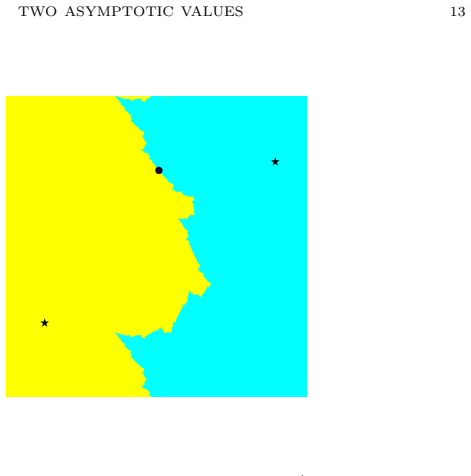
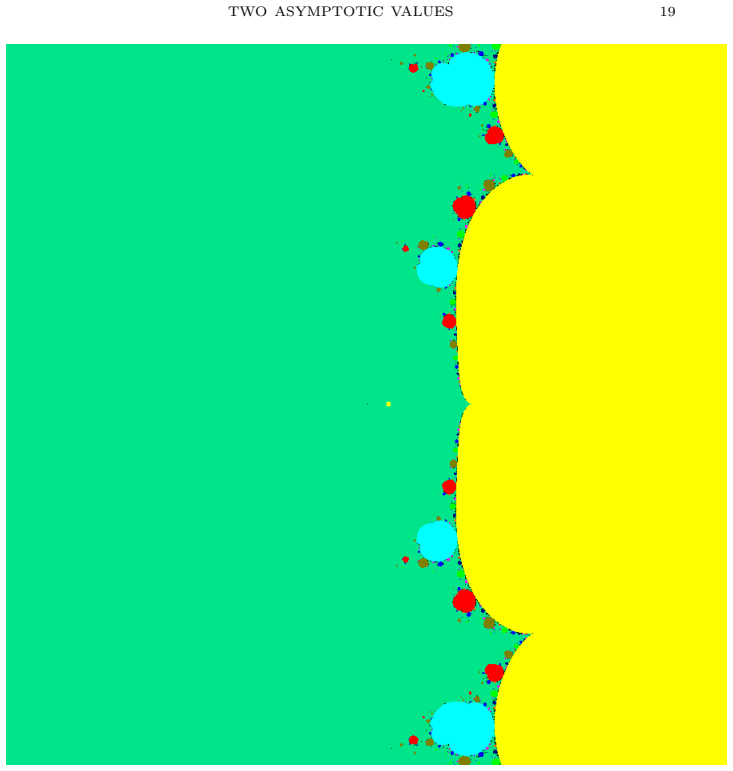
- [§4.3] In the description of Figures 2 and 3, the claim that 'the small bounded multicolored region inside the green region is Mμ' is confusing because the scale makes Mμ nearly invisible in Figure 2; the role of Figure 3 as a blow-up should be stated more explicitly in the caption or text.
- [§2.1] There is a typo 'thier' in the sentence before Corollary 2.2; it should be 'their'.
- [References] The reference to [FK] contains a misspelling: 'Stable comonents' should be 'Stable components'.
Circularity Check
No definitional or fitting circularity; the annulus structure is obtained by explicit surgery, with the main weakness being an unproved normalization in the inverse construction rather than a circular one.
full rationale
The claimed Main Structure Theorem is not derived from its own conclusion. The family F2 is fixed by an explicit Schwarzian normalization (equations (2)-(3) from Nevanlinna's theorem), and the shift-locus annulus is proven by an explicit surgery: Lemma 6.5 defines E(λ)=ξλ(λ) into the model annulus K0\Δ, and §§6.2.2-6.2.4 construct a would-be inverse using the inductive covering lemma and the measurable Riemann mapping theorem. No parameter is fitted to a subset of data and then renamed a prediction, and no quantity is defined in terms of the quantity it is supposed to explain. There is heavy reliance on prior work with overlapping authors — Theorem 4.1 from [FK]/[CK], transversality adapted from [CJK], and the model-map conjugacy from [DK]/[KK] — but these are published, externally checkable results about the tangent family, generalized Nevanlinna functions, and rational maps, not results whose statement already contains the F2 annulus theorem. The proof of the Common Boundary Theorem also states that the [CJK] transversality proof 'can be adapted here' and refers the reader to that paper for details; this is an omitted verification but not a circular reduction, since the cited theorem concerns a different family and is not being used as a renamed form of the present conclusion. The weakest point is in §6.2.4, where the inverse of E requires the normalization 'we require that ω(H(T^2_λ)) ... is conformally equivalent to T and preserves the isotopy class of β.' If that simultaneous normalization is not always achievable, E need not be onto and Theorem 6.4 would fail. That is a potential correctness gap and an unsupported assertion, not a circularity: the text does not define the image of E to be the set of parameters satisfying this normalization, nor does it fit the conclusion into the construction. Accordingly, no circular step is exhibited, and the score reflects only the paper's heavy but non-definitional use of the authors' earlier results.
Assumptions & free parameters
assumptions (6)
- standard math Nevanlinna's theorem (Theorem 2.1): a meromorphic function with p asymptotic values and no critical values has polynomial Schwarzian derivative of degree p-2, and conversely; solutions with constant Schwarzian are of the form (2).
- standard math Measurable Riemann mapping theorem (Ahlfors-Bers), used in Section 6.2.4 to construct the quasiconformal map g conjugating fλ to fλ(p).
- domain assumption Theorem 4.1 (Properties of Shell Components) taken from [FK] and [CK]: multiplier map to D* is a universal cover, unique virtual center, virtual centers equal virtual cycle parameters.
- domain assumption The transversality argument from [CJK] for the tangent family can be adapted to F2.
- domain assumption The model map Q = fλ0 is affine conjugate to t tanh z, with Julia set a vertical line, for the chosen λ0 with multiplier ρ (Section 6.1, citing [DK] and [KK]).
- ad hoc to paper The inverse branches Rj of Q can be defined globally on K0 with a consistent labeling from a principal logarithm branch, as assumed in Section 6.2.1.
invented entities (2)
-
Virtual cycle parameter λ (Definition 1): parameter for which f^{n-1}(λ) = ∞ or f^{n-1}(μ) = ∞.
independent evidence
-
Virtual center λ* of a shell component (Definition 2): boundary point approached by parameters λk where the multiplier of the attracting cycle tends to 0.
independent evidence
Cite this review
Pith. "Pith review of Slices of Parameter Space for Meromorphic Maps with Two Asymptotic Values." pith.science (2026). https://pith.science/paper/PZCUJ6MX
@misc{pith2026190806028,
  author       = {Pith},
  title        = {Pith review of: Slices of Parameter Space for Meromorphic Maps with Two Asymptotic Values},
  year         = {2026},
  howpublished = {\url{https://pith.science/paper/PZCUJ6MX}},
  note         = {Machine review of arXiv:1908.06028}
}
read the original abstract
This paper is part of a program to understand the parameter spaces of dynamical systems generated by meromorphic functions with finitely many singular values. We give a full description of the parameter space for a specific family based on the exponential function that has precisely two finite asymptotic values and one attracting fixed point. It represents a step beyond the previous work in [GK] on degree 2 rational functions with analogous constraints: two critical values and an attracting fixed point. What is interesting and promising for pushing the general program even further, is that, despite the presence of the essential singularity, our new functions exhibit a dynamic structure as similar as one could hope to the rational case, and that the philosophy of the techniques used in the rational case could be adapted.
Figures

Figures from the paper (9 more)


Reference graph
Works this paper leans on
-
[1]
L. Ahlfors and L. Bers, Riemann's mapping theorem for variable metrics. Ann. of Math. (2)72, 1960, 385-404
work page 1960
-
[2]
Bergweiler, Iteration of meromorphic functions
W. Bergweiler, Iteration of meromorphic functions . Bull. Amer. Math. Soc. 29 (1993), 151-188
1993
-
[3]
Birman, The algebraic structure of surface mapping class groups
J.S. Birman, The algebraic structure of surface mapping class groups. Discrete groups and automorphic functions (Proc. Conf., Cambridge, 1975), pp. 163-198. Academic Press, London, 1977
work page 1975
-
[4]
B. Branner, N. Fagella. Quasiconformal surgery in holomorphic dynamics. Cambridge University Press, 2014
work page 2014
-
[5]
I. N. Baker, J. Kotus and Y. L\"u, Iterates of meromorphic functions II: Examples of wandering domains . J. London Math. Soc. 42 (2) (1990), 267-278
1990
-
[6]
I. N. Baker, J. Kotus and Y. L\"u, Iterates of meromorphic functions I . Ergodic Th. and Dyn. Sys 11 (1991), 241-248
work page 1991
-
[7]
I. N. Baker, J. Kotus and Y. L\"u, Iterates of meromorphic functions III: Preperiodic Domains . Ergodic Th. and Dyn. Sys 11 (1991), 603-618
work page 1991
-
[8]
I. N. Baker, J. Kotus and Y. L\"u, Iterates of meromorphic functions IV: Critically finite functions . Results in Mathematics 22 (1991), 651-656
1991
Show all 34 references
-
[9]
A. F. Beardon, Iteration of rational functions . Springer, New York, Berlin, and Heidelberg, 1991
1991
-
[10]
T. Chen, Y. Jiang and L. Keen, Cycle doubling, merging, and renormalization in the tangent family. Conform. Geom. Dyn. 22 (2018), 271-314
2018
-
[11]
T. Chen, Y. Jiang and L. Keen, Accessible boundary points in the shift locus of a family of meromorphic functions with two asymptotic values. to appear, Arnold J. Math, Lyubich Volume, 2021
2021
-
[12]
Chen and L
T. Chen and L. Keen, Slices of parameter spaces of generalized Nevanlinna functions . Discrete and Continous Dynamical Systs. 39 (2019) no.10
2019
-
[13]
R. L. Devaney, N. Fagella and X. Jarque, Hyperbolic components of the complex exponential family. Fundamenta Mathematicae, 174(2002), 193--215
2002
-
[14]
Devaney and L
R. Devaney and L. Keen, Dynamics of tangent. In Dynamical Systems, Proceedings, University of Maryland , Springer-Verlag Lecture Notes in Mathematics, 1342 (1988), 105-111
1988
-
[15]
Devaney and L
R. Devaney and L. Keen, Dynamics of meromorphic functions: functions with polynomial Schwarzian derivative. Ann. \' E cole Normale Superieure, 4^e s\' e rie, t.22, 1989, 55-79
1989
-
[16]
Fagella, A
N. Fagella, A. Garijo, The parameter planes of z^me^z for m 2 . Commun. Math. Phys., 273(3), 755-783, 2007
2007
-
[17]
Fagella, L
N. Fagella, L. Keen, Stable comonents in the parameter plane of meromorphic functions of finite type. Journal of Geometric Analysis, 2020, ArXiv http://arxiv.org/abs/1702.06563
2020 arXiv
-
[18]
L. R. Goldberg and L. Keen, The mapping class group of a generic quadratic rational map and automorphisms of the 2-shift. Invent. Math. 101 (1990), no. 2, 335-372
1990
-
[19]
Hille, Ordinary Differential Equations in the Complex Domain
E. Hille, Ordinary Differential Equations in the Complex Domain. John Wiley and Sons, New York, 1976
1976
-
[20]
Keen and J
L. Keen and J. Kotus, Dynamics of the family of z . Conformal Geometry and Dynamics, Volume 1 (1997), 28-57
1997
-
[21]
Keen, Complex and real dynamics for the family z
L. Keen, Complex and real dynamics for the family z . Proceedings of the Conference on Complex Dynamic, RIMS Kyoto University, 2001
2001
-
[22]
Levin, S
G. Levin, S. van Strien, and W. Shen, Monotonicity of entropy and positively oriented transversality for families of interval maps. arXiv:1611.10056v1
-
[23]
Massey, Algebraic Topology: An Introduction
W.S. Massey, Algebraic Topology: An Introduction . Harcourt, Brace and World, Inc., 1967
1967
-
[24]
McMullen and D.P
C.T. McMullen and D.P. Sullivan, Quasiconformal homeomorphisms and dynamics. III. The Teichm\"uller space of a holomorphic dynamical system. Adv. Math. 135 (1998), no. 2, 351-395
1998
-
[25]
McMullen, Complex Dynamics and Renormalization
C.T. McMullen, Complex Dynamics and Renormalization . Annals of Math. Studies , 135 , Princeton Univ. Press, 1994
1994
-
[26]
Milnor, Geometry and dynamics of quadratic rational maps
J. Milnor, Geometry and dynamics of quadratic rational maps. Experimental Mathematics, Volume 2 (1993), 37-83
1993
-
[27]
Milnor, Dynamics in one complex variable
J. Milnor, Dynamics in one complex variable . Third edition. Annals of Mathematics Studies, 160. Princeton University Press, Princeton, NJ, 2006
2006
-
[28]
Moser, Stable and Random Motions in Dynamical Systems
J. Moser, Stable and Random Motions in Dynamical Systems . Princeton University Press, 1973
1973
-
[29]
U ber Riemannsche Fl\
R. Nevanlinna, \" U ber Riemannsche Fl\" a chen mit endlich vielen Windungspunkten. Acta Math. 58 (1932), no. 1 295--373. MR 1555350
1932
-
[30]
Nevanlinna, Analytic functions
R. Nevanlinna, Analytic functions. Translated from the second edition by Philip Emig. Die Grundlehren der mathematischen Wissenschaften, Band 162, Springer-Verlag, New York-Berlin, 1970. RM 0279280 (43 \#5003)
1970
-
[31]
Lasse Rempe-Gillen, Dynamics of exponential maps. Ph.D. thesis, Christian-Albrechts-Universit \"a t Kiel, 2003
2003
-
[32]
Rippon and G.M
P.J. Rippon and G.M. Stallard, Iteration of a class of hyperbolic meromorphic functions . Proc. Amer. Math. Soc. 127 (1999), no. 11, 3251-3258. MR 1610785
1999
-
[33]
Schleicher, Attracting dynamics of exponential maps
D. Schleicher, Attracting dynamics of exponential maps. Ann. Acad. Sci. Fenn. Math. 28,(2003), 3--34
2003
-
[34]
Wittner, Ph
B. Wittner, Ph. D. Thesis. Cornell University, 1987, Unpublished
1987
Reviewed August 14, 2026 · model on record in the stance chip above.
Discussion (0). Continue with ORCID to comment.