REVIEW 4 major objections 5 minor 28 references
Generalized group-based epidemic model for spreading processes on networks: GgroupEM
T0 review · 4 major / 5 minor · reviewed 2026-08-14 · deepseek-v4-flash
Pith's one-line read GgroupEM generalizes group-based epidemic modeling to arbitrary compartmental models and multilayer networks, shrinking the state space from individual configurations to group-level counts while keeping simulation time low.
desk verdict A real but modest generalization of UMFF to arbitrary compartmental models and multilayer networks; the central mean-field equation has a fixable transpose typo that must be corrected before publication. read the letter →
The pith
A machine-rendered reading of the paper's core claim, the machinery that carries it, and where it could break.
The reading
What carries the argument
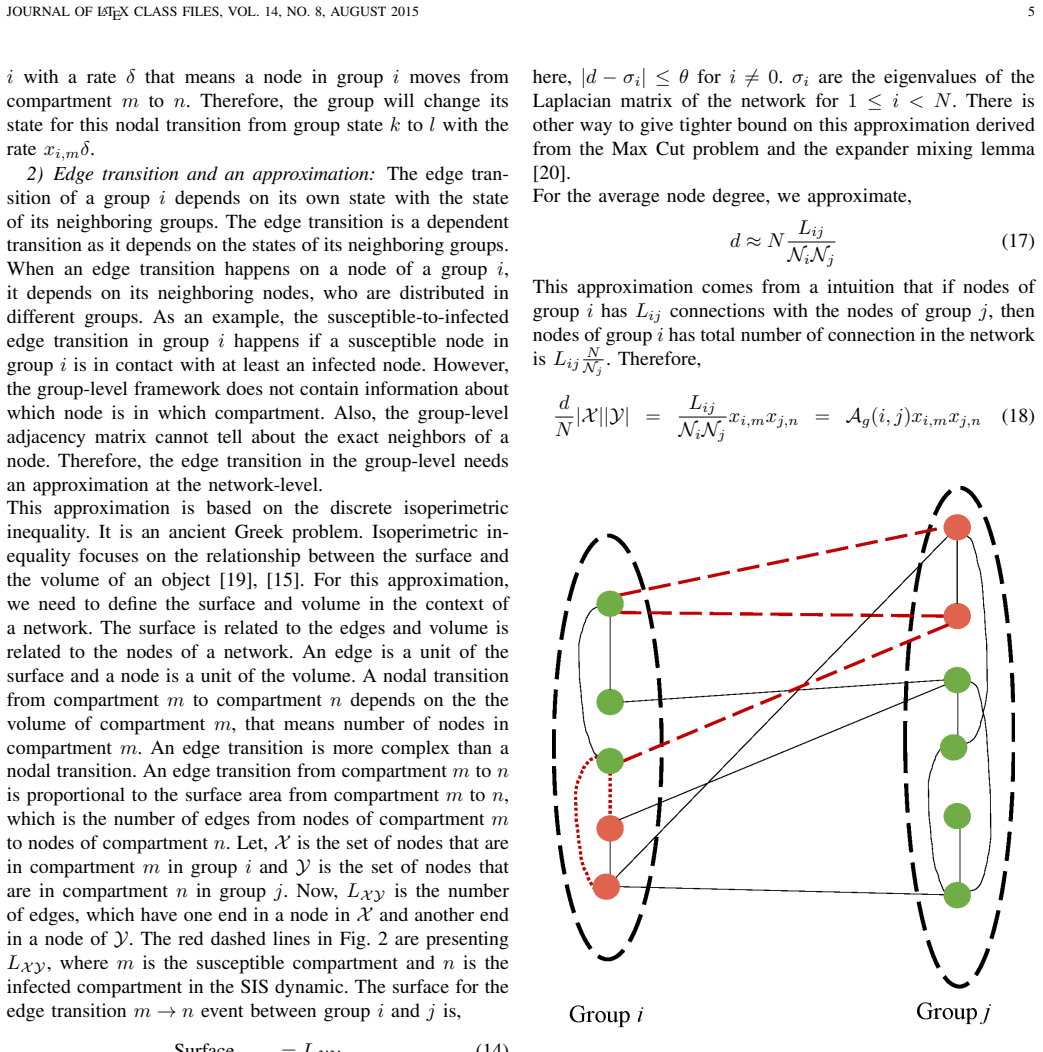
The central object is the group state vector $e_i^k$, one of the stars-and-bars enumerations of all possible count vectors $(x_{i,1},\dots,x_{i,M})$ summing to the group size $N_i$. The load-bearing identity is the topological approximation $L_{XY} \approx A_g(i,j)|X||Y| = A_g(i,j)x_{i,m}x_{j,n}$, which turns the unobservable surface between compartment sets into a product of observable group densities; the discrepancy of this approximation is controlled by the discrete isoperimetric inequality. This identity feeds into the transition-indication matrices $\Delta_{i,\delta_q}$ and $\Delta_{i,\beta_q}$, building the group generator $\Theta$ and, after moment closure, the mean-field equations in the compartment fractions $\rho_i$. The machinery works for any compartmental model because only the $M\times M$ transition matrices $Q_\delta$ and $Q_\beta$ encode the specific disease structure.
What would settle it
Take a two-group network in which all initially infected nodes are placed inside one dense cluster within group 1, compute the exact edge count between susceptible and infected sets, and compare it with $A_g(1,1)|X||Y|$; if the ratio departs from 1 well beyond the isoperimetric bound's promise, then run the full stochastic process and the GgroupEM mean-field equations side by side and measure the divergence in the infected fraction over time.
Extended reading notes
Core claim
The central claim is that a group-level epidemic description does not have to be re-derived for each compartmental model: once the group state is defined as the vector of node counts per compartment, the continuous-time generator $\Theta$ is assembled uniformly from transition-indication matrices, state matrices, and the group adjacency matrix $A_g$. Edge transitions are closed at group level by the topological approximation $L_{XY} \approx A_g(i,j)|X||Y|$, and the network state evolves by $d/dt\,E[G] = \Theta E[G]$. A first-order moment closure reduces this to the mean-field system $d/dt\,E[X_i] = \sum_q Q_{\delta_q}^T E[X_i] + \sum_q \bigl(\sum_j A_g(i,j) E[X_{j,n}]\bigr) Q_{\beta_q}^T E[X_i]$, with only $(M-1)C$ equations. The same construction extends to multilayer networks by summing per-layer edge contributions with layer-specific rates. On random networks with 10,000 nodes, the paper shows SIS, SIR, and SEIR group-based mean-field curves tracking the individual-based stochastic and mean-field results while simulation time drops from seconds to hundredths of a second.
Load-bearing premise
The load-bearing assumption is that the number of edges between any two compartment sets is $L_{XY} \approx A_g(i,j)|X||Y|$, meaning edges are treated as uniformly mixed across each group, so if infected nodes are clustered within a group the approximated edge count can be far from the true value and the stated isoperimetric bound does not directly control the group-specific average-degree replacement used in Eq. (17).
Editorial extensions
If this is right
- Any compartmental model, not just SIS/SIR/SEIR, can be simulated at group level; the user only supplies the compartment-to-compartment transition rates.
- The mean-field state space is $(M-1)C$ equations, so networks with millions of nodes become tractable whenever group-level summaries are what matters.
- Group size becomes a tunable accuracy-speed dial: fewer groups give faster simulation but larger aggregation error, with the isoperimetric inequality bounding the topological part.
- Multilayer contact structures are handled by summing layer-specific edge-transition terms, allowing different transmission rates on different layers.
- The established node-level mean-field approaches appear as the special case of one node per group, giving a single formalism for comparing approximations.
Reading between the lines
- Because the approximation treats edges as uniformly mixed inside groups, GgroupEM is likely to be least reliable on networks with strong community structure or localized outbreaks; testing on such networks would show where the product approximation fails.
- The discrepancy bound in Eq. (16) could be turned into a partition-selection criterion: choose groups to minimize the worst-case bound on $L_{XY}$, giving a principled accuracy-state-space tradeoff that the paper does not develop.
- A natural extension is to derive epidemic thresholds from the dominant eigenvalue of the group-level mean-field Jacobian; the paper does not present threshold conditions, but the framework would support them.
- For multilayer networks, summing per-layer infection terms suggests a disease can persist even when no single layer is above its own threshold, a testable prediction the paper leaves implicit.
Signed reviews
Editorial analysis
A structured set of objections, weighed in public.
Referee Report
Summary. The manuscript develops GgroupEM, a group-based generalization of individual-based epidemic modeling on networks. Nodes are partitioned into C groups, each group is described by the counts of nodes in each compartment, and a continuous-time Markov chain is constructed over the product of the group-state spaces. A mean-field approximation is then introduced by a first-order moment-closure approximation, and the framework is extended to multilayer networks. Numerical experiments on a single Erdős-Rényi network compare group-based mean-field solutions for SIS, SIR, and SEIR models with individual-based stochastic and mean-field results, and report substantial reductions in simulation time.
Significance. If corrected, the framework would provide a useful aggregation method for epidemic simulations on very large networks, with a transparent construction and no fitted parameters. The explicit state-space construction, the worked SIS example in Appendix B, and the reproducible structure of the ODEs are strengths. However, the central mean-field equation contains an internal transpose inconsistency, the group-specific topological approximation is not justified by the quoted isoperimetric bound, the exact group-level chain is never simulated, and the numerical evidence is limited to one dense network realization. These issues currently prevent the advertised generality of the framework from being fully substantiated.
major comments (4)
- [Eq. (34), with Eqs. (26)-(30) and Appendix B] Eq. (34) (and Eq. (30)) places an outer transpose on the edge-transition term: the edge contribution is written with (Δ^T_{i,βq}∘V_{i,m})^T E[g_i(t)], whereas Eq. (26), Eq. (27), and Appendix A use (Δ^T_{i,βq}∘V_{i,m}) without the transpose. For the SIS example in Appendix B, the relevant matrix in Eq. (B.8) for group 1 is A = [[0,β,0],[0,-β,2β],[0,0,-2β]]. If the group is in state [1,1] (state index 2), the transpose gives A^T e_2 = [0,-β,2β]^T, which moves probability into the all-susceptible state during an infection event. The correct term, A e_2 = [β,-β,0]^T, moves probability to [0,2], as required by the stochastic process and by Eq. (40). This is likely a typographical error, but it must be corrected or removed before Eq. (34) can serve as the central mean-field equation.
- [§III.B.2, Eqs. (15)-(18)] Eq. (16) is a discrepancy bound that uses a global average degree d of the network, but Eq. (17) replaces d/N by the group-specific quantity L_{ij}/(N_i N_j). This replacement is not a consequence of Eq. (16), and the quoted isoperimetric bound does not control the approximation error of the group-specific replacement. When infected nodes are clustered within a group, the true number of cross-compartment edges can differ substantially from A_g(i,j)|X||Y|. The paper never quantifies this error in the numerical section. The authors should either derive a bound for the group-specific approximation or explicitly state Eq. (18) as an additional assumption and test it on networks with non-uniform internal structure.
- [§IV and §VI] The numerical section simulates only the mean-field equations; the exact group-level Markov chain defined in §III is never simulated. The conclusion explicitly lists the development of a stochastic GgroupEM simulator as future work. Without a comparison between the exact group CTMC and the group mean-field equations, the first-order closure in Eq. (32) remains unquantified, and the paper itself admits in §IV.A that no error bound for the moment-closure approximation is known. At least one such comparison, or a systematic accuracy study, is needed to support the claim that Eq. (34) approximates the group-based process.
- [Figs. 4-6 and Table II] The evidence for the generality claimed in the abstract rests on a single dense Erdős-Rényi network (N = 10000, p = 0.01) with one initial condition and one parameter set. The group-based mean-field solutions are plotted against the individual-based ones, but no error metrics are reported as a function of the number of groups C, the network density, or the group partition. Since the group partition is a free parameter of the framework, the manuscript should at least vary the partition and report quantitative deviations from the reference simulations; wall-clock time alone is not sufficient to establish usefulness.
minor comments (5)
- [Eq. (16)] The sentence '|d−σ_i|≤θ for i≠0' is undefined: please specify what d, σ_i, and θ are and provide the precise statement of the discrepancy bound being quoted.
- [Eqs. (23)-(24)] The scalar factor Σ_j A_g(i,j)X_{j,n} is written outside the matrix product without parentheses in Eq. (23) and Eq. (24); the intended grouping should be made explicit to avoid ambiguity.
- [Fig. 5 caption] The caption contains a typo: 'simulation time = 0.0.088s' should read '0.088s'.
- [Table II] The table reports wall-clock times without specifying the hardware, the implementation language, or the number of repetitions; these details are needed to make the timing comparisons reproducible.
- [§III.A, Eq. (13)] The marginalization formula in Eq. (13) is correct, but the dimensions of the all-ones vectors should be stated explicitly; as written, the reader must infer them from the Kronecker structure.
Circularity Check
No significant circularity; the GgroupEM derivation is self-contained given the externally cited topological approximation and a standard moment-closure assumption.
full rationale
The paper's central derivation does not reduce to its own inputs. The group-level continuous-time Markov chain, Eqs. (19)-(31), is constructed directly from the compartmental transition rates and the group-state combinatorics, and the mean-field equations (34), (38)-(42) are forward differential equations with pre-specified parameters beta, delta, delta1, delta2; no parameter is fitted to the simulation outputs, so nothing is 'predicted' from a fitted value. The one approximating step that could look like an assumption dressed as a result is the topological approximation L_XY approximately Ag(i,j)|X||Y| in Eq. (15), but the paper explicitly attributes it to Devriendt and Van Mieghem [15], and its stated isoperimetric bound in Eq. (16) is an external mathematical estimate, not a self-citation. The subsequent heuristic replacement d approximately N Lij/(NiNj) in Eq. (17) is acknowledged as an intuitive group-level approximation, and the paper candidly states that the moment-closure error bound is not known; these are accuracy and scoping limitations rather than circular steps. The authors' own GEMF paper [7] is used only for background notation and as an individual-based baseline, and is not the justification for the novel group-level equations. The transpose inconsistency between Eqs. (26) and (34) is an internal mathematical issue that should be corrected, but it does not make the derivation circular.
Assumptions & free parameters
free parameters (1)
- Group partition (C and group sizes N_i) =
C=100, 50, 10 with equal group sizes in the example simulations
assumptions (5)
- domain assumption All node-level transitions are independent Poisson processes with constant rates.
- ad hoc to paper Topological approximation: L_{XY} ≈ Ag(i,j)|X||Y|.
- ad hoc to paper Group-specific average degree approximation d ≈ N L_{ij}/(N_i N_j).
- domain assumption Moment-closure approximation Cov[h_i(t), g_i(t)] ≈ 0.
- standard math Discrete isoperimetric discrepancy inequality.
Cite this review
Pith. "Pith review of Generalized group-based epidemic model for spreading processes on networks: GgroupEM." pith.science (2026). https://pith.science/paper/TZNJUJMJ
@misc{pith2026190806057,
  author       = {Pith},
  title        = {Pith review of: Generalized group-based epidemic model for spreading processes on networks: GgroupEM},
  year         = {2026},
  howpublished = {\url{https://pith.science/paper/TZNJUJMJ}},
  note         = {Machine review of arXiv:1908.06057}
}
read the original abstract
We develop a generalized group-based epidemic model (GgroupEM) framework for any compartmental epidemic model (for example; susceptible-infected-susceptible, susceptible-infected-recovered, susceptible-exposed-infected-recovered). Here, a group consists of a collection of individual nodes. This model can be used to understand the important dynamic characteristics of a stochastic epidemic spreading over very large complex networks, being informative about the state of groups. Aggregating nodes by groups, the state space becomes smaller than the individual-based approach at the cost of aggregation error, which is strongly bounded by the isoperimetric inequality. We also develop a mean-field approximation of this framework to further reduce the state-space size. Finally, we extend the GgroupEM to multilayer networks. Since the group-based framework is computationally less expensive and faster than an individual-based framework, then this framework is useful when the simulation time is important.
Figures


Figures from the paper (4 more)


Reference graph
Works this paper leans on
-
[1]
A.-L. Barab ´asi et al. , Network science . Cambridge university press, 2016
work page 2016
-
[2]
Modelling dynamical processes in complex socio- technical systems,
A. Vespignani, “Modelling dynamical processes in complex socio- technical systems,” Nature physics, vol. 8, no. 1, p. 32, 2012
work page 2012
-
[3]
Epidemic processes in complex networks,
R. Pastor-Satorras, C. Castellano, P. Van Mieghem, and A. Vespignani, “Epidemic processes in complex networks,” Reviews of modern physics, vol. 87, no. 3, p. 925, 2015
work page 2015
-
[4]
Estimation of swine movement network at farm level in the us from the census of agriculture data,
S. A. Moon, T. Ferdousi, A. Self, and C. M. Scoglio, “Estimation of swine movement network at farm level in the us from the census of agriculture data,” Scientific reports, vol. 9, no. 1, p. 6237, 2019
work page 2019
-
[5]
Understanding the survival of zika virus in a vector interconnected sexual contact network,
T. Ferdousi, L. W. Cohnstaedt, D. S. McVey, and C. M. Scoglio, “Understanding the survival of zika virus in a vector interconnected sexual contact network,” Scientific reports, vol. 9, no. 1, p. 7253, 2019
work page 2019
- [6]
-
[7]
Generalized epidemic mean-field model for spreading processes over multilayer complex networks,
F. D. Sahneh, C. Scoglio, and P. Van Mieghem, “Generalized epidemic mean-field model for spreading processes over multilayer complex networks,” IEEE/ACM Transactions on Networking (TON) , vol. 21, no. 5, pp. 1609–1620, 2013. JOURNAL OF LATEX CLASS FILES, VOL. 14, NO. 8, AUGUST 2015 14
work page 2013
-
[8]
Decay of interspecific avian flock networks along a disturbance gradient in amazonia,
K. Mokross, T. B. Ryder, M. C. C ˆortes, J. D. Wolfe, and P. C. Stouffer, “Decay of interspecific avian flock networks along a disturbance gradient in amazonia,” Proceedings of the Royal Society B: Biological Sciences , vol. 281, no. 1776, p. 20132599, 2014
work page 2014
Show all 28 references
-
[9]
Using contact networks to explore mechanisms of parasite transmission in wildlife,
L. A. White, J. D. Forester, and M. E. Craft, “Using contact networks to explore mechanisms of parasite transmission in wildlife,” Biological Reviews, vol. 92, no. 1, pp. 389–409, 2017
2017
-
[10]
A spatio-temporal individual-based network framework for west nile virus in the usa: spreading pattern of west nile virus,
S. A. Moon, L. W. Cohnstaedt, D. S. McVey, and C. M. Scoglio, “A spatio-temporal individual-based network framework for west nile virus in the usa: spreading pattern of west nile virus,” PLoS computational biology, vol. 15, no. 3, p. e1006875, 2019
2019
-
[11]
Epi- demic thresholds in real networks,
D. Chakrabarti, Y . Wang, C. Wang, J. Leskovec, and C. Faloutsos, “Epi- demic thresholds in real networks,” ACM Transactions on Information and System Security (TISSEC) , vol. 10, no. 4, p. 1, 2008
2008
-
[12]
Virus spread in networks,
P. Van Mieghem, J. Omic, and R. Kooij, “Virus spread in networks,” IEEE/ACM Transactions on Networking (TON), vol. 17, no. 1, pp. 1–14, 2009
2009
-
[13]
Epidemic spreading in scale-free networks,
R. Pastor-Satorras and A. Vespignani, “Epidemic spreading in scale-free networks,” Physical review letters, vol. 86, no. 14, p. 3200, 2001
2001
-
[14]
Epidemic spreading in correlated complex networks,
M. Bogun ´a and R. Pastor-Satorras, “Epidemic spreading in correlated complex networks,” Physical Review E, vol. 66, no. 4, p. 047104, 2002
2002
-
[15]
Unified mean-field framework for susceptible-infected-susceptible epidemics on networks, based on graph partitioning and the isoperimetric inequality,
K. Devriendt and P. Van Mieghem, “Unified mean-field framework for susceptible-infected-susceptible epidemics on networks, based on graph partitioning and the isoperimetric inequality,”Physical Review E, vol. 96, no. 5, p. 052314, 2017
2017
-
[16]
M. J. Keeling and P. Rohani, Modeling infectious diseases in humans and animals. Princeton University Press, 2011
2011
-
[17]
Stochastic processes in chemistry and physics,
N. Van Kampen, “Stochastic processes in chemistry and physics,” Chaos, 1981
1981
-
[18]
Feller, An introduction to probability theory and its applications
W. Feller, An introduction to probability theory and its applications . John Wiley & Sons, 2008, vol. 1
2008
-
[19]
Discrete isoperimetric inequalities,
F. Chung, “Discrete isoperimetric inequalities,” Surveys in differential geometry, vol. 9, no. 1, pp. 53–82, 2004
2004
-
[20]
Tighter spectral bounds for the cut size, based on laplacian eigenvectors,
K. Devriendt and P. Van Mieghem, “Tighter spectral bounds for the cut size, based on laplacian eigenvectors,” Linear Algebra and its Applications, 2019
2019
-
[21]
S. M. Ross, J. J. Kelly, R. J. Sullivan, W. J. Perry, D. Mercer, R. M. Davis, T. D. Washburn, E. V . Sager, J. B. Boyce, and V . L. Bristow, Stochastic processes. Wiley New York, 1996, vol. 2
1996
-
[22]
Van Mieghem, Performance analysis of complex networks and sys- tems
P. Van Mieghem, Performance analysis of complex networks and sys- tems. Cambridge University Press, 2014
2014
-
[23]
On random graphs, i,
P. Erd ¨os and A. R ´enyi, “On random graphs, i,” Publicationes Mathe- maticae (Debrecen), vol. 6, pp. 290–297, 1959
1959
-
[24]
An individual-based approach to sir epidemics in contact networks,
M. Youssef and C. Scoglio, “An individual-based approach to sir epidemics in contact networks,” Journal of theoretical biology, vol. 283, no. 1, pp. 136–144, 2011
2011
-
[25]
Susceptible- infected-susceptible model: A comparison of n-intertwined and hetero- geneous mean-field approximations,
C. Li, R. van de Bovenkamp, and P. Van Mieghem, “Susceptible- infected-susceptible model: A comparison of n-intertwined and hetero- geneous mean-field approximations,” Physical Review E, vol. 86, no. 2, p. 026116, 2012
2012
-
[26]
Multilayer networks,
M. Kivel ¨a, A. Arenas, M. Barthelemy, J. P. Gleeson, Y . Moreno, and M. A. Porter, “Multilayer networks,” Journal of complex networks , vol. 2, no. 3, pp. 203–271, 2014
2014
-
[27]
Layered complex networks,
M. Kurant and P. Thiran, “Layered complex networks,” Physical review letters, vol. 96, no. 13, p. 138701, 2006
2006
-
[28]
Gemfsim: a stochastic simulator for the generalized epidemic modeling framework,
F. D. Sahneh, A. Vajdi, H. Shakeri, F. Fan, and C. Scoglio, “Gemfsim: a stochastic simulator for the generalized epidemic modeling framework,” Journal of computational science , vol. 22, pp. 36–44, 2017. Sifat Afroj Moon graduated with a degree in Elec- trical and Electronic E...
2017
Reviewed August 14, 2026 · model on record in the stance chip above.
Discussion (0). Continue with ORCID to comment.